Paul: The Problem With ‘Elites’ May Not Be What You Think It Is

Good column:

Elitism is a frequent target of criticism, especially in politics. Historically, Americans haven’t liked elitists. They don’t appreciate the hoity-toity who look down on everyone else.

These days that disdain emanates most vocally from the populist right. To these self-described down-to-earth folk without airs or fancy talk, “the elite” is shorthand for those who are more educated and have more power, especially cultural power, code for people they don’t agree with and resent.

But the left also has a beef with elitism. To those concerned with social inequity, “the elite” symbolize a flawed meritocracy. In their view, certain demographic groups get elevated over others and bar access to those historically deprived of power, especially political and economic power.

Whatever their respective merits, both critiques are hard not to read as variations on “I want what you have.” The word “elite,” after all, signifies something people aspire to. We admire elite athletes. We rely on elite research institutions to make medical advances. Most people wish they too could sit in first class. Until then, they hotly resent whoever does.

A more sophisticated and productive critique of elites comes from Fredrik deBoer, known to those who read his popular newsletter as Freddie. DeBoer, a Marxist, activist and the author of the book “The Cult of Smart,” is one of the sharpest and funniest writers on the internet. I don’t agree with everything he says, but he’s always thoughtful and he pushes me to think. I hope his new book, “How Elites Ate the Social Justice Movement,” will be read especially by those on the left, because the left is where his heart lies and the failings of the left seem to break his heart most. In this, he and I are fully aligned.

“It’s OK to call nonsense nonsense, even if you feel it’s on your own side,” he writes. “You can defend your values, be a soldier for social justice and be merciless toward conservatives while still admitting when feckless people take liberal ideology to bizarre ends.” As deBoer points out, it’s far better for those of us on the left to clean up our own mess than to hand it over to conservatives as easy fodder for mockery. To that end, he scrutinizes the self-interests of the nonprofit industry, the “elite capture” of the Black Lives Matter movement, the neglect of class as a primary category of political thought and other failures and shortcomings among progressive movers.

What drives deBoer’s argument here is the idea that on the left, elites are undermining progress for the average Joe. Worse, they’re doing it in the name of progress. It’s time, he says, to forcefully question exactly what elites on the left claim is best for everyone else, especially when evidence suggests otherwise.

One of the bravest chapters in his new book examines the elitism of the defund the police movement, which, deBoer argues, hurts the cause of racial justice. Research shows more policing has reduced homicides, which disproportionately affect Black Americans. Black Americans are about 13 percent of the population but make up more than half of homicide victims. As deBoer explains, “police abolition and incremental efforts to reduce policing could easily result in more hardship for the very community that we’re ostensibly fighting for.”

In deBoer’s view, this misplaced enthusiasm for police abolition is largely a result of the economic and cultural gulf between elite activists of all races and the vast majority of Black Americans. What’s easy for radical activists and academics to write on a placard turns out to be hard for many Black Americans to actually live with. Taking police off the streets may minimize the possibility of police violence against Black people, but it will do little to mitigate the far greater problem of all other violence against Black people.

Many Black people, particularly outside of elite circles, are all too aware of this. As deBoer notes, “significant majorities of Black Americans want not less policing but better policing.” In 2022, Black Democrats were twice as likely as white Democrats to say reducing crime should be a top priority. A 2021 survey found that white liberals were more inclined than Black Americans to support defunding the police: “71 percent of white liberals say they would support reducing police budgets and shifting funding to social services,” compared with 53 percent of Black Americans; a significant 44 percent of Black people oppose it altogether.

Yet for many on the left, to point out these facts is considered sacrilege, somehow racist and essentially tantamount to serving the enemy. Many white progressives are so terrified of being labeled “racist” themselves that they prioritize self-protection and fear of their critics over helping out the very people they profess to want to help — people they may not understand well at all.

For deBoer, police violence and other problems of social justice require action from people of all races and ethnicities, rather than heeding the empty diktats of elite discourse. “I feel strongly that there must be a way — there must be a way — to take police violence against Black people immensely seriously and to fight for major police reform,” he writes, “while acknowledging that crimes and violence committed against Black people by those other than police are far more common.”

Last month I met deBoer for lunch near where he lives in Connecticut. He talked a lot about the class disparities of the state, which contains many of the wealthiest pockets in the nation alongside extreme poverty. He sees himself writing in the tradition of leftist thinkers like Eric Hobsbawm, Todd Gitlin, Richard Rorty and Adolph Reed. It seems to pain him that the left so often shoots itself in the foot.

When I asked why he wrote this book, he said, “I really do believe that we live in a country and a culture with deeply entrenched racial inequality, and all decent people have a duty to try to confront that inequality.” However, he emphasized, it’s not only something we have a moral duty to do — we also have a moral duty to do it well. The number of people who genuinely thought there was a chance of police abolition was very small, he told me. “But by making that a centerpiece of their demands, it allowed them to say afterward, ‘Look at how awful things are now, we didn’t go far enough.’”

It’s a way for the left, deBoer explained, to look like “a beautiful failure.”

DeBoer doesn’t consider himself an optimist, but he nonetheless doesn’t want to concede that kind of defeat. The left, he told me, needs to return to the “up from below” approach of the socialist politician Eugene Debs: It needs to invest in real change for those in need rather than heed elite rhetoric. To my ears, all this does sound quite optimistic, considering the polarized discourse and politics of 2023, where shouty or performative extremism often gets in the way of duller and more difficult action. But as deBoer says, a bottom-up approach may be the best, or only, option for meaningful social progress.

Source: The Problem With ‘Elites’ May Not Be What You Think It Is
Douglas Todd: Warnings of today’s foreign-student exploitation began a decade ago

Ignored then and no sign yet of meaningful action today:

North America’s foreign-student system is no longer a humanitarian endeavour to lift up the planet’s best and brightest, and support the developing world.

Instead, it’s become a commercial competition full of marketing rhetoric, which is creating chaos in higher education.

That’s what the West’s leading experts in international education told me 10 years ago.

They were describing how governments and post-secondary institutions were adopting an increasingly cynical attitude toward foreign students.

Philip Altbach, Hanneke Teekens and Jane Knight were ahead of their time in lamenting how international education was turning into a “cash cow” for public and private universities and colleges in the U.S. and especially Canada, where there are at least eight times more per capita than in the U.S.

While the concept of international education continues to have upsides, it’s now becoming obvious to many in Canada that the foreign-student system is creating hard times, especially for students from abroad. Even the Liberal government, long in denial, is starting to admit it.

Prime Minister Justin Trudeau’s government acknowledges it has pumped up the number of foreign students in Canada to, officially, 900,000. That compares to 225,000 in 2013. And experts say Ottawa’s number is a serious undercount.

The Liberals are still not necessarily admitting the obvious: That governments and post-secondary institutions are addicted to foreign-student spending and fees, which are four times higher than those of domestic students. Ten years ago, foreign students brought $8 billion into Canada, now Ottawa estimates it’s up to $30 billion.

The main problem, however, that has suddenly drawn more attention to foreign students is the out-of-control cost of housing, particularly renting.

International students, say housing analysts, are hiking competition for places to live. The average rent for a one-bedroom in Canada has jumped to a worrying $1,800, according to Rentals.ca. Vancouver is the most extreme in the country, at a devastating average of $3,013. A one-bedroom in Toronto is $2,592.

Foreign students are an expanding factor in such expensive housing — and it’s hurting the study visa holders themselves, who, according to both social media and the mainstream media, are increasingly feeling taken advantage of.

Even Canada’s housing minister, Sean Fraser, last month used the word exploited. And he finally admitted universities and colleges are bringing in far more students than they could possibly provide housing for.

That was before Benjamin Tal, chief economist for the CIBC Capital Markets, told Liberal cabinet ministers the government is dangerously undercounting the number of temporary residents, particularly foreign students, in Canada.

While the government, and Statistics Canada, state there are more than one million non-permanent residents in Canada, Tal’s calculations show there are at least one million more missing from the count. “Housing demand is stronger than what official numbers are telling you and that’s why we’re approaching a zero vacancy rate.”

The government’s calculations, Tal said, have ignored that many foreign workers and students don’t leave the country when their visas expire. They stay on in hopes of applying to become immigrants. Census methods for surveying foreign students, he added, are misleading.

Giacomo Ladas of Rentals.ca says, “International students do add pressure to the rental market,” even while he emphasized it’s not their fault.

“There’s such a supply and demand issue in the rental market right now and they add to this imbalance. The study permits for international students have increased by 75 per cent in the last five years. So, that’s a huge influx of people coming in and nowhere to put them.”

Delegates at a recent Union of B.C. Municipalities’ housing summit heard how rapidly foreign students and other non-permanent residents are adding to demand for housing.

The number of non-permanent residents and newcomers to Metro Vancouver has in five years almost doubled, delegates were told. Foreign students and other recent arrivals own eight per cent of all homes in Metro Vancouver, and account for 25 per cent of renters.

Canada’s housing minister received a lot of media attention in August when he responded to a reporter’s direct question by saying he wouldn’t rule out a cap on international students.

But since then both he and Immigration Minister Marc Miller have backtracked, and Trudeau has warned not to “blame” foreign students.

Miller admitted Canada’s “very lucrative” foreign student system “comes with some perverse effects, some fraud in the system, some people taking advantage of what is seen to be a backdoor entry into Canada.”

Whatever the Liberal cabinet is starting to admit in the past month, however, the public would be naive to expect any real reforms.

In addition to anxiety over the housing crisis, many economists also worry international students are being taken advantage of by employers to keep wages down. An earlier StatCan study showed up to one out of three foreign students aren’t attending school.

While some representatives of universities and college, especially private ones, are trying to shut down debate by accusing critics of blaming study visa holders for high housing costs and low wages, the reality is those raising concerns can be seen as standing up for people on study visas.

Many people are aware of a high suicide rate among international students, including alarms raised by funeral homes. The largest cohort of foreign students, by far, now comes from India, and it is often South Asian voices in Canada who are pointing to their victimization, including employer abuse and sexual harassment by landlords.

And Vancouver immigration lawyers such as Richard Kurland and George Lee add the federal government’s decision to allow unlimited international students is setting up many for future immigration disappointment.

Canada is building far too big a pool of people who will be highly qualified for permanent resident status, they say. Not everyone can win the immigration points-system competition, which has an annual cutoff.

The trouble is a lot of vested interests are eager for the foreign-student gravy train to keep chugging along, regardless of the unintended suffering it causes — including for students desperate for a place to live.

Source: Douglas Todd: Warnings of today’s foreign-student exploitation began a decade ago

UN envoy links temporary foreign worker program to ‘contemporary forms of slavery’

Of note. Wonder how Canada compares to other Western countries, let alone the workers in Gulf countries:

A United Nations official on Wednesday denounced Canada’s temporary foreign worker program as a “breeding ground for contemporary forms of slavery.”

Tomoya Obokata, UN special rapporteur on contemporary forms of slavery, made the comments in Ottawa after spending 14 days in Canada.

“I am disturbed by the fact that many migrant workers are exploited and abused in this country,” he said.

Source: UN envoy links temporary foreign worker program to ‘contemporary forms of slavery’

Antisemitic Comments by Palestinian Leader Cause Uproar

Sigh….

Video has emerged of Mahmoud Abbas, the president of the Palestinian Authority, recently asserting that European Jews were persecuted by Hitler because of what he said were their predatory lending practices, rather than their religion.

Mr. Abbas’s false claim drew swift condemnation from Israeli and European officials. It also fueled accusations that Mr. Abbas — an architect of interim peace agreements between Israelis and Palestinians in the 1990s — is not genuinely committed to resolving the ongoing conflict.

In a speech late last month, Mr. Abbas said: “They say that Hitler killed the Jews because they were Jews, and that Europe hated the Jews because they were Jews.”

“No,” Mr. Abbas added. Jews were persecuted, he continued, because of “their social role, which had to do with usury, money, and so on.”

Mr. Abbas also repeated a widely discredited theory that European, or Ashkenazi, Jews have no ancient roots in the Middle East. Instead, Mr. Abbas claimed that European Jews were the descendants of a nomadic Turkic tribe that converted to Judaism during the medieval period, and therefore were not victims of antisemitism.

“When we hear them talk about Semitism and antisemitism — the Ashkenazi Jews, at least, are not Semites,” Mr. Abbas said.

Mr. Abbas’s comments were broadcast live on Palestinian television two weeks ago, in a speech to members of his secular political party, Fatah,

The remarks were brought to a wider audience on Wednesday, when the Middle East Media Research Institute, a Washington-based monitoring group that mainly translates extremist comments by Arab and Iranian leaders, distributed a subtitled version of Mr. Abbas’s speech.

Mr. Abbas is the president of the Palestinian Authority, the semiautonomous body that has administered parts of the Israeli-occupied West Bank since the 1990s, when the Israeli and Palestinian leaderships signed interim peace accords.

His comments illustrated why he has developed a checkered reputation among Israeli and Western partners. Mr. Abbas was one of the chief negotiators in the peace process, and often is credited with helping to reduce tensions following a wave of violence in the 2000s. At times, he has also described the Holocaust as a crime against humanity.

But Mr. Abbas also has a long history of antisemitic remarks. He made similar comments in 2018 about usury and Ashkenazi Jews, and last year he accused Israel of committing “50 Holocausts” against Palestinians.

In 1984 he published a book in which he condemned the Holocaust but also cited historians who disputed the widely accepted death toll of as many as six million Jews.

“This is the true face of Palestinian ‘leadership,’” Israel’s ambassador to the United Nations, Gilad Erdan, wrote on social media in response to Mr. Abbas’s latest speech.

“It is no wonder that mere hours ago a Palestinian teenage terrorist hacked innocent Israelis with a meat cleaver,” Mr. Erdan added, referring to an attack on Wednesday in the Old City of Jerusalem that wounded at least two people.

The European Union said in a statement that Mr. Abbas’s “historical distortions are inflammatory, deeply offensive, can only serve to exacerbate tensions in the region and serve no-one’s interests.”

The statement added: “They play into the hands of those who do not want a two-state solution, which President Abbas has repeatedly advocated for.”

Source: Antisemitic Comments by Palestinian Leader Cause Uproar

‘Impossible situation’: Ottawa’s lengthy delays in processing citizenship for adopted kids has parents scrambling

Unfortunate yet another example of IRCC delays:

Backlogs within Canada’s immigration bureaucracy are creating what one observer calls an “impossible situation” for families adopting children from outside of the country, with processing delays now far outlasting their children’s visas and rendering the kids ineligible for provincial health coverage.

Last weekend, Greg Hanniman and wife Marli Nicol arrived home from Bulgaria with their newly adopted two-year-old son Aleksandar, at the end of a long and expensive process for the Arnprior, Ont. family.

While Aleksandar is adjusting well to his new home and family, Hanniman says they’re now dealing with maddening uncertainty as they wait for bureaucracy at Immigration, Refugees and Citizenship Canada (IRCC) to even begin processing Aleksandar’s application for citizenship.

Children adopted overseas are usually granted a six-month temporary residence permit, essentially a tourist visa, upon entering Canada. That used to be sufficient to allow IRCC to finish processing their citizenship applications. But delays for processing citizenship for adopted kids are now running close to two years, well past the expiry of temporary visas. That is leaving parents scrambling to get extensions and the children ineligible for basic social programs.

“The major concern we have now obviously is health care,” said Hanniman, a Canadian Armed Forces combat veteran who now works in the computer industry.

The couple began looking into adoption in 2019 and, after meeting Aleksandar in Bulgaria earlier this year and falling in love with him, they submitted their paperwork to IRCC in March.

“It’s clear that he will be granted his citizenship, there’s really no reason why he won’t, but now we have to wait years for the bureaucracy to sort itself out.”

Pavel Georgiev, intercountry adoption co-ordinator with Toronto-based Loving Heart International Adoption Agency, said adopting from out of country entails a two-step process to obtain Canadian citizenship for the child.

In the past, IRCC’s turnaround times for the first part’s approval — where the parents notify where they’re adopting from and demonstrate they are both citizens —  was well within the six-month tourist-visa window, Georgiev said. But these approvals are now taking upwards of 20 months. And families are being placed in the position of their newly adopted children overstaying their visas.

“Throughout my 10-plus years of experience in the field of intercountry adoption, this is by far the longest waiting times we’ve seen,” Georgiev said.

“It’s a bit of an impossible situation for adoptive parents.”

Upon landing in Montreal on August 27, Hanniman said he managed to convince immigration officers to grant Aleksandar a two-year visitor record instead of the standard six-month visitor visa. Taking Aleksander back to Bulgaria after a visitor visa expires in six months would have been a non-starter, Hanniman said. And he wasn’t ready to wait nearly two years to bring their son home while IRCC processes his citizenship application

While the extended residency permit has solved most of the family’s short-term problems, it still leaves Aleksandar ineligible for Ontario Health Insurance Plan (OHIP) coverage until his paperwork makes its way through IRCC.

“We have his doctor appointment Tuesday and a dentist on Thursday, but once again, without OHIP, it’s going to be all coming out-of-pocket,” Hanniman said.

When he recently called IRCC to find out the next steps, he said the phone agent told him the government wouldn’t even begin to look at the file until 19 months had passed.

Parents have so far dealt with the uncertainty either by persistently hounding IRCC or their local MP to speed up the approvals, Georgiev said. But he said these are not acceptable solutions.

“Many children who are adopted through intercountry adoption will want to take the child to have a complete assessment by their family doctor,” Georgiev said. But without health coverage, parents are left to pay the medical costs.

Hanniman said he isn’t looking forward to dealing with IRCC when it finally gets around to processing Aleksandar’s paperwork.

“They were not helpful in the slightest,” he said. “They didn’t even try to help.”

IRCC spokesperson Mary Rose Sabater said that IRCC “understands the emotional and financial hardship” experienced in these situations.

She said the two-step process “may take up to six to eight months from start to finish. Depending on the child’s country of origin, it is not unusual for the process to last for two years or even longer.”

Enacting separate adoption-specific immigration streams could help alleviate backlogs, Georgiev said. Once IRCC receives confirmation that an adoption has actually been completed, he said, the government could expedite the paperwork.

“If there were a standardized process through which, once notified and shown documentation that an adoption has been finalized they expedite their review of the part one application and issuance of the approval, that would entirely resolve this problem,” he said.

Processing delays and red tape have become a common complaint for those dealing with Canada’s immigration bureaucracy.

International invitees and delegates, mostly from Africa and southeast Asia, scheduled to attend last year’s Collision technology conference in Toronto were left in the dark after backlogs left them without visas.

Similar processing delays prevented hundreds of African researchers and advocates from attending last year’s International AIDS conference in Montreal, despite many applying months in advance.

Source: ‘Impossible situation’: Ottawa’s lengthy delays in processing citizenship for adopted kids has parents scrambling

Integration – General Deck 2022 data

This is an updated version of my earlier deck with 2022 numbers across immigration, citizenship, settlement and multiculturalism, OECD integration indicators and polling data. The narrative has also been updated to reflect the ongoing shift to two-step immigration, and arguably a shift from an immigration-based country to a migration-based country.

Missing million temporary residents in figures casts doubt on how many have jobs: report 

Good analysis by Mikal Skuterud along with policy implications:

A discrepancy of around a million temporary residents between official figures from two federal bodies is leaving Canada in the dark about how many of those residents actually have jobs, an economist is warning.

Mikal Skuterud, a professor of economics at the University of Waterloo, also says Statistics Canada may be dramatically undercounting the number of temporary residents, including international students and temporary foreign workers, employed in Canada. He describes the findings in a report to be published later this week by the C.D. Howe Institute.

The report notes that Statistics Canada’s Labour Force Survey – which is used to set Canada’s unemployment rate – suggests there were 503,079 temporary residents with jobs in Canada in December last year.

But Mr. Skuterud says information from Immigration, Refugees and Citizenship Canada, the federal department that issues work permits and study visas to foreign nationals, suggests there were 1,585,664 temporary residents with jobs at that time.

“The problem is that the margin of the difference has become so large, now exceeding one million workers, that labour market analysts are increasingly in the dark,” Mr. Skuterud says in a summary of the report.

He told The Globe and Mail that he believes the true number probably falls somewhere between the survey figures and the IRCC numbers.

“I want to know the truth,” he said. “What’s the true number here? The reality is that nobody knows what the truth is – nobody. And that’s a problem.”

The report says undercounting of temporary residents in labour force figures could have a serious impact on planning to alleviate labour shortages, and could also affect wages.

Mr. Skuterud said accurately assessing the contribution of temporary residents in alleviating labour shortages is crucial for policy-makers.

“As this population continues to surge, the significance of this measurement issue is critical,” he added.

The report, Canada’s Missing Workers: Temporary Residents Working in Canada, says there has been a large increase in the number of temporary residents working in Canada since 2006. Since then, the report says, the discrepancy between the IRCC and Statistics Canada figures has widened.

Mr. Skuterud’s analysis found that Statistics Canada’s labour market survey suggests an increase of 391,600 temporary residents with jobs from 2006 to December, 2022.

But IRCC data – which include information on international students permitted to work, as well as temporary residents in the temporary foreign worker program and the international mobility program – suggest an increase of 1,330,404 over the same period, the report says.

The report does not account for undocumented people working illegally in Canada.

“Since the inflow of temporary residents shows no signs of slowing, it is imperative and urgent that Statistics Canada and IRCC revise their data collection to obtain better estimates of employment in the temporary resident population,” the report concludes.

Benjamin Tal, deputy chief economist at CIBC Capital Markets, cautioned federal ministers at their August cabinet retreat that there may be around one million more temporary residents living in Canada than government estimates suggest. He reiterated this in a report, published last week.

Melissa Gammage, a spokesperson for Statistics Canada, said in a statement last week that the agency’s statistics on non-permanent residents “are accurate, produced using robust mechanisms and in collaboration with many stakeholders.”

But she said the agency constantly reviews its methodology, and that starting on Sept. 27 it will publish new data tables on non-permanent residents “computed using a revised methodology and going back to 2021.”

The new tables will include new details on non-permanent residents, “such as their estimated numbers and permit types, as well as other methodological improvements,” Ms. Gammage said.

Mr. Skuterud said it is if unclear if this new methodology will include better estimates of employment in the temporary resident population.

The Labour Force Survey samples around 60,000 Canadian households every month and identifies the work activities of people 15 and older. It has lower response rates in certain subpopulations, which may lead to a downward bias in its estimates, Mr. Skuterud’s report says.

The report says there are also serious questions about the accuracy of the IRCC figures, which it says may have an “upward bias.” This could have partly to do with the fact that holders of valid work permits and study permits are not always employed for the entire time their papers are valid. And some temporary residents might hold both types of permits, potentially leading to double counting.

“Unfortunately, with available data sources, it is impossible to determine the magnitude of the upward bias in the estimates based on the administrative data from IRCC,” the report says.

Source: Missing million temporary residents in figures casts doubt on how many have jobs: report

An Exploration of Methods to Estimate the Number of Immigrant Girls and Women at Risk of Female Genital Mutilation or Cutting in Canada

Of note:

Executive summary: It is estimated that at least 200 million girls and women around the world have experienced female genital mutilation or cutting (FGM/C). The World Health Organization defines FGM/C as “all procedures involving partial or total removal of the external female genitalia or injury to the female genital organs for non-medical reasons” (World Health Organization 2008). The practice of FGM/C is concentrated in Africa, the Middle East, and parts of Asia. However, estimates of FGM/C prevalence vary greatly by country and even by region within countries, and FGM/C has been documented in as many as 92 countries (End FGM European Network, U.S. End FGM/C Network, Equality Now 2020). 

This report explores different approaches used in previous research to estimate the number of girls and women currently living in Canada who may be at riskNote  for FGM/C based on their (and their parents’) country of birth. Information on FGM/C in Canada may help to inform health care providers, community service providers, and policy makers interested in women, health care, and immigration about this issue in Canada. Additionally, this information may inform intervention strategies focusing on women’s human rights, gender equality, and women’s health (Ortensi and Menonna 2017).

In Canada, FGM/C is considered a form of aggravated assault under the Criminal Code (Department of Justice 2017). However, there is a lack of information on the prevalence of FGM/C in Canada. This information gap was highlighted on the International Day for Zero Tolerance for FGM/C in 2021, when Prime Minister Trudeau issued a statement indicating a need for improved data to address FGM/C within Canada (Government of Canada 2021). Monitoring FGM/C in Canada is important for addressing Sustainable Development Goal indicator 5.3.2, which is focused on determining the proportion of girls and women aged 15 to 49 years who have undergone FGM/C, by age (United Nations n.d.). Currently, there are no available data on this issue for Canada. 

While other nations, such as Australia and the United States, have estimated the number of immigrant girls and women at risk for FGM/C in their countries (Australia Institute of Health and Welfare 2019; Population Reference Bureau 2016), previous research examining FGM/C in Canada has largely been qualitative and focused on specific immigrant groups (e.g., Chalmers and Omer Hashi, 2000; 2002; Jacobson et al., 2018; Omorodian, 2020; Perovic et al., 2021). Therefore, an understanding of the number of women and girls in Canada who may be at risk for having experienced FGM/C is lacking. This information would be especially valuable for Canadian health care providers, because a recent study indicated that less than 10 percent of Canadian health care providers felt “very prepared” to care for FGM/C patients, and 90 percent indicated they would benefit from more information and training related to FGM/C (Deane et al., 2022). Additionally, FGM/C patients have reported negative experiences with health care providers in Canada including stigmatization, shame, judgment, inappropriate care, and disregard for health care preferences (e.g., method of delivery), with many indicating that they had delayed seeking health care during pregnancy because of these issues (Chalmers and Omer Hashi, 2000; Jacobson et al., 2022).

Since no national surveys directly collect information on FGM/C, estimates of FGM/C are derived through indirect measures, an approach consistent with other countries (e.g., the United States and Australia). Similar to FGM/C research in other nations, country- and age-specific prevalence rates from international surveys are used (Australian Institute of Health and Welfare 2019; Population Reference Bureau 2016). Data on the country-specific estimated prevalence rates of FGM/C were obtained from the Demographic and Health Surveys (DHS) and the Multiple Indicator Cluster Surveys (MICS) (UNICEF 2017). These estimates were applied to the 2016 Census Canadian population counts of women living in Canada who were born in one of the 29 countries for which nationally representative data on FGM/C prevalence were available at the time of this analysis. 

Four different methods were used to estimate the number of girls and women living in Canada who may be at risk for FGM/C. In approach A, the estimated number of at-risk women in Canada was based on the 2016 Census immigration counts multiplied by 2017 UNICEF estimates for in-country prevalence of FGM/C. Approach B slightly refined this method by using age-specific estimates of FGM/C prevalence. Approach C added first-generation immigrant girls aged 0 to 14 years, as well as women aged 50 and older. Finally, approach D included second-generation immigrants—that is, those who were born in Canada and have at least one parent who was born outside of Canada. Since the rate of FGM/C among second-generation immigrants living in Canada is unclear, approach D estimated a range of risk for FGM/C, varying from no risk among the second generation (i.e., no cases of FGM/C if born in Canada) to the same risk as first-generation immigrants (high-end or upper-bound estimate).  

Among the approximately 125,000 reproductive-aged girls and women (aged 15 to 49) who were currently living in Canada, but had immigrated from one of the 29 countries where the practice of FGM/C was documented (UNICEF 2017), about 58,000 were estimated to be at risk for having experienced FGM/C. When the other first-generation immigrant girls and women (i.e., those aged 0 to 14 years and 50 and older) as well as second-generation girls and women aged 0 to 49 years were included, approximately 95,000 to 161,000 girls and women currently residing in Canada were estimated to be at risk of experiencing or having experienced FGM/C. 

Canada is home to a significant number of first- and second-generation immigrant girls and women who may be at risk for FGM/C, which may have implications for public policy related to health care, immigration, and public safety. However, several limitations warrant consideration. First, selective migration was not considered—that is, women who are more highly educated, who have higher incomes, and who are from urban areas are more likely to immigrate to Canada than their counterparts, and they (and their daughters) may be less at risk of having undergone or undergoing FGM/C (UNICEF 2013; Ortensi, Farina and Menonna 2015; Farina, Ortensi and Menonna 2016). Additionally, there is some evidence that women who migrate may be less likely to have undergone FGM/C, in particular if they are from countries with moderate or low prevalence of FGM/C (UNICEF 2013). Second, acculturation in Canada may mean that second-generation girls and women are less likely to undergo FGM/C. Third, the FGM/C estimates used in this analysis may be limited—rates in many countries are declining over time, and there may be variation in the rate of FGM/C within a country depending on the time of measurement. Moreover, since prevalence rates were only available for 29 countries, there may be women and girls in Canada from other countries of origin where FGM/C is practised that are not included in the calculations. Because of these factors, the estimates could over- or under-estimate the number of girls and women in Canada who are at risk for FGM/C and should not be interpreted as official estimates of FGM/C in Canada. 

Future work may include a qualitative exploration of the experiences of women from countries that practise FGM/C who now live in Canada. A qualitative approach is necessary to understand topics that are difficult to address through surveys, especially when the topics are sensitive and the terms used to describe and understand FGM/C vary. Additionally, qualitative research may better capture differing perspectives and cultural traditions associated with the practice of FGM/C. Future work is needed to inform regional variations within a country, as well as the applicability of country-specific rates of FGM/C to second-generation girls and women. Other research methods could also be explored to better understand the health implications and to address policies, programs, and interventions geared toward this group of women.

Source: An Exploration of Methods to Estimate the Number of Immigrant Girls and Women at Risk of Female Genital Mutilation or Cutting in Canada

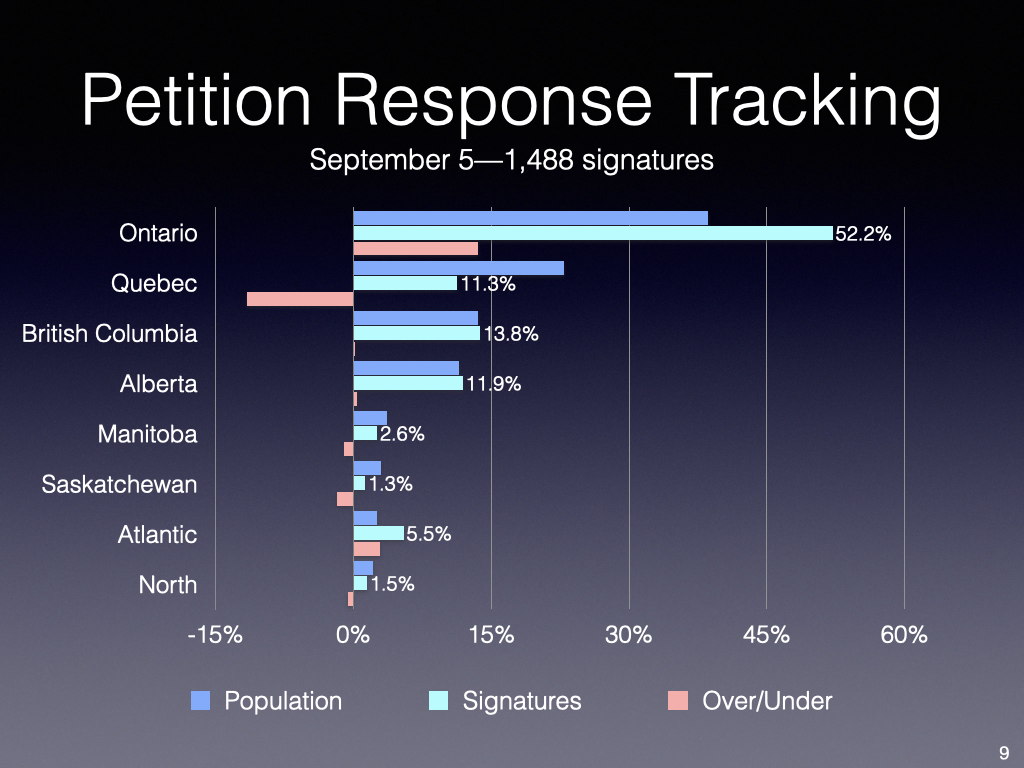
Petition e-4511 – Opposing self-affirmation of the #citizenship oath “citizenship on a click” – Signatures to September 5

The chart below breaks down the 1,488 signatures as of 5 Septembe by province. No major changes by province as numbers plateau.

Fun detail to speculate about. Minister Miller is married to a former Swedish diplomat who presumably is also a naturalized Canadian and who participated in a citizenship ceremony. May bring a needed personal perspective to the ill-advised move to self-affirmation of the citizenship oath and the desired result that “participation in ceremonies would be lower than it is currently, and there would likely be fewer ceremonies overall:”

And if you haven’t yet considered signing the petition, the link is here: https://petitions.ourcommons.ca/en/Petition/Details?Petition=e-4511

Why Joe Biden should scrap US citizenship tests

While some have argued this for Canadian citizenship, they forget that this contributes to support for immigration and citizenship among those who are already citizens, whether born in Canada or elsewhere. But given the current government’s lack of understanding of the meaning of citizenship, seen in proposed self-affirmation of the oath and the lack of update to the citizenship guide, wondering whether the government will partly move in this direction:

“I hereby declare, on oath, that I absolutely and entirely renounce and abjure all allegiance and fidelity to any foreign prince, potentate, state, or sovereignty, of whom or which I have heretofore been a subject or citizen; that I will support and defend the Constitution and laws of the United States of America against all enemies…” 

Exactly 10 years ago, I joined 136 people from 43 countries at a naturalization ceremony in a courtroom in downtown New York to proclaim our allegiance to the country that had embraced us as its own. Overcome by the emotional charge of the occasion, we struggled to keep our voices steady — and our eyes dry. Even Janet Napolitano, administering her Enal oath as secretary of homeland security, teared up as she welcomed us as “my fellow citizens.” 

I was flanked by a young woman from Ukraine and a middle-aged man from Peru; she worked on Wall Street, and he was a cab driver. As we told each other of the journeys that had brought us to that magical moment, her English was heavily accented; his was liberally interspersed with Spanish. 

At one point, we talked about what had been the final hurdle on the path: The citizenship tests. She’d found the civics quiz quite stressful; he, like me, thought it had been easy-peasy. We didn’t talk about the other test — the one that judged our English skills. More than likely, the US Citizenship and Immigration Services officers who had interviewed us skipped over that part of the process in order to move things along. In my case, the examining oficer had said something along the lines of, “You’ve made it this far. There’s no need to waste our time on this.” 

The Biden administration, which is proposing to make the English test harder, apparently does not understand what my USCIS examiner had come to recognize, from some combination of intuition and experience: If you want to be an American and have lived in this country long enough to qualify, then a language test is entirely redundant. 

In the current format, the officer conducting the naturalization interview can evaluate the applicant’s speaking ability by asking questions she or he has already answered when Eling the paperwork. The new test, meant to go into effect next year, would include a speaking section in which applicants would be asked to describe scenes depicted in photographs, such as kinds of food or activities like commuting to work. 

It sounds simple enough, but it is no less superfluous for that. All applicants for citizenship are tested by the ultimate arbiter of American life: The free market. Before they can get to the naturalization test, their abilities are vetted by a system that requires immigrants to End work, shelter, food and access to education and healthcare, with little support from the state. 

And living the American way puts us all through a long and continuous examination, unlike the brief, one-of test at the USCIS. I had been fortunate to be fast-tracked for the Green Card that confers permanent residency in the US, and then waited Eve years, the minimum requirement, before applying for citizenship. It had taken the Ukrainian twice as long and the Peruvian three times as long to reach the test stage. By then, we were as duent as required by the nature of our livelihoods and, by extension, our lives. 

What’s more, we were in a country where the government — city, state and 

federal alike — was getting better and better at communicating in languages 

other than English. Multilingual forms are the norm rather than the 

exception, and even the USCIS website offers information in 33 languages, from Amharic to Vietnamese. 

If the language test is unnecessary, the civics test is just plain unfair. Applicants must correctly answer six out of 10 questions chosen from a published set of 100. Polls have shown most Americans would fail: Why should those who want to join their ranks be held to a higher standard? 

Joe Biden is not the Erst American president to try and raise the bar for naturalization. Donald Trump wanted to make the civics test longer and to introduce more politically loaded questions. Biden rightly scrapped that plan. This makes his administration’s proposal for a tougher English test even more inexplicable. 

Over 9 million Green Card holders are eligible for citizenship, but barely 10% of them apply for naturalization each year. The Biden administration has said it wants that proportion to grow. In typical Washington fashion, it has set up an interagency committee to come up with a strategy to encourage more people to take the path that brought me to that New York courthouse 10 years ago. 

Here’s a good place to start: Scrap the civics and language tests. 

Read more at:
https://economictimes.indiatimes.com/nri/migrate/why-joe-biden-should-scrap-us-citizenship-tests/articleshow/103367059.cms?utm_source=contentofinterest&utm_medium=text&utm_campaign=cppst