Siddiqui: Despite decades of adversity, Muslims have become an integral part of the West

Interesting and relevant reflections:

Last week marked the 22nd anniversary of the Sept. 11 attacks when nearly 3,000 innocent people were killed by 19 Muslim terrorists. In the ensuing American-led war on terror waged overtly and covertly in more than 80 countries, nearly 900,000 Muslims have been killed and at least 37 million have been displaced, according to Brown University’s Cost of War Project.

We also know about the parallel cultural warfare on Muslims. The Green Scare turned out to be worse than the Red Scare of the 1950s – it has had a bigger footprint, lasted longer and affected, besides the Muslim world, Muslim minorities across the West, estimated at more than 30 million.

What we know little or nothing about is this:

Muslims in the West are emerging as an integral part of the mainstream, despite or because of the heavy odds they’ve encountered.

This is particularly true of Canada’s 1.8 million Muslims and the estimated 3.5 million Muslims in the United States, that hotbed of Islamophobia.

Muslims are assuming prominent roles in a range of fields, from politics to business to culture to sports

Not only is this good news for this beleaguered minority but also our democracies, which, despite bouts of abominable bigotry, do provide the legal and political mechanisms for victims to reassert their rights, eventually.

Post-9/11, Muslims became defensive: “I am a Muslim but not a bin Laden Muslim,” “ … not a fundamentalist Muslim,” “ … not a Wahhabi Muslim,” but rather, “a moderate Muslim,” or “a Sufi Muslim.” Not that many knew who or what a Sufi was, only that the designation signalled you were Muslim Lite and unlikely to blow up planes and buildings.

But as Islamophobia intensified, many Muslims gravitated to their faith. Their ethnic, linguistic, racial, cultural, nationalist and doctrinal affiliations began to take a back seat to their pan-Islamic identity. Or, pan-Muslim identity, in the case of the non-observant.

While 48 per cent of Canadian Muslims consider their ethnic or cultural identity as important, more than 80 per cent cite being Muslim and being Canadian as markers of their identity.

Muslim and Canadian. Muslim and American. Muslim and British.

It used to be that demonized minorities in North America kept their heads down and played down their identities. During and after the Second World War, for example, Mennonites in southern Ontario nearly disappeared from the census. But Muslims announced themselves in the 2011 and 2021 censuses when the decennial religion question was asked.

Mosques are overflowing, in part due to increased immigration but not just because of it. Politicians were the first to sniff this out and troll for votes there. On the Friday sabbath, most mosques are holding two or three services. In Ramadan, the late-evening prayers when the entire Quran is recited in the month, congregations are spilling into corridors, classrooms, gyms – in an orderly Canadian manner.

An unprecedented number of women in Canada – and the United States, Britain and parts of Europe – are wearing the hijab. Most were born or bred in the West, and the first in their families to do so, often defying parents. They’ve marched proudly and fearlessly into the front lines of battling both religious and gender discrimination. They are also carving out new paths: Playing hockey and basketball, acing postsecondary education, and being professors, doctors, lawyers, engineers, entrepreneurs, business partners, authors, TV producers, news anchors and stand-up comedians. In my books, they are the real Muslim heroes of the post-9/11 period.

Even the Halal industry is booming, said to be worth around $1.5-billion in Canada alone.

Ismaili Muslims, followers of the Aga Khan, are beginning to fast in Ramadan, and perform the annual hajj pilgrimage in Saudi Arabia. Given that such obligations had long been left to individual choices among the Ismailis, the new trend by their young denotes strong ecumenical solidarity.

This increase in faith activity may spook those who consider religion incompatible with secularism. On the contrary, freedom of religion, including the right to public assertion of it, is a bedrock principle of liberal democracy. So long as a faith practice is within the law, we have little or no reason to panic. Indeed, it can lead to ethical behaviour and a more humane society. Sikh gurdwaras, for example, serve Sikhs and non-Sikhs alike at their langar, free mass feeding, as they did during the COVID-19 pandemic. Churches routinely house refugee claimants.

Mosque-based food banks are feeding people of all faiths and no faith, and mosques are raising funds for neighbourhood public schools and hospitals. The Toronto-based International Development and Relief Foundation – founded in 1984 by a pious Niagara Falls physician, Fuad Sahin – provides humanitarian aid and development programs without discrimination in Canada and abroad. The Aga Khan Foundation Canada is partnering with the federal government to deliver development programs abroad.

All this represents a remarkably swift evolution for a relatively recent immigrant group, especially the Ismailis. Refugees from East Africa in the 1970s, they’ve shown themselves to be highly organized, self-reliant and successful – a model minority within a minority. Former prime minister Jean Chrétien told me during the 1990s recession that what his hometown of Shawinigan, Que., needed was “a dozen Ismaili entrepreneurs.”

Muslim advocacy groups helped turn the politically docile Muslims into a formidable voting bloc. In the 2015 election, nearly 80 per cent of Canadians Muslims voted, according to the group The Canadian Muslim Vote. Nationally, they voted 65 per cent for the Liberals, 10 per cent for the NDP and just 2 per cent for the Conservatives. In the 2021 election, 28 Muslim candidates ran and 12 won. Four have been ministers: Maryam Monsef (a refugee from Afghanistan), Ahmed Hussen (a refugee from Somalia), Omar Alghabra (an immigrant of Syrian descent), and my Toronto area MP Arif Virani (a refugee from Uganda), now Canada’s first Muslim minister of justice. Naheed Nenshi of Calgary was the first Muslim mayor of a large North American city, and Ausma Malik is the first hijab-wearing councillor in Toronto, indeed Canada.

In the United States, 57 Muslims were elected in the 2020 national and state elections. Keith Ellison, the first Muslim elected to the House of Representatives, took his oath of office in 2007 on a copy of the Quran owned by president Thomas Jefferson who, unlike contemporary American politicians, wanted to better understand Muslims. Mr. Ellison has been followed by three others: representatives Andre Carson, Rashida Tlaib and the hijab wearing Ilhan Omar.

In Britain, which has been slower in integrating minorities, there were 55 Muslim candidates in the 2019 general election and 19 were elected. Two were named Conservative ministers – Sajid Javid and Nadhim Zahawi. In Scotland, Humza Yousaf became First Minister earlier this year, the first Muslim to lead a major U.K. party, and the first Muslim to lead a democratic Western European nation. His wife, Nadia El-Nakla, is a councillor in the City of Dundee, the first member of any minority elected there.

The mayor of London since 2016 has been Sadiq Khan. Earlier as a Labour MP, he voted against his own government’s draconian anti-terrorism legislation in 2006, fearing it might snare innocent Muslims. In 2009, he was sworn in as a member of the Privy Council at Buckingham Palace on the Quran. Upon discovering that the palace had none, he left his copy there.

It’s not just politics.

Goldy Hyder is the first Muslim chief executive of the Business Council of Canada, which represents the heads of Canada’s 150 leading businesses. Toronto lawyer Walied Soliman, Canadian chair of Norton Rose Fulbright, has also served as its global chair.

Authors include M.G. Vassanji, Canada’s first two-time winner of the Giller Prize for fiction; Uzma Jalaluddin; Kamal Al-Solaylee; and Omar Mouallem. Rappers K’naan and Belly. TV anchors Omar Sachedina, Farah Nasser and Ginella Massa; broadcaster Adnan Virk. There’s hockey star Nazem Kadri and the wrestler Sami Zayn. Comedian Ali Hassan and Zarqa Nawaz, producer of the CBC sitcom Little Mosque on the Prairie, which drew a record audience of 2.1 million when it premiered in 2007.

We are familiar with American entertainers Hasan Minhaj, Mahershala Ali, and Aziz Ansari; the writers Fareed Zakaria, Reza Aslan, and Ayad Akhtar, who is also the president of PEN America; the painter Salman Toor and his partner, singer Ali Sethi, whose song Pasoori, Punjabi for conflict, has exceeded 500 million views and was the most searched song in 2022, according to Google Trends.

Muslims have traditionally divided the world into Dar al-Islamand Dar al-Harb, the dominion of Islam and the dominion that barred the free practise of Islam. Canadian Muslims speak of Canada as Dar al-Amn, an abode of peace – sans Quebec.

The province has been aping France and certain European jurisdictions in banning the hijab and the niqab (and the turban and the kippa) in public service, on pain of the wearers losing their jobs. France recently also banned the abaya in state schools, the long dress worn by some Arab women. The discrimination is rationalized in the rubric of laïcité, secularism – oblivious to the irony that while the Taliban and the ayatollahs tell women what to wear, these guardians of secularism order women what not to. The urge to control women is the same. Quebec recently banned religious activity (i.e. prayers) in schools, which disproportionally affects Muslim students. China has banned beards in Muslim Xinjiang in the name of curbing “extremism.” We are left to argue only about the degree of the control and the punishments for disobedience.

Quebec also shares another unfortunate trait with France and other parts of Europe. The only Muslims it grants prominent roles in government and the public sector are those who attack fellow Muslims, especially the observant. No dissident voices are allowed to disturb the certitudes of anti-religious secularism.

Happily, in English Canada, Muslim-baiting no longer pays political dividends. Stephen Harper found that out in the 2015 election when Canadians decided that his Barbaric Cultural Practices Act was one dog whistle too many.

Today, no Islamophobic party can win a national election, nor a xenophobic one.

Yet, as we know, Canada has not been immune from Islamophobia.

Six worshippers were massacred in Quebec City in 2017. A caretaker at a Toronto mosque was murdered in 2020. A family of four was mowed down in London in 2021; the trial of the accused is taking place as I write this.

Muslims face hostility – including, shamefully, by the right-wing mainstream media. They suffer high unemployment and underemployment. Hijab-wearing women are still harassed, spat upon, pushed, shoved and kicked in public spaces, pointing to yet another irony: The West thinks that Islam and Muslims mistreat women, yet it is Muslim women in the West who are the biggest victims of discrimination by liberals and louts alike.

Ottawa has appointed a Special Representative on Combatting Islamophobia, Amira Elghawaby, a hijab-wearing human-rights activist. Her role is akin to that of the Special Envoy on Preserving Holocaust Remembrance and Combatting Anti-Semitism. This is appropriate, given that Islamophobia is the new antisemitism.

Through these tough times, as during others through the ages, Muslims have been sustained by a resiliency born of sabr, patience/perseverance, enjoined by the Quran and the Prophet Muhammad. Even the non-observant have it in their DNA. One common refrain among Muslims is that as bad as they’ve had it here, they are blessed, compared with the plight of many Muslims and non-Muslims around the world.

Overcoming adversity, succeeding as a minority, and integrating into the larger society have had two significant beneficial side effects for Muslims:

1) Going or gone is the notion that Muslim states “back home,” or at least the influential ones, would come to the rescue of Muslims here. Or that the Organization of Islamic Co-operation, the Jeddah-based, 56-member umbrella organization of the world’s 1.8 billion Muslims, would.

2) Old-world interdenominational rivalries are dissipating. All strands of Islam co-exist here: There are no Orange Day-like parades, with one set of Muslims needling the other.

All these transformational changes speak to a greater truth: Democracy is the best polity for Muslims, as it is for peoples of other faiths and no faith, so long as it treats all groups fairly.

This is not an exclusively secular idea. It was enunciated with stunning clarity by Islamic clerics back in the 1930s in colonial British India. Its strongest proponent was Husain Ahmed Madani, rector of a highly regarded orthodox madrassah in Deoband, north of Delhi. I’ve been reading about him while tracing my family history in those precincts.

He was a steadfast supporter of Mahatma Gandhi’s joint Hindu-Muslim struggle for independence from the British. He opposed dividing India into a majority-Muslim Pakistan and Hindu-majority India, and would ask: Whose Islam would prevail in Pakistan? Given the range of theological diversity among Muslims, only an authoritarian government could impose the kind of Islam it opted for. He was making the case for Muslims to stay in the democratic framework of postcolonial India. His prescience is being proven over and over in the West, especially Canada.

Haroon Siddiqui is editorial page editor emeritus of the Toronto Star and a senior fellow at Massey College. His latest book is My Name is Not Harry: A Memoir.

Source: Despite decades of adversity, Muslims have become an integral part of the West
Cornellier: De l’huile sur le feu

More Quebec discussions on integration:

Cet été, dans un parc de Joliette, je travaillais mes coups de tennis avec mon lance-balles. Cette machine suscite toujours la curiosité des enfants. Ce soir-là, donc, un enfant de sept-huit ans est entré sur le court pour observer ça et pour m’aider à ramasser mes 75 balles. Nous avons jasé un peu. Il m’a dit s’appeler Mohammed et aller à l’école du quartier. Sa petite soeur est venue se joindre à nous, mais n’a pas pu participer à la conversation puisque, n’ayant pas commencé l’école, elle ne parlait qu’en arabe.

En retournant chez moi, je me disais, rempli d’optimisme, que tout était là : si on veut que l’immigration soit une chance et non une menace pour le Québec, il faut aller à la rencontre des nouveaux arrivants, les accueillir chaleureusement, leur parler, en français, comme à des amis, leur offrir la vie avec nous, qui sommes là depuis un bout, comme une aventure commune. Je n’ai pas peur de Mohammed et de sa petite soeur. Je souhaite, au contraire, les entendre dire « nous autres », en parlant des Québécois, dans dix ans.

Je sais bien qu’on ne fait pas de politique avec de pareils bons sentiments et que l’intégration des nouveaux arrivants ne va pas sans défi. Mon anecdote vise simplement à illustrer que je n’adhère pas à la théorie du « grand remplacement » et que je crois à la possibilité d’une intégration réussie des immigrés, moyennant des compromis de part et d’autre.

Dans Les déclinistes (Écosociété, 2023, 152 pages), l’essayiste Alain Roy, directeur de la revue L’Inconvénient, critique avec sévérité le discours de certains intellectuels opposés à l’immigration, surtout si elle est musulmane. Renaud Camus, Alain Finkielkraut, Éric Zemmour, Mathieu Bock-Côté, Michel Houellebecq et Michel Onfray sont dans sa ligne de mire.

Roy leur reproche de manquer de rigueur intellectuelle, d’ébaucher des scénarios alarmistes au mépris des données statistiques et de n’avoir aucune solution crédible à proposer aux problèmes qu’ils déplorent. Ces essayistes, écrit-il, jettent de l’huile sur le feu en nourrissant l’islamophobie.

Roy vise juste concernant Camus, Zemmour et Houellebecq, quand celui-ci oublie d’être romancier. Voici, en effet, trois trublions prêts à dire n’importe quoi pour se rendre intéressants, même si cela signifie alimenter un climat de guerre civile en France sur le dos des musulmans.

À l’heure actuelle, les immigrés représentent 10,2 % de la population française. Les personnes de culture musulmane représentent environ 8 % de la population. Parmi elles, seulement 25 % affirment être pratiquantes. On est loin du « grand remplacement ».

Au Québec, 3 % des citoyens sont musulmans. Selon le démographe Guillaume Marois (Le Journal de Québec, 4 septembre 2018), si les tendances actuelles en immigration se poursuivent, les musulmans représenteront 14 % de la population en 2061. Dans le scénario improbable où l’immigration de culture musulmane doublerait, les citoyens qui s’identifient à cette confession représenteraient 19 % de la population. Ainsi, Marois conclut que « le Québec n’est pas en voie de devenir une société musulmane », tout en ajoutant qu’il doit demeurer intransigeant envers les manifestations de l’islam politique.

Alain Roy a donc raison de qualifier de délirante la thèse du « grand remplacement ». Ses critiques, cependant, tournent parfois les coins ronds. Roy, par exemple, dit juste en notant que Bock-Côté, qui ne manquera pas de s’en défendre, est plus un polémiste qu’un essayiste, en ce sens que « sa pensée [est] entièrement déterminée par ses prémisses ». Or, c’est aussi le cas de Roy lui-même.

J’en veux pour preuve le traitement qu’il réserve à Finkielkraut. Ce dernier, c’est vrai, a parfois eu des formules malheureuses dans ce débat. Néanmoins, accuser son essai L’identité malheureuse (Stock, 2013) d’islamophobie est injuste. Contrairement à ce qu’affirme Roy, Finkielkraut n’écrit pas que les musulmans sont des « citoyens inassimilables ». Il note que la diversité culturelle se transforme parfois en chocs culturels, mais il ajoute qu’« aucune de ces différences n’est immuable » ou insurmontable. Il souligne, plus loin, que des Français d’adoption, en 1940, ont rejoint le général de Gaulle dans son combat pour la France et cite Lévinas disant que cette dernière « est une nation à laquelle on peut s’attacher par le coeur aussi fortement que par les racines ».

Finkielkraut insiste aussi sur le fait qu’il est « impératif » de ne pas « faire payer tous les musulmans pour le radicalisme islamique ». Avec Claude Lévi-Strauss, il plaide à la fois contre « la tentation ethnocentrique de persécuter les différences » et contre « la tentation pénitentielle de nous déprendre de nous-mêmes pour expier nos fautes ». Ça se défend.

C’est d’ailleurs comme ça, fraternellement, mais sans m’effacer, que je veux accueillir Mohammed.

Essayiste et poète, Louis Cornellier enseigne la littérature au collégial.

Source: De l’huile sur le feu

Aziz: The real reasons Canada’s relationship with India is broken

Classes example of diaspora politics taken to excess:

When Prime Minister Justin Trudeau stood up in the House of Commons on Monday and made the unprecedented allegationthat “agents of the government of India” assassinated a Canadian citizen on Canadian soil, I cannot say I was surprised. It was a brazen and violent encroachment upon Canadian sovereignty, done in public, meant to be discovered, and over one of the issues that the Indian government of Narendra Modi takes most seriously.

I should know. In 2017, I was the Policy Advisor in the Foreign Minister’s office, working closely with the Prime Minister’s Office on India. From the first briefing, it was clear that India-Canada relations were headed in the wrong direction. There had been rumours of Indian intelligence services operating in the Canadian suburbs for years (along with others). The Indians counter-alleged that Canada was giving shelter, if not encouragement, to Khalistani extremists – supporters of an independent Sikh homeland, partitioned out of India. Sikhs in Canada, meanwhile, have likened the Indian government’s violence against them to genocide. The two sides had been talking past each other for years.

The sore point in this, which young Canadians have no memory of, is the tragic Air India bombing of 1985. Until 9/11, this was the worst act of terrorism in the sky, whereby Sikh extremists planted a bomb on an Air India flight, resulting in the deaths of 329 passengers and crew.

By the time I served in government in 2017, two things had recently – and radically – changed. First was the election of Mr. Modi in 2014, and his Hindutva politics. Mr. Modi’s ideology sees India as a primarily Hindu nation, and it stokes ethnic chauvinism and grievance against anyone who dares criticize it. Mr. Modi was a strongman, and would no longer take lecturing from Canada.

The second factor was the election of Donald Trump, which moved everyone’s attention and focus to Washington dramas. India, meanwhile, had gone fully nationalist by this point. Since coming into office, Mr. Modi has silenced critics, targeted Muslimslocked up political opponents, and rewritten the Indian curriculum to blot out India’s syncretic history. Mr. Modi has rolled back India’s democracy, and remains an ally of India’s far-right.When I met with India’s greatest economist, Amartya Sen, last fall, he warned me that the regime was getting worse. There can be no doubt that Mr. Modi has used state violence against minorities in frightening and authoritarian ways.

Over the years, the politics of this issue in Canada had also grown more difficult. There are some 770,000 Sikhs in Canada, one of the most politically organized communities in the country. Canadian Sikhs have kept the issue of Sikh justice on the agenda by continually advocating and pressuring politicians. Because foreign policy in a democracy is ultimately informed by domestic public opinion, the Sikh issue has an enlarged influence on our bilateral relations with India. It came up in every meeting, in every talking point, in every pull-aside. Unfortunately, Canadian politicians then didn’t care enough about either Sikhs or India to give this the policy attention it deserved.

By 2017, when I worked in government, India did not take Mr. Trudeau or Canada seriously. They viewed Canada as a bit player in world affairs, America’s loud-mouthed neighbour. In Ottawa, at least in my experience, officials did not respect India, either – to our peril. Canada’s political establishment is old and white, and infused with an ignorant Eurocentrism that still affects foreign policy priorities. Western Europe and the United States were our focus, and some ministers could hardly see beyond London or Berlin. There’s a reason why, along with India, relations with China, with Latin American countries, with much of Africa have deteriorated. It was a great abdication of our long-term priorities, given where we have ended up.

When Mr. Trudeau went to India in 2018, the trip became a debacle for Canada. Mr. Modi did not greet him on the tarmac, Mr. Trudeau got a chilly reception in general, and the PMO was put on its heels after it was reported that Jaspal Atwal, a Khalistan supporter once convicted of trying to kill an Indian cabinet minister, had been invited to two receptions during Mr. Trudeau’s visit.

Canada should have at least begun to take steps to ensure our land was not used for terrorist financing – a reasonable demand, given that the overwhelming number of Canadian Sikhs are peaceful and uninterested in using violence to create a separate Sikh homeland. (Coincidentally, Khalistan is almost entirely a diaspora issue; there is little organized support, even among Sikhs in India, for a separate homeland.) By taking goodwill measures, it would have at least been possible to keep talking and find workable policy solutions. The only problem was, Mr. Trudeau did not want to lose the Sikh vote to Jagmeet Singh. So we dug in our heels.

What I saw in government was how Canada’s ethnic domestic battles were distorting our long-term foreign policy priorities, and politicians, who never understood South Asia or India anyway, were pandering in lowest-common-denominator ways in B.C. and Ontario suburbs, and playing up ethnic grievances to win votes. This was especially true within internal Liberal Party politics, meaning that we could hardly focus on foreign policy and strategy without factoring in which ridings might be lost because a certain group might be upset. Canada, as a country, has suffered greatreputational damage by such thinking – and none of our allies are going to come to our help on this issue.

Not that Mr. Modi would have necessarily been a great friend to Canada. In my research on right-wing nationalist regimes, it is apparent that governments pursuing state violence internally – against minorities, against critics – will ultimately pursue such aggression externally. It is why the rise of the new authoritarians is so destabilizing for the world order. But Canada ultimately got the worst of all possible deals – nearly ruptured relations with India, and now a potential split in the Western alliance.

The global chessboard is shifting. The United States is strengthening its Asia alliances, something we could and should have been doing six years ago. The new influential club is the Quad – the U.S., Japan, Australia, and India. Canada is not part of it. At the G20, Canada is demeaned. The world powers will eventually face the contradiction between Mr. Modi’s Hindu nationalist regime and his foreign policy influence. What’s worrying is that Canada isn’t even at the table where those decisions are being made.

We have entered a critical period in world affairs. Major realignments are taking place – and now the murder of a Canadian citizen, allegedly carried out with the knowledge if not support of another country, could go many different ways. It is imperative the investigation continues, that its findings are made public, and that Canada seeks de-escalation with India. Canada may never be a major power in international affairs. But it can still be a serious one.

Omer Aziz is a former foreign policy adviser in the government of Justin Trudeau and the author of Brown Boy: A Memoir.

Source: The real reasons Canada’s relationship with India is broken

Woolley: Stop seeing immigration as a get-rich-quick scheme for Canada’s economy 

Indeed. Acknowledge the trade offs and both negative and positive impact:

Immigration is neither as good for Canada as recent federal government pronouncements would suggest nor as bad as some critics might claim. The best economic evidence suggests that, in the long run, immigration has limited impact on the average Canadian’s wages or job prospects. Immigration boosts the economy, but it increases our population, too, leaving the average Canadian’s living standards more or less unchanged.

Yet these long-run averages mask the fact that specific policies create winners and losers. A government that ignores the fact that immigration can have costs risks making two mistakes. First, it might uncritically accept the arguments made by those who stand to benefit from immigration. Second, if it does not take the downside risks of specific immigration policies seriously, it might not act to mitigate them.

Temporary foreign worker programs, for example, are a win for employers. In theory these programs are necessary because employers struggle to find qualified Canadian workers. Yet economists Ian O’Donnell and Mikal Skuterud have found that a significant number of jobs filled by temporary foreign workers do not require any qualifications or skills other than the ability to do hard physical labour. The jobs are hard to fill because the wages are low and the work is unpleasant; for example, $15.80 per hourto do physically demanding, fast-paced, dangerous work in a meat packing plant – at night, if needed.

People will take hard, badly paid jobs if they have no better alternatives (or if the jobs provide a route to citizenship). In Canada, those with the fewest alternatives are temporary foreign workers. My colleagues Pierre Brochu, Till Gross and Christopher Worswick have found that such workers, especially those from low-income countries, have less absenteeism and work longer hours than other workers. This is why no amount of immigration will eliminate firms’ claims that they must hire temporary foreign workers: People are more likely to show up to work if being fired jeopardizes their right to live and work here.

It’s not so much a labour shortage that fuels employers’ support for temporary foreign worker programs as a zest for profit – specifically a desire for a plentiful supply of low-wage workers to fill unattractive positions. But more people competing for low-wage jobs makes it harder for less qualified workers to find employment and dampens upward pressure on wages.

Immigration policy, as with all policy, involves trade-offs – in this case, between higher profits for companies and higher pay for employees. Economist Armine Yalnizyan has long argued for replacing temporary foreign worker programs with higher levels of permanent immigration: If people are good enough to work here, they are good enough to stay and build their lives here. But permanent residents have options that temporary foreign workers lack. They can work as many or as few hours as they choose and are free to work for any employer. This means that, to attract permanent residents, employers have to make workers an offer that is competitive with their other options – and that means improving wages or working conditions or both. Different policy, different trade-offs.

The federal government, in announcing its new immigration plans last year, introduced both enhanced temporary foreign worker programs and increased permanent immigration. If it was trying to make everyone happy, it failed.

Newcomers increase the supply of workers, but they also increase demand – for food and shelter, for example. In the long run, these two effects usually more or less cancel each other outIn the short run, they do not.

The government hoped to avoid worsening the housing crisis by attracting newcomers to small towns and rural communities. But such a strategy forgets that immigrants are people, too. Like people born in Canada, they are pulled by economic gravity to urban centres where there are jobs, social networks and cultural supports.

Yet Canada’s big cities have no more room to sprawl – and it would be bad policy to let them. Most of this country’s population lives in a few concentrated areas such as the Quebec City-Windsor corridor and B.C.’s Fraser Valley. Most of the rest of Canada has a harsh climate or would be very expensive to develop or both. We are not a vast, underpopulated country; we are a densely populated, highly urban, diverse country. We need immigration, housing and transportation policies that reflect that reality.

Most of all, we need to stop viewing immigration as a get-rich-quick scheme. Immigration policy involves trade-offs. We need to be honest about the fact that immigration creates winners and losers, at least in the short run, and figure out ways of preserving the benefits of immigration, both for established Canadians and newcomers, while protecting those who stand to lose out.

Frances Woolley is a professor of economics at Carleton University.

Source: Stop seeing immigration as a get-rich-quick scheme for Canada’s economy

Rioux: Un parfum de colonialisme

Good column on the questionable morality of recruiting skilled healthcare workers from developing countries. Of course, individuals from this countries naturally seek better opportunities:

Il y a des nouvelles qui tombent à plat. Sitôt apparues, elles disparaissent comme par enchantement dans le grand trou noir de l’information. C’est comme si tout le monde, les politiques, les médias et même le public, se donnait le mot pour regarder ailleurs en attendant qu’on parle d’autre chose.

C’est un peu ce qui s’est passé la semaine dernière avec cette information révélant que les campagnes de recrutement de personnel de la santé que mène régulièrement le Québec en Afrique contribuent à fragiliser encore plus des pays africains dont la situation sanitaire est déjà précaire.

À l’encontre de toutes les politiques de l’Organisation mondiale de la santé (OMS), le Québec mène depuis longtemps des campagnes de recrutement dans des pays comme le Bénin, le Cameroun, la Côte d’Ivoire et le Togo. L’an dernier, il annonçait vouloir recruter 1000 infirmières étrangères, pour la plupart africaines. Souvent des infirmières expérimentées. Dans quelques jours débuteront d’ailleurs des entretiens d’embauche avec des candidats du Cameroun, de la Côte d’Ivoire et du Togo, sélectionnés dans le cadre des Journées Québec Afrique subsahariennes. Depuis 2017, le Québec aurait ainsi recruté plus de 1900 travailleurs de la santé, dont de nombreuses infirmières, provenant de 24 pays d’Afrique, d’Amérique du Sud et d’Europe.

Faut-il en conclure que le Québec ne se gêne pas pour participer sans retenue au pillage des cerveaux de ces pays pauvres ? À titre d’exemple, le Cameroun et le Bénin possèdent respectivement moins de 2 et 3 infirmières pour 10 000 habitants alors que, pour la même population, le Québec n’en compte pas moins de 77 ! L’OMS n’est pas seule à penser que ce pillage organisé est indigne du Québec. L’Association des infirmières et infirmiers marocains avait déjà accusé le Canada d’« épuiser les ressources infirmières des autres pays dans lesquels il y a également une pénurie ».

En guise de réponse, nos responsables se contentent généralement de regarder la pointe de leurs souliers en balbutiant du bout des lèvres qu’ils font un recrutement… éthique ! Personne n’aime se faire dire ses quatre vérités, surtout pas les partisans de l’immigration de masse, qui prétendent chaque fois se porter ainsi au secours de l’humanité souffrante. Et si cet « immigrationisme » vertueux n’était au fond que le nouveau visage du bon vieux colonialisme affublé d’un beau tampon humanitaire ?

Il y a longtemps que des chercheurs comme le démographe Emmanuel Todd ont expliqué le fait que, dans un monde où la communication mène le bal, le pillage des cerveaux avait remplacé celui des ressources naturelles. Cette « véritable prédation démographique », écrit-il, serait même plus grave que celle des ressources naturelles, car elle met aujourd’hui « en péril le développement de pays qui décollent ».

Parmi les milliers de migrants qui ont littéralement envahi l’île de Lampedusa la semaine dernière, personne ne s’est demandé — pas même le pape — combien il y avait de mécaniciens, de boulangers ou d’aides-infirmières qui désertent ainsi leurs pays. L’ancien journaliste de Libération Stephen Smith, professeur d’études africaines à l’Université Duke, en Caroline du Nord, a montré dans ses études que, contrairement à ce que sérine la presse, ce ne sont pas les plus pauvres qui émigrent. Ceux-là, en général, n’en ont pas les moyens. En cas de nécessité, ils se déplacent dans un pays voisin. Ceux qui se retrouvent chez nous sont ceux qui peuvent se le payer et qui pourraient donc au mieux contribuer à consolider la classe moyenne de leur pays.

Dans notre vision misérabiliste de l’Afrique — une vision encore aggravée par le catastrophisme climatique —, il ne nous viendrait pas à l’idée que les pays africains qui progressent, et il y en a, ont un urgent besoin de ces travailleurs pour se sortir de la misère. À Madagascar, en 2016, alors qu’il distribuait des bourses d’études, Philippe Couillard s’était ainsi fait rappeler à l’ordre par la ministre de l’Enseignement supérieur de Madagascar, qui lui dit que la plupart de ces boursiers ne revenaient jamais au pays. Et qu’ils étaient donc une perte sèche pour l’île. Belle charité que celle qui ne sert que le bienfaiteur. Ce jour-là, Philippe Couillard avait lui aussi longuement regardé ses souliers.

Dans ce que le politologue Pierre-André Taguieff appelle « l’utopie messianique du salut par l’immigration » — un mal très répandu au Canada —, il y a un mépris profond pour les peuples de nos pays, qui n’auraient d’avenir démographique, économique et culturel qu’en accueillant le plus d’étrangers possible.

Il y a aussi un mépris pour l’Afrique, car il sera toujours plus valorisant de s’épandre en larmes sur la misère africaine que d’appeler ces pays à se prendre en main et de les y aider à le faire. Ce qui me frappe toujours chez ceux qui ne jurent que par cette immigration providentielle, c’est leur désintérêt à peu près complet pour les pays pauvres. Comme si le seul avenir des Africains était de se déverser en nombre toujours plus grand dans nos beaux et grands pays riches et démocratiques. Ne sentez-vous pas là un étrange parfum de colonialisme ?

Source: Un parfum de colonialisme

MPs call for House study after UN report slams Canada’s efforts to combat contemporary slavery, forced labour

Of note:

A recent report from the United Nations’ special rapporteur on contemporary forms of slavery has raised alarm over Canada’s handling of the issue at home, including particular criticism for the Temporary Foreign Workers Program. With Parliament now back from its summer recess, NDP, Liberal, and Conservative MPs say they want to see a House committee undertake a study in response. 

Following a two-week visit, UN Special Rapporteur Tomoya Obokata released a 12-page statement of preliminary findings on Sept. 6, within which he highlighted Canada’s Temporary Foreign Workers Program (TFWP) as a top source of concern, saying the program’s low-wage and agricultural streams in particular “constitute a breeding ground for contemporary forms of slavery,” and that he is “perturbed by reports” that the number of workers entering Canada through this program is “sharply on the rise.”

“The Special Rapporteur is disturbed by the fact that certain categories of migrant workers are made vulnerable to contemporary forms of slavery in Canada, by the policies that regulate their immigration status, employment, and housing in Canada, and he is particularly concerned that this workforce is disproportionately racialized, attesting to deep-rooted racism and xenophobia entrenched in Canada’s immigration system,” reads the statement.

Obokata was in Canada between Aug. 23 and Sept. 6 to assess Canada’s efforts to prevent and address contemporary forms of slavery, including forced and child labour. He’s set to present a full report, which will expand on his initial findings and cover additional issues, to the UN Human Rights Council in September 2024. 

NDP MP Heather McPherson (Edmonton Strathcona, Alta.) said the rapporteur’s initial findings need to be raised in the House of Commons.

McPherson is a member of the House Foreign Affairs Committee’s Subcommittee on International Human Rights, which studied the human rights situation of the Uyghurs, and the role of the Canadian Ombudsperson for Responsible Enterprise in 2021. In light of the rapporteur’s findings, she said she’d like the “subcommittee to be looking at this again.” 

“We’ll be bringing that forward at that point [when the House returns], that they examine this and that we do get testimony on this report,” and look at the issue “from a larger frame,” beyond the ombudsperson, to also include examination of due diligence and human rights legislation, McPherson told The Hill Times on Sept. 15. 

She pointed to the Special Committee on Canada-China Relations and the House Foreign Affairs Committee itself—she is a member of both groups—as other potential arenas to pursue a study, noting, for example, the issue of Uyghur forced labour in Canada’s supply chains. 

“We have an awful lot to study within those committees, and so it’ll be a situation of trying to find the right place for it to land, and whether there’s bandwidth to do that,” said McPherson, adding she thinks the House International Trade Committee should also pick up the issue.

Conservative MP Arnold Viersen (Peace River–Westlock, Alta.), a member of the Subcommittee on International Human Rights and of the All-Party Parliamentary Group to End Modern Slavery and Human Trafficking, said he’s in favour of “studying the issue of human trafficking and how Canada can better fight it at any and every turn, so I would welcome a study in that respect.” 

Liberal MP John McKay (Scarborough–Guildwood, Ont.), another member of the all-party group, agreed the rapporteur’s findings bear “an examination by a House of Commons committee.” 

“We are bringing in a lot of people under particular policies, and it’s always worthwhile to examine the efficacy of those policies. Canada has a labour shortage … but we simply cannot be a nation that exploits other human beings in labour conditions that are such as the rapporteur has described. He used very strong language,” said McKay.

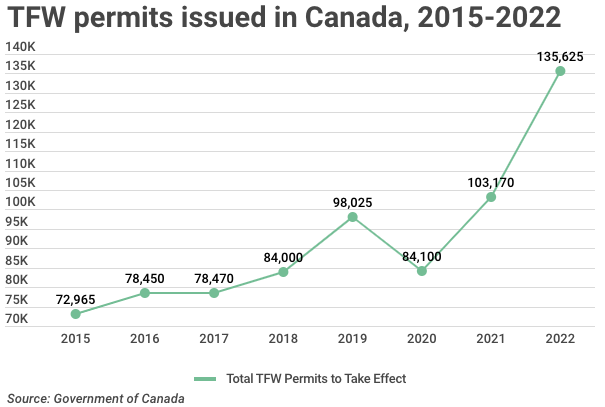
As noted by Obokata, use of the TFWP is on the rise in Canada. Between 2021 and 2022, the number of TFW permit holders increased by 31.5 per cent to reach 135,625 individuals. It’s on track to surpass that total in 2023, with 130,155 such permits already having come into effect in the first three quarters of the year, according to federal data

“It is a fact that temporary foreign workers make vital contributions to Canada’s national economy and possess valuable skills for which there is consistent demand, and yet paths for long-term or permanent residency is extremely limited or non-existent for most workers working in agriculture and other low-skills sectors,” reads the rapporteur’s report.

Obokata said while in Canada, he “received first-hand information from a large number of stakeholders, notably migrant workers themselves, pointing to the appalling working and living conditions in reality,” including excessive work hours, “extra-contractual tasks, physically dangerous tasks, low wages, no overtime pay,” access being denied to health care, limited access to social services, overcrowded and unsanitary employer-provided housing, “as well as sexual harassment, intimidation, and violence at the hands of their employers and their family.”

Such issues could be prevented through “effective labour and health and safety inspections,” but Obokata said from what he heard, those being done by federal, provincial, and territorial inspectors “are grossly ineffective,” don’t happen regularly, can be done remotely, and allow for advance notice to employers when done in person, enabling them to “make necessary preparations on the day of inspection.” Moreover, he said “most migrant workers are unaware” of the existence of existing federal, provincial, and territorial complaint mechanisms, or are afraid to report labour law violations “due to the fear of unemployment or deportation.”

While acknowledging “important developments” in the effort to protect the human rights of workers, and eradicate forced and child labour in the country’s supply chains—like the 2022 release of the Responsible Business Conduct Strategy and the 2021 update to the Code of Conduct for Procurement—Obokata said he still has “some concerns over Canada’s current approach to human rights due diligence for Canadian companies.”

He noted, for example, that Bill S-211’s reliance on self-reporting, lack of monitoring mechanism, and lack of requirements to implement “human rights due diligence” or measures to “prevent, address, and remedy abuses once identified,” risks it “becoming a box ticking exercise where companies simply submit the same statement every year, as has been reported in other jurisdictions.” The Fighting Against Forced Labour and Child Labour in Supply Chains Act, which comes into force in January 2024, requires companies that check two of three boxes—having at least $20-million in assets, $40-million in revenue, or 250 employees—to report on measures taken to “prevent and reduce the risk” of forced or child labour in their operations and supply chains.

Obokata said in raising concerns with the federal government, he was told draft legislation on due diligence to complement Bill S-211 is “currently” being considered. He urged the government to do so “expeditiously,” and for clear guidance on reporting requirements under S-211, and monitoring and oversight mechanisms to be established in the interim. 

McKay, Viersen, and Independent Senator Julie Miville-Dechêne (Inkerman, Que.) were among those who met with Obokata virtually on Aug. 15 just before his visit in their capacity as members of the all-party parliamentary group, with talk focused on S-211, which was sponsored by McKay and Miville-Dechêne in the House and Senate, respectively. 

McKay and Miville-Dechêne told The Hill Times they disagree with Obokata’s assessment of S-211 as a mere “box-ticking exercise,” with McKay saying he takes “strong exception to anyone who says this legislation will not be effective.” 

There’s an “immense amount of work that entities are going to have to do in order to be able to comply with the legislation,” argued McKay, with potential “enormous” consequences, including the fact that “the regulatory filing signed by a senior officer and approved by the board of the entity” will be “looked at by other regulators,” and “by those who do financing,” consumers, and NGOs. McKay said in discussions with lawyers and others “who work in this area” in Toronto last week alongside Miville-Dechêne, the pair heard serious concerns “about the work that’s going to be required in order to make sure that they comply.” 

“Our model is a stronger model than the U.K. model,” said Miville-Dechêne of S-211, noting the bill includes fines for non-compliance, and transmitting information that’s knowingly false. “I would say it’s a step, but a very important step and the first step, too, for a country that has … talked, politically, a lot about our respect for human rights, and by implementing this law, it is a step in the right direction.” 

McKay, Miville-Dechêne, and Viersen all said they expect clear guidance on reporting requirements under S-211 to come through its enacting regulations, which are still being awaited from the minister responsible, Public Safety Minister Dominic LeBlanc (Beauséjour, N.B.). Asked when those regulations would be tabled, LeBlanc’s office did not respond by filing deadline. 

McKay and Miville-Dechêne urged the government to table its draft regulations as soon as possible, with the Senator noting there are only three-and-a-half months left before S-211 comes into force, “which is not, in political terms, that long to give clear guidance to companies.”

Viersen called the wait on regulations “quite frustrating.” 

As for a parliamentary study, Miville-Dechêne said while the rapporteur’s preliminary findings must be listened to—and that she, too, is “very worried” about the potential for exploitation through Canada’s TFW program—she noted “he’s going to have more to say” when the full report is released next year. She highlighted that the Senate Social Affairs Committee is already in the midst of a study on Canada’s temporary and migrant labour force. 

“I find on this particular issue [the TFWP], Mr. Obokata is right on,” she said. 

Among other things, the rapporteur’s report also raised concern over the effectiveness of the federal Ombudsperson for Responsible Enterprisesestablished in 2019, which Obokata noted didn’t release its first initial assessment reports on complaints until this year—nearly four years after its creation. He highlighted that its mandate covers “only a limited number of sectors,” and excludes a number “where labour exploitation is rife, like agriculture, fishery, manufacturing, and construction,” which the rapporteur said should be “core” to the office’s mandate. He called for the ombudsperson to be given statutory powers to compel witnesses and documents, “with clear consequences” for companies that don’t comply, and for its independence to be ensured.  

McPherson said the rapporteur’s report has “echoed all of the concerns that the NDP has raised for some time,” including its criticisms of Bill S-211, which her party voted against in the House, and the effectiveness of the ombudsperson.

“We’ve got a government right now who is saying that they care about human rights, they’re talking about the need to ensure that Canadian companies working abroad are acting effectively, but every chance they have to bring forward good, strong legislation, they fail,” she said.

On the TFWP, McPherson said the NDP, “from the very get-go,” has said “the program needs to be revamped” and “that any individual who comes to Canada to be a worker needs to have a path to become a Canadian citizen.” 

“This program has been flawed” from the very beginning, she said, starting under the previous Conservative government, and continuing under the Liberals, despite its pledge to fix it.

The Hill Times reached out to Trade Minister Mary Ng (Markham–Thornhill, Ont.) and Immigration Minister Marc Miller (Ville-Marie–Le Sud-Ouest–Île-des-Soeurs, Que.) for comment and reaction to the rapporteur’s report. 

An emailed response from Global Affairs Canada confirmed Ng’s office has “reviewed the rapporteur’s statement.”

“We are taking into consideration the findings in the statement and how we can reflect on them moving forward as we work to eradicate forced labour from Canadian supply chains and ensure that Canadian businesses operating abroad do not contribute to human rights abuses,” reads GAC’s response. 

In its emailed response, Miller’s office highlighted “several permanent immigration pathways available for workers,” including through an Agri-Food pilot launched in May 2020 and recently extended until May 2025; the Provincial Nominee Program; the Atlantic Immigration Program; and express entry eligibility for agricultural supervisors and managers, among other things. 

“In Canada, the rights of all workers—including temporary foreign workers—are protected by law. Temporary foreign workers have the same rights and workplace protections as Canadians and permanent residents,” reads the response from Miller’s office, noting that new regulations aimed at increasing protections for foreign workers were implemented federally in September 2022.

“We will continue engaging all levels of government, provinces, and territories—to ensure all workers are safe and protected wherever they are in the country.”

Source: MPs call for House study after UN report slams Canada’s efforts to combat contemporary slavery, forced labour

Ottawa forecasts 1.4 million international student applications a year by 2027, document shows

Hard to deny the impact such numbers would have on housing, healthcare and infrastructure pressures and the increased numbers of disillusioned students given worse economic outcomes and likely frustration for the majority who will not transition to permanent residency.

But unlikely to convince the denialisms among the various interest groups that favour higher numbers.

Good that IRCC officials are carrying out this analysis:

The number of foreign students applying to come to Canada each year is forecast by the federal immigration department to rise to 1.4 million by 2027, an internal policy document says, which also raises concerns that such growth is “unsustainable.”

Immigration, Refugees and Citizenship Canada forecast the rapid rise in the number of foreign students in a paper last month about establishing a class of “trusted” universities and colleges, which would qualify for faster processing of international student study permits.

The document, obtained by The Globe and Mail, says that from 2019 to 2022 study permit applications for overseas students have increased by nearly 300,000 a year.

“By 2027, volumes are forecasted to nearly double to 1.4 million applications per year,” it says.

The federal document was sent to a select group of universities and colleges taking part in a pilot to establish the proposed trusted-institutions framework.

The IRCC paper forecasts that applications from foreign students will reach 949,000 this year, and just over one million next year. The number is projected to rise to 1.1 million in 2025, 1.28 million in 2026 and 1.4 million in 2027.

It says a recent strategic immigration review – and a continuing review of the international students program – has raised a number of concerns including “unsustainable growth in application volumes, impacting education quality, community infrastructure, and IRCC processing capacity.”

The paper says that the rapid growth in the intake of foreign students “has disrupted processing times” for study permits to enter the country. Meanwhile universities and colleges have become “increasingly dependent” on international students for revenue, in some cases not providing international students with “a positive education experience in Canada.”

It is currently piloting metrics to determine which universities and colleges are eligible to be counted as trusted institutions. To qualify they would have to share data annually with the immigration department, including the number and percentage of international students living in university housing.

Alex Usher, founder of Higher Education Strategy Associates, said on-campus housing is often not the cheapest option and this measure could reward universities attracting the wealthiest international students

Housing Minister Sean Fraser – the former immigration minister – floated the prospect of a cap on international student numbers at the cabinet retreat in Charlottetown last month, saying the number of foreign students is putting pressure on rental markets and driving up costs. Immigration Minister Marc Miller said at the retreat that around 900,000 students are expected to enter Canada this year.

A Senate report on Canada’s international student program, published Wednesday, said that many international students are forced to live in crowded, sub-standard housing, with universities failing to provide them with accommodation, even though they pay far higher tuition fees than Canadian students and inject around $22-billion into the economy each year.

One of the report’s authors, Senator Hassan Yussuff, questioned assertions that international students are to blame for the shortage of affordable housing, saying that many are living in cramped and overpriced accommodation with little protection from avaricious landlords.

The Senate report quoted findings by Statistics Canada that 40 per cent of study permit holders live in unsuitable accommodation compared with 9 per cent of the rest of Canada’s population.

Housing supply and affordability are a decades-old problem that cannot be solved by putting the burden principally on international students,” the report said.

It said that reducing international student numbers will reduce housing demand although the benefits would vary in different parts of the country and depend on the “tenancy preferences of Canadians.”

The Senate report said 51 per cent of international students settle in Ontario, with 20 per cent in B.C., and 12 per cent in Quebec.

The report added that the number of foreign students coming to Canada could be affected by diplomatic disputes with India and China, the “top international source countries.”

The IRCC, in assessing whether universities and colleges qualify as trusted, will gather information from government of Canada databases, such as on the “rate of adverse outcomes for study permit holders” –including convictions of international students for crimes in Canada. Ottawa will also check the approval rate of study permits to attend an institution.

It will also assess the “average teacher-student ratio” for the most popular courses taken by international students, retention and completion rates, foreign students’ ability to speak English or French, and the proportion of students who transition to permanent residency in Canada.

It says following the pilot, universities and colleges would be able to apply and the trusted institutions system could be up and running by spring next year. Foreign students applying to attend colleges and universities on the approved list could “receive expedited processing for the 2024 academic session.”

Source: Ottawa forecasts 1.4 million international student applications a year by 2027, document shows

Tensions with India raise concerns fewer international students will choose to study in Canada

Could be a good thing given the stories of fraud and exploitation and failed expectations. But not good for the institutions that rely on the revenues:

Diplomatic tensions between New Delhi and Ottawa threaten to curtail a relationship that funds a significant portion of Canada’s postsecondary education system.

The government of India issued a statement Wednesday warning Indian students in Canada about “growing anti-India activities and politically-condoned hate crimes and criminal violence.”

The statement urged students and other Indian nationals to exercise caution, but did not recommend against travel to Canada entirely. Instead it warned students of a “deteriorating security environment” and advised against visiting regions or venues targeted by those with what it called an “anti-India agenda.”

It’s the latest salvo in a growing diplomatic crisis between the two countries. On Monday, Prime Minister Justin Trudeau said in the House of Commons that Canadian security agencies had been pursuing credible allegations of links between agents of the government of India and the killing of a Canadian citizen, Hardeep Singh Najjar, who supported the movement for an independent Khalistan.

Canada expelled an Indian diplomat earlier this week and India responded by doing the same to a member of Canada’s High Commission in New Delhi.

There is some concern that the Indian government could continue to stir fears about conditions in Canada, which might diminish demand for Canadian postsecondary education.

India issued a similar warning for students in Canada last year, however, and it had little, if any, impact. At the time Canadian police services could not point to any rise in anti-Indian violence.

Students from India make up about 40 per cent of the more than 800,000 international students in Canada, according to the Canadian Bureau for International Education. They are by far the largest single group at Canadian schools, followed by China at about 12 per cent and the Philippines at 4 per cent. At least six Ontario colleges have more students from India than from Canada.

International student tuition, which is several times higher than for Canadian students, has become essential to the finances of many postsecondary schools.

Roopa Desai Trilokekar, a professor of education at York University, said there is some risk that if this diplomatic fight escalates, the government of India could use its platform to discourage Indian students from applying to Canada. Something similar occurred more than 10 years ago with respect to Australia, after incidents that targeted Indian students in that country, she said. Study applications to Australia subsequently dropped.

Canada was already getting negative press in India because of difficulties with housing and work conditions that many students face when they arrive, she said. The diplomatic feud will only heighten the publicity around some of these issues, she said.

“I would imagine that we’re going to see a dip. But I don’t know how large the dip will be. And it will depend whether any official stances will be taken by either of the governments,” Prof. Trilokekar said.

She said the Canadian government, which is reviewing its international education policies, should reconsider the role of education in its geopolitical strategy.

“It’s going to require rethinking. There’s a lot of dependence on students from India.”

Gautham Kolluri, an international student recruiter based in Ontario, said he has already heard from students concerned that supporters of an independent Khalistan would attack Indian students in Canada.

But Mr. Kolluri said he doesn’t believe this diplomatic dispute will seriously reduce the number of students interested in coming to Canada. Demand from India is very high, he said. And unlike Saudi Arabia, which recalled students on government-funded scholarships during a diplomatic dispute with Canada in 2018, India does not have a ready mechanism to alter student migration, he said.

Jaspreet Singh, founder of the International Sikh Students Association, said he doesn’t think the political tensions will affect Sikh international students in Canada. He said India is unlikely to shut off a migration path that offers opportunity to young people who might otherwise have difficulty finding work or a spot in a university.

“If they tried to do something like this, there would be a huge backlash,” he said.

Source: Tensions with India raise concerns fewer international students will choose to study in Canada

A Kinder, Gentler DEI?

An overly negative portrayal of efforts to address some of the excesses of DEI:

The Diversity, Equity, and Inclusion fad is on the ropes.  Multitudes of state lawmakers are attempting to limit or ban DEI training at state-funded institutions. And in at least six states, anti-DEI bills have been signed into law. At the same time, conservative legal groups are increasingly taking aim at corporate diversity programs. Amazon and Starbucks both face discrimination lawsuits over their diversity initiatives. Comcast has already settled a suit of its own.

With DEI in ever-worse odor, a psychologist and a sociologist, both of whom specialize in bias and diversity, have taken to the Wall Street Journal to explain what DEI training gets wrong and how to fix it. Mahzarin Banaji and Frank Dobbin write that DEI programs fail because they tend to “shame trainees for holding stereotypes” and “seek to solve the problem of bias by invoking the law to scare people.” As a result, they say, “people often leave diversity training feeling angry and with greater animosity toward other groups.”

So the authors recommend a different approach. First, DEI trainers should introduce their ideas with humility. Second, they should “give managers a way to counter biases—namely, training in strategies for cultural inclusion.” With these fixes in place, they say, “implicit-bias education can alert students to the fact that people committed to equality nonetheless hold biases.”

Perhaps Banaji and Dobbin should consider this: No implicit-bias training will ever work because free adults rightfully resent being “trained” by academics in how to treat other human beings. People leave DEI sessions feeling angry because the very notion of wise and good consultants trying to improve your character at the workplace is infuriating.

Think about the premise of it. Until the office trainers get ahold of you, you’re assumed to be morally defective, unfit for mixed company. (Never mind that the classroom trainers have already had a crack at you.) It’s a sweeping insult. Your parents, your faith, your spouse, your friends, your education, your own introspection and personal exploration—all failures. You need the folks with the quizzes and pamphlets and roleplaying sessions to sort you out and make you a good person.

It would be bad enough if DEI training was aimed strictly at altering your superficial behavior. But, as we see above, the key concept here is “implicit bias.” The trainers are there to introduce you to your inner bigot and show you how to tame him.

Besides the very real possibility that you might not have an inner bigot, what business is it of anyone’s if you do? There’s no law against thinking cruel and stupid thoughts. There are laws against acts of discrimination, and they should be invoked wherever applicable. It’s not for no reason that fighting “pre-crime” is the stuff of dystopian science fiction. What stays in your head is yours to do with as you please. Period.

If people leave DEI training with “greater animosity toward other groups,” maybe that’s because they had managed to keep the darkest parts of their subconscious healthily buried until someone with a human-resources-related degree tried to drag it out into their conscious awareness.

DEI is failing and under legal attack because it’s a bad idea. Not because real DEI has never been tried. I don’t doubt that many of its champions mean well. But, as with cruel ideas, compassionate ones don’t count until they’re executed. DEI is now doing real-world harm. And there are laws against that.

Source: A Kinder, Gentler DEI?

Une voie rapide d’immigration seulement critiquée par l’Université McGill

Not surprising, as McGill would be most affected

Une voie rapide d’immigration permanente applicable uniquement aux étudiants étrangers ayant étudié en français préoccupe fortement l’Université McGill, qui estime qu’il s’agit d’un système à deux vitesses qui exclura des étudiants.

« Étant donné que ces personnes possèdent un diplôme québécois, qu’elles sont jeunes et qu’elles vivent déjà ici, en français, depuis plusieurs années, elles constituent un bassin exceptionnel où recruter de nouveaux Québécois et de nouvelles Québécoises », écrit le premier ministre du Québec, François Legault, dans le cahier de consultations sur la planification pluriannuelle de l’immigration, en les décrivant comme « des candidats idéaux ».

Cela fait réagir l’Université McGill, qui enseigne et fait de la recherche principalement en anglais, et qui pense que cette approche pénalisera les étudiants étrangers « même s’ils peuvent démontrer une excellente connaissance orale et écrite du français ».

« Nos étudiants risquent de sortir perdants de cet exercice », a déclaré Fabrice Labeau, premier vice-principal exécutif adjoint (études et vie étudiante) de l’Université McGill, lors de son passage aux consultations mercredi après-midi. À la suite de la réforme proposée au volet « diplômés » du Programme de l’expérience québécoise (PEQ), un diplômé du Québec pourra déposer une demande de résidence permanente dès la fin de ses études au lieu d’attendre les 12 ou 18 mois d’expérience de travail actuellement exigés.

Une voie rapide qui crée un système « à deux vitesses » et qui exclura des étudiants, croit-il. Il cite en exemple un étudiant de McGill originaire de Chine qui l’a contacté récemment. Celui-ci suit des cours de français tout en étudiant dans son programme à temps plein en anglais afin de « s’intégrer à la société québécoise ». « Cet étudiant s’inquiète maintenant pour son projet de vie au Québec, qu’il a patiemment construit au cours des dernières années », souligne-t-il.

Une bonne part de l’effectif étudiant songera à d’autres options que l’Université McGill, refroidie par les difficultés de s’établir au Québec par la suite, appréhende Fabrice Labeau. « Si on peut assouplir les règles, nous, on peut travailler fort sur la francisation », assure-t-il. L’établissement accueille présentement 12 000 étudiants étrangers, ce qui représente 30 % de sa population étudiante.

« Ne serait-il pas préférable d’évaluer chaque candidat à l’immigration individuellement plutôt que d’indiquer d’emblée une préférence pour ceux ayant suivi un programme francophone ? » demande l’université dans son mémoire.

Une voie de passage existe, dit Fréchette

Une voie de passage existe, a tenu à préciser la ministre de l’Immigration, de la Francisation et de l’Intégration, Christine Fréchette, en réponse aux préoccupations de l’université.

« Les étudiants qui auront obtenu un diplôme dans un programme en anglais auront tout de même la possibilité d’appliquer pour le PEQ “diplômés”, s’il advenait qu’ils ont fait trois ans d’études en français au niveau secondaire ou postsecondaire », a-t-elle dit. Il est également possible pour eux de déposer leur candidature à la résidence permanente après une année d’expérience de travail s’ils maîtrisent le français au niveau requis.

Une réponse qui n’a pas semblé convaincre Fabrice Labeau, qui a, de son côté, invoqué l’attractivité des universités. « Leur fermer la porte à la voie rapide, c’est une difficulté », dit-il.

Source: Une voie rapide d’immigration seulement critiquée par l’Université McGill