Preventing the Next Wave of Progressive Radicalism—Before It Arrives

Interesting database and analysis:

Recent developments suggest that the influence of social-justice ideology on American university policies has finally crested, and may even be in retreat. Both Harvard University’s Faculty of Arts and Sciences and the Massachusetts Institute of Technology (MIT) recently announced that they will no longer be requiring Diversity, Equity, and Inclusion (DEI) statements from candidates seeking jobs or promotions. Harvard, along with Stanford University, has also announced a policy of neutrality on political and social controversies, a move that likely reflects the toxic spillover from the campus controversies that erupted in connection with Hamas’s 7 October 2023 terrorist attacks and the Israeli military invasion of Gaza that followed. Meanwhile, at the University of Pennsylvania, officials are mulling over strategies to recruit more moderate and conservative voices as a means to balance the otherwise (overwhelmingly) progressive slant of its faculty. While these institutions constitute just a small fraction of American universities, they act as bellwethers within higher education more broadly, as their policy shifts often influence decision-makers at less well-known schools.

But before we begin celebrating the adoption of more sensible, classically liberal policies by university administrators, it should be acknowledged that proponents of aggressive DEI requirements, speech codes, forced anti-racism training, and other illiberal policies still dominate the commanding heights of university life, especially at elite institutions. And even once dislodged, they will likely be back, in keeping with patterns that have been observed on American campuses since the 1960s.

And this is no accident: Numerous published works, such as John McWhorter’s Woke Racism and Coleman Hughes’ The End of Race Politics, have explained how Critical Theorists such as Herbert Marcuse promoted identity-based criticism as a means to advance the goal of restorative equity. Predictably, this process of ideological radicalisation elicits a backlash, as we are now observing. And the cycle will eventually repeat itself.

But rather than rely on this kind of reactive process to repeatedly correct universities’ social-justice overreach, we should be taking steps to empirically study and predict the process of ideological capture before things get so bad that university presidents humiliate themselves in front of legislators while trying to answer basic questions about how campuses should be governed.

In furtherance of this goal, scholars and researchers at various universities, the Foundation for Individual Rights and Expression (FIRE), the Foundation Against Intolerance and Racism (FAIR), the American Council of Trustees and Alumni, and Heterodox Academy (HxA) are using quantitative methods to analyse why different universities have succeeded or failed in upholding liberal values over the last decade. This exercise focuses on independent variables relating to six categories: university characteristics, leadership, faculty, administration, students, and outside influences. The three of us, all scholars at the University of Arkansas, have taken up the task of analysing the data as it becomes available.

University Characteristics

An analysis of FIRE’s data suggests that universities located in America’s northeast region tend to have the weakest commitment to free speech. Moreover, schools that are seen as more prestigious, and which charge students higher tuition, score particularly poorly. We suspect, as Williams College scholar Darel Paul argued in his 2018 book From Tolerance to Equality, this is because promoting DEI-oriented mantras has become a positive class marker among elites, a key part of the “classification struggle” by which they distinguish themselves as high-status individuals.

Private institutions, likewise, tend to score more poorly than their public counterparts. Only two of the top-scoring (which is to say, least illiberal) twenty universities in our analysis are private, compared to thirteen universities in the bottom twenty. This may well be related to the fact that private institutions generally have more autonomy to determine their policies without interference from elected policymakers, and are less likely to be constrained by the First Amendment considerations that affect public institutions.

It’s hard to say if these trends reflect the fact that young progressive students seek to inhabit homogeneous ultra-elite ideological silos governed by similarly minded administrators; or if it is a case of institutions inflicting illiberal policies on students who may be (at least somewhat) open-minded about accepting ideological diversity. Hopefully, further study will cast light on this question.

Leadership

We looked at biographies of university presidents and governing board officers, and set them against data contained in FIRE’s 2022 Free Speech Rankings. We found that leaders with experience outside of academia tend to be more supportive of free speech than leaders who have spent their entire careers in the ivory tower, suggesting that free speech and free inquiry are now less valued in academia than in other high-status professions—an unsettling thought.

We also found apparent gender differences in leadership support for free speech. While only one of the top twenty universities for free speech was found to have a female president, five of the bottom twenty were led by women. It should be emphasised, however, that this difference might be explained by confounding factors, such as a divergence in male-female participation in academic areas that tend to act as feeders for top administrative positions. (More men have terminal degrees—the highest degree available in a given academic discipline—in business and economics, while more women have terminal degrees in liberal arts and music.)

According to even more recent (2023) FIRE data, other variables that seem to be significantly correlated with differences in ideological climate on campuses include the size of university governing boards, the manner in which board members are trained, and how members view their responsibilities toward their universities.

The average board size at the best free-expression universities was less than twenty, significantly lower than the average for the schools that had the poorest records (with some boards at these universities having more than eighty members). One theory is that larger boards contribute to a diffusion of responsibility among board members, making it less likely that anyone will speak up to hold administrators to account. While our research is ongoing, we suspect that many of the board members at low-performing universities are more likely to view their roles as being oriented toward supporting the administration’s decisions as opposed to providing independent oversight.

Faculty

Scholars at the University of Arkansas and FIRE have put together a project whereby researchers will contact and interview more than 800 academics who have faced speech-related sanctions since 2020, as well as the administrators who sanctioned them.

It’s well-documented that university faculty are overwhelmingly left of centre in their politics; and a 2022 FIRE report on faculty attitudes toward free expression and academic freedom shows a worrying trend toward illiberalism among faculty members aged under 35, as compared to older colleagues.

Over sixty percent of surveyed young faculty said they supported shutting down campus speakers with whom they disagreed in at least one of the survey-listed scenarios; and 21 percent expressed support for students using violence to prevent speech they deem offensive (a figure that increased to 36 percent in the case of faculty who are both young and self-identified progressives).

Many faculty members report being afraid that their words could be used as weapons that endanger their employment. Specifically, 25 percent say they’re very or extremely likely to self-censor in their academic publications, and 52 percent said they’re afraid something from their past will show up and hurt their career, including 40 percent of left-leaning faculty members.

These figures are aggregated across all seniority levels, but likely would vary considerably if broken down according to survey respondents’ career status. In particular, one might expect that tenured and tenure-track faculty would express less apprehension than adjunct or contingent teachers, who often earn less than $3,500 per course, and who sometimes rely on welfare programs and food banks. Adjuncts and contingent faculty often have no benefits or long-term contracts, and so can see their jobs vanish without explanation or recourse.

One might expect that few such instructors would dare offend activist students, faculty, or administrators, although one of us stands as an exception. I (Nathanial Bork) didn’t mind the low pay and substandard working conditions at my Colorado community college because I loved the work. But I did mind being told to lower my standards in the name of DEI until no single race- or gender-defined group had an overall pass rate below 80 percent. I also objected to being forbidden from assigning more than eight pages of writing during the entire semester.

The administrator who fired me was subsequently promoted, and now serves as the school’s Vice President of Academic Success. To give the man his due, I won’t dispute that artificially boosting grades based on race and gender, and ensuring that students have trivial workloads, are indeed surefire means to encourage some nominal form of “academic success.” Whether these students are getting an education worth paying for is another question.

Administration

Another ongoing research project involves tracking the effects of DEI policies, as well as the budget and staffing levels of university DEI departments.

Certainly, the amount of money committed to these areas is enough to warp institutional priorities—especially in Virginia, Oregon, California, and Michigan—states whose major universities have been identified as having especially bloated DEI bureaucracies.

A 2023 report from The Heritage Foundation found that while the University of Michigan employs the most DEI officers of all surveyed schools (163, as of September 2023), it was Virginia’s major universities that led the nation in DEI personnel per 100 faculty members (6.5). Senior bureaucrats in these areas often earn six-figure salaries, while using their offices to explicitly promote political causes.

Students

Having been trained to be wary of microaggressions, many students now enter college with a sophisticated understanding of what to say, and not say, on social media or in classroom environments. They also typically understand how they can leverage the services of a university’s DEI and Title IX bureaucracies if they feel offended by others.

We know that 80 percent of students self-censor their viewpoints as a means to avoid criticism or punishment, a phenomenon that’s likely closely connected to the progressive monoculture on many campuses. Indeed, much of the remaining 20 percent may feel little need to self-censor—precisely because their views accord in all respects with doctrinaire progressive viewpoints.

Donors

In ordinary times, the influence of donors might be a difficult factor to study, as few campus controversies at any given university can be expected to attract so much media attention as to move the needle on incoming donations. But since October 2023, the state of campus life has been far from ordinary, with many campuses witnessing protests and slogans that, at least implicitly, have served to glorify terrorism or threaten Jews. As a result, there have been multiple instances of donors publicly announcing their decisions to pull funding from an alma mater.

Indeed, the prospect of Harvard University losing donors is apparently so severe that Lawrence D. Bobo, the Dean of Social Science, was recently moved to write an op-ed urging unspecified “sanctions” against his faculty colleagues—several of whom he lists by name—who, as he put it, “engage in behaviors that plainly incite external actors—be it the media, alumni, donors, federal agencies, or the government—to intervene in Harvard’s affairs.” As one of us—Robert Maranto—pointed out in a co-authored article, this recalls the tactics of southern governors denouncing “outside agitators” for pressuring state governments to enforce civil rights. It would not be far-fetched to conclude that Dr Bobo is suggesting that problematic faculty should pay for their behaviour through lost raises, promotions, and sabbaticals.

Although no systematic study has yet been conducted in regard to the pressures exerted by donors, alumni, media, and other outside actors, it’s clear that this dynamic will have a major effect on the ability of administrators to impose or maintain policies that are perceived to be illiberal.

State Governments

Many Republican-controlled state legislatures have sought to rein in the use of DEI programs in schools, corporations, and government agencies. But even if such bills survive political and legal challenges, it is expected that many institutions will respond by attempting to rebrand their DEI programs so as to ensure formal compliance with the new directives without altering the underlying identity-based policies. One of our research projects will be to track institutional behaviour in these jurisdictions in order to determine whether these laws are achieving their purpose.

How campus progressives respond to the increasing backlash against DEI—including conservative legislative attempts to thwart it—will have a large impact on the intellectual environment at American universities in coming years. While some administrators may heed popular pressure and state edicts, others may become all the more wedded to their biases, on the belief that the dictates of social justice trump all other considerations.


Before closing, we will report that some of our research has already borne fruit. For example, one empirical study conducted by a member of our team, focusing on the prevalence of DEI statements as a basis for university hiring, was cited prominently in a recently published Washington Post editorial that opposed academic policies requiring such statements from job applicants.

We hope and expect that more of our research will be used to inform the debate about how best to address the turn toward illiberalism at countless American universities. As with many other problems facing society, the first step toward solving it is to determine its scope and causes.

Source: Preventing the Next Wave of Progressive Radicalism—Before It Arrives

There’s a values-based case against Canada’s immigration policy. Conservatives should make it

While the header conjures images of value tests and “barbaric cultural practices”, the main argument is in favour of permanent rather than temporary immigration, with “a vision of mutual obligation, not temporary expediency,” as much about citizenship as immigration:

As former federal deputy minister Tim Sargent set out this week in a DeepDive for The Hub, Canada’s immigration policy has undergone a fundamental shift over the past decade or so. It’s not just that the number of newcomers has significantly increased, but the composition of who is entering the country has changed too.

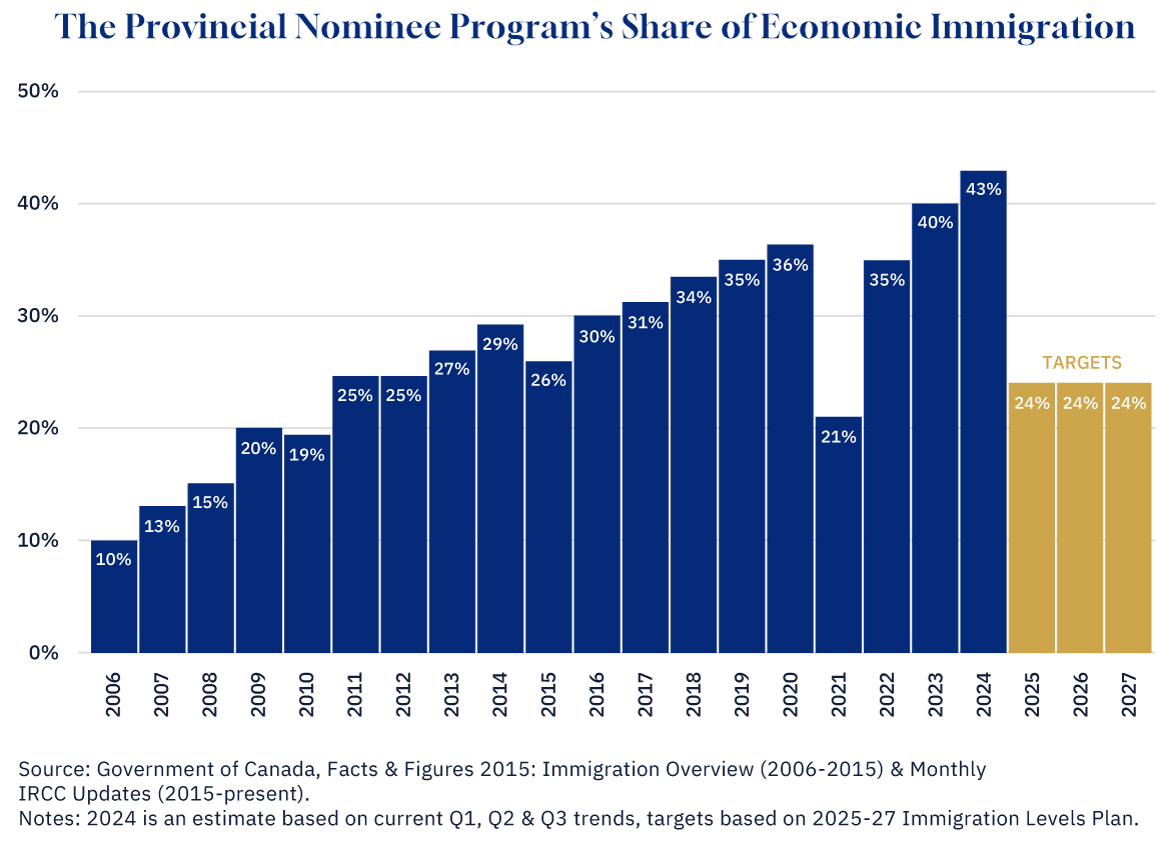
Our self-image of Canada’s immigration system as being hyper-focused on skills and human capital is no longer supported by the evidence. Among the more than 470,000 newcomers who came through the permanent resident stream last year, only about 40 percent were selected according to economic criteria. The majority were the immediate family members of economic immigrants, family members of those who have already immigrated, or refugees.

And even that only tells part of the story. Non-permanent residents—including temporary foreign workers and international students—are now a bigger share of Canada’s annual population growth. In 2023 alone, nearly 805,000 non-permanent residents were added to the population. Sargent estimates that there are now 2.8 million non-permanent residents in the country—of which just under 2 million are entitled to work.

What’s the upshot here? Less than half of those entering Canada’s much-vaunted permanent resident stream are being selected based on economic criteria and more than two-thirds of the total annual intake aren’t even entering as permanent residents. We increasingly have an immigration system that’s shifted away from the country’s long-term economic interests and towards temporary migration to fill low-skilled jobs and subsidize post-secondary institutions.

The Left and Right have begun to talk about these developments in different ways. Conservatives have rightly tended to focus on the basic economics of an influx of low-skilled labour and its downward pressures—including on employment and wages—on Canadian workers. Progressives, by contrast, have played up the poor conditions and risk of exploitation for temporary migrants themselves.

Conservatives shouldn’t limit themselves to economic critiques here. They should be prepared to make values-based arguments too.

Large-scale temporary migration is incompatible with how conservatives think about society as a web of reciprocal relations between neighbours and family. The late British rabbi Jonathan Sacks frequently referred to society as a “home that we build together.” Former Canadian Prime Minister Stephen Harper used to describecitizenship ceremonies as “joining the Canadian family.”

These metaphors of family and home convey something much richer than a mere transactional relationship between migrants and a society in which the former sells his or her labour to the latter. They reflect a Burkean conception of society in which we’re equal parts of a multi-generational partnership. The Canadian family can and should welcome new people to join it. But it shouldn’t really be in the business of temporarily hiring people to do its landscaping or deliver its food or care for its children.

This richer, more textured understanding of immigration is reflected in Canada’s birth-on-soil policy. We grant citizenship based on birthright rather than blood because we envision making long-term commitments to newcomers and their families and expect them to make similar commitments to our society. It’s a vision of mutual obligation, not temporary expediency.

The Trudeau government’s abandonment of this vision has done serious harm to Canadian immigration policy. It’s probably the government’s single biggest policy failure. The Conservatives are right therefore to criticize it. But they shouldn’t merely rely on numbers and facts to prosecute their case. They can draw on the conservative traditions of family and home to present a better image of immigration and its relationship to our society.

Source: There’s a values-based case against Canada’s immigration policy. Conservatives should make it

Canadian residents face the longest waits in the world for U.S. visas

Of note:

Canadian residents who require a visa to visit the United States face the longest wait times in the world.

A CBC News analysis of wait times for appointments to obtain U.S. tourist visas shows that while wait times in countries like India and Mexico have been improving since November 2022, wait times in Canada have been getting worse.

Six of the 10 longest wait times around the world were recorded at the U.S. embassy and consulate offices in Canada that offer visa appointments.

Currently, those who apply for a B1/B2 visitor visa appointment in Ottawa or Quebec City face the longest wait times in the world — 850 days. Halifax is not far behind at 840 days, followed by Calgary at 839 days. Getting a visa appointment in Toronto takes 753 days, while in Vancouver it’s 731 days.

Wait times can fluctuate from day to day. Earlier this month, Toronto had the longest wait time in the world — 900 days.

The other locations with the longest current wait times are Istanbul, Turkey (774 days), Bogota, Colombia (677 days), Guatemala City, Guatemala (645 days) and Hermosillo, Mexico (576 days).

Source: Canadian residents face the longest waits in the world for U.S. visas

LILLEY: Islamic hate preacher now on tour across Canada

Sigh….:

Imagine a controversial Christian preacher from the U.S. who tells his followers that Muslims are our enemy being allowed to tour this country.

Would the Trudeau government allow such a preacher to conduct a lecture tour if he taught that all Muslims are liars who cheat, and that homosexuals are animals?

It’s doubtful — but if it did happen, there would be outrage and demonstrations outside of the tour locations.

Right now, though, there is a Muslim preacher who holds these very views, except about Jews, touring Canada. Assim Al-Hakeem, an Imam based in Saudi Arabia, has already visited Calgary, Milton, Mississauga and Hamilton, and will be in London on Saturday, Montreal on Sunday and Vancouver next Tuesday.

There haven’t been any protests but it’s not clear if that is because Imam Al-Hakeem says protests are banned in Islam, one of many bizarre views this preacher holds. He also believes women should not share workplaces with men and that they should always be covered.

He’s now spreading his message of hate across Canada, a place he calls a “Kafir” country — meaning infidel.

“May Allah liberate it from the oppressors and our enemies, the Jews,” Al-Hakeem said in a recent broadcast discussing the Al-Aqsa Mosque in Jerusalem.

Though based in Saudi Arabia, Al-Hakeem broadcasts online worldwide to a mostly English-speaking audience. When it comes to Jews, he sees them not only as enemies of Islam but as constantly conspiring against Islam.

“We acknowledge that through history the Jews collaborating with the hypocrites had many conspiracies against Islam,” Al-Hakeem said while discussing the Illuminati and Freemasons. “The collaboration and the fingerprints of the Jews, the hypocrites, and the Rafidah is evident.”

Is this the language and thinking we want being spread in Canada at a time when anti-Semitic attacks against Jews have skyrocketed? Is this what we want being preached in the same week that more than 100 Jewish schools, hospitals, community centres and synagogues were targeted with bomb threats?

Watching Al-Hakeem’s videos and reading his writings, it is clear that this man is an Islamic supremacist. He says that Muslims cannot take up the citizenship of Kafir countries, he was specifically talking about Canada, and that the laws of Kafir countries aren’t to be followed.

In another video, he describes how when Islam comes to your country you have two options, submit to Islam or pay the jizyah tax, and if you won’t accept either of those, then Muslims will fight you. As he says Muslims will fight you, he makes a knife across the throat motion with his hand.

The Trudeau government has done plenty to keep out people with less offensive views than this man, but Imam Al-Hakeem gets to enter freely, tour the country and not be harassed.

It was just a couple of weeks ago that Tommy Robinson, a British national, was arrested and had his passport confiscated while on a speaking tour of Canada. He was essentially harassed over his views, which are often described as anti-Muslim and anti-immigrant.

With Al-Hakeem, we have a man who calls Canada a Kafir country, teaches that Muslims don’t need to obey Canadian laws, and has said vile things about Jews, homosexuals and women, yet he is free to tour and preach his hatred.

Source: LILLEY: Islamic hate preacher now on tour across Canada

Immigration experts say Trump’s ‘mass deportations’ pledge could cause surge in illegal border crossings into Canada if he wins back the White House 

Opinions of note, generally reasoned and realistic:

…Michael Barutciski, a lawyer and associate professor of international studies at York University’s Glendon College, says the situation will depend on how the Canadian government responds to Trump and his immigration policies.

“If there’s a general sense that people who are not legally in the U.S. will be removed or deported, it’s logical that anyone unsure about their status in the U.S. will think it might make sense to go north to Canada,” Barutciski said.

Barutciski noted that the key question is: “What does the government do?” which he sees as “an indication of how this potential flow will be handled. Will it be stopped or will it be encouraged?”

He warned that “If Canada sends a welcoming signal—tweets about how everyone is welcome here—we’ll get tens of thousands, maybe 100,000 or even millions.”

Christian Leuprecht, a professor at the Royal Military College and Queen’s University and a Munk senior fellow at the Macdonald-Laurier Institute, also said a Trump presidency could result in an uptick at Canada’s southern border but does not think it would go beyond the tens of thousands.

“The bulk of people who presented irregularly at the border [during Trump’s first term] were people who always intended to cross into Canada and were not fleeing the Trump administration,” he said.

That being said, he explained that if Trump is re-elected, “the small portion of people fleeing the Trump administration would likely increase, but that increase would not be particularly significant, possibly in the thousands, possibly in the tens of thousands.”

Like Barutciski, Leuprecht said the way the Canadian government handles the situation will impact our borders. He said there is a risk the Trudeau government will forgo the rule of law in an attempt to turn the border issue into an American-style wedge for domestic political gain.

“The risk is not actually masses of people showing up on the border here, because Canada can simply invoke the rule of law and say that the better part of 90 percent of the people who would show up would not qualify,” he said. “The risk here is that the Trudeau government will actually violate its own provisions and the rule of law for political reasons so that he can use it as a wedge issue.”

The Trump refugee narrative “is one that the current federal government loves to propagate.”i

Muzaffar Chishti, a lawyer and senior fellow at the Migration Policy Institute, an American non-partisan pro-immigration think tank, casts doubt on the American government’s ability to deport people en masse.

“There are legal impediments that the former president seems generally unaware of. There are constitutional provisions of habeas corpus and due process of law, which strongly impede removing anyone without sending them to a court,” he said.

“Second, there are operational realities—they are not all in one place, not in a camp where you could just extract them. They are intermingled in communities across the country, and getting them out is very, very operationally difficult. Third, there will be a political backlash. Almost all of them are employed, and if they are taken out of their jobs. There could be outcries even from Trump’s own base.”

Chishti also noted that he doesn’t think that the goal of a potential second Trump administration would necessarily be to successfully deport 11 million people, it would rather be “to instill a sense of fear,” which one assumes would discourage other border crossers.

“I think people who respond to that instinct of fear may want to move to Canada. There’s a real possibility of that happening,” he said, given Canada’s reputation as being more receptive to asylum seekers.

What about the Safe Third Country Agreement?

In March 2023, Canada and the U.S. modified the Safe Third Country Agreement so that individuals could no longer make asylum claims from unofficial ports of entry, closing the loophole used by asylum seekers.

However, experts consulted by The Hub said the new March 2023 deal is not a silver bullet and could lead to new problems.

Leuprecht said those who qualify under the exemptions will take advantage and apply, leading to an increase in legal asylum claims.

“We will see a small increase in people who have a legitimate claim to refugee or asylum status, who will present at ports of entry,” he said.

He is also concerned that those without legitimate asylum claims will attempt to cross into Canada illegally at unsupervised, unofficial ports of entry, similar to how illegal immigrants enter the United States from Mexico.

“We will see a small increase in human smuggling across the border.”

Chishti echoed this sentiment, which he said will be a concern of the Canadian government.

“If there is a Trump administration, you could see much more of a commercial enterprise, where you’ll have criminal ranks getting involved,” he said.

“That, I think, will create a sense of chaos and disorder when you will see people being caught in the woods, you know, trying to sneak through, and then you will see the people’s private farms being encroached on, and all that.”

He added that this “is the kind of disorder that creates a political backlash.”

…Experts told The Hub it was crucial for Canada to be prepared and take a series of actions to promote the rule of law and orderly legal immigration, in light of a possible second Trump administration.

“We actually have to start controlling the border with more resources,” said Barutciski. “More border control sends the signal that there are rules to get into Canada.”

“Don’t give off the image to the earth that the integrity of the system has been undermined. That you’re generous and that you don’t really control this. You can’t continue like that.”

He also urged Canada to address its immigration policy issues regardless of who wins the U.S. election. “The current numbers and the way people are coming here is not sending a good signal. It’s a system that is losing credibility. Even if Kamala Harris wins and Trump isn’t President, Canada still has a very difficult situation.”

Leuprecht said Canada needs to be willing to deport those who are not in this country for the right reasons. “We want to make sure we send the right message: “[That] Canada is not the country to go to unless you have a legitimate claim and that you will be deported if you show up here if you do not qualify under the rules.”

He noted that this “would be a significant change in narrative, because, in Canada, we traditionally do not deport people, even when they don’t qualify under the rules. The deportation numbers are tiny in Canada.”

Chishti meanwhile stressed that Canada must do its best to avoid a chaotic situation like the one the U.S. has faced at its southern border.

“The sense of disorder never works, even if it’s a small number of people,” he said. “People like immigrants, but they don’t like chaotic scenes about immigrants, because it creates a sense that we no longer have control.”

Source: Immigration experts say Trump’s ‘mass deportations’ pledge could cause surge in illegal border crossings into Canada if he wins back the White House

ICYMI: Concerns mount over new federal immigration policy that would grant permanent residency to low-wage workers 

Valid concerns:

Economists and policy experts are expressing growing concern over a potential new federal immigration program that would immediately grant permanent residency to temporary residents who are in low-wage jobs.

The program, if launched, would target people who already have Canadian work experience in what Ottawa classifies as TEER 4 and TEER 5 occupations – delivery service drivers, caregivers, food production workers and retail staff, to name a few.

TEER stands for Training, Education, Experience and Responsibilities, and it is a job categorization system the government uses for immigration purposes. TEER 4 and TEER 5 workers typically have a high school diploma or little or no formal education at all.

….This is perhaps exactly why Ottawa is thinking of introducing a new path to permanent residency for low-wage workers, Prof. Skuterud and Toronto immigration lawyer Ravi Jain both say.

“The easiest way to deal with this problem is to create a new pathway to permanent residence,” Prof. Skuterud said. “But it’s not smart policy. It will more likely suppress wages and undermine public support for immigration.”

Source: Concerns mount over new federal immigration policy that would grant permanent residency to low-wage workers

McWhorter: The deeper grammatical logic of “weird”

Interesting analysis of “weird” and how it works for well:

When Gov. Tim Walz called Donald Trump and his worldview “weird,” it got immediate attention, launched a thousand memes and may very well have helped him land the job as Kamala Harris’s running mate. Michelle Obama’s dictum that “when they go low, we go high” is admirable, but there’s a lot to be said for the occasional step or two down the ladder. To many observers, “weird” immediately seemed right, a fresh approach to the mix of childish cattiness and outright menace coming from opponents of Walz and Harris. But the reasons for its success as an epithet aren’t as obvious. They come from deep in the word’s history, and in the ultimate purpose to which we put language.

In Old English the word meant, believe it or not, “what the future holds,” as in what we now refer to as fate. The sisters in “Macbeth” were the “weird sisters,” in the meaning of “fate sisters,” telling the future. But they were also portrayed as ghoulish in appearance and attire. With the prominence of this play and similar fate-sister figures in other ones, the sense set in that “weird” meant frighteningly odd.

In the 20th century, the word lost its hint of the macabre as its meaning became something quieter. “Weird” now means peculiar — perhaps passingly so, but against what one would expect.

In this sense, “weird” has settled into a realm of the language that isn’t taught as grammar in our schools but should be. Verbal communication is not only about whether something is in the past or the future, or whether it is singular or plural. It’s also about what is novel. We tend to seek people’s attention to tell them something they don’t yet know.

Imagine someone new to the English language asking you what the “even” in “He even had a horse” means. It would be hard, because school doesn’t teach us about the role that identifying novelty plays in how we form sentences. “He even had a horse” implies that someone’s possession of a horse, as opposed to just a big backyard, a fence and some dogs, is unexpected. All languages have ways of doing this. In Saramaccan, a language I have studied that was created by Africans who escaped slavery in Suriname, a little word, “noo” — pronounced “naw” — shows that something is news. “Noo mi o haika i” means not just “I will call you” but also “So, OK then, I will call you.”

Applying “weird” to MAGA is a great debate team tactic, a deceptively complex rhetorical trick that uses the simplest of language to make a sophisticated point: that the beliefs that MAGA is supposed to be getting us back to defy expectation, usually for the simple reason that they’re false.

The idea that Central American countries engage in an effort to send criminals to America not only is mean, it also fails to accord with any intuitive or documented analysis. The idea that we should all go smilingly back to an era when it was illegal for women to obtain an abortion — as though there was something sweet about Roberta’s situation in Theodore Dreiser’s “An American Tragedy” in 1925 — goes against what 90 percent of Americans espouse. It is callous to a degree that a great many find perplexing. The idea that a single woman without children is less qualified to lead is jarring even amid the trash talk flying throughout our political landscape.

The typical response to all of this from the outside is to shudder at the nastiness. But an equally valid response is “Huh?” And that’s why “weird” works.

“Weird” works in another way, too: There is no great comeback. You can’t respond to being called peculiar by simply saying, “No, I’m not,” though Trump tried: “He said we’re weird,” the candidate complained, “that JD and I are weird. I think we’re extremely normal people, exactly like you.” Just asserting it convinces no one. Nor does the “No, you are!” defense. On X, Representative Matt Gaetz jibed: “The party of gender blockers and drag shows for kids is calling us weird? Ok.” But we’ve heard all that before. “Weird” is a way to call out the unexpected. Any perceived weirdness on the left is old news. It’s the Democrats who are offering the novel take.

The goal here is not getting down into the mud but opening ourselves to broader perception. Outsiders can view MAGA with dismay, intimidated by how many people subscribe to it, watch its adherents portray themselves as the only true Americans and shake our heads in horror and submission. Or we can dismiss MAGA as more heat than light. We can resist the notion that the essence of America is an ideology whose figurehead lost the popular vote in the presidential election of 2016, lost the election entirely in 2020 and may well lose again this fall. “Weird” pegs MAGA as a detour, a regrettable temptation that a serious politics ought to render obsolete. Calling it “weird” is deft, articulate, and possibly prophetic.

It’s also an example of the power of language, in particular a kind of grammar that too few people are taught. Wouldn’t more kids take interest in the subject if they knew they could use it to shut down a bully?

Source: The deeper grammatical logic of “weird”

Urback: A mass bomb threat against Jews? Who could have seen that coming?

Satirical yet pointed:

…But even then, what would have given someone such a sense of impunity that they would threaten 100 Jewish institutions at once? Was it Winnipeg’s mayor taking downthe city’s menorah, or Moncton’s mayor doing the same? Or Calgary’s mayor skippingthe city’s menorah-lighting ceremony, or Toronto’s mayor declining to attend the Walk with Israel? Was it the empty words offered by Canadian politicians, over and over again, in lieu of action each time a Jewish institution is attacked?

Or maybe these individuals were emboldened by the national indifference this country has shown toward the targeting of Catholic churches, dozens of which have been set ablaze over the course of the last few years? Maybe it was the constant dismissal of the concerns of Jews feeling unsafe in Canada, because, as many have taken to saying now, why should anyone care about hurt feelings here, when people are dying in Gaza?

If only there were warnings, beyond the threats, violence, vandalism, harassment, cultural exclusion, institutional antisemitism, empty words and constant gaslighting. And when – not if – someone gets seriously injured or worse, we’ll wish there had been more signs, too.

Source: A mass bomb threat against Jews? Who could have seen that coming?

Adam Pankratz: Wokeness is deservedly crashing. Let’s be careful about retribution

Good note of caution:

…This is the fear I have harboured for a while now: that the inevitable backlash against the insane and destructive scourge of activist identity politics would arrive and, when it came, the perpetrators would discover that they were a minority and, the majority now coming for them was not in a conciliatory mood. While minorities persecuting majorities is bad (as we have seen via cancel culture), a majority persecuting a minority, whatever they may have done, has the potential to be worse.

The most vehement and vocal adherents and actors in the culture wars of the past years have done enormous damage to both institutions and individuals. They have cost people their jobs, reputations and, in some cases, their lives. It is not unnatural to want to see such bad actors harmed as they harmed others. By doing so, however, those of us who have stood against the tidal wave of woke activism which threatened society, risk becoming the beasts we fought so hard to push back. The Capital Pride debacle demonstrates the societal pendulum is swinging back, my fear is it will bludgeon indiscriminately and plunge us further into extreme societal divides.

Source: Adam Pankratz: Wokeness is deservedly crashing. Let’s be careful about retribution

Le Devoir Éditorial | Sur la question de l’immigration, la stratégie des petits pas

Worth reading. Money quote: “Le dossier de l’immigration demande qu’on l’aborde avec franchise, lucidité, bienveillance et mesure. (The immigration file requires that it be approached with frankness, lucidity, benevolence and measure.)”

Lassé peut-être de vociférer son message à Ottawa sans être réellement entendu, le gouvernement du Québec a joint le geste à la parole cette semaine en annonçant deux mesures censées permettre de réduire le flux d’immigration temporaire. Un moratoire de six mois sur le programme des travailleurs étrangers temporaires à bas salaire, dans la région de Montréal ; et un projet de loi destiné à limiter le nombre d’étudiants étrangers par établissement d’enseignement.

Cette stratégie des petits pas ne contribuera pas à faire fléchir de beaucoup les tendances. Mais dans cette joute que se livrent sans résultats Québec et Ottawa sur le dossier migratoire, ce petit geste fait foi de grand symbole.

« Le fédéral ne manque pas une occasion de dire qu’il faudrait que [le Québec] donne l’exemple », a expliqué mardi le premier ministre François Legault, flanqué de sa ministre de l’Immigration, de la Francisation et de l’Intégration, Christine Fréchette. Québec a donc décidé de donner l’exemple. Responsable de 180 000 des 600 000 immigrants temporaires sis au Québec, le gouvernement de François Legault tente depuis des mois de convaincre Ottawa de l’aider à juguler les entrées, car, selon lui, elles exercent une « pression énorme » sur les services publics, la crise du logement et l’avenir du français à Montréal. Le moratoire et le projet de loi tout juste annoncés constituent l’exemple qu’offre Québec au fédéral, sur qui reposent les 420 000 autres entrées.

Les mesures annoncées ne changeront pas le portrait de manière radicale. Québec concède que le moratoire sur le programme des travailleurs étrangers temporaires à bas salaire (sous la barre des 27,47 $ l’heure) ne viserait, dans la région montréalaise ciblée, que 3500 personnes, sans plus. Quant au projet de loi visant à mieux encadrer l’entrée d’étudiants étrangers dans certains établissements, il cherche à faire diminuer le flot que représentent ces 120 000 étudiants, mais on ne sait pas de combien.

Ce geste symbolique constitue « un premier pas ». Qu’il ait des répercussions mathématiques importantes ou non, il vient confirmer une fois de plus l’encroûtement du dossier de l’immigration dans la joute Québec-Ottawa. Il révèle aussi une certaine mauvaise foi : le Québec a beau plaider aujourd’hui l’urgence nationale et faire porter le poids de plusieurs maux aux nouveaux arrivants, il ne faut pas reculer bien loin dans le temps pour constater qu’il a lui-même contribué au problème, puis a sciemment choisi d’en ignorer les incidences.

Novembre 2021. Le Devoir titre : « Québec veut stimuler l’immigration temporaire ». Sous la plume de notre journaliste spécialisée Sarah R. Champagne, une première phrase qui parle d’elle-même : « Québec presse Ottawa de faire sauter les plafonds de l’immigration temporaire. » Il y a donc moins de trois ans, l’urgence était tout autre : il s’agissait de rehausser les seuils de travailleurs étrangers temporaires dans 71 métiers et professions à bas salaire.

Les temps ont changé. Les chiffres confirment que, de 2021 à 2024, les migrants temporaires sont passés de 300 000 à 600 000. Une « explosion » que le système ne peut prendre en charge, fait valoir le premier ministre. « Ça fait mal à nos services publics [éducation et santé], ça fait mal à notre crise du logement, ça fait mal à l’avenir du français. » Même s’il se veut le plus « factuel » possible, le premier dirigeant du Québec use d’une rhétorique pour le moins glissante en laissant entendre que les engorgements que subit notre système sont le fait des nouveaux arrivants. C’est regrettable. « Je sais qu’il y en a que ça choque quand je dis ça, mais c’est factuel. »

Le gouvernement a raison d’agir pour ne pas aggraver une situation déjà sous haute tension. Il est également en droit de fouetter Ottawa pour obtenir un peu plus de soutien dans ce dossier — la régulation du nombre de demandeurs d’asile et une meilleure répartition de leur entrée sur le territoire canadien, le Québec en accueillant en ce moment plus de la moitié. Mais il est très discutable de tout faire porter sur les épaules du fédéral sans concéder sa propre part de responsabilité.

Où étaient le sentiment d’urgence et la pression intolérable sur les systèmes publics quand, au printemps 2023, en pleine étude des crédits de son propre ministère, la ministre Fréchette a choisi de rejeter la demande de l’opposition d’étendre la réflexion sur l’immigration au Québec aux travailleurs temporaires, aux étudiants étrangers et aux demandeurs d’asile, préférant se restreindre à l’immigration permanente seulement ? Où est la préoccupation pour l’avenir du français à Montréal quand on sait que la demande explose en francisation, signe d’une volonté d’intégration, mais que les budgets et l’offre sont en diminution ? Pourquoi avoir refusé de nommer la crise du logement quand il était encore temps d’agir pour en atténuer les effets ?

Gare aux envolées catastrophistes qui pourraient faire peser (trop) lourd sur les épaules des principaux intéressés. Ceux-ci ne sont coupables de rien d’autre que d’avoir voulu savoir s’il faisait bon vivre au Québec. Le dossier de l’immigration demande qu’on l’aborde avec franchise, lucidité, bienveillance et mesure.

Source: Éditorial | Sur la question de l’immigration, la stratégie des petits pas

Tired perhaps of shouting its message in Ottawa without really being heard, the Quebec government joined the gesture to the floor this week by announcing two measures supposed to reduce the flow of temporary immigration. A six-month moratorium on the low-wage temporary foreign workers program in the Montreal area; and a bill to limit the number of foreign students per educational institution.

This strategy of small steps will not help to bend trends much. But in this joust that Quebec and Ottawa are taking place without results on the migration file, this small gesture is a great symbol.

“The federal government does not miss an opportunity to say that [Quebec] should set an example,” explained Prime Minister François Legault on Tuesday, flanked by his Minister of Immigration, Francisation and Integration, Christine Fréchette. Quebec has therefore decided to set an example. Responsible for 180,000 of the 600,000 temporary immigrants in Quebec, François Legault’s government has been trying for months to convince Ottawa to help it curb entries, because, according to him, they exert “enormous pressure” on public services, the housing crisis and the future of French in Montreal. The moratorium and bill just announced are the example that Quebec offers to the federal government, on which the other 420,000 entries are based.

The measures announced will not radically change the portrait. Quebec concedes that the moratorium on the low-wage temporary foreign workers program (below $27.47 per hour) would target, in the targeted Montreal region, only 3,500 people, no more. As for the bill to better regulate the entry of foreign students into certain institutions, it seeks to reduce the flow represented by these 120,000 students, but it is not known how much.

This symbolic gesture is “a first step”. Whether it has significant mathematical repercussions or not, it confirms once again the encrusting of the immigration file in the Quebec-Ottawa joust. It also reveals a certain bad faith: although Quebec today advocates national urgency and carries the burden of several evils on newcomers, we must not go far back in time to see that it himself contributed to the problem, then knowingly chose to ignore its implications.

November 2021. Le Devoir headlines: “Quebec wants to stimulate temporary immigration”. Under the pen of our specialized journalist Sarah R. Champagne, a first sentence that speaks for itself: “Quebec urges Ottawa to blow up the ceilings of temporary immigration. So less than three years ago, the urgency was quite different: it was a question of raising the thresholds for temporary foreign workers in 71 low-wage trades and professions.

Times have changed. The figures confirm that, from 2021 to 2024, temporary migrants increased from 300,000 to 600,000. An “explosion” that the system cannot support, argues the Prime Minister. “It hurts our public services [education and health], it hurts our housing crisis, it hurts the future of French. Even if he wants to be as “factual” as possible, Quebec’s first leader uses a slippery rhetoric to say the least by suggesting that the congestions that our system undergoes are caused by newcomers. It’s regrettable. “I know it’s shocking when I say that, but it’s factual. ”

The government is right to act so as not to aggravate a situation already under high tension. He is also entitled to whip Ottawa to get a little more support in this file – the regulation of the number of asylum seekers and a better distribution of their entry into Canada, with Quebec currently welcoming more than half. But it is very questionable to put everything on the shoulders of the federal government without conceding its own share of responsibility.

Where was the feeling of urgency and intolerable pressure on public systems when, in the spring of 2023, in the middle of a study of her own ministry’s appropriations, Minister Fréchette chose to reject the opposition’s request to extend the reflection on immigration in Quebec to temporary workers, foreign students and asylum seekers, preferring to restrict herself to permanent immigration only? Where is the concern for the future of French in Montreal when we know that demand is exploding in francization, a sign of a desire for integration, but that budgets and supply are decreasing? Why did you refuse to name the housing crisis when there was still time to act to mitigate its effects?

Beware of catastrophic flights that could weigh (too) heavily on the shoulders of the main interested parties. They are not guilty of anything other than wanting to know if it was good to live in Quebec. The immigration file requires that it be approached with frankness, lucidity, benevolence and measure.