Barutciski: Ambiguous messaging won’t be enough to protect Canada from the U.S.’s mass deportation plan

Correct assessment. Government has shifted messaging but needs to be bolstered by actions that demonstrate seriousness to Trump administration:

…The incoming U.S. administration will be fully aware of a new immigration problem on their northern border: an explosion in illegal southbound crossings, including alleged terrorists. An increased RCMP presence on the Canadian side would not only help prevent illegal crossings in both directions, it would help Ottawa negotiate the removal of the 14-day loophole in the STCA. Proof that the Trudeau government can help Washington address the migration problems at the U.S.-Mexico border, as it did when it negotiated an extension to cover illegal crossings with the Biden administration, would give it leverage in any potential deal.

The U.S. immigration system has been broken for decades, so it should not surprise Ottawa if a new disruptive White House attempts to force change with dramatic methods, including mass deportations. Canada, then, needs to rethink its own approach to border control and to reconceive immigration policy within a continental co-operation framework. Just as with free trade, Ottawa should focus its diplomatic efforts on increasing collaboration with the U.S. – otherwise, there is a real risk that the immigration file will turn into a source of tension between two long-time allies that share the world’s longest undefended border.

Source: Ambiguous messaging won’t be enough to protect Canada from the U.S.’s mass deportation plan
Sadinsky and Bondy | Donald Trump’s plans will mean chaos at the Canadian border. We aren’t even close to being ready

The view from immigration lawyers and likely advocates. Not too early to plan but may be too early to assume it will be that chaotic. Suspect exemptions may be a non-starter in the context of a Trump administration. And once the door is opened for one group or set of circumstances, others would then cite this to advocate for their particular group or circumstances:

…But the suddenly U.S. reality requires immediate reforms to our system. A growing backlog of refugee claims means our system needs more capacity. This can be achieved through efficiencies, such as streaming simpler claims to paper review — that is, by considering documentary evidence, without a hearing in order to issue a positive decision in the case of simple claims — and allowing eligible refugee claimants to apply in other programs.

Canada should also develop a more accessible process for individuals leaving the U.S. to seek personalized exemptions to the restrictions of the Safe Third Country Agreement. Notably, when the Supreme Court of Canada ruled on the constitutionality of the agreement, it upheld it due to “safety valves”, where officers can admit people to Canada in exceptional situations if turning them back to the U.S. would violate their Charter rights. In practice, these safety valves barely exist and do not function. We need a clear, robust process for individuals to seek exemptions and proper training for officers.

Targeted exemptions to the STCA would allow some of the most vulnerable individuals to present themselves at official ports of entry to initiate refugee claims. Article 6 of the STCA permits either country to invoke exemptions to review claims where “it is in its public interest to do so.” In particular, women fleeing domestic violence are often unable to obtain asylum in the U.S. because of how U.S. law interprets the Refugee Convention. In Canada such claims are often successful, and are heard by a specially trained task force of the Immigration and Refugee Board.

The House of Commons Standing Committee on Citizenship and Immigration recommended in a May 2023 report that exemptions also be invoked for individuals from places that Canada has a policy not to deport to. Invoking exemptions for such claimants would permit them to submit their claims at regular ports of entry, and would protect them from smugglers and otherwise dangerous crossings.

Above all, as a federal election looms in Canada, we must not learn the wrong lesson from the U.S. election: that dehumanizing others is a cheap way to secure votes. Changes to our system may be inevitable, but they must not be accompanied by rhetoric that demonizes others and turns members of our community against one another.

Aisling Bondy is President of the Canadian Association of Refugee Lawyers (CARL). Adam B. Sadinsky is Co-Chair of CARL’s Advocacy Committee. Both are immigration and refugee lawyers in private practice in Toronto.

Source: Opinion | Donald Trump’s plans will mean chaos at the Canadian border. We aren’t even close to being ready

Feds want $411 million to cover refugee health care as the number of new arrivals soars

No surprise given rising numbers and equally no surprise that it is prompting questioning among some

The federal government is asking Parliament to approve hundreds of millions of dollars in new spending to cover the health-care costs of eligible refugees and asylum seekers — a budget line item that has soared in recent years as the number of these newcomers reached record highs.

The Interim Federal Health Program (IFHP) is designed to cover migrants who don’t yet qualify for provincial or territorial medicare. By removing some barriers to health care, the program makes it easier for refugees — many of them fleeing conflict or persecution abroad — to get the care they need on arrival.

There’s also a public health benefit: it helps prevent and control the spread of infectious diseases in Canada.

Some resettled refugees receive health care through the IFHP for only a few months before transitioning to provincial plans. Some remain on the federal plan for much longer as they wait for their claims to be adjudicated — a process that now takes more than two years as Ottawa grapples with a mounting backlog.

The IFHP’s cost has soared from roughly $60 million in 2016 to a projected $411.2 million this year, easily outpacing inflation.

Former prime minister Stephen Harper’s Conservative government curtailed the IFHP and eliminated coverage entirely for some refugees and asylum seekers as part of a push to reduce spending and balance the budget.

The Harper government also said it was unfair for taxpayers to be paying for a program that was, in some instances, much more generous than what’s available to some Canadian citizens and permanent residents through public health care.

The decision to cut the program prompted a wave of criticism and was ultimately deemed unconstitutional by a Federal Court judge.

Source: Feds want $411 million to cover refugee health care as the number of new arrivals soars

Speer: As Canada’s diversity increases, anti-racialism becomes essential

We are more than individuals and outcomes reflect a mixture of individual and group characteristics and experience, along with intersectionality within and between groups. Not one or the other, but need to consider both aspects as the various datasets indicated:

…As an epistemological framework, it represents a way of thinking that systematically organizes individuals into group categories based on race and then grants it explanatory power for virtually everything.

I don’t think it’s a coincidence that every “pretendian” cited in Pete’s article is a progressive. As the principal purveyors of identity politics, progressives are distinctly predisposed to racialist thinking. They’re more inclined to think in terms of racial identity and attribute value to membership in certain racial groups.

It’s logical therefore that within progressive circles claiming a particular group identity has greater upside than among conservatives who are more instinctively anti-racialist. Does anyone for instance doubt that progressive figures like Turpel-Lanford or Boissonnault realized status gains from adopting fake Indigenous identities?

Which brings us back to Pete’s case against affirmative action and its perverse incentives. His argument is well taken—but one can argue that we actually need to go deeper. We should aim to address the racialist thinking that underpins those policies and the political culture that enables them. Herein lies Salam’s case for anti-racialism.

The good news is that he believes that in the U.S. context, anti-racialism may represent a powerful political proposition across a multi-ethnic coalition. Donald Trump’s election victory is evidence that he’s right.

There’s a strong case to think that the same is true in Canada—particularly in the coming years. As the country becomes more diverse, the distinction between majority and minority populations will necessarily become far weaker. Defining one’s identity in contradistinction to the so-called “white mainstream” will presumably have less resonance in a world in which “racialized” Canadians represent as much as half of the population as early as 2041. Racial salience may counterintuitively decline in a polity composed of a growing multiplicity of racial identities.

If so, we may look back at this era of identity politics and the “pretendians” that it has produced as a regrettable yet temporary waystation on the path to the meritocratic culture that Pete envisions.

Source: As Canada’s diversity increases, anti-racialism becomes essential

The Great Regression: How do we reverse course in a societal death spiral?

New term for me but seems appropriate. Sound recommendations to improve self-awareness (“know thyself”):

…The Great Regression is a full-out threat to civility, peace, democracy and humanity – a social and public health emergency, or what some have called a social death spiral. And I’d like to offer this plea from the therapist’s chair: We’re so distracted by the left-right axis that we haven’t understood the deeper problem of regression, which is a truly dangerous aspect of polarization.

To be clear, I’m not calling for anyone to water down their cherished ideals or strong political beliefs. But I am asking that those swept up in the culture wars take time to consider these questions: Are you no longer able to be friends with people who hold differing views? Do you dehumanize your political opponents? Do you believe they wish you and your family harm? Do you wish them harm? And are you able to consider the other side in a political debate – even though you strongly disagree?

These are all signs, in my view, that you may be drifting downward on the Great Regression axis. It’s important to catch yourself before you descend to regrettable actions such as destroying relationships, or creating a toxic work environment.

Gaining self-awareness of our processes can be life-improving. It helps us mend fences with family members, develop deeper friendships and get along better with colleagues. At one time, our leaders and institutions – not just political, but in all facets of life – were role models of emotional regulation. In a regressed society, we see fewer healthy examples in public life. That’s why I believe individuals must begin to look at their own position on that up-down axis, painful as it might be. The ability to identify and resist regression in ourselves and others is a great power, and an opportunity to help heal our society’s emotional health.

Thomas Ungar is a professor in the Temerty Faculty of Medicine at the University of Toronto and a staff psychiatrist at North York General Hospital.

Source: The Great Regression: How do we reverse course in a societal death spiral?

Immigration Under the Trump Administration: Five Things to Expect in the First 90 Days

Good solid analysis:

The first Trump administration brought significant changes to U.S. immigration policies, which had profound impacts on businesses and individuals alike. Donald Trump has shared plans for closing the U.S. borders and enforcing mass deportations for undocumented immigrants almost immediately after taking office in January. Below are five major impacts to immigration policy we saw as a result of Trump’s first term, and what we can expect for his second term.

  1. Extreme Vetting: The administration introduced stringent vetting processes for visa applicants, with the stated aim of enhancing national security. This led to longer processing times and increased scrutiny of applicants’ backgrounds. The U.S. Department of State, whose Bureau of Consular Affairs oversees the issuance of U.S. visas, has yet to recover from staffing shortages resulting from the first Trump administration, while geopolitical conflicts continue to grow in size and severity, drawing limited resources away from visa processing. Like under the first Trump administration, visa applicants – and the U.S. companies that employ them – can expect extremely long wait times for visa interview appointments, more frequent administrative processing delays, and much higher visa refusal rates. Foreign workers may be less able to travel internationally for work due to the risk of being unable to return to the U.S.
     
  2. Hiring and Onboarding Delays: Slow adjudication and consular operations, coupled with heavy scrutiny, caused significant delays in hiring and onboarding international employees. Businesses faced challenges in maintaining their high-skilled workforces due to these prolonged processes since such (legal) foreign workers are the cohort most affected by delays and increased scrutiny of work visa applications. Only the H-2 visa category for seasonal and temporary workers seems to have been unaffected by these delays. In fact, the number of available H-2 visas doubled under Trump, and applications maintained an average approval rate of over 98 percent. Given this history, employers should plan for delays in onboarding high-skilled foreign workers as well as decreased ability to recruit such candidates to the U.S., though the ability to recruit short-term and seasonal labor should remain steady.
     
  3. Business Disruption: Border closures, visa bans, skyrocketing processing times, and denial rates under the first Trump administration exacerbated the staffing issues faced by companies during the pandemic and recovery. Year-plus processing times caused foreign nationals working legally in the U.S. to lose their work authorization and, in some cases, their jobs as employers struggled to navigate the changing adjudication standards. Employers in highly scrutinized industries like construction, manufacturing, food service, hospitality, and agriculture can expect increased immigration enforcement activity, including raids. Raids, in particular, have a chilling impact on recruitment and hiring even of authorized workers, including workers permanently authorized to work in the U.S. – like U.S. citizens, permanent residents, and asylees. In 2022, a federal court ordered ICE to pay more than $1 million to victims of the agency’s raid of a meatpacking plant in Tennessee, after determining ICE agents used racial profiling and excessive force to illegally detain workers without regard to their actual status – lawful or unlawful – in the U.S.
     
  4. Increased Costs: The cost of sponsoring employees for visas and green cards increased due to additional documentary requirements and higher denial rates. Businesses had to allocate more resources to manage immigration-related expenses. Under the incoming administration, employers can expect a return to those high immigration costs and then some. Since Biden took office, denial rates for H-1B visa applications have hovered between 2 – 3 percent; under Trump, H-1B denial rates were more than triple that, ranging from 8 – 15 percent.
     
  5. Uncertainty: In the first Trump administration, sudden policy changes, reduced service levels, and uncertain decisions created concern among employees and businesses. Companies had to adjust their expectations and factor in events that created disruptions impacting all levels of their business, including employee onboarding, production, and service delivery. We expect the impacts of the areas outlined above will lead to a significant number of additional uncertainties for both employers and employees that could impact workforce morale and productivity in anticipation of what could come….

Meredith C. Doll, of counsel in Baker Donelson’s Houston office, helps clients with business immigration matters, including strategy planning, worksite compliance and enforcement, and immigrant and nonimmigrant petitions.  Melanie C. Walker, a shareholder in the Baker Donelson’s Global Immigration Group in Chattanooga. Tennessee, provides strategic guidance and immigration counseling services to companies and their employees.

Source: Immigration Under the Trump Administration: Five Things to Expect in the First 90 Days

Seidle: Better co-ordination and governance needed to steer Canada’s migration policies

Good points but implementation always a challenge. Merging IMP and TFWP would be a challenge given their differences but a reexamination of these differences and their justifications would be a worthy initiative along with more explicit recognition of the blurring between temporary and permanent migration:

…At a news conference on October 24, Prime Minister Justin Trudeau said changes will allow “our communities, our infrastructures” time to catch up to population growth.

In that context, governments need to develop joint actions to help break down administrative silos and improve coordination. A case in point concerns international students. Although governments have taken some steps, individually, other issues require a more concerted approach (including between provincial governments and postsecondary institutions).

Consideration should begiven to the merging of the two existing federal temporary worker programs within Immigration, Citizenship and Refugees Canada. The department name could be modified to reflect any change, and acknowledge explicitly the blurring of boundaries between permanent and temporary migration.

Source: Better co-ordination and governance needed to steer Canada’s migration policies

Canada’s immigration minister weighs crackdown on fake job offers in permanent residence applications

Overdue:

Migrants trying to boost their chances for permanent residence by securing an employer’s sponsorship could soon lose the advantage as Ottawa is looking to crack down on fraudulent job offers for immigration purposes.

In a meeting with the Star’s editorial board, Immigration Minister Marc Miller said he is weighing removing the extra points permanent residence applicants could earn through a positive labour market impact assessment (LMIA) submitted by an employer.

Under the current system that awards points based as applicants’ attributes such as educational achievements and work experience, a job offer sanctioned by Employment and Social Development through the labour market assessment is worth 50 bonus points in an increasingly competitive candidate pool.

With Ottawa’s recent plan to reduce immigration levels, more and more employers and recruiters are preying on desperate international students and foreign workers with expiring status by selling fake job offers.

“There’s a value to LMIA but it can’t be $70,000 on the black market or the grey market,” Miller said Wednesday. “Not prejudicing people that have bona fide LMIAs, but it’s a balancing act. I think it’s safe to say I’m seriously considering it.”…

Source: Canada’s immigration minister weighs crackdown on fake job offers in permanent residence applications

Misleading Canadians: The Flawed Assumption Behind the Government’s Planned Reduction in Temporary Residents

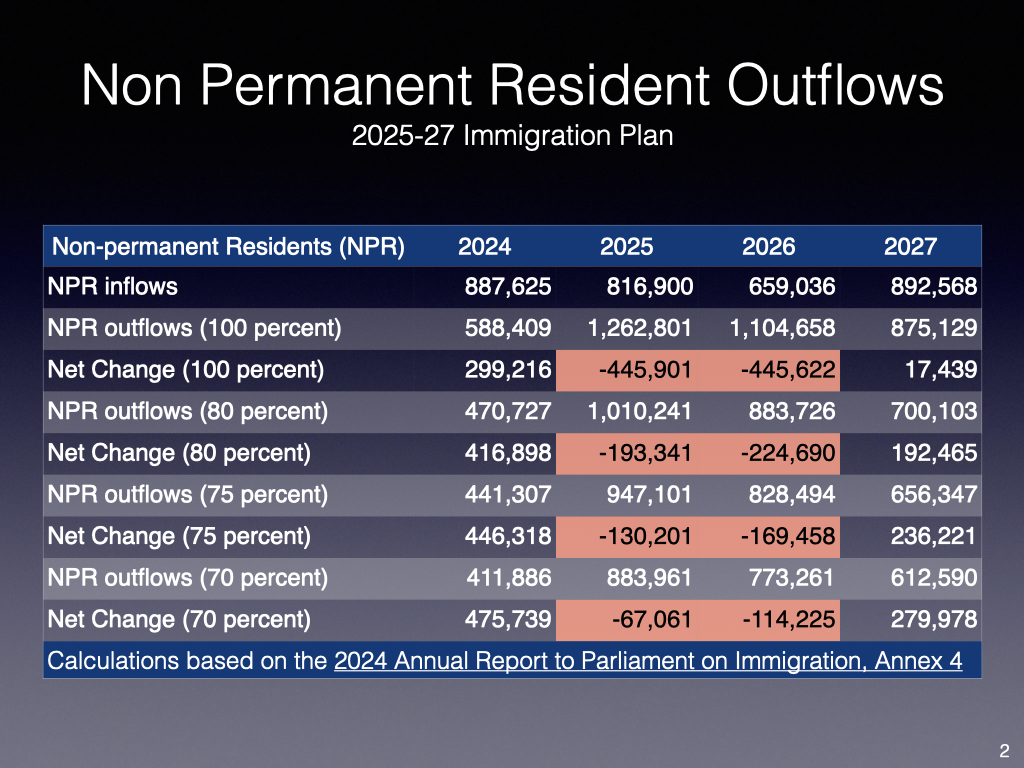
This analysis was prompted by questions regarding the projected numbers of departures with no methodology mentioned, and the suspicion, subsequently confirmed, that it was based on the false assumption that all temporary residents would leave upon expiry of their visa

When IRCC released its annual immigration plan last month, eyebrows were raised over the plan’s prediction of large outflows of temporary residents upon expiry of their visas. The Parliamentary Budget Office noted that “there is significant risk to the demographic projection presented in the Government’s new immigration plan—particularly to the projected outflow of non-permanent residents.” The plan included a table covering projected outflows without indicating the methodology and assumptions behind the table. Subsequently, IRCC has confirmed that the calculations assumed that all temporary residents would leave when their visa expired, save for those who transitioned to permanent residency.

This assumption is just wrong as many temporary residents may well remain in Canada and appears aimed at misleading the public. For illustrative purposes, I revised the plan table to include four assumptions: 100 percent of temporary residents leave (the plan’s assumption), and three alternatives where 80, 75 and 70 percent leave. Should 60 percent or less leave, there would not be any net reduction in the temporary resident population.

The overly precise nature of the numbers—down to individual persons—highlights that the government adapted a purely mathematical approach in its estimates. In the case of permanent resident levels, the government more sensibly uses ranges rather than precise numbers which reflect more accurately operational realities. While politically difficult to admit that some non permanent residents will remain, by not doing so the government attracts more scepticism regarding its plans.

Moreover, as Canada does not track outflows systematically, we will not have accurate data on how many actually leave. The government should explore coordination of flight and CBSA data to obtain better anonymized information on outflows and those who overstay their visa.

The Prime Minister has stated that “Between the amount of people coming and going, we’ll effectively pause population growth for the next two years, then from 2027 onwards, it will balance out and slowly start increasing again at a sustainable pace.” However, this is based on the false assumption that all temporary residents will leave when their visa expires. Unfortunately, as we will not know how many people will stay versus how many people will leave, it will not be possible to verify the extent of errors and estimates.

In short, while inclusion of temporary residents in the annual immigration plan is both overdue and welcome, a more serious approach is needed that better reflects the reality and challenges.

Canada shouldn’t have to shoulder U.S. border problems – or vice versa – Immigration Minister says

Sensible but will see how it works in practice:

Immigration Minister Marc Miller says Canada should not have to shoulder the United States’ problems with border issues – and vice versa – adding that the U.S. needs to talk with Ottawa and work together if it wants issues affecting both countries addressed properly.

Last week, Tom Homan, U.S. president-elect Donald Trump’s choice as border czar, said the security of the northern border with Canada will be a priority for the incoming administration, along with deporting millions of undocumented migrants. He called on the Canadian government to enforce its own immigration laws to stop people, including alleged terrorists, from slipping across the border illegally into the U.S.

Mr. Miller said in an interview that he is planning to meet Mr. Homan for talks about security on the shared border. Fears about waves of migrants trying to cross illegally into Canada to escape deportation have been raised by Bloc Québécois MPs.

“The basic point is this: The U.S.’s problems shouldn’t be Canada’s to shoulder, and Canada’s problems shouldn’t be the U.S.’s to shoulder. That is an alignment of interests that does coalesce around the border and how it’s properly administered,” he said.

“If the U.S. wants to affect anything in its national interest that affects Canada, if it wants it done in a way that we agree with or properly done, it’s going to need to talk to us and work with us,” he added.

Mr. Miller’s remarks followed the third meeting of a cabinet committee on Canada-U.S. relations, reconstituted after the re-election of Mr. Trump.

Source: Canada shouldn’t have to shoulder U.S. border problems – or vice versa – Immigration Minister says