More commentary on Syrian Refugee crisis: Impact of previous policy changes and recommendations what should Canada do?

Syrian_Refugees_MacleansStarting with the use of refugee or migrant:

For most of the Syrians we are hearing about, I would argue, the right term is “refugee.” The origins of that word also belong to the 17th century, when it referred to Protestants who fled religious oppression in a triumphantly Roman Catholic France. Over time the word’s meaning extended to include all those who were escaping war, persecution, or intolerable conditions at home. Kurdi’s family were determined to get away from a civil war that has all but destroyed Syria. They were not making a rational economic decision or a calm political choice. Just like the Vietnamese boat people in the late 1970s, they were fighting for their lives.

Are they refugees or migrants? Why what we call the people fleeing Syria matters

On the implications of the policy changes made to reduce fraud for family sponsorships with respect to Syrian refugees and the Kurdi case:

In earlier humanitarian crises, Canada went directly to the migrants and accepted large numbers quickly. That stands in stark contrast to Thursday’s response from the federal immigration department to the death of a boy found on a beach in Turkey. A group of Canadians had applied to bring in his uncle’s family and hoped to sponsor the boy’s family next. But the family had not been certified as refugees by the UN refugee agency, UNHCR, or a foreign state.

…Canada has required such certification since October, 2012 – when the Syrian crisis was developing – for “group of five” sponsorships, a reference to the minimum number of adult Canadians needed to bring over a refugee family.

…Among the other bureaucratic hurdles is the fact that the waits at visa offices for Canadian officials to review applications – a review that happens after that of the UNHCR – range from 11 months in Beirut to 19 months in Amman to 45 months in Ankara, according to Canadian government figures.

And the immigration department’s central processing office in Winnipeg – which handled the application for the boy’s extended family – takes two or three months to look at applications.

Decades before the current crisis, Canada airlifted 5,000 people from Kosovo in the late 1990s, 5,000 from Uganda in 1972, and 60,000 Vietnamese in 1979-80. From January, 2014, to late last month, Canada resettled 2,374 Syrian refugees.

Canada’s response to refugee crises today a stark contrast to past efforts

Amira Elghawaby and Bernie Farber criticize the Government for providing preference to Christian refugees:

The Canadian government’s departure from established refugee norms began in 2012 with the passage of new laws which created a two-tier system based on country of origin. Canada began to categorize refugee claimants based on group characteristics rather than using a case-by-case approach.

“Group labelling tends to exclude, not welcome. Placing individuals above categoric exclusions is the best way to ensure Canada continues granting asylum to people who need it most,” migration expert Dana Wagner wrote in a 2013 article for the Canadian International Council. It isn’t to deny the role of group identity in understanding why individuals and their families may fear persecution, or violence, in their countries of origin. It is simply to include it as one of many factors that must be examined in an individual’s claim.

While I understand the rationale for their critique, I equally appreciate the Government rationale for its focus on those communities which appear to be most at risk such as Christians and Muslim minorities such as the Yazidis.

 Forget labels when we witness such dire human need 

Ratna Omidvar’s suggests some practical actions:

First: Triple the number of visa officers processing Syrians.

Second: Relax visa requirements out of the European Union.

Third: Canada should grant prima facie refugee status to all Syrians outside their country. Full stop.

Fourth: Allow Syrians in Canada to quickly reunite with their families through a temporary resident permit.

A final requirement is political will. Without it, Canada will neither exceed nor meet its initial pledge.

Practical solutions for refugees flow from political will 

Peter Showler, former head of the Immigration and Refugee Board (IRB):

There are solutions. In addition to the 1979-80 boatlift when Canadians welcomed over 60,000 refugees, Canada has used emergency immigration programs and special teams of immigration officers to bring thousands of refugees quickly from Uganda and Kosovo. Refugees are processed efficiently and quickly and are granted temporary status in Canada. Private sponsorship groups can be enlisted to help them establish in Canada, providing financial support and helping families to integrate into their communities. Later, the refugees can apply for permanent residence from within Canada, if they so choose.

We have done it before. Canada has the expertise and capacity to do it again. Bringing 25,000 Syrian refugees to Canada does not end the war but it saves individual lives and sets an example for other nations to also open their doors. The government often invokes the historical generosity of the Canadian people but has done little to truly encourage it. In 1986, the Canadian people were awarded the Nansen Medal by the United Nations for their extraordinary generosity in welcoming the boat people. It is the only time the medal was given to an entire people.

Canada and its government once again have an opportunity to lead the world to relieve an excruciating humanitarian crisis.

Peter Showler: Canada can do more

Lawrence Hill reminds Canadians of the values at play:

We could do much, much more. We should, and we must. We should live up to the promises we have made – so far undelivered – to accept thousands of Syrian refugees. And then we should increase our quotas and meet them too. We have room for more people. We should send officials in large numbers into refugee camps to process people more expeditiously, cut through red tape, and bring them more quickly to Canada. It’s possible. We’ve done it before. We should demand greater action on the part of our politicians, not just to respond to the crises of famine, war and natural disasters but also to invest more in international development. By helping people develop stronger social and economic infrastructures in their own countries, we help them develop peaceful, organized means to cope with their own crises.

The refugee crisis that rocks the world today belongs to the world. And it belongs to Canada. For one thing, many active, engaged Canadians come from the countries most affected. For another, we have fought in wars – in Afghanistan, for example, and we are now participating in air strikes in Syria – that add to the mayhem forcing people to flee. And we have signed onto refugee conventions committing us to humanitarian principles and action with regard to accepting and assisting refugees. Most important, we owe it to ourselves to respond. To remember what it means to be human. To remember what it means to be Canadian.

 A moment to revisit our Canadian values 

Lastly, some fairly severe criticism of the the role that Gulf countries are (not) playing:

Gulf countries have funded humanitarian aid. Saudi Arabia has donated $18.4-million to the United Nations Syria response fund so far this year, while Kuwait has given more than $304-million, making it the world’s third-largest donor. The United States has given the most, $1.1-billion, and has agreed to resettle about 1,500 Syrians.

….This week, Kuwaiti commentator Fahad Alshelaimi said in a TV interview that his country was too expensive for refugees, but appropriate for laborers.

“You can’t welcome people from another environment and another place who have psychological or nervous system problems or trauma and enter them into societies,” he said.

Cartoonists have lampooned such ideas. One drew a man in traditional Gulf dress behind a door surrounded by barbed wire and pointing a refugee to another door bearing the flag of the European Union.

“Open the door to them now!” the man yells.

Another cartoon shows a Gulf sheikh shaking his finger at a boat full of refugees while flashing a thumbs-up to a rebel fighter in a burning Syria.

…Michael Stephens, the head of the Royal United Services Institute in Qatar, said the decision by the United States not to directly intervene against Assad had left many in the Gulf unsure of how to respond.

“The Gulf Arabs are used to a paradigm in which the West is continuously stepping in to solve the problem, and this time it hasn’t,” Stephens said. “This has left many people looking at the shattered vase on the floor and pointing fingers.”

 Gulf monarchies bristle at criticism over response to Syrian refugee crisis 

Asra Nomani takes a similar tack with a harder edge:

It is not politically correct to utter, but it has to be acknowledged that the arrival of millions of refugees from, yes, mostly Muslim regions raises serious long-term demographic and policing concerns for countries in the West, which will likely see the character and values of their communities completely transformed by refugees who may have values and attitudes about secularism very different from the countries they would be calling home. Already, countries like the United Kingdom struggle with issues of Islamic extremism among legal immigrants that have transformed British culture to the point that London is nicknamed “Londonistan.”

There are serious issues of ideology and identity at risk here.

Reasonable, rational, tolerant folks are saying that the refugee crisis isn’t Europe’s problem to fix, and it is, in fact, a form of reverse racism to let Muslim countries off the hook, as if they are just too backward, intolerant and incapable of finding homes for these refugees. The family of young Aylan, after all, was fleeing Turkey, a Muslim country, for the West, because the father said that the refugees weren’t treated respectfully in Turkey. That is a policy problem in Turkey that needs to be fixed, not displaced to other countries.

Last December, Amnesty International released statistics highlighting that the five Gulf countries—Qatar, United Arab Emirates, Saudi Arabia, Kuwait, and Bahrain—“have offered zero resettlement places to Syrian refugees.”
Mideast Needs To Save Its Own Refugees

Highlights of Media Coverage of the Politics of the Syrian Refugee Crisis

Canadians_divided_along_political_lines_over_whether_to_accept_thousands_of_refugees_in_current_crisis_-_Angus_Reid_InstituteMuch of the focus has been on Minister Alexander’s handling of the crisis. Starting with Calgary Mayor Nahid Nenshi:

“Minister Alexander should have been a star. He was an incredible diplomat. By all accounts he’s a brilliant man, but he’s also the minister behind Bill C-24, which I remind you means that me — born at St. Mike’s hospital in downtown Toronto — could have my Canadian citizenship stripped,” he said.

Calgary mayor lashes out at immigration minister on refugee crisis

Both Robin Sears and Scott Reid attribute his approach to the numbing effect of the overall Conservative party approach:

As one friend put it, he must have been given a Pierre Poilievre blood replacement treatment, so thoroughly have they crushed his humanity. Since becoming minister he has spoken in a wooden, angry snarl in interview after interview. Perhaps frustrated at the nonsense he has been instructed to deliver, he repeats it in a surlier tone. Few of us are able to be smiling, convincing liars in public. It is perhaps a testament to the angst he feels about the role he has been ordered to play that he does it so woefully.
The refugee story looks as if it might now become the pivot issue of the campaign. It speaks to the deep humiliation that many Canadians have come to feel about the harsh vision of Canada the Harper government flaunts to the world. (Alexander’s TV meltdown made the BBC’s front page online.) It speaks to their ferocious defensive attack in response to any criticism from any quarter. And it underlines how far their mean-spirited response to this crisis is from the values of a majority of Canadians.

Sears: The cost of mindless, heartless message control

But it’s not the first time he’s played the part of the unthinking partisan. Watching Wednesday night’s spectacle, one had to wonder what’s gone wrong. Where did that original Chris Alexander go? Up there on the screen that might as well have been Paul Calandra or Pierre Poilievre, government spokespersons that we’ve come to associate with transparent posturing.

That’s the really troubling thing. Alexander, a knowledgeable, talented and presumably well-motivated person, someone whose history and abilities once inspired sincere hopes for great things has allowed himself to become just another one of “them.” A snapping, snarling partisan.

Not because he’s a bad person. Not because he’s taken this particular stand on this particular issue. But because that’s what politics – specifically politics as it’s currently practiced on Parliament Hill – does to people. It brings them low.

If the Conservatives lose this election, don’t underestimate how much this sort of thing contributes to their downfall. When even the likes of Chris Alexander can be so diminished people can see that something about our politics simply has to change.

Reid: Chris Alexander the latest example of how politics debases even the best of us

Both Sears and Reid’s commentary recalls an early piece by Konrad Yakabuski on the almost Faustian bargain Alexander appears to have made (Chris Alexander balances his portfolio and power).

Turning to commentary on the Government and party leaders as a whole), Andrew Coyne calls for a combined non-partisan response by the three main parties (which has been echoed by Liberal leader Trudeau):

Into the void have stepped the country’s mayors. Toronto Mayor John Tory, in particular, has been attempting to organize some sort of coordinated municipal campaign, nationwide. The emphasis, it would appear, would be on encouraging private sponsorship. “I believe we should mobilize to sponsor Syrian refugees. This is who we are as Canadians,” he said Friday. “This will not happen by itself. It will happen when Torontonians step up.” Indeed, the mayor had reportedly already personally sponsored a refugee family, even before the events of recent days.

The thought occurs: what if our national leaders were to put themselves on the line in the same way? What if they were all to get behind the same campaign? What if they were to put politics aside, even for one day, and appear together on the same stage, exhorting the whole country to “step up”? What might we do then?

Andrew Coyne : It took a photo of a dead child to capture our attention. What matters is what we do next

One of the few to defend the PM and Government (silent on Minister Alexander) was Christie Blatchford:

Harper’s view is that only a three-pronged effort has a chance in Syria: accept more refugees and do it faster; give more humanitarian aid; continue to participate in the military campaign.

As he said once, “Laureen and I had the same reaction, but it doesn’t lead to the same conclusion. Our message is (also) we need to help people who are actually there, who can’t get away, and stop the violence being directed at them. I do not know for the life of me how you can look at that picture and say ‘Yeah, I want to help that family’ and say walk away from the military coalition. … It’s incomprehensible to me to see an image like that and conclude you do more of one thing and less of another.”

It wasn’t perfect, but it was a responsible, intelligent and reasoned response to that picture, and on a day when others took an easier path, the one strewn with flowers, teddy bears, balloons and sentiment. Alan Kurdi’s story certainly should galvanize the world, not only to be stricken and weepy, but to fury.

Blatchford: Alan Kurdi’s story should galvanize the world — but Harper can’t be blamed for this tragedy

Tasha Kheiriddin explains a likely factor in the Government’s reluctance:

Harper’s words reveal the unspoken subtext of fear in the Syrian refugee crisis: this new wave of migrants and refugees come from a country where the West is not only directly involved in a war, but in a war with an organization that threatens to take the fight beyond its borders, to our own shores. The fear isn’t simply that these refugees pose a security threat because there could be terrorists among them. The fear is that they pose a social threat — by bringing with them a worldview that could be at odds with the pluralist, secular and socially-liberal societies in which they seek sanctuary.
The fear is that even though the refugees are fleeing the depredations of ISIS, they will not integrate, but seek to change the fabric of their new societies against the will of the current citizenry. It’s a fear grounded in the experiences of European nations like Great Britain, France, the Netherlands and Sweden, which have witnessed social problems ranging from demands for gender-segregated swimming pools, to Islamic “takeovers” of local public schools in Birmingham, to riots in the banlieues of Paris.
It is grounded here at home in the debate over the former PQ government’s Charter of Values in Quebec, incidents of segregation at a Toronto public school and the federal government’s opposition to the wearing of niqabs during citizenship ceremonies.
No one wants to acknowledge the elephant in the room, but if the Syrian refugees are to be saved, someone must. It would be fallacious to deny that practices such as gender segregation, the wearing of the niqab and the subordination of man-made law to that of the divine would make it difficult for any immigrant to integrate into mainstream western society. But it’s just as wrong-headed to assume that all Muslims live this way, or that other religious groups already established in our country, such as the polygamous sect members of Bountiful, B.C., don’t also hold beliefs that conflict with those of the majority.
The answer is not to turn our backs on refugees from Syria, or refugees from any Islamic country, but to impress upon them and on all immigrants that immigration is a two-way street. Newcomers have the rights to their religion, beliefs and practices — but not if those practices violate the norms of the societies to which they must adapt. Values such as equality of the sexes, equal treatment for persons of different sexual orientation, freedom of association, and separation of church and state are not up for negotiation. Any “reasonable accommodation” must be just that: reasonable.
It’s the task of a mature democracy — and compassionate leadership — to find a way forward in this and future refugee crises, and to re-establish Canada’s reputation as a haven for those who need our help.

What’s holding us back from helping the Syrians? Fear.

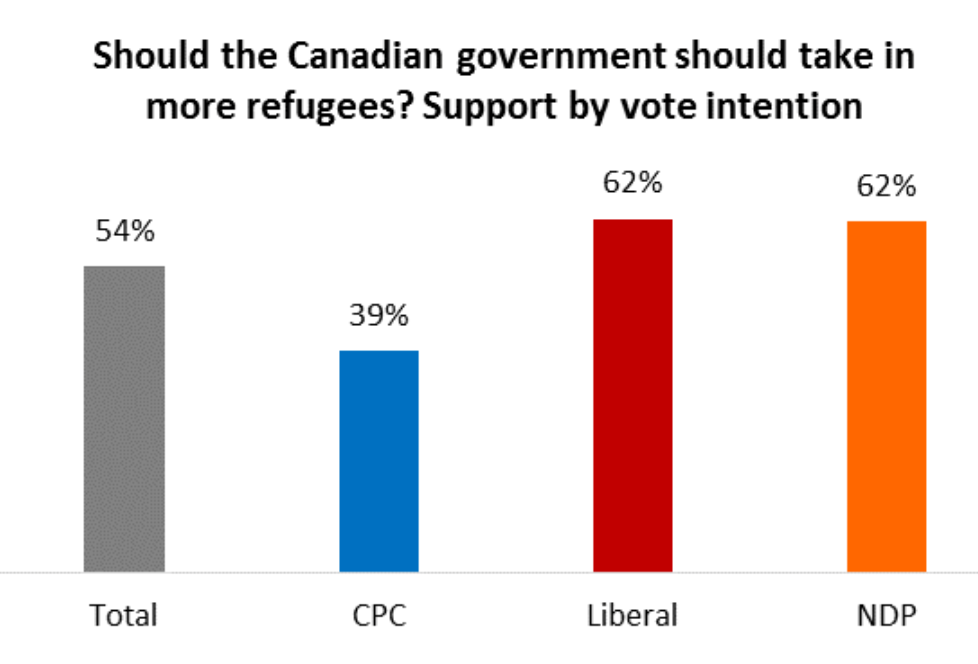
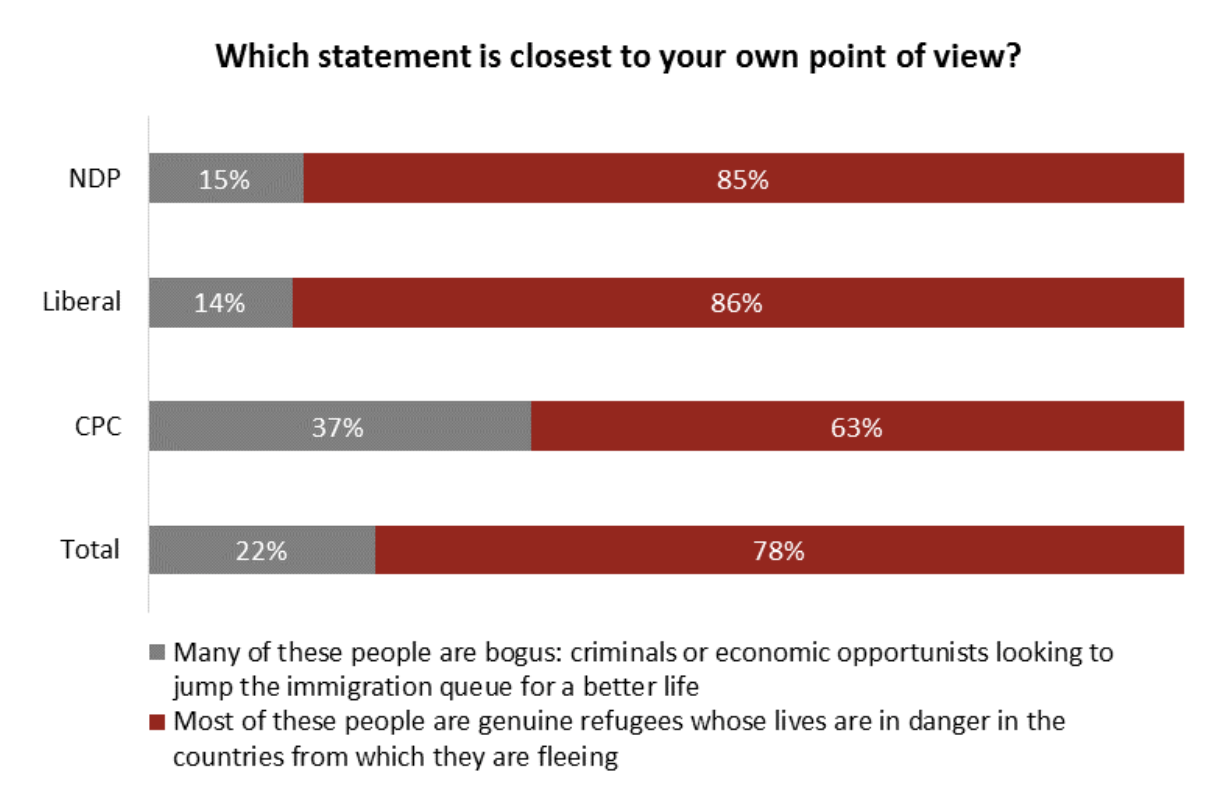
Public opinion polling helps explain the different party positions.
Bogus_refugees_or_notAngus-Reid conducted a useful poll, breaking down opinion by party affiliation, showing the Government’s position is aligned to the Conservative party base and messaging of “bogus refugees”, with the overall key findings being (all parties):

  • Overall, most Canadians (70%) say Canada has a role to play in the migrant crisis, but are divided on increasing the number of refugees the government sponsors and resettles here, and on seeing government spend more to make it happen. (54% and 51% support each, respectively)
  • A significant gender difference exists on whether the people fleeing to Europe from the Middle East are seen as “genuine”: Canadian men are twice as likely as women to say the migrants are “bogus”
  • As to what exactly this country should do, Canadians are most supportive of sending medical and armed forces professionals into the affected European countries areas to assist refugees, divided on taking more refugees and least supportive of “doing nothing”

Canadians divided along political lines over whether to accept thousands of refugees in current crisis

Chris Alexander defends Canada’s refugee response, blames media

For those who missed it, worth watching Alexander defending the Government’s policy and actions with respect to Syrian refugees.

Sep 2, 2015 | 17:53Power and Politics Syrian refugee crisis Video

Unfortunately, he clumsily reverted to attacking the media and getting the facts wrong, which became the focus of Twitter and other commentary:

Alexander, who has served as immigration minister since July 2013 and is running for re-election in Ontario, accused CBC News of ignoring the Syrian refugee crisis.

“I’m actually interested in why this is the first Power & Politics panel we’ve had on this,” he said.

Alexander went on to say that “the biggest conflict and humanitarian crisis of our time has been there for two years, and you and others have not put it in the headlines where it deserves to be.”

Barton noted later the subject had been discussed at least 32 times on Power & Politics, including in interviews with Alexander. As a minister, Alexander was not allowed to appear on panels.

No wonder that he has had to suspend his campaign and return to Ottawa, especially given that the file for the dead boy’s family had apparently been handed to him personally.

Source: Chris Alexander defends Canada’s refugee response, blames media – Politics – CBC News

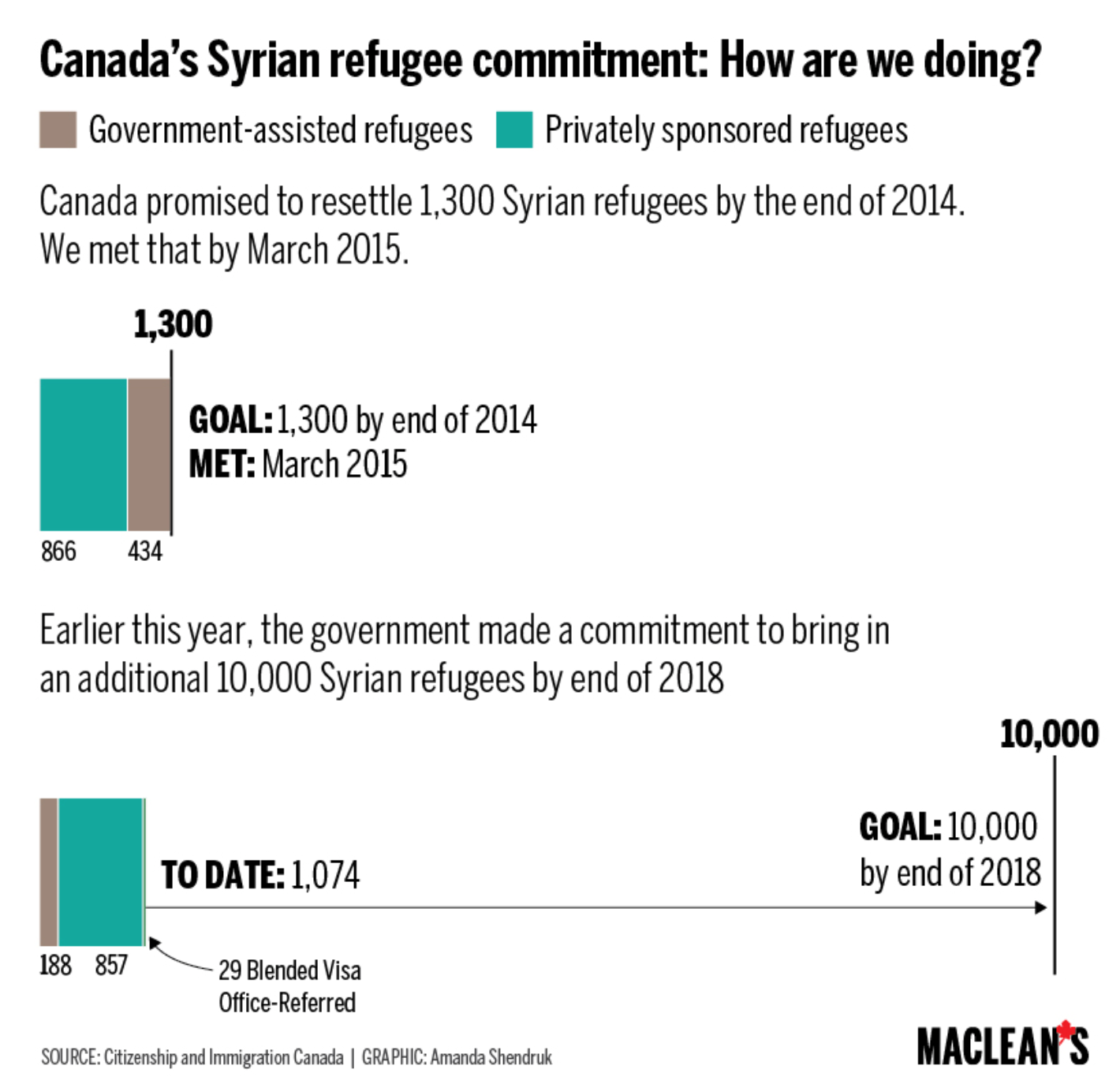
How has Canada fared on resettling Syrian refugees? And government not releasing information.

On how the Government avoids providing information that the public is entitled to:

It was clear, though, that the government had details about the number of arrivals on hand throughout the process. In December 2014, Alexander tabled in the House of Commons a written response to a question by NDP MP Paul Dewar indicating, as of three weeks previous, how many Syrian refugees had arrived and, of those, how many were privately sponsored and how many came with government assistance.

Alexander or his spokesman also made public statements in December and January updating these figures.

It stands to reason, then, that the government knows how many of the 10,000 promised spaces for Syrian refugees have so far been filled. They just won’t say.

Earlier this month, a spokesperson for Citizenship and Immigration (CIC) told me the information was “not available publicly.” The email from CIC went on to provide a link to make a request under the Access to Information Act.

This act is one of those creatively named pieces of legislation that don’t mean what their titles suggest they should. You file a request; weeks, months or sometimes years pass. What you finally receive is heavily redacted. Eventually, you stop asking. If it didn’t suggest such boggling cynicism on the part of the government, I’d swear that was the point.

I decided to play along and filed a request asking how many Syrian and Iraqi refugees have arrived in Canada since January, how many are privately sponsored, and how many came with government assistance.

Today I received a letter from CIC’s Access to Information and Privacy Division, informing me that the information I sought is excluded from the act because it concerned “published material or material available for purchase by the public.”

The letter continued: “Regulation 314 of the Immigration and Refugee Protection Regulations (attached) allows for the production of customized reports for immigration statistical data that have not been published by the Department.”

That’s right: I could buy my answer. The attached regulation informed me that the cost of processing my application for data would be $100 for the first 10 minutes or less of access to the department’s database, plus $30 for each additional minute or less of access.

Or maybe Chris Alexander could publicize that information, because he made a promise, and Canadians have a right to know what progress he’s made toward keeping it.

Given the Minister’s performance on Power and Politics Wednesday, he would be well advised to follow Petrou’s advice.

Source: How has Canada fared on resettling Syrian refugees? – Macleans.ca

Europe’s fear of Muslim refugees echoes rhetoric of 1930s anti-Semitism – The Washington Post

A useful historical reminder by Ishaan Tharoor:

Over the past year, many in Europe have bristled at the influx — from far-right political movements and fear-mongering tabloids to established politicians and leaders. The resentment has to do, in part, with the burden of coping with the refugees. But it’s also activated a good amount of latent xenophobia–leading to anti-Islam protests, attacks on asylum centers and a good deal of bigoted bluster.

Some governments in Eastern Europe have even specifically indicated they don’t want to accommodate non-Christian refugees, out of supposed fear over the ability of Muslims to integrate into Western society.

“Refugees are fleeing fear,” urged a spokesman for the U.N. refugee agency last week. “Refugees are not to be feared.”

It’s important to recognize that this is hardly the first time the West has warily eyed masses of refugees. And while some characterize Muslim arrivals as a supposedly unique threat, the xenophobia of the present carries direct echoes of a very different moment: The years before World War II, when tens of thousands of German Jews were compelled to flee Nazi Germany.

Consider this 1938 article in the Daily Mail, a British tabloid still known for its bouts of right-wing populism. Its headline warned of “German Jews Pouring Into This Country.” And it began as follows:

”  “The way stateless Jews and Germans are pouring in from every port of this country is becoming an outrage. I intend to enforce the law to the fullest.”

In these words, Mr Herbert Metcalde, the Old Street Magistrate yesterday referred to the number of aliens entering this country through the ‘back door’ — a problem to which The Daily Mail has repeatedly pointed.

The number of aliens entering this country can be seen by the number of prosecutions in recent months. It is very difficult for the alien to escape the increasing vigilance of the police and port authorities.

Even if aliens manage to break through the defences, it is not long before they are caught and deported.”

No matter the alarming rhetoric of Hitler’s fascist state — and the growing acts of violence against Jews and others — popular sentiment in Western Europe and the United States was largely indifferent to the plight of German Jews.

“Of all the groups in the 20th century,” write the authors of the 1999 book, “Refugees in the Age of Genocide,” “refugees from Nazism are now widely and popularly perceived as ‘genuine’, but at the time German, Austrian and Czechoslovakian Jews were treated with ambivalence and outright hostility as well as sympathy.”

Source: Europe’s fear of Muslim refugees echoes rhetoric of 1930s anti-Semitism – The Washington Post

When solidarity fails | Institute of Race Relations

Reprinted in its entirety, Liz Fekete, Director of the Institute of Race Relations (IRR), captures all too vividly the failure of Europe in addressing the refugee crisis along with integration:

I want to talk about the immediate institutional crisis in the EU, as hostility grows towards a modest plan by the European Commission to relocate a little over 32,000 asylum seekers from Greece and Italy. The failure of the member states to rise to the humanitarian challenge posed by the boat people arriving via the Mediterranean Sea, the mean-spirited and positively hostile response of some governments, both national and regional, and the breakdown of solidarity between the receiving countries and their richer neighbours, has had consequences. These consequences need to be discussed in terms of cause and effect, in order to fully grasp the intersection between the breakdown of a humanitarian approach to asylum and the growth of racism.

But I would first like to frame my points by making two short observations. First, failures in the institutional response should not blind us to the absolute heroism of ordinary people and over-stretched civil society actors such as Refugees Welcome (Germany), Caritas (Austria) and Migszol (Hungary) who are feeding, clothing and welcoming the new arrivals. Second, we must recognise that the current lack of political leadership, and the failure to find adequate and secure accommodation, is not something new. What I will describe serves merely as the top layer of an existing situation. Europe has fallen far short of providing a safe haven for displaced people, and deaths of migrants do not just occur in tragic circumstances at Europe’s borders. The fact that deaths inside accommodation or removal centres, or as the result of enforced destitution, are met with official indifference, suggests continuity with the moral inertia towards border deaths [2]. The Institute of Race Relations recently published an audit of 160 asylum-and immigration-related deaths within EU States between 2010 and 2015, 46 per cent of which were by suicide, as desperation reached epidemic proportions.

Scaremongering in the media

The roots of the current spate of attacks on migrant accommodation centres start with a scaremongering media discourse and equally irresponsible words from some politicians. Migrants are represented in the media as toxic waste, a dangerous mob, human flotsam, an unstoppable flood and a terrorist threat. In the UK, they have been compared with insects, through the use of inflammatory terms such as ‘swarms of people’ (British prime minister David Cameron) and ‘like cockroaches’ (Sun columnist, Katie Hopkins). The British foreign secretary, Philip Hammond singled out African ‘economic migrants’ in Calais, describing them as ‘marauding migrants’ ‘threatening our standard of living’ and opining that ‘Europe can’t protect itself, preserve its standard of living and social infrastructure if it has to absorb millions of migrants from Africa.’ (It’s also worth noting here that, in relation to Calais, there has been barely a flicker of concern about the fact that at least thirteen migrants, including two teenagers have died attempting to reach the UK since June.)

Spreading hostility not curbing it

The consequence of such scaremongering – which portrays migrants as a security threat – is that it has become much more difficult for electorates to understand why migrants take such a perilous journey, particularly if they hail from African countries, the problems of which are barely covered in the European press. In this climate, too many politicians are pandering to prejudice, acting for short-term self-interest, whipping up distrust, spreading hostility, not curbing it. Unless politicians at a national, local and regional level are encouraged to act responsibly, xenophobia will continue to be manipulated into something more sinister, and potentially deadly. France has sealed its Italian border at Ventimiglia, Hungary is constructing a wall at the border with Serbia (reportedly with the use of prison labour). The Czech interior ministry demands cultural compatibility of those relocated,[3] and the governor of Lombardy threatens to financially penalise northern Italian prefects who go along with the national relocation plan. Luigi Ammatuna, the mayor of the Sicilian port town of Pozzallo, in the Ragusa region, summed up the Italian North-South divide well when he said that the North’s anti-immigration stance was ‘spreading bad feeling’ about migrants across the entire country, adding that its leaders are ‘heartless’ and ‘selfish’ for not working with the government to solve the crisis. Meanwhile, the leader of the powerful Northern League, has declared that the ‘League is prepared to occupy every hotel, hostel, school or barracks intended for the alleged refugees’.

Anti-black racism, anti-multiculturalism

The first step is to end rhetoric which, in some countries, has now gone beyond anti-immigration into a wider anti-multiculturalism and a discourse with heavy overtones of anti-black racism. Here we can specifically identify the interventions of electoral extreme and far-right politicians. For example, the Finns Party – the second largest party in the Finnish parliament – has representatives such as Olli Immonen MP, who wrote on social media that he was ‘dreaming of a strong, brave nation that will defeat this nightmare called multiculturalism’.[4] And Marian Kotleba, the state governor of the Banská Bystrica region, told a rally of 8,000 people in Bratislava protesting against relocation of refugees, ‘I wish you a nice, white day … we are here to save Slovakia’.

Demonstrations and vigilante-style attacks

Such rhetoric encourages hostility at a local level, where examples abound of migrants, seeking safety, being greeted by hate-filled mobs. In Prague, anti-immigration demonstrators waved gallows and nooses, calling for the death of ‘traitors’, i.e. all those who support migrants. In Treviso, Italy, 100 migrants had to be evacuated from one town after two days of protests spearheaded by fascists from Casa Pound – and after the Northern League mayor for the Veneto region had called for the refugees to be cleared out of accommodation near tourist resorts, warning that the region was in danger of ‘Africanisation’. And in Germany, where attacks on refugee accommodation centres for 2015 – specifically arsons – now exceed that of the whole of 2014 (in turn, attacks in 2014 were up threefold from 2013), journalists and local politicians are now facing death threats and the car of one east German politician was blown up.

When politicians lead the way

While Germany has its protest movement, PEGIDA, hostile responses in other countries are led by politicians – in Hungary, by the prime minister,[5] and in others, such as Austria, where the Social Democrats in Burgenland have formed a coalition government with the extreme-right Freedom Party, by state governors and local mayors from both centre Left and centre Right. In Bavaria, the state premier Horst Seehofer has been accused by the Central Council of Jews of provoking hostility towards asylum seekers, and across the North of Italy, hostility has been fuelled by senior politicians in Liguria, Lombardy and Veneto. Other countries like the UK and Denmark have started to cut welfare payments to migrants, in a further lurch towards the nativist agenda of the anti-migration movements. The UK government, for example, has slashed asylum support payments and is proposing to withdraw automatic support for families whose claims are refused but who for legitimate reasons cannot return home – amounting to enforced destitution. And both Italy and the UK are attempting to drive those without papers out of private housing, by outsourcing immigration controls to landlords.

The danger is that xenophobia ‘from below’ will combine with structural neglect of human rights ‘from above’. This will result in a further deterioration of conditions (overcrowding, lack of health care) in reception and detention centres. ‘Fast-track procedures’ to speed up asylum claims will not only lead to grave injustices but more forcible deportations, which also claim lives, as we saw most recently in March 2015 in Sweden when an Iraqi asylum seeker suffocated during a deportation attempt, the seventeenth such deportation death in Europe since 1991.

Though there has been a huge drive by ordinary European citizens to welcome refugees, to take a stand for human dignity, another trend is undermining it. The truth is that we face the possibility of a perfect storm unless those in power take cognisance of their positive duty to combat racism, rather than fuel it.

Source: When solidarity fails | Institute of Race Relations

Court strikes down Ottawa’s ‘safe country’ list for refugees | Toronto Star

Another major defeat for the Government in the Courts:

In a major blow to the Harper government, the Federal Court has struck down its so-called safe country list for refugees as unconstitutional.

In a ruling Thursday, the court said Ottawa’s designation by country of origin or DCO discriminates against asylum seekers who come from countries on this list by denying them access to appeals.

“The distinction drawn between the procedural advantage now accorded to non-DCO refugee claimants and the disadvantage suffered by DCO refugee claimants . . . is discriminatory on its face,” wrote Justice Keith M. Boswell in a 118-page decision.

“It also serves to further marginalize, prejudice, and stereotype refugee claimants from DCO countries which are generally considered safe and ‘non-refugee producing.’

“Moreover, it perpetuates a stereotype that refugee claimants from DCO countries are somehow queue-jumpers or ‘bogus’ claimants who only come here to take advantage of Canada’s refugee system and its generosity.”

It is yet another devastating hit to the Conservative government which recently also lost two cases on constitutional grounds over the ban of the niqab at citizenship ceremonies and on health cuts for refugees.

“This is another Charter loss for the (Stephen) Harper government,” noted Lorne Waldman, president of the Canadian Association of Refugee Lawyers, a party to the legal challenge against the DCO regime.

The government said it will appeal the decision and ask the court to set it aside while it is under appeal.

“Reforms to our asylum system have been successful resulting in faster decisions and greater protection for those who need it most,” said a spokesperson for Immigration Minister Chris Alexander.

“We remain committed to putting the interests of Canadians and the most vulnerable refugees first. Asylum seekers from developed countries such as the European Union or the United States should not benefit from endless appeal processes.”

The latest court decision means all failed refugee claimants — whether from the government’s safe country list or not — are entitled to appeal negative asylum decisions at the Immigration and Refugee Board’s refugee appeal division or better known as the RAD.

Court strikes down Ottawa’s ‘safe country’ list for refugees | Toronto Star.

ICYMI: Germany: Where the refugee flood is a solution, not a problem

Refugees as part of an economic immigration strategy:

Unlike Canada, where refugees are mainly sponsored by families and charities, the German government sorts and disperses its asylum seekers: Towns and cities with the strongest economies get the most. This week, Chancellor Angela Merkel pressed the 27 other European Union countries to imitate this system internationally. The response, so far, has been chilly.

In Germany, by contrast, the public and their politicians are receiving the majority of Europe’s refugees with surprising calm, even optimism. While there was a brief flare-up of anti-immigrant politics earlier this year in cities of the former East Germany (where there are almost no immigrants to be found), those died away quickly. Here, even refugee advocates say they’re surprised by the broadly positive reception.

“I am really amazed at how much this country has changed – even a decade ago this would have created anger and distrust, but today I’m hearing nothing but welcome for the new refugees – people are being really open,” says Zerai Kiros Abraham, a former Eritrean refugee who now runs Project Moses, a refugee-settlement charity in Frankfurt.

Olaf Cunitz, the vice-mayor of Frankfurt responsible for planning and housing, says that the refugees are being seen by many Germans not as a problem but as a solution. “What’s unusual is that here in Frankfurt, people are very, very open to the topic of refugees,” he says. “At the moment, we don’t have any resistance, in any neighbourhood, to the settlement of refugees. People say ‘We need new people, they need our help. We’re a wealthy city, we can handle this.’”

Nowhere is this attitude more visible than in the rural town of Gelnhausen, to the east of Frankfurt, where town officials are hoping that the 2,500 refugees they will receive this year will be just the thing for their aging, fast-shrinking work force. They particularly want the Syrians, who tend to be middle-class and have the professional degrees and technical skills needed here.

“The good thing about the refugees is that they’re here – we don’t have to go out to their communities to get them,” says Susanne Simmler, head of the regional council. “We have labour shortages and demographic changes here, so we need new people – and a rural region like this normally does not attract immigrants.”

Germany: Where the refugee flood is a solution, not a problem – The Globe and Mail.

Anti-Semitism in Malmö reveals flaws in Swedish immigration system

Another story on antisemitism in Malmö, exacerbated by the marginalization of Muslim immigrants and refugees:

Sweden has a generous immigration policy – last year the country of 9 million took in 85,000 refugees. According to an OECD study, that is more than twice as many immigrants per capita as any other member country. Canada, in comparison, takes a twentieth as many refugees proportionately.

In Malmö the immigrants are concentrated in one pocket of the city, Rosengaard. Unemployment in the area runs at 70 per cent, stones are thrown regularly at mail carriers and police, and 150 cars were torched during summer riots in 2013. Protests for and against Muslim immigrants are frequent and tough.

Engineer Peter Fribourg and his wife Marie, a lawyer, are what are now called ‘ethnic Swedes.’ “It’s a tough matter, you have different cultures colliding. We are not succeeding in the way we would like.”

Marie agrees, adding that Malmö meant well but was not properly prepared to help the huge influx of immigrants settle. “I was much more liberal and welcoming before … (but) there have been so many in the last few years we do not know how to deal with them. They will not assimilate.”

There have been 137 anti-Semitic incidents reported to authorities in Malmö the past two years.

The Rabbi of the Malmö synagogue, Shneur Kesselman, says he has been spat upon and cursed. Most recently, a bottle thrown from a passing car narrowly missed his head, he says.

The Rabbi of the Malmö synagogue says he has been spat upon, cursed, and was nearly hit recently by a bottle thrown from a passing car. (Karin Wells/CBC)

Some have left because they are scared. The Jewish community in Malmö has shrunk by 50 per cent to about 1,000 in the past 10 years.

“Hatred of Muslims, as bad as it is — and it’s terrible — is not challenging the Muslim minority, their safety,” Kesselman says.

“Anti-Semitism here in Malmö today is threatening the existence of a minority.”

Anti-Semitism in Malmö reveals flaws in Swedish immigration system – World – CBC News.

Burma’s opposition demands government gives citizenship to Rohingya refugees adrift on the Andaman Sea

Encouraging:

The Burmese government has so far disclaimed any responsibility for the fate of the thousands of Rohingya refugees adrift on the Andaman Sea. But now the spokesman for the National League for Democracy, Burma’s most important opposition party, has demanded a long-term solution to the problem: giving them citizenship.

In an interview with The Independent, U Nyan Win said: “The problem needs to be solved by the law. The law needs to be amended. After one or two generations [of residence] they should have the right to be citizens.”

The statement was a bold break with the NLD’s usual ultra-cautious approach to an issue regarded as highly inflammatory in this Buddhist-majority country – Buddhists constitute 85 per cent of the population – in which atavistic fears of Muslim domination have been whipped up by chauvinistic Buddhist preachers.

Speaking to AFP earlier, he said: “If [the Rohingya] are not accepted as citizens, they cannot just be sent onto rivers. They can’t be pushed out to sea. They are humans. I just see them as humans who are entitled to human rights.”

Burma’s opposition demands government gives citizenship to Rohingya refugees adrift on the Andaman Sea – Asia – World – The Independent.