Mr. Harper, think big on the refugee crisis: Former Ministers and Deputy Ministers

Reprinted in entirety (see article for impressive list of signatories):

Bravo that Conservative Leader Stephen Harper is now preparing a new plan for Canada’s response to what has emerged as the worst refugee crisis in Europe and the Middle East since the end of the Second World War. Perhaps he has heard the many voices across Canada – provincial premiers, mayors of municipalities, faith leaders, non-profit organizations and ordinary citizens – wanting to act but stymied by the reality that the key lever for further progress is within the hands of the federal government.

As former federal ministers and deputy ministers, appreciative of what it takes to translate political announcements into realities, we urge Mr. Harper to think big and not let the exigencies of the election campaign diminish the call to action. There is nothing in the caretaker convention, followed during election campaigns, to stop government from responding to a crisis – particularly when there is all-party support.

Mr. Harper can turn to his professional public servants with their past successful history of managing Bosnian, Ugandan, Kosovo, and Indochinese mass movement of refugees. He can ask them to determine Canada`s maximum capacity for absorption of individuals now streaming into Lebanon, Turkey, Jordan and Europe. Under the Public Policy provisions of the Immigration and Refugee Protection Act, the government can launch a significant new humanitarian Syrian refugee resettlement program. Its goal should be to increase the overall Canadian commitment to numbers of refugees and significantly simplify administrative burdens for both private sponsors and immigration officials.

Mr. Harper can ask officials in the Departments of Finance, Treasury Board, Citizenship and Immigration, Defence and Foreign Affairs to ascertain the financial and human resources required and set those aside. The public record of the contributions of the previous waves of past refugee settlement programs demonstrate the long-term returns to Canada from what may, in the short term, look like significant costs. The government can engage with provincial governments, who are also committing resources, to maximize the effectiveness of all efforts. It is short term investments which will be critical to the success of the program: there will be ample payback for an adequate number of visa and security officers in the field for refugee selection, for professionals to expedite medical clearances and security assessments, and for transportation costs and staging areas in Canada when the refugees arrive. Pending full program implementation, the government can ensure ”all hands on deck” in fast-tracking existing applications, particularly those with family connections in Canada.

We appreciate that the world has changed. We share concerns about the protection of the security of Canadians in the post-Sept. 11 world – but security cannot be an excuse for inertia. In addition to providing adequate screening personnel in the field, security risks can be mitigated by a focus on women at risk, families with children, and families with Canadian connections. Canada can also now benefit from positive changes since earlier humanitarian programs. Social media and other information technologies now exist that were not dreamt of 30 years ago to enable rapid information sharing and decision-making – whether in identifying security risks or refugee resettlement. In contrast to the 1970s, there is a substantially increased cross-Canada network of highly experienced and motivated municipal, provincial and non-profit newcomer settlement agencies ready to act and be proactive partners.

Nor should Canada’s commitment to continuing the fight against Islamic State stop humanitarian initiatives. Public policy often has multiple objectives and there is no reason the two cannot proceed on parallel tracks. We understand that the challenge seems daunting when one considers there are now more than four million refugees. Perhaps in this context, a quote from Mother Teresa is appropriate: “I alone cannot change the world, but I can cast a stone across the waters to create many ripples.” Will Mr. Harper lead Canada in throwing that stone?

Source: Mr. Harper, think big on the refugee crisis – The Globe and Mail
Eight steps to get more Syrian refugees into Canada: Adelman, Alboim, Molloy and Cappe

Best and most comprehensive advice I have seen so far from Howard Adelman, Naomi Alboim, Mike Molloy and Mel Cappe:

1. The government should authorize the admission of Syrian refugees under a special program without the need for individual determination by the United Nations High Commissioner for Refugees (UNHCR) or another state. This has been done for other major refugee movements in the past. This one step would expedite the selection of refugees and reduce the paperwork burden for sponsor groups.

2. The actual number and time frame will have to be negotiated or determined by the government when elected in October, but the method for speeding up the process must be introduced as soon as possible. We believe that it is not unrealistic to call for 25,000 government-assisted and 25,000 privately sponsored Syrian refugees to be admitted each year for the next two years.

3. The vast majority of Syrian refugees should be resettled to Canada from four target countries: Turkey, Lebanon, Jordan and Egypt . This will relieve the pressure on these countries of first asylum and will reduce the desperation that is compelling people to risk their lives to get to Europe.

4. First priority should be given to displaced Syrian families with children in the four target countries. These would include families with significant Canadian connections, which would include relatives of Canadian citizens or of permanent residents. The fundamental rule (applied during the Indochinese movement) would be that extended family groups that have fled or taken refuge together would be processed and travel to Canada together. Families would not be broken up.

5. In addition to those with significant Canadian connections, the new program should target (but would not be restricted to) cases referred by the UNHCR.

6. Canadian visa offices in the field should be reinforced significantly and instructed to accelerate the selection rate for refugees referred by the UNHCR or with Canadian connections so that they can be referred to both the large umbrella sponsor groups (sponsorship-agreement holders) and local sponsor groups (groups of five) in large numbers expeditiously.

7. An increased number of government-assisted refugees should be selected from the pool of refugees referred by the UNHCR or other reputable agencies and should be destined to communities with reinforced agencies providing immigrant and refugee services. Humanitarian considerations should be paramount and provision should be made for hardship cases and those most in need.

8. Early outreach to employers will be essential; the temporary foreign worker program for low-skilled workers should be severely curtailed, freeing up jobs for incoming refugees.

Now is the time for all political parties to demonstrate to Canadians that they can work together to address a crisis of enormous proportions and to reclaim our leadership role on the world stage that reflects our values as a caring and compassionate society. We have the experience and expertise. We did it before and we can do it again. All we need now is the political will.

What do voters hear in Conservatives’ message on refugees?

Good piece on some of the implicit messaging behind reasons invoked:

The further subdividing of Syrian refugees to prioritize “persecuted ethnic and religious minorities” can only make an already slow and burdensome process all the more so.

“Our focus is on the most vulnerable refugees who are often in a more difficult spot and harder to reach,” Conservative Jason Kenney conceded this weekend on CBC Radio’s The House.

But those are just rational arguments.

“The key is to craft messages that trigger fears but are not themselves explicit about the sorts of fears they are trying to trigger,” is the way [Ian] Haney-Lopez explains this type of messaging.

[Lynton] Crosby phrases it slightly differently: “You can have a rational argument, you can have a rational position, but unless you make an emotional connection, you will rarely succeed,” he says in the 2013 video.

Last March, Liberal Leader Justin Trudeau accused the Conservatives of “using dog-whistle politics,” to stir up anti-Muslim sentiments in the debate over anti-terrorism legislation.

However, when asked on Friday if Crosby’s arrival on the scene could mean an increased use of the technique, Trudeau side-stepped.

“I’m not going to comment on my opponent’s campaign and approach,” he told reporters.

Haney-Lopez suggests that’s the wrong answer.

“People don’t realize they are being manipulated, they don’t realize their basest instincts are being appealed to,” he says. “Staying silent and not addressing that is an absolute failure.”

Of course, calling out a dog whistle doesn’t necessarily negate its effect.

As Crosby himself teaches, in the battle of reason over emotion in voters’ minds, reason barely stands a fighting chance.

Source: What do voters hear in Conservatives’ message on refugees? – Politics – CBC News

Some hard truths no one wants to hear on refugees: Cohn | Toronto Star

An appropriate note of caution in terms of long-term trends:

In the rush to sponsor Syrians to Canada, relatively little is said about supporting the infrastructure of refugee processing handled by the UNHCR in countries bordering Syria. While it may generate fewer headlines at home, not enough thought is being given to the more affordable, sustainable, realistic (if less idealistic) alternative of funding camps closer to war zones, so that refugees can be repatriated more rapidly if those conflicts subside.

We need to open our hearts to the latest wave of Syrian refugees, but we also need to open our minds to what lies ahead. The crisis is unlikely to be temporary. It cannot be resolved with a few thousand more sponsorships and a few million more dollars, as important as those contributions are.

The federal Tories have missed the boat on the latest wave of boat people, but many well-intentioned do-gooder’s have been selling us a bill of goods about the refugee crisis. We need to start thinking about what comes next.

It is good to be principled, but we must also be practical. Mass migrations are at the intersection of war, geopolitics, economics, logistics and human smuggling. They defy easy answers. The reality is that refugee fatigue will set in anew, because the flood never ends — it merely fades from the front pages. What then?

Source: Some hard truths no one wants to hear on refugees: Cohn | Toronto Star

Jon Kay makes similar points:

The morally complex task of determining how many Syrians should be allowed to come to Canada must not be performed through the Tories’ usual practice of reciting jingoistic talking points and slogans. But it also cannot become a no-limit humanitarian bidding war. If we want to preserve the open and generous quality of Canadian society, we must balance our open hearts with hard heads.

Jonathan Kay: Even in face of tragedy, there’s no substitute for a seriously considered immigration policy

Q&A: Mike Molloy, the man who delivered the ‘boat people’

Well worth reading in its underlining the importance of political leadership:

Q: The overwhelming reaction of Canadians—and the Clark government of the day—is now a celebrated part of our country’s history: welcoming 60,000 refugees. How did you pull off such a bold promise?

A: It has everything to do with leadership and direction. There was real leadership at the top and a real recognition that this was a historic challenge and we’d better rise to it. As a mid-level civil servant brought into the middle of it, the thing we never doubted was where the leadership wanted us to go. The clarity of the direction from the top, and the commitment of the people at the top, was amazingly empowering. It allowed us to innovate. It allowed us to figure out new ways of doing things. It allowed us never to break the law, but to stretch it as far as it could be reasonably stretched to deal with what we actually saw as opposed to what the policy-makers might have imagined we’d see.

That is missing here. Over the last four or five days, we have the same profound concern bubbling up from our society—perhaps in an even bigger way than back then—but we’re like a ship without a rudder this time. The engines are ready to go full speed, but in what direction?

Q: It may seem like an obvious question, but what triggered such staunch political will? What was the turning point?

A: The case for intervention was clear. Vietnam was the first real TV war. This was the first real TV refugee crisis. In 1979, we saw so many times a boat absolutely packed with people—with kids—and we would watch it going down before our eyes. We would watch people coming out of the surf, dragging kids behind them, maybe alive, maybe dead. These were immediate images coming into the homes of Canadians that caused this enormous springing up of concern. At that stage, the refugee sponsorship program had never been tried; it had just been invented. And yet Canadians grabbed it and ran with it. We didn’t have to thump the drum at all. We didn’t have to promote it. Canadians just grabbed it and ran, and I think there is a similar spirit today.

Source: Q&A: Mike Molloy, the man who delivered the ‘boat people’ – Macleans.ca

Group calls for streamlined refugee process in Canada

Significant, both substantively and in the wide range of people with different partisan affiliations involved. Will see what the Harper government comes up with to respond to these calls for a more compassionate approach:

A committee of prominent Canadians that includes Louise Arbour and Ed Broadbent is calling for an urgent, de-politicized response to the Syrian refugee crisis that would see Canada push for a ceasefire in Syria, cut its immigration red tape and send visa officers into the field to speed refugee processing.

The group, chaired by former immigration minister Ron Atkey, aims to provide the non-partisan advice that could enable Canada to more quickly welcome large numbers of Syrians displaced by civil war. Its stated aim is to admit “as many Syrians as possible as quickly as possible.” It also calls for Canada to step up its diplomatic efforts to broker a ceasefire by convening an international peace conference that would work toward an enduring solution in the region.

“It’s a cri-de-coeur that’s coming out from many parts of the country,” Ms. Arbour said. The former United Nations human-rights commissioner and chief prosecutor at the international criminal tribunals for Rwanda and the former Yugoslavia, said she’s not rosy-eyed about the prospect of a diplomatic solution to the Syrian civil war, but said Canada should lend its voice to the effort.

Mr. Atkey, who oversaw immigration at the time of the Vietnamese crisis of 1979 when Canada welcomed 60,000 refugees, said Canada should take immediate action to put visa officers into the field to evaluate and process refugee applications. It also needs to streamline its refugee process, he said, to give Syrians access to visas that would allow them to travel more quickly, rather than being stuck in a process that can take years to complete. Canada has responded quickly to previous crises, such as the exodus from Kosovo in 1999, he said.

Source: Group calls for streamlined refugee process in Canada – The Globe and Mail

Don’t overstate risk of terrorism among refugees, experts say

Good placing in context:

“When we are dealing with people that are from, in many cases, a terrorist war zone, we are going to make sure that we screen people appropriately and the security of this country is fully protected,” Harper said at a campaign stop in Welland, Ont.

“We cannot open the floodgates and airlift tens of thousands of refugees out of a terrorist war zone without proper process. That is too great a risk for Canada,” he added during a question-and-answer session.

Harper’s remarks continue a security narrative the Conservatives launched after the fatal terror attacks by ISIL sympathizers in Ottawa and Saint-Jean-sur-Richelieu almost a year ago. National security is a key plank in the party’s election platform.

But the government should not be presenting refugee resettlement here as an either/or option with anti-terrorism efforts, says Scott Watson, an associate professor of international relations at the University of Victoria.

“I think it’s possible to do a large-scale operation of assisting refugees that (also) has a thorough screening component for security reasons, if there was enough political will to do so. I think both can be done,” he said.

“The vast majority of the people have no interest in contributing to further violence. There could be a couple of people who are sympathetic to ISIL coming in, but if there’s proper security screening and proper integration once refugees are brought into the country, I don’t think it’s something we need to be concerned about.” Besides, “there’s much better ways for them (ISIL) to do what they want to do than to use refugees as the means of doing it,” said Watson.

He and Whitaker have done extensive research on the rise of national security fears that have accompanied concentrated waves of immigration to Canada. Harper’s framing of the Syrian refugee crisis in security terms is similar to concerns, ultimately unfounded, that communist infiltrators would accompany the arrival of Hungarian refugees to Canada in 1956, or with the Cambodian and Vietnamese boat people in the late 1970s.

Whitaker concludes many refugee groups now tend to be seen as importers of external political conflicts to the West.

Canadian Security Intelligence Service (CSIS) officers overseas are responsible for much of the security vetting of refugees and immigrants. Many refugees understandably have no official identity documents. But, “you can’t go back to the Syrians or an area that’s no longer under Iraqi government control and say, ‘by the way, is Mohammed a resident of Erbil?’” said Ray Boisvert, a former CSIS assistant director of intelligence.

“You try to do your best to interview them and get a decent sense of their background and see if you can poke any holes in it.”

Source: Don’t overstate risk of terrorism among refugees, experts say | Ottawa Citizen

Here’s Why Germany Is Welcoming Migrants With Open Arms

Good analysis behind some of the considerations behind Germany’s welcoming large numbers of Syrian refugees:

But what’s the economic effect of so many migrants streaming into Germany? The country expects to receive 800,000 refugees and migrants by the end of 2015. That could cost as much as 10 billion euros, according to local government estimates. Next year, German officials estimate that as many as 460,000 more people could be entitled to social benefits.

Some anti-immigration groups argue foreigners are a drain on a country’s economy, as they seek to avail themselves of government services before contributing to the state themselves. But Germany has a long history of outsiders representing a net positive for the country’s economy. The 6.6 million people living in Germany with foreign passports paid $4,127 more in taxes and social security on average than they took in social benefits in 2012–generating a surplus of 22 billion euros that year, according to one report. German officials are hopeful that, in the long run, this summer’s new flood of refugees could result in a similar economic gain.

“We will profit from this, too, because we need immigration,” German Labor Minister Andrea Nahles said. “The people who come to us as refugees should be welcomed as neighbors and colleagues.”

Part of Germany’s rationale for allowing hundreds of thousands of migrants through the doors lies in demographics. Germany has one of the world’s most rapidly aging and shrinking populations. With one of the world’s lowest birthrates, the country relies on immigration to plug a growing workforce hole. According to one expert quoted in Deutsche Welle last year, the German economy needs to attract 1.5 million skilled migrants to stabilize the state pension system as more Germans retire. An influx of young migrants could improve the country’s dependency ratio, a measure of those over 65 compared to those of general working age between 15 and 64. According to current official estimates, every third German could be over 65 by 2060, leaving two workers to support each retiree.

Still, the jury is still hung on whether immigrants overall serve as drains or boosts to economies. According to one 2011 working paper from Harvard Business School, immigrants in Northern Europe have traditionally started off as a drain on state resources, though some of their wages tend to increase over time, allowing them to contribute back to the state.

Ultimately, whether or not this new wave of migrants helps or hinders Germany’s economy depends heavily on the skillsets they bring. Many of Germany’s current working foreigners — the ones that created the surplus mentioned above — are high-skilled workers from other European countries like Greece. In contrast, the migrants flooding into Germany right now may not be as well-trained. Though the research on the subject is thin, one estimate pegs more than half of refugees lack professional training. That means German policymakers will have to do a very good job of taking unskilled workers and incorporating them into the German labor force in a way that makes sense for long-term growth, whether that’s by incentivizing them to take low-skilled jobs or training them to do higher-level work.

Canada’s immigration reputation: Charting the Tories’ commitment to taking in refugees

The cumulative effect of changes to refugee policy and operations (safe-third country provisions were aimed at reducing those claiming refugee status for economic reasons, not those fleeing for political reasons):

But while the immigration system has been massively streamlined for economic newcomers, Canada has simultaneously made it increasingly difficult for certain refugees. In fact, the massive system overhaul in 2012 is being blamed for the country’s inaction in addressing the Syrian crisis.

A centralized processing facility was established in Winnipeg to expedite applications for privately sponsored refugee claims. However, an internal report made public by an access to information request revealed that staffing shortages caused backlogs to reach “an unprecedented high.”

Authorities also listed 37 countries as being a “designated country of origin,” and enacted a different system for processing refugee claimants from those countries.

Enacted as part of an attempt to cut down on bogus claims, the 37 countries are considered to be free from persecution, and refugees from these “safe” countries are expedited and have no right of appeal.

However, the system also means a refugee from Syria applying to Canada from a temporary home in a “safe” country may see  the chance of acceptance plummet.

“They’ve just added enormously to the paperwork and the hurdles people have to go through,” said Dench.

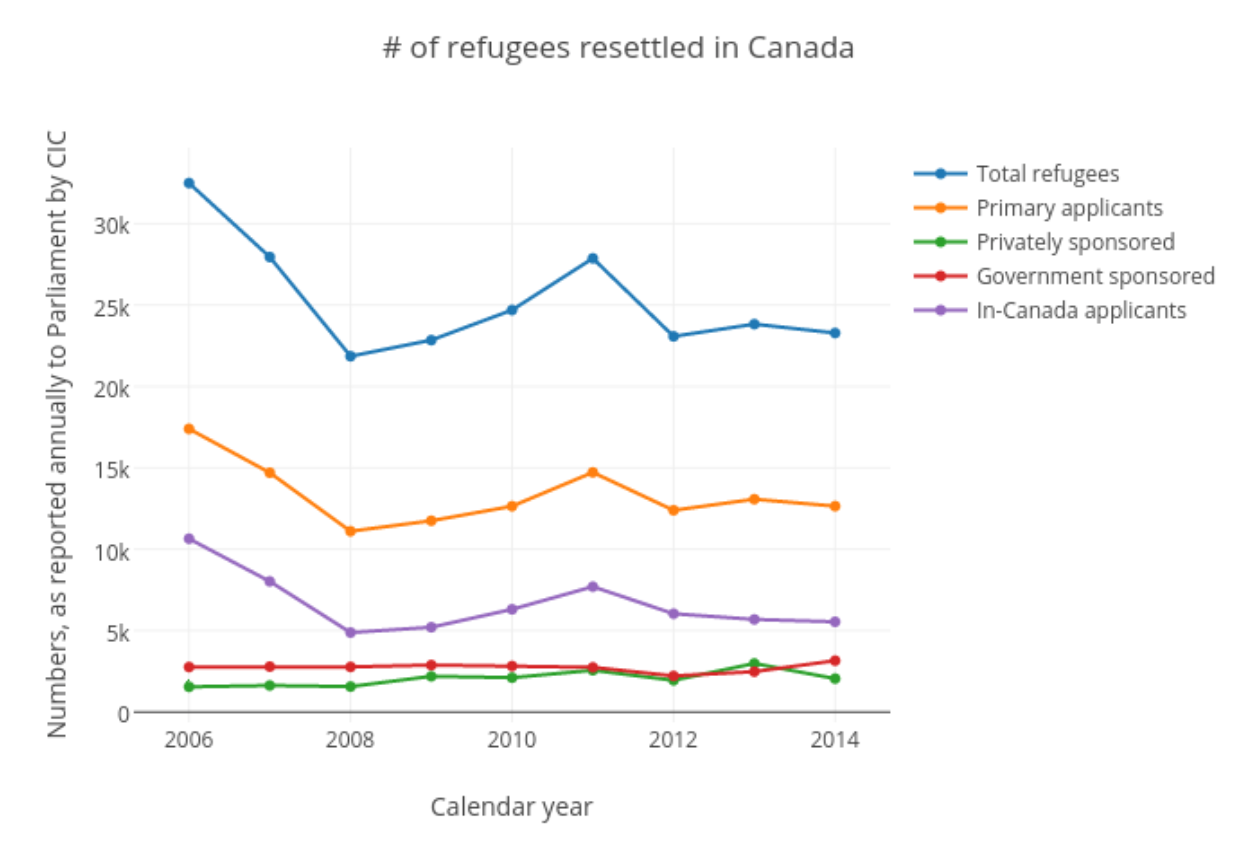
And the evidence, say critics, is in the numbers. Canada received 35,775 refugees in 2005, just before the Conservative election victory. By 2014, the number was 23,286 — a drop of nearly one third.

Most critical to Syrian refugees was the 2012 provision that G5s — refugees who have been sponsored by five or more Canadians — would need to be officially certified as refugees by the United Nations High Commissioner for Refugees (UNHCR).

And with tens of thousands of Syrians streaming into Turkey and Jordan, only a lucky few have been able to undergo the interview and screening process needed to obtain such a certification.

….According to UNHCR, Canada does take in relatively high numbers of “resettled” refugees, having accepted 12,173 of them in 2013 — second only to the United States.

However, this number only refers to refugees who are being transferred from a asylum country to a permanent home.

When it comes to total refugees, UNHCR numbers show Canada ranks 41st globally in terms of per-capita refugees — trounced by countries such as Turkey and Jordan whose share of Syrian refugees equal double-digit proportions of their domestic population.

When gross domestic product and geographic size are ranked, Canada places 55th and 93rd, respectively.

Canada’s immigration reputation: Charting the Tories’ commitment to taking in refugees

Making sense of Canada’s refugee and immigration numbers: Robson

Making_sense_of_Canada_s_refugee_and_immigration_numbersJennifer Robson highlights the obscurity of the formal government reports in understanding the refugee program:

I decided I would try to follow the numbers to better understand the current state of Canada’s federal immigration and refugee programs.

I learned at least four things that I thought are worth sharing:

1) As an outsider, it is very difficult to get detailed information, or to even get information that aligns from one source to the next.

2) There is a $10-million cut planned to Citizenship and Immigration (CIC)’s envelope for refugees.

3) Federal refugee programs are complex and complicated.

4) There are doubtless other cuts to other programs in other departments that any new government may have to live with, especially if it plans on a balanced budget for 2016.

Her report comes with a number of useful charts.

Source: Making sense of Canada’s refugee and immigration numbers