Social Assistance Receipt Among Refugee Claimants in Canada: Evidence from Linked Administrative Data Files

A good illustration of the benefits to evidence-based policy making by linking administrative and economic data. Bit dry analysis but essentially shows that number accessing declines with time but remains about Canadian average:

Focusing on the middle estimate [which excluded non-linked files], the receipt of SA in year t+1 among the 2005-to-2010 claimant cohorts generally ranged between 80% and 90% across family types, with rates highest among lone mothers and couples with more than two children. Similarly, the incidence of SA receipt generally ranged from about 80% to 90% across families in which the oldest member was between 19 to 24 and 55 to 64 years of age. Across provinces, the incidence of SA receipt in year t+1 was generally highest in Quebec, at over 85%, and lowest in Alberta, at under 60%.

SA receipt varied considerably across country of citizenship. Refugee claimants from countries such as Afghanistan, Colombia, the Democratic Republic of Congo, Eritrea, and Somalia all had relatively high SArates (close to or above 90%) throughout most of the study period, while  rates were lower among refugee claimants from Bangladesh, Haiti, India, and Jamaica (generally below 80%).

The rates of SA receipt tended to decline sharply in the years following the start of the refugee claim. Between years t+1 and t+2, rates fell by about 20 percentage points among most claimant cohorts, declining a further 15 percentage points between t+2 and t+3, and 10 percentage points between t+3 and t+4. By t+4, between 25% and 40% of refugee claimants received SA. However, it is important to recall that these figures pertain to the diminishing group of refugee claimants whose claims remained open up to that year. These figures are also well above the Canadian average of about 8%.

Among refugee claimant families that received SA in year t+1, the average total family income typically ranged from about $19,000 to $22,000, with SA benefits accounting for $8,000 to $11,000—or about 40% to 48%—of that total.

In aggregate terms, SA income paid to all recipients in Canada totaled $10 billion to $13 billion in most years. Given their relatively small size as a group, the dollar amount of SA paid to refugee claimant families amounted to between 1.9% and 4.4% of that total, depending on the year and on the treatment of unlinked cases.

Source: Social Assistance Receipt Among Refugee Claimants in Canada: Evidence from Linked Administrative Data Files

Indifference Kills: Roger Cohen

Good and strong reminder:

There is no direct analogy between the situation of millions of refugees today and the Jews who were deported from Milan’s Platform 21 (as the memorial is also known). The refugees are fleeing war — not, in general, targeted annihilation. They are victims of weak states, not an all-powerful one. Their plight often reflects the crisis of a religion, Islam — its uneasy adaptation to modernity — not the depredations of a single murderous ideology.

Still, there are echoes, not least in that word, indifference.

The indifference of Hungary, with its self-appointed little exercise in bigotry: the defense of Europe as Christian Club. The indifference of Britain, where the prime minister speaks of “swarms,” the foreign secretary of “desperate migrants marauding,” and the home secretary of threats “to a cohesive society.” The indifference of a Europe that cannot rouse itself to establish adequate legal routes to refugee status that would stem trafficking that has left about 3,000 people dead this year in the Mediterranean.

Then there is the indifference of an America that seems to have forgotten its role as haven for refugees of every stripe. The indifference of a world unready to acknowledge that more than 4 million Syrian refugees absorbed by Turkey, Jordan and Lebanon need a massive program of economic and educational aid over the next decade to confront the crisis. “It’s a trend and not a blip,” David Miliband, the president of the International Rescue Committee, told me.

If the counter-indifference gesture of Milan’s Holocaust memorial were repeated myriad times across a European Union of more than half a billion people, the impact would be dramatic. One quarter of Lebanon’s population is now composed of Syrian refugees; the numbers reaching the E.U. constitute less than 0.5 percent of its population.

Another echo, for Jews, lies in their own situation in Europe a little over a century ago. They were often marginalized. As Rabbi Julia Neuberger pointed out in a recent sermon at the West London Synagogue, around 150,000 Jews, often fleeing pogroms, arrived in Britain between 1881 and 1914. An anti-immigrant group called the British Brothers’ League declared then that Britain could not become “the dumping ground for the scum of Europe.”

Sound familiar?

Yesterday’s “scum” often proves to be the invigorating lifeblood of renewal. Churchill opposed the Aliens’ Act of 1905, designed to control Jewish immigration, on the grounds that “free entry and asylum” were practices from which Britain “has so greatly gained.”

Europe is awash in small-mindedness, prejudice and amnesia. On Syria, the United States is not far behind.

Jarach, whose Jewish family arrived in Milan in the late 19th century, is assisted by Adhil Rabhi, a Moroccan immigrant. They showed me around the memorial, explained how each boxcar was filled with Jews and then shunted to an elevator that took them up to the platform.

Nobody saw the Jews. Nobody wanted to see them. Indifference kills. As Syria demonstrates.

Prime Minister’s Office ordered halt to refugee processing: Globe article and response

Following this Globe story, PM Harper stated that:

… when it comes to admitting refugees, his government ensures the selection of the most vulnerable people while keeping the country safe and secure.

“The audit we asked for earlier this year was to ensure that these policy objectives are being met. Political staff are never involved in approving refugee applications,” Harper said. “Such decisions are made by officials in the Department of Citizenship and Immigration.”

No PMO vetting of refugees, say Conservatives

But it appears that it was not prompted by security:

Sources tell CTV News that a temporary halt to the processing of some Syrian refugees was ordered earlier this year to make sure the types favoured by the Prime Minister’s Office were being prioritized.

Department of Citizenship and Immigration insiders told CTV’s Ottawa Bureau Chief Robert Fife that PMO staff went through the files to ensure that persecuted religious minorities with established communities already in Canada — ones that Conservative Leader Stephen Harper could court for votes — were being accepted. Insiders say PMO actively discouraged the department from accepting applications from Shia and Sunni Muslims.

Private applications, which are often from church groups, were allowed to continue while the rest were on hold.

Should this be true, it is highly inappropriate both in substance (taking identity and ‘shopping for votes’ politics to a new level) and in process (PMO directed rather than PCO directed), not to mention morally wrong given the impact on refugees and the delays incurred.

During my time at PCO (1998-2000), when PMO had concerns about handling of files, PCO would play a strong policy coordination (and sometimes direction) to departments in close coordination with PMO. But the bureaucratic chain of command was respected.

This indicates a lack of confidence of CIC (and Minister Alexander’s ability to direct the department) to implement preferences for more vulnerable ethnic groups. Globe article that started it all below:

The Prime Minister’s Office directed Canadian immigration officials to stop processing one of the most vulnerable classes of Syrian refugees this spring and declared that all UN-referred refugees would require approval from the Prime Minister, a decision that halted a critical aspect of Canada’s response to a global crisis.

The Globe and Mail has learned that the Prime Minister intervened in a file normally handled by the Citizenship and Immigration department in the months before dramatic images of a dead toddler brought the refugee crisis to the fore. The processing stop, which was not disclosed to the public, was in place for at least several weeks. It is unclear when it was lifted. At the same time, an audit was ordered of all Syrian refugees referred by the United Nations in 2014 and 2015.

The Prime Minister’s Office asked Citizenship and Immigration for the files of some Syrian refugees so they could be vetted by the PMO – potentially placing political staff with little training in refugee matters in the middle of an already complex process.

PMO staff could have also had access to files that are considered protected, because they contain personal information, including a refugee’s health history and narrative of escape, raising questions about the privacy and security of that information and the basis on which it was being reviewed.

As a result of the halt, and the additional layers of scrutiny, families that had fled Syria and were judged by the United Nations refugee agency to be in need of resettlement had to wait longer to find refuge in Canada. It also meant there were fewer cases of UN-referred Syrians approved and ready for sponsorship when the public came forward in large numbers after the drowning death of three-year-old Alan Kurdi in August.

The Prime Minister’s Office did not directly respond to a request for comment, nor did it confirm Stephen Harper’s involvement.

A spokesman for Citizenship and Immigration Minister Chris Alexander, however, said the government was concerned about the integrity of the system and ensuring that security was not compromised in any way.

“The processing of Syrian Government Assisted Refugees resumed only after there was confidence that our procedures were adequate to identify those vulnerable persons in most need of protection while screening out threats to Canada,” said Chris Day, spokesman for Mr. Alexander. He noted that processing of privately sponsored refugees, who are not referred by the UN but by their Canadian sponsors and who make up a growing portion of Canada’s refugees, continued throughout this period.

Critics have long complained about the centralization of decision-making in the PMO – and it would be unusual for a prime minister to sign off on refugee files that have already been vetted by the UN refugee agency, Canadian visa officials and in a small minority of cases by the Canadian Security Intelligence Service and the Canada Border Services Agency.

Source: Prime Minister’s Office ordered halt to refugee processing – The Globe and Mail
Herbert Grubel: Canada should not open its doors to the world

The contrary view to Corcoran (Terence Corcoran: Open our doors to the world). The Grady/Grubel study he refers to have been effectively countered by Pendakur (Fiscal Effects of Immigrants in Canada, Fiscal Effects of Immigrants in Canada):

Fifth, the most important difference between modern Canada and when previous waves of immigrants entered this country is the existence of the welfare state. In the absence of its universal social benefits in the past, only healthy immigrants with strong work ethics, drive and skills came to Canada. Under present conditions, potentially many immigrants would not possess these qualities and impose heavy fiscal burdens on our welfare programs and ultimately bankrupt them. It is for this reason that Milton Friedman, one of the world’s most ardent advocates for human and economic freedom concluded that, “The welfare state and free immigration are incompatible.”

The problem identified by Friedman has been quantified in a study by myself and Patrick Grady, in which we found that the average incomes and tax payments of recent immigrants (documented by Statistics Canada) are much lower than those of the average Canadian and that the immigrants consume roughly the same amount of government services as the average Canadian. The difference between the taxes paid and services consumed by the average recent immigrant equals about $6,000 annually. Given the total number of these immigrants, the annual fiscal burden on Canadian taxpayers comes to about $30 billion.

Sixth, immigrants in large numbers cause a substantial redistribution of income, decreasing the incomes of workers and increasing the income of employers. Drawing on the basic results of a study of the redistribution effect in the United States by Harvard University Professor of Economics George Borjas, in Canada the decrease of the annual income of labour is $40 billion and the gain of employers is $43.5 billion, resulting in a net gain of $3.5 billion for the latter. This gain is called the immigration effect and is due to increased opportunities to trade.

Advocates for free immigration make much of this gain but the data show that it is very small relative to the redistribution of income. These advocates also laud the increase in Canada’s aggregate national income resulting from the immigrants’ economic activities. However, all of this increase accrues to the immigrants in the form of wages, lowers per capita incomes and is accompanied by greater congestion and pollution in metropolitan areas. Increased demand for and cost of housing reduces the ability of young Canadians to own homes and start families, creating frictions between generations.

The economic and social costs just discussed do not make the case against all immigration but make the case for the selection of immigrants with prospects for economic success that are high enough to eliminate the fiscal burden and the admission of immigrants in numbers small enough to prevent the risk of creating the substantial redistribution of income, the establishment of ethnic enclaves, the threat of jihadist terror and the problems associated with substantial and rapid population increases.

In the context of the current debate over policies for the admission of refugees from the Middle East, it is important for all Canadians that these considerations are given proper weight in the selection of immigrants and decisions about their numbers.

Source: Herbert Grubel: Canada should not open its doors to the world

Harper says only bogus refugees are denied health care. He’s wrong.

Good piece in Macleans:

Prime Minister Harper was indignant: “We have not taken away health care from immigrants and refugees. On the contrary, the only time we’ve removed it is where we had clearly bogus refugees who have been refused and turned down. We do not offer them a better health care plan than the ordinary Canadian can receive. That is not something that new and existing and old-stock Canadians agree with.”

Harper’s reference to “old-stock Canadians” got lots of attention. But what’s far more shocking, say refugee experts, is his stony denial of the truth: that the Conservative government has diminished the medical insurance provided to most refugees in Canada—tens of thousands of them, in fact.

As Maclean’s recently reported, the Conservative government made cuts to the Interim Federal Health (IFH) program in 2012 that drastically reduced the medical insurance provided to refugees who are privately sponsored or who make a refugee claim upon arriving in Canada. The two groups represent 59,285 of the refugees who came to Canada between 2012 and 2014, show the latest data from Citizenship and Immigration Canada and the Immigration and Refugee Board of Canada (IRB). The cuts also affect more than 7,000 “legacy claimants” who arrived before December 2012 and are awaiting their claim hearing, according to the Canadian Council for Refugees.

These groups of refugees no longer have health insurance for prescription medications, and “supplemental” coverage for services such as prosthetics, physiotherapy and counselling, as well as emergency dental and vision care. (Pregnant women and children have been granted temporary coverage for medications, until the federal Court of Appeal decides later this year whether the cuts should be reversed. Children also receive supplemental coverage.)

The only group not affected by the IFH cuts is government-assisted refugees, of which 18,646 were resettled in Canada between 2012 and 2014. They receive the same health insurance as the lowest-income Canadians.

“They’ve repeatedly tried to sell the cuts to the public by saying they are only taking away gold-plated health care from bogus refugees,” says Dr. Hasan Sheikh, an Ottawa physician and member of Canadian Doctors for Refugee Care, of the Conservative government. “That is absolutely not true.”
Harper’s reference to “bogus claimants” during the debate is particularly noteworthy—and cringe-worthy, say refugee advocates. It’s a term that’s been used by Harper, as well as Minister of Citizenship and Immigration Chris Alexander, and his predecessor Jason Kenney, many times since 2012, as well as by other Conservative MPs during debates in the House of Commons.

Source: Harper says only bogus refugees are denied health care. He’s wrong.

Changing the temporary mindset of refugees: Saunders

A reminder that while much can be done to foster integration, this also depends on immigrant attitudes and mindset:

There is a scholarly concept known as “myth of return:” the belief widely held among many new immigrants, and most refugees, that they will just stay a while and then move back. I know immigrants who have held this myth for decades. But their success depends on seeing their new location as home, and that home seeing them as fellow citizens.

Ending that “temporary” mindset is the refugee’s job, but there are a number of things that host countries need to do to make it happen. In a research paper examining the obstacles to refugee integration, three Canadian scholars found a number of factors were key.

Employment, housing and schools make a big difference: The sooner they can get a job suited to their skills (and refugees tend to be middle-class), secure tenure in an affordable living space and a school for their children, the sooner they become “here.” Cultural integration tends to follow naturally from economic and educational integration.

Equally important is the ability to be around refugees and immigrants from the same place. “One of the few resources available to most refugees is social capital in the form of social support networks,” two Canadian scholars wrote in a paper on refugee integration. “These many formal and informal social networks are extremely valuable, providing much-needed support and assistance when refugees are faced with financial, employment, personal, or health problems.”

Which means refugees should be allowed to relocate to join clusters of other refugees. A study by Citizenship and Immigration Canada found that 80 per cent of refugees who settled in Ontario, Alberta or British Columbia ended up staying there, whereas half the refugees settled in the Atlantic provinces or Saskatchewan ended up moving, presumably to the big cities.

The success of earlier, larger waves of even more foreign refugees shows that their integration tends to succeed. We just need to help them change their minds.

Source: Changing the temporary mindset of refugees – The Globe and Mail

Few ethnic minorities among Syrians sponsored by Canadian government

Contrast between Government messaging and rhetoric and action:

Syrian refugees who came to Canada through private sponsorship this year were far more likely to be from ethnic or religious minorities than the ones who were directly sponsored by the government, the Citizen has learned.

Since January, almost 90 per cent of those privately sponsored were ethnic or religious minorities, as compared to only about five per cent of those directly sponsored by the government.

The government said in January that ethnic and religious minorities would be a priority as it announced plans to resettle another 10,000 Syrian refugees, on top of 1,300 already promised. Largely overlooked was that an unspecified majority would be privately sponsored.

Conservative leader Stephen Harper reiterated the focus on minorities last month, explaining at a Coptic Orthodox church on Aug. 10 that “ISIS targets innocent men, women and children of the most vulnerable ethnic and religious minorities.”

The government has never revealed how many of the approximately 2,500 Syrians who have arrived in Canada since 2013 were ethnic or religious minorities. But the Citizen has learned that nearly half of the 1,000 admitted this year were categorized as belonging to a vulnerable ethnic or religious minority.

That, however, is only half the story. Only about five per cent of the nearly 400 Syrian refugees sponsored by the government since January were vulnerable ethnic or religious minorities. In contrast, almost 90 per cent of the approximately 600 Syrians who were privately sponsored fit into that category.

When the idea of prioritizing certain groups was first raised, the United Nations said its policy was to help the most vulnerable, no matter their religious background. The government’s policy also prompted allegations of an anti-Muslim bias, with suggestions it would cherry-pick which refugees it accepted.

The figures appear to refute suggestions the government would outright cherry-pick non-Muslims from lists of refugees needing resettlement provided by the UN High Commission for Refugees. But why are privately sponsored refugees overwhelmingly from ethnic and religious minorities, particularly Christians?

Refugee advocates say there are no signs Citizenship and Immigration Canada (CIC) is discriminating against Sunni or Shiite Muslims when it comes to private sponsorship applications. Rather, they say the numbers reflect which organizations are better organized and more experienced with private sponsorships.

Source: Few ethnic minorities among Syrians sponsored by Canadian government | Ottawa Citizen

As resources dwindle, churches worry refugee response will slow

Another aspect to the refugee crisis. Report might have benefited from looking at the activities of the younger churches (e.g., evangelicals), churches with specific-ethnic group clienteles, and of course other faith groups to provide a more complete picture:

Slightly more than a decade ago, Canada admitted about twice as many government-assisted refugees as privately sponsored, but the streams began to converge after the Conservative government took office in 2006. By 2013, the number of new permanent residents who came as privately sponsored refugees, whose expenses in their first year in Canada are borne by citizens or faith groups, surpassed the number being assisted exclusively by the government, according to Library of Parliament research.

“When you look at these churches that sponsor refugees you’re going to see mainly people in their 60s, 70s and 80s,” said David Seljak, professor of religious studies at St. Jerome’s University in Waterloo, Ont. He says church membership is in very rapid decline, more rapid than previously appreciated, and that also means a decline in financial and human resources.

“I think this may be the last refugee crisis in which the churches have the resources to respond on a large scale. They will respond in future, I hope they see it as part of their mission, but whether they’ll have the resources to do it is really an important question,” Prof. Seljak said.

Back in 1979, it seemed natural for the government to partner with religious institutions to help confront the Vietnamese refugee crisis. Religion played a much more important role in community life, and churches still had strong attendance and were seen as key stakeholders. The Presbyterian Church, for example, had 211,000 members in 1981. By 2011, that number had been cut roughly in half, in a country that had grown by 10 million people.

“When you look at what’s going on [with refugee resettlement], you see great faith. They’re involved, they’re committed, but they’re seniors. They won’t be there forever,” Mr. Shropshire said.

Many Christian groups, guided by the biblical principle of welcoming the stranger, have done refugee-settlement work year after year, even when refugee issues were not leading the news agenda.

Source: As resources dwindle, churches worry refugee response will slow – The Globe and Mail

Flight and Freedom: Refugee Stories

Flight and Freedom, the book of refugee stories by Ratna Omidvar and Dana Wagner, is now out.

I read a proof copy and find their book to be a timely and well-needed counterpart to much of the rhetoric around refugees through its highlighting the remarkable personal stories of thirty refugees who have, and continue, to contribute to Canada. These stories make a compelling case for a more generous approach, reminding us of the potential cost of more restrictive approaches, particularly germane in the context of today’s Syrian refugee crisis:

What does escape look like up close? Why do people choose Canada? And once they land in a safe country, what happens next?

In Flight and Freedom, Ratna Omidvar and Dana Wagner draw on 30 astonishing interviews with refugees to Canada to document their extraordinary journeys of flight, and to transform a misunderstood group into familiar, human stories.

Each of the 30 stories documents an escape that is sometimes harrowing and always remarkable. The narrative then turns to contemporary lives and careers, and the impact of refugees-turned-Canadians in the communities they call home, from Halifax to Vancouver.

Stories focus on Canadians who arrived as refugees from notable conflicts around the world, from the War of 1812 to the ongoing War in Afghanistan. Beyond conflict zones, other stories profile people from persecuted groups like gay men and women. At the time of escape, some refugees were children, others were parents, and others got out alone. Notwithstanding the diverse events of a story, the single overriding imperative for all characters can be summed up in one sentence: “We have to run.”

Closing the book is a question: Would they get in to Canada today? Peter Showler, lawyer and former chairperson of the federal Immigration and Refugee Board, answers the hypothetical question by analyzing how the cases would be handled under Canada’s new refugee system.

Source: About the Book – Flight and Freedom

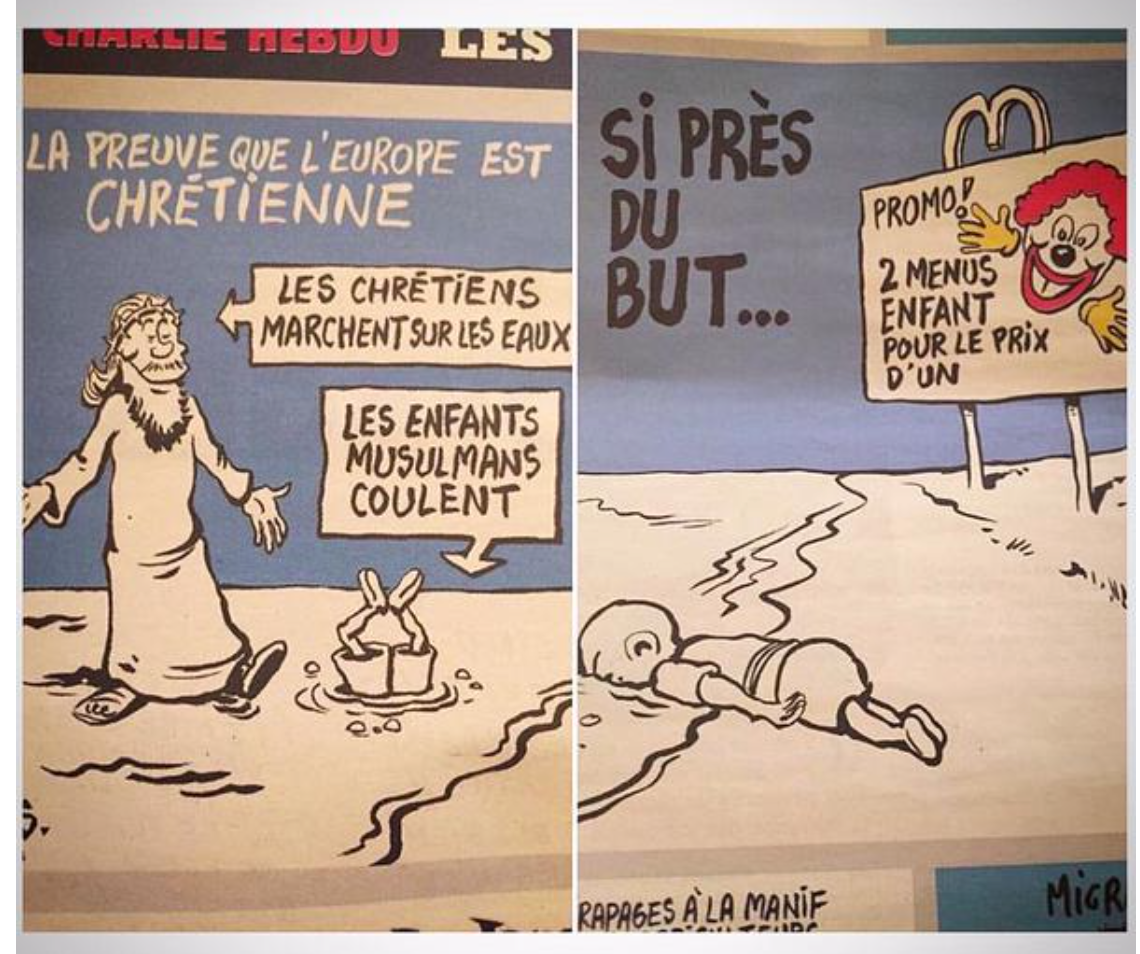
Missing the Point of Charlie Hebdo. Again. – The Daily Beast on satire

Charlie_Hebdo_RefugeesGreat point on once again how many critics of Charlie Hebdo don’t get satire (the offending cartoon above):

Satire is, by definition, offensive. It is meant to make us feel uncomfortable. It is meant to make us scratch or heads, think, do a double-take and then think again. It is supposed to take our prejudices, turn them upside down, reapply them, and make us think we’re seeing something we’re not, until we stop to question ourselves.

Yes taste is always in the eye of the beholder. But that’s the whole point of goodsatire. It is not meant to be to our tastes. It is meant to challenge our tastes. Having our fundamental assumptions about life challenged is never a comfortable thing. Bringing this back to the subject at hand, far from insulting him, these cartoons about Aylan are a damning indictment on the anti-refugee sentiment that has spread across Europe. The McDonald’s image is a searing critique of our heartless European consumerism, in the face of one of the worst human tragedies of our times. In particular, this image plays on the notion that while we moan there are not enough resources to cope with the influx of refugees, we simultaneously offer two for one McDonald’s Happy Meals to our own children. The image about Christians walking on water while Muslims drown is — so — critiquing what the magazine views as hypocritical European Christian “love” and truly bigoted claims, such as Hungarian Prime Minister Viktor Orban’s, that Europe is a “Christian” civilization.

Hebdo is no more racist a magazine than that bastion of liberal media The New Yorker was when it depicted Obama dressed as a Muslim, fist-bumping his angry black-revolutionary wife Michelle.

Not to our taste? Okay. Make us cringe? Fair enough. Don’t like them? Fine. But whatever we do, let us not misrepresent these images. Juxtaposing images of a dead child next to offers of cheap food “meal deals” is not mocking little Aylan, it is mocking us. It is mocking us for what we miss every single day, hidden in plain sight, and we do not see it because this is how desensitized we have become to human suffering. No, those besieged, brave satirists at Hebdo are not mocking Aylan. They are mocking newspaper covers like this from the UK right-wing tabloid The Daily Mail in which an image of Aylan was — in a national newspaper —  placed below an actual food deal. And how many of us noticed that on the day this Daily Mail cover went to print?

Poe’s law refers to a standard by which satire can be judged to be too good, where parodies of extreme views are so well performed that they are indistinguishable from the real thing. Yes, if those courageous disturbers of our conscience at Charlie Hebdo — those who survived the massacre that is —- are guilty of anything, it is that they are too good at their job.

Source: Missing the Point of Charlie Hebdo. Again. – The Daily Beast