True test of Canadian citizenship is in how we welcome Syria’s refugees: Charles Foran

Charlie Foran of the Institute for Canadian Citizenship on the test for all Canadians:

In most regards, Syrians are like every other refugee group. We’ve been reminding ourselves lately of how well we managed with the Vietnamese in the late 1970s, and the Hungarians in the late 1950s. There is a certain degree of false comfort in this. Surrounding these good-news stories, of course, have been numerous other arrivals, many of whose rights we violated. Japanese internment camps shouldn’t be forgotten. Nor the turning away of Jewish refugees from the Holocaust, or Sikhs aboard the Komagata Maru in Vancouver harbour.

To explain Canada’s often begrudging acceptance of immigrants, some of us insist on arcing all the way back to a foundational narrative to make the point. In the spring and summer of 1847, the sleepy colonial outpost of Toronto had its population involuntarily tripled by boatloads of Irish escaping the great famine. “A calamity upon the Province,” is how one emigration agent described the hasty influx of 40,000 impoverished Celts.

Locals, then largely of British extraction, felt much put upon, and didn’t like the Irish showing up in such large numbers, and in such a woeful state. They treated the newcomers badly. But things turned out okay for sleepy Toronto, now the astounding GTA, and the province, and, for that matter, Irish-Canadians. They’ve turned out okay for most everyone else, as well.

With the Syrians, however, there are, unfortunately, uneasy circumstances. None emanates from the refugees themselves, it must be stressed – all are projections upon them. Some people try to draw dark links between a global religion and a virulent extremist movement. Suspicions of guilt are being raised, based on ethnicity and geography alone. Most of the accusers are scared and ignorant, but some are craven and cynical, intent on havoc.

Little in reality confirms these anxieties – terrorists don’t huddle in camps for years and then apply to immigrate; terrorists are usually homegrown – but they exist. In Europe, especially, the sane political centre may be at temporary risk. In the United States, there is Donald Trump, among other worries.

“Alienness,” the author Pico Iyer writes, “inheres not in a place or object, but in our relation to it. Our fears – of course – are as irrational as our dreams.” In the 21st-century Canada I’ve been outlining, it isn’t easy to hold on to those irrational fears of the proverbial alien or “other.” There is just too rapid and ongoing a dissolve of us-and-them divisions for such narrow, dismal thinking to survive scrutiny.

Even so, we’ve already had the election niqab controversy and the Peterborough mosque attack, and it is naïve to assume 2016 will pass without further attacks and signs of strain. Whatever they are, we’ll need to remain calm and assured, and stand our values’ ground. Those values can be, must be, expressed through gestures of welcome, large and small.

For example, I work at the Institute for Canadian Citizenship (ICC), a not-for-profit based in downtown Toronto. One of our programs is the Cultural Access Pass (CAP). It provides new citizens a year of free admission to more than 1,200 cultural attractions, parks and historic sites across the country, and is a modest way of issuing a welcome, and encouraging a sense of belonging. For 2016 we’re going to extend a version of the pass to the Syrians, to say the same, and in case others might be sending them different messages.

Passing our collective citizenship test in 2016 will involve making many such gestures, along with a real thoughtfulness and self-awareness about the “defining moment” the Governor-General has described.

It isn’t just about the year ahead, either. It is about the years, decades, to come.

It is also about 2017, and the 150th anniversary of Confederation. Celebrate the sesquicentennial, we all surely will. But the anniversary should also serve as the next platform to engage in honest exchanges about the kind of country we once were and the kind of country we’re in the process – always the process – of becoming.

Accepting, embracing, the present and future Canada may compel a still greater appetite for the necessary self-examination around issues concerning our complex history with immigrants and First Nations, Métis and Inuit. We sure do need to make a few things right.

If we can keep working on this while celebrating, in 2017, then the next Syrians – whoever they prove to be – will be likewise welcomed, and the next group again after that. The statistical destination of 2030 may soon cease to have any real meaning: By then, we’ll probably already be that bold post-nation-state Canada, with its plurality of minorities and advanced citizenship.

Source: True test of Canadian citizenship is in how we welcome Syria’s refugees – The Globe and Mail

Kelly McParland: Refugee hysteria reaches a new low with plan to search migrants for jewelry

Contrast with Canadian approach striking, as is sad state of conservatism:

Perhaps it had to come to this.

In the squalid competition for the most wretched position on Middle East refugees, Denmark can claim a new low. Having already placed an ad in Lebanese newspapers making clear to asylum-seekers they weren’t welcome, the Danish government is debating a new measure: it wants to seize their jewelry.

In an email to the Washington Post, the Danish integration ministry said the bill — which is expected to pass — would empower officials to search the clothes and luggage of asylum-seekers “with a view to finding assets which may cover the expenses.” Authorities would allow claimants to keep “assets which are necessary to maintain a modest standard of living, e.g. watches and mobile phones,” or which “have a certain personal, sentimental value to a foreigner.”

It is only looking for items with considerable value: for example, the minister of justice said on TV, refugees arriving with a suitcase full of diamonds.

One wonders why a person with a suitcase full of diamonds would need to plead for a place to live, especially one as distant and chilly as Denmark. And while they’re at it, why not search their teeth for gold fillings? But the abject assault on people fleeing the chaos of Syria and Iraq isn’t troubled by simple logic. It’s all about fear, bias and discrimination. Unfortunately, it’s also a cause that has been taken up with enthusiasm by right-wing politicians and ultra-conservative governments, who see political gain to be had in spreading hysteria.

Akos Stiller/Bloomberg

Akos Stiller/BloombergHungary’s Prime Minister Viktor Orban

Conservatism is not about hate, bigotry or exploiting the needy. But its brand is in danger of being permanently tarred by the outspoken braying of demagogues like Donald Trump, or small-minded governments like those in Denmark, Poland and Hungary. The Hungarian government’s response to the flood of people fleeing Syria was to erect a razor-wire fence, accompanied by Prime Minister Viktor Orban’s declaration that Muslims were not welcome and his rejection of European Union resettlement quotas. Hungary’s fence forced others to soon erect their own, as each sought to direct asylum-seekers elsewhere.

The ugliness of discrimination is not lessened by the political gains it sometimes brings.

Poland’s newly-elected right-wing government announced it would refuse to accept the 4,500 refugees assigned it under the quota system, reversing the acceptance of the previous government.

Trump, of course, has assured himself the attention he so openly craves with increasingly loathsome remarks about the purported threat of the refugee hordes. His proposal to ban all Muslims from entering the U.S. — even though the U.S. has millions of honest and patriotic Muslim citizens – has been overwhelmingly denounced, but succeeded in cementing his runaway lead in the Republican presidential sweepstakes.

The ugliness of discrimination is not lessened by the political gains it sometimes brings. The more Trump is attacked, the more support he seems to gain. Orban’s policies were initially reviled, but have been highly popular in Hungary and are now being quietly studied across the EU. Poland’s government was elected on the back of anti-immigrant fervour, and includes a stark anti-Semitic streak.

It’s a trend that should be roundly condemned, and resisted at all costs.  The new Liberal government, of course, has begun accepting — indeed, welcoming — refugees to Canada, and has pledged more aid for those still overseas. Canada’s interim Conservative leader Rona Ambrose has made clear her party welcomes refugees and will continue Canada’s tradition as “a compassionate country and … compassionate people.” The point can’t be made strongly enough, and whoever succeeds Ambrose as leader should ensure it is a bedrock of future policies. There will come a time when the hysteria will subside and people will look back in embarrassment at the ugliness of the debate it has inspired. Canadians should ensure that when that time comes, they won’t be among those with something to regret.

Source: Kelly McParland: Refugee hysteria reaches a new low with plan to search migrants for jewelry

China’s ‘hidden generation’: plea to give citizenship to stateless children of trafficked North Koreans | South China Morning Post

Under-reported:

Campaigners have urged Beijing to give citizenship to a “hidden generation” of stateless children born to trafficked North Korean women forced into marriage or prostitution in China.

They said an estimated 20,000 to 30,000 children born to North Korean women in China have no nationality and therefore cannot access education, health care and basic rights that most people take for granted.

If their mothers are deported, they are often abandoned by their Chinese fathers, leaving them effectively orphaned, according to the European Alliance for Human Rights in North Korea.

Thousands of North Koreans have fled hunger and oppression in the secretive state since a famine in the mid-1990s. Many are in hiding in neighbouring China, which considers them illegal migrants.

The plight of their children is outlined in a report by the rights group co-authored by Yong Joon Park, a teenager now living in Britain who grew up stateless in China.

They treated him badly. His life was worse than the starving children in North Korea. His mother, Jihyun Park, said traffickers sold her as a wife to a poor Chinese farmer after she fled North Korea in 1998.

When their son was five in 2004 she was reported to the authorities and deported back to North Korea.

There she was sent to a labour camp where she endured “horrific conditions” and prisoners were “worked harder than animals”.

“All I could think of was seeing my son again,” said Park, who eventually managed to escape and return to China.

She found her son, but barely recognised him. His skin was filthy and flaking, and when he was hungry he was sent outside to pick up grains of rice from the ground.

“They treated him badly. His life was worse than the starving children in North Korea,” she said. “The Chinese government does not give children like my son a nationality so they cannot go to school.”

She and her son managed to cross the Chinese border into Mongolia and later moved to Britain and were accepted as refugees.

“When my son arrived in the UK he was nine. It was the first time he had a nationality and the first time he went to school.”

Now 16, he scored straight As in his exams this year and is hoping to go to university to become a lawyer.

Source: China’s ‘hidden generation’: plea to give citizenship to stateless children of trafficked North Koreans | South China Morning Post

Refugees and the long political journey: Martin Patriquin

A reminder, as if needed, just how much can change with new political direction, and the ideology and values of the previous government’s restrictive approach. Must read:

Given all this, I asked Vassallo, a 27-year CIC veteran, why the Canadian government took so long to get comparatively few suffering souls to this country. “I can’t answer that, it’s a political question,” he said, with a hint of a smile.

Unfortunately, Vassallo is right, and his non-answer is a reminder of what happens when a life-or-death issue of refugees gets fed into the cauldron of partisan politics, then further distilled by an at times ugly election campaign. In a sense, the machinations by which potential refugees are sorted and selected should be as apolitical as, say, getting one’s license renewed. Yet as the previous Conservative government demonstrated, there was a distinct attempt to shape and direct the work of its civil servants here and overseas when it came to the victims of the crisis in Syria.

Last January, Stephen Harper’s government announced plans to bring in 10,000 Syrian refugees over three years. Yet several months later, only about 10 per cent of this number had been admitted—in part, it seems, because of a directive from Harper’s office itself that attempted to halt the screening process. At the time, it was presented as a security measure “to ensure the integrity of our refugee referral system,” as Citizenship and Immigration Minister Chris Alexander put it at the time.

Numerous sources, including one with first-hand knowledge of the processing of refugees, said the directive was less about security than about ensuring that Christian minorities took precedence over Muslims. “You got the feeling they were trying to cherry pick religious minorities,” one source said. (Syria, which is majority Sunni Muslim, has a sizeable Christian minority.)

It took the picture of Alan Kurdi, whose lifeless body washed up on a Turkish beach, for the government to slacken the reigns somewhat. Because Kurdi’s family was trying to reach Canada, the political intonations on the Harper election campaign were profound. On Sept 10, eight days after the picture made headlines worldwide, the government waived the stipulation that “resettlement candidates” must provide information regarding why they fled their country of origin.

“Going forward, unless there is evidence to the contrary, visa officers will be able to presume those fleeing the conflict meet the definition of a refugee, which will make processing faster,” reads a CIC briefing document.

There is a certain irony in this. The  government to first make a significant security-related change to the processing of refugees—arguably making it easier for Syrians and Iraqis to make it to these shores—was that of the ostensibly security-first, tough-on-terror Stephen Harper. And he did so as a political calculation, out of fear of losing an election.

Meanwhile, the “security concerns” that supposedly prevented the Harper government from increasing the numbers of refugees brought to Canada were seemingly a partisan mirage. “There have been no shortcuts to the process. They’ve accelerated it in the sense that they’ve sent over additional personnel,” Tim Bowen, chief of operations for Canadian Border Services Agency, told me. According to CIC staff, this includes the addition of some 500 officials deployed overseas to help with the effort, including between 50 and 70 visa officers.

Thankfully, there is a happy ending. First and foremost, refugees are finally arriving. Secondly, the Conservatives are critiquing the effort exactly as they should: on purely financial grounds. The refugee resettlement program will cost $671 million. It is a huge amount of money, and Conservative immigration critic Michelle Rempel promised to hold the government to account. “It is one thing to inspire Canadians, it’s another thing to be accountable to them,” she said.

That Rempel said as much without a fear-mongering whisper about “security concerns” shows how far the party has come in two months.

Source: Refugees and the long political journey – Macleans.ca

Canada’s refugee program draws praise around the world

Not surprising that the contrast in language and action noted.

Reinforces the branding strategy of “Canada’s back”:

Only a small fraction of Canada’s expected Syrian refugees arrived last week, but the fanfare around their welcome prompted a slew of headlines – and policy comparisons – around the world.

To New York Times editors, Prime Minister Justin Trudeau “spoke unmistakably to a broader audience” when he personally greeted refugees stepping off Canada’s first government-organized flight, which landed in Toronto late Thursday night.

“Canada’s generosity – and Mr. Trudeau’s personal warmth and leadership – can serve as a beacon for others,” said a Saturday editorial in the newspaper.

“In the meantime, it puts to shame the callous and irresponsible behaviour of the American governors and presidential candidates who have argued that the United States, for the sake of its security, must shut its doors to all Syrian refugees.”

The Thursday plane load to Pearson International Airport, along with a second flight that arrived in Montreal on Saturday, brought just 324 of the 25,000 refugees the Trudeau government has promised to help resettle, including 10,000 by the new year.

But video of their arrival drew hundreds of thousands of views in Canada and elsewhere. The flights coincided with controversy in the United States after Republican presidential front-runner Donald Trump announced a proposal to ban entry of all Muslims to the country.

With many state governors opposing refugee resettlement, several American news organizations noted the widespread support among Canadian leaders for the federal plan.

The Los Angeles Times spoke to Perrin Beatty, the chief executive of the Canadian Chamber of Commerce and a former Tory defence minister, who is working with Canadian Labour Congress president Hassan Yussuff to support the government’s effort.

Mr. Beatty was quoted as saying that Mr. Trump’s “rancid” comments would “drive Canadians in the other direction,” increasing their support for the refugees.

Britain’s Daily Mail wrote that all of Canada’s premiers support the refugee plan, and that members of the opposition, including Conservatives, attended the airport welcome, along with the ministers of Immigration, Health and Defence.

The British government has said it plans to resettle as many as 20,000 Syrian refugees by the end of 2020, and the U.S. government plans to take in at least 10,000 next year.

More coverage followed at Newsweek, the BBC, NBC, Paris Match, CNN, and the Guardian and Independent newspapers in Britain. The American magazine GQ called Mr. Trudeau a “sparklepile of progressive sunshine” at a time when U.S. politics is “a clown show of ventriloquized garbage bags.”

However, The Washington Post noted that recent polls show a similar level of public support in Canada and the United States for welcoming refugees, despite a drastically different tone of public debate south of the border.

A Forum Research poll conducted this month found that 48 per cent of Canadians approve of Mr. Trudeau’s refugee plan and 44 per cent are opposed. The Washington-based Public Religion Research Institute found late last week that 53 per cent of Americans support refugee resettlement, while 41 per cent are opposed, the Post wrote.

News organizations in other countries that have opened their borders to a flood of refugees, particularly in the Middle East, also published articles exploring the significance of Canada’s fledgling program.

“Canada’s programs are an expression of support to Syrian refugees, but importantly for us they are a demonstration, too, of solidarity to countries in the region hosting more than four million Syrian refugees,” Adrian Edwards, a United Nations spokesman, said in a Reuters article published in the Arab News, an English outlet in Saudi Arabia.

Source: Canada’s refugee program draws praise around the world – The Globe and Mail

Liberals promise to bring back refugee health benefits cut by Conservatives

No surprise, in platform and mandate letters, reversing a mean and nasty policy, one ultimately that would cost society more in the long-run:

The federal Liberals say they are poised to restore refugee health benefits trimmed by the previous Conservative government.

Health Minister Jane Philpott says an announcement will come very soon to reverse the cuts to refugee health care and, in the meantime, the needs of Syrian newcomers will be covered.

Prior to 2012, anyone awaiting a refugee status decision had their health care costs — including dental, eye care and medications — paid for by the federal government until their application was decided and provincial health coverage kicked in.

But in June that year, the Conservative government drastically scaled back the available coverage.

The Conservatives launched a challenge to a Federal Court ruling that found the changes they had made to the health-care system for refugee claimants were unconstitutional.

They also reinstated some of the benefits, though not all, to comply with the court ruling.

Source: Liberals promise to bring back refugee health benefits cut by Conservatives

First large group of Syrian refugees on government plane arrive in Canada: Diversity and Inclusion language

Consistent welcoming and inclusive language:

The first large group of Syrian refugees coming to Canada by government aircraft arrived in Toronto late Thursday night, with Prime Minister Justin Trudeau on hand to welcome them at a temporary processing centre at Pearson International Airport.

Trudeau was joined by the ministers of immigration, health and defence, as well as Ontario Premier Kathleen Wynne, local mayors and opposition immigration critics.

“They step off the plane as refugees, but they walk out of this terminal as permanent residents of Canada with social insurance numbers, with health cards and with an opportunity to become full Canadians,” Trudeau said.

“This is something that we are able to do in this country because we define a Canadian not by a skin colour or a language or a religion or a background, but by a shared set of values, aspirations, hopes and dreams that not just Canadians but people around the world share.”

All of the Syrians on board are sponsored by private groups, many of whom had filed the necessary paperwork months ago in order to bring in some of the estimated 4.3 million Syrians displaced by the ongoing civil war in that country.

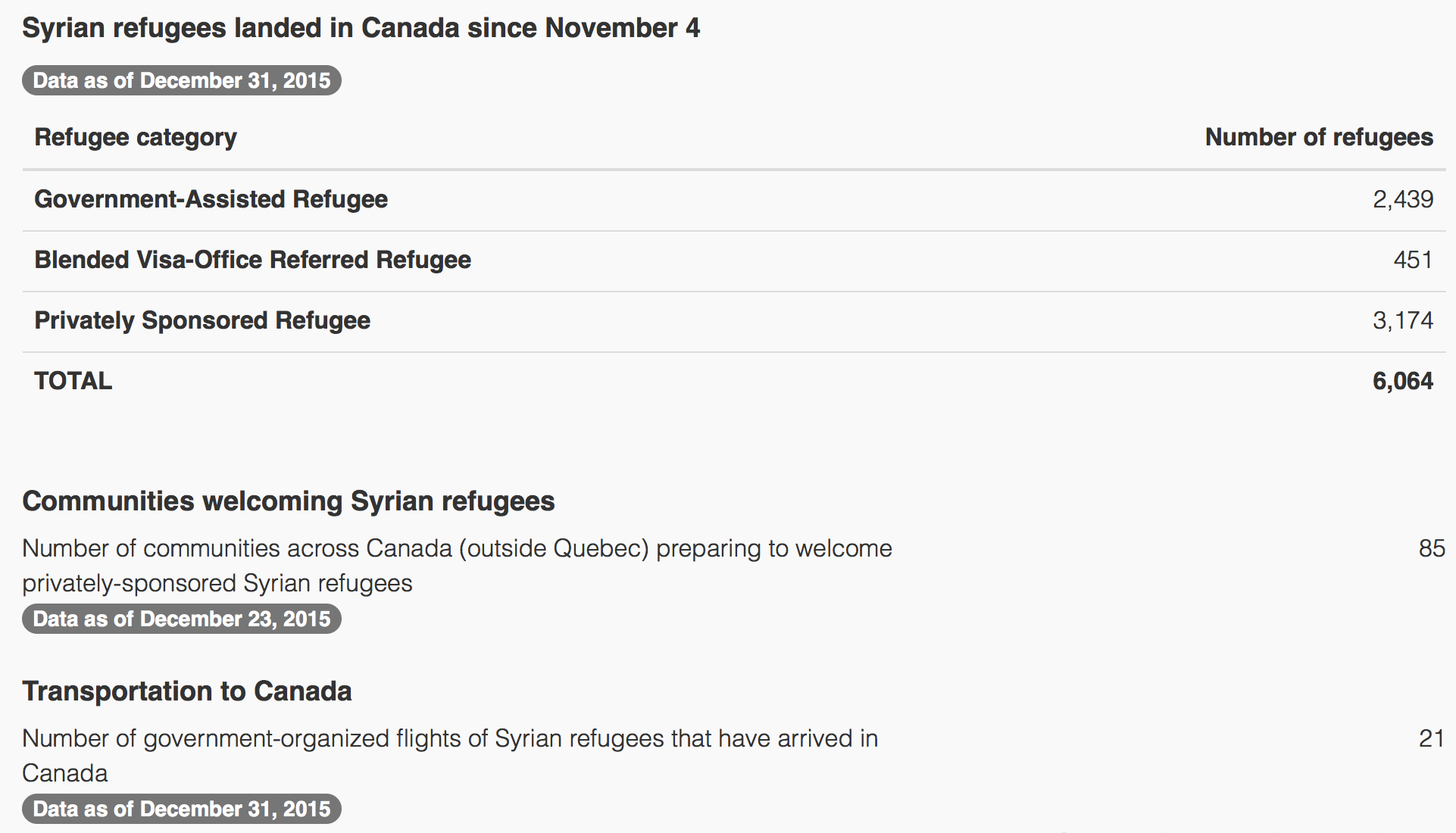
More than 400 refugees have already arrived on commercial flights since the Liberals took office on Nov. 4.

Just before the aircraft arrived, the prime minister thanked the staff and volunteers helping to process and welcome the 163 refugees.

“How you will receive these people tonight will be something they will remember for the rest of their lives, but also I know something that you will remember for the rest of your lives,” Trudeau said.

“So I thank you deeply for being a part of this because this matters. Tonight matters, not just for Canada but for the world.”

Source: First large group of Syrian refugees on government plane arrive in Canada – Macleans.ca

Distinct societies: Why Canada, U.S., diverge on Syrian refugees: Adams

Michael Adams on the contrast between Canada and the USA:

Americans certainly enjoy unique latitude in the individual pursuit of happiness, but the pursuit of happiness doesn’t always look like much fun. In an environment where there is a lot to fear (financial ruin in an unforgiving system, illness leading to bankruptcy, gun violence inflicted by a stranger, a family member, or an unsupervised toddler), it is perhaps not surprising that some are eager to control the one variable that seems like a no-brainer: don’t give jihadists a green card. But one of the San Bernardino jihadis seems to have been born in Chicago. The “big and beautiful wall” Donald Trump proposed to build to keep dangerous people out of America would require complex architecture indeed. No society is or can be perfectly safe. But societies that have traditionally put a little more stock in collective well-being seem to have better odds. To be fair, those safer, quieter places have also not been the birthplaces of Apple, Google, Tesla, Amazon, Wikipedia and the first man on the moon.

As I have written elsewhere, despite the current apparent spasm of xenophobic sentiment and the din of gun violence, our values research suggests that in fact Americans’ values are tilting in a slightly more Canadian direction – toward greater openness to social difference, a more nuanced sense of personal autonomy, and even a less suspicious attitude toward government. The shift is by no means a sea change, but the election of Mr. Obama (twice) was indeed the product of deep and meaningful changes in the electorate, no matter how lonely he may sometimes appear in White House press briefings these days. As younger voters, women (especially single women), and America’s diverse, city-dwelling voters become more influential politically, America is changing. But those who are on average less keen on this direction of social change (older, more conservative, whiter, more religious and patriarchal voters) have some innings left, as the tremendous polarization of U.S. political discourse attests.

What will become of America in the next election cycle and beyond? And how will the noisy debates and decisions of our neighbour to the south influence our own public conversations and political aspirations? As we wait to welcome 25,000 Syrian refugees, Canada feels like a fairly peaceable corner of a turbulent world. Recent reports suggest, however, that of the more than 25,000 refugees interviewed by the UN, fewer than 2,000 were interested in coming to Canada. Many are likely hoping for reunification with family members in Europe. It would be interesting to know how many are holding out for their shot at the American Dream.

Source: Distinct societies: Why Canada, U.S., diverge on Syrian refugees – The Globe and Mail

Donald Trump’s no-Muslims immigration idea right in line with U.S., Canadian history

Canada, of course has its equivalents (Chinese head tax and related restrictions, World War 1 internment, Continuous Journey clause, Japanese World War 2 internment, restrictions on Jewish immigrants etc):

1.Chinese Exclusion Act of 1882

exclusion_act

The first page of the Chinese Exclusion Act of 1882. (U.S. National Archives and Records Administration)

The first major law restricting immigration to the U.S. was the Chinese Exclusion Act, which barred all Chinese people from entering the United States.

Signed into law on May 6, 1882, the act came amid outcry from American-born citizens that Chinese workers were to blame for the high unemployment and declining wages plaguing the West Coast.

Not only did the law bar Chinese immigration, but it also prevented Chinese people already living in the country from gaining citizenship.

The law, originally written to last 10 years, was repeatedly amended and extended until its repeal in 1943, when China became an ally against Japan during the Second World War.

2. Immigration Act of 1917

This U.S. federal law was the first to restrict immigration to those who could pass a literacy test.

It also banned all immigration from the so-called “Asiatic Barred Zone,” which encompassed  India, Afghanistan, Persia (now Iran), Arabia, parts of the Ottoman Empire and Russia, Southeast Asia and the Asian-Pacific islands.

Furthermore, it expanded an already-existing category of barred “undesirables” to include sex workers, criminals, alcoholics, political radicals, contract labourers, “idiots, imbeciles, and [the] feeble-minded,” people with epilepsy, tuberculosis or contagious disease, as well as anyone else deemed “mentally or physically defective.”

3. Chinese Immigration Act of 1923

The United States wasn’t alone in discriminating against Chinese immigrants.

In Canada, the federal government imposed a $50 head tax on Chinese immigrants in 1885 after Chinese workers were no longer needed to work on the Canadian Pacific Railway. The amount was raised to $500 in 1903, the equivalent of about two years’ wages at the time.

On July 1, 1923, the head tax was replaced by the Chinese Immigration Act, which barred any Chinese immigrants — or ethnic Chinese people of other nationalities — from entering the country. There were some exceptions for merchants, diplomats and foreign students with proper documentation.

Canada also cast suspicion on those already living here, forcing all people of Chinese origin or descent to register with authorities and to obtain an identity certificate.

The act remained in effect until 1947.

4.Immigration Act of 1924

Travel-NYC-Holocaust Exhibit

In this 1938 photo, prospective immigrants line up outside the U.S. consulate in Vienna after the German annexation of Austria. American Jews struggled to get refugees out of Nazi-era Europe due to strict immigration quotas in the U.S. (Museum of Jewish Heritage/ Franklin D. Roosevelt Presidential Library/Associated Press)

In an attempt to stem the tide of eastern European immigration to America, the U.S. enacted a quota system, stipulating that visas be provided only to two per cent of the total number of people of each nationality in the United States as of the 1890 national census.

Because so many eastern Europeans moved to the U.S. in the decades leading up to the First World War, lawmakers opted not to use the more recent census of 1910 to calculate the quotas.

The act also barred entry to “any alien who by virtue of race or nationality was ineligible for citizenship” — a provision aimed at the Japanese.

The effects of the quota system were particularly devastating for European Jews, who struggled to obtain visas leading up to the Second World War and the Holocaust.

5. ‘Excessive demand’

The Canadian Immigration and Citizenship Act states “a foreign national is inadmissible on health grounds if their health condition might reasonably be expected to cause excessive demand on health or social services.”

This wording has been used to bar entry of people with illnesses or disabilities.

In 2011, a South Korean family living in New Brunswick faced deportation because their teenage son is autistic. The deportation order was later reversed amid public outcry.

Again in 2012, the National Post reported that a University of Victoria professor from the U.S. and his family were denied permanent residency in Canada because their four-year-old son’s autism.

Source: Donald Trump’s no-Muslims immigration idea right in line with U.S., Canadian history – World – CBC News

ICYMI: Ex-immigration minister Atkey urges Canada to double intake of Syrian refugees

A historical reminder and it appears the Government is listening:

As Canada braces for the arrival of 25,000 Syrian refugees, the man who served as immigration minister during the Vietnamese boat people crisis says Ottawa should be doing much more.

Ron Atkey believes the 25,000 Syrians Ottawa is promising to re-settle initially is a “noble objective” but he wants Canada to up the ante.

“If Canada can do another 25,000 — that would make a significant contribution in line with Canada’s contribution with the Vietnamese boat people in 1979 to 1980. It will demonstrate to the Americans that they have to do more. We’ll shame them into it, similarly the Australians,” says Atkey, who was immigration minister in the Joe Clark government in 1979 when 50,000 Vietnamese refugees were granted asylum in Canada. By the end of 1980, that number had risen to 60,000.

Canada admitted 60,000 Vietnamese refugees in 1979 and 1980.

Canada admitted 60,000 Vietnamese refugees in 1979 and 1980.

“For us to take a dramatic position on the world stage is important. We won a medal from the United Nations High Commission for Human Rights. We gained a lot of prestige as a humanitarian country. I think that’s consistent with Canadian tradition.”

Atkey, who is also a lawyer, professor and national security expert, is chair of Humanity Wins, a group of prominent Canadians who came together earlier this year to advocate for re-settlement of Syrian refugees to Canada.

Source: Ex-immigration minister urges Canada to double intake of Syrian refugees | Toronto Star