Muslim Refugees Were Admitted at a Lower Rate During Trump’s Refugee Ban – The New York Times

Numbers tell the story:

During the week when President Trump’s refugee ban was in effect, refugees were allowed in on a case-by-case basis. Just 15 percent of the 843 refugees who were admitted during this time were Muslim, compared with a weekly average of 45 percent in 2016.

Only two refugees were allowed in from the seven Muslim-majority countries affected by President Trump’s travel ban. About 1,800 refugees from these countries had arrived in the United States every week on average since 2016.

A tougher refugee border pact? America said no. Former Minister Kenney

Useful to hear former immigration minister Kenney’s comments and history of earlier discussions, although his reassurances of the safeguards in the US system, while generally correct, understate some of the significant differences between the Canadian and American approaches (even pre-Trump):

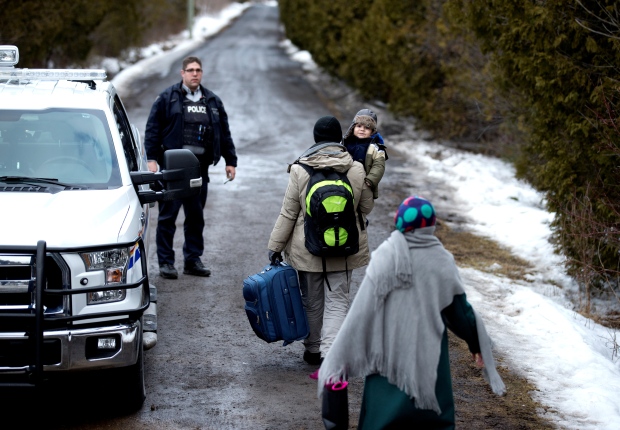
The sometimes tragic phenomenon of asylum-seekers crossing fields in Manitoba and ditches in Quebec has prompted many immigration experts and some politicians to call for changes to the Canada-U.S. pact that makes border hopping the only choice for people urgently seeking refuge. That is: stop shuttering our front doors, our border entry posts, to those desperate for safety and legal protection they want in Canada.

There are those on the other side of the status quo who wish for a way not only to keep the door shut, but to press down on the windows people are finding their way through. One of them is Jason Kenney, Canada’s former immigration minister.

In the face of pressure on the Liberal government to suspend the Safe Third Country Agreement, Kenney has called on Ottawa to instead demand renegotiation with the U.S. to eliminate the de facto exemption which lets people making so-called “irregular” border crossings into Canada’s refugee determination system. Irregular crossing, in this case, means getting one’s feet on Canadian soil somewhere other than an established port of entry.

If it granted such a request, the Trump administration would take pressure off Canada’s asylum program in a way the Obama White House refused to do. Kenney told Maclean’s he made this pitch when he was minister; his counterpart in Washington said no.

“I approached then secretary of homeland security (Janet) Napolitano with a request to reopen the STCA for renegotiation to remove this and other exemptions,” he said in an interview Friday on the sidelines of the Manning Centre Conference. “They basically refused to do so, because I quite frankly think they cynically saw these exemptions as operating in favour of the United States. To put it bluntly, if people whom they regard as illegal aliens go to Canada, they don’t have to worry about them any more, or remove them.”

If the Obama administration was unwilling to change rules to keep asylum seekers on his side of the border, what chance is there the new U.S. government would? Among the administration’s policies is a recent order from John Kelly, the new Homeland Security secretary, which would deport undocumented immigrants to Mexico even if they hailed from other Central American countries—a signal this White House is unconcerned about immigration conventions or norms, as long as foreigners perceived as problematic are out of the country.

…His meeting with Napolitano came about while he was crafting new policies to overhaul refugee laws to deter questionable claimants. While he failed to enact a border crackdown, he did speed up the hearing process, create new options to detain asylum seekers and, controversially, limit their health benefits.

Still, refugee advocates in Canada continued their long-standing criticism of the safe third-country agreement, and have amped up their calls in the wake of Trump’s wide-ranging crackdowns on the immigration system, which included a suspension of refugee resettlement and beefed-up deportation and detention systems. These moves have prompted a spike in migrants crossing over to Canada, in hopes of a fair shake at becoming refugees here. Advocates argue that American bellicosity toward newcomers and refuge seekers puts lie to assertions the U.S. is a safe third country (though many of these critics opposed the border deal even before Trump entered politics).

Ministers in the Trudeau government have said they see no reason to abandon the agreement. Their position has gotten new support from the UN High Commission for Refugees. Jean-Nicolas Beuze, its new representative in Canada, told Maclean’s that the asylum conditions in the U.S. and Canada today are not sufficiently different from 2004, when the safe country pact was established, to warrant a change to the agreement. Having spoken recently to dozens of refugee claimants who entered Canada near the border post at Saint-Bernard-de-Lacolle, Que., Beuze said their “perception” of the Trump actions and rhetoric are prompting their escape north. But the agency, he said, will continue monitoring the situation.

Kenney said there’s no reason refuge-seekers currently in the U.S. should not seek asylum in that country, arguing that “hysteria” has driven the recent trend. “The United States has one of the world’s strongest, fairest asylum systems. It’s not administered by Donald Trump. It’s administered by the independent American judiciary and tribunals,” he said.

There are, in fact, substantial differences between how U.S. and Canada treat refugee claimants, some of them predating Trump. In the U.S., detention is vastly more common; in Canada, claimants have easier access to legal aid for refugee status hearings. Canada has an interim health-care program and gives readier access to work permits, among other benefits. The sharpest emerging contrast, however, is that of image: Trump has boasted of walls and ejections, and has particularly stigmatized Muslims (especially from certain countries) as potential terrorists. Trudeau has highlighted Canada’s openness, both through the Syrian refugee resettlement program and a globally rebroadcast tweet declaring welcome to those fleeing persecution, “regardless of your faith.”

The vast majority of border-hopping refugee claimants have been Muslims from Somalia, Syria, Yemen (all countries targeted by Trump’s now-suspended travel ban), as well as Turkey, Ghana, Djibouti and other countries.

Kenney said the Liberal government should bid to renegotiate the agreement as he previously tried to, as its current limitation “almost incentivizes these irregular crossings.” A sharp increase in the flow would massively burden our system “and blow a hole in the integrity of our immigration system,” he says—particularly if illegal immigrants fearing Trump-ordered deportations start joining the overseas migrants. “I think we need to be soft-hearted but hard-headed about this,” Kenney said.

“This is why I think it’s unhelpful for leaders like Prime Minister Trudeau to muddy the waters with what sounds like an open invitation for foreign nationals of the United States to come north,” Kenney went on. “We have immigration laws for a reason, so we can have an ordered, fair, compassionate, law-based system.  It really doesn’t help if you create the implication that Canada has open borders. We don’t, in our law.”

Source: A tougher refugee border pact? America said no. – Macleans.ca

A crisis is coming: If this many cross the U.S. border in February, how many will come by June? | Coyne

Another good column by Andrew Coyne, reminding that there is no easy solution for the refugees crossing the border, and the more realistic approach is a mix of measures:

I feel for Tony Clement. The Tory MP has been demanding the government “enforce the law” on the mounting numbers of asylum seekers who have been crossing the border from the United States, illegally, in recent weeks. But he found himself sputtering for air Tuesday when a CBC radio interviewer asked him what, specifically, he wanted the government to do, eventually hanging up in a snit.

It’s a good question, though: In what way are the police officers who have been arresting the would-be refugees as soon as they step on Canadian soil failing to enforce the law? The calls from Clement and other critics for a “crackdown” amount to a demand that illegal immigration should be made illegal, enforced by the arrest of all those who are currently being arrested.

But as I say I feel for Clement. Like him, I have no easy answers to this dilemma. Unlike him, however, I’m willing to admit it. The migration of peoples is one of the great motive forces of human history; when large numbers of people are determined to pick up and move somewhere, there isn’t a force in the world that can stop them.

That does not relieve us of the need to address what seems likely to grow into a considerable problem, if not a crisis. We Canadians have been congratulating ourselves at our greater tolerance as we watch Europe struggling with the sudden influx of hundreds of thousands of refugees from the Middle East, or the United States with the accumulated backlog of millions of illegal immigrants from Mexico and points south.

….That leaves … whatever it is the Tories are proposing. But what is that? The police are not empowered to arrest people until they are on Canadian soil — and the minute they do set foot, as asylum-seekers, they have rights, including the right to a hearing to adjudicate their claim.

Perhaps you believe they should be sent back without a hearing. But that is not Canadian law, and given Supreme Court rulings on the matter is unlikely to become law. And there is the little matter that in some cases this really would amount to condemning people to persecution, even death. A decent country — and a signatory to UN conventions — does not do such things.

The easiest of all answers — build a wall — would not just be expensive folly, as in the U.S.-Mexico example: it isn’t even a practical possibility. This is not a problem we are going to solve, but manage, by a combination of measures: by increasing our intake of immigrants and refugees; by adding more staff and resources to border control points; by prevailing upon the Americans, if we can, to preserve a humane and law-based immigration and refugee policy; and by turning back many of those who do apply, perhaps under a revised and extended Safe Third Country Agreement.

Liberals unveil resettlement plan for 1,200 Yazidis and other victims of ISIS

One of the few areas that the Conservative opposition has made a positive contribution. Michelle Rempel deserves full credit for pushing the government:

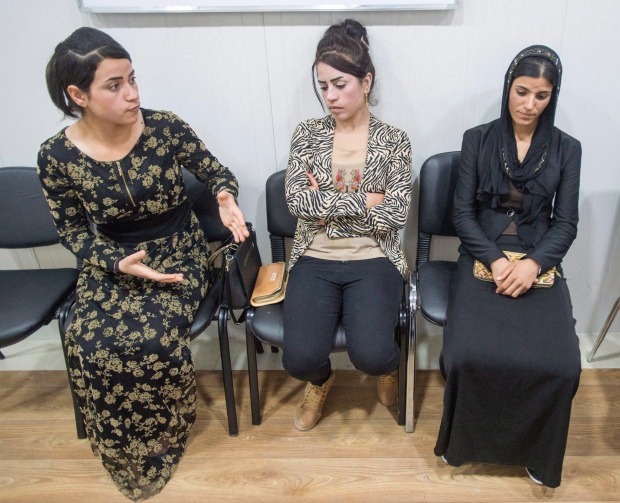
Canada plans to resettle 1,200 Yazidi refugees and other survivors of ISIS by the end of this year.

Immigration Minister Ahmed Hussen announced today that nearly 400 survivors have already arrived in Canada in the last four months since the House of Commons unanimously supported a Conservative motion that called on the government to provide asylum to an unspecified number of Yazidi women and girls.

Of those, about 74 per cent are Yazidi.

Canada has been given consent from the Iraq and Kurdish regional governments, which are supporting and co-operating with the plan, Hussen said.

The motion recognized that ISIS, also called Daesh, is committing genocide against the Yazidi people and holding many of the group’s women and girls as sex slaves.

Hussen said many of the newcomers will have far greater needs than other refugees who have come to Canada.

“Many have experienced unimaginable trauma and vulnerability, both physical and emotional, and many will have unique physical, psychological and social needs, such as trauma counselling,” he told reporters at a news conference in Ottawa Tuesday.

Survivors arriving at ‘controlled pace’

The survivors have been arriving on commercial flights at a “controlled pace” to avoid over-burdening support services. The federal government will also work with provincial, territorial and municipal governments to ensure unique ongoing needs are met.

Although the motion referred only to providing asylum to Yazidi women and girls, the 1,200 refugees will include male family members. Hussen said ISIS also deliberately targets young boys, so the program will help resettle all child survivors of ISIS.

The government will also facilitate private sponsorships of Yazidi refugees, he said.

Source: Liberals unveil resettlement plan for 1,200 Yazidis and other victims of ISIS – Politics – CBC News

Refugee claims at Canada-U.S. border have doubled over past 2 years

Will likely be an ongoing challenge under the Trump administration:

The number of refugee claims made at the border has more than doubled over the past two years, surging to 7,023 in 2016, according to the Canada Border Services Agency.

By comparison, 4,316 people sought refugee status in Canada at land border crossings in 2015 and another 3,747 did in 2014.

But the spike isn’t unusual and represents a return to the volume of refugees Canada has previously received, said Janet Dench, executive director of the Canadian Council of Refugees.

land border refugee claims

“The numbers may look high, but that is because the range you are looking at is one where Canada has been receiving unusually low numbers of claimants,” Dench said in an email interview, noting that there were more than 8,000 land border claims made annually from 1999 to 2004.

“So in the longer perspective, 7,000 is not a very large number,” Dench explained.

Canada changed the way it receives refugees in 2004 with the introduction of the Safe Third Country Agreement with the United States. The agreement says that people seeking protection must make their claim in the first country they arrive in. Canada must accordingly send asylum seekers trying to cross at the border back to the U.S.

21.3 million refugees around the world

In 2016, the largest group of people making refugee claims at border crossings in Canada came from Colombia, followed by Syria, Eritrea, Iraq and Burundi. There were 21.3 million refugees around the globe in 2015, according to the United Nations.

Lorne Waldman, a Toronto-based lawyer who specializes in immigration and refugee law, attributes the recent rise to geopolitical instability. For example, there was a dramatic rise in Turkish refugee claims in Canada following the coup in Turkey.

“The numbers tell stories and the stories are really related to what’s happening politically,” he said, noting that Canada observed a rise in Pakistani refugee seekers that arrived via the U.S. following the Sept. 11 attacks.

land border claims

Waldman said the election of U.S. President Donald Trump, who campaigned on a promise to crack down on immigration and recently tried to enact a controversial travel ban restricting travel from seven Muslim majority countries, likely contributed to the bump.

“As the situation deteriorates in the U.S., the likelihood that we’re going to see more people crossing is very high,” he said.

But, Waldman noted that there has long been a perception among asylum seekers — even before Trump took office — that the U.S. is not sympathetic to refugee claims.

Source: Refugee claims at Canada-U.S. border have doubled over past 2 years – Canada – CBC News

Is Trump’s refugee crackdown threat pushing asylum seekers into Canada?

is_trumps_refugee_crackdown_threat_pushing_asylum_seekers_into_canada____toronto_starNumbers still relatively small but significant increase:

Under the Safe Third Country Agreement, only those asylum seekers who have family already living in Canada or those who have already been refused refugee status in the United States will be considered for asylum if they show up at Canadian land border posts.

But those who cross illegally are exploiting a loophole in the law — the conditions of the Safe Third Country Agreement do not apply to people who are already in Canada when they make a claim for asylum.

The Canada Border Service Agency will not reveal how many asylum seekers are crossing into Canada illegally. But overall, there has been a sharp rise in the number of people seeking asylum in recent months.

In 2016, there were 2,529 asylum claims made at Quebec’s land border crossings, according to statistics from the agency. That figure averages out to 211 claimants each month.

But the numbers started to climb dramatically this fall. There were 289 refugee claimants in October, 369 in November and 591 in December.

Montreal immigration lawyer Éric Taillefer said his caseload of refugee claimants began to increase noticeably in December.

“Before I had one from time to time and now in December and early January there have been many,” he said, adding that most of his clients are from coming from Eritrea, Iraq and Libya.

“These are people who have fears of returning to their country of origin,” said Handfield.

Most of his clients are people who were already living in the United States, but others obtain tourist visas to travel to the U.S. and use that as the entry point for their trek to Canada. Despite American fears about border security since the Sept. 11 terrorist attacks, Handfield said it remains easier to obtain the necessary permissions to enter the U.S. than those required to enter Canada.

Source: Is Trump’s refugee crackdown threat pushing asylum seekers into Canada? | Toronto Star

Storm of reaction to news Syrian refugee charged with sex assaults

Good commentary by David Tait of Carleton University on how the media should and should not report on cases like this:

Reports that a man accused of sexual assaults on six Edmonton teenage girls was a Syrian refugee have ignited a firestorm of reaction, from anti-immigration diatribes to criticism about how the media dealt with the story.

Groups that work with refugees in the city have been inundated with calls and texts over the past 24 hours, some from people calling for an end to the refugee program and others from refugees themselves apologizing on behalf of their community.

Erick Ambtman, executive director of the Edmonton Mennonite Centre for Newcomers, said his organization received a message on Twitter from a white supremacist group that included a picture of a Syrian refugee, asking the centre to confirm whether the photo was the same man accused of the crimes.

“It may be just to scare us or to unnerve people,” Ambtman said.

“But around my office that’s what’s happening. People are starting to get really nervous, and the [English] language students are starting to get really nervous.

“And the Syrian students are apologizing for somebody who they don’t even know, because he’s got the same country of origin as they do.

“It’s really spiralling into a really ugly place.”

Soleiman Hajj Soleiman, 39, was arrested Saturday and charged with six counts of sexual assault and six counts of sexual interference after six teenage girls, all younger than 16, told police they were inappropriately touched while swimming at the West Edmonton Mall water park.

…When the media reports stories like this one, decisions about what information is relevant have to be made on a case-by-case basis and sometimes on a day-by-day basis, said David Tait, a professor at Ottawa’s Carleton University who has taught ethics courses at the journalism school.

“Journalists have to sort of go and look at a situation not from the standpoint of, ‘Is there public appetite for this information? Do people want to know it?’ But, ‘Is that detail relevant at this stage to this story?’

“And that’s a very difficult thing to determine as a journalist, because you also have to be careful that you’re not making your judgment for some sort of social engineering purpose.

“To say, ‘Oh I don’t want to make these sorts of people look bad’ or ‘I don’t want to make these sorts of people look good.’ You shouldn’t make your journalistic judgments based on how you want people to think about something, because that’s not the journalistic mission.”

‘Our job is to report what’s going on’

Tait said in this case, while reporting immediately after the arrest was made public, he would have questioned whether details about the accused’s background were relevant.

“My question would be, would we have run additional background details about this person if they were a gay man? A gun owner? If they were Jewish? If they were a fundamentalist Christian? If they were a recent arrival from the United States? If they were any number of other identifiers?”

It’s the responsibility of journalists to try to determine what the public needs to know to understand the story. Once the public has the information, people will make their own choices about what’s relevant to them, he said.

Some will seize on information that confirms their own views about the world and overlook other aspects of the story.

“Our job is to report what’s going on out there in the world,” he said.

The story about the water park allegation, Tait said, “is a classic example of where people these days are rushing to grab details, to use individual facts as weapons instead of looking at those details and saying, ‘How does this fit into my developing understanding of the world?'”

Ambtman said Soleiman came to Canada in January 2016 with his wife and six children, aged one to 13 years. The family was assisted by the Mennonite Centre.

Some commenters are exploiting the fact that a Syrian refugee has been charged with a crime, he said.

“They’re exploiting what’s happened to these girls to say something about immigration, and it’s just a really ugly thing to do. It’s been pretty awful to bear witness to.”

It will be up to the justice system to determine the facts of the case and, if a crime has been committed, punish the person responsible, he said.

“To make this about immigration is just absurd. What has happened is there has been a sexual assault at West Edmonton Mall and six girls are going to be traumatized likely for the rest of their lives because of a crime that somebody perpetrated on them. To me, that’s the concern.

The new underground railroad to Canada

Likely to accelerate under the Trump administration. Good long read by Jason Markusoff:

The taxi stopped at the side of the I-29 interstate after cruising north for about an hour. Their $400 in the cabbie’s pocket, he dropped off Seidu Mohammed and Razak Iyal a two-minute drive short of the North Dakota-Manitoba line. The driver pointed the men toward a darkened prairie field and a row of red blinking lights, wind turbines in the distance. Walk toward those lights, and they could grasp freedom.

“We didn’t feel any sign, but we could feel we are in Canada, because of the cold—very, very intense,” Mohammed recalls. By this point, they were a couple of hours into their trek through field and brush, unsure exactly where to stop. It was Christmas Eve, and fields outside Emerson, Man., were smothered in waist-high snow.

That “Canada” moment Mohammed recalls was a nasty wind gust that overwhelmed these underdressed African migrants, whipping off their flimsy gloves and Mohammed’s ballcap. By the time they wanted to dial 911 for police to retrieve them from the Manitoba roadside, their hands were frozen claws unable to grip a phone.

A trucker eventually rescued them, and a month later they were on a new, safer road, toward possible refugee status in Canada. But their frostbitten fingers are gone. Iyal has one thumb and a half-thumb left. Mohammed has nothing. As the 24-year-old former soccer player lies in his Winnipeg hospital bed a week after the amputation, the ends of his bandaged hands are left open to reveal the skin graft stapled over them to cover the wound. After recalling the extreme burning sensation of that night, the fear he might have died, he can’t stop staring at them in disbelief. “Look at my hands. Look, look,” Mohammed says, cheeks dripping with tears he cannot wipe away.

The duo’s frostbite was a tragic cap to a surprisingly busy year for unanticipated refugees sneaking into Canada via Emerson. The RCMP intercepted 515 refugee claimants crossing near the border post last year—more than in the three previous years combined. They’re intercepted rather than “caught” because they want the police to bring them to the Canada Customs office to make their refugee claims, something current rules don’t let them do by coming in Canada’s front door.

They’re seeking refuge to the north because they fear deportation under the tough U.S. asylum system that existed before Donald Trump—and more and more these days, they’re not even trying their chances in the harsher new regime. “When I got to Canada, I felt so happy. I escaped from Donald Trump,” says Mouna, a Djiboutian who walked across the border three weeks after the U.S. election. The Ghanaian pair’s widely reported frostbite has proven no horror-story deterrent for those desperately seeking safety and freedom. Thirty-nine more arrived to Winnipeg’s largest refugee centre for help in frigid January, including eight on the Monday after the new U.S. President’s refugee and travel ban.

Source: The new underground railroad to Canada

Trudeau must match words with action in Trump era, say critics, rights groups

Government is wise to wait and monitor before changing such a fundamental policy as safe third country. In the end, should the Trump administration continue with such policies, it will likely become harder to resist such calls, on both policy and political grounds:

Justin Trudeau’s invitation on Twitter to “those fleeing persecution, terror & war” attracted global attention as a subtle response to President Donald Trump’s order temporarily banning refugees and immigrants from seven Muslim-majority countries, but now Canadian opposition politicians and human rights groups want Mr. Trudeau to match his words with action.

Mr. Trump’s executive order banned refugees from resettling in the United States for 120 days and nationals from Iran, Iraq, Libya, Syria, Somalia, Sudan, and Yemen from entering the U.S. for 90 days. Thousands of people gathered outside of the U.S. embassy in Washington and consulate in Toronto to protest the decision Monday.

The prime minister’s “diversity is our strength” tweet sent the message that “regardless of [their] faith,” those seeking refuge will find an open door to Canada as the one in the U.S. temporarily closes.

The New Democratic and Green parties, along with Amnesty International’s Canadian and U.S. sections, in turn have called on the federal government to remove the U.S. as a “safe third country” for refugee determination under Canada’s Immigration and Refugee Protection Act.

A 2004 order-in-council giving the U.S. that designation, which was briefly overturned by the Federal Court and later reinstituted by the Federal Court of Appeal, requires most refugees travelling through the U.S. to Canada to make a claim for protection in the U.S.

Amnesty wants Immigration, Refugees, and Citizenship Minister Ahmed Hussen (York-South Weston, Ont.) to immediately rescind the U.S. as a safe country and allow refugees to cross the border and seek asylum in Canada. “The risk of not doing this is going to deny an avenue of protection for people who are going to need it in the days, weeks, and months to come,” said Alex Neve, secretary general of Amnesty International Canada, who believes that Mr. Trump might support the U.S.’s removal as a safe haven.

“It would mean more refugee claimants turning to Canada for protection rather than the United States, which seems to be what he wants,” said Mr. Neve. “Canada doesn’t have to issue a press release loudly and angrily denouncing the U.S.’s refugee-protection record. It’s something that can be done quietly and quickly through an order-in-council.”

Source: Trudeau must match words with action in Trump era, say critics, rights groups – The Hill Times – The Hill Times

No plans to change refugee target in wake of U.S. travel ban: immigration minister

Calibrated response:

As MPs debate U.S. President Donald Trump’s travel ban in the House of Commons, Canada has already confirmed it will not hike its refugee intake target in the wake of a contentious immigration and travel crackdown in the U.S., says Immigration Minister Ahmed Hussen.

Under pressure by the NDP, human rights groups and refugee lawyers to bring more asylum-seekers to Canada, the minister said Canada’s plan will not change in response to an executive order by Trump that suspends the U.S. refugee program and bars entry to nationals from seven Muslim-majority countries.

“Our immigration levels plan has an allocation that is historically high for refugees,” Hussen said. “We intend to maintain that plan.”

Canada’s 2017 immigration plan is set to accommodate 40,000 refugees.

Hussen also rejected calls to suspend the Safe Third Country Agreement, a pact which considers asylum-seekers safe in both Canada and the U.S.

“All the parameters of that agreement are in place and there is no change at this time,” he said.

MPs held an emergency debate Tuesday evening, which concluded around midnight, on the U.S. immigration and travel directives,.

Noting that the U.S. has now agreed to allow in 872 refugees who were already screened and in transit, and were previously denied entry, Hussen said that’s a sign the situation is evolving fast. He added that Canada will closely monitor developments.

“The responsible thing to do is to maintain contact, to continue to engage and make sure we monitor the situation closely to make sure we provide information to Canadians,” he said.

Ottawa U.S. Embassy Trump protest travel ban Jan 30 2017

People gathered outside the U.S. Embassy in Ottawa Monday afternoon to protest an executive order signed by President Donald Trump banning citizens of seven Muslim-majority countries from entering the United States. (CBC)

Call for ‘special measures’

NDP immigration critic Jenny Kwan, who requested the emergency debate, held a news conference Tuesday morning urging the government to lift a cap on privately sponsored refugees and to fast-track refugee claims.

The B.C. MP laid out a number of proposed “special measures” ahead of the debate.

“There is no question that this ban promotes hate and intolerance,” she said. “This ban will have a disastrous effect for thousands of innocent travellers and refugees.”

Calling it “absolutely shocking,” Kwan said the Trump travel ban will have a huge negative impact on the economy, as well as cultural and academic development.

…Conservative immigration critic Michelle Rempel used the debate to launch into an examination of whether Canada was effectively managing its own immigration file.

She questioned whether there was adequate funding to help refugees integrate into Canadian society, and whether it was wise to lift the visa restrictions on Mexicans coming to Canada.

“To respond to the immigration policies of other nations, we must first get our own house in order, and then through those actions, show the world what immigration policy best practice looks like,” Rempel said.