Australia election: Why is Australia’s parliament so white?

More on the lack of diversity among Australian politiciants:

Australia is one of the most multicultural nations in the world, but it’s a different story in the country’s politics, where 96% of federal lawmakers are white.

With this year’s election, political parties did have a window to slightly improve this. But they chose not to in most cases, critics say.

Tu Le grew up the child of Vietnamese refugees in Fowler, a south-west Sydney electorate far from the city’s beaches, and one of the poorest urban areas in the country.

The 30-year-old works as a community lawyer for refugees and migrants newly arrived to the area.

Last year, she was pre-selected by the Labor Party to run in the nation’s most multicultural seat. But then party bosses side-lined her for a white woman.

It would take Kristina Kenneally four hours on public transport – ferry, train, bus, and another bus – to get to Fowler from her home in Sydney’s Northern Beaches, where she lived on an island.

Furious locals questioned what ties she had to the area, but as one of Labor’s most prominent politicians, she was granted the traditionally Labor-voting seat.

Ms Le only learned she’d been replaced on the night newspapers went to print with the story.

“I was conveniently left off the invitation to the party meeting the next day,” she told the BBC.

Despite backlash – including a Facebook group where locals campaigned to stop Ms Kenneally’s appointment – Labor pushed through the deal.

“If this scenario had played out in Britain or the United States, it would not be acceptable,” says Dr Tim Soutphomassane, director of the Sydney Policy Lab and Australia’s former Race Discrimination Commissioner.

“But in Australia, there is a sense that you can still maintain the status quo with very limited social and political consequences.”

An insiders’ game

At least one in five Australians have a non-European background and speak a language at home other than English, according to the last census in 2016.

Some 49% of the population was born or has a parent who was born overseas. In the past 20 years, migrants from Australia’s Asian neighbours have eclipsed those from the UK.

But the parliament looks almost as white as it did in the days of the “White Australia” policy – when from 1901 to the 1970s, the nation banned non-white immigrants.

“We simply do not see our multicultural character represented in anything remotely close to proportionate form in our political institutions,” says Dr Soutphomassane.

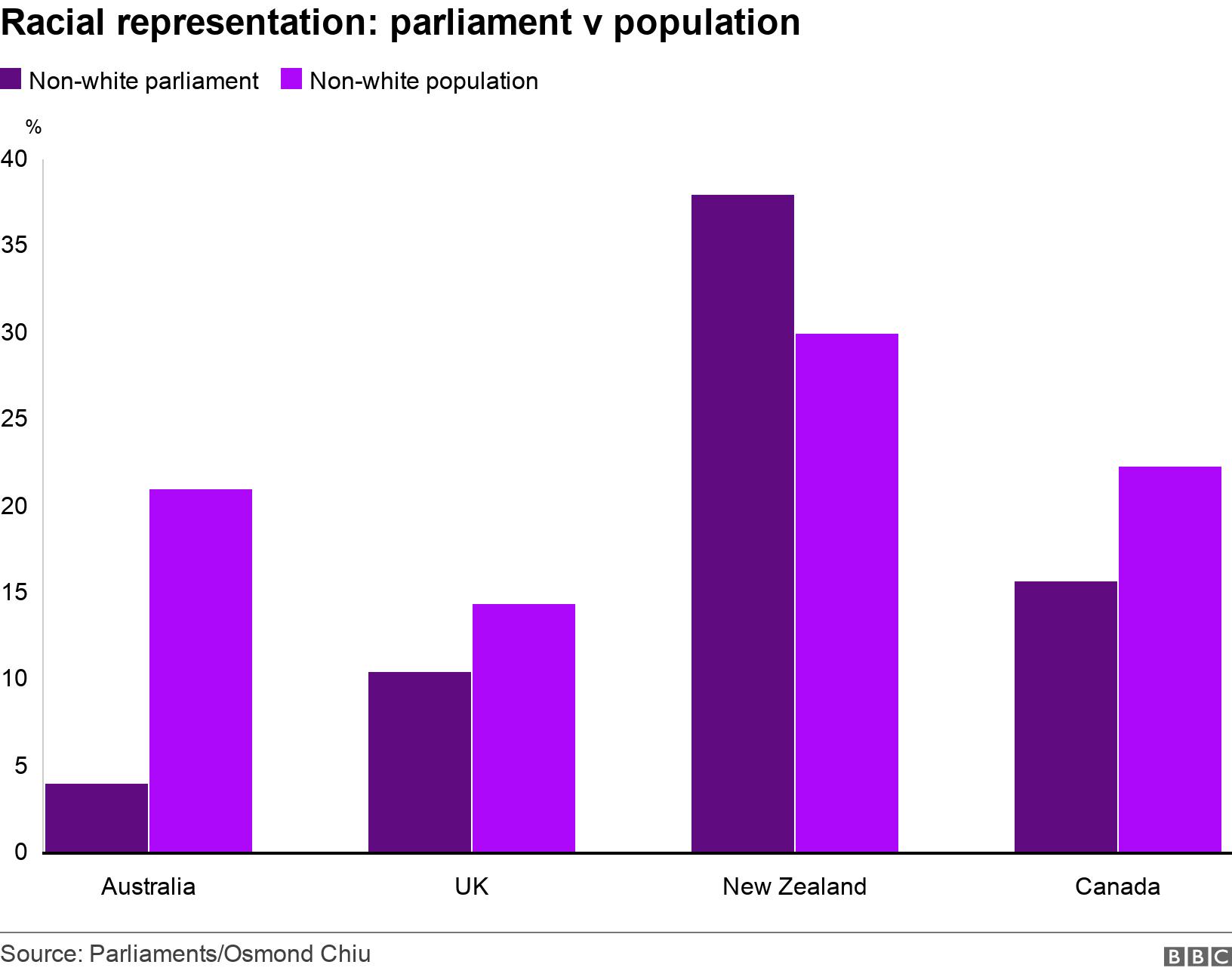
Compared to other Western multicultural democracies, Australia also lags far behind.

The numbers below include Indigenous Australians, who did not gain suffrage until the 1960s, and only saw their first lower house MP elected in 2010. Non-white candidates often acknowledge that any progress was first made by Aboriginal Australians.

Racial representation: parliament v population. .  .

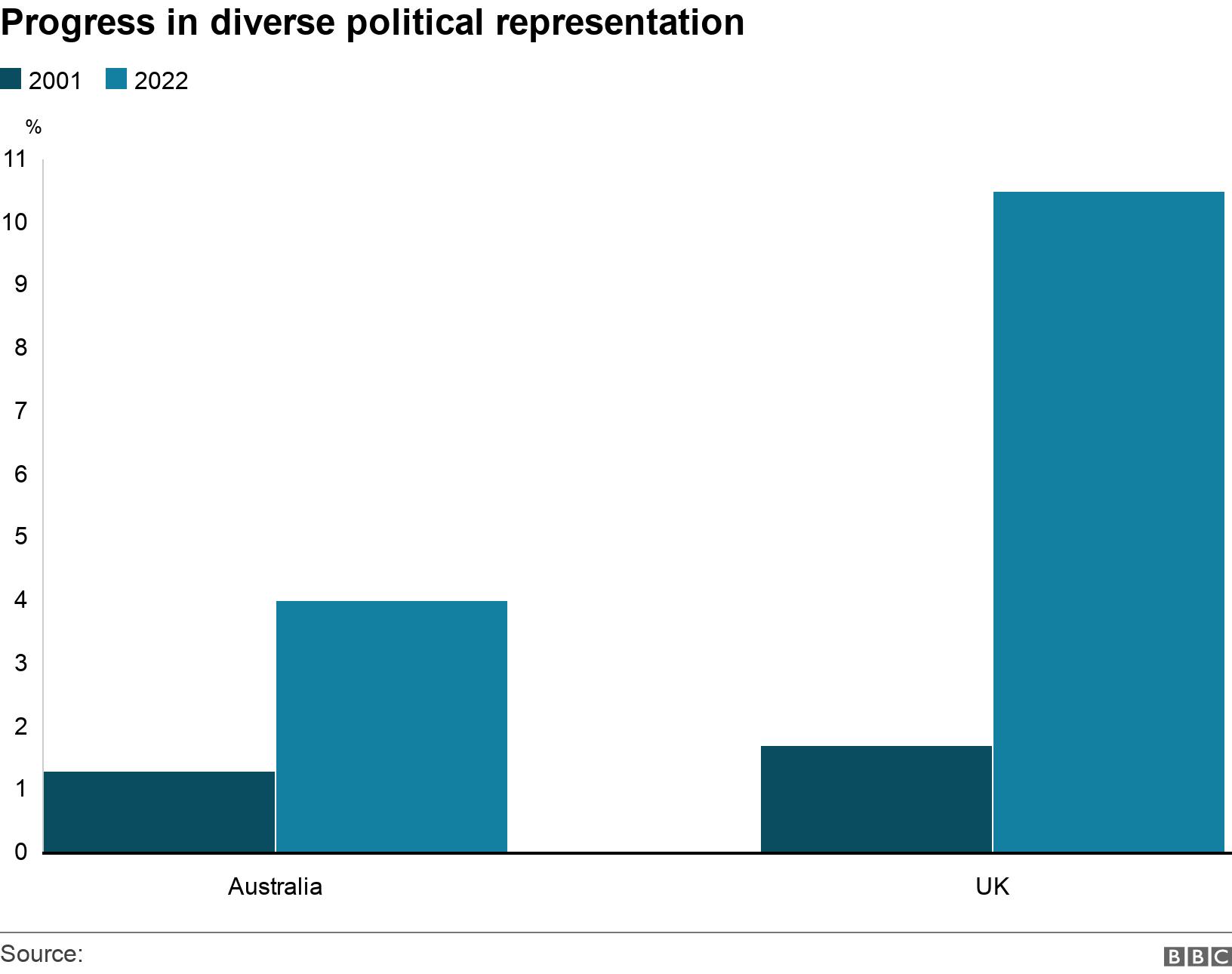
Two decades ago, Australia and the UK had comparably low representation. But UK political parties – responding to campaigns from diverse members – pledged to act on the problem.

“The British Conservative Party is currently light years ahead of either of the major Australian political parties when it comes to race and representation,” says Dr Soutphomassane.

Progress in diverse political representation. .  .

So why hasn’t Australia changed?

Observers say Australia’s political system is more closed-door than other democracies. Nearly all candidates chosen by the major parties tend to be members who’ve risen through the ranks. Often they’ve worked as staffers to existing MPs.

Ms Le said she’d have no way into the political class if she hadn’t been sponsored by Fowler’s retiring MP – a white, older male.

Labor has taken small structural steps recently – passing commitments in a state caucus last year, and selecting two Chinese-Australian candidates for winnable seats in Sydney.

But it was “one step forward and two steps back”, says party member and activist Osmond Chiu, when just weeks after the backlash to Ms Le’s case, Labor “parachuted in” another white candidate to a multicultural heartland.

Andrew Charlton, a former adviser to ex-PM Kevin Rudd, lived in a harbour mansion in Sydney’s east where he ran a consultancy.

His selection scuppered the anticipated races of at least three diverse candidates from the area which has large Indian and Chinese diasporas.

Source: Australia election: Why is Australia’s parliament so white?

Australia: Only 8% of candidates in the federal election come from diverse backgrounds

Sharp contrast with Canada where 18.2 percent of candidates in the 2021 election were visible minorities:

Of the more than 1,200 candidates in the federal election running for the House of Representatives, just 100 (8%) come from backgrounds other than Anglo-Australian, according to lists compiled by the Asian Australian Alliance and the Centre of Multicultural Political Engagement, Literacy and Leadership (Compell). There are a further 38 diverse candidates running for the Senate.

According to a report from the Australian Human Rights Commission, 21% of Australians have a non-European background and 3% an Indigenous background. Over 300 ancestries were identified in the 2016 census.

Less than 40% (458) of House candidates are women, with the majority of both diverse and female candidates running as challengers in safe or fairly safe seats.

The most commonly self-identified occupations of House candidates – aside from existing members of parliament – are managers, retirees and businesspeople. Some unique occupations listed by only a single candidate include a showman, firearms dealer, humanitarian and a carbon farmer.

Although the lists are largely crowdsourced via public statements and may not be comprehensive, as the Australian Electoral Commission does not release extensive data on candidates’ backgrounds, they nevertheless highlight a troubling lack of diversity in the electionwhich “is not representative of multicultural Australia”.

Most diverse candidates are challenging safe seats

Of the 100 House candidates identified as having backgrounds other than Anglo-Australian, just three are incumbents in safe seats: the Coalition’s Ian Goodenough and Labor’s Linda Burney and Peter Khalil. Labor’s Cassandra Fernando is contesting in Wills, where the incumbent Labor MP Anthony Byrne is retiring.

The majority of diverse candidates identified (57%) are challengers in safe or fairly safe seats. There are five diverse candidates in marginal seats currently held by their parties, including Dave Sharma, Marion Scrymgour, Gladys Liu, Anne Aly and Ken Wyatt.

Tharini Apolline Rouwette, the CEO of Compell, says the makeup of parliament and the candidates isn’t reflective of Australian society. “Our parliament is not representative of multicultural Australia, hence why we need diversity in parliament and also to normalise people of colour in leadership roles,” she says.

“There’s about 4% of people of colour in parliament today which is hardly reflective of the Australian population that is increasingly becoming multicultural. The information collected, together with my follow-up surveys/interviews will hopefully be the beginning of a long journey towards collecting information that will inform us as to what we need to do to get more people of colour elected in government.”

More candidates in marginal seats are women

Men make up over 60% of the 1,204 candidates in the AEC list, according to data compiled by Ben Raue at the Tallyroom. There are four non-binary candidates and two whose gender is unknown.

Both major parties have more male than female candidates, but a slightly higher percentage of Labor candidates are women.

Women make up a disproportionate share of candidates in marginal seats – they represent 38% of all candidates, but 41.6% of candidates in marginal seats. Some 263 women (56%) are running as challengers in safe or fairly safe seats.

Occupations

Guardian Australia compiled a list of occupations from the AEC candidate list, identifying around 254 unique occupations – an approximation, since there can be a number of names for the same occupation, and some candidates wrote expansive job titles such as “finance” or “business”.

Aside from member of parliament, lawyers, directors, consultants, managers, retirees and the unemployed are among the biggest occupations for candidates in the major parties. Some candidates who quit their jobs to contest the election are listed as unemployed.

The most common occupations for Coalition members are lawyers and directors (nine each), followed closely by consultants and managers. Union officials and unemployed are the top occupations for Labor candidates.

Students and retirees make up the top occupations for the Greens. Managers and businesspeople top the list for the United Australia Party, and retirees is the most common occupation listed for One Nation.

Source: Only 8% of candidates in the federal election come from diverse backgrounds

Essential Politics: Conspiracy theories and fear of immigrants — a toxic mix

Of interest:

Long before Donald Trump descended the escalator to the Trump Tower lobby, where he launched his presidential campaign while labelling Mexican immigrants as “rapists,” immigration was playing a powerful role in motivating voters on the right. 

Along with opposition to the Affordable Care Act, the effort to stop immigration reform played a key role in mobilizing conservatives during President Obama‘s two terms in office. Trump’s candidacy further ramped up the political focus on immigration. It also allowed the spread of toxic falsehoods that had been largely relegated to the fringe. 

One of the most pernicious is “replacement theory” — the belief that elites (big business, Democratic politicians, major cultural figures and so on) have conspired to bring large numbers of immigrants to the U.S. in a deliberate effort to replace the native-born population with more subservient people who will work for less and vote for whom they’re told. 

The conspiracy theory, which gained traction on the far right in Europe before being popularized in the U.S., has become a staple of some prominent cable television figures, like the Fox News host Tucker Carlson, who said last year that President Biden wanted to increase immigration “to reduce the political power of people whose ancestors lived here and dramatically increase the proportion of Americans newly arrived from the Third World.” 

Nearly 1 in 5 American adults believe at least a couple of major tenets of that theory, according to a new study by the National Opinion Research Center and the Associated Press.

Conspiracy theories shape debate

Overall, the American public remains largely supportive of immigration, the new AP-NORC study found. Almost 40% of Americans say that the number of immigrants to the U.S. should remain at about its current level, while 25% think the number of immigrants should be larger.

On the opposite side, 36% say the number of immigrants should be reduced, with 19% saying the number should be cut “a lot.”

Support for immigration restriction continues as a major rallying cry for the Republican base. A lot of the rhetorical ire is aimed at illegal border crossing, but proposals to dramatically reduce legal immigration became official White House policy under Trump and remain important to a large segment of his core supporters.

The AP-NORC study asked a number of questions about immigration, including two aimed specifically at gauging how many Americans believe key parts of the replacement theory.

One question asked whether “there is a group of people in this country who are trying to replace native-born Americans with immigrants who agree with their political views.” About 1 in 7 Americans said they “strongly agree” with that. A similar share said they were “very concerned” that “native-born Americans are losing economic, political, and cultural influence in this country because of the growing population of immigrants.”

About 1 in 5 Americans agreed with both of those tenets of replacement theory to at least some extent.

That finding was “the primary thing that got our attention” when analyzing the study results, said Jennifer Benz of NORC. The researchers were struck by “how widespread the belief in these core arguments of replacement theory are,” Benz said. “It’s a larger segment of the population than we may have expected going into this who have this fairly extreme view.”

Viewers of right-wing media especially shared those ideas: Among people who said they most often watch OANN or Newsmax, 45% agreed with both of the replacement theory statements. So did 31% of Fox viewers, compared with 13% of CNN viewers. 

That reflects the partisan nature of America’s immigration debate, but something else as well: The most widespread support for ideas central to replacement theory came from Americans who believe generally in conspiracy theories. 

The AP-NORC study used a four-question scale to measure a person’s belief in conspiracies. The questions ask if people believe that major events are the result of plots executed in secret, whether events are directed by a small group of powerful people, whether those people are unknown to voters and whether that group controls the outcome of elections, wars, economic recessions and other major developments. 

People who scored high on the conspiracy scale were, in most respects, very similar to the general population. Comparing the 25% who scored highest on the conspiracy scale with the rest of America, the researchers found no significant difference by education, for example — people who believe events are controlled by a small, secret cabal are as likely to have graduated from college as people who don’t hold that view, Benz noted. There’s no gap by income either.

There is a partisan gap — people who score high on the conspiracy scale tend more often to be Republicans and also tend to identify as evangelical Christians. That’s especially true of white conspiracy thinkers, who are heavily Republican and voted for Trump in 2020.

By contrast, people of color who scored high on the conspiracy scale were more likely to identify as Democrats. They were as likely to have not voted as to have cast a ballot for Biden.

Conspiratorial thinkers also are more likely to believe they have been discriminated against, the study found. That’s especially notable among white conspiracy thinkers: On a series of questions about whether people believe they have been discriminated against because of their race in seeking jobs, getting a house, obtaining healthcare or applying for a loan, about 30% of white conspiracy thinkers said yes, compared with about 10% of whites who aren’t conspiracy thinkers.

That reflects a basic fact about people who believe in conspiracies, said political science professor Joe Uscinski of the University of Miami, who for the past decade has studied conspiracy theories and who developed the scale the AP-NORC study used to measure conspiratorial thinking.

A certain set of personality traits seems to lead some people to believe in conspiracies, and belief that they belong to an oppressed group is a part of that, Uscinski said.

The fact that belief in conspiracy grows out of personality types helps explain “why we find so much stability” in the share of the population that’s conspiracy minded, he said. A decade of work has produced no evidence for the widespread belief that conspiracy theories are on the rise, he noted.

“A lot of people worry that people see these ideas on cable TV or on the internet and start believing in conspiracies, but that’s not really how this works,” Uscinski said. “People are either disposed to those particular kinds of ideas or they’re not.” 

The problem for American democracy is not so much the share of Americans who believe in conspiracies, but the political system’s weakened ability to keep those ideas at bay.

Through most of U.S. history, “we’ve generally counted on our elites” not to exploit conspiratorial thinking among their followers, Uscinski noted. Some presidents “would dabble in conspiracy theories now and then,” but mostly, they steered clear of them. Trump changed all that.

“The way that Trump used it was at a level and volume we haven’t seen,” he said. And other ambitious political figures have taken note. “They’ve seen the prototype,” he said. “It works.” 

Source: Essential Politics: Conspiracy theories and fear of immigrants — a toxic mix


Sears: Where did Canada’s famed civility go?

Indeed:

At the beginning of this century, former senator Hugh Segal — one of the few politicians with genuine friendships across all party lines — made a plea. 

He called it “In Defence of Civility,” a book published in 2000. Segal is the classic Red Tory, fiscally somewhat conservative, socially somewhat liberal, always courteous.

His plea made the usual case for civility, especially in public discourse where its absence lets dangerous currents rise to the surface. Segal’s effort to put his finger in the dike came at a time when the decline in civility was still in its “Your mother wears army boots” phase. We had yet to fall to today’s depths, where a would-be prime minister once thought it was acceptable to attack a former Liberal party leader as the father of a policy “tar baby.” (Pierre Poilievre was forced to apologize.) 

Or when an MP can accuse Justin Trudeau of behaving like a “dictator,” although in his defence one must also note that Stephen Harper was regularly denounced as a “traitor” by opponents. 

This might all be dismissed as adolescent male schoolyard dissing, except for what comes in its wake. Some bewildered Canadians — like the man who rammed his pickup truck into Rideau Hall with the intention of killing the prime minister — decide traitors need to be “dealt” with. Or the vicious attacks on politicians — more often on women than men — on social media; attacks frequently include obscene death threats. 

Alberta MLA Shannon Phillips discovered that Lethbridge police officers had illegally surveilled her every move, stalked her into restaurants and then published covert photographs of her online, along with threatening commentary. All are still unpunished and on salary. 

Canadians used to be famous, even mocked, for our civility, tolerance and willingness to compromise, as in the joke: “How do you get a Canadian to apologize? Stomp on his toe.” 

It’s hard to nail down why a commitment to such an unusually mild public discourse emerged. 

It is certainly not part of the social DNA of Americans, Aussies or Brits, with whom we share so much common history. Traditional French incivility may be more elegantly framed, but no less wounding for all that. 

Perhaps it grew out of the need to pretend to show respect to Canada’s Indigenous peoples, so as to beguile them into suicidal concessions. 

Or as David Graeber and David Wengrow point out in “The Dawn of Everything,” their monumental study of how we made the societal choices we did, the influence may have been that of Indigenous peoples on Canadian settlers. Contrary to myth, most Indigenous peoples had deeply layered forms of courtesy and respect for each other and their enemies, communicating with eloquent formality on state occasions. It was part of how they kept the peace. 

Another thread in our effort to maintain a harmonious social tapestry must have been the often painful relationship between francophone and anglophone Canadians, and the need to manage mutual concessions on an ongoing basis. 

It is evident in our remarkable, if unfathomable, success at growing from an all-white, somewhat racist and socially rigid community to the most successful multicultural nation on earth. Surprisingly, we are in overwhelming agreement that adding nearly five million immigrants and refugees a decade — more than ten per cent of our population — to Canada is a good and necessary thing.

So why are we so frivolously throwing away the social civility that makes that possible? We can blame Americans, social media, too little civics education and more. More usefully, we might examine why over-the-top insults are so appealing to most of us, when directed at a hated target, or why Trudeau knows that when he uses insulting invective to attack his opponents, it’s a political plus for him. And then putting ourselves in the shoes of those under attack — especially the young and the vulnerable — before spitting a slur at someone who offends us. 

Perhaps even acknowledging that we are the masters of the fate of our civility, and that “ the fault, dear Brutus, is not in our stars, but in ourselves.”

Source: Where did Canada’s famed civility go?

Wiseman: Redistributing seats in the House of Commons

Punchy commentary:

When governments redistribute seats in the House of Commons, they often claim they are doing what the public wants or acting in the interests of fairness. When Mike Harris’ Conservative government reduced the number of MPPs at Queen’s Park in 1996, they labelled their bill the Fewer Politicians Act. When Stephen Harper’s Conservatives increased seats in the Commons in 2011, they branded their bill the Fair Representation Act. To be consistent, Jim Flaherty, John Baird, and Tony Clement, senior cabinet ministers in both governments, ought to have termed their federal bill the More Politicians Act.

As required by law and shifts in the population, Elections Canada has determined that the House ought to expand by four seats, from 338 to 342, adding three seats for Alberta, one each for Ontario and British Columbia, and reducing Quebec’s seats by one, from 78 to 77.

By entering your email address you consent to receive email from The Hill Times containing news, analysis, updates and offers. You may unsubscribe at any time. See our privacy policy

Rather than constantly enlarging the House as two acts of Parliament require—the 1985 grandfather clause and the 2011 representation rule—Parliament ought to keep to the constitutional principle established at Confederation: proportionate provincial representation. The only exception is the “senatorial clause,” added to the Constitution by Westminster in 1915, entitling provinces to no fewer MPs than Senators. Changing that rule requires the unanimous consent of the provinces and Parliament, an impossibility.

Parliament ought to repeal both the “grandfather clause” and the “representation rule.” Neither required the consent of provinces and neither requires provincial consent for revocation. Parliament should also consider reducing and fixing a permanent number of seats. If the United States can manage with 435 Congressional representatives for 334 million people, 250 MPs ought to be sufficient to represent Canada’s 38 million people. MPs fearful of losing their jobs will argue that they are essential to serving their constituents, but more constituency staff could easily do that.

MPs are elected to represent their constituents and the parties under whose banners they run. They are not elected to represent provinces. Senators are appointed to represent provincial interests. Premiers do it especially well. But premiers have no more business in the redistribution of Commons seats than the prime minister has in how seats are distributed in a province. The idea that MPs represent their province holds no water. If it did, MPs would vote along provincial lines. The reality is they vote strictly along party lines. What constituents or provincial legislatures prefer is secondary to the preferences of party whips.

The Bloc Québécois makes much of the fact that Parliament has recognized Quebec as a nation. Quebec Premier François Legault claims “the nation of Quebec deserves a certain level of representation” regardless of its population. This begs some questions including: Should Quebec’s First Nations be entitled to a certain level of representation in the National Assembly regardless of their population since the assembly has assigned the status of “nation” to eleven provincial aboriginal groups including the Inuit, Mohawk, Cree, Algonquin, and Naskapi? Carrying Quebec’s brief, Yves-François Blanchet, whose BQ rejected the 1992 Charlottetown Accord which guaranteed Quebec 25 per cent of Commons seats in perpetuity, is outraged at the prospect of his province losing a seat. He has promised to unleash the “fires of hell” if it does.

Pure laine (dyed in the wool) or de souche (old-stock) francophones may claim to be a nation, but Quebec is merely a territory. Stephen Harper’s description of the Québécois is appropriate: “a unique people bonded together by a common language, culture and history—a nation.” However, increasing numbers of Quebecers, like provincial Liberal leader Dominique Anglade, do not fit that definition. Mordechai Richler, whose writings are set in the province, was dismissed as “not one of us” and not a “real Quebecer” by the co-chair of Quebec’s Commission on the Political and Constitutional Future of Quebec. Jacques Parizeau infamously articulated the distinction between the Québécois de souche and other Quebecers when he declared that “money and the ethnic vote” had determined the outcome of Quebec’s 1995 referendum.

Bloc Québécois founder Lucien Bouchard claimed, “Canada is not a real country” on account of its multicultural complexion, and Quebec’s governments have rejected Canada’s multiculturalism policy. Quebec is certainly not a country and if it can make the claim to nationhood, why should not Saskatchewan? Yes, the French fact makes Quebec—the only jurisdiction on the continent where a majority are francophones—distinctive in a way that Saskatchewan is not, but the language of nationhood is inappropriate for both.

If Quebec must have more MPs than to which it is entitled, let Parliament adopt another feature of the United States Congress: non-voting members. All provinces, except Newfoundland and Labrador and British Columbia, have lost seats in the past. Quebec is a cry baby in demanding overrepresentation and the federal political parties are too eager to cater to its howls.

Nelson Wiseman is the author of Partisan Odysseys: Canada’s Political Parties(University of Toronto Press).

Source: Redistributing seats in the House of Commons

New Parliament has some fresh, diverse faces, but is it enough?

Some good commentary by Erin Tolley. Agree with her that it would be preferable for the Library of Parliament to collect and maintain this data, as they do for women, Indigenous and those born outside Canada:

The number of visible minority MPs and of other historically marginalized communities in Canada’s 44th Parliament, which resumes Monday, Nov. 22, has notably increased, but some analysts question the depth of the changes. 

The number of Indigenous MPs went from 10 in 2019 to 12. There will be a total of eight Black MPs, including the five incumbent from the 2019 Parliament and three new additions.

Based on the validated and judicial recount results posted on Elections Canada website, the Liberals have 160 seats (up by three from 2019), the Conservatives 119 (down two), the NDP 25 (up one), the Bloc Québécois an unchanged 32, and the Greens two.  

Despite seemingly little change on the surface, the election yielded a relatively high turnover — bringing a total of 52 new MPs from all parties who will take their seats in the House of Commons for the first time. 

Critical twists

In at least six ridings where visible minorities were either incumbents or contenders, there were critical twists and turnarounds. 

Liberal Parm Bians unseated the Conservative Kenny Chiu in the riding of Richmond East. Paul Chiang unseated the Conservative Bob Saroya in Markham-Unionville. George Chahal defeated Jagdeep Kaur Sahota in Calgary Skyview, thus swaying an important seat for Liberals in the province of Alberta. Conservative Nelly Shin lost to the NDP candidate in Port Moody-Coquitlam, and the Conservative Michelle Ferreri defeated Maryam Monsef in Peterborough. 

The sixth important riding where visible minorities lost out to a third candidate was Kitchener-Centre, where the dropping out of the race of Raj Saini led to an easier win for the Green party candidate Mike Morris.      

Election 44 reflected the greatest diverse pool of candidates in any election thus far, and as a result, the new Parliament will have greater representation for many historically neglected communities. 

The new Parliament will have 103 female MPs, three more than the previous one, and women MPs in total now make up 30.5 per cent of the House of Commons, a slight increase from 29 per cent. 

For comparison, in 2015, there were 88 women MPs. The Liberal Party has increased its number of female MPs since then from 52 to 57. The NDPs have gone from nine to 11. For the Conservatives, the number of women remained steady at 22, as did the number for the Bloc Québécois at 12 and for the Greens at one. The 44th Parliament likewise marks an increase in LGBTQ2S+ MPs, with eight openly LGBTQ2S+ MPs elected, double the number from 2019.  

In the runup to the September election, a team of Carleton University researchers led by Erin Tolley, Canada research chair in gender, race and inclusive politics, launched a project to track candidate’s diversity. 

The dataset collected includes information about their gender, race, Indigenous background, age, occupation, and prior electoral experience, as well as riding, party, and province. 

Slow and incremental

But while there is visibly increased diversity, Tolley says the progress has been slow and incremental.  

“The snap election and short campaign likely had some impact on who ran for office this time around,” she told New Canadian Media. 

“We know that it takes longer to find and convince women, racialized and Indigenous candidates to run, not because they don’t want to but because politics historically has been inhospitable to them.”

Without being proactive, she says, another election might come sooner than we think. 

“If parties are serious about diversifying politics, they should already be laying out the groundwork, identifying promising candidates, encouraging them to run, and giving them the support they need to do so,” she says. 

Tolley also points out that, based on the observation of successive election cycles, racialized and Indigenous candidates remain somewhat pigeon-holed in a select number of ridings, mostly those with large racialized or Indigenous populations. This, according to her, creates a ceiling in terms of how many can be elected to Parliament. 

“We know that racialized and Indigenous candidates can win in a number of ridings, regardless of the riding’s demographic composition. Parties should think more broadly about the contexts in which they recruit diverse candidates so as not to limit their opportunities,” Tolley suggests. 

Reflecting on the makeup of the new Parliament, Andrew Griffith, a media commentator, policy analyst and the fellow of the Canadian Global Affairs Institute, likewise sees it as a “slow and steady progress,” both in terms of the number of visible minority candidates and elected MPs.  

He also considers that growing diversity is reflected in the new Cabinet that was announced on Oct. 26, and expects this to extend into Parliamentary secretaries. 

Not enough data 

Of the 338 candidates during the election, Liberals had 147 women running for office, 25 Indigenous,18 Black and another 50 visible minority candidates and 17 who identify as LGBTQ2S+.  

The Conservatives, out of 338 candidates in total, had 114 female candidates, their largest number so far. Of those, eight were Indigenous and Metis candidates. The Conservatives also had four LGBTQ2S+ candidates in this election. 

There were also 14 Black and 60 visible minority candidates, bringing the total of the non-white candidates to 74. The NDP had 177 women, 29 of them Indigenous. It had 104 visible minority candidates and 69 LGBTQ2S+ candidates. The Bloc Québécois had a total of 78 candidates, including 37 women, and 13 visible minority candidates, which albeit small, in comparison to others, was the most in the Party’s history. 

Based on the final tally of the candidates, the Liberals once again have the highest number and percentage of MPs, with 43 elected to serve. The Conservatives have six visible minority MPs. The NDP has three. One visible minority MP, a former Liberal candidate, won as an independent. 

Such figures, however, are not readily available as neither the Parliamentary Library nor the political parties put them out. 

Tolley is especially critical of the lack of institutionalized collection of demographic data on candidates or the racial backgrounds of MPs.  

“The Library of Parliament does publish information on women and Indigenous MPs, but nothing related to race. This leaves journalists and researchers without reliable and systematic data on diversity in parliament. That makes it difficult to track progress or hold parties accountable”, she says. 

The first item of business when Parliament resumes will be the election of the Speaker.

Source: https://newcanadianmedia.ca/new-parliament-has-some-fresh-diverse-faces-but-is-it-enough/

Wiseman: Taking on Quebec’s nationalists

Refreshing and courageous questioning:

The inability of Air Canada CEO Michael Rousseau to speak French should raise a bigger question: why is Air Canada headquartered in Montreal? Based on the volume of flights, Air Canada’s de facto hub is Toronto. If geography is a consideration for a head office, Air Canada might want to think about relocating to Winnipeg where most of the corporation’s overhaul and maintenance work was done before being shifted to Montreal by Pierre Trudeau’s government in 1968. Outrage followed, damaging national unity: police had to clear a path for Trudeau as the airline’s Winnipeg employees swarmed around him, shouting anti-Quebec slogans at a Liberal fundraiser.

When Brian Mulroney’s Progressive Conservatives in 1987 awarded the lucrative CF-18 fighter maintenance and overhaul contract to a Montreal firm rather than to a Winnipeg firm whose bid was cheaper, technically superior, and recommended by the neutral federal bureaucracy, some westerners began to refer to Mulroney as Pierre Elliot Mulroney; he had broken his promise to award contracts based on business principles and not political expediency as he said the Trudeau Liberals had done.

Mulroney’s decision led directly to Preston Manning’s launch of the Reform Party, the first step leading to the demise of the Progressive Conservative party. In 1988, Mulroney’s government conditioned Air Canada’s privatization on its headquarters remaining in Montreal. Decisions by the Liberal and Progressive Conservative governments, their caucuses top heavy with Quebec MPs, discriminated in favour of Quebec.

After the Parti Québécois gained power in 1976 and the Quebec National Assembly passed the Charter of the French Language (Bill 101), making communicating in French with French-speaking staff at companies such as Sun Life Assurance mandatory, the company announced it was moving its headquarters from Montreal to Toronto. A political storm erupted; Michael Cassidy, the soon-to-become Ontario NDP leader called on Ontario’s Conservative minister of industry to resign for welcoming Sun Life’s relocation, while Trudeau said Bill 101 undermined Montreal’s historic role as a financial and commercial centre for national and international companies.

And that is what happened. Although both the Royal Bank of Canada and the Bank of Montreal kept their official “head office” in Montreal, not wanting to incur the wrath that Sun Life’s departure did, they shifted their management operations and “corporate headquarters,” their de facto head offices, to Toronto and to where their chief executives live. Trudeau warned that other companies might follow Sun Life’s lead if Bill 101 was not changed.

Justin Trudeau, who became Liberal leader and prime minister by the leverage his father’s name gave him, is not on the same page as his father.

Now, Quebec-based SNC-Lavalin CEO Ian Edwards has postponed a speech he was scheduled to give to Montreal’s Canadian Club. He knows that he will be pilloried as Rousseau has been for his deficiency in French, incurring a similar public relations nightmare. Rousseau and Edwards have said they will study French, but at their age—Rousseau is 61, Edwards 57—they will gain little practical command of it as a working language.

Although most of CNR’s operations are in Western Canada, its head office is also in Montreal. CNR CEO Jean-Jacques Ruest is a francophone but is soon to step down. Will candidates to replace Ruest be required to demonstrate that they are bilingual? Memphis-born Hunter Harrison, famous for introducing precision scheduled railroading and leading the CNR to record profits, promised to learn French when he was the corporation’s CEO, but there is no record of his ever having spoken it.

When the Official Languages Act was introduced in the 1960s, the Trudeau government assured Canadians that it simply entitled them to deal with and be served by the federal government and its crown corporations, like Air Canada and the CNR at the time, in their preferred official language. The law does not require their CEOs or board members of federally regulated industries to have a working command of both official languages.

The French language is not in danger in Quebec as Quebec nationalists would have you believe; the percentage of Quebecers speaking French at home has not declined. However, Quebec’s share of Canada’s population has been steadily shrinking, accelerated by François Legault’s Coalition Avenir Québec government which has cut the number of immigrants to the province.

Unilingual anglophones like myself have noticed how the federal political parties have tip-toed around Quebec and the CAQ’s positions, such as the ban on schoolteachers’ and public servants’ religious headgear, violations of the Charter of Rights. And there is Bill 96 which claims to unilaterally change the Canadian Constitution, which Pierre Trudeau said would last for a thousand years. Where, oh where is Justin Trudeau?

Had Erin O’Toole taken on Quebec’s nationalists, perhaps his Conservatives would have done better in the election. Kow-towing obviously didn’t work.

Nelson Wiseman is a professor emeritus of political science at the University of Toronto.

Source: Taking on Quebec’s nationalists

Who voted for the People’s Party of Canada? Anti-vaxxers and those opposed to vaccine mandates

Preliminary analysis. Will be interesting to see what others come up with such as the Canada Election Study. As it is likely that COVID and vaccination will not be a top issue (we hope!) in the next election, likely the PPC will focus on immigration and other related issues, and their advocacy for more restrictive policies:

At first glance, the 2021 federal election appears to have changed very little. Each party was returned to the House of Commons with about as many seats as it had previously held. 

Beneath the surface, however, some shifts occurred. Most notably, while the People’s Party of Canada failed to win any seats, its share of the popular vote grew to five per cent — more than double what it earned two years earlier.

The PPC’s support is small yet not easily dismissed. The 841,000 votes it earned makes it the fifth most popular party in the country, well ahead of the Greens (who have appeared on the ballot, addressing the prominent issue of climate change, for decades). The People’s Party won three times more votes than the Reform Party did when it first fielded candidates in 1988, one election prior to its breakthrough in 1993.

Understanding exactly what to make of the PPC’s growing support is especially important for the leadership of the Conservative Party of Canada. If PPC voters are former Conservative supporters disappointed with the party’s attempt to appeal to middle-of-the-road, suburban Canadians, it signals a serious dilemma — each voter the Conservatives gain by moving to the centre could be matched by a right-leaning voter lost to the PPC.

PPC voters bemoan ‘loss of freedom’

What, then, do we know about PPC voters? At first glance, our fall 2021 survey shows PPC voters have the profile many would expect. They’re dissatisfied with the way things are going in our country today, feel the economy is getting weaker, think there are too many immigrants coming to Canada who don’t adopt the country’s values and hold a favourable opinion of the United States.

Yet these opinions do not really set them apart. Most Conservative Party supporters also hold these views. What does distinguish current PPC voters is their views on the COVID-19 pandemic, and specifically on the issue of vaccination, vaccine mandates and vaccine passports. 

Our survey, conducted during the 2021 election campaign, asked Canadians to identify the most important problem facing the country today. 

Both Liberal and Conservative Party supporters were most likely to mention the COVID-19 pandemic in general. Climate change was most likely to be mentioned as the most important problem by NDP, Bloc Québécois and Green Party supporters. 

But for PPC supporters, the No. 1 issue was the loss of freedom stemming from vaccine mandates — a concern barely mentioned by anyone who supported other parties. 

A more rigorous analysis of the survey results, which tests the significance of different factors while holding others constant, confirms the importance of vaccination issues to current PPC voters. 

Someone who singled out “loss of freedom” during the pandemic as the most important issue facing the country had a 59 per cent chance of supporting the PPC, compared to only a five per cent chance for someone who mentioned any other issue. 

Similarly, someone who singled out “COVID-19 vaccination issues” as the most important issue facing the country had a 44 per cent chance of supporting the PPC, compared to a six per cent chance for someone who mentioned any other issue. 

Immigration not a decisive factor

This last example, furthermore, likely underestimates the impact of PPC voters’ irritation with vaccination requirements. It can be assumed that the very few number of Liberals who also singled out “COVID-19 vaccination issues” as the most important issue probably had something very different in mind — perhaps frustration with those who won’t get vaccinated — than their PPC counterparts. 

Nonetheless, the main point is clear: voters concerned about the push to be vaccinated and what they perceive as a loss of freedom during the pandemic were much more likely to vote PPC than voters concerned about anything else. 

Equally important is the finding that PPC voters stand out much less for their attitudes on immigration. The impact of immigration views on someone’s likelihood of supporting the PPC is barely significant, in stark contrast to their opinions on vaccination.

This does not mean that PPC voters are strong supporters of immigration; rather, it means simply that their views on the subject do not differentiate supporters of the PPC from supporters of some other parties — notably, the Conservatives. 

Incidentally, it should be noted these findings apply only to Canadians indicating they intended to vote for the PPC, not to the party’s leadership, organizers or funders who may regard closing our borders to newcomers as more of a priority.

A message for Conservatives

Nonetheless, the fact that the growth in PPC support is tied to the unusual issue of vaccination against COVID-19 is no guarantee that the party’s popularity will fade once the pandemic ends. Other issues may come along to take its place. 

But it does send a cautionary note to Conservatives who might be wondering what the party can do to bring PPC voters back into the fold. Rejecting new policies on climate change or social diversity is unlikely to help so long as PPC supporters continue to be motivated largely by a single issue — their opposition to vaccines. 

As the election outcome itself showed, showing flexibility on vaccine mandates in order to win back defectors to the PPC risks putting more distance between the Conservative Party and the mainstream of Canadian public opinion

In short, PPC voters were not simply typical Conservative supporters leaning furthest to the right on a range of issues that include government spending, taxation, climate change and immigration. They were, on average, a unique cluster of voters who have rejected the overwhelming public consensus on the need to be vaccinated to contain the spread of COVID-19.

The growth potential for the Conservative Party lies not in chasing the small number of voters angered by vaccine mandates, but in appealing to the much larger pool of voters whose top priorities include bringing the pandemic to an end and refocusing attention on the fight against climate change.

Source: https://theconversationcanada.cmail19.com/t/r-l-triyyhjl-kyldjlthkt-n/

Coren: Religion and politics shouldn’t mix when it comes to COVID-19

Another good commentary by Coren, with any number of political commentators pronouncing on the impact on the CPC and its leader:

Anybody who assumed that the struggle against the COVID-19 pandemic would be purely medical and humanitarian clearly didn’t quite grasp the dark depths of politics and religion. From the moment we knew that a deadly plague was smothering the world, those with warped agendas were as animated as a squirrel in a peanut store.

Enter the conspiracy theorists and the paranoid hysterics, claiming that the virus was either a hoax, a plot to reduce and control the population, or the beginnings of the “great reset.” And that vaccines are weapons of Satan, the mark of the beast, and developed from fetal stem-cells and thus — in their words — “the product of the abortion genocide.”

These Christian fundamentalists and libertarian fanatics are dismissed by almost every responsible religious figure, from the Pope to the Chief Rabbi, and by all political leaders worth the name. But not by all, and not everywhere — including Canada.

A small but galvanized set of right-wing church leaders resist vaccines and masks, and their activism has bled through into Canadian conservatism. Federal Tory leader Erin O’Toole and most Conservative provincial leaders may disagree with these people, but they also know that their base is swamped in denial lunacy. If they’re too bold in condemning anti-vaccine zealots, or in any way supportive of vaccine mandates, they could see their leadership challenged and even defeated.

Ontario Premier Doug Ford’s refusal to demand vaccinations for those working in health care, in spite of the advice of experts, is an obvious case. Ford is more secure than O’Toole, but he has long relied on the Christian right and owes them far too much to risk their anger, especially with an election so close.

Erin O’Toole’s decision not to require that all Conservative MPs be vaccinated against COVID-19 has annoyed many of his caucus, but placated those who see him as far too liberal on their chosen obsessions. Yet he still hasn’t gone far enough for many. At the end of last week it was announced that a group of 15 to 30 Conservative MPs and senators intended to start a “civil liberties caucus.” Conservative MP Marilyn Gladu says that it will speak for those who may be losing their jobs for refusing to be vaccinated.

It’s a tangible threat to the leader, already in a precarious position, and there are a number of potential rivals waiting in the shadows. One of the more prominent and ambitious is Leslyn Lewis, the newly minted MP for Haldimand-Norfolk. She did extremely well in the party’s leadership contest, and her candidacy was supported by a number of socially conservative groups who now oppose vaccines. She’s the darling of religious conservatives, with some “interesting” opinions on many of the issues that the Tory base in rural Ontario and Western Canada still consider vital. When I mentioned her views in a column more than a year ago she immediately blocked me on social media, and I was harshly attacked by some of her supporters. In other words, she’s not someone to take lightly.

One of the ironies of all this is that for a party that boasts of its patriotism, this new conservatism is far more American than Canadian. The progressive Toryism of former years, one that had far more in common with conservative parties in northern Europe and Britain, was abandoned long ago, and Canadian conservatives now look south to the U.S. Republicans. That party, in turn, has had to bend to the Christian right, because without that vote no Republican can ever hope to become president.

The conservative Christian world is much smaller in Canada, but it’s far from insignificant and punches well above its weight. It’s also become more energized and organized in the last 15 years, largely because it sees what has been achieved in the U.S. Canadian right-wingers witness the victory of Donald Trump and other hardline leaders and regard it as a triumph. The truth, however, is that the crisis faced by modern Christianity is largely due to its perversion by the very people so revered by the Canadian conservatives who are currently influencing policies on vaccines and public health.

Religion and politics. Pray, and pray hard, that in this case they stop mixing.

Source: Religion and politics shouldn’t mix when it comes to COVID-19

PEN: Educational Gag Orders-Legislative Restrictions on the Freedom to Read, Learn and Teach

Significant:

Today PEN America released a report on an alarming trend mounting across the country to impose legislative limitations on teaching and learning on topics including race, gender, and American history. In the first nine months of 2021, 24 state legislatures introduced 54 bills that would restrict teaching and training in K-12 schools, public colleges and universities, and/or state agencies and institutions. Eleven of those bills have become laws in nine states. These bills reflect raging debates underway in communities across the country that came to a head during last week’s gubernatorial election in Virginia and are dominating discussions in school boards and faculty lounges nationwide.

For those concerned about the impact on the higher education sector, 21 of the bills introduced or pre-filed explicitly apply to colleges and universities. Of these, 16 explicitly impose restrictions on academic courses or curricula, and 10 explicitly address training for college students or employees. Ten bills explicitly targeting academic college-level teaching are pending or have been pre-filed for 2022.

This legislative wave followed the mass protests that swept the United States in 2020 in the wake of the murder of George Floyd, and the reckonings initiated to come to grips with the lingering legacy of racial injustice.
Efforts to delve into and more thoroughly address the role that slavery, race, and racism play in American society implicate complex questions relating to history, politics, and human relations. Rather than engaging in reasoned debate on these critical issues, the bills and laws documented in our report seek to shut down discourse through legislative fiat. We label these measures “educational gag orders,” a reflection of their censorious effect that imposes viewpoint-based constrictions on what can be discussed in American classrooms.

PEN America calls on all those who believe in free speech to oppose these efforts to silence discussion and debate through force of law.Educational Gag Orders: Legislative Restrictions on the Freedom to Read, Learn, and Teach examines these bills in depth. Many would punish educators, colleges, schools, and districts that dare to cover excluded topics. The report documents how these bills and laws have already had a chilling effect on campuses and in classrooms across the country, on both open discourse and academic freedom, and risk further muzzling vital societal discourse on racism, sexism, and the complexities of American history.

Educational Gag Orders: Legislative Restrictions on the Freedom to Read, Learn, and Teach examines these bills in depth. Many would punish educators, colleges, schools, and districts that dare to cover excluded topics. The report documents how these bills and laws have already had a chilling effect on campuses and in classrooms across the country, on both open discourse and academic freedom, and risk further muzzling vital societal discourse on racism, sexism, and the complexities of American history.

Source: https://b46674ee0d922ea3560b2c63b8d5fa34.tinyemails.com/21e22508c148a3777f075d12b9411cca/8e7676d24e8e81dc149a24f1e883a04d.html