The Spiral Of Silence – Social Media « The Dish

Another angle to how social media narrows discussion and debate:

It seems counter-intuitive–if we’re getting only what Facebook things we want to get based on everything they know about us, which is a lot, shouldn’t we assume we are always among friends? But it makes sense. We’re worried about losing friends, which is to say that we’re worried our number of friends will diminish.

What’s peculiar about the Pew study is how the questions were asked. Though the survey took place in the months after Snowden’s revelations, the subjects were asked will you and would you… not did you. Using the conditional to report on behavior that already might or might not have happened tends to make the whole exercise, well, an exercise.

It turns out, too, that the spiral of silence does not only extend to individuals. Take this week’s revelation about the NSA’s Google-like search engine that shares something on the order of 850 billion data points such as private emails obtained without a warrant from ordinary American citizens among numerous government agencies. This is a big deal for many reasons, not the least of which is that it may enable the FBI or the DEA to illegally obtain evidence and cover their tracks while so doing. Yet the mainstream media almost uniformly ignored the story. When I searched ICREACH today, only the online tech media had picked it up and run with it. Is it possible that the mainstream media is afraid of losing friends, too?

The Spiral Of Silence « The Dish.

Werner Herzog on Creativity, Self-Reliance, Making a Living of What You Love, and How to Turn Your Ideas Into Reality

For film fans, and fans of Werner Herzog, a good selection of quotes from the book, A Guide for the Perplexed. My favourite on the creative process:

The problem isn’t coming up with ideas, it is how to contain the invasion. My ideas are like uninvited guests. They don’t knock on the door; they climb in through the windows like burglars who show up in the middle of the night and make a racket in the kitchen as they raid the fridge. I don’t sit and ponder which one I should deal with first. The one to be wrestled to the floor before all others is the one coming at me with the most vehemence. I have, over the years, developed methods to deal with the invaders as quickly and efficiently as possible, though the burglars never stop coming. You invite a handful of friends for dinner, but the door bursts open and a hundred people are pushing in. You might manage to get rid of them, but from around the corner another fifty appear almost immediately… Finishing a film is like having a great weight lifted from my shoulders. It’s relief, not necessarily happiness. But you relish dealing with these “burglars.” I am glad to be rid of them after making a film or writing a book. The ideas are uninvited guests, but that doesn’t mean they aren’t welcome.

Werner Herzog on Creativity, Self-Reliance, Making a Living of What You Love, and How to Turn Your Ideas Into Reality

Amazon-Hachette Dispute: Amazon’s Self-Serving Messaging

Hadn’t been following this dispute that much but when Amazon sent me the letter below, pretending to be on the side of the angels, I reacted in my response to them below:

I am sorry, but this letter and its request, is self-serving and outrageous.

I say this as someone who has both bought and published with Amazon.
I will be contacting the publishers telling them I do not support Amazon’s position as detailed in your letter.
Cloaking your corporate interests in consumer-friendly language, neglecting the content creation aspects of publishing, and shamefully invoking Orwell, is an extremely cynical move.
Will be sharing your letter and my response on my blog.

The NY Times points out that Amazon has misrepresented Orwell:

But Orwell then went on to undermine Amazon’s argument much more effectively than Hachette ever has. “It is of course a great mistake to imagine that cheap books are good for the book trade,” he wrote. “Actually it is just the other way about … The cheaper books become, the less money is spent on books.”

Instead of buying two expensive books, he says, the consumer will buy two cheap books and then use the rest of his money to go to the movies. “This is an advantage from the reader’s point of view and doesn’t hurt trade as a whole, but for the publisher, the compositor, the author and the bookseller, it is a disaster,” Orwell wrote.

The real problem, the writer argued in an essay a decade later, “Books v. Cigarettes,” was with the books themselves. They had a hard time competing against other media — a point people are still making in 2014.

“If our book consumption remains as low as it has been,” he wrote, “at least let us admit that it is because reading is a less exciting pastime than going to the dogs, the pictures or the pub, and not because books, whether bought or borrowed, are too expensive.”

Bits Blog: Dispute Between Amazon and Hachette Takes an Orwellian Turn

The original letter:

Dear KDP Author,

Just ahead of World War II, there was a radical invention that shook the foundations of book publishing. It was the paperback book. This was a time when movie tickets cost 10 or 20 cents, and books cost $2.50. The new paperback cost 25 cents – it was ten times cheaper. Readers loved the paperback and millions of copies were sold in just the first year.

With it being so inexpensive and with so many more people able to afford to buy and read books, you would think the literary establishment of the day would have celebrated the invention of the paperback, yes? Nope. Instead, they dug in and circled the wagons. They believed low cost paperbacks would destroy literary culture and harm the industry (not to mention their own bank accounts). Many bookstores refused to stock them, and the early paperback publishers had to use unconventional methods of distribution – places like newsstands and drugstores. The famous author George Orwell came out publicly and said about the new paperback format, if “publishers had any sense, they would combine against them and suppress them.” Yes, George Orwell was suggesting collusion.

Well… history doesn’t repeat itself, but it does rhyme.

Fast forward to today, and it’s the e-book’s turn to be opposed by the literary establishment. Amazon and Hachette – a big US publisher and part of a $10 billion media conglomerate – are in the middle of a business dispute about e-books. We want lower e-book prices. Hachette does not. Many e-books are being released at $14.99 and even $19.99. That is unjustifiably high for an e-book. With an e-book, there’s no printing, no over-printing, no need to forecast, no returns, no lost sales due to out of stock, no warehousing costs, no transportation costs, and there is no secondary market – e-books cannot be resold as used books. E-books can and should be less expensive.

Perhaps channeling Orwell’s decades old suggestion, Hachette has already been caught illegally colluding with its competitors to raise e-book prices. So far those parties have paid $166 million in penalties and restitution. Colluding with its competitors to raise prices wasn’t only illegal, it was also highly disrespectful to Hachette’s readers.

The fact is many established incumbents in the industry have taken the position that lower e-book prices will “devalue books” and hurt “Arts and Letters.” They’re wrong. Just as paperbacks did not destroy book culture despite being ten times cheaper, neither will e-books. On the contrary, paperbacks ended up rejuvenating the book industry and making it stronger. The same will happen with e-books.

Many inside the echo-chamber of the industry often draw the box too small. They think books only compete against books. But in reality, books compete against mobile games, television, movies, Facebook, blogs, free news sites and more. If we want a healthy reading culture, we have to work hard to be sure books actually are competitive against these other media types, and a big part of that is working hard to make books less expensive.

Moreover, e-books are highly price elastic. This means that when the price goes down, customers buy much more. We’ve quantified the price elasticity of e-books from repeated measurements across many titles. For every copy an e-book would sell at $14.99, it would sell 1.74 copies if priced at $9.99. So, for example, if customers would buy 100,000 copies of a particular e-book at $14.99, then customers would buy 174,000 copies of that same e-book at $9.99. Total revenue at $14.99 would be $1,499,000. Total revenue at $9.99 is $1,738,000. The important thing to note here is that the lower price is good for all parties involved: the customer is paying 33% less and the author is getting a royalty check 16% larger and being read by an audience that’s 74% larger. The pie is simply bigger.

But when a thing has been done a certain way for a long time, resisting change can be a reflexive instinct, and the powerful interests of the status quo are hard to move. It was never in George Orwell’s interest to suppress paperback books – he was wrong about that.

And despite what some would have you believe, authors are not united on this issue. When the Authors Guild recently wrote on this, they titled their post: “Amazon-Hachette Debate Yields Diverse Opinions Among Authors” (the comments to this post are worth a read).  A petition started by another group of authors and aimed at Hachette, titled “Stop Fighting Low Prices and Fair Wages,” garnered over 7,600 signatures.  And there are myriad articles and posts, by authors and readers alike, supporting us in our effort to keep prices low and build a healthy reading culture. Author David Gaughran’s recent interview is another piece worth reading.

We recognize that writers reasonably want to be left out of a dispute between large companies. Some have suggested that we “just talk.” We tried that. Hachette spent three months stonewalling and only grudgingly began to even acknowledge our concerns when we took action to reduce sales of their titles in our store. Since then Amazon has made three separate offers to Hachette to take authors out of the middle. We first suggested that we (Amazon and Hachette) jointly make author royalties whole during the term of the dispute. Then we suggested that authors receive 100% of all sales of their titles until this dispute is resolved. Then we suggested that we would return to normal business operations if Amazon and Hachette’s normal share of revenue went to a literacy charity. But Hachette, and their parent company Lagardere, have quickly and repeatedly dismissed these offers even though e-books represent 1% of their revenues and they could easily agree to do so. They believe they get leverage from keeping their authors in the middle.

We will never give up our fight for reasonable e-book prices. We know making books more affordable is good for book culture. We’d like your help. Please email Hachette and copy us.

Hachette CEO, Michael Pietsch: Michael.Pietsch@hbgusa.com

Copy us at: readers-united@amazon.com

Please consider including these points:

– We have noted your illegal collusion. Please stop working so hard to overcharge for ebooks. They can and should be less expensive.
– Lowering e-book prices will help – not hurt – the reading culture, just like paperbacks did.
– Stop using your authors as leverage and accept one of Amazon’s offers to take them out of the middle.
– Especially if you’re an author yourself: Remind them that authors are not united on this issue.

Thanks for your support.

The Amazon Books Team

P.S. You can also find this letter at www.readersunited.com
Nine things everyone should know how to do with a spreadsheet | Macworld

As I am starting to use spreadsheets to analyze demographic and related data, my basic knowledge of spreadsheets is being challenged. Another primer from Macworld (but applies to Excel and Google’s Sheets as well).

As I have been only using sum and average functions, these examples of other functions caught my eye:

=MAXRANGE and =MINRANGE: Return the largest and smallest values in a range. Related to these two, I also often use =RANKCELL,RANGE, which returns the rank of a given cell within the specified range.

=NOW: Inserts the current date and time, which is then updated each time the spreadsheet recalculates. In both Excel and Sheets, you need to add a set of parentheses: =NOW.

=TRIMCELL: If you work with text that you copy and paste from other sources, there’s a good chance you’ll find extra spaces at the beginning or end of some lines of text. The TRIM function removes all those leading and trailing spaces but leaves the spaces between words.

Nine things everyone should know how to do with a spreadsheet | Macworld.

Nine things everyone should know how to do with a presentation app | Macworld

Most of these are fairly familiar to people who use presentation software regularly but there is always a useful tip or two.  Tip that worked for me:

Menu commands in Google Docs, PowerPoint, and Keynote let you arrange objects by their center, top, bottom, or right/left margins. Keynote’s and PowerPoint’s Arrange menus include additional commands to distribute three or more objects top-to-bottom or side-to-side equally without affecting their positions in the other direction. A convenient option in Keynote 6.2 Arrange > Distribute Objects > Evenly spaces selected objects uniformly along an imaginary line using the objects closest to the edge of the slide as end points.

Nine things everyone should know how to do with a presentation app | Macworld.

Ten things everyone should know how to do with a word processor | Macworld

Macworld has published a useful series on the basic programs many of us use on a regular basis. Covers Apple, Microsoft and Google versions of word processing, spreadsheet and presentation software.

As will be travelling over the next few days, will post one of these articles per day for those interested.

Even though I am somewhat of a power user, particularly for word processing and presentation software (I use the Apple suite), usually learn something new from these articles.

The biggest timesaver is the use of shortcuts:

When I’m in the flow of writing, there’s nothing worse than having to lift my fingers from the keyboard, grab the mouse, and click to select, copy, cut, paste, or format text, or to save or print a document. But in most cases, my hands never actually need to leave the keys to take care of these things. I use keyboard shortcuts instead.

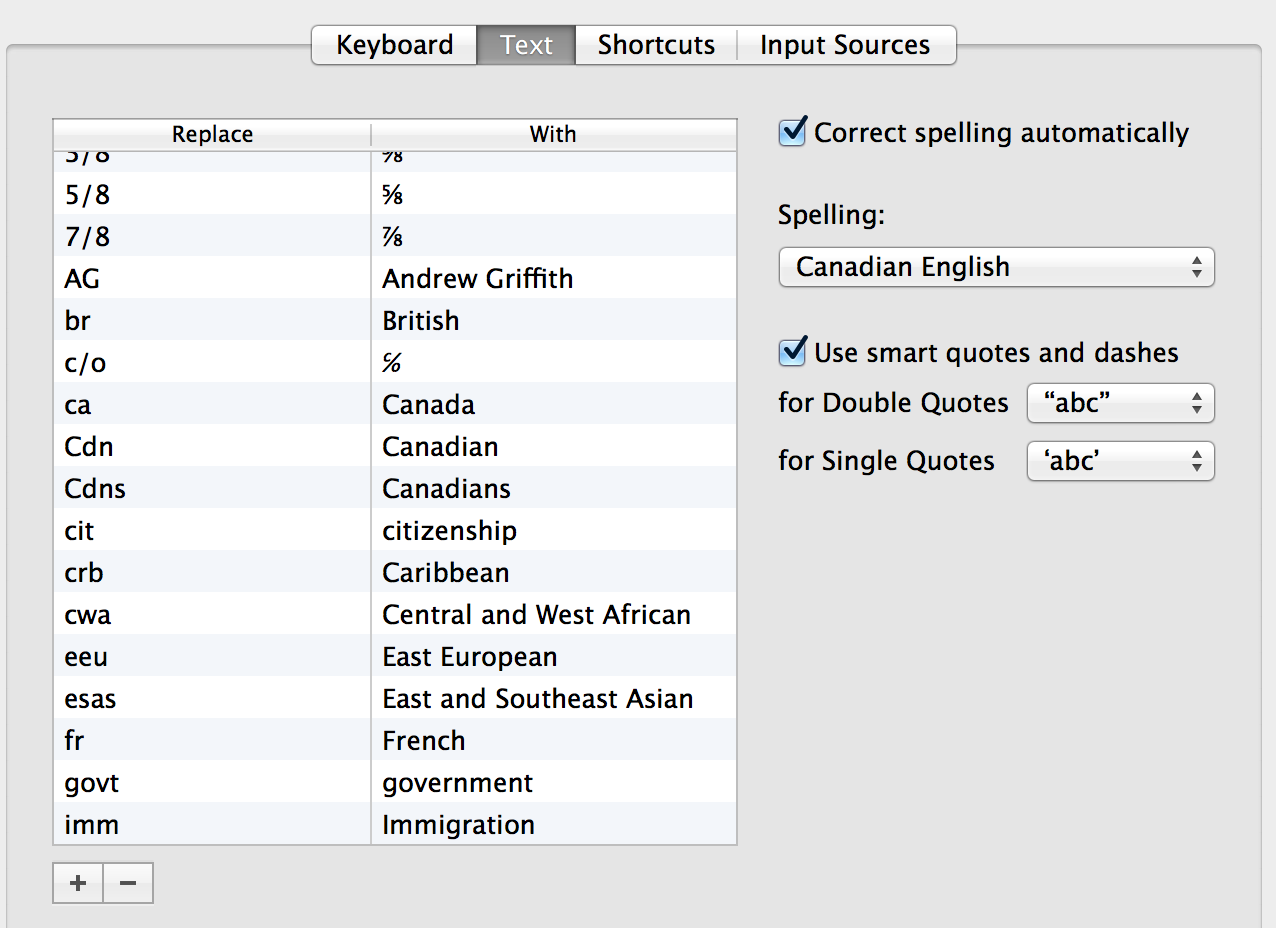
While outside word processing, I also use computer wide shortcuts for frequently used words (in my case, government, citizenship, multiculturalism, Temporary Foreign Workers etc). In the Mac world, go to System Preferences, Keyboard, Text and you will see the standard text shortcuts and can add your own.

Keyboard Text

Ten things everyone should know how to do with a word processor | Macworld.

‘Hawking index’ charts which bestsellers are the ones people never read

Fun example of innovative analysis (and for all those of you who claim to read Piketty or other similar tomes):

Jordan Ellenberg, a mathematician at the University of Wisconsin, Madison, has just about proved this suspicion correct.

In a cheeky analysis of data from Kindle e-readers, Mr. Piketty’s daunting 700-page doorstopper emerged as the least read book of the summer, according to Prof. Ellenberg, who calls his ranking the Hawking Index in honour of Mr. Hawking’s tome, famous as the most unread book of all time.

As a result, he is tempted to rename it the “Piketty Index,” because Mr. Piketty scored even worse than Mr. Hawking.

As such, both stand as extreme case studies in aspirational reading. Like the Economist magazine’s Big Mac index of hamburger prices around the world, which is both silly and serious, Prof. Ellenberg’s Hawking Index is funny, in that it reveals the vanity of many book choices. But it also offers an interesting psychological perspective on reading that is born of good intentions, and dies of boredom on the dock or beach.

The calculation is simple, and as Prof. Ellenberg says, “quick and dirty.” It exploits a feature of Kindle that allows readers to highlight favourite quotes. It averages the page number of the five most highlighted passages in Kindle versions, and ranks that as a percentage of the total page count. Although it does not measure how far people read into a book, it makes a decent proxy for it.

“Why do you buy a book? One reason is because you know you’re going to like it,” Prof. Ellenberg said. “Another reason might be, ‘Oh, I think this book will be good for me to read.’”

….. He said his formula illustrates what mathematicians call the problem of inference, meaning he cannot say for sure these books are going unread, just that he has strong evidence for it.

“You can make some observation about the world, but there’s some underlying fact about the world that you’d like to know, and you want to kind of reverse engineer. You want to go backwards from what you observed to what you think is producing the data you see,” he said.

Other books reveal different insights into why people buy books they start but do not finish. Michael Ignatieff’s political memoir Fire And Ashes, for example, scores comparatively well for non-fiction at 44%, far better than Hillary Clinton’s Hard Choices, which barely cracked 2%. Lean In, the self-help book by Facebook executive Sheryl Sandberg, scored 12.3%.

In fiction, The Luminaries, by Canadian-born New Zealand author Eleanor Catton, which won last year’s Man Booker Prize, scores a mere 19%, and would score a lot lower if not for one highlighted quote near the end.

Prime Minister Stephen Harper’s book on hockey, A Great Game, curiously has no highlighted passages, so cannot be ranked on the Hawking Index (or, equivalently, ranks as low as is theoretically possible).

Fiction tended to score higher, likely reflecting the tendency for non-fiction authors to put quotable thesis statements in the introduction. The only novel that was down in the range of the non-fiction books was Infinite Jest by David Foster Wallace.

Prof. Ellenberg does not mean to disparage the low ranking books, he said, noting that the reason people buy them in the first place is that they are rich in content.

“I think it’s good to do back of the envelope computations as long as you do them with the appropriate degree of humility, and understand what it is that they’re saying,” he said. “I think any statistical measure you make up, you take it as seriously as it deserves to be taken.”

‘Hawking index’ charts which bestsellers are the ones people never read

Leonard Cohen on Creativity, Hard Work, and Why You Should Never Quit Before You Know What It Is You’re Quitting

For something lighter and yet deeper today, and for the Leonard Cohen fans among us, a nice selection of Cohen quotes on the creative process:

I’m writing all the time. And as the songs begin to coalesce, I’m not doing anything else but writing. I wish I were one of those people who wrote songs quickly. But I’m not. So it takes me a great deal of time to find out what the song is. So I’m working most of the time.[…]

To find a song that I can sing, to engage my interest, to penetrate my boredom with myself and my disinterest in my own opinions, to penetrate those barriers, the song has to speak to me with a certain urgency.

To be able to find that song that I can be interested in takes many versions and it takes a lot of uncovering.

Leonard Cohen on Creativity, Hard Work, and Why You Should Never Quit Before You Know What It Is You’re Quitting | Brain Pickings.

What a Muslim American Learned from Zionists

An interesting and challenging initiative by the Shalom Hartman Institute that brought American Muslim thought leader to a year-long fellowship in Jerusalem that helped both sides understand each other’s narrative:

Despite living on the front lives of this conflict, many Jewish friends at Hartman said it took the relationships built through the program for our Jewish friends to fully absorb the Palestinian narrative.

After a year we built the trust necessary for a needed exchange of admissions. The Muslim fellows understood Jewish fear and the Jews’ deep desire for a homeland after thousands of years of being a mistrusted minority. And Israeli Jews affirmed to us the daily devastation of the occupation and the shattering of Palestinians through which Israel was born. These exchanges between Zionists and pro-Palestinians were monumental.

They are also an affirmation that there is still hope for dialogue and relationships that can actually make a difference. Until now, both parties have been speaking inside their own bubbles, safe in dialogue with people that agree with them. The walls have been built so high that breaching them to reach out to the other side is tantamount to treason. Hartman and the participants both took huge risks in being part of this program with hopes to forge a new way forward. This fellowship proves that building relationships between people who fundamentally disagree can uncover empathy and mutual recognition that despite differences, everyone deserves dignity, security, prosperity and self-determination.

What a Muslim American Learned from Zionists | TIME.

ICYMI: The United States of Metrics – NYTimes.com

Nice piece by Bruce Feller on the penchant to measure everything and the quantified self:

Given that everyone faces messiness sooner or later but that everyone also seems to enjoy a bit of data gazing, maybe what’s needed is a fresh way of putting all these numbers in perspective. Curiously, one seems to be at hand, and it’s even got backing from the social scientists: It’s called the law of diminishing returns. Numbers can help, but after a while they become overkill. What we need is a simpler model, something more akin to pass-fail.

“The analogy I would make is diet,” Mr. Watts, of Microsoft Research, said. “If you do a rigorous, exhaustive study of dietary science, I guarantee all you’re going to get is confused. There are thousands of studies out there, and they’re all contradictory. It’s just hopeless. Instead, eat reasonable food, exercise, get a good night’s sleep. After all, you might get hit by a bus tomorrow.”

Mr. Taleb concurs. There are two schools of thought about metrics, he said. You can optimize everything, or you can do what the ancients did and say, “Good enough.”

“Good enough is vastly more rigorous than any metric,” he said, “and it’s more humane, too. Once you reduce a human to a metric, you kill them.”

Or, as the greatest numbers person of the 20th century, Albert Einstein, warned, “Not everything that can be counted counts, and not everything that counts can be counted.”

The United States of Metrics – NYTimes.com.