Stephen Gordon: Canada doesn’t have a Harvard, and that’s a good thing

Stephen Gordon on the weakness of the US elite college system in terms of social mobility:

It’s hard to tell which theory is correct: human capital models and signalling models both make the same basic prediction about the salaries of university graduates. Researchers are obliged to leverage information from natural experiments to distinguish between the two theories, and it’s usually the case that evidence that seems to support one side can be re-interpreted as supporting the other as well. A reasonable conclusion is that both stories have support in the data, and that each may play stronger roles in different contexts.

This brings us back to Harvard. The lengths to which people will go in order to obtain a Harvard degree are easier to understand if you think if a Harvard degree as a signal, and not a measure of human capital. To be sure, Harvard’s faculty deserves its reputation, but to the extent that teaching assistants and contract lecturers are responsible for much of the teaching at the undergraduate level (as is the case at so many other universities), the amount of human capital on offer at Harvard is unlikely to justify the prestige a Harvard degree conveys.

A more plausible story is that a Harvard degree conveys a signal: it shows that you have what it takes to get into Harvard in the first place. And indeed, the signalling story would also explain the trend to grade inflation at Harvard and other Ivy League universities. The grade most frequently awarded at Harvard is an A, and the median grade is A-. If students (and their parents) are paying for a signal, elite universities are going to be expected to provide it.

Signalling — and the wasted effort that goes with it — is much less pervasive in the Canadian university system. While some universities and some programs may have relatively higher entrance standards, getting into a “top” Canadian university is nowhere near as difficult as entering an elite U.S. college: the entire undergraduate population of the Ivy League is roughly equivalent to that of the University of Toronto. Moreover, the consequences of not getting into a top Canadian school are relatively minor: those who graduate from a Canadian undergraduate program are on a much more equal footing than they are in the U.S.

The U.S. has a rigid hierarchy of universities: the fact that they have a certain number of high-prestige schools has to be set against the fact that access to them is extremely limited, and that those who don’t make it into the top are at a permanent disadvantage. And since children from high-income families have greater access (elite universities typically offer “legacy” admissions to children of alumni), post-secondary education in the U.S. is at best a weak force for social mobility.

If — as available evidence suggests — Canadian social mobility is significantly greater than it is in the U.S., then much of the credit goes to the fact that there is no Canadian university that plays the prestige-signalling game that Harvard does. A “Harvard of Canada” is the last thing we need.

Source: Stephen Gordon: Canada doesn’t have a Harvard, and that’s a good thing | National Post

Just How Many LGBT Americans Are There? – The Daily Beast

Noteworthy generational change:

Estimates of the size of the LGBT population have always been murky, bordering on mythological. The 1-in-10 figure first emerged out of post-World War II studies by the pioneering sexologist Alfred Kinsey, who reported that 10 percent of men were “more or less exclusively homosexual.” That number wasn’t perfect—and it’s been continuously revised—but it became a politically expedient tool in the Stonewall era.

Now, over 60 years after Kinsey’s death, new Gallup data shows that the estimated size of the U.S. LGBT population as a whole is getting closer than ever to the legendary “1-in-10” number—among millennials, at least.

Using Gallup data taken from interviews with over 1.6 million adults, demographer Gary J. Gates reported that 10 million Americans—4 percent of the population—now identify as LGBT.

That includes a record-high 7.3 percent of people born between 1980 and 1998 who now identify as LGBT—up from 5.8 percent in 2012. (This new data reinforces a 2015 conclusion from the Public Religion Research Institute—first highlighted by The Daily Beast—that “7 percent of millennials identify either as lesbian, gay, bisexual, or transgender,” based on a survey of 2,000 adults.)

But will that number ever reach 10 percent in the population at large?

“It’s not a completely unrealistic figure,” Gates told The Daily Beast. “Certainly it appears as if—given a little more time—it might, in fact, be [the case] that close to 10 percent identify as LGBT.”

Gates is one of the top demographers of the LGBT population in the United States, and the author of a widely-cited 2011 Williams Institute meta-analysis on the subject, which estimated that 3.5 percent of adults identify as lesbian, gay, or bisexual, and 0.3 percent identify as transgender. He told The Daily Beast that the increasing size of the LGBT population estimate can largely be attributed to “people feeling more comfortable and more willing to identify [as LGBT].”

Source: Just How Many LGBT Americans Are There? – The Daily Beast

How a spat over PC culture in philosophy betrayed philosophy itself

Good and thoughtful commentary by Adrian Lee over the controversy University of London Student Union’s demand that the School of Oriental and African Studies remove philosophers like Plato, Rene Descartes and Immanuel Kant “because they are white” in a mandate that sought to “decolonize” SOAS:

The whole thing is a missed opportunity: A missed opportunity for academics to give the story little credence and prove that philosophy was above the fray of the overly personal bickering that has infected the political climate. A missed opportunity from reporters to find out from the angriest of these academics why they think that teaching more diverse voices means teaching Western European voices less. (In fact, that’s the kind of defensive mentality—that addition must mean subtraction—that’s awful familiar from the most blinkered responses to the Black Lives Matter movement, or to any urge for equality that touches a frayed nerve.) Hell, it was even an opportunity to simply acknowledge that philosophers owe a lot to non-white thinkers. It would be hard, for instance, to imagine a legacy for Aristotle without the efforts of the Islamic scholar Averroes, whose work then inspired Thomas Aquinas. Plato’s legacy was continued and refined by Plotinus, who was born in Egypt. St. Augustine, best known for his Confessions, was an Algerian; Voltaire’s political writings were influenced by what he saw on visits to China.

And even if we were to take the story on its face value—that indeed, philosophy students from the University of London, rather than a specialized school like SOAS, wanted to learn more about philosophers outside of the Western canon and sought a critical take on hoary canonical icons. How is that so wrong? How could students taking an active and expansive interest in what they’re being taught scare teachers, when sparking thoughtful considerations like that is the very goal of education? Wanting to learn more about historical contexts and seeking to think critically and contextually about what they’re studying aren’t signs of a dismissible “snowflake” student. It’s actually the sign of a good one.

But mostly, the whole philosophy fracas is a depressing vision. How sad that academics—the high-minded thinkers who think they have themselves escaped the cave—thought defending philosophy meant parroting easy outrage and succumbing to overly simplistic falsehoods. How tragic that teachers appeared to so quickly abandon their students for the most bargain-bin of straw men. And that may be the saddest thing of all: if falsehoods and polarized politics and manufactured outrage and the leaping to simple fallacies can infect philosophy’s lofty rafters, then what hope do the rest of us have?

After all, if those philosophers had indeed re-read Plato, they would have known better. The characters in the imagined conversations in The Republic are more than mere fools built up to be knocked down. They challenge Socrates’ proofs, urge him on, and make them better. They wield ideas, not personal attacks. They are rhetorical dance partners, not useful idiots. Socrates, the book’s Platonic mouthpiece, even acknowledges that he is willing to be convinced otherwise on various points. Philosophy of the sort in The Republic is, in short, not a project of balkanization, where ideas are heroic or villainous. It’s a dialogue, the kind we need more of, from all of us—but especiallyour philosophers.

Source: How a spat over PC culture in philosophy betrayed philosophy itself – Macleans.ca

Hell is Silicon Valley people who won’t grow up – Recode

Kara Swisher on the Silicon Valley mentality and denial of some of the negative effects of technology:

Did Silicon Valley, which has reaped the rewards of this system by amassing startlingly enormous piles of wealth, imagine that all this would not eventually have to be paid for by someone?

Or as Trump’s main digital guru, investor Peter Thiel, has written: “In a world of scarce resources, globalization without new technology is unsustainable.”

As most regular readers know, Thiel is not someone I agree with often, given his disturbingly cavalier attitude toward a lot of values and standards I think are inviolate. (Don’t sue a publisher out of business secretly for personal reasons and then brag that you love journalism. Check!)

But in this, Thiel is correct: The results of tech have been and will continue to be devastating to too many in the general populace. So it would be nice if Silicon Valley could take that sentiment to heart as the days and years that stretch ahead look ever more serious and more fraught by all the technologies that have been created over the last two decades.

And, more to the point, things that technology is creating now are certain to result in even more unrest as they intensify. The questions that need to be asked are many and include:

What happens to all the many jobs that will be impacted by self-driving technologies, given so much of our population makes its living driving and transporting? While it may be for the best in terms of energy savings and the ending of needless human-caused accidents, is anyone developing in this arena thinking about its repercussions on existing jobs or scoping out what new jobs can be created?

It’s the same thing with a slate of on-demand or home-rental tech, the impact of which are too often shrugged off as “negative externalities,” which is a great euphemism for terrible things. Something can be both promising and also devastating at the same time, so try hard to take both things in.

What about acceleration of robotic technologies in factories and through the system from restaurants to retailers to banks to healthcare and more? While it is entirely clear these changes have a myriad of advantages, who in Silicon Valley is thinking about the job loss and what to do about this? (A salient point made to me in my Recode Decode podcast this week by New York Times columnist Tom Friedman, who noted, “people who worry about Mexicans [taking away their jobs], should worry about robots.”)

And, of course, who is assessing what will happen with leaps in artificial intelligence and the potential for replacement of many service jobs. from legal work to accounting to, yes, journalism? Will, as Elon Musk told me in an interview, humanity become mere “house cats” of the technologies? (Even if the food is good and the litter is fresh, do we want to become house cats?)

I am not heartened that anyone in the high echelons of tech is thinking about any of this in a consistent and systematic way, largely from the reaction so far.

Calls for California to secede from the U.S. — fyi, we’ll need a lot more firepower than what comes from servers to do that — come only because figuring out what’s next is really hard.

Murmurs that Silicon Valley companies might place a token manufacturing facility in the U.S. to shut Trump up seems not really profound enough to make a true difference.

Memos and quotes saying techies will not create appalling things like Muslim registries are great, but do not address what they will do in cooperation with an administration bent on destroying many, many more core values of this industry.

And tramping up to Trump Tower en masse to talk about a variety of the expected topics while saying nothing in order to get things for the present seems very short-sighted indeed. (Kudos for Facebook’s Sheryl Sandberg for bringing up women and minorities, but only Alphabet’s Larry Page had a truly unusual idea about changing the electrical grid — more on that soon.)

It all reminds me of the vision that tech continues to reflect about itself as a place of fresh ideas and newness at all times. To my mind, which I often say — hat tip to investor Pejman Nozad — Silicon Valley is still a place of big minds chasing small ideas.

It’s often referred to as a Peter Pan mentality, in which its denizens are trying to remain forever young in a land of perpetual boyhood, making things like photo apps and social media and new ways to play old video games.

Personally, I think there is a far more sinister comparison to another fairy tale, that of Pinocchio’s transformation into a jackass on Pleasure Island. It’s a place where boys are indulged with endless fun until it becomes clear that there is actually a price for all that indulgence.

It also reminds me of another thing Sartre wrote: “Man is condemned to be free; because once thrown into the world, he is responsible for everything he does.”

Well, Silicon Valley, it’s finally time to pay up and admit that you are not forever young. More importantly, you need to stop acting like you aren’t powerful or that you don’t have huge businesses and, most of all, that you just can’t fix big problems because it’s super-duper hard. You’ve been part of creating this mess and you should absolutely be part of fixing it.

Source: Hell is Silicon Valley people who won’t grow up – Recode

Read Bob Dylan’s Nobel Prize Speech: ‘I Recognize That I Am in Very Rare Company’ | TIME

In his own words:

Well, I’ve been doing what I set out to do for a long time, now. I’ve made dozens of records and played thousands of concerts all around the world. But it’s my songs that are at the vital center of almost everything I do. They seemed to have found a place in the lives of many people throughout many different cultures and I’m grateful for that.

But there’s one thing I must say. As a performer I’ve played for 50,000 people and I’ve played for 50 people and I can tell you that it is harder to play for 50 people. 50,000 people have a singular persona, not so with 50. Each person has an individual, separate identity, a world unto themselves. They can perceive things more clearly. Your honesty and how it relates to the depth of your talent is tried. The fact that the Nobel committee is so small is not lost on me.

But, like Shakespeare, I too am often occupied with the pursuit of my creative endeavors and dealing with all aspects of life’s mundane matters. “Who are the best musicians for these songs?” “Am I recording in the right studio?” “Is this song in the right key?” Some things never change, even in 400 years.

Not once have I ever had the time to ask myself, “Are my songs literature?”

So, I do thank the Swedish Academy, both for taking the time to consider that very question, and, ultimately, for providing such a wonderful answer.

Source: Read Bob Dylan’s Nobel Prize Speech: ‘I Recognize That I Am in Very Rare Company’ | TIME

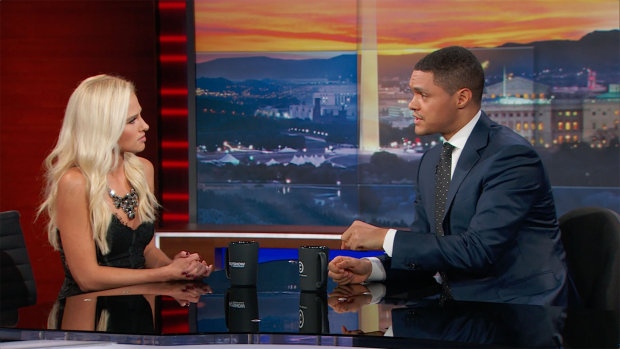
Trevor Noah defends controversial Tomi Lahren interview

Took a certain degree of courage on both their parts rather than remaining within the bubbles, despite the risks of “normalization.” And a much more serious exchange than the Mansbridge/Coulter interview:

Trevor Noah said he invited right-wing pundit Tomi Lahren on his show because he believes Americans with different worldviews need to break out of their ideological bubbles and have conversations with each other.

The South African comedian who took the reins of Comedy Central’s news parody powerhouse The Daily Show when Jon Stewart retired last year has garnered both praise and scorn for his recent interview with Lahren, a hard-line commentator on The Blaze who has come under fire for comparing Black Lives Matter to the Ku Klux Klan.

Headlines labelled the interview a “showdown” and a “faceoff,” but the liberal-leaning Noah insisted it was a “conversation” free of the hatred and vitriol so common to U.S. politics.

Tomi_Invw

Trevor Noah went head-to-head with Tomi Lahren on a recent episode of The Daily Show, in an interview that’s been both praised and scorned. (The Comedy Network)

“The conversation everyone seems to be having is: Do we live in bubbles? Do we live in a space where we are unable to understand or acknowledge the fact there are people out there in the world who have views that are very different to us?” Noah told CBC’s The National.

“It seems fruitless to some, but … the other alternative is to stay in those bubbles that you talk about, so why not have a conversation?”

Source: Trevor Noah defends controversial Tomi Lahren interview – Entertainment – CBC News

Facebook’s AI boss: Facebook could fix its filter bubble if it wanted to – Recode

While Zuckerberg is correct that we all have a tendency to tune-out other perspectives, the role that Facebook and other social media have in reinforcing that tendency should not be downplayed:

One of the biggest complaints about Facebook — and its all-powerful News Feed algorithm — is that the social network often shows you posts supporting beliefs or ideas you (probably) already have.

Facebook’s feed is personalized, so what you see in your News Feed is a reflection of what you want to see, and people usually want to see arguments and ideas that align with their own.

The term for this, often associated with Facebook, is a “filter bubble,” and people have written books about it. A lot of people have pointed to that bubble, as well as to the proliferation of fake news on Facebook, as playing a major role in last month’s presidential election.

Now the head of Facebook’s artificial intelligence research division, Yann LeCun, says this is a problem Facebook could solve with artificial intelligence.

“We believe this is more of a product question than a technology question,” LeCun told a group of reporters last month when asked if artificial intelligence could solve this filter-bubble phenomenon. “We probably have the technology, it’s just how do you make it work from the product side, not from the technology side.”

A Facebook spokesperson clarified after the interview that the company doesn’t actually have this type of technology just sitting on the shelf. But LeCun seems confident it could be built. So why doesn’t Facebook build it?

“These are questions that go way beyond whether we can develop AI technology that solves the problem,” LeCun continued. “They’re more like trade-offs that I’m not particularly well placed to determine. Like, what is the trade-off between filtering and censorship and free expression and decency and all that stuff, right? So [it’s not a question of if] the technology exists or can be developed, but … does it make sense to deploy it. This is not my department.”

Facebook has long denied that its service creates a filter bubble. It has even published a study defending the diversity of peoples’ News Feeds. Now LeCun is at the very least acknowledging that a filter bubble does exist, and that Facebook could fix it if it wanted to.

And that’s fascinating because while it certainly seemed like a fixable problem from the outside — Facebook employs some of the smartest machine-learning and language-recognition experts in the world — it once again raises questions around Facebook’s role as a news and information distributor.

Facebook CEO Mark Zuckerberg has long argued that his social network is a platform that leaves what you see (or don’t see) to computer algorithms that use your online activity to rank your feed. Facebook is not a media company making human-powered editorial decisions, he argues. (We disagree.)

But is showing its users a politically balanced News Feed Facebook’s responsibility? Zuckerberg wrote in September that Facebook is already “more diverse than most newspapers or TV stations” and that the filter-bubble issue really isn’t an issue. Here’s what he wrote.

“One of the things we’re really proud of at Facebook is that, whatever your political views, you probably have some friends who are in the other camp. … [News Feed] is not a perfect system. Research shows that we all have psychological bias that makes us tune out information that doesn’t fit with our model of the world. It’s human nature to gravitate towards people who think like we do. But even if the majority of our friends have opinions similar to our own, with News Feed we have easier access to more news sources than we did before.”

So this, right here, explains why Facebook isn’t building the kind of technology that LeCun says it’s capable of building. At least not right now.

There are some benefits to a bubble like this, too, specifically user safety. Unlike Twitter, for example, Facebook’s bubble is heightened by the fact that your posts are usually private, which makes it harder for strangers to comment on them or drag you into conversations you might not want to be part of. The result: Facebook doesn’t have to deal with the level of abuse and harassment that Twitter struggles with.

Plus, Facebook isn’t the only place you’ll find culture bubbles. Here’s “SNL” making fun of a very similar bubble phenomenon that has come to light since election night.

Let’s get real. Facebook is not to blame for Trump. – Recode

While I think Williams downplays the role and responsibility of social media (see Social Media’s Globe-Shaking Power – The New York Times), his raising of confirmation bias is valid.

Communications technology is not neutral, and perhaps it is time to reread some of the Canadian classics by Harold Innis (Empire and Communications) and Marshall McLuhan (Understanding Media: The Extensions of Man):

Much of the coverage and outrage has been directed toward social media, its echo chambers, and specifically those of the Facebook platform. While, to be sure, much of the fake or inaccurate news is found and circulated on Facebook, Facebook is not a news outlet; it is a communication medium to be utilized as its users so choose. It is not the job of Facebook’s employees, or its algorithms, to edit or censor the content that is shared; in fact it would be more detrimental to do so. This is for two very good reasons:

One, either human editors, or artificial intelligence editors, by removing one item or another will appear to introduce bias into the system. The group who’s content is being removed or edited will feel targeted by the platform and claim it, rightly or wrongly, is biased against their cause. Even if the content is vetted and found to be true or false.

Two, censorship in any form is bad for the national discourse.

So rather than blaming Facebook or other platforms for the trouble in which we find ourselves, let’s give credit where credit is due: The American people.

This comes down to two very important concepts that our society has been turning its back on, in the age of social media: Confirmation bias and epistemology.

Explained by David McRaney, the You Are Not So Smart blogger and author of “You Are Now Less Dumb: How to Conquer Mob Mentality, How to Buy Happiness, and All the Other Ways to Outsmart Yourself,” confirmation bias is the misconception that “your opinions are the result of years of rational, objective analysis,” and that the truth is that “your opinions are the result of years of paying attention to information which confirmed what you believed while ignoring information which challenged your preconceived notions.” Or, more precisely: The tendency to process information by looking for, or interpreting, information that is consistent with one’s existing beliefs.

If we find a piece of content that says that Donald Trump is clueless, or that Hillary Clinton belongs in prison, we accept the one because it reinforces our like for one candidate over the other, and discard the negative item as some falsehood generated by the opposing party to discredit your candidate. We don’t care about the information or what it says, as long as it reinforces how we feel.

That brings us to epistemology, “the study or a theory of the nature and grounds of knowledge especially with reference to its limits and validity,” a branch of philosophy aptly named from the Greek, meaning “knowledge dscourse.” This is a concept that has existed since the 16th century and very likely conveniently ignored in political campaigns ever since, perhaps because it’s just easier to believe and propagate than it is to read and validate.

In fact, a recent Pew Research Center survey called the American Trends Panel asked if the public prefers that the news media present facts without interpretation. Overwhelmingly, 59 percent of those posed the question preferred facts without interpretation, and among registered voters, 50 percent of Clinton supporters, and 71 percent of Trump supporters preferred no interpretation. While those numbers may seem incredible, the telling result is that 81 percent of registered voters disagree on what the facts actually are. Aren’t facts just facts? Yes, they are, but our biases and distrust of intellectual sources say otherwise.

Does Facebook create echo chambers on both sides of the political spectrum? No. Facebook and other social media only serve to provide a high-speed amplifier of what already exists in our society; especially to those who enjoy the communal effect of sharing information with others in their personal circles. Facebook goes give them a wide and instant audience.

In a 2012 study published in the journal Computers in Human Behavior, computer scientists Chei Sian Ma, and Long Ma said, “… we also establish that status seeking has a significant influence on prior content sharing experience indicating that the experiential factor may be a possible mediator between gratifications and news sharing intention.”

Or, in other words, it’s fun to share something and get congratulatory high-fives from your like-minded friends. Facebook does make that activity almost instantaneous. Sharing news, or fake news, and being liked for doing so feels good. Never mind the ramifications on the accuracy of cultural or political discourse.

During his final press conference in Berlin with Angela Merkel, President Obama puts this as succinctly as it could possibly be said: “If we are not serious about facts, and what’s true and what’s not . . . if we can’t discriminate between serious arguments and propaganda, then we have problems.”

From Hate Speech To Fake News: The Facebook Content Crisis Facing Mark Zuckerberg : NPR

Another good long read on social media, particularly Facebook, and its need to face up to ethical issues:

Some in Silicon Valley dismiss the criticisms against Facebook as schadenfreude: Just like taxi drivers don’t like Uber, legacy media envies the success of the social platform and enjoys seeing its leadership on the hot seat.

A former employee is not so dismissive and says there is a cultural problem, a stubborn blindness at Facebook and other leading Internet companies like Twitter. The source says: “The hardest problems these companies face aren’t technological. They are ethical, and there’s not as much rigor in how it’s done.”

At a values level, some experts point out, Facebook has to decide if its solution is free speech (the more people post, the more the truth rises), or clear restrictions.

And technically, there’s no shortage of ideas about how to fix the process.

A former employee says speech is so complex, you can’t expect Facebook to arrive at the same decision each and every time; but you can expect a company that consistently ranks among the 10 most valuable on earth, by market cap, to put more thought and resources into its censorship machine.

The source argues Facebook could afford to make content management regional — have decisions come from the same country in which a post occurs.

Speech norms are highly regional. When Facebook first opened its offices in Hyderabad, India, a former employee says, the guidance the reviewers got was to remove sexual content. In a test run, they ended up removing French kissing. Senior management was blown away. The Indian reviewers were doing something Facebook did not expect, but which makes perfect sense for local norms.

Harvard business professor Ben Edelman says Facebook could invest engineering resources into categorizing the posts. “It makes no sense at all,” he says, that when a piece of content is flagged, it goes into one long line. The company could have the algorithm track what flagged content is getting the most circulation and move that up in the queue, he suggests.

Zuckerberg finds himself at the helm of a company that started as a tech company — run by algorithms, free of human judgment, the mythology went. And now he’s just so clearly the CEO of a media company — replete with highly complex rules (What is hate speech anyway?); with double standards (If it’s “news” it stays, if it’s a rant it goes); and with an enforcement mechanism that is set up to fail.

Source: From Hate Speech To Fake News: The Facebook Content Crisis Facing Mark Zuckerberg : All Tech Considered : NPR

Social Media’s Globe-Shaking Power – The New York Times

Good long read by Farhad Manjoo on the increasing influence of social media and some of the implications:

As the technology industry came to grips in the last week with the reality of a presidential election that did not go its way, many in Silicon Valley landed on the idea that widespread misinformation spread online was a primary factor in the race’s outcome.

On Monday, both Google and Facebook altered their advertising policies to explicitly prohibit sites that traffic in fake news from making money off lies. That’s very likely a worthwhile fix, even if it comes too late. The internet has loosened our collective grasp on the truth, and efforts to fight that dismaying trend are obviously worth pursuing.

Yet it would be a mistake to end this investigation at fake news. In fact, the dangers posed by fake news are just a symptom of a deeper truth now dawning on the world: With billions of people glued to Facebook, WhatsApp, WeChat, Instagram, Twitter, Weibo and other popular services, social media has become an increasingly powerful cultural and political force, to the point that its effects are now beginning to alter the course of global events.

The election of Donald J. Trump is perhaps the starkest illustration yet that across the planet, social networks are helping to fundamentally rewire human society. They have subsumed and gutted mainstream media. They have undone traditional political advantages like fund-raising and access to advertising. And they are destabilizing and replacing old-line institutions and established ways of doing things, including political parties, transnational organizations and longstanding, unspoken social prohibitions against blatant expressions of racism and xenophobia.

Most important, because these services allow people to communicate with one another more freely, they are helping to create surprisingly influential social organizations among once-marginalized groups. These ad hoc social movements range widely in form, from “alt-right” white supremacists in the United States to Brexiters in Britain to ISIS in the Middle East to the hacker collectives of Eastern Europe and Russia. But each in its own way is now wielding previously unthinkable power, resulting in unpredictable, sometimes destabilizing geopolitical spasms.

“You now have billions of people on the internet, and most of them are not that happy with the status quo,” said Ian Bremmer, the president of the Eurasia Group, a research firm that forecasts global risks. “They think their local government is authoritarian. They think they’re on the wrong side of the establishment. They’re aggrieved by identity politics and a hollowed-out middle class.”

Many factors accounted for Mr. Trump’s win: middle-class economic anxiety in the industrial Midwest; an inchoate desire for some kind of change in the national direction; and some mix of latent racism, xenophobia and sexism across the electorate. But as even Mr. Trump acknowledged in an interview with “60 Minutes” aired Sunday, social media played a determining role in the race.

In the past, Mr. Bremmer said, the concerns of Mr. Trump’s supporters might have been ignored, and his candidacy would almost certainly have foundered. After all, he was universally written off by just about every mainstream pundit, and he faced disadvantages in money, organization and access to traditional political expertise. Yet by putting out a message that resonated with people online, Mr. Trump hacked through every established political order.

“Through this new technology, people are now empowered to express their grievances and to follow people they see as echoing their grievances,” Mr. Bremmer said. “If it wasn’t for social media, I don’t see Trump winning.”

For people who like an orderly, predictable world, this is the scariest thing about Facebook; not that it may be full of lies (a problem that could potentially be fixed), but that its scope gives it real power to change history in bold, unpredictable ways.

But that’s where we are. It’s time to start recognizing that social networks actually are becoming the world-shattering forces that their boosters long promised they would be — and to be unnerved, rather than exhilarated, by the huge social changes they could uncork.

This should come as no surprise. In a way, we are now living through a kind of bizarro version of the utopia that some in tech once envisioned would be unleashed by social media.

Over much of the last decade, we have seen progressive social movements powered by the web spring up across the world. There was the Green Revolution in Iran and the Arab Spring in the Middle East and North Africa. In the United States, we saw the Occupy Wall Street movement and the #BlackLivesMatter protests.

Social networks also played a role in electoral politics — first in the ultimately unsuccessful candidacy of Howard Dean in 2003, and then in the election of the first African-American president in 2008.

Yet now those movements look like the prelude to a wider, tech-powered crackup in the global order. In Britain this year, organizing on Facebook played a major role in the once-unthinkable push to get the country to leave the European Union. In the Philippines, Rodrigo Duterte, a firebrand mayor who was vastly outspent by opponents, managed to marshal a huge army of online supporters to help him win the presidency.

The Islamic State has used social networks to recruit jihadists from around the world to fight in Iraq and Syria, as well as to inspire terrorist attacks overseas.

And in the United States, both Bernie Sanders, a socialist who ran for president as a Democrat, and Mr. Trump, who was once reviled by most members of the party he now leads, relied on online movements to shatter the political status quo.

Why is this all happening now? Clay Shirky, a professor at New York University who has studied the effects of social networks, suggested a few reasons.

One is the ubiquity of Facebook, which has reached a truly epic scale. Last month the company reported that about 1.8 billion people now log on to the service every month. Because social networks feed off the various permutations of interactions among people, they become strikingly more powerful as they grow. With about a quarter of the world’s population now on Facebook, the possibilities are staggering.

“When the technology gets boring, that’s when the crazy social effects get interesting,” Mr. Shirky said.

One of those social effects is what Mr. Shirky calls the “shifting of the Overton Window,” a term coined by the researcher Joseph P. Overton to describe the range of subjects that the mainstream media deems publicly acceptable to discuss.

From about the early 1980s until the very recent past, it was usually considered unwise for politicians to court views deemed by most of society to be out of the mainstream, things like overt calls to racial bias (there were exceptions, of course, like the Willie Horton ad). But the internet shifted that window.

“White ethnonationalism was kept at bay because of pluralistic ignorance,” Mr. Shirky said. “Every person who was sitting in their basement yelling at the TV about immigrants or was willing to say white Christians were more American than other kinds of Americans — they didn’t know how many others shared their views.”

Thanks to the internet, now each person with once-maligned views can see that he’s not alone. And when these people find one another, they can do things — create memes, publications and entire online worlds that bolster their worldview, and then break into the mainstream. The groups also become ready targets for political figures like Mr. Trump, who recognize their energy and enthusiasm and tap into it for real-world victories.

Mr. Shirky notes that the Overton Window isn’t just shifting on the right. We see it happening on the left, too. Mr. Sanders campaigned on an anti-Wall Street platform that would have been unthinkable for a Democrat just a decade ago.

Now, after Hillary Clinton’s loss, the way forward for Democrats will very likely be determined as much by collectives on Facebook as by elites in Washington — and, as a result, we’re likely to see more unlikely candidates and policy positions than we would have in the past.

The upshot is further unforeseen events. “We’re absolutely going to get more of these insurgent candidates, and more crazy social effects,” Mr. Shirky said.

Mr. Trump is just the tip of the iceberg. Prepare for interesting times.