Speaks for itself – petition and involvement more to raise funds than substance – see highlighted text:
Two Canadians arrested by Chinese authorities on trumped-up charges have been in prison for exactly one year on December 10th.
Enough is enough.
We’re tired of the Chinese communist regime bullying Canada.
To anyone paying attention to China, both its grotesque human rights record and its increasingly belligerent foreign affairs, it’s clear that China is no friend to Canada.
It’s time the Trudeau government stand up to China and demand the release of Michael Kovrig and Michael Spavor.
One can only imagine what conditions they’re being detained in.
It is hard for outsiders to understand how gruelling, exhilarating, exciting, frustrating and physically demanding it can be for journalists covering an election. In the modern multi-media, multi-tasking universe in which journalists live, reporters on campaign planes may be tweeting, doing live interviews and writing several stories in the course of 18-hour days, often eating crappy food at irregular hours without proper exercise and with inadequate sleep. All while trying to be fair and accurate. On election night, columnists like the Toronto Star’s Chantal Hébert and the National Post’s Andrew Coyne were writing their pieces for the next day’s papers while simultaneously appearing on live TV shows.
Ordinary reporters broke stories in this campaign and exhaustively documented the statements of the leaders. Analysts and commentators took apart the platforms. And despite what you may have thought or heard, they collectively produced reams of copy on policy issues. Every time I saw someone complaining that no one was writing about some specific issue, I went online and found deeply reported stories. There were policy pieces on housing affordability and the dependency ratio, and examinations of party platforms on child care and the environment, just to offer a few examples.
But for all the individual excellence and all the expenditure of energy and intellectual capital from journalists, this was a deeply dissatisfying election for many Canadians, and the media played a part in that.
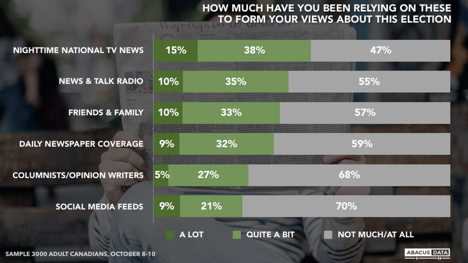
First, let’s be clear. Despite talk that the mainstream media have been displaced by social media, they continue to play a dominant role in the way most Canadians experience a campaign. More than half of Canadians relied on the evening national TV news to form their views on the election, according to a survey by Abacus Data. That was followed by talk radio. Both of these old-fashioned news sources were ahead of social media, as was the influence of “family and friends.”
Not surprisingly, the picture was quite different when it came to the youngest cohort, those 18-29 years of age. For them, the most important source of election information was not social media, though, but family and friends. True, social media were more important to this group than mainstream media; nonetheless, TV news, talk radio and newspapers were all important sources of election information for more than 40 percent of them. What this suggests is that the grip of the mainstream media might continue to diminish over time, but the day of its irrelevance has surely not yet come.
So, the coverage mattered. And the coverage, certainly as it was experienced by many voters, was predominantly negative. We have some interesting data on this from Greg Lyle at Innovative Research Group. He asked respondents mid-campaign whether they had read, seen or heard anything in recent days about each leader. Among those who had heard anything about Liberal leader Justin Trudeau, they said it led them to think less favourably of him by a margin of two-to-one. Almost precisely the same was true of Conservative leader Andrew Scheer.
This is very much in keeping with the unprecedently negative tone of the entire 2019 campaign in which both major parties trended down in the polls and which produced a government with the lowest-ever share of the popular vote.
Like any campaign, so much happened in such a short time that it can be easy to forget the way it began. In the first few days after the writ was dropped, it felt like a formless void, a space without narrative. And this was a vacuum that was gleefully filled by the Liberal war room. The Liberals had obviously accumulated a little video storehouse of horrors: Conservative candidates saying controversial or outright offensive things on abortion, Quebec, homosexuality and race. In that first week, they dropped bits of what they had found onto social media with deliberate menace just hours before Scheer made campaign appearances with particular candidates.
So, it was the Liberals, not the media, who set the tone of the campaign in its first week. Gloomy Ways! But they did so by performing a sort of hack on the media, exploiting their weakness for novelty and tension. Because it was in video form, it took little or no effort to verify on the fly.
What reporter rushing to a constituency event where the less-than-electric Scheer was slated to address some small-bore policy idea recycled from Harper 2015 could resist the lure of the video the Liberals had just dropped on Twitter? Particularly when the Tory candidate obliged the Liberal war room by running away from the camera, as Justina McCaffrey did.
So, the media did not set the tone, but their weakness for a particular kind of story enabled and amplified it. This kept everyone occupied until thatblackfacephoto appeared on Time’s website, giving Justin Trudeau his time in the barrel (and forcing the Liberals to cage in the residents of their war room for a while). Two weeks later, though, the media dug up information about Andrew Scheer’s resumé and then his citizenship, swinging the narrative back to him.
Of course, the media are not helpless in the face of the narratives that campaigns present any more than the parties themselves are. Indeed, every day is a struggle among the parties themselves and between them and the media to decide what the election should be about. On the very first day of the campaign, the Globe and Mail dropped a story on the RCMP looking into the SNC-Lavalin affair that the paper may have hoped would set the frame for the entire campaign. It did set the frame, but for only a day. Later it seemed plain that many people in the media expected the blackface controversy to dominate the rest of the campaign, until it seemed it had not made much of a dent in the Liberals’ polls, at which point they moved on.
Neither of those narratives would have elevated the tone of the election campaign, it has to be said. You could argue in contrast that the Toronto Star strove admirably to frame the election around climate change, which if you believe is real, as I do, is surely as worthy a subject to debate at election time as free trade in 1988 or cutting the GST in 2006. The Star published a series of vividly reported stories that helped remind those who read them of the stakes if we do not act. But it was Swedish activist Greta Thunberg’s journey to North America that raised the profile of the issue in the media more generally, at least for a week, along with an assist from the Liberals on the hustings anxious to move on from blackface. But then climate change, too, faded into the cacophony.
In the last week, it was the most familiar of media narratives that dominated: who is ahead in the polls; can anyone get a majority; if not, who will play with whom in the new Parliament? This emptied the election of most of its policy content and opened up a mostly negative conversation among the parties about which voters should fear the most. Should we be more afraid of Liberal/NDP profligacy or of Conservative budget cuts?
It would be wrong to say that the media alone were responsible for the negativity of this campaign. What we witnessed was rather a cycle, much of it beginning with the parties themselves, turbo-charged by the media, spun through social media, then picked up again and further amplified by the politicians. This cycle could have been broken had the parties presented big ideas or divided more clearly on issues of principle or policy, but for the most part they chose not to. And there were signs of resistance in the media — reporters and columnists who worked mightily to bring us back to what mattered, or should matter: climate change, the economy, taxes and deficit, systemic racism, the scandal of the condition of Indigenous people, foreign policy even. But in the end, all their efforts to save us from this dismal election were in vain.
It is hard enough deciding who is a journalist without delegating the decision to a judge in the midst of an election campaign — or for that matter the Parliamentary Press Gallery. Last week, a judge ordered that three men from two far-right outfits, Rebel Media and the True North Centre for Public Policy, be accredited as journalists to attend the party leaders’ debate. The judge has not yet given his reasons for the decision, but the Leaders Debates Commission reportedly argued in court that they should not be included because of their history of advocacy, which it argued precludes them from being accredited as journalists.
When you think of it historically, the idea that advocacy is inconsistent with journalism is a strange one. Historically, “advocacy” was no bar to being a journalist; in many cases it was its hallmark. Otherwise, what are we to make of Joseph Howe’s Novascotian, which excoriated the magistrates and police? Or George Brown’s Globe, which attacked slavery and Catholicism with equal vehemence? The motto that Brown chose and still adorns its successor, the Globe and Mail, presents a masterclass in journalistic passive aggressiveness: “The subject who is truly loyal to the Chief Magistrate will neither advise nor submit to arbitrary measures.”
In contrast, the model of journalism that many people, including many journalists, carry around in their heads nowadays, where concepts such as balance, fairness and objectivity reign, is primarily a 20th-century construct. It arose from a combination of circumstances, including the commercial pressures on newspapers in medium and small markets to appeal to readers across the political spectrum, the emergence of wire services catering to outlets of different political stripes, and the invention of broadcasting, which led to a combination of publicly owned and highly regulated privately owned broadcasters. It was also connected with the attempt to turn reporters, essentially a trade in the 19th century plied mainly by members of the educated working class, into a “profession,” supported by journalism schools, which were also a 20th– century phenomenon.
However, the earliest champions of press freedom, such as John Peter Zenger, who fought off a libel charge from the royal governor in the colony of New York in the 1730s (after languishing in jail for a time) were defending advocacy on the basis that it was truthful, even if defamatory. When James Madison composed his draft of the US Constitution’s First Amendment, he conceived of freedom of the press as part of a wider set of liberties such as freedom of speech and religion, which were obviously not bounded by standards of fairness or objectivity.
Photo: Parliamentary Press Gallery, Ottawa, 1914. City of Toronto Archives, Fonds 1244, Item 9066.
When you think of it, anyone can speak and anyone can have a religious viewpoint. The real difference between these rights and press freedom is that until very recently relatively few people had ready access to a printing press. In other words, the right to freedom of the press was always circumscribed by sheer logistics. Until roughly the dawn of the 21st century, one of the many differences between you and Conrad Black was that he had access to a printing press and you didn’t. (When Black re-entered the Canadian market in a big way about that time, by the way, he explicitly sought for the National Post to be a “crusading newspaper.”)
This logistical difference between the press and other forms of expressive liberty led to a media tradition that was in fact much narrower than the precepts espoused by Madison and Thomas Jefferson at the Constitutional Convention in 1787, which were then finally transposed into our own Charter of Rights and Freedoms in 1982. The modern media have always imposed limits on the spectrum of views they would tolerate.
If you look at the formal statements of major news organizations such as the CBC or the Globe and Mail, they are replete with boasts that they carry a diversity of views; but they say relatively little about the limits to that diversity. Yet you are unlikely to see a supporter of ISIS get a weekly column or even an occasional op-ed. And Rosemary Barton is not about to add a dash of spice to her weekly panel by, say, adding an alt-right figure such as Faith Goldy. This is true even though we know there are Canadians who hold such views.
The best explanation I have seen of the structure of permitted expression in the media was articulated by an American scholar, Daniel Hallin, at the time of the Vietnam war. Hallin described what he called “three spheres” in journalistic discourse. The first is the sphere of consensus. This includes topics on which the media take the view that consensus is so broad that no opposing view needs to be offered. So, journalists take for granted that slavery is bad, for example, and that democracy is preferable to dictatorship. They feel no need to offer “balance” or another point of view when touching on such topics.
The second is the sphere of legitimate controversy. In the current election campaign, this sphere would include the debate about the size of the deficit and the speed with which it should be addressed, the question of whether to adopt a national pharmacare plan, and whether to build a pipeline. In this sphere, reporters feel a responsibility to maintain neutrality, to “balance” their reports and to maintain a personal disinterest in the outcome of the debates they are reporting on. In this zone, columnists and editorial boards are free to weigh in with their views.
The third is the sphere of deviance. These are ideas such as those I described above, espoused by ISIS or neo-Nazis, which are considered outside the sphere of legitimate discourse, and might also include ideas that are regarded as laughable, ridiculous or simply unfounded. They might be covered as news events but the substance of their arguments is dismissed. Nowadays, this sphere can include people such as climate deniers and anti-vaxxers.
These last two examples point to an important feature of the spheres: that they are constantly in flux as a result of social and journalistic controversy. A decade ago, it was not unusual for a news story on climate change to go out of its way to quote what we now call a climate denier as a way to balance a story. Today it is unusual, and when it happens it is referred to as “false balance” in journalistic circles. Something similar is happening with the debate over vaccinations, with the anti-vaxxers well on their way to the sphere of deviance.
The reason that many people were so angry with the Globe and Mail when it afforded Ezra Levant the platform of its op-ed page early in the election campaign was that it appeared to move someone who was well on his way into the sphere of deviance back into the sphere of legitimate controversy.
Although from a libertarian perspective it is easy to criticize the imposition of the strictures of the three spheres as the arrogant pronouncements of a media (and perhaps corporate) elite, it is not hard to see how they play a cohesive role in our society. Most obviously, it is conducive to a peaceful, orderly, happy society that we don’t give platforms to those who question the full humanity of people of colour or of women or who advocate violence in the pursuit of their political aims.
That having been said, the ability of the mainstream media to police and arbitrate those spheres is now under radical attack in two ways. First of all, the internet has destroyed many of the barriers to entry into the media. You no longer need a printing press or a broadcasting tower to publish. You just need a WordPress account and a server somewhere. Any idiot can get on Twitter. (As you may have noticed, many do.)
Secondly — and this could be a related phenomenon — the sphere of consensus is breaking down in many Western countries. It might be too much to say that there is no longer a broad consensus, for example, that democracy is preferable to authoritarianism, but we have seen the emergence of Strongman-envy in the slaverings of Donald Trump and some of his supporters. A survey in the United States last year found that while 84 percent of seniors agreed that democracy is “always preferable” to other systems of government, that was true of only 55 percent of those aged 18-29. The erosion of a consensus about democracy appears to be happening in many Western countries and though there is disagreement about the degree to which this is happening in Canada, it would be foolish to assume we are immune.
Thus, at the same time as the media’s quasi-monopoly on the printing presses and their modern-day equivalents are eroding their ability to enforce ideas of consensus and deviance, the bulwarks of the old consensus are also under attack.
The issue of who is a journalist in this election campaign has mixed up two debates. The first is one about the guild privilege as exercised by the Parliamentary Press Gallery (and other similar organizations) to which the Debates Commission, like Parliament itself, had contracted out the responsibility to decide who could be accredited. This is where the would-be journalists from the Rebel and True North had their strongest case and on which, I am guessing, the judge decided the matter.
The Gallery, which is still dominated, though not as exclusively as it once was, by big traditional media, has spent the last two decades working through the thorny issues of who would get access to the hallowed halls of Parliament as waves of bloggers, start-up internet websites, quasi-lobbyists, hobbyists and, yes, advocacy groups clamoured for admittance to the club. This is an issue the Gallery has had to manage for logistical reasons if nothing else, and the politicians have been happy to let them do it rather than wading into the thorny issue of who is a journalist themselves.
But whatever you think of the Gallery’s attempt to negotiate these shoals, its guiding principle has not been a commitment to that popular contemporary image of journalism as free, open, balanced, objective news coverage. The “tell” could be that the current membership of the Gallery includes a correspondent from the TASS news agency, as it has done since the Soviet era, and also one from the People’s Daily, the official newspaper of the Communist Party of China.
The much more challenging debate than the one the Gallery, the debate commission and the judge are effectively squabbling over is whether there is still a degree of consensus in our society that makes it worthwhile trying to wall off a zone of legitimate controversy from those who would challenge fundamental values, for example, about democracy, race and gender; what the limits of that zone should be; and who should enforce them. And if we were to decide that such a zone is worth defending, would it even be possible in the age of the internet?
For those of us who are both fascinated and bored by horse race reporting, found this article and related analyses of interest:
When journalists covering elections focus primarily on who’s winning or losing — instead of on policy issues — voters, candidates and the news industry itself suffer, a growing body of research has found.
Media scholars have studied so-called “horse race” reporting for decades to better understand the impact of news stories that frame elections as a competitive game, relying heavily on public opinion polls and giving the most positive attention to frontrunners and underdogs who are gaining in popularity. It’s a common strategy for political coverage in the United States and other parts of the world.
Thomas E. Patterson, the Harvard Kennedy School’s Bradlee professor of government and the press, says election coverage often does not delve into policy issues — what candidates say they would do if elected. Policy issues accounted for 10% of news coverage of the 2016 general presidential election, according to an analysis Patterson did as part of a research series that looks at journalists’ work leading up to and during the election. The bulk of coverage that Patterson examined concentrated on who was winning and losing and why.
“The horserace has been the dominant theme of election news since the 1970s, when news organizations began to conduct their own election polls,” Patterson writes in a December 2016 working paper, “News Coverage of the 2016 General Election: How the Press Failed the Voters.”“Since then, polls have proliferated to the point where well over a hundred separate polls — more than a new poll each day — were reported in major news outlets during the 2016 general election.”
Decades of academic studies find that horse race reporting is linked to:
Distrust in politicians.
Distrust of news outlets.
An uninformed electorate.
Inaccurate reporting of opinion poll data.
Horse race coverage also:
Is detrimental to female political candidates, who tend to focus on policy issues to build credibility.
Gives an advantage to novel and unusual candidates.
Shortchanges third-party candidates, who often are overlooked or ignored because their chances of winning are slim compared to Republican and Democratic candidates.
“The media’s tendency to allocate coverage based on winning and losing affects voters’ decisions,” Patterson writes. “The press’s attention to early winners, and its tendency to afford them more positive coverage than their competitors, is not designed to boost their chances, but that’s a predictable effect.
The following academic studies, most of which were published in peer-reviewed journals, investigate the consequences of horse race reporting from multiple angles. For added context, we included several studies that take a critical look at how journalists use and interpret opinion polls in their election stories.
In this study, researcher Alon Zoizner of the Hebrew University of Jerusalem, analyzes 32 studies published or released from 1997 to 2016 that examine the effects of “strategic news” coverage. Zoizner describes strategic news coverage as the “coverage of politics [that] often focuses on politicians’ strategies and tactics as well as their campaign performance and position at the polls.”
Among the main takeaways: This type of reporting elevates the public’s cynicism toward politics and the issues featured as part of that coverage.
“In other words,” Zoizner writes, “this coverage leads to a specific public perception of politics that is dominated by a focus on political actors’ motivations for gaining power rather than their substantive concerns for the common good.”
He adds that young people, in particular, are susceptible to the effects of strategic news coverage because they have limited experience with the democratic process. They “may develop deep feelings of mistrust toward political elites, which will persist throughout their adult lives,” Zoizner writes.
His analysis also finds that this kind of reporting results in an uninformed electorate. The public receives less information about public policies and candidates’ positions on important issues.
“This finding erodes the media’s informative value because journalists cultivate a specific knowledge about politics that fosters political alienation rather than helping citizens make rational decisions based on substantive information,” the author writes. Framing politics as a game to be won “inhibits the development of an informed citizenship because the public is mostly familiar with the political rivalries instead of actually knowing what the substantive debate is about.”
Another key finding: Strategic news coverage hurts news outlets’ reputations. People exposed to it “are more critical of news stories and consider them to be less credible, interesting, and of low quality,” Zoizner explains. “Strategic coverage will continue to be a part of the news diet but in parallel will lead citizens to develop higher levels of cynicism and criticism not only toward politicians but also toward the media.”
Horse race reporting gave Donald Trump an advantage during the 2016 presidential primary season, this working paper finds. Nearly 60% of the election news analyzed during this period characterized the election as a competitive game, with Trump receiving the most coverage of any candidate seeking the Republican nomination. In the final five weeks of the primary campaign, the press gave him more coverage than Democratic frontrunners Hillary Clinton and Bernie Sanders.
“The media’s obsession with Trump during the primaries meant that the Republican race was afforded far more coverage than the Democratic race, even though it lasted five weeks longer,” writes Patterson, who looked at election news coverage provided by eight major print and broadcast outlets over the first five months of 2016. “The Republican contest got 63 percent of the total coverage between January 1 and June 7, compared with the Democrats’ 37 percent — a margin of more than three to two.”
Patterson’s paper takes a detailed look at the proportion and tone of coverage for Republican and Democratic candidates during each stage of the primary campaign. He notes that the structure of the nominating process lends itself to horse race reporting. “Tasked with covering fifty contests crammed into the space of several months,” he writes, “journalists are unable to take their eyes or minds off the horse race or to resist the temptation to build their narratives around the candidates’ position in the race.”
Patterson explains how horse race journalism affects candidates’ images and can influence voter decisions. “The press’s attention to early winners, and its tendency to afford them more positive coverage than their competitors, is not designed to boost their chances, but that’s a predictable effect,” he writes. He points out that a candidate who’s performing well usually is portrayed positively while one who isn’t doing as well “has his or her weakest features put before the public.”
Patterson asserts that primary election coverage is “the inverse of what would work best for voters.” “Most voters don’t truly engage the campaign until the primary election stage,” he writes. “As a result, they enter the campaign nearly at the point of decision, unarmed with anything approaching a clear understanding of their choices. They are greeted by news coverage that’s long on the horse race and short on substance … It’s not until later in the process, when the race is nearly settled, that substance comes more fully into the mix.”
This study finds that corporate-owned and large-chain newspapers were more likely to publish stories that frame elections as a competitive game than newspapers with a single owner. It also finds that horse race coverage was most prevalent in close races and during the weeks leading up to an election.
Researchers Johanna Dunaway, an associate professor of communication at Texas A&M University, and Regina G. Lawrence, associate dean of the School of Journalism and Communication Portland, looked at print news stories about elections for governor and U.S. Senate in 2004, 2006 and 2008. They analyzed 10,784 articles published by 259 newspapers between Sept. 1 and Election Day of those years.
Their examination reveals that privately-owned, large-chain publications behave similarly to publications controlled by shareholders. “We expected public shareholder-controlled news organizations to be most likely to resort to game-framed news because of their tendency to emphasize the profit motive over other goals; in fact, privately owned large chains are slightly more likely to use the game frame in their campaign news coverage at mean levels of electoral competition,” Dunaway and Lawrence write.
They note that regardless of a news outlet’s ownership structure, journalists and audiences are drawn to the horse race in close races. “Given a close race, newspapers of many types will tend to converge on a game-framed election narrative and, by extension, stories focusing on who’s up/who’s down will crowd out stories about the policy issues they are presumably being elected to address,” the authors write. “And, as the days-’til-election variable shows, this pattern will intensify across the course of a close race.”
Gender Bias and Mainstream Media Conroy, Meredith. Chapter within the book Masculinity, Media, and the American Presidency, 2015.
In this book chapter, Meredith Conroy, an associate professor of political science at California State University, San Bernardino, draws on earlier research that finds horse race coverage is more detrimental to women than men running for elected office. She explains that female candidates often emphasize their issue positions as a campaign strategy to bolster their credibility.
“If the election coverage neglects the issues, women may miss out on the opportunity to assuage fears about their perceived incompetency,” she writes. She adds that when the news “neglects substantive coverage, the focus turns to a focus on personality and appearance.”
“An overemphasis on personality and appearance is detrimental to women, as it further delegitimizes their place in the political realm, more so than for men, whose negative traits are still often masculine and thus still relevant to politics,” she writes.
How does framing politics as a strategic game influence the public’s trust in journalism? This study of Swedish news coverage suggests it lowers trust in all forms of print and broadcast news media — except tabloid newspapers.
The authors note that earlier research indicates people who don’t trust mainstream media often turn to tabloids for news. “By framing politics as a strategic game and thereby undermining trust not only in politics but also in the media, the media may thus simultaneously weaken the incentives for people to follow the news in mainstream media and strengthen the incentives for people to turn to alternative news sources,” write the authors, David Nicolas Hopmann, an associate professor at University of Southern Denmark, Adam Shehata, a senior lecturer at the University of Gothenburg, and Jesper Strömbäck, a professor at the University of Gothenburg.
The three researchers analyzed how four daily newspapers and three daily “newscasts” covered the 2010 Swedish national election campaign. They also looked at the results of surveys aimed at measuring people’s attitudes toward the Swedish news media in the months leading up to and immediately after the 2010 election. The sample comprised 4,760 respondents aged 18 to 74.
Another key takeaway of this study: The researchers discovered that when people read tabloid newspapers, their trust in them grows as does their distrust of the other media. “Taken together, these findings suggest that the mistrust caused by the framing of politics as a strategic game is contagious in two senses,” they write. “For all media except the tabloids, the mistrust toward politicians implied by the framing of politics as a strategic game is extended to the media-making use of this particular framing, whereas in the case of the tabloids, it is extended to other media.”
This study, based on in-depth interviews with 41 U.S. journalists, media analysts and public opinion pollsters, documents changes in how news outlets cover public opinion. It reveals, among other things, “evidence of eroding internal newsroom standards about which polls to reference in coverage and how to adjudicate between surveys,” writes the author, Benjamin Toff, an assistant professor at the University of Minnesota’s Hubbard School of Journalism and Mass Communication. Toff notes that journalists’ focus on polling aggregator websites paired with the growing availability of online survey data has resulted in an overconfidence in polls’ ability to predict election outcomes — what one reporter he interviewed called the “Nate Silver effect.”
Both journalists and polling professionals expressed concern about journalists’ lack of training and their reliance on poll firms’ reputations as evidence of poll quality rather than the poll’s sampling design and other methodological details. Toff, who completed the interviews between October 2014 and May 2015, points out that advocacy organizations can take advantage of the situation to get reporters to unknowingly disseminate their messages.
The study also finds that younger journalists and those who work for online news organizations are less likely to consider it their job to interpret polls for the public. One online journalist, for example, told Toff that readers should help determine the reliability of poll results and that “in a lot of ways Twitter is our ombudsman.”
Toff calls on academic researchers to help improve coverage of public opinion, in part by offering clearer guidance on best practices for news reporting. “The challenge of interpreting public opinion is a collective one,” he writes, “and scholarship which merely chastises journalists for their shortcomings does not offer a productive path forward.”
In this study, researchers find that journalists covering Danish elections are more likely to cover polls that suggest shifts in voter support than polls that reflect stable voter support. The researchers also find that when journalists tell their audiences that voter support has risen or fallen, it’s often misleading — there usually has been no statistically significant change when taking the poll’s margin of error into account.
Erik Gahner Larsen, a lecturer in quantitative politics at the University of Kent, and Zoltán Fazekas, an associate professor of business and politics at the Copenhagen Business School, examined news coverage of all opinion polls that eight polling firms conducted between 2011 and 2015 to measure Danish voters’ intentions. The analysis focuses on 4,147 news articles published on the websites of nine newspapers and two national TV companies, which, together, featured the results of a combined 412 opinion polls.
“In a majority of the cases the [journalists’] reporting should be about stability,” Larsen and Fazekas write. “However, 58% of the articles mention change in their title. Furthermore, while 82% of the polls have no statistically significant changes, 86% of the articles does not mention any considerations related to uncertainty.”
The authors note their findings reflect “systematic patterns in how journalists turn these polls into an illusionary political horserace.”
This paper, which also looks at news coverage of opinion polls in Denmark, finds that Danish journalists don’t do a great job reporting on opinion polls. Most journalists whose work was examined don’t seem to understand how a poll’s margin of error affects its results. Also, they often fail to explain to their audiences the statistical uncertainty of poll results, according to the authors, Yosef Bhatti of Roskilde University and Rasmus Tue Pedersen of the Danish Center for Social Science Research.
The two researchers analyzed the poll coverage provided by seven Danish newspapers before, during and after the 2011 parliamentary election campaign — a 260-day period from May 9, 2011 to Jan. 23, 2012. A total of 1,078 articles were examined.
Bhatti and Pedersen find that journalists often interpreted two poll results as different from each other when, considering the poll’s uncertainty, it actually was unclear whether one result was larger or smaller than the other. “A large share of the interpretations made by the journalists is based on differences in numbers that are so small that they are most likely just statistical noise,” they write.
They note that bad poll reporting might be the result of journalists’ poor statistical skills. But it “may also be driven by journalists’ and editors’ desires for interesting horse race stories,” the authors add. “Hence, the problem may not be a lack of methodological skills but may also be caused by a lack of a genuine adherence to the journalistic norms of reliability and fact-based news. If this is the case, unsubstantiated poll stories may be a more permanent and unavoidable feature of modern horse race coverage.”
Having lived in Saudi Arabia 1986-88, hard to see the country attracting many tourists, although the desert is imposing and some of the modern architecture, incorporating elements of Islamic design, is impressive:
The world’s 1.8 billion Muslims look to one country above all others.
As the birthplace of Islam, Saudi Arabia is a symbol of purity for many who direct their prayers toward Mecca wherever they are in the world.
The latest in a series of liberalizing reforms attributed to the modernizing influence of Crown Prince Mohammed Bin Salman runs counter to that reputation for religious conservatism.
As they awoke to the news on Friday that women from outside the kingdom would no longer be required to wear the flowing abaya that’s been mandatory for decades, Muslims in Asia broadly welcomed the shift. But many also expressed misgivings about the overall direction of the lodestar of the Islamic world, and wondered just how far the changes would go.
“I view Saudi Arabia as the most sacred place for a Muslim,” said Amirah Fikri, 30, an administrator in the Malaysian capital, Kuala Lumpur, who called the kingdom “an example of a Muslim country in the eyes of the world.”
While reforms such as allowing women to drive and to travel without a guardian’s approval are positive, some things “are better left unchanged,” she said. The risk is of “harming the purity of Saudi when new, non-Islamic practices start to spread in the holy place.”
Khashoggi Murder
The Saudi bid to appeal to tourists with a relaxed dress code for foreign women and the promise of easier access to the country is aimed at diversifying the economy away from its overwhelming reliance on oil. But it also serves to present a softer image of the kingdom to the west at a time when its reputation is distinctly mixed.
The crown prince was excoriated internationally over the gruesome murder in Turkey last year of columnist Jamal Khashoggi, and his prosecution of a bloody war in Yemen resulting in famine and thousands of civilian casualties prompted Germany and other countries to halt weapons sales to Saudi Arabia.
At home, the kingdom’s extensive use of the death penalty, torture, arbitrary detentions of rights activists and “severely restricted” freedoms are among the issues cited by Amnesty International in its overview of Saudi Arabia. “Despite limited reforms, including allowing women to drive, women faced systematic discrimination in law and practice and were inadequately protected against sexual and other violence,” Amnesty says.
Yet that evidence of the country’s deeply conservative nature and its rigid interpretation of Islam helps to give a sense of the potential for domestic resistance to any kind of modernizing reform — and the risks to the crown prince in pursuing change.
“Tourism of course will help the economy, but if it involves anything that goes against our religious beliefs then it will not be accepted,” said Sultan, a 33-year-old resident of Riyadh, who only gave his first name. “Our religion is more important than anything.” Foreign tourists will “import their culture” and “over time, these ethics and values will be stripped away from our conservative society.”
Necessary Change
Yet for many in Indonesia, the most populous Muslim country in the world, Saudi Arabia has no choice but to open up.
“Change is a necessity,” said Nasaruddin Umar, Grand Imam of Istiqlal Mosque in Jakarta. “There will be pressure from the traditional clerics group in the country. But I see what MBS is doing as a smart move because he does so in a measured way.”
Didik Saputra, a 32-year-old high school teacher from Depok in West Java, one of the most conservative Muslim provinces in Indonesia, spoke while on a visit to the country’s largest mosque in central Jakarta during its renovation and expansion.
“Saudi Arabia must accept changes without totally eliminating the old customs and practices,” he said over the noise of construction workers. “I agree with MBS that Saudi Arabia must be progressive and promote modernization of Islam. That would be good as it will also improve the image of Islam in the world.”
Beliefs and Culture
The threat of liberalization jeopardizing Saudi Arabia’s global standing among devout Muslims is a proposition dismissed by Ahmed Al-Khateeb, chairman of the Saudi Commission for Tourism and National Heritage and a key adviser to the crown prince. Saudi Arabia is any case no stranger to foreign visitors, he said.
“We don’t expect this to affect Saudi Arabia’s image as the host for the Muslim world,” he told Bloomberg Television in Riyadh on Thursday. “The Muslim world knows that Saudi Arabia follows rules and has beliefs and culture.”
Saudi Arabia has suffered far worse damage to its reputation in the recent past. It’s less than two decades since the kingdom almost became an international pariah after al-Qaeda leader Osama bin Laden, a Saudi national, claimed the worst terrorist attack on U.S. soil.
The country’s post-World War II alliance with the U.S. survived the 9/11 attacks orchestrated by bin Laden. Donald Trump chose Saudi Arabia as the destination for his first overseas trip as president, and was quick to rally to its side after this month’s attacks on Saudi oil installations widely attributed to regional rival Iran. However, that dependence on the U.S., more than Saudi Arabia’s reform efforts, is regarded with suspicion by some Muslims.
“Saudi has lost her nobility ever since they chose to be in bed with the United States to fund extremist groups and create violent conflicts in their neighboring Arab countries,” said Fatin Mohd Husni, 29, a teacher in Malaysia. “So I see these reforms as neither diminishing nor harming the purity of Saudi, because there’s nothing so pure about the Saudi administration to begin with.”
Drawing a Line
In India, with some 200 million Muslims, men heading out of Friday prayers at the Jama Masjid adjacent to Parliament House in New Delhi welcomed Saudi Arabia’s move to open up.
“Muslims across the world should support Saudi Arabia’s decision,” said Fazle Mobin Siddique, 45, secretary at the Diamond Charitable and Educational Trust in the central-Indian city of Nagpur. “This is a progressive step for Islam. Excessive restrictions on women and the moral police needed to go.”
For Tauqueer Khan, 40, a government consultant, Saudi Arabia’s reforms are an effort to counter the stigma of being “synonymous with backwardness, extremism, radicalism and terrorism” and show the world it too can change with time.
“These changes up to a certain level is OK,” he said. “But if they go beyond these and open up a pub with liquor, it will not acceptable at all. The Muslim world looks on Saudi as the guardian of Islam. If they go beyond a certain level, obviously, the Muslim community will not like that.’’
John Geddes draws on Northrop Frye in this interesting column:
Anyone clinging to sanity deserves a mechanism for coping with the latest Donald Trump outrage. The socially sanctioned default response—I couldn’t imagine him going any lower, but he’s done it again—is too benumbed to feel nearly adequate. My own defensive twitch is to mutter the words “tantrum style” at the iPhone screen when news appears of the inevitable worst-yet presidential utterance, which draws some looks on the bus, but at least I’m not left entirely speechless.
I lifted the phrase from a lecture series Northrop Frye delivered in 1961, which was preserved in a slim book called The Well-Tempered Critic. Midway through a virtuosic explication of the sort of language deployed by the Trumps of this world, the late Canadian literary theorist described the basic transaction: “A mob always implies some object of resentment, and political leaders who speak for the mob aspect of their society develop a special kind of tantrum style, a style constructed almost entirely out of unexamined clichés.”
Frye was at his best in precisely cataloguing the topics covered in the clichés spouted by the tantrum-throwing ego. “It can express,” he said, “only the generic: food, sex, possessions, gossip, aggressiveness and resentments.” Doesn’t that satisfyingly sum up Trump’s constricted range? He’s aggressive and resentful, of course, and a vicious gossip, and obsessed with possessions. But don’t pass over the seemingly quotidian first item on Frye’s list: food. Trump was never more Trumpian than when—in recounting how he told Xi Jinping over dinner at Mar-a-Lago about a U.S. missile strike on Syria—he gloated that they were, at that moment, eating “the most beautiful piece of chocolate cake, and President Xi was enjoying it.”
It’s not the usual line of attack to parse Trump closely enough to grasp how his fixation on the menu fits with all the rest. His racism, his nativism, his populism—these are all aspects of the era’s dominant figure that lend themselves to analysis by writers who come at him through political conviction or even political philosophy. The spate of books and essays that might be gathered under the heading Trump vs. the Enlightenment are almost touching in the earnestness of the authors as they extol values handed down from the 18th-century, like respect for democratic institutions and regard for science, now banished from the White House.
But these approaches can only remind us of what Trump and the rest of the right-wing populists are undermining, not how they’re doing it. In other words, the political thinkers who can help us get clear on what’s worth defending aren’t much help in figuring out what’s put us on the defensive. For that, we don’t need philosophy, but we might be able to make use of a literary critic’s insights in order to fathom how Trump’s crude rhetoric can possibly be working.
He’s a voice, after all, not a mind. If stray scraps of ideology cling to his blather, they don’t add up to much—certainly nothing coherent enough to make any clear-headed listener doubt the basic tenets of democratic liberalism. But he sure knows how to string together clichés—or, as they say on Twitter, make a thread of them—and the world evidently can’t or won’t block him. Frye left us a guide to understanding his tantrum style, and, even better, a way to start thinking again about fostering a culture that hears how empty it really is.
Born in 1912, Frye’s concerns were rooted in his reaction to the totalitarianism that was on the march as he came of age in the 1930s, when he was studying at University of Toronto and Oxford. Hitler’s raving never quite stopped echoing for him, right through to his last big book, 1990’s Words With Power, published the year before he died, in which he describes how the most debased political rhetoric comes down to a “shrieking head” ranting until the “steady battering of consciousness becomes hypnotic, as the metaphor of ‘swaying’ an audience suggests.”
Frye was never swayed by the pull fascism exerted on, to stick to his literary field, Eliot and Pound. As for any tug from the left, well, he once reportedly dismissed rival critic Terry Eagleton as a “Marxist goof.” Frye proposed arming citizens against ideological assaults with educated imaginations, so they would know a verbal bludgeoning when they heard one. “Literary education should lead not merely to the admiration of great literature, but to some possession of its power of utterance,” he wrote in The Well-Tempered Critic. “The ultimate aim is an ethical and participating aim, not an aesthetic or contemplative one, even though the latter may be the means of achieving the former.”
The notion of literary appreciation underpinning participatory citizenship might well land as naïvely bookish. Yet it would be a mistake to assume Frye was out of touch. Despite his tweeds and rimless spectacles—not to mention the intimidating reputation draped over him after his daunting masterpiece, Anatomy of Criticism, appeared in 1957—he never really retreated into his Blake, his Shakespeare, and his King James Bible.
For instance, he dutifully watched countless hours of miscellaneous TV for the Canadian Radio-television Commission in the early 1970s. From the notes he jotted down, which were published much later, we know he was astute enough about popular culture to see football was the medium’s ideal sport (its “discontinuous and intensely localized rhythm seems to me the rhythm of television”) and to greatly enjoy a segment of a CBC comedy special co-created by Lorne Michaels (soon to break big with “Saturday Night Live”).
He grappled more systematically with his times in a 1967 lecture series published as The Modern Century. Frye spoke of how the liberal ideal of social progress had devolved, at the individual level, to the progress of time ticking toward death. When life feels so pointless, so alienating, many individuals shield themselves by adopting a “deliberately frivolous” attitude, he observed, ignoring news other than tabloid “human interest” pieces. (Imagine if Frye had lived to witness the rise of reality TV.)
At the same time, he detected in advertising and propaganda—and especially their new hybrid progeny, PR—the ascendant forms of language. Decades before the Internet emerged as an all-encompassing digital counter-reality—ushering in a presidency that’s only fully itself only on Twitter—Frye sensed something like it coming. “The triumph of communication is the death of communication: where communication forms a total environment, there is nothing to be communicated,” he wrote.
He was never easy to label. Frye insisted that literary criticism must not be an adjunct of any ideology, whether feminism or Marxism or, back in his day, Freudianism. His resistance to isms in his core work was known to sow confusion about where to peg him on the left-right spectrum. On one hand, the RCMP kept a secret file on him, their interest reportedly prompted by his involvement with a “teach-in” on China at University of Toronto in 1966; he also opposed the Vietnam war and apartheid in South Africa. On the other hand, he scoffed at the student radicals of the ’60s, who sounded to him, as a former student of the ‘30s, to be repeating the “formulas of the ignorant and stupid of a generation ago.”
In other words, he was more or less a centrist liberal, which frustrated his detractors during his lifetime. How could such a formidable genius be so politically bland? I think this largely explains why he’s fallen so far out of intellectual fashion. Yet today—with the best parts of the postwar status quo we used to take for granted under siege by the forces of raw stupidity—Frye’s critical preoccupation with cultivating what he called democracy’s “shaping and controlling vision” takes on an unforeseen urgency.
In the roiling spring of 1969, when he was accepting an honorary degree at Acadia University, Frye pleaded for a return to a “revolutionary belief in democracy and equality,” arguing that, at least for Americans and Canadians, “the dynamic of democracy is an inclusive one, and it moves toward dissolving the barriers against excluded or depressed groups.” He acknowledged where North American society was falling short, but believed the solutions had to be found in its own myths. “The old middle-class and white-ascendancy stereotypes are no longer strong enough to hold society together, and of course they were never good enough,” he said that day. “But the recovery of its own democratic tradition is the key to the present identity crisis on this continent.”
What might be impeding the recovery of that tradition? More than 50 years ago, Frye warned that the comfortably prosperous democracies are vulnerable to an insidious internal blight more dangerous than any overt ideological challenge. “The most permanent kind of mob rule,” he wrote in The Modern Century, “is not anarchy, nor is it the dictatorship that regularizes anarchy, nor even the imposed police state depicted by Orwell. It is rather the self-policing state incapable of formulating an articulate criticism of itself and developing a will to act in its light.”
Sensing that their state is paralyzed in this way, citizens grow susceptible to the empty calls to action bellowed by Trump, or the Brexiters, or any number of subsidiary blowhards. When well-intentioned politicians can’t come to grips with climate change or shrink income inequality, reform immigration or fix health care, why keep voting them in? Supposedly enlightened leaders who haven’t been able to muster plausible critiques, or summon the will to act on them, won’t put populism back in its place until they regain their mobility.
Along with recovering the capacity to move on what matters, they’ll need to find the language to regain the respect of distracted voters. Frye wasn’t against healthy rhetoric. In Words With Power, he cited the most redoubtable of classics—Lincoln’s Gettysburg address and Churchill’s 1940 speeches—as examples of “how an ideology maintains itself in a historical crisis.”
Lincoln and Churchill, he wrote, didn’t appeal so much to reason, as to a shared understanding that respect for the rational is integral to an even deeper social bond. “The principle invoked is that we belong to something before we are anything, that our loyalties and sense of solidarity are prior to intelligence,” Frye said. “The sense of solidarity is not simply emotional any more than it is simply intellectual: it might better be called existential.”
And that solidarity was, for Frye, reliant on the vision that makes a society more than a mob. By vision, he meant everything we lump together, in a post-religious era, as culture. He placed the utmost importance on schools and universities doing the work of keeping genuine culture alive in students’ imaginations. That job, however, cannot be reduced to some sort of ideological indoctrination. At its heart, it must be about instilling a familiarity with and a taste for great stories—the sensibility most likely to carry with it a strong distaste for insults and lies.
What goes on in the classroom takes on real urgency where liberty is most threatened, and thus most valued. In Hong Kong, the high-school level liberal studies curriculum is being blamed by the Beijing regime and its apologists for creating a generation of pro-democracy activists. Frye would have been fascinated, and even more intrigued by reports that link recent efforts to enhance liberal-arts education at Hong Kong’s universities to the cause of bolstering liberal-democratic values there.
But that’s in a city under severe duress. In complacent North America, skeptics will doubt public education is up to a task as existential as reinvigorating democracy through the teaching of the humanities. Think about it this way, though. Let’s say the question is, “What is needed to keep liberal democracy healthy?” and your answer does not include, “The schools will have to do more heavy lifting.” In that case, the alternative answer escapes me. We need to teach the basic mechanisms of democracy (what we call “civics”) and the literature and art that bind us together as a democratic society (what Frye called “culture”).
Near the end of The Well-Tempered Critic, he described what culture accomplishes at its best, on the broadest, most democratic level. “It does not amuse,” Frye wrote, “it educates, hence it acts as an informing principle in ordinary life, dissolving the inequalities or class structure and the dismal and illiberal ways of life that arise when society as a whole does not have enough vision.” If that sounds utopian, will anything less suffice when dystopia commands a beachhead in the most powerful office in the world?
….Arguing morally isn’t easy, but here are five tips to help:
Avoid thinking that when someone starts up an argument, they are mounting an attack. To adapt a saying by Oscar Wilde, there is only one thing in the world worse than being argued with, and that is notbeing argued with. Reasoned argument acknowledges a person’s rationality, and that their opinion matters.
There is always more going on in any argument than who wins and who loses. In particular, the relationship between the two arguers can be at stake. Often, the real prize is demonstrating respect, even as we disagree.
Don’t be too quick to judge your opponent’s standards of argument. There’s a good chance you’ll succumb to “defensive reasoning”, where you’ll use all your intelligence to find fault with their views, instead of genuinely reflecting on what they are saying. Instead, try and work with them to clarify their reasoning.
Never assume that others aren’t open to intelligent argument. History is littered with examples of people genuinely changing their minds, even in the most high stakes environments imaginable.
It’s possible for both sides to “lose” an argument. The recently announced inquiry into question time in parliament provides a telling example. Even as the government and opposition strive to “win” during this daily show of political theatre, the net effect of their appalling standards is that everyone’s reputation suffers.
The upshot
There is a saying in applied ethics that the worst ethical decisions you’ll ever make are the ones you don’t recognise as ethical decisions.
So, when you find yourself in the thick of argument, do your best to remember what’s morally at stake.
Otherwise, there’s a risk you might lose a lot more than you win.
Have you ever read something online and shared it among your networks, only to find out it was false?
As a software engineer and computational linguist who spends most of her work and even leisure hours in front of a computer screen, I am concerned about what I read online. In the age of social media, many of us consume unreliable news sources. We’re exposed to a wild flow of information in our social networks — especially if we spend a lot of time scanning our friends’ random posts on Twitter and Facebook.
For example, during the 2016 election in the United States, an astounding number of U.S. citizens believed and shared a patently false conspiracy claiming that Hilary Clinton was connected to a human trafficking ring run out of a pizza restaurant. The owner of the restaurant received death threats, and one believer showed up in the restaurant with a gun. This — and a number of other fake news stories distributed during the election season — had an undeniable impact on people’s votes.
It’s often difficult to find the origin of a story after partisan groups, social media bots and friends of friends have shared it thousands of times. Fact-checking websites such as Snopes and Buzzfeed can only address a small portion of the most popular rumors.
The technology behind the internet and social media has enabled this spread of misinformation; maybe it’s time to ask what this technology has to offer in addressing the problem.
In an interview, Hilary Clinton discusses ‘Pizzagate’ and the problem of fake news online.
Giveaways in writing style
Recent advances in machine learning have made it possible for computers to instantaneously complete tasks that would have taken humans much longer. For example, there are computer programs that help police identify criminal faces in a matter of seconds. This kind of artificial intelligence trains algorithms to classify, detect and make decisions.
When machine learning is applied to natural language processing, it is possible to build text classification systems that recognize one type of text from another.
During the past few years, natural language processing scientists have become more active in building algorithms to detect misinformation; this helps us to understand the characteristics of fake news and develop technology to help readers.
A second approach examines the writing style of a news article rather than its origin. The linguistic characteristics of a written piece can tell us a lot about the authors and their motives. For example, specific words and phrases tend to occur more frequently in a deceptive text compared to one written honestly.
Spotting fake news
Our research identifies linguistic characteristics to detect fake news using machine learning and natural language processing technology. Our analysis of a large collection of fact-checked news articles on a variety of topics shows that, on average, fake news articles use more expressions that are common in hate speech, as well as words related to sex, death and anxiety. Genuine news, on the other hand, contains a larger proportion of words related to work (business) and money (economy).
This suggests that a stylistic approach combined with machine learning might be useful in detecting suspicious news.
Our fake news detector is built based on linguistic characteristics extracted from a large body of news articles. It takes a piece of text and shows how similar it is to the fake news and real news items that it has seen before. (Try it out!)
The main challenge, however, is to build a system that can handle the vast variety of news topics and the quick change of headlines online, because computer algorithms learn from samples and if these samples are not sufficiently representative of online news, the model’s predictions would not be reliable.
One option is to have human experts collect and label a large quantity of fake and real news articles. This data enables a machine-learning algorithm to find common features that keep occurring in each collection regardless of other varieties. Ultimately, the algorithm will be able to distinguish with confidence between previously unseen real or fake news articles.
Suppose that a public figure has said or done something that many people consider offensive, outrageous or despicable — for example, lied about his military service or insulted people’s religious convictions. Should he apologize?
Let’s assume that his goal is not to be a good person, but only to improve his standing — to increase the chance that he will be elected, get confirmed by the Senate or keep his job.
Recent evidence converges on a simple answer: An apology is a risky strategy.
A case in point, now receiving reconsideration as a result of recent reporting in The New Yorker about the allegations against Al Franken. In response to claims of inappropriate physical contact with several women, Mr. Franken, then a member of the Senate, publicly apologized. But the apology did not appear to do him much good, and it might have fanned some flames. Soon after apologizing, he was forced to resign.
Mr. Franken’s post-apology experience may not be so exceptional. According to recent surveys that I have conducted, apologies do not increase support for people who have said or done offensive things.
Good long read on the lack of quality control and standards:
The Sanford Guide to Antimicrobial Therapy” is a medical handbook that recommends the right amount of the right drug for treating ailments from bacterial pneumonia to infected wounds. Lives depend on it.
It is not the sort of book a doctor should puzzle over, wondering, “Is that a ‘1’ or a ‘7’ in the recommended dosage?” But that is exactly the possibility that has haunted the guide’s publisher, Antimicrobial Therapy, for the past two years as it confronted a flood of counterfeits — many of which were poorly printed and hard to read — in Amazon’s vast bookstore.
“This threatens a bunch of patients — and our whole business,” said Scott Kelly, the publisher’s vice president.
Mr. Kelly’s problems arise directly from Amazon’s domination of the book business. The company sells substantially more than half of the books in the United States, including new and used physical volumes as well as digital and audio formats. Amazon is also a platform for third-party sellers, a publisher, a printer, a self-publisher, a review hub, a textbook supplier and a distributor that now runs its own chain of brick-and-mortar stores.


 Multicultural Meanderings