Until last summer, the Cyclorama of Jerusalem in Sainte-Anne-de-Beaupré, Que., was largely unloved. Visitors to the massive 360-degree panoramic depiction of Jerusalem at the time of Christ’s crucifixion were growing scarce, and those who paid the $12 admission often left disappointed.
“It was just bizarre and I would not recommend,” one critic wrote on Trip Advisor last year. “This painting is from another era when pilgrims flocked from all over and were believers, which is not the case these days,” another wrote in August. Compared to the soaring Sainte-Anne-de-Beaupré Basilica next door, the Cyclorama was a kitschy eyesore.
But then something strange happened. News broke at the beginning of August that the Cyclorama was up for sale and that the owners were looking for a foreign buyer to pack up the crucifixion panorama and move it elsewhere. Instead of a shrug, the news was met with instant mobilization. A group of academics called on the province to buy the Cyclorama before it was lost, and the minister of culture declared it a “heritage jewel.” Attendance jumped. And two weeks after the first news reports of the sale, the government announced that the attraction built in the late 19th-century would be protected as an official heritage site. The government is now in discussions with the owners about providing financial aid for upgrades to the building.
The swift intervention to save a religiously themed tourist attraction seems odd for a province that prides itself on its secularism — or laïcité in French. Indeed, the drive to limit the place of religion in the public sphere is shaping up to be a central issue in next year’s election. The Liberal government of Philippe Couillard passed its religious neutrality act, Bill 62, in October preventing women who wear the niqab or burka from providing or receiving government services, and the opposition Parti Québécois and Coalition Avenir Québec have promised even stricter legislation if elected.
The Cyclorama of Jerusalem outside Quebec City. (sothebysrealty.ca)
But there are frequent reminders that secularism in Quebec comes with an asterisk. Typically, the religions that need to be restricted are those of minorities – Muslims, Sikhs, Jews. More often than not they are practiced by relative newcomers to Quebec. And despite the conventional wisdom that Quebecers broke free from the yoke of the Catholic Church in the Quiet Revolution, a stubborn attachment to Christian symbols remains, leading critics to label Quebec’s secularism “catho-laïcité.”
In the aftermath of the adoption of Bill 62, Gabriel Nadeau-Dubois of the left-wing Québec Solidaire party, saw an opportunity to correct what he saw as a glaring contradiction. The law targeting niqab-wearing Muslims in the name of religious neutrality was adopted in a legislature where a crucifix hangs prominently behind the Speaker’s chair. (A judge last week suspended the application of the niqab ban until another section of the law comes into force.) Citing the need for a “separation of powers between religion and the state,” Nadeau-Dubois called for legislators to debate moving the crucifix out of the legislative chamber, which is known as the Salon Bleu because of its blue walls. His motion went nowhere when the Liberals and CAQ refused to grant the unanimous consent required to debate it. “It’s part of the history of the Salon Bleu,” Liberal member Serge Simard explained to Radio-Canada. “It’s part of the history of Quebec.”
The Quebec flag backdropped by a church near Sacre-Couer-de-Jesus, Que. (Mike Drew/Postmedia)
Haroun Bouazzi is head of Association of Muslims and Arabs for a Secular Quebec. In principle, he says, secularism should be a positive thing for minority religions, protecting freedom of belief while shielding the state from the influence of any one sect. But what he has witnessed in Quebec in recent years is secularism being invoked by politicians and opinion leaders to oppress rather than protect. Seeing Bill 62 adopted under a crucifix was the height of hypocrisy, Bouazzi says. “How can you be so strict about secularism that you want to put people out of a job because they have chosen to believe something, and then vote that specific (law) under a cross?” he asks. “Sadly, secularism seems to be invoked just to take away rights from religious minorities and not for the right things.”
When Bouazzi arrived in Quebec from his native Tunisia in 2000, he absorbed the standard Quebec history of a 1960s rupture with the once powerful church, which led to a commitment to secularism. He now sees that account as a myth. “It’s not true that all Quebecers got rid of religion,” he says.
Solange Lefebvre, a religious studies professor at the Université de Montréal, agrees. “It’s not true that religion has been abandoned. That infuriates me,” she says. “That is the myth of the Quiet Revolution, spread even by academics sometimes.” As the “simplistic” story goes, Quebecers were in darkness until the Quiet Revolution, then they saw the light, were emancipated from religion and fashioned a skilled bureaucracy to perform functions previously controlled by the church. Lefebvre says the actual story is more nuanced because the influence of religion is felt on multiple levels.
“They were emancipated from certain aspects: from a church that played a lot of roles, that had control over health and education services,” she says. “But religious education continued until 2000. Rites of passage were very much in demand. The Catholic Church in Quebec was very dynamic after the 60s — there were bishops who were stars.”
Census data show that while Quebec pews have emptied, a strong attachment to the church remains. The 2011 National Household Survey found that 75 per cent of Quebecers declared a Catholic religious affiliation, and just 12 per cent declared no religious affiliation – the lowest of any region, according to University of Waterloo professor Sarah Wilkins-Laflamme. It is British Columbians who are the least religious Canadians, with 44 per cent declaring no religious affiliation.
Reginald Bibby, a sociology professor at the University of Lethbridge who has long tracked religious trends in Canada, says the identification of francophone Quebecers with Catholicism remains surprisingly high. For example, nearly 90 per cent of adults aged 35 and under who were raised in Catholic homes continue to identify as Catholic. He says many francophone Quebecers have an “à la carte” approach to religion, praying privately and believing they experience God, but rejecting church authority over issues relating to sex, sexual orientation and abortion.
Bibby says the historical importance of the Catholic Church to Quebec-born Catholics is inescapable. Catholicism “is virtually ‘in their bones’ and is not only part of their culture but also part of their personal identities,” he said in email correspondence. “The result is that they feel natural affinity with Catholic symbols, public and otherwise. Any efforts to obliterate those features of their culture is also an assault on identity and can be expected to be met with opposition, sometime vigorous.”
Demonstrators take part in a protest against Quebecu2019s proposed Values Charter in Montreal on Sept. 14, 2013. (Ryan Remiorz/Canadian Press)
Such a response was seen last February when, in the name of state religious neutrality, a Quebec City hospital took down a crucifix hanging by its elevators. The action drew a threat of violence, a scolding from government ministers and a petition signed by more than 13,000 people, egged on by the former politician behind the PQ’s failed Charter of Values. When the hospital returned the crucifix, it drew praise from Health Minister Gaétan Barrette, who declared the cross “heritage.”
For Lefebvre, religious symbols like the crucifix have taken on a disproportionate importance. “But we have no choice. It’s loaded with symbolic meaning, in connection with identity. So it is very risky now for political parties, for public personalities, to take a stand against these symbols,” she says. Spencer Boudreau, a retired McGill University education professor and a practicing Catholic, has trouble understanding how the crucifix, hung in the National Assembly in 1936, has survived more than 80 years of tumultuous history. But he sees ample evidence that Quebecers’ attachment to Catholicism persists — from the atheist politician and writer Pierre Bourgault requesting a funeral in Montreal’s Notre-Dame Basilica in 2003 to the Journal de Montréal’s publication last week of a calendar of cultural events to mark Advent. “It’s like your family,” Boudreau says. “There might be things you don’t like in the past, maybe you’ve got this crazy uncle, but that doesn’t mean you reject everything.”
Quebec efforts to grapple with secularism in the past decade have included the 2007-’08 Bouchard-Taylor commission, the 2013 Charter of Values seeking to ban conspicuous religious symbols from the public service and Bill 62, which is already the subject of a constitutional challenge. And still confusion reigns. Municipalities use zoning to restrict new places of worship while largely empty Catholic churches occupy prime estate. Residents of a small town outside Quebec City last summer blocked the opening of a Muslim cemetery on the grounds that a graveyard should be open to all, even though Catholic cemeteries can be just as restrictive.
With no sovereignty referendum on the horizon, secularism is likely to be a key “Quebec identity” issue as the province moves toward an election next October. CAQ leader François Legault, who is currently leading in the polls, has promised a “values test” for immigrants and he has identified the full-body burkini swimsuit as something that runs counter to Quebec values. His party also wants to prohibit people in positions of authority, including judges, police officers and schoolteachers, from wearing religious symbols.
The legislature in Quebec City on Nov. 16, 2017. (Jacques Boissinot/Canadian Press)
Félix Mathieu, a PhD student in Political Science at the Université du Québec à Montréal who co-authored a paper on the PQ Charter of Values, says the push to preserve symbols of Quebec’s Catholic past is led by conservative thinkers who argue that secularization went too far and the baby was thrown out with the bathwater. “They have a really flexible tolerance for religious symbols,” he says. “Those of the majority are accepted because they speak to our past; those of minorities — in particular Muslims and Sikhs — are identified as elements that sow division.”
Since the Liberals defeated the PQ in 2014 and the proposed Charter of Values died, the conservatives have been in retreat. But Mathieu says the next election could reverse that.
Quebecers are not alone in resisting minority religious symbols, but polls suggest they are the most opposed. An October poll by the Angus Reid Institute after Jagmeet Singh won the NDP leadership found that 47 per cent of Quebecers would not consider voting for a turban-wearing Sikh, compared with 32 per cent in Alberta, 23 per cent in British Columbia and 24 per cent in Ontario.
A nun outside Mary Queen of the World Cathedral in Montreal. (Graham Hughes/Canadian Press)
Another Angus Reid poll later that month showed 68 per cent of Quebecers thought niqab-wearing women should be prohibited from visiting government offices, well above the national average of 49 per cent. The same poll found 55 per cent of Quebecers consider Islam to be damaging to Canada and 22 per cent said Judaism is damaging (compared with 11 per cent who said it is benefiting.) Catholicism, on the other hand, was seen as damaging to society by 10 per cent of Quebecers and benefiting by 36 per cent.
Angus Reid, founder of the institute, says the results show that Quebecers’ suspicion of minority religions cannot be explained simply by an embrace of secularism. “When you look at Quebec society, you find a level of intolerance for diversity which is significantly higher than the rest of the country,” he says. “It is seen in spades in the current Islamic debate that’s going on. It’s also seen in the fundamental question of the perception of Judaism.”
It is worth nothing that in 2011 just three percent of Quebecers identified as Muslim, one per cent as Jewish and a fraction of a per cent as Sikh. Lefebvre is optimistic that the more contact Quebecers have with adherents of minority religions, the more open they will become. “It’s familiarity that allows people to get over prejudices,” she says. And she questions whether other Canadians really view minority religions all that differently.
“Canada remains a country that is very inspired by Christianity from a certain point of view,” she says. “To me, the big difference between Quebec and the rest of Canada is that we are very vocal. We say what we are thinking loud and clear.”
Speaks for itself – “any debate on the topic is unacceptable”:
Egypt’s Al-Azhar, the Sunni Muslim world’s main religious institution, asserted on Monday in a fatwa, or religious decree, that it is compulsory for women in Islam to wear the veil, while those who deny this are “extremist” and “abnormal”.
Through a statement released by The International Electronic Center for Fatwas of Al-Azhar, the institution said the veil, or hijab, is an obligatory duty imposed by the teachings of Islam, and any debate on the topic is unacceptable.
“It is not acceptable that anyone from the public or non-specialized people, regardless of their culture, to voice their opinions on the matter. The hijab […] aims to preserve [women’s] feminine nature, ” the statement read.
It went on to say that the fact that the veil is compulsory in Islam helps women to become successful and productive in society while preventing them from just being seen as a body.
It added adding that in different countries around the world such as India, China and Japan women wear clothes similar to Islam’s veil as they are keen to follow the nature’s of their nations.
The statement concluded by calling on all who deny that the veil is compulsory in Islam to stop spreading their opinions or issuing fatwas on the matter as they are not specialized or authorized to speak on the issue.
The inclusion of “God” in the preamble to Canada’s 1982 Constitution Act was a last-minute addition by Pierre Trudeau.
Thirty-three years later, as his son Justin presided over the swearing in of a new Liberal cabinet, over half of its members chose to drop the words “so help me God” from their oath of office. In a little more than a generation, the religious beliefs that were once the central tenets of Canadian society have been swept aside, as the courts and Parliament moved to assert a person’s individual liberty over their body, their identity and their relationships, from birth to death. And Canadian public opinion — sometimes leading, at other times following — has marched largely kept pace with this transformation.
The era when churches and religious leaders held sway over public policy in Canada has come to an end. There are important pockets of religious opposition to abortion, assisted dying and gender neutralization, but in the final analysis secularism seems to have won the day.
Religion and religious influence declined in Canada after the Second World War. (In Quebec during the 1960s the process accelerated, and the province moved from being the most to the least churched society in the modern world.) In the 1980s, not long after Pierre Trudeau wrote the word “God” into the constitutional preamble, regular church attendance in Canada was at around 40 percent. When Justin Trudeau formed his first cabinet in 2015, regular attendance had decreased to around half that….
With this decline in influence, the era of religious dominance in the public square has come to an end. But this is not the end of the story. The role of religion in setting public policy has been replaced by a new issue: religion itself as a topic for public policy.
The highest-profile example is the controversy over the clothing worn by some Muslim women. In Quebec — once more at the centre of a religion-versus-state tangle — Bill 62 would require citizens to show their faces when receiving public services. Squarely aimed at niqabs and burkas, this legislation is wildly popular in Quebec but less so in the rest of Canada, where such moves have failed to garner majority support…
The niqab/burka issue is part of a larger drama playing out in Canada concerning rising levels of religious diversity, how Canada should adapt to this multifaith reality and the importance Canadians place on religious freedom guarantees enshrined in the Constitution.
The current debate over religious freedom isn’t limited to the Muslim religion. Indeed, major issues of religious freedom that have recently been before the courts involve Christian organizations attempting to assert their rights: for example, in British Columbia, Trinity Western University’s policies that impose moral standards on their students; in Ontario, the fight with the College of Physicians and Surgeons over exempting health care workers from activities related to abortion or assisted dying; and in Quebec, Loyola College’s demand to be able to set its own religious instruction curriculum, independent of the one established by provincial education authorities.
Beyond the legal aspects, the fate of religion in Canada ultimately depends on public attitudes. On this, the results of surveys by the Angus Reid Institute in 2017 reveal there is cause for concern among religious communities and faith groups. The most startling finding is the relatively tepid support for the very concept of religious freedom. Asked whether the inclusion of religious freedom in the Constitution makes Canada a better or worse country, only slightly more than half (55 percent) of 1,500 respondents in an October 2017 poll said “better.” A sizable minority — roughly 1 in 7 — said “worse”….
These findings, which reflect deep division in Canada over the country’s increasing religious diversity, follow decades of immigration from non-Christian countries. Canada may prize its multiculturalism, but when it comes to the religious roots of this diversity, Canadians are divided.
When asked if religious diversity in Canada is good or bad, 26 percent said “good” and 23 percent “bad,” and the rest were unsure or felt the impact is “mixed.” (Not surprisingly, Quebec is the outlier on this question, with those who said “bad” outnumbering those who said “good” by nearly 2 to 1.) This finding is supported by another from our polling, which asks Canadians if they think the country does too much to accommodate different religious and faith groups… Here we find opinions massively on the side of doing too much (53 percent think the country does too much to accommodate religion, only 9 percent say it doesn’t do enough, and the rest think it strikes the right balance).
The lack of deep support for religious freedom and religious diversity suggests that faith communities could come under increased scrutiny in the future, especially if political leaders sense an advantage in limiting the special status enjoyed by these organizations in taxation, education and health care.
On taxation, recent polling shows Canadians divided — 55 percent in favour and 45 percent against — on special tax status for religious organizations; in Quebec, the percentages are reversed…. The same pattern is evident on opinions about religious schools and about regulations that would curtail the right of faith-affiliated hospitals to opt out of assisted dying.
Starting with the election of Stephen Harper, and continuing into Justin Trudeau’s government, there has been an increasingly politicized debate over religion. Although Harper appointed a special ambassador for religious freedom, he also voted against a motion proposed by members of his own caucus to set up a parliamentary committee to study when life begins. Trudeau, in contrast, did not hesitate to ban pro-life candidates from running for the Liberal Party. When the Governor General he appointed used her maiden speech to disparage those who believe in “divine intervention,” he was quick to jump to her defence.
It’s still early days in this political chapter, where leaders are seeking to change public expression and institutional arrangements associated with religious belief. Ironically, the diversity that is at the heart of this emerging debate may impose the greatest limits on those who would seek to limit religious expression: Canadian immigration policies favour vibrant Islamic, Sikh, Hindu and Christian communities.
The late Richard Neuhaus, one of the 20th century’s great activists and thought leaders on matters of religion and the public square, was born a few miles down the Ottawa River from Canada’s parliament. He understood better than most that politics is a function of culture, and culture is ultimately a function of religion. Canada, which so proudly celebrates its multiculturalism, is witnessing a growing debate over religious diversity that eventually will have far-reaching political consequences. How the debate evolves depends on whether the different religions and traditions can cooperate and have sufficient impact in the political sphere to withstand the forces of secularism that are driving large elements of public policy in Canada.
Tend to agree that more studies needed with respect to visible minorities and religion (some obvious links, Canadian Sikhs, evangelical or more fundamentalist Christians among Chinese Canadians), and the political impacts:
Did Christy Clark increase her popularity by 10 percentage points when she stopped attending Vancouver’s giant Pride parade?
That’s one of the more spicy possibilities raised in a new book that delves into how religion makes a big difference in politics in Canada, even in unusually secular B.C.
The authors of Religion and Canadian Party Politics, from UBC Press, devote a chapter to the ways conservative Christians have been a crucial factor in B.C.’s political dogfights, with a glance also at Sikh influences.
The University of Toronto’s David Rayside and Carleton’s Jerald Sabin and Paul Thomas explain how Clark, who had been happily attending Pride parades, abruptly stopped doing so in 2012.
With Clark painting herself as more socially conservative, her polling numbers went up and those of the then-robust B.C. Conservative party plummeted by 10 percentage points.
The ex-premier did more than snub Vancouver’s Pride parade to cement the “religious vote” in the pivotal 2013 B.C. election, however.
Clark’s advisers obtained an endorsement from Stockwell Day, a preacher and former Conservative cabinet minister. Clark also appeared on the evangelical TV show of David Mainse, host of 100 Huntley St. In addition, the book cites my report on her speech to the Christian organization, City in Focus, in which she said it’s “tragic” more people don’t worship God.
Religion and Canadian Party Politics cites how B.C.’s private schools, which are mostly conservative Christian, with some Sikh and Muslim, are growing to the point they now educate 13 per cent of all the province’s young students.
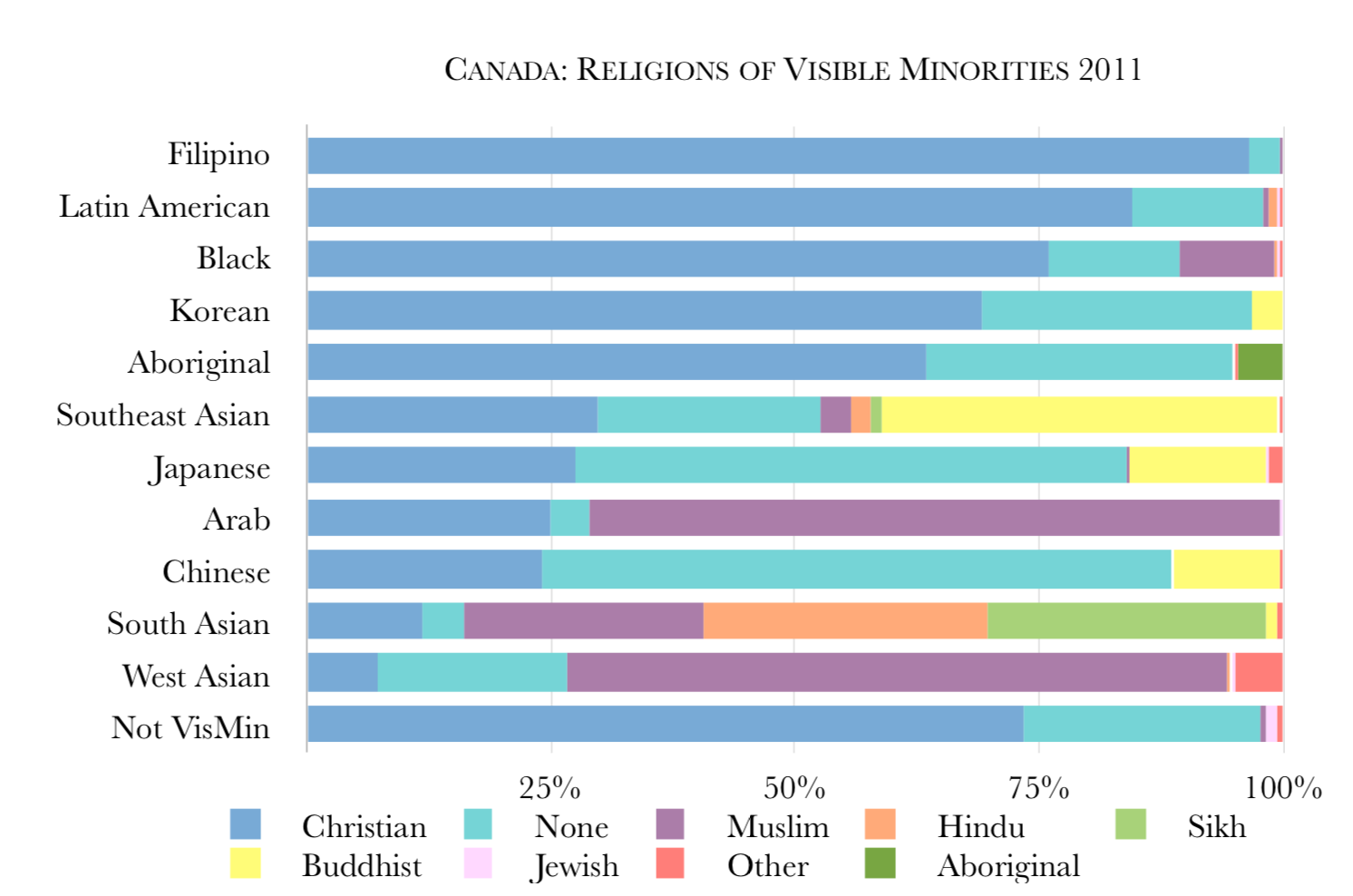
The tactics of Clark, an Anglican, were not only aimed at white Christians, but also B.C. Filipinos (95 per cent of whom are Christian), Koreans (64 per cent Christian) and ethnic Chinese (22 per cent Christian, 59 per cent not religious).
As for the B.C. NDP, Religion and Canadian Party Politics points to polls suggesting they appear to disproportionally rely on non-religious voters.
That is significant since the portion of British Columbians who are atheists, or unaffiliated, is arguably the highest of anywhere in North America, at 44 per cent.
It should be noted, though, that despite the tendency of B.C. Liberals to attract religious voters and the NDP to do the opposite, polls suggest all the province’s parties are capable at different times of drawing support from across the ethnic and faith spectrum.
It’s too bad, in an era when almost all politicians are going out of their way to court minority religious and ethnic groups, the book touches only briefly on Clark’s early success with Sikhs.
It quotes a source saying 30 per cent of the B.C. Liberal party’s membership was made up of Sikhs, even though they comprise just five per cent of the B.C. population. Metro Vancouver’s Sikhs number almost 200,000 and their large gurdwaras often host political gatherings.
Unfortunately, since Religion and Canadian Party Politics was published in 2017, it was not able to report on the way many Sikhs seemed to feel betrayed by Clark during this year’s B.C. election.
The NDP this May won all eight Metro Vancouver ridings with significant Sikh/South Asian populations.
An even more recent overlap of Sikhism and politics in B.C. occurred with the October election of Jagmeet Singh, an orthodox Sikh, as leader of the federal NDP. Singh won in part because he signed up 10,000 new members in B.C., many of them Sikhs.
It’s paradoxical that Singh is now leading a progressive, morally liberal party, even while he’s a baptized Sikh loyal to a faith devoted to conservative sexual ethics.
Even though Singh, 38, is unmarried, the Sikh religion emphasizes orthodox males are expected to be married, emphasizing they should not have sex until then.
Homosexuality is also not accepted in Sikh teaching, and abortion is seen as generally wrong. Nevertheless, Singh appears to express the kind of tolerance promoted by Sikh teachings about not hating anyone based on their race or sexuality.
How do Canadian Muslims vote?
That question may not be quite as significant in Metro Vancouver, where the Muslim population is three per cent, as it is in places such as Montreal and Toronto, where Muslims make up eight per cent of the population.
Even though Religion and Canadian Party Politics doesn’t delve into it, polls suggest many Canadian Muslims support patriarchy, reject homosexuality and discourage mixed unions.
The paradox is partly explained by Stephen Harper’s campaign, however. The federal Conservative party took a stand against the face-covering niqab worn by some Muslim women and, as Rayside said in an interview, showed “very one-sided support for Israel.”
Such is the complicated world of religion and politics in Canada.
While Religion and Canadian Party Politics is strong in critically assessing the influence of conservative white Christians on politics, sometimes by stealth, it’s not as useful on the impact of minority ethnic and religious groups.
Rayside acknowledged many scholars are reluctant to appear to criticize ethnic-based faiths.
But whites are now a minority in Metro Toronto and Vancouver. And about 17 per cent of Metro Vancouver residents, and 22 per cent of Torontonians, follow a non-Christian religion.
As scholar Reginald Bibby points out in his new book, Resilient Gods (UBC Press), in the decade leading up to 2011 more than 478,000 immigrants arrived who were Catholic (mostly Filipino and Chinese), 442,000 had no religion (mostly Chinese and Europeans), 388,000 were Muslims (mostly Iranians and Pakistanis), 154,000 were Hindus (from India) and 107,000 were Sikhs (India).
Scholars may have to overcome their cautiousness and more seriously study the impact of such fast-growing ethnic and religious groups.
It’s not just conservative Christians who have been quietly changing the face of Canadian partisan politics. So have Sikhs and Muslims: Many would expect they would be the hot new thing in political research.
Another good article on the relationship between Sufism and Islam:
The attack on Al Rawdah mosque in the Sinai last Friday, during which Islamists claimed at least 305 lives, was quite possibly the deadliest terrorist atrocity in modern Egyptian history and one of the largest terrorist attacks worldwide. Because the mosque was often frequented by Muslims linked to a Sufi order, the massacre also brought to light the deeply flawed ways Sufism is discussed—both by those who denigrate Sufism and by those who admire it.Extremist groups like ISIS promote the idea that Sufism is a heterodox form of Islam, and then go further to declare Sufis legitimate targets. But it’s not just violent extremists who foster the heterodoxy misconception. In Saudi Arabia, for example, crown prince Mohammed bin Salman claimed on Sunday that “the greatest danger of extremist terrorism is in distorting the reputation of our tolerant religion”—yet intolerance with regard to Sufism is the bedrock of much of the purist Salafi approach that underpins the Saudi religious establishment.
That’s not to say that all those who self-describe as “Salafi” claim that Sufism ought to be met with violence. But many, if not most, deny its centrality within Sunni Islam. Certainly the vast majority of the Saudi religious establishment espouses that kind of belief, which is a massive challenge that the crown prince will have to tackle if he’s serious about his promise to spread “moderate” Islam.The birth of the purist Salafi movement (which many pejoratively describe as “Wahhabism”) saw preachers inspired by the message of 18th-century figure Muhammad bin Abdul Wahhab attacking Sufism writ large in an unprecedented way. While presenting themselves as the orthodox, these types of purist Salafis were actually engaging in a heterodox approach. Many of these figures had to ignore or rewrite large chunks of Islamic history in order to present Sufism and Sufis as beyond the pale.
Ahmad bin Taymiyya, a commonly quoted authority for Salafis, for example, was reportedly a member of the Sufi order of Abdal Qadir al-Jilani. The Sufi affiliations of many medieval authorities have been airbrushed from history in several modern editions of their texts published by Salafi printing houses. Yet, there were virtually no prominent Muslim figures who cast aside Sufism in Islamic history. When followers of ibn Abdul Wahhab attempted to do so by describing Sufis as outside the faith, they were themselves decried by the overwhelming majority of Sunni Islamic scholarship as indulging in a type of heterodoxy because of their intolerance and revisionism.
While some who portray Sufis as heterodox do so with malicious intent, many fans of Sufism in the West seem to agree that Sufis are heterodox—it’s just a type of heterodoxy that they prefer to the normative mainstream of Islamic thought, which they seem to think is different from Sufism. Ironically, the well-meaning nature of this misinformed perspective echoes the fallacy that extremists promote.And it is an extraordinary fallacy. Until relatively recently, it would have been unthinkable for students in Muslim communities to consider Sufism anything other than an integral part of a holistic Islamic education. The essentials of theology, practice, and spirituality—that is, Sufism—were deemed basic, core elements of even elementary Islamic instruction. And religious figures known for their commitment to Sufism would not have been considered a minority; they would have been by far the norm. Indeed, the very label of an Egyptian “Sufi minority” being bandied about since the mosque attack is a peculiar one: Sufism isn’t a sect—it’s integral to mainstream Sunni Islam.
That doesn’t mean that Sufis were never singled out for criticism in traditional Islamic scholarship—they were. Those criticisms were issued by Sufi scholars themselves, much as expert jurists criticized what they saw as shoddy attempts in jurisprudence, and specialized theologians critiqued amateurish forays into theology. One modern critic, a famed Sufi of the Comoros, said, “If we were better Sufis, everyone else wouldn’t think we are anything but good Muslims.”
Another myth is that Sufis are generally apolitical or eschew any martial activity. Historically, that certainly was not the case. Sufi figures like Abu-l-Hasan al-Shadhuli and Ibn Abdal Salam (the latter a famous jurist of his time) were at the forefront of campaigns to defend Egypt from the armies of King Louis of France. The Libyan struggle against the Italian fascist occupation was led by Sufis of the Sanusi order of Sufis, including the famed Omar al-Mukhtar. Shaykh Abdal Qadir al-Jaza’iri was a militant opponent of the French invasion of Algeria in the 19th century, while Imam Shamil of the Caucasus fought against the Russian incursion into his own land. But while they most certainly believed in that martial endeavour, and called it jihad, it was a jihad that meant that the likes of al-Jaza’iri fought to protect Christians; a jihad that meant that al-Mukhtar refused to mistreat prisoners of war; in other words, a jihad that was constrained by the mainstream understanding of Sunni Islam.
This activist trend among Sufis remains in existence today. In my own research over the years, I came across teachers of Sufi texts likeShaykh Seraj Hendricks of South Africa and Shaykh Emad Effat in Egypt. The former was detained for activism against apartheid, while the latter was killed in the midst of protests in late 2011. This is to say nothing of the scores of members of Sufi orders in Syria who participated in the Syrian revolutionary uprising against the Assad regime, as well as against ISIS. It is also true that some Sufi figures engaged in actively supporting autocrats and repressive governments—which other Sufis critiqued for what they saw as inconsistency. That critique has everything to do with what such Sufi figures see as orthodoxy and orthopraxy in the Islamic tradition.
It’s too easy to cast Sufis as a quasi-sectarian group that is somehow detached from Islam. Sufism never betrayed Islamic orthodoxy; if anything, it is Islamic orthodoxy in its purest form. Both those who denigrate Sufis, like ISIS and the Saudi religious establishment, and those who admire Sufis, like Rumi-loving Westerners, would do well to finally recognize this. Otherwise, we all risk betraying Islamic history.
Another good and relevant column by Michael Coren on much of the nonsense about a “war against Christmas”:
…. there is not and never has been a war on Christmas, whether it’s the appearance of Happy Holidays cards (so what?), multicultural television commercials (surely a good thing), or carol singers allegedly being banned from shopping malls (they aren’t). But the sausage roll reveals a sorry irony. If there is a religious war, it is not on the season we have somewhat arbitrarily and relatively recently chosen as the date of Jesus’s birth. Rather, it is an attack against the Christian, egalitarian virtues that the child and the event are supposed to epitomize—a charge led by some Christians and churches themselves.
Truth be told, some of the loudest and most active Christians tend to be socially conservative and harsh in their opinions of what is new, novel, and challenging, often obsessed with issues such as abortion and homosexuality. The latter is a subject I myself wrestled with for a long time, and I once accepted—albeit somewhat reluctantly—that same-sex marriage was forbidden in Scripture. A deeper reading of the Bible, however, and a less anachronistic grasp of its meaning, led me to question what I had considered self-evident. I also saw firsthand the love and commitment of so many same-sex couples, often Christian same-sex couples, that must lead God to smile with delight.
We must remember, however, that these are not issues that Jesus explicitly mentioned in the Bible. Yes, he did respond to the Pharisees’ question about divorce by noting that marriage was between a man and a woman, but we also read of his dealings with a Roman centurion and a slave whom the said Roman loves—a romantic love, according to some textual readings. St. Paul does mention homosexuality—a word not used as it is today until the 19th-century—but this is more about heterosexual men using boys than loving, adult relationships. And while some of the stories in the New Testament are certainly up for debate, Jesus’s emphasis on refusing to judge others, especially where sexual sin is concerned, is not.
What is expressed repeatedly in the Gospels, however—with a virtual monomania—is love for neighbour. Christ teaches that authentic devotion to God can only by demonstrated by this love, this fraternal romance, and such a love demands social justice, a passion for the poor and marginalized, and a revolutionary understanding of power and morality. If Jesus does condemn anyone, it is the reactionaries, those who have authority, who obscure love under law, and who disguise the kingdom behind formalities and regulations. Instead of opening the doors wide, they close them and bolt them tight.
I have no doubt that those Christians who complain about the ostensible war on Christmas and have such right-wing attitudes about so many subjects still believe in their religion, and I certainly have no right or ability to look into their souls. But it has all reached a crisis point now, particularly for those of us who embrace a more progressive but nevertheless committed belief in Christianity. Quite frankly, the antics of the Christian right also turn people away from Christianity, and understandably so. If that’s what Jesus is about, some people say, I want nothing of it.
Don’t forget that one of the leaders of the battle against this chimerical war on Christmas, and a powerful leader of North American Christianity, is Franklin Graham, the son of Billy. He believes that Islam is “very evil and wicked,” admires Vladimir Putin, and demanded that LGBTQ people be barred from churches because Satan“wants to devour our homes.” He also claimed that the election of Donald Trump was due to the “hand of God” at work. Imagine putting all that on a card for Santa.
What he and his friends seem to consider as Christmas is the stuff of tinselled nostalgia mingled with the self-prescribed absolute right of Christians to dominate the public square and dictate the private conscience. And if anything should anger followers of Jesus at Christmas time, it shouldn’t be some irrelevant commercial for food, but rather the fact that millions of people go without food altogether; it shouldn’t be that Jesus’s name is taken in vain but that His teachings are taken in vain; it shouldn’t be that we don’t say “Merry Christmas” as often as we did, but that we so seldom say “I forgive you,” “You are loved,” and “All are welcome in church.” After all, per the once-ubiquitous question, “What would Jesus do,” the answer would probably be, “tell everyone to grow up, re-read what the New Testament says, and then go and turn the world upside-down”—not just at Christmas, but every day of the year.
Ktunaxa elder Chris Luke Sr. lives in B.C.’s Purcell Mountains, about 1,000 kilometres east of Vancouver. He doesn’t speak English and he knows how to keep his silence.
Still, Luke is a powerful man.
For eight years, the elder’s religious vision has seized the attention of Canada’s top courts, demanding the focus of hundreds of lawyers, judges, civil servants and politicians.
Their work became necessary because Luke said he had an epiphany in 2004 — which he did not reveal to his people until 2009 — that the grizzly bears that inhabit a large chunk of public land in the Purcells are sacred, divine protectors.
As a result, Luke’s small tribal group entered into years of hard political negotiations with the B.C. government, which turned into a precedent-setting court case against developers of a ski resort called Jumbo Glacier.
The case, which Luke and his people lost this month in the Supreme Court of Canada, not only raised profound questions about Canada’s commitment to protect religious freedom, it opened a bigger cans of worms. It highlighted philosophical, ethical, anthropological and religious issues.
Four of the broad questions from Luke’s case are: Who decides what is “sacred?” Are religious beliefs static? Is Indigenous spirituality monolithic? Do aboriginals consistently respect the land?
In the case, known as “Ktunaxa Nation versus British Columbia,” the elder was put forward as the sole source of religious truth.
“The record is clear that the Ktunaxa (believe) only certain members of the community, knowledge-keepers, possess information about spiritual values, and that only Mr. Luke could speak to these matters,” wrote the judges.
The Supreme Court of Canada agreed the Ktunaxa were “sincere” in following Luke’s vision of the “Grizzly Bear Spirit.” But the judges noted the Ktunaxa had believed for less than a decade that the grizzly territory they call Qat’muk was of utmost spiritual significance.
The judges concluded timing didn’t matter, though. “Whether this belief is ancient or recent plays no part in our analysis. The Charter protects all sincere religious beliefs and practices, old or new.”
In other words, Canadian courts are obliged to take seriously almost anybody who convinces their followers that land in B.C., or anywhere, is absolutely sacred.
Theoretically, Luke could have been a New Age guru from, say, Los Angeles, who persuaded a group to “sincerely” believe parts of Saskatchewan, or Mississauga, were untouchable. The potential is high for arbitrariness.
Even though the Ktunaxa lost their case, two of nine Supreme Court judges (and many aboriginals and their supporters) believe the majority made a mistake in one of the reasons they refused to stop the ski development for religious reasons.
In general, I tend not to champion giant ski resorts, nor shopping malls nor casinos, whether on public, private or Aboriginal land. Like many Canadians, I also strongly support reconciliation with Canada’s Indigenous populations, along with the treaty process.
The Supreme Court of Canada agreed the Ktunaxa were ‘sincere’ in following their elder’s vision of the ‘Grizzly Bear Spirit.’ But the judges noted the Ktunaxa had believed for less than a decade that the grizzly territory in the Purcell Mountains was of utmost spiritual significance. Determining ‘sacredness’ is subjective, and the courts justifiably don’t want to take a stand on it.
But, with the Ktunaxa case, it’s hard not to think the majority of judges were more reality-based than the dissenters.
One of the flaws in the Ktunaxa lawyers’ arguments was in the definition of sacred. Who decides what is sacred? And what rights does that give those who claim it?
The court concluded understandings of “sacred” are subjective. In a pluralistic society, one person’s sacred is another person’s profane.
So, instead of legally protecting a physical place or object that some claim sacred, the only thing Canada’s courts rightly felt justified in guarding is religious expression (which includes giving Sikhs the right to carry kirpans, or ceremonial knives).
Beyond the legal angles, which are many, the Ktunaxa case also brings up many broad religious issues, including about whether faiths are static.
Though many think religions such as Christianity or Islam are set in stone when they’re founded, many other believe they change over time. The Ktunaxa case inadvertently confirmed how a group’s theology can dramatically evolve, since the court found no evidence they believed in the “Grizzly Bear Spirit” before contact with Europeans.
The case also touches on the question: Are Canadian Indigenous beliefs monolithic?
The two dissenting judges seemed to assume so, with Judge Michael Moldaver saying things such as, “There is an inextricable link between spirituality and land in Indigenous religious traditions.”
But no judge mentioned the wide religious diversity among Canada’s 1.7 million Indigenous people, including that two of three are Christian. That includes many Ktunaxa.
We cannot assume religious uniformity among Indigenous people or anyone else, even though the dissenting judge appeared to do so — somewhat naively, romantically.
Canadian scholar Rod Preece’s Animals and Nature has detailed hundreds of ways North American Indigenous people have through the centuries mistreated the land and animals.
That includes the way Prairie natives killed thousands of buffalo at a time, wasting their meat, sometimes just taking their tongues. It also entails recent events, such as the Inuit hunter on his snowmobile who chased 162 wolves to their deaths and B.C. aboriginals joining non-Aboriginals in overfishing.
North American aboriginals often ambivalent approach to nature also suggests itself when tribal groups erect unsightly billboards and casinos on what is supposedly “sacred” land, along with huge commercial developments, such as the new Tsawwassen mall.
Such troublesome realities, however, didn’t stop Judge Moldaver from playing the role of a religion expert when he insisted Aboriginals are unique in their firm belief physical things are sacred.
That’s unlike those who follow “Judeo-Christian faiths,” Moldaver claimed, “where the divine is considered to be supernatural.”
Thousands of religion scholars would disagree with the judge’s generalization. They might cite the Christian theology of “incarnation,” which teaches God is embedded in every natural thing, not to mention the commitment of Jews and Muslims to their holy lands.
Moldaver’s awkward attempts at theology serve as a reminder of why Canadian courts have decided never to rule on what is religiously “orthodox.”
To be fair, the dissenting judge was trying in his way to further the valuable process of reconciliation with Canada’s aboriginals.
But the majority of judges went ahead and actually did so: By clarifying that ostensibly political claims about who controls public land cannot be made on religious grounds.
Canadians are divided over whether religious diversity is healthy for the country, but they consider Islam in particular to be a negative force, a new poll has found.
In the survey, conducted the same week Quebec adopted a law prohibiting niqab-wearing women from receiving government services, 26 per cent of respondents said increasing religious diversity is a good thing while 23 per cent said it is bad. Nearly half — 44 per cent — said diversity brings a mix of good and bad; the remaining seven per cent were unsure.
When the pollsters sought respondents’ views on particular religious groups, anti-Islam sentiment stood out. Forty-six per cent of the people polled said Islam is damaging Canada compared with 13 per cent who said it is beneficial. The others either did not know (20 per cent) or said it has no real impact (21 per cent.)
The Angus Reid Institute, which conducted the poll in partnership with Faith in Canada 150, said the results are in keeping with “a well documented pattern” in recent years. “Namely, if Islam is involved, a significant segment of Canadians will react negatively,” the institute said in its analysis of the numbers.
The only other religion with an overall negative score was Sikhism, with 22 per cent calling it damaging and 13 per cent beneficial. Catholicism, Protestantism, evangelical Christianity and Judaism all had overall positive ratings.
Angus Reid, the founder and president of the institute, said he found it disheartening that Canadians are not more committed to the freedom of religion enshrined in the Charter of Rights and Freedoms.
A slight majority — 55 per cent — of respondents said freedom of religion makes Canada a better country, while 14 per cent said the freedom makes Canada worse and 21 per cent it has no impact.
“I think the low number of Canadians who celebrate the fact that we have religious freedom is very troubling and really speaks to the forces of secularization that are at work in Canadian society,” Reid said in an interview.
He sees in the results a “potential for intolerance” toward the faithful, especially adherents of minority religions. Asked whether various groups’ influence was growing or shrinking in Canada, respondents identified Islam, Sikhism and Hinduism as growing. Canada’s more established religious groups were all seen to have a shrinking influence.
The poll is part of Faith in Canada 150, a multi-faith initiative of the think tank Cardus to highlight the role religion has played historically and continues to play in Canada.
I don’t think the people answering this poll are answering from the consequence of day-to-day experience. I think what we’re talking about is a public narrative
Ray Pennings, executive vice-president of Cardus, noted that roughly three per cent of Canadians are Muslim and less than two per cent are Sikh, so the chances of a poll respondent having a Muslim or Sikh neighbor are slim.
“I don’t think the people answering this poll are answering from the consequence of day-to-day experience. I think what we’re talking about is a public narrative,” he said.
He said it is telling that the two groups seen negatively are also those with visible religious symbols such as the hijab and turban. “Is it a discomfort with the particulars of their faith? Or is it a discomfort with the fact that they’re different than us?”
The poll asked about cases where religious practice intersects with the public sphere. There was solid opposition to the niqab — a garment worn by some Muslim women that covers the entire face except the eyes. Forty-nine per cent of respondents said a woman in a niqab should be prohibited from visiting a government office and 29 per cent said she should be discouraged but tolerated. Twenty-two per cent said the woman should be welcomed.
There was greater tolerance for the idea of opening a council meeting with a non-denominational prayer to God — just 25 per cent said the practice should be prohibited. Opinion was divided on whether organized religions should continue to receive special tax consideration, with 55 per cent saying yes and 45 per cent saying no.
The same split — 55 per cent yes and 45 per cent no — emerged on the question of whether a religiously affiliated nursing home should be able to refuse the practice of physician-assisted death.
Reaction to the accusations against Tariq Ramadan:
Sexual assault charges targeting a prominent Islamic scholar have left many European Muslims stunned, and triggered sharply disparate reactions within the multi-faceted community, even as many fear a broader backlash.
Swiss-born theologian Tariq Ramadan took a leave of absence from teaching at Oxford University last week, following complaints of rape and assault filed by two French women and reports of similar charges in Switzerland. A statement by the university said the decision was mutual. Ramadan denies the accusations.
While some analysts say Ramadan’s star has been waning in recent years, the impact of the accusations has been immense. Especially in French-speaking countries, 55-year-old Ramadan inspired a generation of young Muslims to believe Islam and citizenship were compatible in a distinctly secular Europe. Unlike many religious clerics here, he spoke in French rather than Arabic during meetings and symposiums that were usually packed.
“I think this affair is going to lead to big changes,” said Alexandre Piettre, a specialist in Islam at the Ecole Pratique des Hautes Etudes, in Paris. “He had a discourse of integration, and without it, it leaves space for political radicalism that was contained by it; those who reject public participation in the West and call for a return to Muslim countries — the Hijra — or even armed jihad.”
Double discourse?
The grandson of Egypt’s Muslim Brotherhood founder Hassan el-Banna, Ramadan has long been a polarizing figure. Critics claim he wielded a “double discourse,” hiding political Islam behind unifying rhetoric. He was temporarily banned from the U.S. under the Bush administration, a measure lifted under the Obama one.
Much of the debate surrounding him has taken place in France, where an estimated five million Muslims make up Western Europe’s biggest Islamic community.
In April, French authorities expelled Ramadan’s older brother, controversial Swiss preacher Hani Ramadan, on grounds he was a threat to public order.
The preacher also sparked outrage in 2002, by publishing an article in France’s Le Monde newspaper that supported stoning adulterers — a position condemned by his brother Tariq.
“Tariq Ramadan: double discourse or double personality?” France’s conservative Le Figaro newspaper asked last week, wondering if the “charming predator” was a sexual one as well.
Multiple accusations
The assault charges come amid a broader global outcry against sexual harassment, triggered by the Harvey Weinstein scandal that began in the United States. As the charges mounted last month, French activist and former Salafist Henda Ayari filed a police complaint accusing Ramadan of brutally raping her in a hotel room in 2012. Since then, another French woman has come forward with a similar story, according to media reports. French prosecutors are probing the accusations.
In neighboring Switzerland, a Geneva newspaper reported four young women said they had sexual relations with Ramadan as minors when he was teaching at their school — at least three of the incidents were said to be non-consensual. Media reported another rape claim in Belgium.
Meanwhile, Oxford University graduate Aymenn Jawad al-Tamimi posted a blog that gave voice to an American Muslim friend, who recounted an unwanted sexual advance by Ramadan in 2013. The account echoed a pattern described by the two French women: an initial interaction with Ramadan on social media to discuss religious matters, then an eventual meeting in a hotel room because Ramadan said he did not wish to be seen in public.
“For me it’s not about his political views,” said al-Tamimi, who works for a think tank opposed to Ramadan, but says he is not part of that debate.
The most balanced commentary I have seen on the GG controversy by McKnight, a former Templeton-Cambridge fellow in science and religion at the University of Cambridge:
My horoscope warned me that I’m likely to offend everyone today, so here goes: Governor-General Julie Payette is wrong. And so are her critics.
In a speech attacking anti-scientific sentiments in society, Ms. Payette riffed on astrology and climate change skeptics and, in the interest of complete self-immolation, tackled religious belief by saying: “We are still debating and still questioning whether life was a divine intervention or whether it was coming out of a natural process let alone, oh my goodness, a random process.”
As many critics have charged, Ms. Payette’s language was impolitic to say the least. Her incredulous “oh my goodness” suggests she’s shocked – shocked, I tell you – that anyone might think God had something to do with life. But I’ll leave it to others to discuss the proper decorum for a governor-general.
I’d rather discuss science and religion. And on the former subject, I’m not even sure of what science Ms. Payette was referring to. That “random process” business sounds like evolution by natural selection, which, as any biologist can tell you, is as well confirmed as any scientific theory.
Or perhaps she was referencing the origin of life, which is the province of abiogenesis, not natural selection. And as any biologist can also tell you, abiogenesis is not nearly a settled matter.
But here’s the rub: As scientists work on abiogenesis or any other scientific theory, they won’t appeal to divine intervention – because they can’t. Science, as the study of the natural world, permits consideration only of natural causes – causes involving matter, energy and their interaction. Scientists must therefore resist any appeal to supernatural causes, be they God, karma or voodoo.
This approach, known as methodological naturalism, has proven tremendously successful, allowing us to predict and control much of the natural world. But it doesn’t mean that supernatural causes don’t exist; it only means that science must, by its own choosing, remain silent about the supernatural.
And indeed, many scientists who are faithful to the methodological naturalist approach are also faithful to God, because they recognize that the supernatural lies beyond science, that when science tries to squeeze God out of the equation, it is overstepping its bounds. This, it seems, is Ms. Payette’s faux pas: She may know a lot about science, but she evidently doesn’t know where science ends.
That’s only half the story. Ms. Payette’s critics make the same mistake, from the other side. Conservative Leader Andrew Scheer, for example, spoke of “faith groups who believe there is truth in their religion” and opined that “respect for diversity includes respect for the diversity of religious beliefs.”
Now where to begin with that? How about here: Mr. Scheer is effectively equating respect for people with respect for opinions. That’s more than a little ironic coming from a conservative: Remember when the left was rightly ridiculed for promoting exactly this sentiment – “viewpoint discrimination” – which means we must accept all opinions as equal?
But more to the point, if religion is going to use its theories to explain the natural world – to overstep its bounds and compete with science on its own turf – then it ought to be criticized, for criticism is essential to science. Unfortunately, though, if the United States is any example, the prohibition on viewpoint discrimination has taken hold. So we see “religious freedom” laws that demand equal time for evolution and creationism in science classes. After all, these are two opinions about the nature of life, and all opinions are equal, right?
Religious freedom laws are, of course, disastrous for science. But the attempt to compete with science on its own turf, the failure to recognize where religion ends, is also detrimental to religion: It presents an impoverished view of God, one where the divine becomes part of nature rather than something transcendent, something beyond the natural world. And worse, it draws religion away from the big questions that lie beyond science, the moral and metaphysical questions that have preoccupied the religious for millennia.
Rather than engaging in turf wars, as Ms. Payette and Mr. Scheer seem destined to do, perhaps we should consider how science and religion can co-exist and, indeed, complement each other. Science, after all, teaches us about the nature of life, about what we are and how we came to be, while religion teaches us about the nature of living, about who we are and how we ought to behave. And we need both. In their rightful places.




 Multicultural Meanderings