Immigrants in Canada are turning to faith for settlement, support and sociability

Interesting research and findings on the generational shifts, with appropriate nuance on trends:

Upon arrival in Canada, newcomers often look to spiritual communities for support, whether for help learning a new language, locking down a job or simply to find a social circle as they make their way in a new country.

And, while some new immigrants find spiritual fulfilment in addition to material help from these communities, firmly held religious views — such as the role religion ought to play in public life — tend to sag over subsequent generations, says new research by the Angus Reid Institute, a non-profit opinion research organization, and Cardus, a non-partisan, faith-based think tank.

“I’m not sure Canadians appreciate the story of what faith communities do,” says Ray Pennings, Cardus’s executive vice-president. “They actually play a pretty significant role in our day-to-day life.”

The report says nearly one-half of those born outside of Canada received material support from a faith-based group, while 63 per cent relied on them to form a social network.

“They don’t know anyone, so they go to their church, synagogue, temple or whatever, and that’s where they find people,” says Angus Reid, chairman of the Angus Reid Institute. The survey, Reid says, didn’t differentiate between services from religiously based organizations and those provided directly from congregations.

“You’re going back to the history of settlement in Canada. Churches always, always played a big role,” says Fariborz Birjandian, who heads the Calgary Catholic Immigration Society, which provides services ranging from child care and transitional shelter to employment services. He says many agencies, including his, started as specifically faith-based organizations and are now more religiously diverse, serving a wide array of religious and cultural backgrounds.

Ray Pennings is vice president of research for the Work Research Foundation, a think tank dedicated to the study of Canada’s social architecture.

“If you look at it deeply, the faith groups, part of the mandate is to help those (who are) vulnerable,” he says.

Birjandian, a Baha’i refugee from Iran, says he was helped by the Baha’i community when he arrived in Canada. “That’s was actually an amazing place for us to go, because we were accepted when we went to our faith group with no questions,” he says. “You want to be accepted … and definitely a faith group plays a big, big role.”

And, yes, 65 per cent of respondents — the sample included 1,509 adults who are members of the Angus Reid Forum, a community of opinion-givers, and 494 members of Ethnic Corner, a research group focusing on ethnic groups and new Canadians — said they found a spiritual home among Canada’s religious communities. The polling includes both refugees and those who immigrated for different reasons.

But the data suggest there is a change in religiosity between generations of immigrants: 20 per cent of those newly arrived, for example, say religion should have a major influence on public life. But among second-generation immigrants, it drops to 14 per cent and, among those the survey calls “third generation+” (those who trace their roots to their grandparents at least – so, most of the rest of us) that percentage drops to just 10 per cent.

Reid says that while “the political implications of all this remain something you can only speculate on,” the belief in the importance of religion in the public sphere could pose a challenge on issues such as abortion or public funding of religious schools.

On other metrics, too, some views fade, such as the importance of a formal welcoming into religious life, such as baptism. 60 per cent of those born outside of Canada say this is very or somewhat important, dropping to 50 per cent for second-generation Canadians and 47 per cent for everyone else.

As for believing in God or a higher power, 65 per cent of immigrants believe this is very or somewhat important for their children, while 57 per cent of the second generation and 51 per cent of the third generation say that’s the case.

Among those surveyed born outside of Canada, 57 per cent said religion has more positive than negative effects on Canada; by the second generation, 54 per cent say it’s a mix of good and bad and just 33 per cent agree with their parents on its positive effects.

Peter Beyer, a University of Ottawa professor who’s researched religion and migration, says these trends aren’t surprising, although he says some research suggests, among certain demographics, trends of declining religiosity among each generation doesn’t always hold true.

Still, he says, “in the history of migration studies … this has been noted again and again: Immigrants do not stay the same.”

Source: Immigrants in Canada are turning to faith for settlement, support and sociability
ICYMI – The Saudi-Moroccan spat: Competing for the mantle of moderate Islam

Interesting:

Lurking in the background of a Saudi-Moroccan spat over World Cup hosting rights and the Gulf crisis is a more fundamental competition for the mantle of spearheading promotion of a moderate interpretation of Islam.

It’s a competition in which history and long-standing religious diplomacy gives Morocco a leg up compared to Saudi Arabia, long a citadel of Sunni Muslim intolerance and ultra-conservatism.

Saudi Arabia is the new, baggage-laden kid on the block with Crown Prince Mohammed bin Salman asserting that he is returning the kingdom to a top-down, undefined form of moderate Islam.

To be sure, Prince Mohammed has dominated headlines in the last year with long-overdue social reforms such as lifting the ban on women’s driving and loosening restrictions on cultural expression and entertainment.

The crown prince has further bolstered his projection of a kingdom that is putting ultra-conservative social and religious strictures behind it by relinquishing control of Brussels’ Saudi-managed Great Mosque and reports that he is severely cutting back on decades-long, global Saudi financial support for Sunni Muslim ultra-conservative educational, cultural and religious institutions.

Yet, Prince Mohammed has also signalled the limits of his definition of moderate Islam. His recurrent rollbacks have often been in response to ultra-conservative protests not just from the ranks of the kingdom’s religious establishment but also segments of the youth that constitute the mainstay of his popularity.

Just this week, Prince Mohammed sacked Ahmad al-Khatib, the head of entertainment authority he had established. The government gave no reason for Mr. Al-Khatib’s dismissal, but it followed online protests against a controversial Russian circus performance in Riyadh, which included women wearing “indecent clothes.”

The protests were prompted by a video on social media that featured a female performer in a tight pink costume.

In a similar vein, the Saudi sports authority closed a female fitness centre in Riyadh in April over a contentious promotional video that appeared to show a woman working out in leggings and a tank-top. A spokesman for the royal court, Saud al-Qahtani, said the closure was in line with the kingdom’s pursuit of “moderation without moral breakdown.”

Saudi sports czar Turki bin Abdel Muhsin Al-Asheikh said “the gym had its licence suspended over a deceitful video that circulated on social media promoting the gym disgracefully and breaching the kingdom’s code of conduct.”

Mr. Al-Sheikh’s sports authority moreover apologized recently for airing a promotional video of a World Wrestling Entertainment, Inc., event that showed scantily clad female wrestlers drawing euphoric cheers from men and women alike.

To be sure, the United States, which repeatedly saw ultra-conservative Islam as a useful tool during the Cold War, was long supportive of Saudi propagation of Islamic puritanism that also sought to counter the post-1979 revolutionary Iranian zeal.

Nonetheless, Saudi Arabia’s more recent wrestle with what it defines as moderate and effort to rebrand itself contrasts starkly with long-standing perceptions of Morocco as an icon of more liberal interpretations of the faith.

While Saudi Islamic scholars have yet to convince the international community that they have had a genuine change of heart, Morocco has emerged as a focal point for the training of European and African imams in cooperation with national governments.

Established three years ago, Morocco’s Mohammed VI Institute for Imam Training has so far graduated 447 imams; 212 Malians, 37 Tunisians, 100 Guineans, 75 Ivorians, and 23 Frenchmen.

The institute has signed training agreements with Belgium, Russia and Libya and is negotiating understandings with Senegal.

Critics worry that Morocco’s promotion of its specific version of Islam, which fundamentally differs from the one that was long prevalent in Saudi Arabia, still risks Morocco curbing rather than promoting religious diversity.

Albeit on a smaller scale than the Saudi campaign, Morocco has in recent years launched a mosque building program in West Africa as part of its soft power policy and effort to broaden its focus that was long centred on Europe rather than its own continent.

On visits to Africa, King Mohammed VI makes a point of attending Friday prayers and distributing thousands of copies of the Qur’an.

In doing so Morocco benefits from the fact that its religious ties to West Africa date back to the 11th century when the Berber Almoravid dynast converted the region to Islam. King Mohammed, who prides himself on being a descendant of the Prophet Mohammed, retains legitimacy as the region’s ‘Commander of the Faithful.’

West African Sufis continue to make annual pilgrimages to a religious complex in Fez that houses the grave of Sidi Ahmed Tijani, the 18thcentury founder of a Sufi order.

All of this is not to say that Morocco does not have an extremism problem of its own. Militants attacked multiple targets in Casablanca in 2003, killing 45 people. Another 17 died eight years later in an attack in Marrakech. Militants of Moroccan descent were prominent in a spate of incidents in Europe in recent years.

Nonetheless, protests in 2011 at the time of the popular Arab revolts and more recently have been persistent but largely non-violent.

Critics caution however that Morocco is experiencing accelerated conservatism as a result of social and economic grievances as well as an education system that has yet to wholeheartedly embrace more liberal values.

Extremism is gaining ground,” warned Mohamed Elboukili, an academic and human rights activist, pointing to an increasing number of young women who opt to cover their heads.

“You can say to me this scarf doesn’t mean anything. Yes, it doesn’t mean anything, but it’s isolating the girl from the boy. Now she’s wearing the scarf, but later on she’s not going to shake hands with the boy . . . Later on she’s not going to study in the same class with boys. Those are the mechanisms of an Islamist state, that’s how it works,” Mr. Elboukili said.

Mr. Elboukili’s observations notwithstanding, it is Morocco rather than Saudi Arabia that many look to for the promotion of forms of Islam that embrace tolerance and pluralism. Viewed from Riyadh, Morocco to boot has insisted on pursuing an independent course instead of bowing to Saudi dictates.

Morocco refused to support Saudi Arabia in its debilitating, one-year-old economic and diplomatic boycott of Qatar but recently broke off relations with Iran, accusing the Islamic republic of supporting Frente Polisario insurgents in the Western Sahara.

Moroccan rejection of Saudi tutelage poses a potential problem for a man like Prince Mohammed, whose country is the custodian of Islam’s two holiest cities and who has been ruthless in attempting to impose his will on the Middle East and North Africa and position the kingdom as the region’s undisputed leader.

Yet, Saudi Arabia’s ability to compete for the mantle of moderate Islam is likely to be determined in the kingdom itself rather than on a regional stage. And that will take far more change than Prince Mohammed has been willing to entertain until now.

Source: The Saudi-Moroccan spat: Competing for the mantle of moderate Islam

Conservatives prefer an authoritarian God, liberals like younger, more feminine face, study says

Interesting and not surprising how preferences reflect values and ideologies:

Gone are the days when God was an old man up in the clouds, peering down with stern, aged eyes.

According to a new study, modern American Christians now picture God as a younger, cuter and more approachable guy who could just as easily be drinking a beer at the bar.

However, the tendency to group the apparent divine makeover with celebrities such Elon Musk and Ryan Gosling has left researcher Joshua Jackson shaking his head. Jackson stressed that the goal of the study was not to compile an absolute result but rather compare individual features that 511 American Christian participants chose out of more than 300 face samples, all constructed off an demographic average of the American face.

“The strength of the study is that the features people constantly collected aligned with their view of God and those are the features that you should compare,” he said.

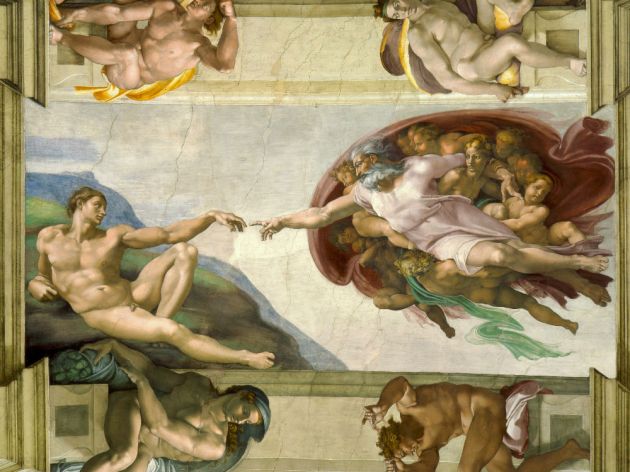
On comparing the faces chosen by study participants, Jackson and his colleagues at University of North Carolina, were surprised to see a face ‘much more kinder and loving’ than the authoritarian old man painted on the Sistine Chapel, giving life to Adam.

Michaelangelo’s iconic painting of God giving life to Adam, on the 16th century Sistine Chapel.

Furthermore, comparing the study results with earlier studies that compared verbal descriptions of God, has Jackson and his colleagues revisiting the stereotypical notion of the old, bearded man altogether. “People were generating these benevolent, warm adjectives much earlier than the kind of authoritarian figure we see,” he said.

That’s not to say that the authoritarian description was thrown out of the mix altogether. Conservative participants still visualize a face that was relatively ‘masculine, older, more powerful and wealthier’, reflecting what the study called, their ‘motivation for a God who enforces order.’

Liberals, on the other hand, sought a God is socially tolerant and were therefore more lenient in their choices, picking faces that were younger, more feminine and more African-American than that of their political counterparts.

It all comes down to individual motivation, according to Jackson. “Some theory in research has argued that people’s views of the divine figures are related to their motivations,” he said. “And so people are more inclined to conceptualize a God that’s more suited to their needs.”

So, African-Americans chose someone who was marginally more black while Caucasians chose someone who was more white. People who perceived themselves as more attractive chose a better-looking God, fitting in with the researcher’s hypothesis that people would choose faces that matched their own.

Gender did not play a significant role in the choice of the divine. “It could be that people don’t naturally use their gender a reference point when they think of divine figures, compared to other physical features,” said Jackson.

Jackson said researchers were ‘surprised’ to not see a face that was more authoritarian.

“It could suggest, but not prove, that our view of God has been changing throughout history as this is naturally something people have definitely chosen,” he added.

Would researchers be able to expect similar results on surveying American Muslims, or a Chinese community? It’s hard to say. While it is possible to predict a face based on overall cultural motivations, Jackson does note that there will be ‘cultural differences that they won’t be able to account for, which can amplify across a geographical region’ and impact the results of their study.

Using the study composite comes with its own set of constraints as Jackson acknowledges that there are some features that have not been included in the base face. “We were never going to faces (in the study result) with a dramatic change, like the face of a brunette, or someone who has a beard.”

It is the first time that a study of this kind has used this method of ‘reverse correlation’, i.e., asking participants to choose randomly generated facial samples with subtle changes. While the method has been used for other purposes, i.e., to determine how participants visualize trustworthiness, previous studies on visualizing the divine have relied on using verbal adjectives.

Source: Conservatives prefer an authoritarian God, liberals like younger, more feminine face, study says

Maryam’s daughters: Is Berkeley mosque changing the face of contemporary Islam or eroding the faith?

Interesting:

This story originally appeared in the June 2018 issue of San Francisco magazine. Read the rest of the issue’s content as it becomes available.

Inside Berkeley’s Qal’bu Maryam, Tuli Bennett-Bose was preparing for jummah, the Friday prayer service. At 18, Bennett-Bose was a recent convert to Islam, and still working out the intricacies of dress and ritual that come with being an observant Muslim. “I’m a half-jabi,” she joked as she rewrapped her rust-colored hijab to frame her face. Sometimes she prefers to let her head covering reveal some of her silver pixie cut. On this afternoon, she was covering all of her hair because of the service, and also because it was raining.

Qal’bu Maryam — Arabic for “Maryam’s heart” — opened in Berkeley in April 2017. The mosque represents a stark departure from orthodox Muslim tradition, welcoming LGBTQ congregants, allowing women to lead prayers and deliver sermons (called khutbahs), and encouraging all genders to pray shoulder to shoulder. Bennett-Bose stumbled upon the congregation online and was drawn to its inclusivity. “I know that I was meant to be Muslim,” she says. “But I also knew that I was gay before I converted.” Although many mainstream strains of Islam shun homosexuality, Bennett-Bose took the shahada, the Muslim declaration of faith. Soon after, she visited Qal’bu Maryam.

Neither Qal’bu Maryam nor its founder, Rabia Keeble, who converted to Islam 15 years ago, have been universally welcomed within the East Bay’s Muslim community. Some faith leaders criticize the congregation for its deviation from traditions that have been in place for millennia. Abdullah Ali, an assistant professor at nearby Zaytuna College, the first accredited Muslim undergraduate university in the country, has little love for Keeble’s “particular project.” Men and women praying side by side “is definitely not the instruction given by our prophet,” he says, referring to the hadith, or the sayings of Prophet Muhammad. “The instruction was very clear, and we know what prayer looked like at this time: Women pray behind men.”

More important, Ali says, Qal’bu Maryam was founded with the explicit intention of being “provocative” and, in particular, of antagonizing people who are committed to traditional Islamic teachings. “They want to challenge what they consider to be orthodoxy,” he says.

On that point, he won’t get much argument from Keeble. An Ohio-raised woman (she declines to share her age), Keeble came to the faith in 2003 and lives by a “no tolerance for bullshit” policy, doling out grand, confrontational statements that often rankle whomever she’s debating. “What I did started a conversation,” she tells me of Qal’bu Maryam’s founding. “Men and women need to learn together. This will end misogyny within the religious sphere.”

Keeble is a self-proclaimed “third-wave black feminist and womanist” whose daily getup includes hijab, eyeliner, and bright lipstick. Central to her mission is to reconcile Islam with contemporary feminism; it’s on this point that she encounters the most resistance. Both she and Ali believe the two worldviews can and do coexist. How they achieve it, however, is very much a point of contention.

Feminist Islam is not a new concept. While Europe suffered through the Dark Ages, women in Arabia benefited from inheritance, consent as a requirement for marriage, and education. Muslims frequently cite the Prophet’s wife, Khadija, an independent businesswoman, as evidence of the faith’s feminist principles in action.

“Feminists are not anti-Islam. We want the fulfillment of what the Prophet, peace be upon him, started before his death,” Keeble says. Ali agrees that Islam can be consistent with feminist ideology, but he points to liberation feminism, which “accepts that men and women are fundamentally different and that men have often belittled the importance of women.” “Equality feminism” of the type practiced by “people like Rabia Keeble” is not compatible with Islam, he says. “Equality feminism is focused on attempting to equalize the degree of influence and level of authority between men and women to the extent that we completely ignore biological differences.”

For Ali, the hadith was never to be taken as a sign of women’s inferiority, “just as leading the prayer was never taken as a sign of political power.” Instead, he says, the practice is rooted in principle: “The Prophet told the people, ‘Pray as you see me pray.’ And we know that the norm is that he was always leading prayer during his lifetime.” For that reason and others — for instance, the fact that Keeble thinks women can pray while on their periods, a practice considered taboo by Ali and others—he looks upon Qal’bu Maryam as a prayer space, not a mosque. It lacks the sanctity, he says, that a mosque deserves.

It’s exactly that inequality, in Keeble’s eyes, that has hurt Muslim women and caused them to have shallower relationships with their faith. Because of male dominance in mosques, “it is very difficult for women to approach the imam after sermons to ask questions,” she explains.

Fighting for her congregation has been draining for Keeble. Earlier this year, she took a month-long leave from the mosque to regroup; aside from dealing with “so-called volunteers who were all talk and no show,” she was “physically worn out” from handling outreach and logistics alone. She was also attending speaking engagements, creating and distributing weekly advertisements, and scheduling Friday speakers. During her period of reflection, she refocused on Qal’bu Maryam’s mission, paying particular attention to the sermons being delivered there. “I wanted to focus on the use of gendered language specifically. I have to ask myself, Is this language that honors women?”

….

Source: Maryam’s daughters: Is Berkeley mosque changing the face of contemporary Islam or eroding the faith?

USA: Richardson (Texas) minister stands by church flier that warns Judaism, Islamism ‘dangerous’ | Dallas News

One is sorely tempted to add “Christianism” to the list given the minister’s lack of awareness:

A minister of a Richardson church that included Judaism and Islamism among “dangerous isms” on a flier distributed in area neighborhoods is standing behind the message and the events it advertised.

Pulpit minister Shelton Gibbs III said Greenville Avenue Church of Christ could have better handled the wording of the advertisement, which included the faiths with pessimism, materialism and alcoholism.

He said the church’s leadership was meeting Sunday night to discuss the social media backlash that followed the church’s distribution of the fliers on the doors of homes in the area.

Gibbs said the church will go ahead with the series, despite objections to categorizing the other religions, along with atheism and liberalism, as dangerous.

“We’re not here to criticize or be antagonistic toward people and to beat them down,” he said. “There’s no threat. The people in the community should not feel a threat.”

The church plans to conduct the summer series on 10 Wednesdays, starting June 13. Islamism will be covered June 27.

Judaism is scheduled for discussion Aug. 22, according to the flier, which included a Star of David alongside icons that appear to symbolize pessimism, materialism and alcoholism.

Gibbs said that though “dangerous” probably wasn’t the best word to use, the other faiths run counter to his church’s belief that God wants all people to follow Jesus Christ.

He said the series will aim to explain God’s message for each of the “isms.”

“What is his message to those who espouse Islam? What is his message to those who are caught up in materialism? Those who are pessimistic?” Gibbs said.

When asked why the list didn’t include other “isms,” such as racism or sexism, Gibbs said there are only so many Wednesdays in a summer.

In the future, he said, the church will work on its phrasing.

“We’re living in an age where every word means something, and you have to be very careful about the words that you use,” Gibbs said.

“And I think going forward, I’m sure we’ll be able to phrase it where people are drawn in, and not that we have somehow marginalized them and caused them to fear. That’s not Jesus.”

The predominantly African-American church was formed as Hamilton Park Church of Christ in 1959 and occupied several different sites before it moved in 1990 to its home on Greenville Avenue, near Centennial Boulevard, and changed its name to reflect the new location.

The church, formed with 20 members, has grown under Gibbs’ decades of leadership and provides three Sunday services. The church has made community outreach one of its main focuses.

via Richardson minister stands by church flier that warns Judaism, Islamism ‘dangerous’ | Richardson | Dallas News

Jehovah’s Witnesses can shun members as they see fit, just like any old bridge club: Supreme Court

Reasonable decision, although I expect some interesting commentary arguing against it:

A new Supreme Court ruling that Jehovah’s Witnesses are free to banish and shun any member they wish, regardless of how they decide to do it, offers a powerful precedent for religious independence in Canada.

It follows years of uncertainty of just how deeply into the waters of faith and doctrine Canada’s judges are willing or able to wade.

Now the limits are clear, thanks to the case of Randy Wall, a Calgary real estate agent and longtime Jehovah’s Witness whose “disfellowship” destroyed his client base and led him to seek redress in the courts. He did not dispute the right of the Highwood Congregation to banish him, but claimed they did so unfairly, without telling him detailed allegations, or whether he could have counsel or a record of proceedings.

The top court’s decision rejects that view, bluntly refers to his “sinful” behaviour, and says it has no business making legal decisions about it.

At issue were two episodes of drunkenness, one in which Wall “verbally abused” his wife, for which he was not “sufficiently repentant,” according to court records. The family was under great stress, stemming from the emotional troubles of their teenage daughter, who had similarly been disfellowshipped, leaving the parents in the strange position of being required by their religion to shun their own daughter. Wall said he was even pressured to evict her from their home.

He convinced a lower court it had the jurisdiction to hear his complaint, because it engaged his civil and property rights. The Alberta Court of Appeal agreed. But the Supreme Court has now said once and for all that the courts ought not to interfere in religious discipline.

To borrow an analogy used by a lower court judge in his case, a church is less like a public company that has to act fairly and more like a “bridge club” that can pick and choose its members — or boot them out — at its own discretion.

Supreme Court Justice Malcolm Rowe borrowed this analogy in his reasons on behalf of the unanimous nine-judge court, one of the last cases under former Chief Justice Beverley McLachlin: “By way of example, the courts may not have the legitimacy to assist in resolving a dispute about the greatest hockey player of all time, about a bridge player who is left out of his regular weekly game night, or about a cousin who thinks she should have been invited to a wedding.”

The discipline panels of voluntary religious groups do not exercise state authority like, for example, a professional regulatory tribunal for doctors or dentists. They are not “public decision makers” whose actions must be subject to judicial review, the court decided.

In this case, Wall has no fundamental right to be a member of the Highwood Congregation, so he does not have a right to procedural fairness in the decision whether to shun him. The group has no constitution or bylaws it must obey. The “disfellowship” may have spoiled his real estate business when other Jehovah’s Witnesses refused to do business with him, but that is likewise not a matter for the courts.

Lastly, and most crucially, this was a dispute over ecclesiastical issues, the court ruled. These cannot be decided by judges. How, for example, could a court of law evaluate the Highwood Congregation’s finding that Wall was not repentant enough for his sins? There is no common law on this, and rightly so, the court found.

“Even the procedural rules of a particular religious group may involve the interpretation of religious doctrine, such as in this case. The courts have neither legitimacy nor institutional capacity to deal with contentious matters of religious doctrine,” Rowe’s decision reads.

The limits of court intervention in religious affairs have not always been so clear.

In 1992, the Supreme Court said churches must show procedural fairness, like any tribunal, and not just issue edicts from on high. That precedent, in which the top court sided with a man expelled from a Hutterite colony, is part of the reason, for example, why the United Church of Canada last year gave up its push to defrock the popular atheist minister Greta Vosper.

Courts are always reluctant to tread on religious freedoms, and have typically intervened in church disputes only after the complainant has exhausted all internal processes.

But once they have, the courts have often heard the appeals, sometimes finding that the internal processes are unfair. Courts have intervened, for example, over the unfair discipline of United Church ministers.

But now the bar is very much higher.

“The Supreme Court’s ruling provides clarity to Canadians that neither courts nor governments can legally compel citizens to associate together unwillingly,” said John Carpay, president of the Justice Centre for Constitutional Freedoms.

Wall could not be reached for comment. The case attracted many intervenors, representing Muslims, Sikhs, various Christian groups, and civil liberties advocates.

Source: Jehovah’s Witnesses can shun members as they see fit, just like any old bridge club: Supreme Court

What Islamophobic Politicians Can Learn From Mormons @NYTOpinion

Valid points regarding how previous experiences of discrimination can shape current attitudes for some groups:

Last month, the Supreme Court heard oral arguments on President Trump’s travel ban, popularly known as the “Muslim ban” because of his statements, like one in 2015 calling for “a total and complete shutdown of Muslims entering the United States.”

But Mr. Trump is far from the only Republican willing to discriminate against Muslims. BuzzFeed News reported in April that since 2015, Republican officials in 49 states have publicly attacked Islam, some even questioning its legitimacy as a religion.

The only exception? Utah. In that state, where a majority of residents is Mormon, members of the Church of Jesus Christ of Latter-day Saints, elected officials seem to have a deep understanding that an attack on the religious freedom of one group is an attack on the religious freedom of everyone. The rest of the nation should follow their example.

Utah’s politicians stand out against many of those whose statements BuzzFeed News chronicled, like an Oklahoma state representative named John Bennett, who in 2014 called Islam “a cancer,” and last year met with Muslim constituents only after they filled out questionnaires asking whether they beat their wives. A Nebraska state senator, Bill Kintner, proposed that Muslims be required to eat pork if they wished to enter the United States. A state senator in Rhode Island, Elaine Morgan, wrote that “Muslim religion and philosophy is to murder, rape and decapitate anyone who is a non-Muslim” and recommended that Syrian refugees be housed in camps. She later said she was referring only to “fanatical/extremist” Muslims.

In January, Neal Tapio, a South Dakota state senator who is running for the United States House, questioned whether the First Amendment applies to Muslims, asking, “Does our Constitution offer protections and rights to a person who believes in the full implementation of Islamic law, as practiced by 14 Islamic countries” and millions of Muslims “who believe in the deadly political ideology that believes you should be killed for leaving Islam?”

Representative Bennett, the lawmaker who required Muslim constituents to answer questionnaires on whether they beat their wives, said in 2014, “Islam is not even a religion; it is a social, political system that uses a deity to advance its agenda of global conquest.”

Jody Hice, a 2014 Republican congressional candidate from Georgia, questioned the compatibility of Islam with the American Constitution and wrote in 2012 that “Islam would not qualify for First Amendment protection since it’s a geopolitical system.”

And yet, in Utah — one of the most crimson-red states in the Union — such rhetoric is conspicuously absent.

“I’d be the first to stand up for their rights,” said Utah’s senior senator, Orrin Hatch, in 2010 amid the controversy surrounding the construction of an Islamic community center close to ground zero in New York City. He called Islam “a great religion.”

Utah’s other Republican senator, Mike Lee, said he did not vote for Donald Trump in part because he saw the travel ban as a “religious test.” In explaining why many in Utah opposed the ban, Utah’s Republican governor, Gary Herbert, observed, “We had Rutherford B. Hayes in 1879 issue an envoy to Europe saying in essence, ‘Don’t send those Mormon immigrants to America anymore.’”

Pointing to this history of Mormon persecution, in 2017, a group of scholars with expertise in Mormon history filed an amicus brief in the United States Court of Appeals for the Ninth Circuit opposing the ban. They drew a comparison between the government’s current posture toward Muslims and the government’s 19th-century treatment of Mormons. “This court should ensure that history does not repeat itself,” they wrote.

Mormon politicians seem to understand better than many of their fellow Republicans that if another’s freedom of faith is under attack, so, too, is their own. Perhaps this has to do with the church’s 11th Article of Faith, which states, “We claim the privilege of worshiping Almighty God according to the dictates of our own conscience, and allow all men the same privilege, let them worship how, where or what they may.”

Their interest in the rights of people of other faiths has also been traced to the views of the Mormon founder Joseph Smith, who put it this way: “If it has been demonstrated that I have been willing to die for a Mormon, I am bold to declare before Heaven that I am just as ready to die in defending the rights of a Presbyterian, a Baptist or a good man of any denomination.”

Mormons know too well what it means to be singled out for persecution, and to have one’s faith maligned as a threat to America. But it shouldn’t require that experience to understand that religious freedom for some is really religious freedom for none.

via Opinion | What Islamophobic Politicians Can Learn From Mormons – The New York Times

Countering the rise of radicalism in private Islamic schools in Indonesia – Opinion – The Jakarta Post

More on increased radicalization in Indonesia and the influence of Islamic schools, with a useful breakdown of the different types:

A series of terrorist acts has rocked Indonesia in the past week. Starting from a clash in a detention centre at the Police Mobile Brigade headquarters in Depok, West Java, last week, attackers then bombed three churches in Surabaya, East Java, last Sunday, followed by another terrorist bombing at Surabaya Police Headquarters. Dozens were killed and wounded.

In response, President Joko “Jokowi” Widodo has reiterated the government’s commitment to exterminate terrorism down to its roots.

We must appreciate Jokowi’s statement. However, terrorism is a complex issue because there is no single factor that can explain why a person becomes a terrorist.

The importance of schools to prevent radicalism

One of the strategies that the government can use to stop terrorism in Indonesia is to take preventive steps using educational institutions to promote tolerance, which can eventually stop the spread of radical thoughts.

But what is happening in Indonesia is the opposite. Many schools in Indonesia have become fertile ground for radicalism.

The latest surveys from the Wahid Institute, Pusat Pengkajian Islam Masyarakat and the Centre for Study of Islam and Society (PPIM) and Setara Institute have indicated the spread of intolerance and radical values in educational institutions in Indonesia.

A student tolerance survey from Setara Institute in 2016 revealed that 35.7% of the students showed a tendency to intolerance in their minds, 2.4% were involved in acts of intolerance, and 0.3% had the potential to become terrorists. The survey was based on 760 respondents who enrolled in public high schools in Jakarta and Bandung, West Java.

Surveys from the Wahid Institute and PPIM have shown the same worrying trend.

The characteristics of schools prone to radicalism

In 2017, I was involved in research on efforts to respond to radicalism at 20 private Islamic schools in Central Java. The research involved academics from Monash University in Australia, Walisongo State Islamic University in Semarang, Central Java, and Gadjah Mada University in Yogyakarta with funding support from the Australia-Indonesia Centre.

We managed to identify three types of schools that are prone to radicalism. In accordance with confidentiality principles, we will not publish the schools’ names in this article.

These three types of schools are:

1. Closed schools

Instead of embracing changes, this type of school offers students a narrow perspective and tends to shut them off from foreign ideas.

We interviewed one of the headmasters from these schools. He explained the importance of Islamic civilisation to protect students against Western values.

Aside from see Islam and the West as being in conflict, closed schools also stress the importance of practising their version of Islamic teachings and reject the moderate Islam that most Muslims adhere to in Indonesia.

2. Separated schools

These schools can be identified from their teacher recruitment system and their limited participation in social activities.

The teacher recruitment process in these schools is very strict, especially the recruitment of religion teachers. In addition, these schools do not want to participate in social activities that they deem to be against their values.

This type of school is very different from other Islamic schools that are affiliated with the country’s more traditional Muslim organisations such as Nahdlatul Ulama (NU) or Muhammadiyah. Whereas separated schools recruit religion teachers from their own groups only and will use their networks to recruit alumni who share the same Islamic values, NU and Muhammadiyah schools will not consider differences in their teachings as an issue. For example, one of the headmasters from a NU-affiliated school stated that his school also recruited teachers from Muhammadiyah.

NU and Muhammadiyah schools are also active in social activities, including interfaith activities. Separated schools are not.

3. Schools with pure Islamic identity

The third type can be identified by the way they create students’ Islamic identity. The schools that are prone to radicalism tend to build in a student a single Islamic identity, refusing other identities.

This understanding is different from other Islamic schools, which tend to consider that a person’s identity as a Muslim is not against his/her other identity. Moderate Islamic schools do not see a conflict between their students’ identity as Muslims and as Indonesian citizens.

When a school builds this single Muslim identity, that school will also foster radical attitudes among students as they only believe in a single Islamic interpretation that is in line with their values.

Headmasters from this type of school usually order their students to follow all religious rituals at schools, despite the students’ different religious background.

A headmaster told us that his students with a NU background must abandon their prayer ritual in the morning called qunut when they are enrolled in his schools.

This policy is different from other schools that allow flexibility for their students in their religious practices.

In addition, the rejection of other identities creates a “we versus them” attitude not only between different religions but also within the larger Islamic community itself.

What we can do

These three types of schools contribute to the growth of intolerance as well as radicalism at schools, which can lead to terrorist acts.

Therefore, we believe that the recent terrorist attacks should give momentum to the government to plan preventive measures to promote diversity, social integrity and diverse identities in various schools across the country.

The government’s campaign on tolerance should reach different educational institutions via the Culture and Education Ministry as well as Religious Affairs Ministry.

The government must also provide platforms and programs to promote tolerance. Apart from that, related government institutions in the regions must develop the capacity to identify schools that are prone to radicalism and apply persuasive approaches to prevent the spread of radicalism in those schools.

via Countering the rise of radicalism in private Islamic schools in Indonesia – Opinion – The Jakarta Post

The core Isis manual that twisted Islam to legitimise barbarity | The Guardian

Horrific:

The jihadist manual behind the brutality that underpinned Islamic State has been revealed for the first time in new analysis of a 579-page text, written by the Isis ideologue Abu Abdullah al-Muhajir.

The text attempts to legitimise the barbarous acts of the jihadist group, including the mutilation of corpses, the trade in human organs, beheading, the killing of children along with “scorched earth operations” and global terrorist attacks.

After two years examining and transcribing the document, experts at the counter-extremist group Quilliam have completed a meticulous appraisal of the extremists’ core textbook along with a robust theological rebuttal of its “twisted” interpretation of Islamic teachings. Used by Isis and its supporters to validate a large range of horrific acts, the “bible for jihadists” provided the theoretical and legal framework for the violent terrorist group.

“There is a startling lack of study and concern regarding this abhorrent and dangerous text in almost all western and Arab scholarship,” says the report. “We hope to expose and deconstruct this unprepossessing yet deeply insidious and pernicious text.”

Known as the Fiqh al-Dima (or The Jurisprudence of Blood), the book is the key Salafi-jihadist text. It attempts to justify the use of weapons of mass destruction, perpetrating genocide, the murder of non-combatants, the taking of sex slaves and hostages.

Researchers for Quilliam managed to acquire a copy of the manual online in 2015, after researchers spotted the Fiqh al-Dima being used to teach new recruits to Isis’s caliphate in Syria. Back then, Islamic State’s self-styled caliphate encompassed vast swaths of Syria and Iraq and a population of up to eight million. Since then the group has lost 98% of territory in the two countries and is now largely confined to a strip of desert straddling the Iraqi-Syrian border.

The manual offers the group guidance on “military retreat” with a chapter devoted to “surrender vs fighting to the death” that says jihadists should choose death instead of handing themselves over to the enemy.

However, Sheikh Salah al-Ansari, a senior Quilliam researcher who translated the manual from Arabic and wrote the rebuttal, said no religious requirement existed to “fight to the death” and that the Islamic tradition of warfare encouraged the humane treatment of prisoners of war. “Our work comprehensively debunks and rejects Isis’s proto-Islamic arguments, demonstrating their ignorance and disregard for traditional Islamic scholarship as well as for the basic humane and Islamic values of mercy and compassion,” said Ansari.

The titles of the text’s 20 chapters include “Beheading, decapitation and mutilation”, “Kidnapping warring infidels” and “How to kill spies”.

Another chapter, titled “Indiscriminate killing of warring infidels”, opens with an inflammatory message that calls for force to be used against unbelievers: “Kill them, fight them by every means that may snatch away their souls, drive their spirits from their bodies, cleansing the earth of their filth and removing their scourge from mankind, whatever that means may be.”

A separate chapter documents attempts to justify the use of weapons of mass destruction. “The central aim for which we strive – and we do so with all available strength – is the acquisition of weapons, weapons of mass destruction, for there is no escaping the obligation to defend against these defiant perverters of faith and end the aggression of the malodorous filth against Islam and its people,” writes Muhajir, the Isis author.

Each point he makes is theologically rebutted by Quilliam using the Qur’an, Islamic teachings and reference to acts prohibited by Islamic warfare ethics and Islamic morality. “This text offers intricate details on the use of jihad in its traditional Sunni discussion, and misuses these features to provide Islamic legal cover to terrorist operations,” said Ansari.

Among one of its central strands is the distinction between the “lands of Islam” and the “lands of unbelief (kufr)” and the notion that jihadists are entitled to fight the unbelievers.

“This entire binary construct is a later invention of Muslim theologians that is now obsolete, and so the justification of excommunication (takfir) and military attacks against civilians on this basis is completely absurd,” says the Quilliam report. Even so, Ansari said history had proved that some were swayed by the text, even chapters 11 and 12, which attempt to provide an Islamic sanction for the mutilation of bodies, the cutting of body parts and beheading.

“A susceptible and vulnerable reader who has no previous training in Islamic jurisprudence might easily become seduced by this book because it is written in a way that gives the impression that it has religious weight. While the text is somewhat based on traditional readings, it does not reflect the diverse and pluralistic complexities of Islamic rulings,” said Ansari.

The jihadis’ interpretation of jihad – the text has also been used by al-Qaida and Nigeria’s militant Islamist group, Boko Haram, to justify and commit atrocities – would have been core teachings to Isis’s 6,000 European Muslims who travelled to the calpihate, of which about 850 were British.

“They would have been introduced to this book, it is their bible, their most important text,” said Ansari.

via The core Isis manual that twisted Islam to legitimise barbarity | World news | The Guardian

Understanding other religions is fundamental to citizenship | Big Think

Valid points on the process of dialogue and understanding with respect to religions but applicable more broadly:

By walking down the street of any major city, you are likely to see more diversity than an 18th-century explorer did in a lifetime. People with very different ideas of how society should function must live together, and there is no idea more divisive than that of religion. Many of the most important moral disagreements break out along religious lines. Indeed, differing religious views on freedom, sexuality and justice threaten social cohesion. That must not be allowed to happen.

One crucial way that people can best learn to live with one another is by increasing their religious literacy. In 1945, the British author C S Lewis said that one will gain greater insight into other belief systems by stepping inside and looking ‘along’ them, rather than looking ‘at’ them from the outside. He explained this by analogy. Think of the difference in the experience of looking at a beam of light through a window, in comparison with the experience of looking along it. It is from within that we can test a system’s internal consistency and its ability to form and inform the believer. The idea is to see religion not merely as a set of propositions held in the head, but, in the words of the Canadian philosopher Charles Taylor, as a ‘lived experience’.

The key to this kind of understanding is dialogue. This isn’t the all-too-common conversation in which the goal is to poke holes in another’s religious argument. Rather, the purpose is only to understand, however fanciful or wrong the beliefs might appear. It requires moral imagination, letting the human voice of a believer express in concrete terms how his or her world is experienced. When questions are asked, they are there to reveal rather than eviscerate. It’s similar to how you experience stories, entering into them imaginatively and empathising with the characters. Stories are at the heart of human life, and also at the heart of religions. It is through understanding the way that human stories are affected by religious ones that we begin to look along that beam of light, rather than at it.

Becoming literate is a predicate of a stable and peaceful multicultural society. Countries throughout the world are seeing the emergence of a poison-breathing hydra that has never been taught to understand anything other than itself. The inevitable result of this has been the scapegoating, racism, tribalism and isolationism that have marked our recent politics. Increasing religious literacy will not necessarily lead to more agreement – indeed, it might even steel our convictions. But it will lead to being able to ‘disagree better’ (the aim of the Scriptural Reasoning movement) by tampering cheap stereotypes and petty caricatures.

In educational theory, religious literacy could be considered a ‘threshold concept’ for 21st-century citizenship. The word threshold comes from the word threshing: to separate the wheat from the chaff, filtering out what does not nourish in order to be left with what does. A concept that establishes a threshold is one that disabuses us of superficial understandings, and creates something more profound, complex and paradigmatic. For example, a threshold concept in physics would be understanding ‘temperature gradient’, or in literature it could be learning to deconstruct text for analysis. They are a boundary through which one must pass in order to advance in the understanding of a subject, allowing one a fuller grasp of a discipline. Similarly, in the study of religion, and indeed global citizenship, religious literacy should also be deemed a threshold concept, as it moves towards a perspectival understanding of religion rather than a reductionist one. Religion moves from being a set of propositions and practices, to an animating force behind human behaviour – something that needs to be heard in its own key.

Teaching religious literacy requires a focus on process rather than content. Since religious literacy is predicated on meaningful dialogue, the purpose is to develop these skills in students: active listening, honest questioning and humility. Teachers need to create and facilitate encounters of the ‘I-Thou’ variety, in the words of the Jewish theologian Martin Buber – where encounters are deep and genuine, rather than the instrumentalised and utilitarian ‘I-It’ encounters. Buber, unlike Jürgen Habermas (another major proponent of the educational value of dialogue) emphasises the need for dialogue to be based around a common focus – understanding of faith positions provides a worthy and generous focus.

Without developing religious literacy on a societal scale, it is difficult to see how our great multicultural experiment will avoid descending into the tribal warfare that so many are spoiling for. To take a small but current example from the United Kingdom, one could look at the ongoing controversy of Sharia councils. Sharia councils provide legal rulings and advice to Muslims based on interpretation of Sharia law. While they do not carry legal weight in the UK, they effectively arbitrate on a number of issues. The idea that Sharia operates as a parallel legal system in the UK is anathema to some, and petitions are being made to ban such councils. In much of the debate, what is lacking is an ability to see that justice is understood and reasoned differently from different perspectives. Of course, this does not suggest that Sharia courts should have a place in the British justice system, but rather that without some understanding and empathy, without some religious literacy, debates about such issues are liable to create more heat than light. Aeon counter – do not remove

via Understanding other religions is fundamental to citizenship | Big Think