The far right spreads its wings over Europe

Good survey of the rise of intolerance and right-wing anti-immigration parties by Jonathan Manthorpe and his plea for perspective:

There’s no doubt at all that public fears of Islamist violence have been stoked by government alerts and alarmism — a trend that started before the 9-11 attacks. More recently, western governments — including our own — have seized on the psychopathic Islamic State group in Syria and Iraq, warning that Muslim citizens recruited into IS will return with terrorist skills and cause havoc at home.

As with the Charlie Hebdo attack, the “lone wolf” killings of two Canadian soldiers in Quebec City and Ottawa in October have been held up as evidence of the threat of radicalized Muslims living in the West. What’s missing from these panic-fueled statements is anything like perspective.

Remember, just two Canadian misogynists — Robert Pickton and Marc Lepine — together accounted for the deaths of 63 people. And on any bad day, Canada’s warring drug gangs in greater Vancouver and Toronto notch up death tolls far outstripping anything Islamic terrorists can come up with. And most mass killings of Mounties in recent years — four at Mayerthorpe in 2005 and three in Moncton last June — have been perpetrated by mentally unstable Canadians with hunting rifles.

The far right spreads its wings over Europe (paywall)

And Gwynne Dyer on the situation in Germany:

Germany is taking in more immigrants than ever before: some 600,000 this year. That’s not an intolerable number for a country of 82 million, but it does mean that if current trends persist, the number of foreign-born residents will almost double to 15 million in just 10 years. That will take some getting used to—and there’s another thing. A high proportion of the new arrivals in Germany are Muslim refugees.

Two-thirds of those 600,000 newcomers in 2014 were people from other countries of the European Union where work is scarce or living standards are lower. They have the legal right to come under EU rules, and there’s really nothing Germany can do about it. Besides, few of the EU immigrants are Muslims.

The other 200,000, however, are almost all refugees who are seeking asylum in Germany. The number has almost doubled in the past year, and will certainly grow even larger this year. And the great majority of the asylum-seekers are Muslims.

This is not a Muslim plot to colonize Europe. It’s just that a large majority of the refugees in the world are Muslims. At least three-quarters of the world’s larger wars are civil wars in Muslim countries like Syria (by far the biggest source of new refugees), Iraq, Yemen, Somalia, Afghanistan and Libya.

Asylum-seekers: The limits of tolerance in Europe

And a more encouraging story from Germany, that of Professor Mouhanad Khorchide:

In his lecture, the long conversation and a telephone call after the shootings on Wednesday at the office of the satirical newspaper Charlie Hebdo in Paris, Mr. Khorchide was calm and optimistic, delivering insight with a Viennese lilt in his German.

He expressed fear that extremists on both sides would try to use the attack for their own ends. “The Muslim extremists will say, ‘Oh, look how strong and mighty we are,’ ” he said, “while those who fear Islam will say, ‘See, that is what Islam is, and what we were warning about all along.’ ”

He said he expected more attacks, but also more questioning from Muslims. “Such events force us to discuss openly about theological positions,” he said. “It is too simple to say, ‘No, no, that has nothing to do with Islam.’ These people,” he added of jihadists, “are referring to the Quran, and we must confront these passages in the Quran.”

His students, he said, were angry after the Paris shootings. In part, they were upset with Muslim extremists seeking to please what they consider a false idol. But they were also resentful that now “they must justify themselves: ‘We are peaceful,’ ” he said. “And this constant justifying and defending oneself is annoying.”

Europe’s populist current “whips up fears where no fears exist,” Mr. Khorchide said. “For instance, the Islamization of Europe: Demographic data shows that this is a fantasy.”

Furthermore, he noted, Muslim children born in Europe now tend to adopt its ways, the tiny minority who go off to fight in Iraq and Syria notwithstanding.

Teaching Islam’s ‘Forgotten’ Side as Germany Changes

Lastly, from the Netherlands, not surprising to see a spike in support for Geert Wilders.

But interesting that the Dutch PM declined to use the word “war” in favour of  a more nuanced expression, yet one that also communicates resolve:

Wilders, known for his inflammatory rhetoric, said after the Paris bloodshed that the West was “at war” with Islam, drawing a rebuke from Dutch Prime Minister Mark Rutte on Sunday.

If elections were held now, his party would be the single largest in the Netherlands, with 31 seats in the 150-member parliament, more than twice as many as it won in the last elections, according to a Sunday poll.

The governing Liberal and Labour parties, damaged by persistent sluggish growth, would have just 28 seats between them, compared to the 79 they held after the 2012 elections.

The Freedom Party was polling 30 seats just prior to the Jan. 7-9 Paris attacks, in which 17 people including journalists and policemen were killed by three Islamist gunmen who were later shot dead by French special forces.

Wilders this week called in an interview for measures against Islam: “If we don’t do anything, it will happen here,” he was quoted by the newspaper Het Parool as saying.

But speaking to Dutch public television shortly before leaving to attend a peace rally in Paris, the Dutch prime minister distanced himself from Wilders’s comments.

“I would never use the word ‘war,'” he said. “We are in a struggle with extremists who are using a belief as an excuse for attacks.”

More than 80 percent of respondents to the De Hond poll said people who left the Netherlands to wage jihad (holy war) in Syria should lose their Dutch citizenship and those returning from fighting in Syria or Iraq should face lengthy jail terms.

Paris attacks boost support for Dutch anti-Islam populist Wilders | Reuters.
Paris policeman’s brother: ‘Islam is a religion of love. My brother was killed by terrorists, by false Muslims’

From the brother of the slain police officer, Ahmed Merabet:

“My brother was Muslim and he was killed by two terrorists, by two false Muslims,” he said. “Islam is a religion of peace and love. As far as my brother’s death is concerned it was a waste. He was very proud of the name Ahmed Merabet, proud to represent the police and of defending the values of the Republic – liberty, equality, fraternity.”

Malek reminded France that the country faced a battle against extremism, not against its Muslim citizens. “I address myself now to all the racists, Islamophobes and antisemites. One must not confuse extremists with Muslims. Mad people have neither colour or religion,” he said.

“I want to make another point: don’t tar everybody with the same brush, don’t burn mosques – or synagogues. You are attacking people. It won’t bring our dead back and it won’t appease the families.”

Paris policeman’s brother: ‘Islam is a religion of love. My brother was killed by terrorists, by false Muslims’ | World news | The Observer.

Charlie Hebdo shooting: Debate over publishing the Muhammad cartoons

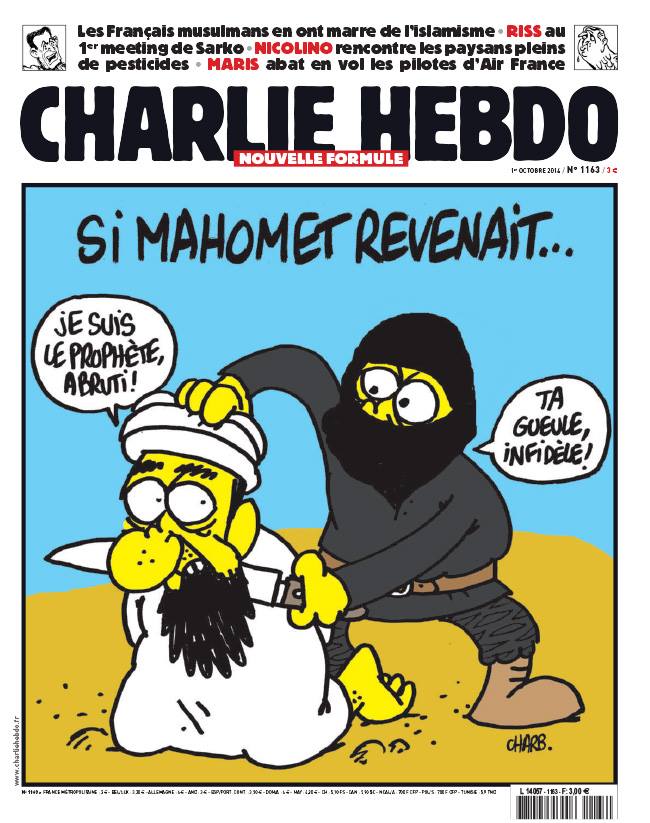
charlie hebdo no1163 011014While it is a legitimate debate to have over whether or not to publish the cartoons given fear of giving offence or further stirring things up, my sense is that editors have made a blanket decision rather than looking at the cartoons and selecting some that are not gratuitous but make valid points.

My example would be the one above:

Studer said the CBC decided against running the cartoons, arguing that to show those depictions of Muhammad would needlessly offend Muslims, who consider such depictions sacrilege.

And he wasn’t alone in putting forward that argument. The New York Times executive editor Dean Baquet told the paper’s public editor he spent about half of the day deciding whether or not to publish the cartoons, changing his mind twice before ultimately deciding not to run the images.

“We have a standard that is long held and that serves us well: that there is a line between gratuitous insult and satire. Most of these are gratuitous insult,” Baquet said.

The Washington Post ran one image on its editorial pages while the main U.S. networks, including ABC News, CNN and Fox backed off from publishing the cartoons. The Associated Press also declined to make them available.

In Canada, of the Toronto-based newspapers, only the National Post ran the controversial cartoons. Almost none of the U.K. papers ran the cartoons, nor did the BBC and the Paris-based papers Le Monde or Le Figaro.

Charlie Hebdo shooting: Debate over publishing the Muhammad cartoons – World – CBC News.

And in Quebec media, which apart from the Montreal Gazette, widely published some of the cartoons:

Publier les caricatures ou pas?

In the Mideast, as in France, satire is a weapon against extremists

Interesting piece by Nahrain Al-Mousawi on satire within the Arab world with some quite amusing examples. Her conclusion regarding the risks of organizing such satire by Western governments is valid.:

While the efforts highlighted above are organic, based on a shared community, other efforts appear to be more technocratically orchestrated. A recent article noted that Mr. Sharro’s satirical chart was widely shared, including by the U.S. State Department’s Center for Strategic Counterterrorism Communications. The CSCC has exhibited its own type of muted mockery in a video countering IS recruitment efforts. The integration of humor in U.S. counter-terrorism strategies has been ramped up since the development of social media and its snarky style of communication. A State Department program calling itself Viral Peace confronts and undermines online currents of extremism with “logic, humor, satire,” in its creator’s words.

But a government-backed effort does not necessarily make for an effective means of striking back (and can often be perceived as intrusive, stilted or awkward). After all, satire’s subversiveness can be an ill-fitting mask worn by government institutions, distinct from more organic efforts, produced in times of crisis by a shared, discursive community – at least, when that community itself is threatened. Still, if laughing in the face of the absurd reveals an ability to “dwell with the incomprehensible without dying from fear or going mad,” then that may be the first step in striking back – by having the last laugh.

In the Mideast, as in France, satire is a weapon against extremists – The Globe and Mail.

Barbara Kay: When it comes to Islam, the media needs to ditch the ‘narrative,’ and report the truth

What Kay misses, in her reductionist approach to ideology and extremism of all kinds, is what are the factors that push some to violence and what are the ones that increase resilience to these appeals.

With lone-wolf extremists, it is clear that mental illness and other issues can be one of the factors that push them over the edge. It does not mean that Islamist ideology is not involved; it is just that there can be other factors as well that make some individuals more susceptible.

And I would distinguish between these kinds of attacks and the more “sophisticated”and “professional” attacks that took place on Charlie Hebdo.

And of course, none of this reduces the horror over any attack, no matter the motives or factors:

We’re in the middle of a Hot War with Islamism. There will be more attempted, or realized, lone-wolf terrorist attacks on our shores. In the event, it would be helpful if the liberal media could ditch its love affair with narratives, and stick with the truth.

The right-wing media also should ‘ditch its love affair with narratives’ and recognize the complexity of the various factors involved.

Barbara Kay: When it comes to Islam, the media needs to ditch the ‘narrative,’ and report the truth | National Post.

ICYMI: Experts view radicalized individuals who incite violent attacks as misfits with ‘overvalued ideas’

More on radicalization:

But [Matthew] Logan said it would be a disservice to categorize him simply as a “jihadist.” Many radicalized individuals are misfits of society who cling obsessively to “overvalued ideas” as a way to elevate their sense of self, Logan said. They can just as easily be drawn to the cause of animal activism as the Islamic State narrative, he said.

“They’re not terrorists. They’re people with overvalued ideas jumping on a cause,” he said.

In a column published in the journal Violence and Gender, Logan wrote that while they may see themselves as rebels for a particular cause, “it should be understood that it is really not ‘the cause’ that moves them to violence,” but an underlying psychopathology, perhaps mixed with a bit of narcissism.

“These persons have idealized values, which have developed into such an overriding importance that they totally define the ‘self’ or identity of the individual,” he wrote.

Academics have used the concept of “overvalued ideas” to try to explain the actions of everyone from Ted Kaczynski (the “Unabomber”), the American mathematician who sent mail bombs as part of a campaign against technology, to people with anorexia nervosa, the eating disorder in which people starve themselves to achieve a desired body image.

Logan is quick to add, however, that having “overvalued ideas” should not diminish one’s culpability for a violent act.

Experts view radicalized individuals who incite violent attacks as misfits with ‘overvalued ideas’.

Radical Islam, Nihilist Rage – Kenan Malik

Kenan Malik on radicalization and rejection of modernity (apart from using social media and weaponry of course!):

Anti-imperialists of the past saw themselves as part of a wider political project that sought to modernize the non-Western world, politically and economically. Today, however, that wider political project is itself seen as the problem. There is considerable disenchantment with many aspects of modernity, from individualism to globalization, from the breakdown of traditional cultures to the fragmentation of societies, from the blurring of moral boundaries to the seeming soullessness of the contemporary world.

In the past, racists often viewed modernity as the property of the West and regarded the non-Western world as incapable of modernizing. Today, it is radicals who often regard modernity as a Western product, and reject both it and the West as tainted goods.

The consequence has been the transformation of anti-Western sentiment from a political challenge to imperialist policy to an inchoate rage against modernity. Many strands of contemporary thought, including those embraced by “deep greens” and the far left, express aspects of such discontent. But it is radical Islam that has become the lightning rod for this fury.

There are many forms of Islamism, from the Taliban to Hamas, from the Muslim Brotherhood to Boko Haram. What they have in common is a capacity to fuse hostility toward the West with hatred for modernity and, seemingly, to provide an alternative to both. Islamists marry political militancy with a conservative social sensibility, a hostility to globalization with the embrace of a global ummah (the worldwide community of Muslim believers). In so doing, they turn the contradictory aspects of their rage against modernity into a strength.

Jihadism provides Islamist ideology with a military form and seemingly creates a global social movement, at a time when radical alternatives have collapsed. What jihadism does not possess is the moral and philosophical framework that guided anti-imperialist movements. Shorn of that framework, and reduced to raging at the world, jihadists have turned terror into an end in itself.

Radical Islam, Nihilist Rage – NYTimes.com.

Changing the minds of wannabe terrorists

More commentary on deradicalization approaches:

And while these may seem to be the only two options open to Canadians who turn down the path of violent extremism — death or a court date — experts say a third option — deradicalization — isn’t receiving the attention it deserves.

“These programs can work,” said Jocelyn Bélanger, a psychology professor at the Université du Québec à Montréal who has studied radicalization around the world.

“Even though the number of cases (of homegrown extremism) are limited, we know how much damage just a few individuals can create. … If we do it well, if we read the research on this, we can develop better programs. We can be preventive as well, flagging individuals who are at risk, and once they are flagged they go into a (deradicalization) program.

”Existing approaches to this type of “deprogramming” have had varying degrees of success, and the rehabilitation is usually offered on a voluntary basis, Bélanger said. In most cases, the “beneficiary” is given a choice, to serve their sentence in jail or in a special facility.

“I know it sounds like a false choice, but it is nonetheless psychologically important,” explained Bélanger. In Saudi Arabia, he noted, “Imams will actually use the Qur’an, will engage in discussion with the beneficiary about the Qur’an, ultimately trying to convince them that Islam does not support the killing of innocents.”

Changing the minds of wannabe terrorists.

Farzana Hassan, who seems to be oblivious to the many messages from Canadian Muslims against extremism:

Muslims need to transcend the propaganda that has so defined their narrative on these issues and reject the naive “crusader” fiction.

Tragically, this is a point lost on the majority of the faithful, even supposed moderates.

Mosques must discredit this narrative actively, and they must preach the values of Canadian identity even above religious affiliation.

While Muslims are of course entitled to remain distinct, they must abide not only by the laws of the land but also by its universal values.

Inciting the murder of innocent Canadians is a clear violation of those laws and values.

In dealing with religious extremism, true moderation involves more than refusing to commit violence; it involves campaigning against the absurd political assumptions that may encourage it in others.

…It is the obscurantist views of extremists like Maguire that have hampered progress towards economic prosperity and political stability in the Muslim world for so long.

Muslims must not see attacks on ISIS as attacks on their religion as a whole.

On the contrary, they may help alleviate all the burdens that have bedeviled the Islamic world for so many decades.

Al Canadi’s rants are those of an impressionable and disturbed young man brainwashed by a lethal world view, a view so simplistic we can only wonder at its appeal.​

http://www.torontosun.com/2014/12/11/john-maguire—brainwashed-disturbed …

Michel Petrou provides a good overview of some of the challenges with deradicalization and the absence of an equivalent program in Canada, citing the UK experience in particular:

Usama Hasan, a British imam and senior researcher at the Quilliam Foundation, a counter-extremism think tank in Britain, says he is “astonished” that Canada does not have a de-radicalization program for Canadians who have returned from Syria and Iraq.

“There may be a risk that they’ve spent time with extremist groups and been brutalized by the war. So there’s always a risk that their minds won’t be thinking straight. So it’s very important to have ‘de-rad,’ which has to include a bit of mental health counselling and looking at PTSD and things like that,” he says.

“Even if they are prosecuted and convicted, you still need to de-rad them, because they will eventually be released from prison, and quite possibly they will be even more of a threat then because they will have been hardened in prison, and so they’re a threat either way.”

When he was a student at Cambridge University in the early 1990s, Hasan left Britain and briefly joined the Islamist insurrection, or jihad, against Afghanistan’s communist government.

At the time, Hasan was a radical Salafist and followed an extreme interpretation of Islam. He has since become much more moderate. In addition to officiating at interfaith marriage ceremonies, he now advises the British government on its own de-radicalization program, dubbed Channel.

People immersed in extremist groups “live in a kind of disconnected world,” says Hasan.

“They have their own reality, which they invent and perpetuate among their group by repeating the same old propaganda over and over again, but also blocking out anything that runs counter to that world view. We have to find holes in their world view and try to get through to them in as many ways as possible to make them doubt and rethink those kinds of ideas.”

Has likens the process to convincing someone to leave a gang. “You have to give them alternatives, address their needs,” he says.

When extremists rely on their faith to justify their world view, “you have to address all those religious points as well,” he says, “with better religion.”

Hasan describes recently counselling a young man who was determined to go to Syria. Hasan says the man knew “almost nothing” about the conflict there, or about the Middle East in general.

“People had just told him it was a war between Muslims and non-Muslims, and it was his duty to go and fight for Islam.”

The man believed there were American ground troops in Syria whom he could fight. Hasan educated him about the war, especially its sectarian nature and the ongoing slaughter occurring between Muslims. The potential recruit decided to stay in Britain.

He was lucky. Many others have left from Britain, Canada and other Western countries and died far from home. Some have committed horrific atrocities. Some will come back. Whether we like it or not, we’re going to have to figure out a way to live with them.

Canada’s extremist problem – Macleans.ca

From the US and the need for a more differentiated approach:

“Should they be prosecuted, should they be counseled, should they be reintegrated in a more compassionate way?” says Juan Zarate, who used to be a terrorism official at the Treasury Department. He’s now at the Center for Strategic and International Studies.

“Those are important questions because to the extent they are not fully radicalized, they perhaps were lured by a romanticized vision of what life was like in Syria,” he says. “Maybe it is appropriate to apply different tools and measures to peel them away from the movement as opposed to the same tools we have applied to more hard-core members of the group.”

When Americans Head To Syria, How Much Of A Threat Do They Pose?

A Muslim Message to Those Leaving Canada to Join ISIS | Shahla Khan Salter

Some of the anti-extremist messaging by Canadian Muslims:

If you are a Canadian Muslim, considering joining ISIS, here are a list of sins you will commit if you do:

– You will murder the People of the Book, mainly Iraqi and Syrian Christians and others, without justification.

– You will destroy churches.

– You will kill innocent Muslims, Sunni, Shia and others — including seniors, the disabled, women and children of all ages.

– You will destroy mosques, Sunni and Shia.

– You will remove people, Muslims, Christians and others, including those many consider “believers” from their homes and promote the exodus of innocent families from the region to refugee camps, where many suffer and some die, including seniors, children and pregnant women.

– You will dishonour your parents, particularly your mother, upon whom there is the duty to regard in the highest honour, regardless of her faith.

– You will engage in acts of rape and child abuse, none of which is permissible.

– You will act in contravention of the laws of your country, the nation of Canada.

– You will imitate the oppression perpetuated by the established tribes of Mecca, during the period of jahiliyya, against our Holy Prophet Muhammad (pbuh). It was as a result of such oppression that our Holy Prophet (pbuh) joined with Jews, Christians and pagans to stop such oppression, as our Iraqi and Syrian brothers and sisters, against ISIS, are doing now.

As well, many Muslim Canadians, including peaceful conservative ones, those you likely consider “strong” Muslims, will no longer consider you part of the Muslim Ummah. As a result of your expressed hatred for much of humankind, you will be considered a kufr, subjected to takfir.

A Muslim Message to Those Leaving Canada to Join ISIS | Shahla Khan Salter.

John Maguire ISIS video is silly, say radicalization experts

I think the experts have it about right. The videos may resonate with some who are already down the radicalization path but are unlikely to trigger interest in radicalization:

[Amarnath] Amarasingam says ISIS’s belief that it can win followers by throwing a few local references into its boilerplate message about Muslim grievances is ineffective.

Theyre “making an argument from deep inside the jihadi narrative,” hoping that it will resonate with westerners “who don’t believe in that narrative.”

The fact that Maguire emphasizes that he was a “bright” student with a “strong” grade-point average in university is ISIS’s attempt to counter the idea that Westerners who join the group suffer from mental problems, says Paul Bramadat, director of the Centre for Studies in Religion and Society at the University of Victoria.

Maguire appears to be challenging “the notion that only terribly alienated, dislocated, or mentally disturbed people might be attracted to this particular religious or political ideology,” says Bramadat, who is also the co-editor of the book Religious Radicalization in Canada and Beyond.

“By underlining his very ordinary upbringing – the hockey, the music – he is saying, Look, I have been a normal member of Canadian culture. I know what I am talking about. I am not an outsider.”

But any right-thinking person can see through it, says [Robert] Heft. “Who is [the message] really going to? A young, uneducated, sometimes depressed and unstable person in society.

“Theres nobody who is a balanced person who says, Wow, he’s fighting a great cause.”

John Maguire ISIS video is silly, say radicalization experts – CBC News – Latest Canada, World, Entertainment and Business News.