Why aren’t we looking into the Saudi role in San Bernardino attack?

Neil MacDonald, on Saudi Arabia and the uncomfortable parallel with ISIS:

Usually, executions — more than 150 so far this year — are performed with a “godly” sword. In public, of course, for the entertainment of a self-righteous crowd. But there are also crucifixions and mutilations.

SAUDI-ELECTION/

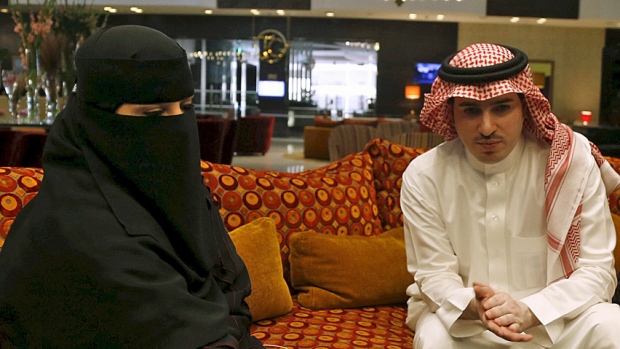
Saudi woman Fawzia al-Harbi, a candidate for local municipal council elections, sits next to one of her chaperones at a shopping mall in Riyadh last month. Saudi Arabian women are running for election and voting for the first time on Dec. 12, but their enfranchisement marks only a pigeon step towards democracy and gender equality in the Islamic kingdom. (Reuters)

Saudi women are treated better than immigrants, but are still severely oppressed, and treated like chattels of the male population.

If that all sounds like the modus operandi of ISIS, which the Saudis have been accused of having funded and armed before becoming a stout ally in the U.S. bombing campaign, well, the shoe does fit.

The Saudis have actually threatened to sue anyone who makes the ISIS comparison, but objectively, it’s not unreasonable.

The main difference is that the Saudis are extremists who managed to create a nation and have it recognized. And of course their king doesn’t claim to lead a new caliphate.

It’s almost a cliché to say this is all about oil, and the Saudi willingness to sell it, and sell it cheaply in unlimited quantities, to the West.

Because it is about oil. It’s also about the Saudis’ willingness to spend billions of that petro-revenue back in the West, signing contracts for military materiel that our governments are ecstatic to arrange.

If you’re inclined to think otherwise, try this mental exercise: imagine if Cuba, or Russia, or Venezuela (or even Canada) had produced 15 of the 19 9/11 hijackers, and had remained a consistent leader in exporting murderous ideology, and radicals like Tashfeen Malik.
Source: Why aren’t we looking into the Saudi role in San Bernardino attack? – World – CBC News

San Bernardino shooting highlights tensions within Islam

More on the Saudi influence on radicalization by Nadeem F. Paracha:

Faisal Shahzad, the American-Pakistani who tried to blow up New York’s Times Square in 2010, had also spent some time in Saudi Arabia. Like Tashfeen, he, too, belonged to a middle-class family.

The authorities in Pakistan still have no clue how to address the phenomenon of educated and relatively well-to-do young people becoming overtly radicalized to the point of committing grave violence.

The country’s military establishment, along with the government headed by the moderate center-right party, the PML-N, has unleashed a widespread operation against hardened and organized militants.

Part of the operation also includes an elaborate plan to neutralize the harder and more puritan stands of the faith that have seeped into various sections of Pakistani society ever since the 1980s.

This aspect of the operation has been tougher to implement because one major section of PMLN’s vote-bank in the Punjab is made up of men and women whose economic status has been enhanced by the money they made in the Gulf states.

But, again, till now, though such Pakistanis have often been known to denounce the faith followed by most of their compatriots and to fund a number of apolitical Islamic evangelical outfits that preach their kind of Islam, they are never expected to cross the line that separates them from militancy.

Ready-made narratives

However, as one Pakistani psychologist suggested two years ago at a seminar, young people in Pakistan with serious emotional problems and unresolved psychological issues are now being handed ready-made religious and political narratives by populist electronic and social media outlets. These narratives, he said, encourage them to give violent expression to their angst, confusion and failures while believing that they are doing so for a grander, more divine cause.

This seems to have been the case with Tashfeen. Hailing from a small town family steeped in indigenous forms of the faith; allegedly flown away to Saudi Arabia by a stubborn father who believed his country’s people were “flawed Muslims” and that “true Islam” was practiced only in Saudi Arabia; returning to Pakistan as a young woman and perhaps coming to the conclusion that her father was correct; linking up with an equally disgruntled soul from the US; marrying him; and then finally discovering her true calling: mass murder.

Hers was a psychotic break emerging from unresolved emotional issues, but combined with a warped politico-religious narrative that simply promised her a catharsis. But it was a catharsis that left 14 innocent people dead; a six-month-old child scarred for life; and a Muslim community in the US scratching their heads and wondering where they went wrong in simply trying to lead “pious lives.”

Source: San Bernardino shooting highlights tensions within Islam | World | DW.COM | 07.12.2015

How fear became the politician’s weapon of choice

Ian Buruma on the politics of fear:

As long as France’s state of emergency lasts, police may arrest people without warrants, break down the doors of private residences in the middle of the night, take over restaurants and other public places with armed force, and generally behave like agents in a police state. Most French citizens are now so frightened of Islamist attacks that such measures are widely supported. But they are almost certainly counterproductive.

A national leader can declare war on a state, not on a network of revolutionaries. Islamic State, despite its claims, is not a state, and Mr. Hollande should not treat it as one. Besides, even if bombing IS strongholds in Iraq or Syria makes military sense, it won’t break the spell of Islamist revolution for frustrated, bored and marginalized young people in French slums.

On the contrary: The canny leaders of IS also rely on an apocalyptic “us or them” view of the world. Most Muslims are not violent revolutionaries who condone, let alone admire, mass violence. IS seeks to broaden its support, especially among young Muslims, by convincing them that true Muslims are in an existential war with the West – that the infidels are their mortal enemies. For them no less than for Mr. Trump, fear is the most powerful weapon.

So the more a Western government allows its policemen to humiliate and bully Muslims in the name of security, the more IS is likely to win European recruits. The only way to combat revolutionary Islamist violence is to gain the trust of law-abiding Muslims in the West. This will not be easy, but arbitrary arrests are surely the wrong way to go about it.

Likewise, when it comes to civil wars in the Middle East, Western restraint is usually a better strategy than hasty military intervention driven by domestic fear. Republican candidates in the United States are already using the recent murder spree in Paris to blame President Barack Obama, and by extension any future Democratic candidate, for being weak. Mr. Trump has promised to “bomb the shit out of ISIS.”

This bellicosity has had the effect of pushing Hillary Clinton, the front-runner for the Democratic presidential nomination, into distancing herself from Mr. Obama. As with Mr. Hollande, she has to assuage public fear by talking tough and promising more military action.

Mr. Obama has consistently resisted the temptation to unleash more wars. His policies have sometimes been inconsistent and irresolute. But in his refusal to give in to panic and act rashly, he has been far braver than all the big talkers who accuse him of being a wimp.

Source: How fear became the politician’s weapon of choice – The Globe and Mail

How Young Brains Get Radicalized – The Daily Beast

Not surprising, the same neuroscience that helps explain greater willingness to take risks (e.g., drunk driving, extreme sports etc) also plays a role in understanding susceptibility to radicalization:

Fortunately, findings from neuroscience may help us to understand where these vulnerabilities exist, and why some brains—particularly adolescent brains—are more susceptible to believing whatever they are fed. Such neural insights are important because they contribute to a better understanding of how to combat radicalization here at home.

According to peer-reviewed research, radicalization is made easier in brains that have impaired functioning in one of the main regions responsible for generating the ability to doubt. Specifically, scientists have found that damage to the brain area known as the ventromedial prefrontal cortex (vmPFC) may cause individuals to have a “doubt deficit”—a hindered ability to question, scrutinize, or be skeptical of new information.

In a 2012 study published in the journal Neuropsychology, researchers found that patients with damage to the vmPFC scored higher on measures of religious fundamentalism and authoritarianism compared to others.

Such qualities would make people with similar impairments, such as those with decreased or disrupted brain activation in the vmPFC, the perfect prey for ISIS recruiters. According to the authors of the study, “Individuals high in authoritarianism tend to easily submit to authority, are often aggressive in the name of authority, and tend to hold dogmatic beliefs without a reflexive critique.”

So the question is, who possesses poor brain circuitry in the prefrontal cortex that could produce doubt deficits? The unsettling answer: young people.

There is overwhelming evidence that teenagers and those in their early 20s have brain circuits in the prefrontal cortex that are still developing. It may come as no surprise that this brain region is also involved in controlling impulses, regulating our emotions, and making sound decisions. The brain’s wiring simply hasn’t had a chance to make all the proper connections to support such behavior.

This falls in line with what is actually being observed in the real world. Teenagers are commonly targeted through the Internet by ISIS recruiters, like 19-year-old Asher Abid Khan from Texas, who was drawn to the group after watching propaganda videos put up by ISIS online.

In another case, ISIS members spent months carefully grooming a 23-year-old female named Alex, who was a devout Christian and Sunday school teacher. A recruiter known to her only as “Faisal” provided the lonely girl with constant companionship by spending hours communicating with her through Skype, Twitter, and email, teaching her the fundamentals and rituals of Islam as a first step.

By being so persistent, ISIS recruiters are also exploiting the brain’s natural tendency to accept beliefs rather than reject them. Since the latter requires an additional evaluation phase, which means more work for the brain, its default state is to believe.

These accounts clearly show that ISIS recruiters recognize the young brain’s vulnerabilities—and how to take advantage of them. If we want to protect against their techniques, we have to understand these vulnerabilities as well.

Source: How Young Brains Get Radicalized – The Daily Beast

What ISIS songs reveal about the group’s evolution

Another side of Daesh/ISIS’ propaganda and recruitment strategy:

After this month’s attacks in Paris, ISIS released an audio recording celebrating the attacks and taking responsibility for them. The RCMP is still investigating the recording to determine whether the voice on the recording belongs to a Canadian. Some linguists are convinced it does, and that the speech patterns suggest he is from Ontario. But it’s still not clear whose voice is on that recording.

What we do know is that the audio statement begins with an acapella song that’s as hooky as any pop song, and it plays throughout the five and a half minute recording.

The song takes the form of a traditional Islamic holy chant, called a “nasheed”. These songs have become key to the ISIS propaganda machine. They’re the soundtrack to the shocking execution videos, they’re blasted from cellphones on the battlefield and now, they’re showing up more and more in English.

Aymenn Jawad Al-Tamimi,fellow at the Middle Eastern Forum, says the Islamic State is one of the leading producers – if not the­ leading producer – of jihadi nasheeds today.

Day 6 asked him to  listen to the music in ISIS’ latest audio recording following the Paris attacks, and to compare it to other jihadi songs that ISIS has produced.

“My immediate thoughts on that nasheed is the language used: English,” says Al-Tamimi. He says the Islamic State has recently branched out into producing nasheeds in other languages, including English, French, German and even Hindi and Uyghur to reach  out to non-Arabic foreigners to join the Islamic State.

“This one  is what you could call one of the more generic nasheeds in terms of content, referring to conceptions of martyrdom and virgins of paradise promised for those who die in the cause of jihad,” says Al-Tamimi.

And he says the catchiness of the songs serves a strategic purpose. “In regards to the melodies of nasheeds being catchy, it can help subconsciously imbibe the nasheed into your mind. The catchiness of the nasheed will help reinforce the messaging and indoctrination,” says Al-Tamimi.

Source: What ISIS songs reveal about the group’s evolution – Home | Day 6 | CBC Radio

Good example of Muslim criticism of violent extremists

A reminder to those who continually ask question the perceived lack of criticism of terrorism by Muslims that it is not too hard to find, as this short video attests:

Saudi-Born Singer Shams Bandar: Why Do We Pin All Our Problems on the West?

Pope Francis says interfaith dialogue needed to battle extremism

Part of the puzzle but requires an openness for dialogue. And many of those susceptible to radicalization may not be open to such dialogue:

Pope Francis said on Thursday dialogue between religions in Africa was essential to teach young people that violence and hate in God’s name was unjustified, speaking in Kenya which has been the victim of a spate of Islamist militant massacres.

Bridging divisions between Muslims and Christians is a main theme of his first tour of the continent that also takes him to Uganda, which like Kenya has been victim of Islamist attacks, and the Central African Republic, riven by sectarian conflict.

“All too often, young people are being radicalized in the name of religion to sow discord and fear, and to tear at the very fabric of our societies,” the pope told Muslim and other religious leaders gathered in the Kenyan capital Nairobi.

“Ecumenical and inter-religious dialogue is not a luxury. It is not something extra or optional, but essential,” he said at a morning meeting with about 25 religious leaders in the Vatican embassy here.

He stressed that God’s name “must never be used to justify hatred and violence.”

He referred to Somalia’s al Shabaab Islamists’ 2013 attack on Nairobi’s Westgate shopping mall and this year’s assault on Garissa university. Hundreds of people have been killed in the past two years or so, with Christians sometimes singled out by the gunmen behind the raids.

The chairman of the Supreme Council of Kenya Muslims (Supreme), Abdulghafur El-Busaidy, also called for cooperation and tolerance.

“As people of one God and of this world we must stand up and in unison, clasp hands together in all the things that are essential for our collective progress,” he said at the meeting, adding doctrinal differences should be put aside.

Source: Pope Francis says interfaith dialogue needed to battle extremism – World – CBC News

Experts: Yes, Anti-Refugee Rhetoric Helps ISIS – The Daily Beast

Unfortunately, not understood by so many:

President Obama said Sunday that by rejecting and vilifying Syrian refugees, Republicans (and Democrats who are going along with them) are doing the terrorists’ work for them.

“Prejudice and discrimination helps ISIL and undermines our national security,” Obama said. This sounds like a political talking point, but if you speak with the independent academics who actually study the mentality and motivations behind terrorism, it turns out Obama is correct.  Broad anti-Muslim suspicion and rhetoric is not only anti-American, it helps the terrorists!

I spoke with a number of our nation’s top academics who study the pathology and psychology of terrorism in general and ISIS in particular. Every single one agreed that the anti-Syrian refugee policies and rhetoric help ISIS.

“There is no place for bigotry in effective counterterrorism,” Professor James Forest, the director of the graduate program in security studies and interim director of the Center for Terrorism and Security Studies at UMass Lowell, told me. “Terrorist groups like al Qaeda and Islamic State thrive when they can exploit the vulnerable seams within a society, when they can exacerbate prejudices.”

Arie W. Kruglanski, professor of psychology at the University of Maryland, has written about how ISIS recruitment strategy is based on psychology, not theology.  And within that context, Kruglanski told me: “The refugee debate could fuel the bitterness and sense of grievance of young Muslims anywhere and could be used by ISIS propaganda machine to enhance anti-US sentiment and boost recruitment.”

“Counterterrorism tries to do two things,” explained Professor Max Abrahms, a political scientist at Northeastern University who studies terrorism. “You try to neutralize existing terrorists and you try to not breed new ones. The surest way to breed new ones is if you’re indiscriminate—for instance, punishing non-violent, moderate Muslims.”

In fact, Abrahms noted he thinks an attack like the one in Paris, from so-called homegrown terrorists, is less likely “because the American Muslim population is much happier, better integrated and does better financially.”

A more moderate Muslim population yields a smaller share of extremists and better relations with law enforcement—which explains why Muslims helped law enforcement prevent one out of every two al-Qaeda related plots against the U.S. since 2009.

“We need to cherish the support and moderation of the American Muslim community,” says Abrahms.

Source: Experts: Yes, Anti-Refugee Rhetoric Helps ISIS – The Daily Beast

Half of the attacks since 2001 were committed by men born in the United States.

The paths to violence for the United States-born attackers varied. Some were recent converts to Islam. At least three who were born in the U.S. had previous criminal histories, and onehad a history of mental illness. One seemed to have radicalized after spending time in Yemen. Another became radicalized after being convicted of lying to F.B.I. agents — denying he had made plans to travel to Somalia when in fact he had.

Security experts argue that the risks of routine travel — including the U.S. visa waiver program, which allows citizens of Britain, France, Belgium and 35 other countries to enter the United States without a visa for stays of up to 90 days — are greater than the threat of foreign terrorists coming through the refugee program.

“Further restricting the acceptance of refugees does not address the most likely vulnerability to attacks from abroad, which is the large number of people from visa-waiver countries involved in the conflict in Syria,” said David Sterman, a researcher for the International Security Program at the New America think tank who has been cataloging terrorist attacks carried out since Sept. 11.

Source: The Origins of Jihadist-Inspired Attacks in the U.S. – The New York Times

After the terror: A time for calm reflection, not policy on the fly – The Globe and Mail

Paul Heinbecker, in his call for reflection, notes an important aspect of Canada’s strength:

Fifth, as for Canada, we, like others, cannot be defeated by terrorists but we can grievously harm ourselves if we scare ourselves into sacrificing too much liberty and dignity for security.

In a world rent by xenophobia, Canada has stood out as a successful society that has profited from refugee flows and immigration better than any other country has done. We can do it again this time with Syrian refugees. We are rare in our capacity to integrate foreigners into our society and to make the consequent diversity a strength.

The example we set is heartening to many people abroad who admire what we achieve and who aspire to the same for their own societies. Our cosmopolitanism is an extraordinary strength that anchors our well-being in a global sea of instability. We should take the time to ensure that our domestic- and foreign-policy choices do not put it at risk.

Source: After the terror: A time for calm reflection, not policy on the fly – The Globe and Mail