An Open Letter to Bill Maher From a Muslim American

Rabia Chaudry on Bill Maher’s anti-Islam rants (to be fair, he rants against all religions):

Nothing I tell you would matter, though. The facts are irrelevant. That’s how bigotry operates. It’s both telling and troubling that you referred to these issues as “the Muslim question.” The reference didn’t escape me and it’s hard to believe it was anything but deliberate. Think for a second about what was unleashed by the “Jewish question” in Europe. Bigotry sometimes does that, too.

So while I support you in continuing to expose Muslims and others who shock the conscience of decent people, who destroy lives, and who wreak havoc, I caution you on the anti-Islam rhetoric. You have a massive following and are successfully leading a movement to demonize Islam in the liberal left, a place many American Muslims call home. You are leading people into rocks and hard places when you posit that Islam is the problem. You are putting Muslims up against a wall and pushing those who fear us further into spaces where little choice is left. As the mother of two American-born daughters, and a Muslim who calls the U.S. her home, I worry deeply about the solutions your followers may propose to your “Muslim question.” You should too.

An Open Letter to Bill Maher From a Muslim American | TIME.com.

Survey on Religion, Racism and Intergroup Relations in Canada Shows Differences in Attitudes Among Anglophones, Francophones and Other Groups

January 2014 survey on religious diversity, racism and intergroup relations by ACS and Canadian Race Relations Foundation. Not much surprising, communities tend to focus on their issues (and socialize more from within) and Québec attitudes towards religious diversity more negative. Racism highlights below:

Almost two in three Canadians (62%) report they are “worried” about a rise in racism. Concerns about racism and discrimination against particular groups such as Muslims, Aboriginal Peoples, immigrants and Jews vary greatly from one group to another.  Members of a particular group appear more concerned about a rise in racism and discrimination directed against their own group. Jews show a relatively high level of concern about racism directed against other groups as well. Francophones also show a higher level of concern except as it relates to anti-Aboriginal sentiment.

Survey on Religion, Racism and Intergroup Relations in Canada Shows Differences in Attitudes Among Anglophones, Francophones and Other Groups – Press Release – Digital Journal.

Why Race Has Been the Real Story of Obama’s Presidency All Along

Lengthy but interesting article by Jonathan Chait on the enduring legacy of slavery, and how it plays into the political and ideological divides in the US. Worth reading:

And the truth is almost too brutal to be acknowledged. A few months ago, three University of Rochester political scientists—Avidit Acharya, Matthew Blackwell, and Maya Sen—published an astonishing study. They discovered that a strong link exists between the proportion of slaves residing in a southern county in 1860 and the racial conservatism (and voting habits) of its white residents today. The more slave-intensive a southern county was 150 years ago, the more conservative and Republican its contemporary white residents. The authors tested their findings against every plausible control factor—for instance, whether the results could be explained simply by population density—but the correlation held. Higher levels of slave ownership in 1860 made white Southerners more opposed to affirmative action, score higher on the anti-black-affect scale, and more hostile to Democrats.

The authors suggest that the economic shock of emancipation, which suddenly raised wages among the black labor pool, caused whites in the most slave-intensive counties to “promote local anti-black sentiment by encouraging violence towards blacks, racist norms and cultural beliefs,” which “produced racially hostile attitudes that have been passed down from parents to children.” The scale of the effect they found is staggering. Whites from southern areas with very low rates of slave ownership exhibit attitudes similar to whites in the North—an enormous difference, given that Obama won only 27 percent of the white vote in the South in 2012, as opposed to 46 percent of the white vote outside the South.

The Rochester study should, among other things, settle a very old and deep argument about the roots of America’s unique hostility to the welfare state. Few industrialized economies provide as stingy aid to the poor as the United States; in none of them is the principle of universal health insurance even contested by a major conservative party. Conservatives have long celebrated America’s unique strand of anti-statism as the product of our religiosity, or the tradition of English liberty, or the searing experience of the tea tax. But the factor that stands above all the rest is slavery….

And yet—as vital as this revelation may be for understanding conservatism, it still should not be used to dismiss the beliefs of individual conservatives. Individual arguments need and deserve to be assessed on their own terms, not as the visible tip of a submerged agenda; ideas can’t be defined solely by their past associations and uses.

Liberals experience the limits of historically determined analysis in other realms, like when the conversation changes to anti-Semitism. Here is an equally charged argument in which conservatives dwell on the deep, pernicious power of anti-Semitism hiding its ugly face beneath the veneer of legitimate criticism of Israel. When, during his confirmation hearings last year for Defense secretary, Chuck Hagel came under attack for having once said “the Jewish lobby intimidates a lot of people up here,” conservatives were outraged. (The Wall Street Journal columnist Bret Stephens: “The word ‘intimidates’ ascribes to the so-called Jewish lobby powers that are at once vast, invisible and malevolent.”) Liberals were outraged by the outrage: The blog Think Progress assembled a list of writers denouncing the accusations as a “neocon smear.” The liberal understanding of anti-­Semitism is an inversion of conservative thinking about race. Liberals recognize the existence of the malady and genuinely abhor it; they also understand it as mostly a distant, theoretical problem, and one defined primarily as a personal animosity rather than something that bleeds into politics. Their interest in the topic consists almost entirely of indignation against its use as slander to circumscribe the policy debate.

Why Race Has Been the Real Story of Obama’s Presidency All Along — New York Magazine.

Reviewers will find more spelling errors in your writing if they think you’re black – Vox

While the study is a relatively small sample, and there are a number of methodological flaws, indicated in the article, nevertheless is consistent with some other kinds of tests (e.g., blind cvs) to measure implicit bias.

In an experimental context, when reviewers were told the author of a legal brief was black they consistently rated identical pieces lower in quality and identified more spelling, grammar, factual, or analytical errors. It’s evidence that, even if the days of overt bigotry and explicit discrimination are mostly past, the United States still struggles with a deep problem of implicit racism.

Arin N. Revees, the president of Nextions and the author of the study, argues that the implicit racism happened because reviewers take the racial information she provided as a cue for how they should judge the work. When the author is supposed to be white, reviewers excused errors as out of haste or inexperience. They commented that the author “has potential” and was “generally a good writer but needs to work on” some skills. When the author is supposed to be black, those same errors became evidence of incompetence. A reviewer said he “can’t believe he [the author] went to NYU,” and others said he “needs lots of work” and was “average at best.”

Reviewers will find more spelling errors in your writing if they think you’re black – Vox.

Joseph Heath: How to beat racism

More Joseph Heath, this time on racism. Helpful to have so much of his book in the National Post, not sure if this is helping book sales for Enlightenment 2.0 or substituting for them:

… What matters is not so much the differences between individuals but which differences we choose to invest significance in. This is the good news on race. It suggests that the best way to overcome race may simply be to distract people from it. If there is nothing else to attract people’s attention, the set of physical characteristics that distinguish race will be regarded as significant, but this can be overcome by reducing the salience of these characteristics. There is probably nothing we can do to stop people from classifying others into groups and developing animosity toward those whom they regard as belonging to an out-group. Yet even if we are unable to change this basic feature of human psychology, we can develop an effective work-around, by manipulating the environment so that people classify each other in ways that are less socially pernicious. For example, instead of allowing people to fixate on inherited features of individuals — such as skin colour — we could encourage them to focus on arbitrary or symbolic features — like hair style. The advantage of hair style is that it can easily be changed, and so does not translate into permanent disadvantage for any class of individuals.

This may explain why the military and sports teams have been far more successful at creating racial integration than many other institutions in American life. What distinguishes both of them is that they cultivate very intense, particularistic loyalties. There is good reason to think that these forms of group identification simply crowd out the other ones based on race. This can be far more effective than asking people to subscribe to some universalist ideal, one that forces them to overcome or suppress their “groupish” instincts.

From this perspective, the real problem in America is not so much racism as it is race consciousness. (Indeed, to any non-American, the most oppressive feature of intercultural relations in America is not that people are racist, but just that they talk and think incessantly about race, even worse than the way the English talk and think incessantly about class.) And yet this feature of American culture seems to be one that everyone, white and black, conservative and liberal, is involved in a giant conspiracy to sustain and reinforce. This is because most Americans who are progressive on the subject believe that racism must be overcome directly, and that this can only be done by increasing sensitivity and awareness of racial difference. A lot of progressive black politics has done the same, by rejecting the older ideal of a “colour-blind” society and insisting upon the recognition and affirmation of a positive black identity. This winds up being an inadvertent recipe for the reproduction of racism. Even though the intention is to create a positive group identity, its dominant effect is to make race salient as a basis of group identity, which means that it will also, inevitably, become a locus of negative valuation for some.

Joseph Heath: How to beat racism | National Post.

Finding a cure for hate | Toronto Star

Interesting and lengthy article on trying to understand the psychological and medical reasons behind hate, an initiative by Dr. Izzedin Abuelaish, of U of T’s Dalla Lana School of Public Health, who became famous after most of his family was killed by an Israeli rocket in Gaza, and became the basis for his book, I Shall Not Hate.

For his part, Abuelaish likes to think of hatred as a disease or mental disorder. It certainly works, metaphorically — hatred spreads from person to person, like an infection, he says. It can metastasize, like cancer; it can be chronic, like diabetes. People are not born with hatred, he believes; they acquire it from the environment, just as people are exposed to bacteria or second-hand smoke.

Others at the workshop were hesitant to brand hatred as a disease or disorder. Much controversy has come from the “great tendency of psychiatry to turn issues that are popularly in the human condition into mental disorders,” noted Dr. Alexander Simpson, chief of forensic psychiatry with the Centre for Addiction and Mental Health (CAMH) in Toronto.

“To hear a universal human experience — an expression of negative emotion like hate — being someway turned into a disease is the sort of thing that psychiatry’s been told off for doing for the last 30 years,” Simpson said. “I have some reluctance to consider that.”

He raised the possibility that perhaps hatred can be likened to blood pressure; we all have it but when it reaches a certain level, we get sick.

Finding a cure for hate | Toronto Star.

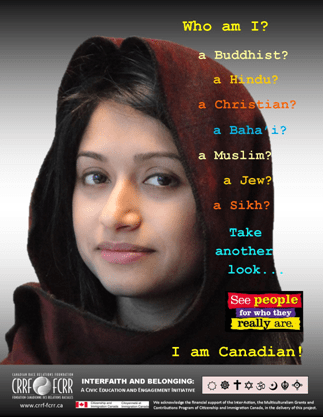
What’s wrong with this Canadian anti-racism poster?

While I agree with Todd’s views that we are a mix of identities, I think he goes too far in over interpreting the Canadian Race Relations Foundation poster.

After all, the poster is simply trying to say look at the person first, treat them equally and fairly, it doesn’t preclude further curiosity and discussion or ignore the various identities we have. And that no group is monolithic; one has to look at the individual and get to know them as a person, not a stereotype:

The poster is promoting confusing ideas about racism by telling viewers the only thing anyone should be concerned about regarding anyone is that they are “Canadian!”

But everyone in Canada has multiple identities.

They are shaped in part by being Canadian. But they are also shaped by their ethno-cultural background. They are shaped by being members of a religion (or not), by being female, by having roots in certain countries, by their economic status, by their familiarity with certain languages, by their family status and a host of other things.

Many factors make up who we are.

Multiculturalism should not be about assuming everyone is the same, ie. “Canadian.” That is not the end of our identities. But anti-racism groups like this act as if we should think and believe everyone is the same.

It’s dangerous teaching. They’re stifling curiousity. And what they are doing has potential to poison relations in Canada between people from different ethno-cultural-religious groups.

What’s wrong with this Canadian anti-racism poster? | Vancouver Sun.

Disclosure: I was an ex officio Board Member of the CRRF as part of my duties as DG – Citizenship and Multiculturalism

Stephen Colbert furor is a mess of hurt feelings: Mallick

Heather Mallick on the Colbert controversy. Think she nails it:

Colbert plays an idiot on his show, “an egomaniacal right-wing gasbag.” Nine years ago, even he did not think his show would succeed and he somewhat regrets the fact that he didn’t change his name before it became a hit. He doesn’t allow his children to watch the show lest they catch their father being “insincere.” Park was being an idiot about an idiot.

Truly, Twitter has eaten itself. Meta beyond belief, the Colbert frenzy has made me comment on a commenter who commented on the reaction to a tweet by a commenter who commented on a comedian playing a character who joked about a remark by a racist reacting to comments by football fans on the name of his team. And I’m boiling it down here.

All this would be worthy if I were commenting on actual racism, which is probably the worst virus going around. The expression of pointless racial prejudice has caused hundreds of millions of early deaths and soured countless lives. That said, can we not concentrate on damage caused rather than feelings felt?

Stephen Colbert furor is a mess of hurt feelings: Mallick | Toronto Star.

International Day for the Elimination of Racial Discrimination: Difference in Tone

Quite a different approach from Minister Alexander compared to Minister Kenney. Incredibly bureaucratic and normal:

Citizenship and Immigration Canada (CIC) coordinates the federal activities related to the implementation of the International Convention on the Elimination of All Forms of Racial Discrimination (ICERD). The ICERD is a United Nations Convention that promotes and encourages universal respect for and observance of human rights and fundamental freedoms for all without distinction based on race, sex, language or religion.

Our role

CIC’s role includes:

  • coordinating federal input to periodic reports to the Committee on the Elimination of Racism (CERD) on Canada’s implementation of the ICERD;
  • leading Canada’s periodic appearances for the presentation of reports to the CERD, a committee of independent experts that monitors implementation of the ICERD; and
  • consulting with partner departments regarding progress in responding to recommendations from the CERD.

CIC activities

Under the mandate of the Canadian Multiculturalism Act, CIC works to foster the full participation and integration of Canadians from all ethnic, racial and religious backgrounds into society. CIC’s multiculturalism activities in support of the ICERD implementation include:

The CIC Settlement Program also supports locally based approaches to remove barriers as well as help build welcoming and inclusive communities. The wide range of stakeholders involved with the program allows projects to address many different challenges to integration, including those faced in the workplace, schools and community members at large.

Human Rights.

But of course, Minister Kenney in his role as Multiculturalism Minister also issued a statement, more political in tone than the bureaucratic one under Minister Alexander. Not a bad division of roles but even Minister Kenney’s current statement below is subdued compared to previous years:

“The International Day for the Elimination of Racial Discrimination is a day observed in like-minded countries around the world to reaffirm our shared commitment to combatting racism.

“Canadians are rightly proud of our country’s successful pluralism, fostering a society where all citizens, regardless of ethnicity, faith, or country of origin, have a place.

“Our government continues to be actively engaged in efforts to fight discrimination both at home and abroad.

“Throughout the past year, Canada maintained our status as a world leader in the global fight against anti-Semitism as the Chair of theInternational Holocaust Remembrance Alliance (IHRA). Our government will continue to work closely with the IHRA to promote Holocaust education, remembrance and research.

“Moreover, Canada’s Office of Religious Freedom continues to advocate for the rights of persecuted religious communities around the world.

“As Minister for Multiculturalism, I encourage all Canadians to take a moment on this day to reflect on the importance of our country’s values of freedom, democracy, human rights and the rule of law.”

In contrast, the 2013 press release had much more involvement and direction by the Minister:

“The International Day for the Elimination of Racial Discrimination is an opportunity for Canadians to join with other freedom-loving people around the world in reaffirming our commitment to reject and eliminate all forms of racial discrimination.

“While we can be proud of our own country’s successful pluralism, we need to ensure that all Canadian citizens reject extremism, do not import ancient enmities, and continue to embrace Canada’s tradition of ordered liberty, which guarantees the equality of all citizens under the law.

“Through initiatives such as the Office of Religious Freedom, our Government will also continue to condemn acts of racial hatred around the world. These acts often accompany the targeting of religious communities.

“As Minister of Citizenship, Immigration and Multiculturalism, I encourage all Canadians to continue to uphold the fundamental values of our free, democratic and peacefully pluralist society and to reject all forms of unjust discrimination.”

Minister Kenney issues statement to mark the International Day for the Elimination of Racial Discrimination (2014)

Minister Kenney issues statement on the International Day (2013)

And lastly, the Canadian Race Relations Foundation continues to align itself with the government’s priorities:

Today the CRRF is proud to launch a new resource area dedicated to “Imported Conflict”, an emergent arena of study and public discourse that encompasses immigration, citizenship, multiculturalism and approaches to social and economic integration, and is essential to our understanding of what still needs to be done to promote integration and civic participation of Canadians of all origins.

The first document to be included in the special resource collection will be the Mosaic Institute’s recently released report, The Perception & Reality of “Imported Conflict” in Canada, and its abundant resources. The report is the culmination of a two-year study of Canadians’ perceptions and concerns about “imported conflict” in Canada. The report provides an interesting perspective as an initial endeavour, and the CRRF looks forward to examining and gathering further research in this area.

CRRF announces new initiative on International Day for the Elimination of Racial Discrimination
Is criticism of Israel anti-Semitic? | My take

One of my recommendations on the approach to antisemitism from my piece in the CJN:

Secondly, we must strengthen messaging on the commonalities between anti-Semitism and other forms of hatred and intolerance. Some of the pioneering work by Jewish communities is being lost in the focus on anti-Semitism. More express links among all forms of hatred, racism and discrimination can help combat anti-Semitism through engagement of a broader range of communities. The activities of the Holocaust centres in Canada in educating our increasingly diverse population are good examples. Perceived exclusive government focus on anti-Semitism may undermine understanding and support among other communities.

Is criticism of Israel anti-Semitic? | The Canadian Jewish News.