Are Canadians racist? Yes, let’s stop denying it | Former Senator Oliver

Former Senator Don Oliver on racism and equality:

Racism still exists—in a subtle, underlying current of apathy and ignorance that continues to impede the advancement of visible minorities toward equality.

That’s why we must continue to advocate for change within the federal public service—and within corporate Canada. This change is crucial. Canada’s demographic profile is becoming increasingly diverse. Its workforce is aging. Meanwhile, the competition for workers is escalating with the growing global shortage of talent.

If we want to compete effectively, Canadian organizations—both public and private—must bring and keep the best and the brightest on board—and increasingly, the best and brightest are visible minorities. We need visible, committed leadership to effect real change. Most of all, we need to put an end to racism—through proactive non-tolerance of any form of discrimination, through training, and through robust support systems for visible minorities.

Complacency and denial about the reality of racism haven’t made Canada a truly diverse and inclusive place to make a living and build a future. Let’s stop kidding ourselves now.

Are Canadians racist? Yes, let’s stop denying it | hilltimes.com.

9 Ugly Lessons About Sex From Big Data | TIME

Interesting example of big data and some reminders that we are not yet living in a post-racial society:

5. According to Rudder’s research, Asian men are the least desirable racial group to women…On OkCupid, users can rate each other on a 1 to 5 scale. While Asian women are more likely to give Asian men higher ratings, women of other races—black, Latina, white—give Asian men a rating between 1 and 2 stars less than what they usually rate men. Black and Latin men face similar discrimination from women of different respective races, while white men’s ratings remain mostly high among women of all races.

6. …And black women are the least desirable racial group to men.Pretty much the same story. Asian, Latin and white men tend to give black women 1 to 1.5 stars less, while black men’s ratings of black women are more consistent with their ratings of all races of women. But women who are Asian and Latina receive higher ratings from all men—in some cases, even more so than white women.

8. Your Facebook Likes reveal can reveal your gender, race, sexuality and political views.A group of UK researchers found that based on someone’s Facebook Likes alone, they can tell if a user is gay or straight with 88% accuracy; lesbian or straight, 75%; white or black, 95%; man or woman, 93%; Democrat or Republican, 85%.

9 Ugly Lessons About Sex From Big Data | TIME.

Watch John Oliver Deliver a Flawless Takedown of the Turmoil in Ferguson

One of the better pieces on Ferguson (15 minutes):

Watch John Oliver Deliver a Flawless Takedown of the Turmoil in Ferguson | TIME.

Tracked tweets reflect racist attitudes online, says of U of A researcher

Not sure the numbers are as bad as portrayed as they cover a three-month period, and the numbers are very low in terms of total number of tweets.

Compare this to comments in newspaper columns on immigration and multiculturalism, where my anecdotal observations indicate a fair number of offensive comments, depending on the article:

“In Canada, we’re so reluctant to talk about race and racism specifically so often times in public discourse it’s rarely ever brought up but when you shift to the online realm people are … freely being racist,” said Chaudhry, who will present his findings at the Social Media and Society International Conference in Toronto next month.

To conduct his research, Chaudhry flagged common racist terms coming out of Calgary, Edmonton, Vancouver, Winnipeg, Toronto and Montreal.

In Calgary, as well as Edmonton and Winnipeg, the majority of comments were directed at the aboriginal community.

About 50 per cent of all the racist tweets were real-time observations, said Chaudhry.

“I’d always notice people complaining to Calgary transit about aboriginals in public spaces,” he said.

Overall, he said the number of Calgary-based racist tweets was low. Toronto accounted for 434; Vancouver had 99; Winnipeg had 78; Edmonton had 60; and Montreal had 43. In Toronto, Vancouver and Montreal, the n-word was the most common racist term.

Darren Lund, a professor at the U of C’s the Werklund School of Education who researches social justice issues, said he was disheartened but not surprised by the findings.

“It seems that most of us have been raised in a way that even if we’re really nice, well-intentioned people, we’re still taught in some ways to think of aboriginal people as less than, or as flawed,” he said.

Tracked tweets reflect racist attitudes online, says of U of A researcher.

WWI racism: black, Asian and aboriginal volunteers faced discrimination

Another angle to the coverage of WWI and Canada’s role, and a reminder how Canada has changed:

Many of those remembered by the monument [honouring Japanese-Canadian soldiers] were denied the right to enlist in British Columbia at the start of the war and had to travel to Alberta, where they joined up with regiments like the Calgary Highlanders.

Dozens died while fighting in Europe, and shortly after the war ended, the limestone cenotaph was erected, etched with the names of the men who fought.

Professor Tim Cook, a historian at the Canadian War Museum and an adjunct research professor at Carleton University, said Canadians of African and Asian ancestry, as well as First Nations, all faced discrimination.

“Canada was not the multicultural country that it is today,” he said. “It was very much a prejudiced society.”

After Britain declared war on Aug. 4, 1914, most of the first recruits were Anglo-Saxon and English speaking, and those who weren’t were simply turned away, said Cook.

First Nations were treated a bit differently, he added, because they had a reputation for being snipers and scouts. Still, the government didn’t know what to do with aboriginal volunteers because it feared the Germans wouldn’t extend any mercy on the battlefield to those they captured. By the end of the war, about 4,000 First Nations served, said Cook.

About 60 per cent of Canada’s first contingent of soldiers were British-born, 30 per cent were Canadian and about 10 per cent were others, Cook said, adding that most of the recruits were former British soldiers who served in the Boer War or were members of the Canadian militia or professional army.

WWI racism: black, Asian and aboriginal volunteers faced discrimination | Toronto Star.

From the Vancouver Sun, a good profile of the Louie brothers, Chinese Canadians, who fought in WW1:

In 1917, when there were conscription riots in Canada by those not willing to fight, the brothers’ dogged insistence on joining the Canadian Army and fighting for a country that refused them full citizenship and whose racial policies deemed them inferior was nothing short of astonishing.

The brothers were among the 300 or so Chinese-Canadians believed to have volunteered to fight in the First World War but about whom very little is known.

The pair’s exploits, therefore, must stand in for all those unknown warriors who, like the Louies, didn’t seek safety behind what they might have considered a convenient aspect of racism — their exemption from conscription.

Col. Howe Lee, one of the founders of the Chinese Canadian Military Museum at 555 Columbia St., in Vancouver’s Chinatown, says the Canadian government exempted Chinese Canadians from conscription in the First World War as a means to continue denying them citizenship.

“It’s generally accepted if a foreigner fights for a country during a war, they are entitled to citizenship. The Louie brothers weren’t foreigners, they were born here, but that didn’t matter. When conscription came in, they were exempt because the government didn’t want to give citizenship to Chinese,” said Lee.

Photographs of both soldiers and some of the letters they wrote home from the Western Front on army-issue paper are now on display in a small room at the museum, as is Wee Tan’s steel helmet that he brought home from France.

Battling enemies overseas, fighting racism on home front

We’re not a post-racial society. We’re the innocent until proven racist society | Danielle Henderson

Strong commentary by Danielle Henderson in The Guardian on the enduring presence of racism in the US (some of the examples apply more broadly), and the wilful or unconscious denial that occurs (with the caveat that correlation is not necessarily causation):

Racism is not just part of our shameful past as many would like to think: it’s a vicious factor in the gulf of inequality that still plagues us today.

People of color still suffer the effects of racism on a regular basis: statistics show that we incarcerate African-Americans and Latinos at disproportionate rates; white people then strongly support continuing criminal justice policies that disproportionately target Latinos and African-Americans when given information about the disproportionate rates of incarceration. Our schools still expel and suspend black students at “triple the rate of their white peers”. People of color are more likely to be arrested for drug related crimes, even though whites use and abuse drugs at similar rates, and, once arrested, get longer sentences than white people arrested for the same crimes. Unemployment is consistently twice as high among black Americans compared to white Americans, and black Americans have to search for work longer than white ones. African-Americans pay more for car insurance, for home loans and for access to credit, and they are racially profiled while shopping by store security personnel – including at Best Buy. Having tons of money is no panacea: even though they make up 65% of the NFL, black players receive 92% of the penalties for unsportsmanlike conduct, and a store clerk in Switzerland refused to show a $38,000 Tom Ford handbag to Oprah Winfrey, whose net worth is $2.9bn, because it was “too expensive”.

And yet, people still hold on to the belief that we live in a color-blind system in which nobody is a racist, despite such obvious examples of persistent racism. The “post-racial” society is an intellectual refuge for white Americans, who largely benefit from racism even when they’re unwilling or unable to admit it. We certainly shouldn’t keep denying that racism exists, but white America needs to wake up and recognize just how complicit it has become in a system constantly perpetuating false notions of equality.

Were not a post-racial society. Were the innocent until proven racist society | Danielle Henderson | Comment is free | theguardian.com.

Jonathan Kay: Stop calling people ‘racialized minorities.’ It’s silly and cynical

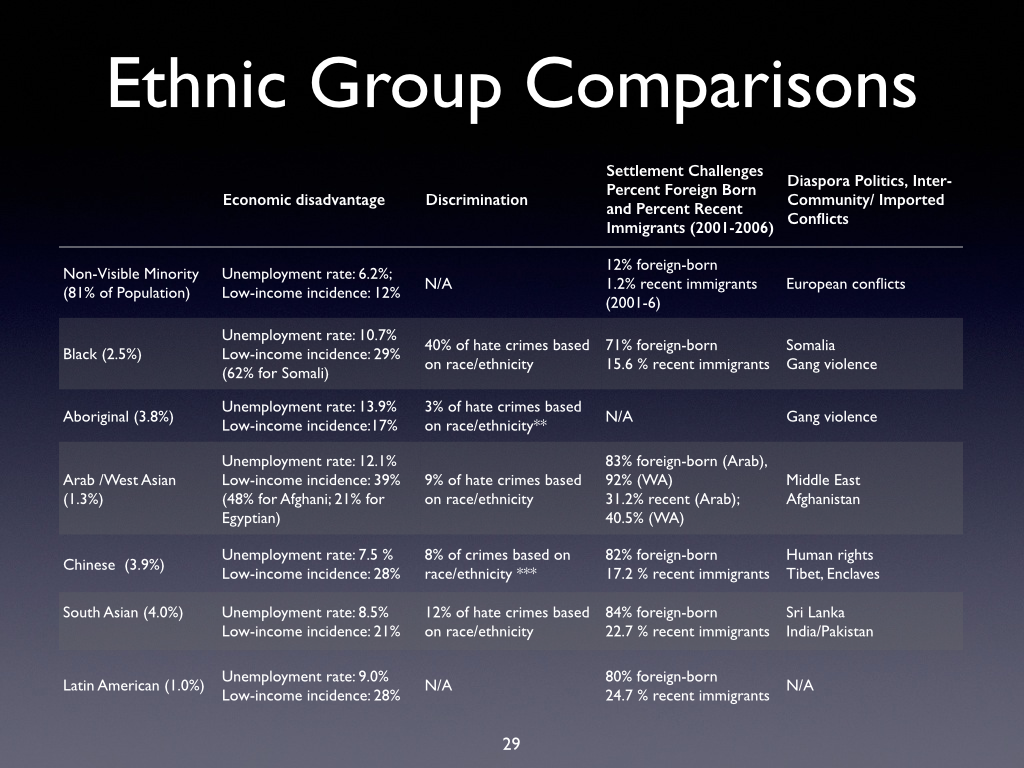
Ethnic Community Comparisons

From Policy Arrogance or Innocent Bias: Resetting Citizenship and Multiculturalism

Jon Kay takes the easy route out on faulting Carol Goar on her terminology, “racialized,” but ignores the broader, and more uncomfortable question she raised regarding inclusiveness and participation (Toronto is diverse but not as inclusive as it could be):

“Racialized Torontonians” as they call themselves?

Here’s a question for readers who live in Toronto: Do you know a single ordinary person — someone who is not either an activist, or enrolled in feminist film studies at Ryerson, or a “diversity consultant” hired by governments and big companies — who routinely refers to herself or anyone as a “racialized” person?

To be more specific, have these words ever escaped anyone’s lips within the 7,124 square kilometers of the Greater Toronto Area: “As a racialized Torontonian, I’m supporting Argentina over Germany in the World Cup final.” “As a racialized Torontonian, that shade of eye shadow really doesn’t go with my skin tone.” “As a racialized Torontonian, I’m having trouble finding a restaurant that serves authentic soul food.”

I suspect that most ordinary Torontonians would be utterly confused if Ms. Goar insisted on addressing them as a “racialized” person in a restaurant or store. They might assume she was taking some kind of ethnic census. If pressed to describe themselves through the lens of race-obsession, they might more simply respond: “If you really want to know, I’m half-black.” Or, “I’m Sephardic Jewish with a quarter Latino.” Or “I was both in The Philippines.” Or perhaps many might just avoid eye contact and say, “I’m a Canadian who lives in Toronto.”

Jason Kenney questioned the use of the term “racialized” along with “white power” and “oppression.” Grant and contribution proposals that included these terms, or websites of applicants with these terms, were routinely rejected.

While the underlying policy rationale was overdue – given Canada’s increased diversity, integration challenges within and among communities were equally significant – this change downplayed equity aspects of multiculturalism.

Jonathan Kay: Stop calling people ‘racialized minorities.’ It’s silly and cynical | National Post.

ICYMI: From Washington Redskins to queer culture, the uneasy evolution of the slur

Neil Macdonald on the changing nature of slurs and how our perceptions of what is acceptable and what is not changes:

Personally, for the sake of consistency, I’ve begun to avoid using the word “Redskins” in news reports about the controversy surrounding the team’s name.

It goes against my grain to do so; I’m a speech libertarian, and I believe we should shrink from no word if it is relevant to the discourse at hand, which, in this city, Redskins most certainly is.

But I also try, at least, to avoid hypocrisy, and there’s plenty of that in the discussions of the controversy surrounding the team.

The word itself is a self-evidently racist, slangy, condescending term for Indians, as a U.S. government commission ruled just recently. And yet we in the news media still use it when describing the team, simply because the team’s owner refuses to consider changing the name.

Imagine for a moment someone naming a team the “Houston Wetbacks.” Or the “New York Coons.” Would we repeat those names in reports? To ask that question is to answer it.

Other slurs are so radioactive they cannot even be uttered in a hypothetical discussion, so I wont. Again, I don’t think any word should be off-limits to discussion, but like the comedian Louis CK, I despise the fig-leaf coyness of euphemisms like “the n-word.”

So why is it still acceptable to use the term Redskins?

Do we allow ourselves to use it because it’s the name of a major sports team? Or is it still the name of a major sports team because we allow ourselves to use it?

Some people say that not all Indians regard the word as necessarily racist. But pretty clearly a large number of them do. Indian groups have tried, and failed, to force a name change.

That leaves us with the ugly conclusion that native Americans simply don’t have the political clout in the U.S. that some other minority groups have acquired through vigorous activism.

From Washington Redskins to queer culture, the uneasy evolution of the slur – World – CBC News.

Canadian-born visible minority youth facing an unfair job future

Diversity by City

Some good analysis of income gaps between visible minorities and the “mainstream” by Andrew Jackson of the Broadbent Institute:

… while members of visible minority groups are more likely to be recent immigrants than other Canadians, a high and rising proportion of non-whites were born in Canada.

Forty per cent of visible minority youth age 20 to 24 were born in Canada and thus have the same educational experience as other Canadians. Many others came to Canada as young children and were mainly educated in Canada. But they still encounter greater problems in the job market than whites.

2011 was a year of partial recovery from the Great Recession of 2008-09, and the overall unemployment rate averaged 7.8 per cent.

The NHS data show that the unemployment rate in 2011 was 9.9 per cent for visible minority workers compared to 7.3 per cent for white workers, a difference of 2.6 percentage points. The difference in unemployment rates between visible minorities and white workers was significantly greater for women 10.6 per cent vs. 6.7 per cent than for men 9.3 per cent vs. 7.8 per cent.

The unemployment rate in 2011 was especially high for Arabs 14.2 per cent, blacks 12.9 per cent and South Asians 10.2 per cent.

A high level of education did not narrow the unemployment rate gap between visible minority and white workers. In fact, the gap 7.9 per cent vs. 4.1 per cent was greater for workers with a university degree.

Strikingly, there was a big difference in unemployment rates in 2011 between visible minority workers who were born in Canada and white non-immigrants – 11.8 per cent compared to 7.4 per cent.

The gap was a bit smaller but still significant for young visible minority workers age 20 to 24 born and educated in Canada and white workers in the same age group, also born and educated in Canada – 17.2 per cent compared to 14.1 per cent.

Canadian-born visible minority youth facing an unfair job future – The Globe and Mail.

‘Check your Privilege’ Debate

A fairly typical rant by Rex Murphy on ‘check your privilege’:

It is a direct effort to impose guilt where gratification should reign. It is to make those who work hard, try to conduct themselves responsibly, who apply themselves to study, feel that none of these attributes, none of their honest effort, has earned them success. Why should all a young person’s effort and sweat, holding on to a moral code, and determined application to make something of their life be turned against them, be denied its efficacy, and everything praiseworthy about a person be dismissed as merely a gift of their ethnicity?

What’s most obnoxious about this trend is its blatant attempt to chase effort, merit, industry and determination off the field entirely. The privilege movement seeks to sully and taint  the commonplace eternal virtues, so that when one of us sees another happy in marriage, perhaps, or successful in business, and maybe temperate and easy in private life , we should all shout in envy and hate. It is bitterly ironic that the anti-racist message has been reduced to this: You have all that you have only because you have white skin.

It is the cheapest form of racism, no subtlety at all … and it finds fullest expression in those academic institutions most attuned to any whiff of prejudice. Only in the very best universities would you ever be able to find so stupid a thought being given such frantic attention. And Orwell’s famous taunt about some ideas being so stupid only an intellectual would support them is sadly truer now, by far, than when he wrote them.

Rex Murphy: Check your bigotry

Which in turn, provoked a good debate, starting with Dawn Black in iPolitics (pay wall):

Asking people to check their privilege isn’t a matter of keeping certain voices out of the conversation – it’s about ensuring that all voices, especially those that have historically been kept silent, have the chance to be heard. It’s not about blaming white people for their achievements – it’s about knowing that we can’t end racism until we understand how and why it continues to exist. It’s not about humiliation – ultimately, it’s about empathy.

Social inequality is, unfortunately, a fact of life. Recognizing that inequality exists – and trying to find ways to eliminate it – is a fundamental part of responsible citizenship. Trying to shut down discussions of privilege won’t make that privilege disappear; it will only make inequality harder to fight.

Check your privilege, Canada:

And echoed by Deborah Douglass in the National Post:

Let’s be clear: To acknowledge the role of privilege does not negate the role of self-determination and personal responsibility. They are understood. Even I cringe at new speech-policing concepts such as trigger warnings, which are used to control speech on university campuses. And those on the losing end of privilege could stand to watch how they couch their argument when calling it out. Often, they, too, possess some form of privilege. I know I do. Sometimes people elevate their victimhood to suggest that’s the extent of their value and comes across as a form of emotional blackmail others cannot access.

The beautiful thing about being part of a democracy is the notion of perfecting it. The least we can do is to open our minds and hearts. That’s a nice way of saying that if you’re white or male or upper-middle class or athletic or skinny or good-looking or privileged in any way, you cannot go on assuming everything that comes to you belongs only to you, and that there’s something wrong with those who aren’t as privileged.

It is said that to whom much is given, much is required. That same famous source also cautions against suffering fools, which means challenging foolish notions and weeding out racism or sexism in all its nuanced and structural forms.

Weeding out racism

One of the issues Minister Kenney and his staff had with multiculturalism policy and G&C proposals was reference to “white power,” an essentially similar concept.

One can view ‘check your privilege’ as another way to slow down one’s thinking and assumptions, to shift from System 1 automatic to System 2 deliberative thinking, to use Kahneman’s phrase, to allow for more open-ended discussion. I think Douglass’ comments have it about right; Rex has remained within his System 1 “mental prison” to use a Gilles Paquet term.