The real secret to Asian American success was not education – The Washington Post

Interesting and relevant study on how barriers affect mobility:

This claim has been with us since at least the 1960s, when it served as a popular rejoinder to the challenges issued by the civil rights movement. Many newspapers printed flattering portraits of Asian Americans to cast skepticism on the people marching for economic and social justice.

“At a time when it is being proposed that hundreds of billions be spent to uplift the Negroes and other minorities, the nation’s 300,000 Chinese-Americans are moving ahead on their own,” claimed a 1966 story in the U.S. News and World Report, which noted their “strict discipline” and “traditional virtues.”

To the extent that all myths are rooted in truth, this model minority stereotype recognizes a real pattern of Asian upward mobility. A century ago, Asian Americans were known as laborers of the lowest wage. They were ditch diggers, launderers, miners. Yet over the decades, despite poverty, racial violence and widespread discrimination, many Asians managed to clamber up the socioeconomic ladder.

Until now, the story of how that happened has been poorly understood.

“The widespread assumption is that Asian Americans came to the United States very disadvantaged, and they wound up advantaged through extraordinary investments in their children’s education,” says Brown University economist Nathaniel Hilger.

But that’s not what really happened, he says.

Hilger recently used old census records to trace the fortunes of whites, blacks and Asians who were born in California during the early- to mid-20th century. He found that educational gains had little to do with how Asian Americans managed to close the wage gap with whites by the 1970s.

Instead, his research suggests that society simply became less racist toward Asians.

Asian Americans have been part of the United States for most of its history. The first major wave of immigrants came in the 1800s, when Chinese laborers flocked to California to help build railroads. Their presence soon stirred up resentments among white Americans. The Chinese Massacre of 1871, which took place in the streets of Los Angeles, counts among the largest lynchings in U.S. history.

In 1882, Congress passed the Chinese Exclusion Act, which shut the door on the influx of low-skilled Chinese labor. By 1924, nearly all immigration from Asian nations was banned. Despite widespread discrimination, many families remained, settling mostly in California. Opinion surveys from that era show that whites expressed extreme prejudice against both Asian and African Americans. Asians also lived in segregated neighborhoods and often sent their children to segregated schools. To survive, many opened their own businesses because no one would employ them.

Hilger’s research focuses on native-born whites, blacks and Asians to rule out the effects of subsequent immigration. In 1965, changing laws ushered in a surge of high-skilled, high-earning Asian workers, who now account for most of the Asians living in the United States today.

But even before the arrival of those highly educated immigrants, the Asians already living in the United States had more or less closed the wage gap with whites.

At the time of the 1940 census, Hilger found, California-born Asian men earned less than California-born black men. By the 1970 census, they were earning about the same as white men, and by the 1980 census, the native-born Asian men were out-earning white men.

Throughout this time, many Asian American families did invest, increasingly, in their children’s education. But Hilger discovered that the improvements in educational attainment were too modest to explain how Asians’ earnings grew so fast.

The picture became much clearer when he compared people with similar levels of education. Hilger found that in the 1940s, Asian men were paid less than white men with the same amount of schooling. But by the 1980s, that gap had mostly disappeared.

“Asians used to be paid like blacks,” Hilger said. “But between 1940 and 1970, they started to get paid like whites.” The charts below shows average earnings for native-born black, white and Asian depending on how much education they had.

In 1980, for instance, even Asian high school dropouts were earning about as much as white high school dropouts, and vastly more than black high school dropouts. This dramatic shift had nothing to do with Asians accruing more education. Instead, Hilger points to the slow dismantling of discriminatory institutions after World War II, and the softening of racist prejudices. That’s the same the explanation advanced by economists Harriet Orcutt Duleep and Seth Sanders, who found that in the second half of the 20th century, Asian Americans not only started to work in more lucrative industries, but also started to get paid more for the same kind of work.

In other words, the remarkable upward mobility of California-born Asians wasn’t about superior schooling (not yet, anyway). It was the result of Asians finally receiving better opportunities — finally earning equal pay for equal skills and equal work.

Why couldn’t African Americans close the wage gap? It’s hard to say. Hilger found some evidence that there were underlying differences in skill. Between Asians and African Americans with the same amount of schooling, African Americans tended to achieve lower scores on military enlistment tests during the 1940s.

But it’s also likely that postwar racial attitudes shifted differently for Asians than for African Americans. In the 1850s, newspapers in California complained that Chinese immigrants were the dregs of the laboring class, having “most of the vices and few of the virtues of the African.” Yet by the 1960s, attitudes had completely flipped. Journalists praised Asians for being hard workers who cherished education, kept their heads down and rarely complained.

Hate Lives In Canada Too | Sarah Beech

ocasi-hiring-posterAlways good to increase awareness and mindfulness of implicit biases, and the impact they have on hiring and other decisions. But simplistic in its characterization of Harper government:

This month, the Ontario Council of Agencies Serving Immigrants (OCASI) in partnership with the City of Toronto launched the second phase of the their ‘Toronto For All’ campaign. Phase one of this campaign focused on xenophobia and Islamaphobia, whereas this phase focused on anti-Black racism.

One of the images featured in the campaign was of a black person beside a white person with the caption: ‘Quick, rent to one.’ The subtext read: ‘Anti-Black racism happens here. Let’s confront it. torontoforall.ca’. While diversity may be our strength, multiculturalism alone is not our saviour.

Canada is not devoid of racism because of our multiculturalism and the ‘Trump Effect’ must not eclipse the domestic racism that has long existed in this country.

 Lest we forget, it was not long ago that former Prime Minister Stephen Harper was making racist and xenophobic remarks during the federal election when he appealed to ‘old stock’ Canadians. Shortly thereafter, Prime Minister, Justin Trudeau renounced Canada’s colonial baggage, thus dismissing the long history of racism in this nation.

Racism did not appear in this country overnight and it will not be solved overnight. Although multiculturalism is worthy of celebration it does not mean there is no more work to be done.

Canadians need to stop being polite about their racism and start owning it. Resist the urge to get defensive of multiculturalism and realize not everyone experiences Canada in the same way. Multiculturalism alone cannot mitigate prejudice, not without action.

Campaigns like the one launched by OCASI and the City of Toronto are needed to prompt internal bias so people can take responsibility and ownership for the ways they contribute to the racism and prejudice that exists in this country.

Accountability starts with you. So, quick, who would you choose?

Source: Hate Lives In Canada Too | Sarah Beech

Groups fighting hate, anti-Semitism see surge of support

Not necessarily surprising but certainly encouraging:

In the wake of the election, the Anti-Defamation League — the national organization devoted to fighting anti-Semitism and bigotry in all forms — is wasting no time in accelerating its efforts against hate in America.

The climate at the organization’s offices post-election is characterized by “exhaustion and energy,” Deborah Lauter, ADL’s senior vice president for policy and programs, told CBS News.

“There’s more of a sense of urgency, more of a sense that we’re more relevant than ever before,” Lauter said. “The day after, when people were shocked by the result personally, they said, ‘Thank God I work here because at least I can get hugs from my colleagues.’”

The organization — which conducts large-scale research on hate groups, including the alt-right; partners with law enforcement to better deal with hate crimes; and cultivates public awareness of hate and bigotry, among other campaigns — has seen an explosion in financial contributions and volunteer interest since Donald Trump’s election. The president-elect won the White House after conducting a campaign critics accused of trafficking in racist and anti-Semitic stereotypes. At various points, Trump called Mexicans “murderers” and “rapists;” suggested an American-born federal judge could not do his job impartially because of his Mexican heritage; advocated “a total and complete shutdown” of Muslims coming to the U.S.; and used imagery lifted from white supremacists and Neo-Nazi online message boards.

It was an election that “saw hate move from the fringes and into the mainstream with unprecedented volume and velocity,” the ADL said in a statement after Donald Trump’s win.

The ADL joins other prominent nonprofit organizations — like the American Civil Liberties Union, the investigative journalism site ProPublica, and Planned Parenthood — who’ve seen dramatic spikes in donations since the election.

Contributions to the ADL jumped 50-fold the day after the election, and that level of giving has persisted throughout last week and this week, the group said. About 70 percent of those donations came from first-time donors. Several major donors are also upping their contributions in light of the election, some to six figures.

In addition, the group’s 27 regional offices have seen significantly higher call volume — 10 to 20 times what they’d normally receive — from people asking how they could support the organization’s work combating bigotry, the ADL said.

“We have seen so many instances where we fear and are concerned about the fact that the extremists’ rhetoric has become mainstream,” Lauter said. “The feeling is one of being disheartened at how easily this can happen. But [we’re] also somewhat energized at how important this work is to rebuild what we thought was the status quo of tolerance in this country.”

Source: Groups fighting hate, anti-Semitism see surge of support – CBS News

‘I am not a racist,’ Conservative contender Kellie Leitch says

Breaks one of the basic rules of political communications: don’t repeat the accusation and thus draw more attention (for the record, I don’t believe Leitch as a person is a racist but she and her campaign are deliberately stoking xenophobia and racism in their identity politics):

Conservative leadership candidate Kellie Leitch says her enthusiasm for Donald Trump does not make her a racist.

During an exchange on CTV’s Question Period, rival candidate Michael Chong suggested Leitch was importing the divisive style practised by the U.S. president-elect.

Leitch proposes screening newcomers for Canadian values, and says she shares some ideas with Trump on immigration.

The exchange comes as candidates for party chief prepare to debate today at a conference centre just south of Ottawa.

They sparred earlier this week in Saskatoon over immigration, carbon pricing and the proposed Trans-Pacific Partnership trade deal.

Twelve people are running to be the next Conservative leader, who will be chosen in May.

Leitch has attracted headlines – and some barbs from other leadership contenders – for her immigration screening proposal, which she has yet to flesh out. She denies endorsing the controversial Trump.

“I am not a racist,” Leitch said during the CTV segment aired today. “I am not a person who’s out groping other individuals. I do not do those things and I don’t think that the Canadians who support the ideas I’m talking about do those types of things.”

Source: ‘I am not a racist,’ Conservative contender Kellie Leitch says

Australia: Repealing 18C will consign the idea of a ‘fair go’ to the dustbin of Australian history | Richard di Natale

Australian Green Party Senator di Natale on the proposed watering down of anti-discrimination legislation:

Malcolm Turnbull is a smart man. He must understand that section 18C of the Racial Discrimination Act just sets the minimum standard of engagement in a respectful, multicultural society and all that is required is that any public debate on matters of race and culture be conducted “in good faith”.

And he must also know that the 18C debate is a proxy. When certain far-right politicians say they want to repeal 18C, what they’re really saying is that they want to repeal multiculturalism itself.

Just last year we celebrated forty years of the visionary Racial Discrimination Act, the final death-knell of the White Australia policy and a signal moment in our journey towards becoming the world’s most successful multicultural society.

Multiculturalism – the celebration of cultural differences within our diverse Australian nation – is one of Australia’s great strengths, a source of our prosperity and happiness. Multiculturalism is a source not only of cultural capital, but financial capital as well. When we attack it we become poorer in every respect.

By reviving the toxic debate about section 18C, Malcolm Turnbull has given in, yet again, to those who seem determined to consign the notion of the “fair go” to the dustbin of Australian history. What we politicians say in our nation’s parliament has a direct impact on communities – right down to how children are treated in playgrounds and on their way to and from school. Opening up 18C just gives cover for some people to be racist.

Source: Repealing 18C will consign the idea of a ‘fair go’ to the dustbin of Australian history | Richard di Natale | Opinion | The Guardian

Racial profiling, by a computer? Police facial-ID tech raises civil rights concerns. – The Washington Post

The next frontier of combatting profiling:

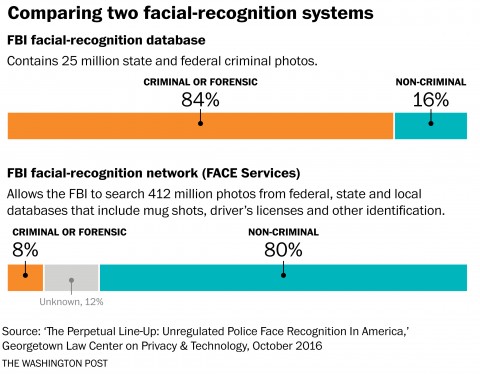
The growing use of facial-recognition systems has led to a high-tech form of racial profiling, with African Americans more likely than others to have their images captured, analyzed and reviewed during computerized searches for crime suspects, according to a new report based on records from dozens of police departments.

The report, released Tuesday by the Center for Privacy & Technology at Georgetown University’s law school, found that half of all American adults have their images stored in at least one facial-recognition database that police can search, typically with few restrictions.

The steady expansion of these systems has led to a disproportionate racial impact because African Americans are more likely to be arrested and have mug shots taken, one of the main ways that images end up in police databases. The report also found that criminal databases are rarely “scrubbed” to remove the images of innocent people, nor are facial-recognition systems routinely tested for accuracy, even though some struggle to distinguish among darker-skinned faces.

The combination of these factors means that African Americans are more likely to be singled out as possible suspects in crimes — including ones they did not commit, the report says.

“This is a serious problem, and no one is working to fix it,” said Alvaro M. Bedoya, executive director of the Georgetown Law center that produced the report on facial-recognition technology. “Police departments are talking about it as if it’s race-blind, and it’s just not true.”

The 150-page report, called “The Perpetual Line-Up,” found a rapidly growing patchwork of facial-recognition systems at the federal, state and local level with little regulation and few legal standards. Some databases include mug shots, others driver’s-license photos. Some states, such as Maryland and Pennsylvania, use both as they analyze crime-scene images in search of potential suspects.

At least 117 million Americans have images of their faces in one or more police databases, meaning their resemblance to images taken from crime scenes can become the basis for follow-up by investigators. The FBI ran a pilot program this year in which it could search the State Department’s passport and visa databases for leads in criminal cases. Overall, the Government Accountability Office reported in May, the FBI has had access to 412 million facial images for searches; the faces of some Americans appear several times in these databases.

Source: Racial profiling, by a computer? Police facial-ID tech raises civil rights concerns. – The Washington Post

Whiteness is a racial construct. It’s time to take it apart: Denise Balkissoon

Interesting commentary on “whiteness:”

Being white in Canada means a lower chance of developing cancer, hypertension and asthma. It also means being less likely to live in poverty. That doesn’t mean that every white person is healthy, wealthy or the prime minister (though every PM we have had has been white).

It does mean that as cards are dealt in the hand of life, white is a good one to get. But unearned benefits based on an unchosen identity are uncomfortable to grapple with – and that’s why people prefer not to say “white.”

“As a social concept, ‘white’ is profound in its meaning,” Robin DiAngelo, an educator and consultant in California, told me. “It means people who either come from or appear to come from Europe, but it’s necessarily a construct of oppression.”

Dr. DiAngelo, who is white, has dedicated her professional life to examining what it means to be white, what she calls “the missing piece” of studies of race and racism. She spent years as a professor and now leads workshops and seminars about racism for mainly all-white audiences, which include sharing language that helps to deconstruct whiteness.

Because, as with every other race, white is a construct. Racialization, or using ethnicity as an excuse to disenfranchise individuals and groups, can happen to people with light skin, too. In 2016, Ukrainians and Italians in Canada are pretty much white, but both were interned as enemy aliens in the past.

Italian-Canadians are an interesting case: Greeted with prejudice when they first arrived, they’ve since persuaded us to adopt their patio culture (after receiving tickets for eating outdoors in mid-20th century Toronto) and have been elected to every level of government. They now enjoy the benefits of whiteness, but many say that they’ll never be mangia-cakes.Yes, race is complicated.

Dr. DiAngelo tries to teach people not to be afraid of terms such as “white privilege” – daily, unspoken advantages due to skin colour – or “white supremacy,” the entrenchment of whiteness as the sun around which other, inferior cultures revolve.

That fear is a problem. Toronto Mayor John Tory, at an election campaign event two years ago, demurred on whether white privilege existed, while Ottawa Mayor Jim Watson recently called those who accused him of white supremacy as being “vulgar and rude.” What’s actually vulgar is that being white increases access to power and privilege, and that by not engaging with that truth, politicians can help to maintain that inequality.

Dr. DiAngelo has a term for that avoidance, too. “White fragility,” she says, is the inability to cope with conversations about race that don’t protect individual white people’s sense of innocence. Western society maintains that racism is an act that individuals do, not a system that all of us exist in.

Thus, she says, it teaches us that “being a good person and being complicit with racism are mutually exclusive.” To hear an accusation of racism is to believe one’s basic morality is in question, which stirs up guilt and defensiveness, leading to anger and avoidance.

White people experience obvious physical relief, Dr. DiAngelo says, when she tells them it isn’t a personal failing to ascribe to white supremacy. It’s what we’ve all been taught from birth. The conversations don’t necessarily get easier from there, she says, but her audiences’ ability to listen, and to cope with unpleasantness, gradually improves.

The solution to white fragility, she says, is to build up stamina; just as with exercise, that involves doing the painful task over and over again until you get better. So try it. Say “white.” Say it to white people.

Source: Whiteness is a racial construct. It’s time to take it apart – The Globe and Mail

Race, School Ratings And Real Estate: A ‘Legal Gray Area’ : NPR

Not surprising that neighbourhoods become a proxy for race:

With her infant son in a sling, Monique Black strolls through a weekend open house in the gentrified Shaw neighborhood of Washington, D.C. There are lots of factors to consider when looking for a home — in this one, Monique notices, the tiny window in the second bedroom doesn’t let in enough light. But for parents like Black and her husband, Jonny, there’s a more important question: How good are the nearby schools?

It’s well-known in the real estate industry that highly rated schools translate into higher housing values. Several studies confirm this, and even put a dollar figure on it: an average premium of $50 a square foot, in a 2013 national study.

In Chappaqua, N.Y., an affluent bedroom community for New York City, the town supervisor recently went so far as to declare that, “The schools are our biggest industry — whether you have kids in the school or not, that’s what maintains our property values.”

But some advocates for fair housing see a potential problem with the close ties between school ratings and real estate. They say the common denominator, too often, is race. And they argue that the problem has intensified in the last decade with new web platforms bringing all kinds of information directly to homebuyers.

“A school rating map mirrors a racial dot map,” showing patterns of segregation and diversity, observes Sally Santangelo, the executive director of Central New York Fair Housing, a group that provides education and legal assistance to oppose housing discrimination.

Which, in turn, raises some complicated questions about how factors like test scores and school ratings are used to influence home-buying decisions.

Characteristics like safety and parent involvement — the qualities Monique and Jonny say they value in a school— can be hard to quantify. Most states base their school ratings primarily on more easily measured factors, like standardized test scores and graduation rates. And these indicators, in turn, are heavily influenced by inequities of race and class.

There’s a large, persistent, and well-documented gap in test scores between black and Hispanic students and their white and Asian peers. There are many reasons for these disparities: income and wealth gaps, disciplinary policies that “push out” black students from school systems, less experienced teachers, the early-learning gap between high- and low-income children. But they all end up reflected in one number: a school rating.

“A lot of time, with schools that serve majorities of students of color, you get a negative rating because the test scores are low,” says Genevieve Siegel-Hawley, an assistant professor who studies race and housing at Virginia Commonwealth University. But, she says, “most of the variation in test scores is explained by the kids’ own poverty or the poverty of their school.”

Housing patterns and school ratings, of course, also reinforce each other. In most places around the country, school budgets are partly linked to local property taxes. Highly rated schools beget higher housing values, which in turn beget more richly resourced schools.

It’s a virtuous cycle for a town like Chappaqua, but a vicious cycle elsewhere.

What does all this mean for potential homeowners like Monique Black? Or for realtors who see school quality as a selling point?

For a realtor, directly discussing the racial composition of a neighborhood with homebuyers is against the law. In 1968, the Fair Housing Act outlawed the practice of racial “steering” by realtors. This can mean showing different properties to a white family and a black family who have the same requirements, or telling them different things about the desirability of a given property or neighborhood, in a way that tends to maintain segregation or perpetuate discrimination.

The National Fair Housing Alliance, an advocacy group, conducts “mystery shopper” sales tests, sending out people of various backgrounds to pose as house hunters and determine whether they hear different messages.

In a 2006 report, the NFHA documented some form of steering in 87 percent of these encounters. And, says Morgan Williams, the organization’s general counsel, this steering included discussions of school quality.

“A striking pattern regarding schools emerged from these sales tests,” the report states. “Instead of making blatant comments about the racial composition of neighborhoods, many real estate agents told whites to avoid certain areas because of the schools. It is evident from the investigation that schools have become a proxy for the racial or ethnic composition of neighborhoods.”

For example, white testers reported that they were told to avoid the Tarrytown, N.Y., schools, which are predominately Hispanic. In several cases, the report says, agents there told whites that the schools were “bad,” but Latinos were told that the same schools were “good.”

In Philadelphia, an agent told a white tester that the schools in a particular town were very good, then added, “But don’t tell anyone I told you that.”

Source: Race, School Ratings And Real Estate: A ‘Legal Gray Area’ : NPR Ed : NPR

The Difference Between Racism and Colorism | TIME

Lori Tharp’s Same Family, Different Colors: Confronting Colorism in America’s Diverse Families makes the case to talk about colourism rather than racism and prejudice. Seems more semantics, as the substance is largely the same:

In the U.S., it has been repeatedly proven that skin tone plays a role in who gets ahead and who does not. Despite the fact that the word colorism doesn’t exist, researchers and scholars are now systematically tracking its existence. A 2006 University of Georgia study found that employers of any race prefer light-skinned black men to dark skinned men regardless of their qualifications. Sociologist Margaret Hunter writes in her book, Race, Gender and the Politics of Skin Tone that Mexican Americans with light skin “earn more money, complete more years of education, live in more integrated neighborhoods and have better mental health than do darker skinned …Mexican Americans.” In 2013, researchers Lance Hannon, Robert DeFina and Sarah Bruch found that black female students with dark skin were three times more likely to be suspended at school than their light-skinned African-American counterparts.

Suffice it to say, one’s health, wealth and opportunity for success in this country will be impacted by the color of one’s skin, sometimes irrespective of one’s racial background. Even darker-hued white people have different experiences than their lighter-hued Caucasian counterparts when it comes to access and resources. Colorism is so deeply ingrained in the fabric of this nation that we are all implicated and infected by its presence. And the sad thing is, for many people the lessons of color bias begin in the home.

In black families, Latino families, Asian-American families and obviously interracial ones, too, skin colors can vary in microscopic gradients or in obvious shades of difference. Luckily many parents are able to create a safe-space in the home where skin color differences only matter when it is time to buy sunscreen for the beach. But too often, the pervasiveness of a color hierarchy in the outside world seeps into the household and becomes part of the implicit and explicit teachings of parenting.

That is not to say that the solution to solving our color problem as a country lies in the home, but that is precisely where the conversation should begin. From day one, parents of every color should begin to celebrate color differences in the human spectrum instead of praising one over the other or even worse, pretending we’re all the same. Then, we could have a more public facing, cross-cultural dialogue about the more global problem of colorism and plot its necessary demise.

Source: The Difference Between Racism and Colorism | TIME

How to be Black at work: Andray Domise

Interesting series of anecdotes:

Last week, I spoke to a meeting of the Canadian Association of Urban Financial Professionals, a professional association for Black people working in the financial sector. During the talk, I discussed the importance of representation in the workplace—an all-too familiar conversation for those of us in corporate environments. But I also spoke to my experience as a former financial planner and manager at a time when Black people losing their lives to police violence was becoming the stuff of weekly headlines. After the talk was over, I was approached by several Black business professionals, some of them in senior management and C-level positions, who traded stories about Blackness in the workplace at a time of resistance. The consensus was, despite the money and resources that many companies pour into diversity training, the corporate world doesn’t appear ready for this conversation.

I reached out to other Black professionals to share their stories, and the result, while unsurprising, was disheartening. “It’s very subtle, a lot of it is unspoken stuff,” said David, a sales manager. “In a team huddle environment, you normally talk about current events, just to break the ice. But in one huddle, the subject of police brutality came up, and some members of my team were so uncomfortable with that conversation, they put their heads down.”

 He said he felt isolated. “What I got from it was that people in the room felt uncomfortable, because they didn’t feel the way I did about it. There’s nobody to talk to about it, and there’s definitely no one on my level bringing it up.” Normally, he told me, going to work the day after reading about another Black person executed by police is manageable. But when he saw the video of Philando Castile dying in the passenger seat of his vehicle in Minnesota, it took him a week to regain his focus in the workplace. “You have to protect yourself, and know who really stands with you,” he said. “So I was also trying to gauge how other people felt about it, and whether I’d be able to look at them the same way after that.”

Another woman, Melanie, talked about treading carefully around discussions of Black lives in the workplace, even as other causes are openly embraced. “We need to not feel that we’re making a career-limiting move by talking about these things that affect us. We have Breastober and Movember, but we can’t talk about bias and racism in the workplace, or in our daily lives.” It was an interesting point, given the renewed attention the psychology community is paying to the toll that racism and micro-aggressions have on the psychological health of Black people. She explained that, in a previous position, a superior heard about her Jamaican background. To break the ice, he asked her if she could score weed for him. “We have such a long way to go,” she said. “But there’s no one to talk to about it. A white, male executive might see how his daughter, or his gay son could impacted by discrimination, and say, ‘I don’t want them to go through this,’ and make some changes. But unless some benevolent actor sees how Black people are affected in the workplace, nothing will happen.”

Sometimes, the challenge in the workplace doesn’t come from superiors, but from peers, company partners, and those lower on the pay scale. When I spoke with Vivian, a white-collar manager working with mostly blue-collar employees, she told me colleagues and subordinates would often bring up the protests by the Black Lives Matter Toronto—but only to heap scorn. “There’s just no understanding of why we give a s–t,” she told me. “I’d hear it all around the workplace. ‘Why are these Black Lives Matter people demonstrating here? All of this stuff that’s happening is in the States.’ ” As the only Black woman manager in a building with over 1,400 employees, she told me that she felt walled-off in a workplace where the conversation around Black lives barely registered. “You listen to people’s stories about their cats, and their cottages. And I’m thinking, ‘Yeah? Because I spent the weekend writing articles and speaking on panels about people f–king dying. Tell me more about your cat.’”

Vivian likened the experience in the workplace to her experience as a sex abuse survivor. “For many years, I couldn’t talk about it. I couldn’t disclose. But every day that I had it in me and couldn’t talk about it, or get it out, it felt like another traumatic day.” Vivian explained that, for a long time, the trauma of the incident left her vulnerable to being triggered by seeing or hearing things that reminded her of the abuse, but she couldn’t express to her friends or family what the problem was, for fear of having to defend herself, and relive the trauma. “That’s how it feels, going to work as a Black person in this climate right now,” she said.

Though Black people working in the corporate world are not usually the ones on the front lines of protest, all of us are dealing with the movement in our own way. Some of us donate to Black Lives Matter, some attend community consultations with police and local government, and some offer mentorship and support to our youth. But the dual nature of the workplace environment, where Black people face pressures from the community to create pathways, and from the white-dominated corporate world to maintain the status quo or face career-limiting consequences, leaves many of us without a way to make meaningful change. Perhaps that’s why the central conceit of #Missing24 was so flawed. In the workplace, where we’ve had to outshine our peers in order to simply be included, we can’t afford to go missing. The only way to make our presence felt is by having more of us show up.

Source: How to be Black at work – Macleans.ca