Donald Trump’s sharp contrast from Obama and Bush on Islam has serious implications – The Washington Post

Well-worth reading, William McCants assessment of the risks of Trump and his team, providing historical context:

President-elect Donald Trump and his top political and security advisers are convinced Islam’s moral rules, the sharia, not only imperil the safety of Americans but their very way of life. They break sharply with Presidents Obama and George W. Bush who refused to equate traditional Islam with terrorism. The rupture view could ultimately serve as a boon to jihadist recruitment.

The president-elect has called for an “ideological screening test” for immigrants “who believe that sharia law should supplant American law.” His chief political strategist, Steve Bannon, has said that the Roman Catholic Church and the “Judeo-Christian West” have to “struggle against Islam” just as their ancestors did. He is reportedly taking advice from the notorious sharia conspiracy theorist Frank Gaffney, whose team briefed Trump on the dangers of sharia during the campaign.

Trump’s national security adviser, Michael Flynn, called Islam a “cancer” and a “political ideology” that “hides behind this notion of it being a religion.” (Flynn regularly promotesfalse stories of sharia law taking over in the United States.) And Trump’s nominee for the nation’s chief law enforcement officer, Sen. Jeff Sessions, has said that the true threat confronting the United States is “the toxic ideology of Islam” and has proposed screening out immigrants who “believe in sharia law.”

Suspicion of Sharia is not confined to Trump and his advisers. It permeates mainstream Republican politics. More than half Fox viewers believe American Muslims want to impose sharia. Former House Speaker Newt Gingrich, a front-runner in the previous election cycle, described sharia as “a mortal threat to the survival of freedom in the United States and in the world as we know it.” (He upped the ante during Trump’s campaign, calling for deporting every Muslim citizen who believes in it.)

The content of the sharia alone cannot explain fears of it. Many of its controversial rules, like death for blasphemy and apostasy, have parallels in the Hebrew Bible, a book revered by many Americans. Most Muslim countries to do not impose the sharia in total — they either limit its application to family law or ignore it entirely. And most of the 1 percent of Americans who are Muslim believe the sharia is just ethical personal guidelines that should not supersede the Constitution — even according to the crudest online polls promulgated by the right. Like any faith community in the United States, American Muslims can practice the Sharia as long as it does not violate American law.

So whence the worry? It arises from deeper fears of physical and cultural death. The physical fear is a consequence of the 9/11 attacks, which deeply scarred the psyche of a nation that is not used to war on its soil. The attacks shattered Americans’ sense of security and invulnerability. Because the attackers justified their atrocity on the basis of Islamic scripture, the religion and its adherents became objects of suspicion blame — never mind that the kind of Sharia jihadists want is not the kind most American Muslims want.

That paranoia has grown following a series of lone wolf attacks claimed by the so-called Islamic State: San Bernardino, Orlando, St. Cloud. In some ways the fear is worse now than after 9/11 because the attacks are carried about by Americans acting on their own and not by foreigners directed by an organization. When I was promoting my book on ISIS in small towns, I was stunned to hear audience members expressing their terror that their local mall or Walmart could be next. If it can happen in San Bernardino, it can happen here, they suggested.

The paranoia is stoked by jihadist organizations like the Islamic State, who claim attacks in its name even if the attacker has no connection to the organization. It wants non-Muslims to distrust their Muslims neighbors, hoping they will become alienated and more susceptible to recruitment. Even lone-wolf attackers deliberately foster distrust. “Btw, every single Muslim who disapproves of my actions is a sleeper cell, waiting for a signal,” wrote the Ohio State attacker on Facebook.

That the Ohio State attacker was a refugee from Somalia plays into the related fear that immigrants from non-Western countries are a threat to the American way of life, especially immigrants from Muslim-majority countries. Notice that condemnations of sharia as a security threat almost always accompany peaens to America’s Judeo-Christian heritage. The sharia is presented as the inverse of everything America stands for — the shadow that offsets the light.

The distant fathers of American law, the Romans, would have empathized with this strain of America’s cultural anxiety. In their day, the Roman elite worried about Jewish law subverting Roman culture, including those who were particularly concerned about Romans who converted to Judaism. The senator Tacitus scorned “those who come over to their religion adopt the practice, and have this lesson first instilled into them, to despise all gods, to disown their country, and set at nought parents, children, and brethren.”

The fear of Jews, which a historian of the ancient world dubbed Judeophobia, continued on in the Christian empires that replaced Rome for many of the same reasons. Jews were deemed a people apart, worshiping a law that God had annulled when he sent his only begotten son. “I advise that their rabbis be forbidden to teach henceforth on pain of loss of life and limb,” Martin Luther wrote, because “they wantonly employ the poor people’s obedience contrary to the law of the Lord.”

There was some anti-Semitism in early American history, but there weren’t enough Jews in America to worry about until the mid-19th century when Jewish immigration began to sharply increase. Because Jews were associated with international banking in the public imagination, they were blamed for the financial downturns in the late nineteenth century that triggered spasms of populist rage.

When global anti-Semitism reached a fevered pitch in the run-up to World War II, Christians and Jews combated it together by portraying Judaism as part of a common American patrimony. To that era we owe the phrase, “Judeo-Christian heritage.” The national guilt for failing to protect the Jews from the Holocaust forever enshrined the phrase in the America’s political lexicon.

Jews are again the target of populist rage in the United States. Hundreds of journalists received anti-Semitic death threats on Twitter during the election. But to those who consider minority faiths to be a threat, Jews have been eclipsed by Muslims, who, in the popular imagination, threaten to destroy the white Christian West physically with terrorism and immigration and culturally with alien laws.

A classically American approach that protects the many religious streams running together to form the American cultural heritage rather than damming one in favor of another. As historian Denise Spellberg observes of Thomas Jefferson’s view of Islam, “In the formation of the American ideal and principles of what we consider to be exceptional American values, Muslims were, at the beginning, the litmus test for whether the reach of American constitutional principles would include every believer, every kind, or not.” Jefferson didn’t care for Islam (or any organized religion, for that matter). But he understood that America would be stronger if citizens favoring one stream of its heritage vigorously argued its merits without seeking to place legal limits on those arguing for the merits of a different stream.

In the short term, Jefferson’s approach will not alleviate the fear behind the laws contemplated by Trump and his team. But by refusing to put unfair restrictions on Muslims, we rebuff the jihadist recruiters and ensure that our roiling cultural heritage, energized by passionate debate, can continue to adapt to the ever-changing demographic landscape.

Demonizing and repressing a religious minority because it has different moral rules than the majority can have unintended consequences. Just ask the pagan Romans who scorned Jews because of their religious laws. Some of those Jews reacted by changing how they practiced their religion, arguing that one could be faithful to the spirit of Judaism without obeying Jewish law and faithful to Roman law without disobeying God. The change made it easier for those Jews — known as Christians — to proselytize among the Gentiles, which ultimately paved the way for their takeover of the empire. Presumably that’s not the outcome Trump and his advisers have in mind for the restrictions they are contemplating.
Source: Donald Trump’s sharp contrast from Obama and Bush on Islam has serious implications – The Washington Post

New archive highlights years of racism faced by Chinese Canadians | Toronto Star

A good reminder of our history:

Seventy-one years ago Mavis Chu Lew Garland and eight of her preschool classmates were photographed on the porch of the Chinese Canadian Institute on the corner of Dundas St. W. and University Ave.

Times were different, rather “extremely difficult,” she says, being born to a Chinese immigrant father and a white mother when interracial marriages were seen as unacceptable.

But now, at the age of 76, Garland and her classmates have come together to recreate a photo that was taken during a period of discrimination, and now represents a snapshot of Canadian immigrant history.

The photo, which Garland found while scrounging through old shoeboxes is just one of the artifacts donated to the Toronto Public Library as part of a three-year initiative, the Chinese Canadian archives, which opened on Tuesday at the Toronto Reference Library.

Since the announcement calling for donations in July, the library has received hundreds of articles to commemorate the historic voices of the Chinese people in Canada. Among the collection are old photographs of the city’s first Chinese restaurants, and businesses that once existed in the area where City Hall stands today.

But among the pieces of colourful memorabilia are documents highlighting a Canadian history of discrimination, including documentation on the racist Chinese head tax, showing how it rose from $50 in 1885 to $100 in 1900 and eventually to $500 in 1903 — at the time the price of buying two houses in Toronto.

Seventy-one years ago Mavis Chu Lew Garland and eight of her preschool classmates were photographed on the porch of the Chinese Canadian Institute on the corner of Dundas St. W. and University Ave.

Times were different, rather “extremely difficult,” she says, being born to a Chinese immigrant father and a white mother when interracial marriages were seen as unacceptable.

But now, at the age of 76, Garland and her classmates have come together to recreate a photo that was taken during a period of discrimination, and now represents a snapshot of Canadian immigrant history.

The photo, which Garland found while scrounging through old shoeboxes is just one of the artifacts donated to the Toronto Public Library as part of a three-year initiative, the Chinese Canadian archives, which opened on Tuesday at the Toronto Reference Library.

Since the announcement calling for donations in July, the library has received hundreds of articles to commemorate the historic voices of the Chinese people in Canada. Among the collection are old photographs of the city’s first Chinese restaurants, and businesses that once existed in the area where City Hall stands today.

But among the pieces of colourful memorabilia are documents highlighting a Canadian history of discrimination, including documentation on the racist Chinese head tax, showing how it rose from $50 in 1885 to $100 in 1900 and eventually to $500 in 1903 — at the time the price of buying two houses in Toronto.

Then there was the construction of the Canadian Pacific Railway in 1881, when an estimated 17,000 Chinese workers were brought to Canada and endured long working days, for around $1 a day. Due to the poor working conditions and illnesses, records estimated that they died in the thousands.

“All of them remained nameless in the history of Canada,” the monument standing just outside the Rogers Centre commemorating the Chinese CPR workers reads.

“I feel like a lot of the lives, work, and contributions of Chinese-Canadians have remained nameless,” 28-year-old Coly Chau told the Star.

Chau immigrated to Montreal from Hong Kong at the age of 5.

“Elementary and secondary education gave me very little exposure to the history of Chinese Canadians” Chau says.

After graduating high school, Chau said a lack of belonging pushed her to “dig deeper” to research and learn about her history.

“As an immigrant, my experiences have been greatly attributed to the contributions and experiences of those Chinese Canadians that came before my family and I,” Chau said. “There are instances of racism that I’ve experienced, or the feeling of being an outsider — but those that came before me worked very hard to dismantle a lot of it, and lessen it for us now.”

Source: New archive highlights years of racism faced by Chinese Canadians | Toronto Star

‘We won’t back down’: Young right-wing activists agitate across Europe for an idealized past – Canada – CBC News

Interesting profile of the white supremacist movement and key players in France, similar to the likes of Robert Spencer and the like in USA:

They are traditionalists with a YouTube channel, nostalgic nationalists who text and tweet.

Young, white and European, they call themselves Identitarians, right-wing activists agitating across the continent against immigration and Islam and for a future rooted deep in an idealized past.

“I’m a product of my time,” says Pierre Larti, a spokesman for Génération identitaire (GI), the French branch of the movement. “But I know the difference between what is good in this era and what isn’t.”

Larti is buff, squeaky clean and, at 27, already part of the old guard of the movement.

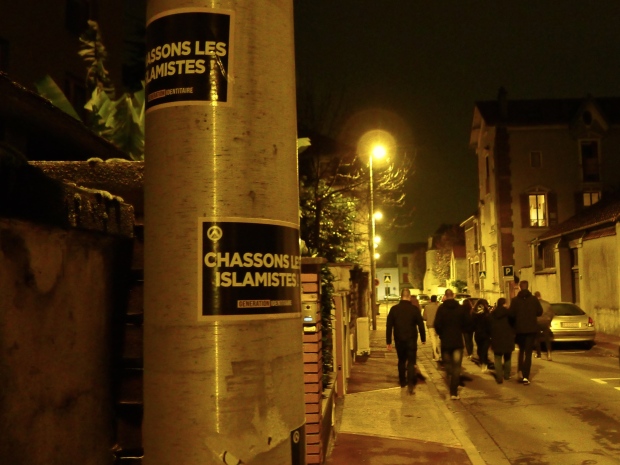
Issy stickering

Génération identitaire uses of range of strategies to get its message across, from Greenpeace-style shock tactics to postering and stickering in like-minded neighbourhoods. (Michelle Gagnon/CBC)

After a long day and a meeting that ran late — Larti works in HR at a yogurt factory — he travelled more than 50 kilometres to lead a low-tech, late-night postering and stickering campaign in Issy-les-Moulineaux, a suburb just outside Paris.

“I’ve lived in this multiethnic society and seen its ravages, the dangers it poses for us, for the French. We’ve become passive, too accepting,” Larti says.

“We accept the veil in the public square. We accept burkas. Little by little, we accept everything. We accept that France now has more than 2,500 mosques.

“We accept one or two attacks a year,” he pauses and then asserts: “I cannot accept that.”

Source: ‘We won’t back down’: Young right-wing activists agitate across Europe for an idealized past – Canada – CBC News

The Scourge of Racial Bias in New York State’s Prisons – The New York Times

Good but disturbing investigative reporting:

Most forbidding are the maximum-security penitentiaries — Attica, Clinton, Great Meadow — in rural areas where the population is almost entirely white and nearly every officer is too. The guards who work these cellblocks rarely get to know a black person who is not behind bars.

Whether loud and vulgar or insinuated and masked, racial bias in the state prison system is a fact of life.

It is also measurable.

A review by The New York Times of tens of thousands of disciplinary cases against inmates in 2015, hundreds of pages of internal reports and three years of parole decisions found that racial disparities were embedded in the prison experience in New York.

In most prisons, blacks and Latinos were disciplined at higher rates than whites — in some cases twice as often, the analysis found. They were also sent to solitary confinement more frequently and for longer durations. At Clinton, a prison near the Canadian border where only one of the 998 guards is African-American, black inmates were nearly four times as likely to be sent to isolation as whites, and they were held there for an average of 125 days, compared with 90 days for whites.

A greater share of black inmates are in prison for violent offenses, and minority inmates are disproportionately younger, factors that could explain why an inmate would be more likely to break prison rules, state officials said. But even after accounting for these elements, the disparities in discipline persisted, The Times found.

The disparities were often greatest for infractions that gave discretion to officers, like disobeying a direct order. In these cases, the officer has a high degree of latitude to determine whether a rule is broken and does not need to produce physical evidence. The disparities were often smaller, according to the Times analysis, for violations that required physical evidence, like possession of contraband.

Blacks make up only 14 percent of the state’s population but almost half of its prisoners. Racial inequities at the front end of the criminal justice system — arrest, conviction and sentencing — have been well documented.

The degree of racial inequity and its impact in the prison system as documented by The Times have rarely, if ever, been investigated. Nor are these issues systematically tracked by state officials. But for black inmates, what happens inside can be profoundly damaging.

Bias in prison discipline has a ripple effect — it prevents access to jobs and to educational and therapeutic programs, diminishing an inmate’s chances of being paroled. And each denial is likely to mean two more years behind bars.

A Times analysis of first-time hearings before the State Board of Parole over a three-year period ending in May found that one in four white inmates were released but fewer than one in six black inmates were.

Source: The Scourge of Racial Bias in New York State’s Prisons – The New York Times

Ottawa: Community tells Ontario government of systemic racism

The last in a series of public consultations to help inform the Ontario anti-racism directorate:

Hiwot Adhanom couldn’t believe what she was hearing from two co-workers conducting a hiring process for a public service job.

Her colleagues were attempting to determine who might meet the job criteria’s preference for Canadian citizens. “The first answer is ‘I guess we can tell by their name’,” Adhanom said she overheard them say. It wasn’t until they saw her nameplate that they stopped to think that Canadian citizenship means more than that. It was not her first experience with racism in a workplace.

At another job, a manager at a retail store who hired her nonchalantly told her how she was “not anything like all of the other black people who come in here looking for work.” “She saw nothing wrong with that, she thought she was paying me a compliment by insulting me and every other person who happens to be black,” said Adhanom, one of dozens of people who lined up behind microphones Saturday to tell their experiences to Ontario’s political leaders.

The anti-racism directorate is attempting to come up with a strategy to address systemic racism within government. The meeting is the last of 10 public consultations held across the province before it comes up with a policy, which is expected to be released in the spring of 2017.

For Adhanom, it was asking the directorate to develop tools and resources that employers are required to use to ensure fairness and equality in hiring.

It was just one of a spectrum of concerns about systemic racism and injustice that Ontario’s minister responsible for anti-racism, Michael Coteau, heard about from an audience of 200 during the two-hour meeting at the RA Centre. Others described systemic racism in the criminal justice system, health care, child welfare system, schools and the hiring process. Many called on more education as a means to combat it.

Attorney General Yasir Naqvi also attended the meeting, along with local MPPs Nathalie Des Rosiers, John Fraser and Marie-France Lalonde. Ottawa police chief Charles Bordeleau, other senior police officers and Ottawa councillors Jeff Leiper and Mark Taylor were also present.

The directorate’s goal is to eliminate systemic racism in institutions governed or regulated by the Ontario government, increase awareness and understanding of systemic racism among the public, promote fair practices and policies that lead to racial equity, and collaborate with the community, business organizations and the Ontario Human Rights Commission.

“You have to start in government. You can’t go out there preaching that change needs to happen but not take care of that change internally,” said Coteau. “What we are talking about today is not about putting in quotas or saying ‘X amount of jobs have to be this,’ it’s about removing barriers so people have the opportunity to compete on a fair basis to get the types of jobs that they are qualified to get.”

Source: Ottawa Citizen | Latest Breaking News | Business | Sports | Canada …

When faced with Trump’s extremism, the media falter: Macdonald

Good commentary by Neil Macdonald:

It’s warming and bias-confirming to browse quotes about the importance of journalism to democracy. Thomas Jefferson said he’d vastly prefer newspapers without government to government without newspapers.

Napoleon said four newspapers are more to be feared than a thousand bayonets.

But others saw into the reality most journalists know well, and live daily.

George Orwell noted that “anyone who challenges the prevailing orthodoxy finds himself silenced with surprising effectiveness.” Noam Chomsky characterized the media as the guard dog of the establishment, rather than the watchdog.

And Norman J. Ornstein said just the other day that the mainstream press, “behaving like a battered spouse,” is knuckling under to the new president-elect, normalizing extremism, rationalizing boorish thuggery, “thinking ‘Maybe it’s us…we should be nicer to him.'”

Ornstein, a left-leaning resident scholar at the right-leaning American Enterprise Institute, has been on a Twitter tear since Nov. 8, adding his scorn of the media to that of Donald Trump’s legions.

Righties have long despised what they call the “lamestream media,” preferring, somewhat like the hard left, to swim exclusively in their own pool, eagerly consuming the demagoguery of websites like Breitbart, arguably the choice of “white nationalists” once led by Steve Bannon, Trump’s new chief policy adviser.

There, they are reassured that Hillary Clinton is a criminal, that blacks are responsible for the treatment of blacks, that leftists are conspiringagainst Christmas, and so forth.

It’s a cartoonish view, one cheered on by Trump himself, who liked to goad crowds at his rallies against the reporters following him, complaining media outlets were deliberately ignoring his popularity, even as they did just the opposite.

Fear of audience

Ornstein, though, is relentlessly grinding his fist into a vulnerability that mainstream reporters know actually exists, but which they seldom acknowledge. My craft is often corporatist, hopelessly bourgeois, genuflects to power and, ultimately, fears its audience.

Anyone who requires proof of that need only review the unhinged media madness after 9/11; suddenly, anyone who opposed invading Iraq was pro-terrorist. Entire cities in Iraq were populated by terrorists. Patriotic correctness eclipsed the political correctness, and George W. Bush quickly brought most of the national press corps, whimpering, to heel.

Now that Trump has been validated by a minority of American voters (Clinton won the popular vote by at least two million votes, roughly the population of America’s largest city), the collective critical faculties of the media are faltering again.

Ornstein is right; extremism is being either ignored or glossed over. When a group of “alt-right” white supremacists held a celebratory party in a Washington restaurant to celebrate Trump’s victory, ending the night with Sieg Heil salutes, it was treated as a bad-apple one-off, even though Trump never proactively disavows his support from the extreme right.

“It is SO politically correct,” Ornstein tweeted sarcastically after that episode, “to frown on Nazi salute, overt antisemitism, and rank racism.”

Source: When faced with Trump’s extremism, the media falter – CBC News | Opinion

The Canadian roots of white supremacist Richard Spencer

Avery Haines of CityNews interviews white supremacist Spencer and research by Barbara Perry on white suprematism in Canada:

So what does Richard Spencer’s ideal world look like? “I hope that one day all Europeans can be united. That we could revive something like the Roman Empire. Having a state that is for us, that is always going to be for us. Jews have such a state. It’s called Israel. There are many Muslims who are attempting to build such a state, a caliphate. We really need to think of ourselves as a civilization and a people.”

Spencer says it was on a TTC bus, when he lived in Toronto, that he looked around and realized he was the only white person. “It’s not the kind of place I want to live. I don’t want my child or my grandchild to be in a situation where they feel alone, where they feel that everyone around them doesn’t trust them. Being a minority is very difficult. We have recognized this when we look at other minorities, and yet we, as white people, seem to want to become minorities in our own homeland. It’s a very odd thing.”

Profile pieces on Richard Spencer come under criticism for mentioning his looks and his charm. But, like many notorious leaders of the past, he possesses a disarming charisma that can normalize his beliefs.

Barbara Perry has conducted one of the only large-scale research papers on the white supremacist movement in Canada. She says Richard Spencer is the new-and-improved white supremacist, the kind who has a charm that is dangerous. “There is not much difference in the rhetoric or ideologies. The difference is how they present that in a way that appeals to more people and isn’t as frightening as the black-booted neo-Nazis. They carry that same thread of white nationalism, very often anti-Semitism, homophobia. The difference is they are couching that in a much more professional presentation.”

Perry’s research, conducted through the University of Ontario Institute of Technology, has identified more than 100 hate groups operating in Canada, most of them in Quebec and Ontario. But she says the strength of the movement isn’t from the size of the rally, but the online hits. “We saw much more online chatter leading up to and after the election. Newcomers [are asking] what are these people saying, what is the message they are sending, do you they have answers for why my life seems to have gone awry?”

Perry says the legitimizing of the alt-right south of the border has definitely migrated north. “It’s really facing us head-on now. It’s spilled over. It’s a porous border. Especially when we are talking about language and speech.” Perry believes it’s important to shine a light on these views and to talk about them. Her research students are doing workshops in schools right now to educate teens about right wing extremism. “The students are lapping it up. They are appalled and shocked but also very engaged and want to know what can they do.”

Richard Spencer and I Skype for about half an hour. He talks about how he wakes up in the morning feeling not hateful toward others, but hopeful for his “big dream.” He claims not to incite violence and believes it is the immigration policies of the U.S., U.K. and Canada that will lead to “blood and tears.” “I have no problem dealing with individuals,” he says. “But do we really trust each other? Do we really love one another? I am afraid the answer is no.”

I ask him what his mum and dad, who are somewhere in the house getting ready for the Thanksgiving holiday, think about his views. He pauses and says: “They think I’m a bit crazy, just like the rest of the world, right? They are okay with it, in the sense they are not going to reject me. I’m sure they, like the rest of the world, are saying, “Oh, what is Richard doing?”

Source: The Canadian roots of white supremacist Richard Spencer – Macleans.ca

The Identity Politics of Whiteness – The New York Times

Good thought-provoking piece by Laila Lalani:

A common refrain in the days after the election was “Not all his voters are racist.” But this will not do, because those voters chose a candidate who promised them relief from their problems at the expense of other races. They may claim innocence now, but it seems to me that when a leading chapter of the Ku Klux Klan announces plans to hold a victory parade for the president-elect, the time for innocence is long past.

Racism is a necessary explanation for what happened on Nov. 8, but it is not a sufficient one. Last February, when the subject of racial identity came up at the Democratic primary debate in Milwaukee, the moderator Gwen Ifill surprised many viewers by asking about white voters: “By the middle of this century, the nation is going to be majority nonwhite,” she said. “Our public schools are already there. If working-class white Americans are about to be outnumbered, are already underemployed in many cases, and one study found they are dying sooner, don’t they have a reason to be resentful?”

Hillary Clinton said she was concerned about every community, including white communities “where we are seeing an increase in alcoholism, addiction, earlier deaths.” She said she planned to revitalize what she called “coal country” and explore spending more in communities with persistent generational poverty. Senator Bernie Sanders took a different view: “We can talk about it as a racial issue,” he said. “But it is a general economic issue.” Workers of all races, he said, have been hurt by trade deals like Nafta. “We need to start paying attention to the needs of working families in this country.”

This resonated with me: I, too, come from the working class, and from the significant portion of it that is not white. Neither of my parents went to college. Still, they managed to put their children through school and buy a home — a life that, for many in the working class, is impossible now. Nine months after that debate, we have found out exactly how much attention we should have been paying such families. The same white working-class voters who re-elected Obama four years ago did not cast their ballots for Clinton this year. These voters suffer from economic disadvantages even as they enjoy racial advantages. But it is impossible for them to notice these racial advantages if they live in rural areas where everyone around them is white. What they perceive instead is the cruel sense of being forgotten by the political class and condescended to by the cultural one.

While poor white voters are being scrutinized now, less attention has been paid to voters who are white and rich. White voters flocked to Trump by a wide margin, and he won a majority of voters who earn more than $50,000 a year, despite their relative economic safety. A majority of white women chose him, too, even though more than a dozen women have accused him of sexual assault. No, the top issue that drove Trump’s voters to the polls was not the economy — more voters concerned about that went to Clinton. It was immigration, an issue on which we’ve abandoned serious debate and become engulfed in sensational stories about rapists crossing the southern border or the pending imposition of Shariah law in the Midwest.

If whiteness is no longer the default and is to be treated as an identity — even, soon, a “minority” — then perhaps it is time white people considered the disadvantages of being a race. The next time a white man bombs an abortion clinic or goes on a shooting rampage on a college campus, white people might have to be lectured on religious tolerance and called upon to denounce the violent extremists in their midst. The opioid epidemic in today’s white communities could be treated the way we once treated the crack epidemic in black ones — not as a failure of the government to take care of its people but as a failure of the race. The fact that this has not happened, nor is it likely to, only serves as evidence that white Americans can still escape race.

Much has been made about privilege in this election. I will readily admit to many privileges. I have employer-provided health care. I live in a nice suburb. I am not dependent on government benefits. But I am also an immigrant and a person of color and a Muslim. On the night of the election, I was away from my family. Speaking to them on the phone, I could hear the terror in my daughter’s voice as the returns came in. The next morning, her friends at school, most of them Asian or Jewish or Hispanic, were in tears. My daughter called on the phone. “He can’t make us leave, right?” she asked. “We’re citizens.”

My husband and I did our best to quiet her fears. No, we said. He cannot make us leave. But every time I have thought about this conversation — and I have thought about it dozens of times, in my sleepless nights since the election — I have felt less certain. For all the privileges I can pass on to my daughter, there is one I cannot: whiteness.

Is the Mainstream Media Normalizing Neo-Nazis? – The Daily Beast

Valid criticism:
The Los Angeles Times stands criticized for normalizing the white supremacist National Policy Institute, after a tweet that read, ‘Meet the new think tank in town: The ‘alt-right’ comes to Washington.’

When the Los Angeles Times’s social media team tweeted a link to a story about last Saturday’s celebratory post-election gathering in Washington of racists, anti-Semites, and white nationalists, the reaction—at least by some—was collective outrage.

“Worthless @latimes covers resurgent neo-Nazi movement as if it was a new boy band,” one of dozens of aggrieved readers tweeted after the paper touted the story on the benignly yet deceptively named National Policy Institute with the cheeky tweet, “Meet the new think tank in town: The ‘alt-right’ comes to Washington.”

“This tweet by the @latimes is beyond offensive,” liberal radio host Roland Martin posted on Twitter. “Calling these white nationalists a ‘think tank’ is atrocious.”

Another critic, actor Adam Shapiro, who was in the cast of Aaron Sorkin’s Steve Jobsbiopic, objected to the respectful attention the Times’s coverage of the conference accorded National Policy Institute president Richard Spencer, who is credited with coining the term “alt-right” for his fellow twenty- and thirty-something clean-cut millennials who would rather not be tagged as xenophobic thugs.

“WTF?! Why are you glamorizing this guy, @latimes? This is not a think tank. It’s a hate group,” Shapiro tweeted in response not only to Lisa Mascaro’s story—which quoted Spencer as hailing “the alt-right as an intellectual vanguard”—but also to an accompanying video in which the telegenic and articulate white nationalist was given four unchallenged minutes to reasonably explain his dream “to influence politics and influence culture” to restore white people of European descent to unquestioned power and social dominance, adding, “I think we have an amazing opportunity to do that with Donald Trump.”

Another tweeter, technology reporter Jack Smith IV, posted: “What ‘normalization’ ACTUALLY looks like: the @latimes running straight uploads of Richard Spencer sermons without qualification.”

In fairness, Mascaro’s story—which eventually carried an altered headline, dropping the “think tank” idea in favor of “White nationalists dress up and come to Washington in hopes of influencing Trump”—did point out that “the formally dressed men more resembled Washington lobbyists than the robed Ku Klux Klansmen or skinhead toughs that often represent white supremacists, though they share many familiar views.”

But unlike more unsympathetic accounts of the gathering in The New York Times and The Daily Beast, it made no mention of partygoers, including former MTV host Tila Tequila, jubilantly giving the Nazi salute and engaging in other less than democracy-friendly behavior.

Still, the LA Times story also quoted Heidi Beirich, of the anti-hate group nonprofit, the Southern Poverty Law Center, as warning against the “mainstreaming” of pernicious ideologies that the National Policy Institute represents.

“I don’t want anything to normalize the National Policy Institute,” she told The Daily Beast. “I think there has been a tendency in the press to not understand what the alt-right is—which is white supremacy. And I think we’re letting haters basically rebrand themselves to sounds less threatening—and that is very disappointing. I worry about that.”

Val-d’Or is forcing Quebec to think about big problems

More on Val-d’Or and its relations with its Indigenous communities:

Like many mining towns across northern Canada, Val-d’Or, pop. 31,862, is close geographically to a number of First Nations communities.

And people here say the allegations have strained relations between the town and the local Algonquin and Cree populations. Some Indigenous people are even calling for a boycott of the municipality for events and meetings.

If you say it three times, does it suddenly appear?

But the provincial legislature seems reluctant to discuss racism.

Parliamentary reporters in Quebec City noticed last week that both Public Security Minister Martin Coiteux and Native Affairs Minister Geoffrey Kelley refused to endorse the concept of “systemic racism” when asked about Lafontaine’s findings.

They preferred instead to speak of “social issues” or a “larger perspective” that needed to be considered.

That reticence was shared by members of the opposition. François Legault, leader of the Coalition Avenir Quebec, said he didn’t “like the word ‘systemic.'”

As for the Parti Québécois, Indigenous affairs critic Alexandre Cloutier would only say that the events in Val-d’Or raised the question of whether systemic racism was an issue among Quebec police. He left reporters guessing about the answer.

Ghislain Picard, chief of the Assembly of the First Nations of Quebec and Labrador, attributes this reluctance to talk about systemic racism to the government’s opposition to an independent inquiry into the relations between indigenous Quebecers and police.

‘A government in complete denial’

To date, the Liberals have been steadfast in their refusal to hold such an inquiry. They maintain it would simply rehash the work of the federal inquiry into murdered and missing Indigenous women, which has promised to look into the Val-d’Or allegations.

“They have refused from the beginning to acknowledge that there is systemic racism,” Picard said of the Quebec Liberals. “This is a government in complete denial.”

Indigenous leaders, though, have not been the only members of civil society pushing the government to take a sustained look at systemic racism.

A group called Québec Inclusif, based in Montreal, has also called for a public commission on institutional discrimination. They have the backing of the small progressive party Québec Solidaire and several prominent intellectuals.

While the government has indicated it is receptive to the group’s concerns — which include discriminatory hiring practices — it has yet to respond to their specific demand.

Is there, perhaps, a reason other than political stubbornness for ducking the question of systemic racism?

Our system of laws is designed to hold individuals -— people or corporate entities — responsible. The problem with systemic racism is that there is no Oz behind the curtain, pulling the strings.

The arc of the moral universe

Responsibility for such types of injustice don’t lie with one person, advocates suggest.

Structural injustice, the American philosopher Iris Marion Young once wrote, “is an unintended but unjust consequence of the actions of millions of differently positioned individuals … all usually acting on normal and accepted rules.”

Their argument is that confronting systemic racism may entail accepting that some of our most trenchant social problems are not anyone’s fault, but everyone’s faults— some more than others, to be sure, but each of us, if only a little.

The Indigenous leaders of Val-d’Or, and their advocates, have proposed a smaller step, one they nevertheless believe will help bend the arc of the moral universe back towards justice.

“We issue a message to the Quebec population to believe these women,” Michel said, after her meeting with the Crown prosecutors in Val-d’Or.

“Show these women, these victims, that there is someone, somewhere, who believes them.”

Source: Val-d’Or is forcing Quebec to think about big problems – Montreal – CBC News