Implicit bias against black people linked to police use of lethal force, study suggests

Good summary of some of the latest research on implicit bias and the difficulties in reducing its impact:

New research suggests the way our brains make associations between black people and the physical threat we think they pose is the greatest predictor of police using lethal force against a black person. These biases are held not just by the officers in question, but by the wider communities in which black people are killed by police.

This correlation is reported by a team of researchers led by Eric Hehman, an assistant professor of psychology at Ryerson University, in the journal Social Psychological and Personality Science. Dr. Hehman’s study adds to a growing body of research on implicit bias and how it can influence how police interact with black people.

For their study, Dr. Hehman’s team looked at the results of 2,156,053 U.S. residents who completed Harvard University’s famous Implicit Association Test, an online tool that measures the strength of the associations one makes between white people, black people and good and bad traits. They geolocated the results and analyzed them alongside data on people killed by police in the U.S. during a nine-month period in 2015.

They found that in places where implicit bias against black people and an association between black people and weapons were stronger, there was a disproportionate use of lethal force by police against black residents. Canadian data on fatal police shootings of black people was not available to include in the study, but Dr. Hehman said the principles they were researching could extend to Canada, too.

“We’re measuring the lady down the street who lives on the corner, the person who’s selling you some oranges. Just regular, average community members,” Dr. Hehman said. “But we’re still predicting these extremely potent and important consequences that are by police.”

It may be even more difficult to defeat the implicit biases police officers hold because of the nature of their work. In training simulations where individuals must decide whether or not to shoot armed or unarmed individuals, police who deal with non-white individuals in routinely dangerous situations – such as those on a drug force or SWAT team – have been found to be more likely than beat cops or civilians to shoot unarmed black men.

“In a moment where they’re under extreme stress and duress, they’re not really able to think consciously about what they’re saying, what they’re doing and so on. They’re going to revert back to their instincts,” says Nicholas Rule, a Canada Research Chair in social perception and cognition.

In June, Dr. Rule, who teaches psychology at the University of Toronto, testified at the coroner’s inquest into the death of Andrew Loku. He shared results of one study he did, in which participants consistently guessed that black men, just based on photos of their faces, were larger and stronger than white men of similar build. With those misperceptions came the assumption that more force would be needed to subdue them compared with white men.

In the verdict following the Loku inquest, the jury made several recommendations, one of which Dr. Rule had pushed for: to require all new officers and those requalifying to take the Implicit Association Test – the same one that was used in Dr. Hehman’s research. The jury also suggested officers receive implicit-bias and anti-blackness training.

But there’s little evidence to support implicit-bias training across various sectors. Several analyses found that after 24 hours, the bias-reducing effects of the training had vaporized, usually as a result of the individual returning to their regular life and exposure to the very stereotypes they were trying to stamp out.

Based on decades of research, many social scientists believe the best treatment for bias is what was first described by American psychologist Gordon Allport in 1954 as the “intergroup contact hypothesis” – a theory that the more contact members of a majority group having with a minority group, the less prejudice they feel towards them. But Dr. Allport emphasized that not just any contact would work: the quality was important and required equal status between all individuals.

For this reason, Emilie Nicolas is skeptical of whether anything can change implicit bias in police because of the immutable power dynamics between officers and the people they serve. Ms. Nicolas is the president of the NGO Québec Inclusif, which has been pressing the Quebec government to launch a commission into systemic racism in the province. She says there is a hierarchy between black people and white people that is naturalized through policing. Even if a beat cop spends all his time in a black neighbourhood and hosts community events, the nature of his interactions with residents isn’t the sort of quality contact Dr. Allport’s theory requires.

“Community barbecues are based on the assumption that if you don’t do them, these people may be impolite or whatever,” Ms. Nicolas says. “You don’t have these community barbecues in [wealthy white neighbourhoods] so the very fact that they have them speaks of prejudice that exists.”
Source: Implicit bias against black people linked to police use of lethal force, study suggests – The Globe and Mail

Quebec: Discrimination systémique et racisme: une consultation dès septembre 

Will be interesting to see how the hearings progress and the tenor of the interventions:

La ministre de l’Immigration, Kathleen Weil, pouvait difficilement mieux tomber, jeudi, en annonçant une vaste consultation sur la discrimination systémique et le racisme à compter de septembre prochain.

L’annonce de Mme Weil coïncidait avec l’apparition d’une affiche proclamant «Saguenay ville blanche» au cimetière de Saguenay, à Saint-Honoré, et d’autocollants anti-immigration à Sherbrooke.

«Tous ces gestes haineux sont inacceptables dans une société, a déclaré Mme Weil en marge de son annonce à Montréal. C’est blessant. Moi ça me touche profondément.»

…Pour le professeur André Gagné, spécialiste en radicalisation au département d’études théologiques de l’Université Concordia, ces gestes sont «l’expression d’un malaise» face à l’islam.

«C’est présent depuis plusieurs années, mais ça semble maintenant se manifester davantage», note-t-il, déplorant «la tendance pour les gens de faire cet amalgame entre ce que des djihadistes font et ce que les musulmans peuvent être».

Et cette tendance, basée sur une incompréhension de l’islam, sert particulièrement les extrémistes. «On a des individus, des groupes, qu’on peut qualifier d’extrême droite, qui jouent sur la peur de certaines personnes, qui est une peur de l’inconnu et aussi une peur au plan identitaire», dit-il.

Il rappelle qu’il y a pourtant davantage de points de convergence que de divergence entre la tradition judéo-chrétienne et l’islam, une des trois religions monothéistes qui se rattache autant au judaïsme qu’au christianisme, qui a les mêmes figures et que, malgré des différences, on y retrouve à peu près les mêmes principes et les mêmes commandements.

Surtout, il fait valoir que les petits groupes d’extrême droite reçoivent beaucoup d’attention bien que le le phénomène ne soit pas généralisé, comme le démontre «le très grand élan de solidarité qu’on a vu à travers toute la province après les événements tragiques du mois de janvier», faisant ainsi référence à l’attentat du 29 janvier au Centre culturel islamique de Québec qui a fait six morts et huit blessés.

Consultations: «un exercice ouvert, démocratique, utile et nécessaire»

Le professeur Gagné applaudit par ailleurs la démarche du gouvernement en matière de lutte contre le racisme et la discrimination systémique.

«Ce n’est pas une mauvaise idée pour le gouvernement d’investiguer ce qui se passe au niveau de l’éducation, de la santé et d’autres domaines pour voir s’il y a cette chose que l’on appelle le racisme systémique et, si c’est le cas, de faire des recommandations pour éradiquer le problème», dit-il.

«Il faut qu’il y ait un dialogue. La meilleure manière de se comprendre, de vivre ensemble et de mieux apprendre à apprécier l’autre, c’est de dialoguer.»

Les consultations annoncées par Mme Weil seront pilotées par la Commission des droits de la personne et des droits de la jeunesse (CDPDJQ), avec l’objectif de «proposer des solutions concrètes et durables (…) pour combattre ces problématiques».

En mêlée de presse à la suite de son annonce, Kathleen Weil s’est bien défendue de vouloir faire le procès des Québécois, un reproche qui a été adressé au gouvernement Couillard, notamment par le chef du Parti québécois, Jean-François Lisée, en mai dernier.

«Je ne suis pas préoccupée du tout par ces commentaires, a-t-elle dit. Je crois que les gens vont voir l’exercice pour ce qu’il est: un exercice ouvert, démocratique, utile et nécessaire.

«Cette consultation, c’est la pièce manquante pour aller plus profondément dans le vécu. Il y a des gens qui souffrent encore», a-t-elle fait valoir.

La présidente de la CDPDJQ, Tamara Thermitus, avait préalablement fait état d’exemples de discrimination systémique, rappelant que les personnes «racisées» nées au Canada ou ailleurs affichent un taux de chômage deux à trois fois plus élevé que les autres Québécois, peu importe le parcours académique.

Elle a également rappelé qu’une enquête de la Commission avait démontré qu’à qualifications égales, un candidat ayant un nom à consonance franco-québécoise a 60 pour cent plus de chances d’être interviewé pour un emploi qu’un candidat ayant un nom à consonance africaine, arabe ou latino-américaine.

«Mieux vaut s’appeler Tremblay que Traoré», a-t-elle laissé tomber en conférence de presse.

La consultation s’amorcera en septembre.

Un site web sera alors mis en ligne avec un questionnaire pour les citoyens intéressés, qui pourront également y déposer un mémoire.

Des organismes communautaires des différentes régions mèneront des séances de consultation publique en septembre et en octobre. Ils seront sélectionnés par un appel d’offres qui a été lancé jeudi.

Parallèlement, quatre groupes de travail seront formés en septembre pour analyser les questions de discrimination systémique et de racisme dans les domaines de l’emploi et du travail; de l’éducation, la santé, les services sociaux et le logement; la justice et la sécurité publique; ainsi que la culture et les médias.

L’effort se conclura par un forum public en novembre.

La Commission aura ensuite la tâche de recueillir tous les éléments de la démarche et faire rapport au gouvernement.

Source: Discrimination systémique et racisme: une consultation dès septembre | Pierre Saint-Arnaud | Politique québécoise

Shia LaBeouf’s sorry apology for racist rant during arrest highlights lack of racial awareness: Paradkar 

Valid point:

You know that had you been Black or brown-skinned you would not be able to: struggle, get aggressive with police, yell profanities at them, run away when they were trying to arrest you without possibly deadly consequences. You know further that being openly racist to police and accusing them of being racist are actions that result in a few angry tweets, a few raised eyebrows and calls to help you, that they are textbook examples of the unearned privilege conferred upon you for the colour of your skin.

Do you think the words racist or race or racism deserved a place in your apology? No? Well, why would you?

In your world, being racist isn’t a crime. Only those who live with the consequences of racism are treated like criminals. Overt racism is never your fault. It’s invariably the fault of addiction or mental illness. It’s an act that cries out for compassion and forgiveness.

The system works for people like you. It works to erase the bits that reflect badly on other people like you. Look at all the stories eager to exonerate you.

Here’s CNN: “Body camera video released by authorities showed a surly, unco-operative LaBeouf yelling profanities at police.

The very progressive Rolling Stone says, “the actor apologized for his language,” in a story that doesn’t mention the racist rants at all.

The headline in Variety: Shia LaBeouf Calls Police Officer ‘Dumb F—’ in Arrest Footage

It does list his racial tirade in another piece about the apology, but doesn’t mention that he didn’t apologize for the racism.

Turns out that in 2017, we still live in a place where profanities offend puritanical morals. Racism, not so much.

Source: Shia LaBeouf’s sorry apology for racist rant during arrest highlights lack of racial awareness: Paradkar | Toronto Star

The anti-racist ad that triggered a backlash

Certainly provoked discussion.

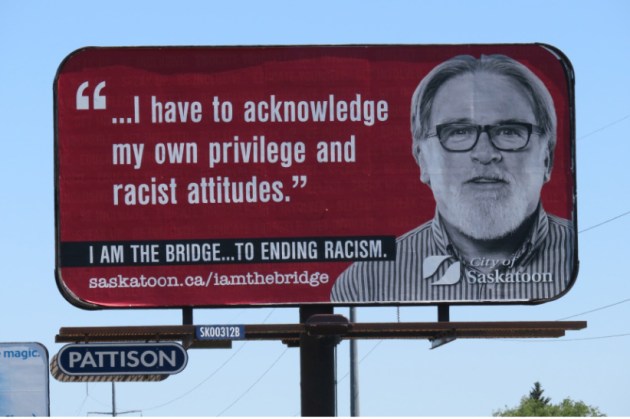
The comments by the Saskatoon city councillor on what they are trying to achieve with the campaign – more mindfulness and awareness of personal advantages (or disadvantages) – are sensible:

In the first phase of the campaign, the committee called on residents to submit videos of themselves answering questions about their thoughts on and experiences with racism, and what personal role they can play in ending it in Saskatoon. Williams was one of a few dozen culturally diverse volunteers to submit a video.

Here’s what he had to say: “I am a white, heterosexual, able-bodied male: the most privileged demographic in human history. If I’m going to be the bridge to ending racism in Saskatoon or anywhere else, I have to acknowledge my own privilege and I have to acknowledge my own racist attitudes, and work through my discomfort.”

In June, the city rolled out phase two of the campaign, which involves ads spread out across the city in bus shelters, restaurants and bars, along with four billboard installations, featuring quotes from former volunteers. In Williams’ billboard, which shows his face, but not his name, his quote was boiled down to: “…I have to acknowledge my own privilege and racist attitudes.”

With those 10 words, Williams, a professor at Saskatchewan Polytechnic, ignited a firestorm on social media of folks jumping to defend themselves against what they took as an accusation. One Reddit user kicked off a debate on the platform, asking: “Why is the city of Saskatoon purchasing billboards simply to say white men have privilege?” To which someone else replied: “You then invite a series of people who hate men and are racist against whites to criticise your every word and action until they are satisfied by your subservience.” Another wanted to make it clear that: “I have not had one hand out due to being white I’ve worked my ass off to get where I am. All of my friends and family have worked their ass off to get where they are.” Ezra Levant’s the Rebel, went on to call the billboard itself racist, as did an alt-right British group called Western Defence, and a slew of other Twitter users.

In an email to Maclean’s, Williams said that, despite the backlash, “I’m proud to be part of the ‘I am the Bridge’ campaign. I chose my words carefully and I stand by them completely.”

The city is likewise defending the billboard, saying that it wasn’t meant to suggest all people are racist, but rather to encourage residents to consider how they can play a personal role in mitigating racism. “Certainly the level of feedback indicates that the campaign is doing its job,” said Saskatoon city councillor Hilary Gough, “which is to get people talking and thinking about racism and the reality of it in our community.”

Indeed, surveys and polls on racism in the province do suggest that race relations are tense and deteriorating in Saskatchewan. Last year, following the murder of Colten Boushie, a 22 year-old Indigenous man from the Red Pheasant First Nation in Saskatchewan, the NRG Research Group and Peak Communications conducted a survey on racist attitudes across the country. In Saskatchewan, 46 per cent of respondents—more than anywhere else in the country—said racism was a big problem. Meanwhile 30 per cent of respondents in the western Prairies (Saskatchewan and Alberta), said race relations in their communities have gotten worse over the last decade.

Of course, broaching the issue of racism often draws prickly reactions like those towards Williams’ billboard. “Certainly, I think there is some defensiveness in this,” she says. “It takes time to learn about one’s own privilege without feeling like we need to feel guilty.” Part of the backlash, though, comes from a mistinterpretation of the campaign, says Gough. “We aren’t saying that everybody is racist and has racist attitudes, but we are trying to create space for each of us to consider how we can most productively engage with the structures we’re living in and figure out what our role is in eliminating and addressing racism.”

The I Am The Bridge ad campaign, which cost the city $14,000 this year, runs until July 16.

Source: The anti-racist ad that triggered a backlash – Macleans.ca

Politicians can’t let another year of hate crimes pass without action – Macleans.ca

Not really much insights in this column on the latest StatsCan hate crimes report, nor any particular startling or new recommendations. No real clarity of what government’s acting “forcefully” would entail beyond the Ontario government’s strategy and its emphasis on wider collection of race-based data to inform policy and programs.

The longer-term view shows no clear overall trend: a decline 2009-2011, an increase 2013-15. And no recognition that the recent increase may also reflect a greater willingness to report hate crimes as well as an actual increase.

While any hate crime or equivalent is an abomination, are the numbers really so high compared to the population? How do they compare to other countries?

When racial and religious groups insist discrimination is a hindrance to their success and well-being in Canada, governments must act forcefully to remove this barrier to demonstrate that mistreating someone based on their race or religion is unacceptable in contemporary Canadian society. This display of solidarity from politicians may act as a deterrent to future hate crimes and finally bring down the stubbornly high incidents of hate crimes towards Blacks and Jews, as well as the spike against Muslim Canadians.

Source: Politicians can’t let another year of hate crimes pass without action – Macleans.ca

How Prejudice Can Harm Your Health – The New York Times

Good and revealing article by Khullar:

Long before the Rev. Dr. Martin Luther King declared health inequity the most shocking and inhumane form of injustice, W.E.B. Du Bois wrote that “the Negro death rate and sickness are largely matters of condition and not due to racial traits and tendencies.” Before Du Bois made his case, James McCune Smith — the nation’s first black doctor — carefully detailed the health consequences of freedom and oppression.

These men grasped an insight that modern researchers and policy makers often fail to make explicit: Discrimination, especially when chronic, harms the body and the mind. How we treat one another, and how our institutions treat us, affects how long and how well we live.

We tend to think of discrimination as a moral or legal issue, and perhaps, in the case of immigration, an economic one. But it’s also a medical issue with important public health consequences. A growing body of evidence suggests that racial and sexual discrimination is toxic to the cells, organs and minds of those who experience it.

Research suggests that discrimination is internalized over a lifetime, and linked to a variety of poor health markers and outcomes: more inflammation and worse sleep; smaller babies and higher infant death rates; a greater risk of cancer, depression and substance use. The cumulative burden of discrimination is linked to higher rates of hypertension and more severe narrowing of important arteries in the heart and neck. Even the telomeres at the end of our chromosomes, which act as a sort of timer for aging cells, can shorten.

Discrimination, of course, is only part of the health equation. Individuals are not doomed to disease because of their circumstances. Health and illness are the result of a complex interplay between genetics, behavior and environmental conditions. But experiencing persistent bias can tip the scale.

In one study, researchers asked black women to complete questionnaires on how often they experienced minor “everyday” discrimination, as well as major instances of unfair treatment in housing, employment or with the police. They then followed the women for six years, and found that those who had reported more frequent discrimination were more likely to develop breast cancer. The more pervasive the reported discrimination, the higher their risk.

This remained true even after adjusting for more than a dozen other factors like family history, education level, physical activity and use of hormonal supplements or oral contraceptives. Similar work has found that discrimination is a strong predictor of lower back pain in black patients — but not in white patients, who were less likely to report discrimination and for whom discrimination was unrelated to pain.

Those who endure chronic discrimination not only experience more stress, but may also process it differently. To test this theory, researchers used surveys to assess the extent of lifetime discrimination that black and white patients had experienced. They then injected patients with phenylephrine (a chemical similar to adrenaline) and found that black patients had a larger temporary increase in blood pressure than white patients. Those who had experienced more discrimination had the largest rise of all.

These effects start early. By fifth grade, black and Hispanic children are already more than twice as likely as white students to say they’ve experienced discrimination at school. (About 7 percent of white children also reported discrimination, and online bullying is a growing problem for students of all backgrounds.)

Children who experience discrimination have higher rates of depression, A.D.H.D. and other behavioral problems. And teenagers who endure more discrimination — racial slurs, physical threats, disrespectful behavior, false accusations — are more likely to have disrupted cortisol levels, elevated blood pressure and higher body mass index years later.

Most studies have focused on the health effects of what researchers call interpersonal discrimination, including harassment, “micro-aggressions” or even just the anticipation of prejudice. But an emerging literature is also exploring the role of structural discrimination — the social and economic policies that systematically put certain groups at a disadvantage.

Researchers have tried to calculate structural bias by using racial differences in four domains — political participation, educational achievement, employment and incarceration. Blacks, for example, are 12 times more likely to be imprisoned than whites in Wisconsin, but only twice as likely in Hawaii. In Arkansas, the unemployment rate for blacks is 3.6 times higher than for whites; in Delaware, they’re employed at similar rates.

These unequal social conditions foster unequal health outcomes. Blacks in states high in structural discrimination are more likely to have heart attacks than blacks in low-discrimination states, and black women are more likely to give birth to babies too small for their gestational age. (Data is mixed on whether whites in these states do better or worse.)

In a revealing study of historical data, researchers found that before the abolition of Jim Crow laws, the black infant death rate was nearly 20 percent higher in Jim Crow states versus non-Jim Crow states. This disparity declined sharply after the Civil Rights Act of 1964, such that the gap had essentially closed a decade later. Still, the caustic effects of segregation persist: Blacks in segregated neighborhoods remain at higher risk for hypertension, chronic disease, violence and exposure to environmental pollutants.

Research is also identifying harmful inequities for white Americans along geographic and socioeconomic lines. Whites living in rural areas, compared with those in metropolitan centers, now contend with many of the same structural challenges that worsen health: less education, lower incomes, higher unemployment rates and poorer access to medical care. They increasingly feel that they, too, face significant discrimination. In some counties in the Midwest and South, the death rate for white women in their 40s has doubled since 2000.

Other work has found that gays and bisexuals living in states that institute policies restricting their rights — like same-sex marriage bans or lack of workplace protections — are more likely to develop depression, anxiety and substance use disorders. And a recent studysuggests that the Deferred Action for Childhood Arrivals program, or DACA, conferred large mental health benefits to eligible Hispanic adults, who were nearly 50 percent less likely to report symptoms of major depression compared with noneligible people at risk of being deported.

As important as specific policies may be, the general social and political climate probably has broader and longer-lasting effects. Even if they haven’t experienced bias themselves, members of minority groups may develop a hyperawareness for cues of mistreatment, and this sustained vigilance can lead to chronic stress, mood problems and poorer health outcomes. For example, amid a sharp rise in anti-Arab sentiment after the Sept. 11 attacks, women with Arabic names — but not other women — had an increased risk of preterm birth and low-birth weight babies.

If Dr. King’s moral arc does in fact bend toward justice, it still has a long way to go. When people are marginalized, even unintentionally, it inflicts a toll. Discrimination raises many moral concerns — but also, it seems, many medical ones.

New Orleans mayor delivered the reality check America needs: Gary Mason

Mason on Mitch Landrieu, the mayor of New Orleans, and his political courage in arguing for and  taking down Confederate statues:

While far from a household name in the United States, I remember thinking at the time Mr. Landrieu was someone whose political horizon could one day stretch all the way to Washington – although he poo-pooed having any grander ambitions than the job he had.

Recently, however, the New Orleans’s mayor may have unwittingly (or wittingly) launched the journey that could one day take him to the White House. In a stunningly eloquent speech defending the city’s decision to remove four statues honouring Confederate generals and soldiers, Mr. Landrieu reminded Americans why words continue to matter.

It was the kind of soaring oratory that became the foundation of Barack Obama’s historic rise to power. And against the backdrop of the current administration, and the monosyllabic shallowness of President Donald Trump, it stood out even more.

In one memorable line, Mr. Landrieu undermined the notion that statues such as the one glorifying the racist Civil War general Robert E. Lee were necessary to recognize the country’s history. Said Mr. Landrieu: “There are no slave-ship monuments, no prominent markers on public land to remember the lynchings or the slave blocks. …”

He went on: “These statues are not just stone and metal. They are not just innocent remembrances of benign history. These monuments purposefully celebrate a fictional, sanitized Confederacy; ignoring the death, ignoring enslavement and the terror that it actually stood for.”

Taking these statues down was not an easy thing to do in a southern city such as New Orleans, where racism remains entrenched. Many residents thought the mayor needed to be worrying more about murder and less about monuments. But he felt it was time the South confronted a deeply painful issue. He thought about what a black mother would tell a young daughter who asked about the metal sculptures and what these men had done to be exalted in this manner.

“Can you look into that young girl’s eyes and convince her that Robert E. Lee is there to encourage her?” he said in his speech. “Do you think she will feel inspired and hopeful by that story?”

It was brilliant.

In the last month, Mr. Landrieu was mentioned in The New York Times as a possible contender for the Democratic presidential nomination for 2020 – along with the names of many others. But even if this speech doesn’t take him any further than the mayor’s office, it was important.

It was important because it was an exemplary example of a politician taking on a tough issue, knowing the solution will create upset and anguish. But also, elegantly explaining the rationale behind his decision.

Source: New Orleans mayor delivered the reality check America needs – The Globe and Mail

Do babies show bias? Researchers seek the roots of racism

Interesting research and related debate:

Is your brain racist?

The answer may not be simple.

For decades, sociologists and scientists have been studying racism and racial bias. And it turns out, human brains may be at the root.

There are two types of bias: explicit, which is obvious, and implicit, where preconceived ideas of which people are unaware influence their behaviour.

While people may hold the steadfast belief that they aren’t racist, it’s still likely they exhibit implicit bias.

There have been many examples of how racial bias creeps into everyday life, from hiring practices to police actions to basketball.

There’s even a test for it, the Implicit Association Test. Developed by researchers at Harvard University, it measures people’s automatic associations between concepts and evaluations.

The test measures responses when sorting black and white faces while connecting them with words. The key is hesitation. A person may try to associate good with a particular race, but it might take them longer to respond, a sign that subconsciously, a person’s brain associates unpleasantness with a particular race.

Babies’ brains

So when do people begin to exhibit signs of racial bias? Some studies suggest it begins when babies are mere months old.

Kang Lee, a developmental neuroscientist who studies social cognition and behaviour at the University of Toronto, has done several studies on racial bias.

Most recently, Lee published two studies in the journal Child Development. One study suggested that racial bias may be present in babies between six and nine months old.

The study concluded that between these ages, babies begin to associate faces from their race with pleasant music and faces from other races with sad music.

“Basically, at three months of age, they like to look at things that are familiar, like food,” Kang said. They like familiar formula or prefer to hear their mother’s voice over someone else’s.

“This is purely experiential and based on perception cues,” he siad. “But there is no bias; they don’t attach negativity to people they’re not familiar with. But by six months of age they start to do that.”

In his second study, Lee concluded that babies are more likely to learn faster from people of their own race than from others.

The tendency to prefer own-race faces, or associate them with pleasant experiences, may be left over from early human evolution, Lee said. Before globalization, humans existed in more homogenous societies. They rarely encountered those from other races, and when they did, often they’d battle over food or territory.

Another researcher disagrees

But not everyone agrees that children so young exhibit racial bias. Andrew Baron, an associate professor in the department of psychology at the University of British Columbia, has also extensively studied bias. He doesn’t believe children just months old are necessarily exhibiting racial bias.

Many of the tests for babies, including Lee’s, measures the time a baby looks at an individual. But Baron says that’s not a fair measure.

“They look at things they like,” Baron said. “Total looking time doesn’t tell you what they’re thinking. In [Lee’s] study, they reported longer looking time, but there’s no reason to think that longer is due to race.”

Instead, they could be looking longer because an object is new to them, he said.

“My take is that it could be that own race is paired with positive,” Baron said. “But they could be looking at other race because it’s new and strange; there could be other interpretations.”

Reversing the process

Children’s apparent preferences for those of their own race don’t necessarily last, and they don’t mean the babies will become racist.

But there are ways to limit racial bias in children.

“Introduce kids to have experiences with other-race individuals, either face-to-face or with media,” Lee suggests. Parents could also avoid labelling people by race.

Source: Do babies show bias? Researchers seek the roots of racism – Technology & Science – CBC News

Google tells the truth we aren’t willing to admit out loud

I have always thought that we need to make more use of social media insights to probe attitudes.

Seth Stephens-Davidowitz, former Google data scientist and author of Everybody Lies: Big Data, New Data and What the Internet Can Tell Us About Who We Really Are does just that as this excerpt on racism illustrates:

There are other “dark currents flowing beneath the civilized surface of America,” Stephens-Davidowitz notes when discussing some of his more incendiary political findings. Americans annually launch seven million Internet searches that include the n-word. They look for “n-word jokes” 17 times more than anti-Semitic, homophobic, sexist, anti-everybody-else jokes combined. On Barack Obama’s first election night, one per cent of the searches for his name also included the n-word or KKK. Some states recorded more searches for “n-word president” than “first black president.” Explicit, if hidden, racism remains a potent political force—the hotbeds of those searches correlate to the “surprise” areas that put Trump in the White House, including western Pennsylvania and the industrial Midwest. One arresting statistic from election night 2008: nine years later, the white supremacist group Stormfront has yet to equal the website traffic it generated then. That’s a defining illustration, says Stephens-Davidowitz, “of the contrast between what people say about the world and what they really think of it.”

Source: Google tells the truth we aren’t willing to admit out loud – Macleans.ca

Jasmin Zine: Let’s worry more about violent Islamophobes—and less about writers who fear being called ‘Islamophobic’ 

Jasmin Zine on Barbara Kay:

I let her know that plenty of people use terms like, say, “racism” without having a textbook definition for it, but they know when they experience it or witness it.

When I read Barbara’s Kay’s column about me, it was with a mixture of anger, frustration and a heavy heart.

I informed her that I found the traditional definition of Islamophobia as a “fear or hatred of Islam and Muslims” to be limiting. So in my definition, I place it in a broader sociological framework where fear and hatred manifest into individual, ideological, and systemic practices (on this, other scholars might differ). Individual practices include things like name-calling, vandalism, assaults, and the like. And that the ideologies that justify these actions include stereotypes such as seeing Islam as a violent faith or seeing Muslims as terrorists, or as people who do not accept “Canadian values,” and these notions are inculcated into systemic practices such as racial profiling and domestic security policies targeting Muslims.

In my exchange with Kay, I pointed out that while she often criticized the concept of Islamophobia in her writing, I was surprised that she did not have a definition of it herself. And, yet, her lack of knowledge on the subject had not stopped her from critiquing something she was clearly unsure about.

She began to lecture me about “free speech,” proceeding to argue that a non-binding federal motion — one that looks to study manifestations of Islamophobia in Canada in the aftermath of a massacre of Muslim men praying in a Canadian mosque — would curtail her right to criticize Islam. I reminded her that hate-speech laws would govern what can and cannot be said within the boundaries of lawful dissent. While the law permits a legitimate critique of religion, the demonization of a particular faith is different. This type of demonization becomes mapped onto its adherents and can lead to mass violence and genocide, and to argue otherwise works against the weight of history. Kay might not see how Islamophobia and anti-Muslim racism and violence are connected, but we have already seen how this has led to unprecedented and deadly consequences in our country.

It is telling that Kay admitted to me that she was concerned that after M-103 passed, her columns would be branded Islamophobic. I told her that ship had already sailed and that this motion alone would not curtail her from expressing her views. Still, it was interesting that she was more worried about being labelled Islamophobic than she was about the Islamophobia that evidently led to the deaths of six innocent Canadian men.

While Kay lamented to me the backlash against people like Bridget Bardot and Georges Bensoussan in France for their views criticizing Islam and Muslims, she has no problem lambasting my research on Islamophobia, which she paraphrases poorly, twists and takes of out context, while stopping just short of accusing me of supporting terrorism, all to further her fearmongering against Muslim academics.

Kay needs to acknowledge that the things she writes play a part in this onslaught of hate directed towards Muslims. Her rhetoric is taken up by and helps fuel the white supremacist and neo-fascist groups that are on the rise in Canada. In the aftermath of her column, since arriving home from California I’ve received several hate-filled emails, with subject lines such as “Islam is Satanic.” I admit this is nothing compared to the 50,000 hate-filled emails Khalid received after she proposed M-103 and many Muslim academics I know have received death threats.

Along with my fellow Muslim academics and our allies, I will not sit quietly as Kay discredits, maligns and slanders me and other scholars who work in this field. The day Kay applauds my work is the day I’ll be concerned. For now, attacks by her and others of her ilk confirm that I am standing on the right side of history.

Source: Jasmin Zine: Let’s worry more about violent Islamophobes—and less about writers who fear being called ‘Islamophobic’ | National Post