Ukraine: How citizenship and race play out in refugees’ movements in Europe

More nuanced explanation that in most articles:

As millions of refugees flee Ukraine as a result of the Russian invasion, one question that has been raised is: Why have Ukrainians been welcomed into eastern Europe, unlike Syrians, Iraqis, Afghans and Eritreans? Is it because they are white?

Criticisms imply that the European Union treats refugees from the Global South differently, and that such treatment is based on race. Critics also highlight that Romania and Poland’s hospitality to Ukrainians stands in stark contrast to their past reluctance to accommodate refugees from Africa and the Middle East. Al Jazeera looks at the treatment of Black and Indian refugees at the Polish border.

Yet hasty interpretations that single out race as the primary force in refugee favouritism simplify geopolitical realities. They also ignore the EU legislative framework that produces categories of refugees based on nationality and citizenship.

Europe rests on a hierarchy of nations, with older EU members at the top of the pile followed by new members, and then countries being considered for membership in the EU. At the bottom of the pile is everyone else.

Geopolitics play a role

Commitments to welcoming one million Ukrainians to Polandand 500,000 to Romania are linked to these countries’ geographical proximity to the Ukrainian border.

Refugees usually head to the closest safe place. Think of the Syrian war: neighbouring Turkey, Lebanon and Jordan resettled the largest number of Syrians. Turkey hosts close to four million, Lebanon over 800,000 and Jordan close to 700,000

Similarly, more than half of Eritrean refugees are in neighbouring Ethiopia and Sudan. Bangladesh also hosts the majority of Rohingya refugees from neighbouring Myanmar.

Ethnic composition and regional labour market flows also play a role. Poland is the primary EU destination country for Ukrainian migrants. By the end of 2020, a record number of a million and a half Ukrainians had migrated to Poland for work. 

In Ukraine, close to 160,000 people are ethnic Hungarians, and over 150,000 are of the Romanian minority. The Union of the Ukrainians in Romania is an ethnically based political party with a seat in the national parliament.

Ukrainians regularly cross regional borders for personal reasons, such as accessing medical care or visiting family.

Pre-existing affinities

Eastern Europe shares a common Soviet history and after the end of the Cold War in 1989, an anti-Russian sentiment. With the fall of the Berlin Wall, most eastern European states rejected communist ideas as being Russian-centric. Integration into the West and the adoption of liberal ideas of freedom, free market and democracy, have become synonymous with opposing Russian neo-imperialism.

Solidarity based on a similar history of oppression is common across the former Eastern Bloc countries (the Soviet Union, Poland, East Germany, Albania, Bulgaria, Yugoslavia, Romania, Czechoslovakia and Hungary). A shared memory of Russian aggression makes the pain of Ukrainians more intelligible to other eastern Europeans.

Linguistic similarities between Ukrainian and Polish make Poland more accessible to Ukrainian migrants. Both languages are Slavic and have long influenced each other. The Polish and Ukrainians close to the border largely understand what each other is saying.

Most countries from the former Eastern Bloc are Christian Orthodox. Not only is Christian Orthodoxy intertwined with national identity but Orthodoxy has also flourished since the fall of Communism. In Ukraine, about 39 per cent of the population self-identified as Orthodox in 1991 — by 2015, the number had doubled.

Ukraine’s position

Ukraine is not a member of the EU, but it is a signatory to the European Neighbourhood Policy (ENP) and the 2014 EU-Ukraine Association Agreement.

The 2014 Association Agreement was key in defining Ukraine as a European country with shared common history and values. It also paved the way for granting Ukrainians visa-free access to the Schengen Area, which comprises all the EU members except Ireland, as well as Norway, Iceland, Switzerland and Lichtenstein, for up to 90 days.

Both agreements outline the foreign policy expectations of countries on the path to EU integration. These agreements legally produce different categories of migrants. Ukrainians are on the path to integration into the European labour market, unlike third-country nationals, defined as non-citizens without the right to free movement in the EU.

Through a budget of 15.4 billion euros, the ENP supports economic and social reforms for neighbouring countries of the EU including Algeria, Armenia, Azerbaijan, Belarus, Egypt, Georgia, Israel, Jordan, Lebanon, Libya, Moldova, Morocco, the Palestinian Authority, Syria, Tunisia and Ukraine. 

Since 2014, the ENP has funnelled more than 200 million eurosto help Ukraine’s path to EU integration. Ukraine has received over 17 billion euros in grants and loans, inclusive of financial supports for the COVID-19 pandemic.

Fortress Europe

With central and eastern European member states joining the EU in 2004, 2007 and 2013, eastern Europe has became the bordering outskirts of the EU. And so recent refugee flows have to be managed in the peripheral east, now tasked with militarizing their borders and keeping refugees out.

In contrast to the warm welcome granted to Ukrainian refugees, Poland has recently let Iraqi and Afghani refugees freeze to deathat its eastern border. It was the EU that tripled the border management funds to Latvia, Lithuania and Poland to reduce access to asylum, and increase border push-backs and detentions. 

Citizenship or race?

The mistreatment of foreign nationals fleeing Ukraine has been attributed to race.

“Black people” and “African students” are terms interchangeably used to describe those being held back at borders or being prevented from boarding evacuation buses. 

Ukraine has continued the former Soviet tradition of regularly recruiting Global South students within the medical field. India, Morocco, Turkmenistan, Azerbaijan, Nigeria, China, Turkey, Egypt, Israel and Uzbekistan are the top 10 countries of origin for international students in Ukraine

Much of eastern Europe is made out of racially homogeneous countries, where non-citizens are often visibly non-white. Using a racial lens to understand how borders respond to the attempts of international students to cross them diverts attention from citizenship regimes in allocating rights. 

It also minimizes the larger problem at hand — the precarious status of temporary residents, including international students, who inhabit a marginal position by bureaucratic design.

Citizenship becomes the primary basis of exclusion. It is a related phenomenon that citizenship gets descriptively associated with race.

We do not intend to legitimize the racist and discriminatory coverage that has surfaced in relation to the Ukrainian refugee crisis.

Race does matter in refugee favouritism. But the opening of refugee corridors to Ukraine’s neighbours has little to do with race and more to do with geopolitical and citizenship regimes that determine freedom of movement within Europe.

Source: Ukraine: How citizenship and race play out in refugees’ movements in Europe

Immigration Canada probing claims of systemic racism at two offices, union says

Notable that these complaints are related to the Montreal call centre, and the pressures described are likely common to most call centres. On the stereotyping mentioned by one staffer regarding “liars,” completely inappropriate but one has to recognize that fraud and misrepresentation occur, and that this may be more prevalent from certain source countries or areas:

Immigration, Refugees and Citizenship Canada (IRCC) is investigating claims of systemic racism at two of its offices, says the union representing its employees.

Meanwhile, the department has hired an outside company, Charron Human Resources, to conduct a workplace audit at IRCC’s call centre in Montreal — the department’s only Canadian call centre — where employees have been working to fulfil the federal government’s commitment to bring in 40,000 refugees from Afghanistan.

The Canada Employment and Immigration Union (CEIU) — which represents employees at IRCC, Service Canada, Employment and Social Development Canada (ESDC), and the Immigration and Refugee Board (IRB) — says the IRCC’s internal racism probes stem from complaints filed by employees.

The news comes after the IRCC released a damning report late last year. That report cited employees complaining of repeated instances of staff and supervisors using offensive terms with racialized colleagues, and of limited opportunities for advancement for racialized minorities.

“We are going to be proving that there is a national problem at the IRCC across the workplace,” said Crystal Warner, the CEIU’s national executive vice-president.

“IRCC is committed and believes in creating a workplace free from racism, harassment, discrimination and marginalization of any kind,” the department said in a statement, adding it could not comment on the probes due to confidentiality issues.

The union said workplace issues at the Montreal call centre — the subject of Charron Human Resources’ workplace audit — go back years but have been aggravated by Canada’s daunting commitment to bring in 40,000 Afghans after the Taliban took over Afghanistan.

“[Staff] are telling us that all the new employees that are getting hired are leaving within a few months because of the pressure to produce, to stay on the call and take the next call,” Warner said.

“You could be on the phone and you could hear someone telling you about a sibling being beheaded or a relative that had been raped and all these horrible situations,” she said, adding employees aren’t permitted to take a moment to decompress before taking the next call.

The investigations came as little surprise to two federal civil servants who, fearing workplace reprisals, spoke to CBC News on the condition they not be named.

One staffer — who is Black — started her career at the IRCC call centre in Montreal in 2017 and now works in a different federal department.

Pressure to produce

She described an office of overworked staff constantly being monitored by management — where the pressure to field as many calls as possible affected everything, even bathroom breaks.

“If you took more than the allotted surplus time that you had in order to do your bodily functions, you would get an email saying, ‘You’re really off your stats today, what’s going on?'” she said.

“Am I supposed to ask like in a kindergarten? Raise my hand and say, ‘Ma’am, can I please go to the bathroom?'”

She reported racist attitudes toward immigration applicants from certain countries — particularly those from Cuba and Nigeria.

“That came from the top, how we were instructed to deal with people from certain countries,” she said. “There was a lot of stereotyping going on … ‘People from this country, people from that country, they’re all liars, you know?'”

The report the IRCC released last October spoke of employees referring to a group of 30 African countries as the “dirty 30.”

‘Plebeian tasks’ left to people of colour, staffer says

The unnamed staffer also said there were few career advancement opportunities at the call centre for people of colour.

“The plebeian tasks were left to the people of obvious ethnic background and the higher-ups were homogeneous in their colour and culture,” she said.

The second employee who spoke to CBC — who is also Black — started his career at the call centre in Montreal in 1998 and now works as an immigration officer.

He said he noticed a reluctance to promote employees of colour within the department over the years. He said he went through about a dozen applications before he got a promotion.

“They would find ways to tell me, ‘You’re not qualified, come and we’ll discuss about the failure and we’ll tell you exactly what to do next,'” he said.

Farahldine Boisclair, director of the IRCC’s anti-racism task force, admitted the department has a lot of work to do.

“Racism is a factor in Canadian life,” Boisclair said.

The department created her position and the task force after George Floyd’s death at the hands of Minneapolis police in 2020 triggered widespread protests against police violence targeting people of colour.

She said the department has been working hard to stamp out workplace racism through training for managers. She said IRCC has introduced programs to help emerging talent from racialized minority groups move up the ranks.

“The higher you move up, the less diverse it gets at the top,” she said. “What we’re trying to do is really empower employees to share their experiences with us, in whatever fashion.”

External audit expands scope

According to emails seen by CBC News, the scope of Charron’s audit expanded over the past two months.

A message sent to staff by Charron on Jan. 6 explaining the nature of the audit was limited to employees who had lodged workplace complaints, as identified by an IRCC director-general.

A second email, dated Feb. 7, went to everyone at the call centre. Like the first, it promised to keep all information confidential and suggested interview dates for later in the month.

Charron did not return requests for comment.

The CEIU said it has little faith in the department’s internal processes or its impartiality.

“It’s like you’re your own judge and jury,” Warner said, adding that as a result, many staff choose not to report individual complaints. “If your complaint is founded, you basically get an email saying, ‘We agree that you have been harassed.'”

The union says it intends to file a collective grievance about workplace discrimination and harassment.

It said it has more faith in the external audit performed by Charron since it’s a third party.

Source: Immigration Canada probing claims of systemic racism at two offices, union says

Mood shifts in Polish border town as alt-right supporters go after dark-skinned refugees from Ukraine

Sigh….:

The Przemyśl train station is a spot that’s come to be known in the last six days for its heartwarming scenes of volunteers welcoming tired and hungry refugees with a cup of hot tea and a smile. On a grey Wednesday morning, however, under a brooding, overcast sky, tension is building on the ground.

Yellow-vested volunteers, who days before held their positions alone outside, are now crowded out by a heavy police presence. Officers in green and blue uniforms pace through the parking lot of the square, and tall guards frame the entryway to the platforms, scanning everyone who makes their way in and out of the building.

“It’s really scary now,” says Soufiane, an Algerian volunteer who’s been offering translation services in Arabic, French, English and Polish. The change, he explains, was the immediate result of the actions carried out the night before by a group of alt-right supporters targeting refugees who fled the Russian invasion.

Tuesday evening, a Polish outlet shared video footage of a dozen black-hooded men descending on the train station. Their targets, explained the reporter who was quick enough to pull out her phone when she saw the men rushing the station, were the arriving refugees. But, she adds, only the ones who “looked like they weren’t Ukrainian.”

“They began shouting at the group of three Indian men, ‘go back to the railway station, go back to your country,’ ” says Anna Mikulska, a reporter with oko.agency.

Among hundreds of thousands of refugees from Ukraine arriving in Poland are Africans, Indians and others lacking Ukrainian passports. Some reported racist treatment by officials on the Ukrainian side.

Around the same time that night and a bit further down the road, a similar scene, albeit more contained, began playing out in the parking lot of the relief centre in the town of Medyka. There, we saw a similar group of balaclava-clad men prowling the aisles where volunteers were offering free food and clothing while a determined line of police followed closely behind.

While there were no reports of anything serious happening at Medyka, the same cannot be said for Przemyśl.

“We were just going to our car … when we were stopped by some people,” starts one of the three German men in the video captured by OKO. “They slapped us and tried to hit us.”

The group of Germans came to Poland with the NGO Humanity First to assist with volunteer efforts. The attacking football hooligans — as they’re called locally here — appeared to mark them because of their skin colour.

“We’re just trying to find another way to get to our car,” says the German man, timidly.

Football hooligans, Przemysław Witkowski tells me the morning after the incident, are called that because they’re all fans of specific teams. “But they all share similar affiliations of nationalist and anti-refugee sentiment,” says the academic, who specializes in studying the far right in Poland.

“These people represent a small minority of the Polish people,” he underscored. “But they’re still out there.”

Groups like these organize primarily on platforms like Facebook groups to communicate. In recent days, they have begun using the social media tool to co-ordinate street patrols.

“Two beige on beige walking down the street,” reads one of the posts uncovered by a freelance Polish journalist who specializes in tracking the movements of these groups.

This kind of sentiment isn’t new, Witkowski explains. Even before the Russian invasion of Ukraine prompted masses of people to arrive on Poland’s doorstep, these groups were rife with anti-refugee sentiment.

The recent violence can be traced back to a series of social media posts that began making the rounds in the last few days. The tweets and Facebook posts falsely allege that women and children are being targeted by those who had recently arrived from the Przemyśl train station.

“They then see it as a call to arms, to protect their Polish women,” says Mikulska, the reporter. The pressure from these posts eventually prompted the local police to issue a tweet to dispel the rumours.

The tweet says there is “false information in social media that there have been serious criminal offenses in Przemyśl and border counties: burglaries, assaults and rape. It’s not true. The police did not record an increased number of crimes in connection with the situation at the border.”

Some are attributing this flurry of fake news accounts to a Russia-fuelled disinformation effort. Witkowski agrees that, while he can’t confirm these specific stories were plants, that kind of strategy has been used in the past by the Kremlin and would be advantageous to them now.

“Presenting Poland as racist and aggressive towards other countries is exactly the kind of soft power that Russia could wield to destabilize the country’s standing on the global stage,” he said.

Indeed, later that day, Witkowski sends along the latest figures from the Polish Institute for Internet and Social Media Research, which found more than 120,000 attempts at disinformation in Poland under the hashtags #Ukraine, #Russia and #war in the last 24 hours. Much of the content related to fuelling anti-refugee hysteria.

The trains are still arriving in Przemyśl — 47,000 people in the last 24 hours, Soufiane tells me — but the feeling on the ground has certainly shifted. Blanket-huddled figures are now being quickly shuffled onto buses to their next destination and volunteers are encouraging people to move onto bigger cities like Warsaw and Krakow instead of lingering.

“I’m afraid today because I’m thinking: what if they think I’m a refugee?” Sanoufie tells me as we jockey between two officers in their own blue balaclavas. He’s been living in Poland for seven years, and this is the first time such thoughts have entered his mind.

“I took the bus home last night. Walking just didn’t feel safe.”

Source: Mood shifts in Polish border town as alt-right supporters go after dark-skinned refugees from Ukraine

Europe’s different approach to Ukrainian and Syrian refugees draws accusations of racism

Of note. But important to distinguish whether the intent was more factual, e.g., “refugee wave we have been used to,” unfortunate contrasts “these people are intelligent” implying others are not, and more right wing deliberate anti-immigrant language.

That being said, the situation of many non-Ukrainians fleeing the invasion, is extremely disturbing:

They file into neighbouring countries by the hundreds of thousands — refugees from Ukraine clutching children in one arm, belongings in the other. And they’re being heartily welcomed, by leaders of countries such as Poland, Hungary, Slovakia, Bulgaria, Moldova and Romania.

But while the hospitality has been applauded, it has also highlighted stark differences in treatment given to migrants and refugees from the Middle East and Africa, particularly Syrians who came in 2015. Some among them say the language they are hearing from leaders now welcoming refugees has been disturbing and hurtful.

“These are not the refugees we are used to; these people are Europeans,” Bulgarian Prime Minister Kiril Petkov told journalists earlier this week. “These people are intelligent. They are educated people…. This is not the refugee wave we have been used to, people we were not sure about their identity, people with unclear pasts, who could have been even terrorists.

“In other words, there is not a single European country now which is afraid of the current wave of refugees.”

‘Racism and Islamophobia’

Syrian journalist Okba Mohammad says that statement “mixes racism and Islamophobia.”

Mohammad fled his hometown of Daraa in 2018. He now lives in Spain and with other Syrian refugees founded a bilingual magazine in Arabic and Spanish. He described a sense of déjà vu as he followed events in Ukraine.

He also had sheltered underground to protect himself from Russian bombs. He also struggled to board an overcrowded bus to flee his town. He also was separated from his family at the border.

“A refugee is a refugee, whether European, African or Asian,” Mohammad said.

The change in tone of some of Europe’s leaders who in the past have expressed among the most extreme anti-migration views in the bloc has been striking. They have shifted from “We aren’t going to let anyone in” to “We’re letting everyone in.”

Those comments were made only three months apart by Hungarian Prime Minister Viktor Orban. The first quote is from statements he made in December when he was addressing migrants and refugees from the Middle East and Africa. The second from comments made this week addressing people from Ukraine.

Some journalists, too, are being criticized for descriptions of Ukrainian refugees.

“These are prosperous, middle-class people,” an Al Jazeera English television presenter said. “These are not obviously refugees trying to get away from areas in the Middle East … in North Africa. They look like any European family that you would live next door to.”

The channel issued an apology saying the comments were insensitive and irresponsible.

CBS news apologized after one of its correspondents said the conflict in Kyiv wasn’t “like Iraq or Afghanistan that has seen conflict raging for decades. This is a relatively civilized, relatively European” city.

Reports of Nigerians, Indians and Lebanese stuck at borders

As more and more people scrambled to flee Ukraine, several reports emerged of residents, including Nigerians, Indians and Lebanese, getting stuck at borders. Unlike Ukrainians, many non-Europeans need visas to get into neighbouring countries. Embassies around the world were scrambling to assist their citizens in getting through.

Videos shared on social media under the hashtag #AfricansinUkraine allegedly showed African students being kept from boarding trains out of Ukraine to make space for Ukrainians.

The African Union in Nairobi said Monday that everyone has the right to cross international borders to flee conflict. The continental body said “reports that Africans are singled out for unacceptable dissimilar treatment would be shockingly racist and in breach of international law.”

It urged all countries to “show the same empathy and support to all people fleeing war notwithstanding their racial identity.”

Polish UN Ambassador Krzysztof Szczerski said at the General Assembly on Monday that assertions of race- or religion-based discrimination at Poland’s border are “a complete lie and a terrible insult to us.”

“The nationals of all countries who suffered from Russian aggression or whose life is at risk can seek shelter in my country,” he said.

Szczerski said people of some 125 nationalities had been admitted to Poland on Monday morning from Ukraine, including Ukrainian, Uzbek, Nigerian, Indian, Moroccan, Pakistani, Afghan, Belarusian, Algerian and more. Overall, he said, 300,000 people have arrived during the crisis.

Hostility toward Syrian refugees in Europe

When over a million people crossed into Europe in 2015, support for refugees fleeing wars in Syria, Iraq and Afghanistan was relatively high at first. There were also moments of hostility — such as when a Hungarian camerawoman was filmed kicking and possibly tripping migrants along the country’s border with Serbia.

Still, back then, Germany’s then chancellor, Angela Merkel, famously said “Wir schaffen das” (“We can do it”), and the Swedish prime minister urged citizens to “open your hearts” to refugees.

Volunteers gathered on Greek beaches to rescue exhausted families crossing on boats from Turkey. In Germany, they were greeted with applause at train and bus stations.

But the warm welcome soon ended after EU nations disagreed over how to share responsibility, with the main pushback coming from Central European countries such as Hungary and Poland. One by one, governments across Europe toughened migration and asylum policies, earning the nickname “Fortress Europe.”

Just last week, the UN High Commissioner for Refugees denounced the increasing “violence and serious human rights violations” across European borders, specifically pointing the finger at Greece.

Last year, hundreds of people, mainly from Iraq and Syria but also from Africa, were left stranded in a no man’s land between Poland and Belarus as the EU accused Belarusian President Alexander Lukashenko of luring thousands of foreigners to his country’s borders in retaliation for sanctions. At the time, Poland blocked access to aid groups and journalists. More than 15 people died in the cold.

‘Deeply embedded racism’

Meanwhile, in the Mediterranean, the European Union has been criticized for paying Libya to intercept migrants trying to reach its shores, helping to return them to abusive and often deadly detention centres.

“There is no way to avoid questions around the deeply embedded racism of European migration policies when we see how different the reactions of national governments and EU elites are to the people trying to reach Europe,” Lena Karamanidou, an independent migration and asylum researcher in Greece, wrote on Twitter.

Jeff Crisp, a former head of policy, development and evaluation at UNHCR, agreed that race and religion influenced treatment of refugees.

“Countries that had been really negative on the refugee issue and have made it very difficult for the EU to develop coherent refugee policy over the last decade, suddenly come forward with a much more positive response,” Crisp said.

Much of Orban’s opposition to migration is based on his belief that to “preserve cultural homogeneity and ethnic homogeneity,” Hungary should not accept refugees from different cultures and different religions.

Members of Poland’s conservative nationalist ruling party have echoed Orban’s thinking, saying they want to protect Poland’s identity as a Christian nation and guarantee its security.

These arguments have not been applied to their Ukrainian neighbours, with whom they share historical and cultural ties. Parts of Ukraine today were once also parts of Poland and Hungary. Over one million Ukrainians live and work in Poland and hundreds of thousands more are scattered across Europe. Some 150,000 ethnic Hungarians also live in Western Ukraine, many of whom have Hungarian passports.

“It is not completely unnatural for people to feel more comfortable with people who come from nearby, who speak the [similar] language or have a [similar] culture,” Crisp said.

In Poland, Ruchir Kataria, an Indian volunteer, told The Associated Press on Sunday that his compatriots got stuck on the Ukrainian side of the border crossing into Medyka, Poland. In Ukraine, they were initially told to go to Romania, hundreds of kilometres away, he said, after they had already made long journeys on foot to the border, not eating for three days. Finally, on Monday they got through.

Source: Europe’s different approach to Ukrainian and Syrian refugees draws accusations of racism

Black and Indigenous people’s confidence in police and experiences of discrimination in their daily lives

Of note, even if not particularly surprising:

Black and Indigenous people are twice as likely as others to report that they have little or no confidence in police

The everyday experiences and perceptions of Indigenous and Black people in Canada differ from those of the non-Indigenous, non-visible minority people in many ways. Recently, social movements seeking racial and social equity in response to injustice—both current and historical—have demonstrated the importance of measuring and monitoring the perceptions and experiences of diverse populations. In particular, inequities among First Nations people, Métis, Inuit, and racialized groups regarding public safety measures, victimization, and the criminal justice system have been a key focus.

Two Juristat articles, released today, contain detailed analysis of the perceptions and self-reported experiences of diverse populations in Canada, with a particular focus on Black and Indigenous people: “Perceptions of and experiences with police and the justice system among the Black and Indigenous populations in Canada” and “Experiences of discrimination among the Black and Indigenous populations in Canada, 2019.” 

Black people twice as likely as non-Indigenous, non-visible minority people to report that they have little or no confidence in police

Black people have experienced and continue to experience various forms of racism, discrimination and unfair treatment in Canada, many of which are specific to the criminal justice system. On the whole, Black people living in Canada reported being less confident in police. According to the 2020 General Social Survey (GSS) on Social Identity, one in five (21%) Black people aged 15 and older reported having little or no confidence in police, double the proportion reported by non-Indigenous, non-visible minority people (11%).

Among non-Indigenous, non-visible minority people, 7 in 10 (70%) said that they had either some or a great deal of confidence in the police, compared with approximately half (54%) of Black people.

Chart 1  
Confidence in police, by population group, provinces, 2020

Chart 1: Confidence in police, by population group, provinces, 2020

Black people reported having lower general confidence when it comes to specific elements of police performance. Specifically, close to one in three (30%) Black people said that police were performing poorly in at least one part of their job, a higher proportion than non-Indigenous, non-visible minority people (19%).

Compared with the overall population, Black people had particularly negative perceptions of the police’s ability to treat people fairly and to be approachable and easy to talk to. For instance, 20% of Black people said that they felt that police were doing a poor job treating people fairly, compared with 7% of non-Indigenous, non-visible minority people.

Experiences of discrimination more common in the daily lives of Black people

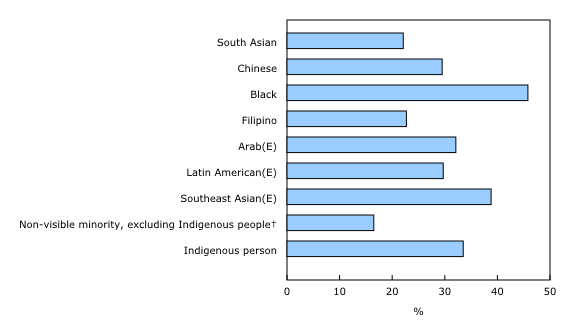
In daily life, Black people were more likely to report experiencing discrimination in a variety of circumstances, including in banks, stores or restaurants, and when dealing with the police. According to the 2019 GSS on Canadians’ Safety (Victimization), nearly half (46%) of Black people reported experiencing discrimination in the past five years—aproportion that was nearly triple that of the non-Indigenous, non-visible minority population (16%).

Chart 2  
Experiences of discrimination in the past five years, by population group, Canada, 2019

Chart 2: Experiences of discrimination in the past five years, by population group, Canada, 2019

Specifically, 4 in 10 (41%) Black people said that they had experienced discrimination based on their race or skin colour.

According to the GSS on Victimization, experiences of discrimination in the five years preceding the survey were more commonly reported in 2019 than in 2014. This was particularly the case among the Black population, with 46% of Black people reporting discrimination in 2019, compared with 28% in 2014.

Indigenous people are significantly more likely than non-Indigenous people to report little or no confidence in the police

Similar to the Black population, Indigenous people reported lower rates of confidence in the police, compared with non-Indigenous, non-visible minority people. Specifically—according to the 2020 GSS on Social Identity—2 in 10 (22%) Indigenous people reported having little or no confidence in the police. This proportion was double that reported by non-Indigenous, non-visible minority people (11%).

Chart 3  
Confidence in police, by Indigenous identity, provinces, 2020

Chart 3: Confidence in police, by Indigenous identity, provinces, 2020

As noted, 7 in 10 (70%) non-Indigenous, non-visible minority people reported having either some or a great deal of confidence in the police. This proportion is much higher than the proportion reported by First Nations people (48%) and Métis (54%). Estimates for Inuit from the 2020 GSS on Social Identity are not releasable because of the sample size.

When looking at indicators of police performance, Indigenous people were more likely than non-Indigenous, non-visible minority people to state police were doing a poor job at the following: enforcing the laws (10% versus 5%), promptly responding to calls (16% versus 7%), providing information on crime prevention (16% versus 9%), ensuring the safety of citizens (11% versus 5%), and treating people fairly (15% versus 7%).

According to the 2019 GSS on Canadians’ Safety (Victimization), one-third (33%) of Indigenous people reported experiencing discrimination in the past five years—a proportion well above that of the non-Indigenous, non-visible minority population (16%). More specifically, experiences of discrimination in the five years preceding the survey were reported by 44% of First Nations people, 24% of Métis, and 29% of Inuit.

Chart 4  
Experiences of discrimination in the past five years, by Indigenous identity, Canada, 2019

Chart 4: Experiences of discrimination in the past five years, by Indigenous identity, Canada, 2019

Often, Indigenous people reported experiencing discrimination based on their ethnicity or culture (15%), or their race or skin colour (14%). These proportions were notably higher than among the non-Indigenous, non-visible minority population (2% and 3%, respectively).

Indigenous people were also more likely than non-Indigenous, non-visible minority people to perceive discrimination or unfair treatment because of their physical appearance (14% versus 5%), physical or mental disability (7% versus 2%), and religion (5% versus 2%).

As was also the case for the Black population, discrimination was more common among Indigenous people in 2019 (33%) than in 2014 (23%). Among the non-Indigenous, non-visible minority population, discrimination also increased, albeit to a lesser extent (from 12% in 2014 to 16% in 2019).

Source: Black and Indigenous people’s confidence in police and experiences of discrimination in their daily lives

Being Black in Mexico: How this country is changing its views

Of interest. Likely a lot of colourism in Mexico as in many countries in Latin America:

Black Mexicans are starting to get widespread public recognition after centuries of being ignored.

Why it matters: Mexico has historically underplayed the roles and contributions of Black people, largely keeping them out of textbooks, too.

  • The country added Afro-Mexicans to the Constitution’s second article, which lauds the nation’s multiculturalism, in 2019.
  • The 2020 Census asked, for the first time, whether people identified as Black, Afro-Mexican or of African descent.

What to know: Two out of 100 Mexicans, or around 2.5 million people, identified as Black in the Census.

  • Black communities are mostly found in Veracruz — where the Spanish disembarked enslaved people from Africa — and the coast of Oaxaca and Guerrero, where Afro-Indigenous traditions from colonial times endure, like the dance of the devils for Day of the Dead.
  • Mascogos, descendants of Black Seminoles and of people who fled U.S. slavery in the 1830s after Mexico outlawed the practice, live in Coahuila state, which borders the U.S.

Between the lines: The Spaniards had a racist caste systemthat considered Blackness the lowest societal status, creating a stigma around identifying as Black.

  • A majority of Mexicans consider themselves mestizos, or mixed race, and many falsely claim that disparities in access to education or jobs are due solely to socioeconomic differences, not skin tone.

What they’re saying: “It was difficult and painful to come out and say ‘soy negra,’ because it’s almost ingrained into you that the term itself is bad, let alone being Black,” Denisse Salinas, who owns a coffeehouse in Oaxaca, told Axios Latino.

  • “But I see many young people doing the same as me, reclaiming the term and identity, and that does give me a glimmer of hope.”

Flashback: Historians believe two key figures in Mexico’s independence were of African descent:

  • José María Morelos y Pavón, who led insurgents to occupy and reclaim the south and southeast parts of Mexico.

  • Vicente Guerrero, who was Morelos’ right-hand man and went on to be the second president of Mexico. Guerrero declared the end of slavery.

Source: Being Black in Mexico: How this country is changing its views

Serwer: Whoopi Goldberg’s American Idea of Race

Good thoughtful analysis and commentary, and the importance of understanding historical experiences:

It made sense, to the New York Daily News sports editor, that these guys dominated basketball. After all, “the game places a premium on an alert, scheming mind and flashy trickiness, artful dodging and general smartalecness,” not to mention their “God-given better balance and speed.”

He was referring, of course, to the Jews.

In the 1930s, Paul Gallico was trying to explain away Jewish dominance of basketball. He came up with the idea that the game’s structure simply appealed to the immutable traits of wily Hebrews and their scheming minds. It sounds strange to the ear now, but only because our stereotypes about who is inherently good at particular sports have shifted. His theory is not any more or less insightful now than it was then; his confidence should remind us to be skeptical of similar, supposedly explanatory arguments that abound today.

Looking back at old stereotypes is a useful exercise; it can help illustrate the arbitrary nature of the concept of “race,” and how such identities shift even as people insist on their permanence and infallibility. Because race is not real, it is malleable enough to be made to serve the needs of those with the power to define it, the certainties of one generation giving way to the contradictory dogmas of another.

Whoopi Goldberg, the actor and a co-host of The View, stumbled into a public-relations nightmare for ABC on Monday when she insisted that “the Holocaust wasn’t about race.” After an episode of The Late Show With Stephen Colbert aired in which she opined that “the Nazis were white people, and most of the people they were attacking were white people,” she was temporarily suspended from The View. She has apologized for her remarks.

I don’t mean to pile on Goldberg here, who I think is struggling with an American conception of “race” that renders the anti-Semitism that led to the Holocaust illegible. I regard her remarks not as malicious, but as an ignorant projection of that American conception onto circumstances to which it does not apply. In America, distinctions among European immigrants that were once considered deeply significant dissolved in the melting pot, leaving an absence in popular memory that might explain their salience elsewhere, and how someone could be seen as white in America and yet still be subject to persecution based on their “race.”

The Nazi Holocaust in Europe and slavery and Jim Crow in the United States are outgrowths of the same ideology—the belief that human beings can be delineated into categories that share immutable biological traits distinguishing them from one another and determining their potential and behavior. In Europe, with its history of anti-Jewish persecution and violent religious divisions, the conception of Jews as a biological “race” with particular characteristics was used by the Nazis to justify the Holocaust. In the United States, the invention of race was used to justify the institution of chattel slavery, on the basis that Black people were biologically suited to permanent servitude and unfit for the rights the nation’s Founders had proclaimed as universal. The American color line was therefore much more forgiving to European Jews than the divisions of the old country were. But they are branches of the same tree, the biological fiction of race.

In the United States, physical distinctions between most Black and most white people have misled some into thinking that the American conception of race is somehow more “real” than the racial fictions on which the Nazis based their campaign of extermination. Applying the American color line to Europe, the Holocaust appears merely to be a form of sectarian violence, “white people” attacking “white people,” which seems nonsensical. But those persecuting Jews in Europe saw Jews as beastly subhumans, an “alien race” whom they were justified in destroying in order to defend German “racial purity.” The “racial” distinctions between master and slave may be more familiar to Americans, but they were and are no more real than those between Gentile and Jew.

Adherence to religious belief was not required to be subject to Nazi persecution, and unlike some prior moments in European history, conversion was insufficient to escape danger. Jewish ancestry was enough, because it was ancestry—a person’s “race”—that made someone inescapably Jewish. In his infamous memoir, Adolf Hitler regretted that, early in life, he’d seen anti-Semitism as persecution of a people on the basis of religious belief, which he thought wrong. He later came to think of this as a Jewish lie to hide the reality that the Jewish people were a separate “race” whose goal was to enslave the rest of mankind. It should not be lost that enslaving all of mankind is a concise summary of Hitler’s own political project.

“Judaism predates Western categories. It’s not quite a religion, because one can be Jewish regardless of observance or specific belief,” my colleague Yair Rosenberg wrote. “But it’s also not quite a race, because people can convert in! It’s not merely a culture or an ethnicity, because that leaves out all the religious components.”

This is all true, but Black Americans are not really a “race” either, and the borders of Black American identity can also be difficult to define or agree upon. To some extent, shared history, culture, and ancestry exist, but as the scholars Karen and Barbara Fields write in Racecraft, the very concept of race implies a material reality where none exists. Most American descendants of the emancipated have white ancestry, and millions of white Americans with African ancestry have no knowledge of it. “Race is not an idea but an ideology. It came into existence at a discernible historical moment for rationally understandable historical reasons,” the Fieldses write, “and is subject to change for similar reasons.”

It is not necessary for race to be real for racism to be real. It is only necessary that people believe race to be real. When people act on fictions, those actions have repercussions even if the underlying belief is false—even if the people know that the underlying belief they are acting on is false. The fact that anti-Semitic conspiracy theories about Jewish control of the media, of governments, and of financial institutions are untrue does not rob them of their explanatory power for those who choose to believe in them. For Thomas Jefferson to know, somewhere in the disquiet of his own conscience, that slavery was a “cruel war against human nature itself” did not in and of itself grant freedom to those he owned as property.

“The people who settled the country had a fatal flaw. They could recognize a man when they saw one. They knew he wasn’t—I mean you can tell, they knew he wasn’t—anything else but a man; but since they were Christian, and since they had already decided that they came here to establish a free country, the only way to justify the role this chattel was playing in one’s life was to say that he was not a man,” James Baldwin wrote in 1964. “For if he wasn’t a man, then no crime had been committed.”

To this, we could add Jean-Paul Sartre’s observation that “if the Jew did not exist, the anti-Semite would invent him.” Race allows humanity to keep inventing, in language that can bend the most rational minds, groups of people whose supposed characteristics justify whatever cruelty we might wish to indulge.

Adam Serwer is a staff writer at The Atlantic, where he covers politics.

Source: Whoopi Goldberg’s American Idea of Race

Heckbert: Advice to Well-Meaning Protestors: Don’t Stand with Nazis

Really good piece:

A quick primer for those who wanted to “support the truckers” with this protest:

  1. It wasn’t really truckers – any more than it was carpenters, or nurses, or bricklayers. Calling it a Freedom Convoy – rather than “bunch of white guys in pickup trucks going for a long drive” – is the mistake.
  2. If you want to know why Erin O’Toole, Pierre Poilievre and others were quick to support this movement – there are eight million reasons why. A GoFundMe effort raised $8 million in a week – to Conservative fundraisers, that was their money. Or worse, it’s money that could have gone to Maxime Bernier. Until politicians say, “if these are your beliefs, you are not my people” to groups like this, the temptation to stay with the money is there.
  3. Numbers don’t matter – just because 10,000 people, or 100,000 people, or even a million people support something – that doesn’t mean you’re on the right side of the issue. The earth, for example, is round. You can get a million people to believe it isn’t, and yet, there it is – still round.  Look around you when you’re angry about something – is your anger focused on the right thing, or are you howling in the wind? Are people frustrated with the pandemic and government responses to it? Absolutely. Does that mean yelling at a teenager at a hotel in downtown Ottawa, and honking your horn as you drive around yelling “Freedom!” will convince others of the rightness of your viewpoint? Ummm, no, it won’t.
  4. If you’re a parent and you brought your child out to support this yesterday, maybe some shame wouldn’t kill you. Again, admitting you were wrong is a sign of intelligence – take your child and say, “I misunderstood what we were supporting – we, in fact, are not in favour of the things that represented.”
  5. It’s time for social media companies to be held accountable, and here’s a quick way to start: no more anonymous accounts. Zero. Every account verified. “But that will be hard to do,” say the people at Meta, Twitter, Google, et al. The truth? Your revenues suggest you can afford it.
  6. Expectation management matters – people can see, with their own eyes, when your numbers don’t come anywhere near what you said they would, and while, yes, there was some support along the route, it wasn’t nearly as evident as people said it would be.
  7. Once the Nazi and Confederate flags show up, once you desecrated the Terry Fox statue and the National War Memorial, and once you started harassing the young men and women just trying to do their jobs, your protest turned into a national embarrassment, not a movement. And, please, if you want to tell me about “the good people there who aren’t like that,” let me quote Chris Rock – if ten white guys are standing somewhere with a Nazi, that’s 11 Nazis.

Some basic facts: more than 80 per cent of truckers are vaxxed, a percentage not out of line with the general population. A large percentage of those truckers come from a very diverse background – if this were really a Freedom Convoy, it would have looked a little more like Canada and a little less like a rural Albertan’s idea of Canada.

My father was a diesel mechanic. My father, in 1980, let a young man park his van beside our small business and handed him all the money out of his wallet while he was early in his Marathon of Hope. I grew up around truckers. The ones I grew up around would not have had the time, nor the desire, to spend any time with the bros on the Hill this weekend. So, please, thank a trucker – a real trucker – for their ongoing efforts. And don’t let this group claim to represent truckers.

Finally – it bears repeating you have to spend time understanding someone – or some group – before you give them your support and your money. For anyone prone to blame the “media” for “not covering the real story” – I can’t hear you because of where you’re standing. Don’t stand with Nazis, and maybe then we can talk.

The co-author, with Phil Gaudreau, of “Headliner,”and the co-host of Headliner: The Podcast, Stephen Heckbert is a professor of public relations at Algonquin College.

Source: Advice to Well-Meaning Protestors: Don’t Stand with Nazis

‘Racist’ junior high immigration assignment has advocates calling for curriculum change

Not convinced by the arguments advanced against the approach of having students contrast and compare opposing perspectives and develop their critical thinking.

Most of the immigration opposing points reflect polling and other data and students will likely be exposed to these positions in any case outside of the more controlled space of a classroom.

Of course, the role of teachers in leading and framing the issues is critical.

And while I hate the term “snowflake,” (which can apply both the “woke” and “non-woke”), this is a classic example of underestimating the ability of people to handle such material:

Advocates and university professors are calling this school assignment ‘dehumanizing.’ (Name withheld)

Anti-racism advocates and a university professor are calling an assignment handed out at a junior high school in St. John’s “racist” and say it could result in bullying and discrimination.

A textbook assignment that was sent to CBC News by a concerned parent asked students to write down two reasons why immigrants and refugees should be allowed into the country — and two reasons why they should not be.

The textbook provides a list of reasons why immigrants and refugees should be allowed in the country; for example, “Canada is a big country with room for many more people” and “Immigrants provide new ideas and skills.”

Source: ‘Racist’ junior high immigration assignment has advocates calling for curriculum change

COVID-19 related racism impacts sense of belonging, reporting incidents: Study

Of interest given lack of major difference between first and second generation:
The dramatic increase in reports to Vancouver police of hate crimes targeted at Asian-Canadians in 2020 shocked many.

Now, a new study delves into the psychological impact of experiencing COVID-19 and racism when it comes to the sense of belonging held by different generations of Chinese-Canadians. It finds these feelings could hinder the reporting of incidents just as policy-makers are grappling with how to better understand what’s happening.

Source: COVID-19 related racism impacts sense of belonging, reporting incidents: Study