Rights groups call for oversight of Canada border agency

Another due process pressure point on the Government:

Civil society groups proposed a model Thursday for independent oversight of the Canada Border Services Agency, following the deaths of two immigration detainees in March.

Recent revelations that the CBSA had fully implemented just one of the 19 recommendations from a coroner’s inquest examining the 2013 death of Lucia Vega Jimenez at the Vancouver airport are another indication that the border agency is in need of oversight, said Josh Paterson of the B.C. Civil Liberties Association.

The CBSA is the only law enforcement agency in Canada that has no independent oversight body, noted Canadian Association of Refugee Lawyers president Mitch Goldberg, even though officers generally have more power and less training than police.

An oversight body for the CBSA would need to be independent of political influence and have legal power to both investigate and monitor CBSA activities, said Canadian Council for Refugees president Loly Rico. The council has proposed a model for a CBSA oversight body, recommending that it have the ability to receive and review complaints from citizens and non-citizens about their interactions with the CBSA, compel CBSA to share information, and make recommendations to the Public Safety Minister.

Canada has been criticized by three United Nations agencies in the last four years over its treatment of immigration detainees, said Alex Neve, secretary-general of Amnesty International Canada. Some of the practices criticized by the United Nations included the practice of keeping children in detention, the lack of a limit under Canadian law on the amount of time an individual can be detained, and the country’s extensive use of immigration detention, when it should be a last resort, Neve said.

“That is a very strong signal that Canada’s immigration detention system is broken,” he said, adding that it is “unconscionable” that there is no independent oversight of CBSA.

Source: Rights groups call for oversight of Canada border agency

In defence of the Office of Religious Freedom: Solomon, de Souza

Nuanced opinion by Evan Solomon, supporting the concept of an Office for Religious Freedom:

We not only ought to be saving religious groups from persecution—that should be basic foreign policy—we need to have a deeper understanding of the impact religions have on societies if we have any hope of making a difference in these conflicts. It’s hard to forget the accounts from the famous Black Hawk Down incident in Somalia, where U.S. soldiers flying in choppers over Mogadishu hung their feet out open doors. No one told them showing the soles of their feet to the local population was a profound insult, further turning the population against them.

The Office of Religious Freedom was flawed, and never quite lived up to its billing, hobbled by its puny budgets and by the Harper government’s propensity to imbue everything with a partisan mission. But it barely got off the ground, and the core idea is sound. If Canada really is back—this government’s mantra—it had better make sure it takes religion seriously. There is no point in tripling the number of trainers in Iraq if we don’t deeply understand the belief system of the very soldiers we are trying to support, as well as the ones we are fighting.

Conflicts of the future will have twin threats: terror, and the danger of giving in to a xenophobic response. Winning both sides will mean being unafraid to talk about religion, and engaging with religious communities. Without an office to do that, how does this become a government priority?

Source: In defence of the Office of Religious Freedom

And less nuanced support by Father Raymond J. de Souza, the Chair of the former advisory committee:

That reading is rendered more plausible given that the foreign affairs department (now called Global Affairs) undertook no consultations with the ORF’s advisory committee, drawn from religious leaders from across the country. The non-partisan, volunteer group includes many who are in direct contact with persecuted communities around the globe. I am the chairman of the advisory committee, and the new minister’s office never consulted the committee, or its leaders. If there was a commitment to religious freedom, but through a different means, such consultation would have been an obvious starting point.

If the Liberals had a credible plan to advance religious freedom in a world of increasing religious persecution, surely it would have been announced. But since the election, the government refused even to announce its intention to close the ORF, even long after staff was told to look for positions elsewhere. Only last week, when the opposition moved a motion in the House of Commons, did the government declare its decision to close the ORF. Doing that on the day before the budget was released, before a two-week recess of the House, suggests a desire to bury this news. It does not appear that the government even thinks the decision a good one, or has an alternative plan. 

It is also short-sighted. Religious persecution and massacres are on the increase. Should the government decide to launch a particular program, likely more costly than the ORF, to promote, for example, legal rights in criminal justice systems abroad, or political rights in new democracies, or to encourage our authoritarian allies to respect minority rights, then it will be open to the charge that it simply chose not to put a priority on religious freedom.

This week, Dion outlined his foreign policy philosophy as one of “responsible conviction.” The idea is that one stands up for Canada’s convictions, but in a responsible manner, meaning that the objections of those who do not share our convictions have to be generously taken into account, whether it be Saudi Arabia or Russia or Iran. If the closing of the ORF is an example of “responsible conviction” in action, the message will be clearly understood in Riyadh, Moscow and Tehran. Of course, Canada stands foursquare behind religious freedom, but will not raise the matter if it proves awkward. 

Dion himself knows that is the case, as he stressed that “responsible” is not to be understood as an adjective that empties the noun of any meaning. Otherwise he would not have insisted that his new approach should not “be confused with moral relativism or the lack of strong convictions.” The need to emphasize that something is not what it appears to be is the customary way politicians confirm that it is precisely that.

Burying the Office of Religious Freedom

I think most critics of the Government’s decision have overly focussed on the question of the Office and the Ambassador per se rather than the sun-setting of the modest program funds for projects to help support religious freedom, where likely more impact will be felt.

A French Minister Has Compared Muslim Women to ‘American Negroes’ | TIME

No wonder France has integration problems:

She has apologized for her choice of words, but stands by her general observation.

France’s Minister for Women’s Rights has found herself in hot water after comparing Muslim women who wear their faith’s traditional garments to “American negroes” who supported slavery.

Laurence Rossignol, the government minister, made the remark during a French television interview on Wednesday. She was condemning retailers like H&M and Dolce & Gabbana for their decision to sell product lines designed for Muslim women, saying these firms were “promoting the confinement of women’s bodies,” France 24 reported.

The interviewer noted that some Muslim women in fact choose to wear articles of clothing like burqas and hijabs.

“Of course there are women who choose it,” Rossignol replied. “There were American negroes who were in favor of slavery.”

Rossignol has since expressed remorse for her choice of words, calling it an “error of language” and insisting that she would only use the word negro in the context of slavery, but otherwise she is standing by her observation. She is now the target of a social-media backlash. As of early Thursday morning, a Change.com petition demanding that Rossignol face “sanctions” for her language had received more than 15,800 signatures.

Source: A French Minister Has Compared Muslim Women to ‘American Negroes’ | TIME

Governor in Council Appointments – 2016 Baseline diversity

GiC Baseline 2016.010With the overall Government commitment to diversity and inclusion in all appointments, this deck provides a detailed analysis of the more the 1,300 current GiC appointments.

Governor in Council Appointments – 2016 Baseline

Belgian theater director Luk Perceval: ′We should see multiculturalism in a positive light′| DW.COM

Interesting interview but too simplistically links marginalization to violence. As others have noted (e.g., Gurski), the backgrounds of extremists and terrorists vary, although marginalization does play a role:

The great power of theater is that we don’t only recognize ourselves on stage, in one of the characters, but that we also feel included. On stage, questions are asked that every person deals with: questions of love, death, war, everything that we don’t know or are unsure of in life. The moment when we feel this sense of not knowing, this insecurity in the group, and we can laugh or cry together about it – that’s when a feeling of community is created.

Art is suspending for a moment people’s feeling of being alone. It is feeling that we are all part of humanity and we have the same problems and doubts.

To what extent should theater deal with current social issues?

I grew up in Belgium, a country that has seen so many wars in the past and has become a kind of thoroughfare for Europe. Here you’re confronted with so many cultures and languages. That’s why I personally feel the need to tell people to watch out and not erect fences. They won’t help with anything.

Should theater always send that message? I don’t know. Only if there is an honest commitment behind it. But after Paris and Brussels, it’s necessary to talk about our shock. And I think it’s important for theater to create space where people can discuss their feelings.

How optimistic are you about the future? 

I’m afraid that this is just the beginning of something horrible. I hope that the peace talks in Syria can achieve constructive results. Diplomatic solutions must be found for this war. It’s not just about the criminals in Brussels. Salah Abdeslam was able to hide in Brussels for four months. That shows how powerful the network behind him is. The fundamental question is, though, to what extent terror is also linked to tremendous injustice in the world – particularly in the Arab World.

I really am concerned that things will escalate as long as the gap between rich and poor – not just in Brussels, but worldwide – doesn’t change. Until then, I’m afraid these murders won’t end.

Source: Belgian theater director Luk Perceval: ′We should see multiculturalism in a positive light′ | Arts | DW.COM | 29.03.2016

The Obama Doctrine: Why Islamism Isn’t Like Communism – The Atlantic

Thoughtful:

In one of my recent conversations with Obama, he dilated on this point in an interesting way. (“The Obama Doctrine” contains many thousands of words of Obama’s thoughts on foreign policy. However, I could not, for reasons of space, include all of what he had to say. In the coming weeks, I will be highlighting some of the things he told me that did not make it into the original article.) Obama made these particular comments during a conversation about Ronald Reagan’s influence on Republican thought. His main argument here is that rhetoric that could legitimately be deployed against an ideology like communism cannot be similarly deployed against the world’s second-largest religion.

Obama first praised Reagan’s “moral clarity about communism,” saying, “I think you can make a credible argument that as important as containment was in winning the Cold War, as important as prudence was in winning the Cold War, that at a time when perhaps the West had gotten too comfortable in the notion that, ‘Look, the world is divided and there’s nothing we could do about it,’ Reagan promoting a clearer moral claim about why we have to fight for freedom was useful and was important.”

The danger comes, Obama told me, when people apply lessons of the struggle against communism in the struggle against Islamist terrorism.

“You have some on the Republican side who will insist that what we need is the same moral clarity with respect to radical Islam. Except, of course, communism was not embedded in a whole bunch of cultures, communism wasn’t a millennium-old religion that was embraced by a whole host of good, decent, hard-working people who are our allies. Communism for the most part was a foreign, abstract ideology that had been adopted by some nationalist figures, or those who were concerned about poverty and inequality in their countries but wasn’t organic to these cultures.”

He went on to say, “Establishing some moral clarity about what communism was and wasn’t, and being able to say to the people of Latin America or the people of Eastern Europe, ‘There’s a better way for you to achieve your goals,’ that was something that could be useful to do.” But, he said, “to analogize it to one of the world’s foremost religions that is the center of people’s lives all around the world, and to potentially paint that as a broad brush, isn’t providing moral clarity. What it’s doing is alienating a whole host of people who we need to work with us in order to succeed.”

Obama said that the manner in which a president discusses Islam has direct bearing on the fight against Islam’s most extreme manifestations. “I do believe that how the president of the United States talks about Islam and Muslims can strengthen or weaken the cause of those Muslims who we want to work with, and that when we use loose language that appears to pose a civilizational conflict between the West and Islam, or the modern world and Islam, then we make it harder, not easier, for our friends and allies and ordinary people to resist and push back against the worst impulses inside the Muslim world.”

Source: The Obama Doctrine: Why Islamism Isn’t Like Communism – The Atlantic

The fashion world is keeping stats on runway diversity, but what’s the real goal?

I really don’t get the point of Robin Givhan’s piece. Without numbers, we are left with impressions and anecdotes. What doesn’t get measured doesn’t get managed. Numbers and data are useful tools.

But I have a bias towards evidence and data:

Surely success is when those models are regularly just part of the mix at Prada, Céline, Saint Laurent and other shows that have far-reaching aesthetic influence and can launch a model into a lucrative advertising contract.

Ideally, diversity should be part of the story-telling and myth-making, not a mathematical equation. All the counting is well-intentioned, but what’s the goal? If it’s to have a runway show more honestly reflect the consumer base of a luxury brand, well, clear the runway for 30-something men of Asian and Middle Eastern descent. Is it to more accurately represent womankind — at least the American version? Then there should be a glut of size 14 models who stand 5-foot-4. But no one is counting the number of short models on the runway (Lady Gaga in the Marc Jacobs show notwithstanding).

We understand that fashion must balance fantasy with the reality of doing business in a diverse world. Those models booked for a runway show are cast to express a unique vision, to make viewers dream. They are, by definition, a rare and lucky lot. They are the chosen.

They should also be a diverse group because they bear the responsibility of embodying a cultural standard.

But as we all become more invested in fashion, there is the temptation to expect that each show should offer a unique representation of every conceivable consumer. To some degree, we are looking to see near mirror-images on the runway. But fashion has a responsibility to reflect the culture, not the individual.

It’s fine to dissect diversity in all its many iterations. The question is whether all those fractions add up to a more welcoming industry or just a growing list of numbers.

Source: The fashion world is keeping stats on runway diversity, but what’s the real goal? | National Post

Time to name an Aboriginal justice to the Supreme Court: Hassan and Siddiqui

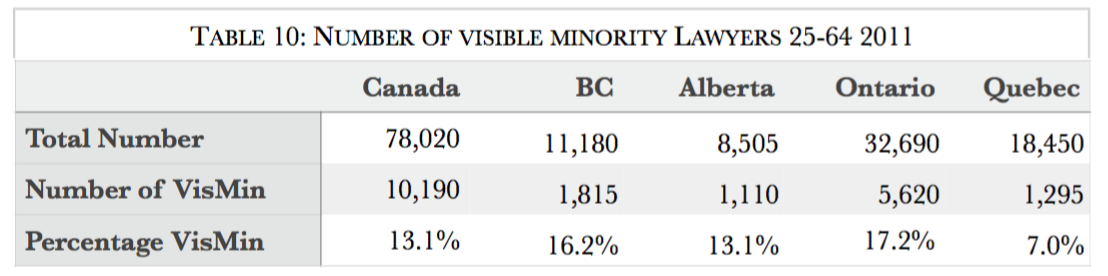
 Visible Minority LawyersNader Hassan and Fahad Siddiqui make the argument (the number of visible minority lawyers is higher than their article, based upon NHS data that I used in my book, Multiculturalism in Canada: Evidence and Anecdote):

These criteria narrow the field considerably [member of provincial superior court, bilingual, Maritime], and risk obscuring another important fact: our high court does not look like the rest of Canada. No Aboriginal or visible minority has ever been appointed to the Supreme Court. Regional representation — which convention so assiduously protects — is important, but in an increasingly ethnically and religiously diverse country, it is only one of many indicia of diversity.

Since the Abella Equality in Employment Royal Commission Report in 1984, a consensus has emerged among judges, lawyers and academics that judicial diversity matters. A diverse judiciary results in a broader range of perspectives, which is crucial to judicial decision-making. And greater judicial diversity fosters public confidence in the administration of justice.

Little progress has been made so far. Professor Rosemary Cairns Way of the University of Ottawa reports that Aboriginal and visible minority members account for roughly 23 per cent of the population, and yet from 2009 to 2014, only 1.04 per cent of appointees to the provincial superior courts were Aboriginal, and only 0.5 per cent were members of a visible minority group.

The same appears to be true of the senior reaches of the legal profession. The body that regulates lawyers in Ontario, the Law Society of Upper Canada, does not regularly collect comprehensive demographic data. But a Society report, released in 2010, shows that only 5 per cent of lawyers in Ontario between the ages of 45 and 64 are Aboriginals or visible minorities even though those two groups make up more than a fifth of that segment of the population.

It is sometimes argued that as Canada’s population diversifies, the legal profession will too. Problem solved — some years or decades down the line.

The statistics we have don’t bear out that claim though. Even among younger generations, Aboriginals and visible minorities are under-represented at the bar. And those who have managed to gain a foothold in the profession face unique challenges. The society reports that a majority of Aboriginal and visible minority lawyers believe that having a different cultural background has disadvantaged their careers. In that sense, the legal profession reflects trends in the broader job market. According to a recently released study led by University of Toronto researchers, black job applicants are 25.5 per cent more likely to land a job interview when they scrub their resumé of clues of their race.

The time has come for change. And this change requires leadership from the top. We need out-of-the box thinking, such as Trudeau’s laudable decision to name women to half his cabinet positions — including Canada’s first Aboriginal justice minister. The prime minister will have to take a similarly bold approach to fill the high court vacancy. An Aboriginal candidate should take priority. It’s an absolute shame that Canada’s highest court has never had representation from among our First Nations.

Liberals to let religious freedom office expire on March 31

Expected:

Mr. Dion confirmed the office’s closure at a global affairs conference in Ottawa on Tuesday.

“Our government shares the same conviction as the previous government, but it assesses the consequences of its chosen method of promoting this conviction differently. I am referring to freedom of religion or belief, which we will defend tooth and nail, but not through the office that the Harper government specifically set up for this purpose,” said Mr. Dion during a speech at the University of Ottawa.

The Liberals have previously indicated their intention to close the office. The office’s mandate expires March 31.

Last week, the Conservatives tabled a motion in the House of Commons to renew the mandate of the Office of Religious Freedom. The Liberals voted against the motion and it was defeated 225 to 90.

Prior to the motion, Religious Freedom Ambassador Andrew Bennett, who was appointed by the Conservatives in 2013, accepted a position as a senior fellow at Cardus, a leading Christian think tank. He will also serve as chair of the think tank’s Faith in Canada 150 program while he completes his term at Global Affairs Canada. His new position is voluntary and unpaid with support of Global Affairs Canada.

Mr. Bennett’s three-year term was originally set to end in February, but the Liberals extended it to March 31 to coincide with the expiration of the office’s mandate and $5-million in annual funding. While Mr. Bennett’s future at Global Affairs Canada is unclear, the minister’s office has applauded his work as ambassador.

The Conservatives first promised to create an Office of Religious Freedom during the 2011 election campaign. The office’s mandate is to “speak out and to protect and promote religious freedom around the world.”

While the Conservative initiative was criticized for mixing politics and religion, certain religious groups supported it. In a letter to Mr. Dion in January, Jewish, Sikh and Ahmadiyya Muslim organizations asked the Liberal government not to scrap the office.

On Tuesday, Mr. Dion reiterated the government’s thinking in determining how to best defend various rights.

“We believe that human rights are better defended when they are considered, universal, indivisible, interdependent and interrelated, as set out in the Vienna Declaration,” said Mr. Dion.

The remaining question is the degree to which future projects focused on religious freedom  will be funded within existing Global Affairs program funds. I expect not absent any declaration to the contrary.

Source: Liberals to let religious freedom office expire on March 31 – The Globe and Mail

Mr. Trudeau: Don’t be so quick to brag about Sikhs in your cabinet – Ramesh Thakur

The latest complaint regarding the number of Sikhs in Cabinet (the selection of Parliamentary Secretaries somewhat addressed under-represented groups – see my deck Big Shift or Big Return? Visible Minority Representation in the 2015 Election for the numbers):

India is an exemplar par excellence of power sharing and political accommodation in a multi-ethnic, multireligious society. In a country where 80 per cent of the people are Hindus, at one point the heads of government, state and army were a Sikh, Muslim and Sikh respectively; and the real power behind the throne was an Italian-born Catholic widow. Diversity and pluralism have no better champion. At the official White House banquet hosted by U.S. President Barack Obama for India’s Prime Minister Manmohan Singh – a Sikh – on Nov, 24, 2009, a glittering new dimension of Indian soft power was in evidence with the presence of many Indian and Indian-American women from the political, business, literary, cultural and educational worlds.

Sikhs make up under 2 per cent of India’s population, so two Sikhs in Mr. Modi’s cabinet is a better reflection of India’s diversity than four in Mr. Trudeau’s is of Canada’s demographic makeup. In fact the Congress Party, not Mr. Modi, needs a reckoning on Sikhs. After Indira Gandhi’s assassination by Sikh bodyguards in 1984, 3,000 Sikhs were slaughtered in a pogrom often orchestrated by senior Congress leaders, including more than 2,000 killed in the nation’s capital. One of the extraordinary features of modern Indian history is how Mr. Modi was demonized internationally for his alleged role in the anti-Muslim riots of 2002 in Gujarat but the Congress Party escaped global odium for its role in the worse atrocities of 1984. It is hard to see how there can be closure for the victims’ families until such time as there is criminal accountability for those events.

Moreover, any mention of Sikhs in the context of Indo-Canadian relations inevitably rakes up ugly memories from three decades ago, when Canada seemed to be home to a large number of separatist Sikh extremists.

On June 23, 1985, Air India flight 182 was blown up over the Irish Sea en route from Montreal to Delhi via London, killing all 329 people on board. Most were Canadian citizens of Indian ancestry. This was the first bombing of a 747 jumbo jet, the deadliest plane bombing, the deadliest attack involving an aircraft until 9/11 in New York and remains the biggest mass murder in Canadian history. The perpetrators are believed to have been Sikh terrorists, although the subsequent trials were less than satisfactory.

All in all, what may have been a lighthearted quip by Mr. Trudeau is fraught with hidden dangers and best avoided in future.

Source: Mr. Trudeau: Don’t be so quick to brag about Sikhs in your cabinet – The Globe and Mail