Australia finally ending long nightmare of peaceful multiculturalism

Andrew Street’s critical look at Australia’s language and actions with respect to immigrants and refugees:

And while we might differ over what constitutes a “generous humanitarian program” when taking 18,750 of the literal millions of people seeking asylum, the Prime Minister’s argument appears to run as follows: fierce border protection allows Australians to be generous and welcoming to those we invite to join in our proud multicultural success story.

If we’re not taking just anyone, in other words, we can afford to be generous with those we do take. And that would be awesome if it wasn’t also completely, laughably, insultingly false.

It can’t be lost on Malc that our increasing level of panic about The Boats hasn’t exactly been accompanied by a commensurate increase in tolerance and celebration of our nation’s cultural diversity. Isn’t that right, Muslim Australians?

In fact, you might say that all the evidence points in the oppositedirection – almost as though years of leaders making political mileage by demonising foreigners as at best greedy and at worst probably terrorists has encouraged the worst racist instincts of Australians.

Should this seem like an unfair assessment, a quick look at the current make up of the Senate might be instructive.

(And while everyone is apparently united in their anti-people smuggling rhetoric, is anyone else curious as to why people smugglers are clearly evil opportunists preying on the vulnerable when we’re talking about countries with less-white populations but they were brave freedom fighters snubbing their noses at repressive regimes when, say, smuggling economic migrants out of communist East Germany?)

Also, the PM might more easily highlight Australia’s gosh-darn generosity in resettling 12,000 Syrian refugees, if maybe more than a quarter of them had actually been resettled in the year since the promise was made, amid accusations that the government has been deliberately focussing on accepting non-Muslim refugees because… um, their suffering is more noble, presumably?

And sure, suggesting that harsh border policies somehow fosters greater generosity within Australia might be accurately perceived as being a new version of arguing that indefinite offshore detention under horrific circumstances is somehow “saving lives at sea”: a complete non-sequiter designed to deflect criticism with zero basis in fact.

But on the plus side, by dividing those fleeing violence, oppression and terror into the deserving and undeserving on the basis of their religion or ethnicity, the Turnbull government is helping to embed an outspokenly us-and-them spirit which puts Australian citizens at risk while encouraging racists to express their vile, hateful opinions in word and in deed to a degree that risks destroying this peaceful, stable, genuinely magnificent society we’ve built together.

And making Australia a more hateful, unstable, violent place to live is the plan, right? Because if so, it all appears to be going great.

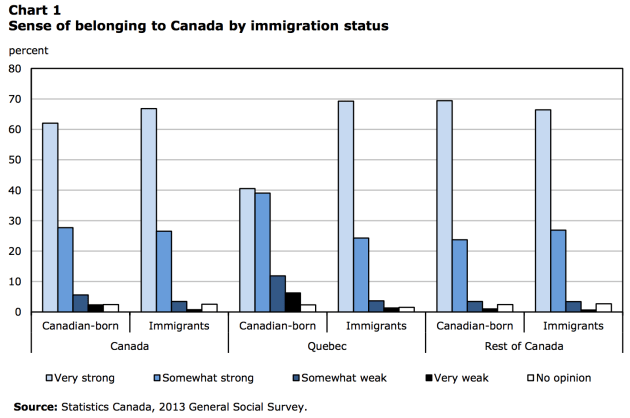
That being said, I do think that support for immigration does correlate with confidence that inflows are controlled and managed, at least in the Canadian context.

Source: Australia finally ending long nightmare of peaceful multiculturalism

The danger in Poland’s frontal attack on its Holocaust history: Jan Grabowski

Worrisome:

Last year’s presidential and parliamentary elections in Poland gave power to a right-wing, nationalistic and populist party, called Law and Justice. The ensuing changes on the political scene were nothing short of dramatic—and deeply troubling. Those who thought that the constitution was the supreme law of the land, were in for a nasty surprise: the new Polish government, with the help of the president, immediately started to dismantle and muzzle the Constitutional Court (an equivalent to the Canadian Supreme Court), the only remaining obstacle to its complete control of the state. The court is now paralyzed, and its most important verdicts are simply ignored by the authorities.

Elsewhere, the journalists of the state radio and television have been purged and those less sympathetic to the new regime were fired. Not surprisingly, the European Parliament took a dim view of the dismantling of democracy in one of its member states and repeatedly expressed its deep and growing concern over the situation in Poland.

However, the departure from democratic practices also goes hand in hand with a frontal attack on Polish history. “Who controls the present, controls the past,” wrote George Orwell, and the Polish authorities seem to have taken Orwell’s words to heart.

Earlier this month Zbigniew Ziobro, the Polish minister of justice, introduced new legislation intended to “defend the good name of the Polish nation.” The new set of laws, already approved by the cabinet, would impose prison terms of up to three years on people “who publicly and against the facts, accuse the Polish nation, or the Polish state, [of being] responsible or complicit in Nazi crimes committed by the III German Reich.” In the governmental narrative, the recently approved law is a penalty for those who talk about the “Polish death camps” of the Second World War. In reality, however, the new law, with its ambiguous and imprecise wording, is meant to freeze any debates which might be incompatible with the official, feel-good, version of the country’s own national past.

 This “feel good” narrative, which the new Polish authorities espouse, is, however, based on historical lies and revisionism masquerading as a defence of “the good name of the Polish nation.” Just a few weeks ago Anna Zalewska, the Polish minister of  education, declared herself unable to identify the perpetrators of the notorious 1946 Kielce pogrom. It is a matter of very public record that in 1946, in Kielce, in the center of Poland, one year after the end of the war, an enraged mob, incited by tales of blood libel, murdered close to 50 Jewish survivors of the Holocaust; women, men and children. Unfortunately, the minister was unable to admit that much. “Historians have to study the issue further,” she said, before finally declaring “it was perhaps anti-Semites.”

Her words were echoed Jaroslaw Szarek, the new chief of the Institute of National Remembrance, a state institution that aspires to be the guardian and custodian of Poland’s national memory. He flatly denied Polish involvement in, and responsibility for, the communal genocide in Jedwabne in 1941. Again, it is a matter of historical record that in July 1941 Polish citizens of Jedwabne herded hundreds of their Jewish neighbours into a barn and then set the barn on fire, burning their neighbours alive. The new law will, quite likely, make further debates surrounding these unpleasant events unlikely.

It so happens that the list of “unpleasant” historical themes, which could soon become a topic of interest to the police and to state prosecutors, is long. For instance, in the face of the new legislation, historians who argue that certain segments of Polish society were complicit in the extermination of their Jewish neighbours in the Second World War will now think twice before voicing their opinion. What about those who would like to study the phenomenon of blackmailing of the Jews, known in Polish as shmaltsovnitstvo? What about those who would like to talk about the role of the Polish “blue” police who collaborated with the Germans in the extermination of the Polish Jewry? What about those who want to shed light on the deadly actions of the Polish voluntary firefighters involved in the destruction of Jewish communities? Or on the involvement of so-called “bystanders,” who might have been much more involved in the German policies of extermination than had previously been thought?

Those are but a few of the who questions that have not yet been tackled by historians. Now, it’s the minister of justice and his prosecutors will probably decide what is a historical fact and what is not.

In the light of the clear message sent by the authorities, the new law, which should be adopted by the Polish parliament any day now, becomes a clear and present threat to the liberty of public and scholarly discussions. It is also a dramatic departure from the democratic principles and standards which govern the laws of other members of the European Union. Finally, introducing prison terms for people who dare to tackle some of the most difficult questions of the country’s past puts Poland right next to Turkey, infamous for its laws against “slandering of Turkish identity,” which is a code word for denying the Turkish responsibility for the Armenian genocide.

Unfortunately for Polish authorities—and fortunately for those involved in the study of the past—the history of the Holocaust, which is at stake here, is not the property of the Polish government. The history of the destruction of the European Jewry is, actually, the only universal part of the national history of Poland, one which resonates in the minds and hearts of people around the world. Any attempt to muzzle debate and to stifle academic research into the various aspects of the history of the Shoah can, should and, hopefully, will be seen as a form of Holocaust distortion, or Holocaust denial—something to be vigorously protested by the international community.

Source: The danger in Poland’s frontal attack on its Holocaust history – Macleans.ca

Liberal replacement for Conservatives’ Office of Religious Freedoms costs four times as much | National Post

Irresponsible headline: the proper comparison would be with respect to the budget for the previous human rights division plus the Office of Religious Freedoms, which I suspect would show little to no change.

Comparing a basket of apples with one apple:

The overall budget for the Office of Human Rights, Freedoms and Inclusion, which replaces the Conservative-era Office of Religious Freedoms, could exceed $18 million, according to foreign minister Stéphane Dion.

The office budget was stated at “up to $15 million” in a June press release from Global Affairs Canada. But that’s just the programming budget, according to the response — there’s anther $3.04 million allotted annually to operations and salaries.

That compares to $4.25 million and $720,386, respectively, under the Office of Religious Freedoms.

Since its creation four months ago, the office has been “working to identify programming opportunities,” Dion said in response to a Conservative question on the order paper.

The office is engaging with organizations that already received funding under the previous administration, Dion confirmed, but also “new stakeholders” looking at a broader range of issues including “peaceful pluralism, inclusion, diversity and democracy.”

 Those themes are divided into three divisions, with 36 full-time employees in total: human rights and indigenous affairs; inclusion and religious freedom; and democracy.

Only five people worked for the Office of Religious Freedoms, Dion said.

To focus on indigenous rights abroad could force the government to walk a tightrope, since some Canadian mining operations have been opposed by local populations in Latin America and Southeast Asia. Still, Dion told Postmedia in May he thought “the overwhelming majority of the mining industry of Canada will welcome this focus … they will be willing to work with this office, I’m sure.”

The buck doesn’t stop there for human rights promotion, with Dion explaining that heads of Canada’s diplomatic missions are now “empowered” to speak out about issues in their day-to-day responsibilities, and to media.

“Human rights promotion, including freedom of religious or belief, is now entrenched in our heads of missions’ core objectives and priorities and will be included in their annual performance commitments,” he said.

Source: Liberal replacement for Conservatives’ Office of Religious Freedoms costs four times as much | National Post

Anti-Defamation League Creates Post To Combat Online Anti-Semitism – Forward.com

Makes sense, with hopefully some broader lessons for combatting hate speech of all kinds on the Internet:

The Anti-Defamation League has created a position dedicated to fighting anti-Semitism and bigotry on the internet.

The hiring of Brittan Heller, a lawyer who has prosecuted cyber crime at the U.S. Department of Justice and the International Criminal Court in The Hague, follows the ADL’s formation of a task force earlier this year to combat online harassment of Jewish journalists.

Heller will be the group’s first director of technology and society, the ADL announced Monday.

From her base in Northern California’s Silicon Valley, Heller will work to reduce hateful rhetoric on the internet in collaboration with technology companies and law enforcement.

Heller, a graduate of Yale Law School, has herself been a victim of cyber harassment. In 2009, she and a fellow Yale alumna settled a high-profile lawsuit against a group of online commenters who posted sexually explicit comments about them on an internet forum.

“As the use of social media and technology to marginalize Jews and other communities increases, Brittan’s new role is at the forefront of the fight against anti-Semitism and all forms of bigotry,” ADL head Jonathan Greenblatt said of Heller’s position in a statement.

The ADL had created the task force to deal with anti-Semitic and racist harassment of journalists on social media platforms.

This election season has seen a number of high-profile cases of Jewish journalists being harassed by supporters of Donald Trump, notably in May, when reporter Julia Ioffe was flooded with anti-Semitic death threats after she wrote a critical profile of the Republican nominee’s wife, Melania.

Leitch says Trudeau a ‘Canadian identity denier,’ but he’s pointed to ‘shared values, openness, respect’

Leitch continues to play hard on identity politics and mischaracterizing PM Trudeau’s comments on identity, just as her source, Candice Malcolm, has (see my review of her most recent book, A response to Candice Malcolm’s Losing True North – Policy Options):

New York Times Magazine story about Prime Minister Justin Trudeau last December that prompted Conservative leadership contender Kellie Leitch to accuse Mr. Trudeau of practising “dangerous” politics and being a “Canadian identity denier” also contains references by the newly elected prime minister to values Canadians share, including “openness, respect, [and] compassion.”

Ms. Leitch surprised a handful of journalists as she was entering the House of Commons on Monday, into the first sitting of the Commons following a 12-week parliamentary recess, and took several minutes to criticize Mr. Trudeau for allegedly denying Canadians have a national identity.

A journalist noted it had been a “very, very big summer” for Ms. Leitch, following a controversy she stirred at the beginning of September by floating the possibility Canada should screen would-be immigrants for “anti-Canadian values,” and asked the leadership hopeful what “tone” she was expecting in the Commons.

“Look, you know, I had a great time and a great campaign, but I do have a concern today and my concern is that our prime minister has denied that we have a core Canadian identity. He’s a Canadian identity denier,” Ms. Leitch replied.

“I’m looking forward to the discussions in our party, but also in the House, over the course of the next number of weeks and months, you know, I think focusing on Canadian values is extremely important,” said Ms. Leitch (Simcoe Grey, Ont.).

“We as a people do have a core identity, we have Canadian values. And I think we’re very proud of them,” Ms. Leitch, who several times described Mr. Trudeau’s position as dangerous.

Asked what she meant, Ms. Leitch replied: “The prime minister of Canada is playing a dangerous game. He denies that we have a core Canadian identity. He’s a Canadian identity denier. I think that is dangerous politics because we as Canadians share a common set of values, and that’s made our country extremely strong.”

The journalists present were later perplexed over the cause of Ms. Leitch’s complaint against Mr. Trudeau, and The Hill Times found a column published in the Toronto Sun that had expressed similar sentiment.

The columnist, Candice Malcolm, weighing in on the critical comments Ms. Leitch experienced in response to a Sept. 1 news report of a survey in which she asked prospective leadership supporters whether Canada should screen refugees and potential immigrants for Canadian values, criticized Mr. Trudeau and briefly quoted a portion of comments Mr. Trudeau made to The New York Times late last year.

“There is no core identity, no mainstream in Canada,” Ms. Malcolm quoted Mr. Trudeau as saying in an interview with the newspaper, adding that Mr. Trudeau also said in the interview he sees Canada as “the first post-national state.” Ms. Malcolm was a press secretary to Conservative MP Jason Kenney (Calgary Midnapore, Alta.) when he was immigration minister.

A search on the New York Times newspaper website failed to find a report containing Mr. Trudeau’s comments, but the quotations appear in an article in the Dec. 13, 2015, edition of the weekly New York Times Magazine.

The Toronto Sun columnist, seemingly on whose description Ms. Leitch was depending, quoted only a small portion of the interview comments.

The journalist, who interviewed Mr. Trudeau following the election, in his lead-up to the contested comments noted how Mr. Trudeau and his party had campaigned on a promise to bring 25,000 Syrian refugees into Canada by the end of the year.

The journalist, Guy Lawson, also referred to the November 2015 terrorist attacks that had just rocked Paris.

“Trudeau said he wants Canada to be free from the politics of fear and division,” Mr. Lawson wrote.

“Countries with a strong national identity, linguistic, religious or cultural, are finding it a challenge to effectively integrate people from different backgrounds. In France, there is still a typical citizen and an atypical citizen. Canada doesn’t have that dynamic.”

Mr. Lawson described Mr. Trudeau’s “most radical argument” as his statement that “Canada is becoming a new kind of state, defined not by its European history but by the multiplicity of its identities from all over the world.”

Mr. Trudeau described a recent vandalism attack against a mosque in Cold Lake, Alta. and said “the entire town came out the next day to scrub the graffiti of the walls and help them fix the damage.”

‘‘Countries with a strong national identity—linguistic, religious, or cultural—are finding it a challenge to effectively integrate people from different backgrounds. In France, there is still a typical citizen and an atypical citizen. Canada doesn’t have that dynamic.’’ said Mr. Trudeau.

Mr. Lawson recalled how Mr. Trudeau’s father, former prime minister Pierre Elliot Trudeau, had argued against cultural and historical nationalism and its negative effect on Quebec prior to the 1960s social and political change in the province.

“There is no core identity, no mainstream in Canada,” Mr. Lawson quoted Mr. Trudeau as saying.

‘‘There are shared values—openness, respect, compassion, willingness to work hard, to be there for each other, to search for equality and justice. Those qualities are what make us the first postnational state,” Mr. Trudeau said, in remarkable similarity even to some of the values Ms. Leitch has mentioned in response to her critics.

Source: The Hill Times

Law Society report proposes changes to combat systemic racism

Will be interesting to see whether the report and its recommendations are fully or partially adopted, and the degree to which they are implemented.

But it all starts with data and pleased that one of the recommendations is for just that:

Law Society of Upper Canada working group is proposing that the regulatory body step in to ensure that law firms and other legal workplaces move to eradicate systemic racism in the legal profession, and to penalize those that fail.

The Challenges Faced by Racialized Licensees Working Group spent the past four years studying the issue and holding consultations and will present its final report and recommendations Thursday to the Law Society’s benchers — its board of directors — for information purposes. A final vote is expected on Dec. 2.

“The challenges faced by racialized licensees are both longstanding and significant,” reads part of the report, obtained by the Star. “In our view, the Law Society must take a leadership role in giving legal workplaces reasonable deadlines to implement steps that are important to bring about lasting culture change.”

The report goes on to say: “It is clear from the working group’s engagement and consultation processes that discrimination based on race is a daily reality for many racialized licensees; however, many participants stated that they would not file a discrimination complaint with the Law Society for various reasons, including fear of losing their job, fear of being labeled as a troublemaker, and other reprisal-related concerns.”

Lawyer Paul Jonathan Saguil said it’s important that the public, as well as lawyers, see themselves reflected in the legal profession.

“What happens when you get to the pinnacle of the profession — people who are applying to the bench or to tribunals? As you go up the pipeline, you get people who are more and more removed from what is the true diversity of the Canadian population, and that has an impact,” he said. “For lawyers, too, it has a psychological impact when they don’t see themselves reflected at their firm, and wondering how they can succeed.”

Saguil, who is Filipino-Canadian, mentioned as his role model Superior Court Justice Steve Coroza, believed to be the first Filipino-Canadian appointed to a superior court.

“Once you see someone advance in that position, you start hoping that one day you can achieve even a modicum of that success,” Saguil said.

Major recommendations — most of which the working group envisions would be implemented over the next three years — include requiring legal workplaces of at least 10 licensees (which include lawyers and paralegals) to develop and implement a human rights/diversity policy, “addressing at the very least fair recruitment, retention and advancement.”

A representative of each of those workplaces would also have to complete an equality, diversity and inclusion self-assessment of their office every two years, according to one proposal.

Another recommendation proposes “progressive compliance measures” for workplaces that don’t implement a human rights/diversity policy, and/or workplaces “that are identified as having systemic barriers to diversity and inclusion.”

The 15-member working group, made up of benchers, proposes a “gradation of responses,” from meeting with representatives of legal workplaces to discuss concerns, “to disciplinary approaches if there is deliberate non-compliance with requirements, despite multiple warnings, or no efforts are made to address systemic barriers.”

Observers say change is needed now more than ever, as the number of racialized lawyers in Ontario has doubled — from 9 per cent of the profession in 2001, to 18 per cent in 2014. According to the 2011 census, 26 per cent of Ontarians identified as racialized.

“The overall goal is to change the culture of the legal profession,” said lawyer Raj Anand, co-chair of the working group.

“We had a very important issue that has not been addressed — certainly not to this extent by any law society in Canada . . . I don’t think there’s any law society that has gone to the point of mandatory measures in order to effect culture change.”

Anand said he hopes other law societies can use his working group’s report as a model to change the culture in other provinces.

“The issues are still serious ones, and enough time has passed. It’s time to put in place some base minimums. These are not radical recommendations.”

Progress would be measured by annually providing legal workplaces of 25 licensees or more with the self-identification data of their firm’s lawyers and paralegals. That information, compiled by the Law Society, would then allow the firm to compare its numbers with the profession as a whole.

Licensees would also be asked to answer questions about inclusion at their workplace every four years, and a summary would be given to the workplace.

The Law Society would also be required to publish an “inclusion index” every four years that would contain the legal workplace’s self-assessment information, demographic data and information collected from the inclusion questions.

The group also recommends mandatory training for every licensee on equality and inclusion, to be taken once every three years, as well as improvements for mentoring.

Source: Law Society report proposes changes to combat systemic racism | Toronto Star

Toronto Film Festival: Black Filmmaking Has A Breakthrough : NPR

TIFF does have an amazing diversity of films, with this but one example:

This year we’ve seen endless loops of online commentary and Hollywood hand-wringing about the enduring whiteness of American cinema and how structural challenges continue to restrict filmmakers of color. So it was not surprising that there was so much anticipation around the October release of first-time director Nate Parker’s film The Birth of a Nation. The story of Nat Turner’s slave rebellion and self-empowerment, as seen through the artistic vision of a young, black filmmaker, caused a bidding war at the Sundance Film Festival at the height of the #OscarsSoWhite campaign.

But by the time the Toronto International Film Festival opened last week, Parker was embroiled in a much louder conversation about sexual assault and toxic masculinity after debate about his acquittal on rape charges during his college days resurfaced. A month before the film that would prove Hollywood’s diverse bona fides was to open, it was already in full-blown public relations free fall.

Fortunately, The Birth of a Nation was neither the only nor the most anticipated film about black life to screen in Toronto, which hosts the largest film festival in North America; one that sets the tone for the Oscars and tests the viability of serious American cinema. Festival artistic director Cameron Baily told me that this year’s festival may have been its blackest edition ever. It pushes back against the idea that Hollywood can only absorb one black story at a time, and challenges the limited parameters of a “black film”.

This year’s festival shifted the conversation about diversity from a focus on the absence of black faces in movies to a feast of cinematic styles and stories as wide-ranging as the black experience itself.

Most importantly, the films opening at Toronto explored stories about justice, family, and selfhood without didactic or conventional Hollywood bluster about race. From the struggle for interracial marriage rights in the restrained drama Loving to a young boy’s battle to reconcile his masculinity and sexuality in Barry Jenkins’ lyrical second film Moonlight, this year’s program introduced a new set of faces and performances for critics to savor and nominate.

Indian-born filmmaker Mira Nair premiered Queen of Katwe, a story about a young Ugandan woman’s journey to become an international chess champion. The movie was filmed in Uganda and South Africa and opens in wide release as a Disney production. It stars Oscar winner Lupita Nyong’o and David Oyelowo (Selma), and features no white saviors.

Perhaps the best-received film of the festival to directly confront the limited portrayal of blackness on screen was I Am Not Your Negro, filmmaker Raoul Peck’s searing new documentary about writer James Baldwin. The film won the festival’s prestigious top documentary prize and was purchased for wide release by Magnolia pictures. Made in collaboration with the Baldwin estate, Peck’s documentary tells the story of American racism through the words of Baldwin’s unfinished manuscript, archive interviews, and his essays on race relations. It features no talking heads, hazy footage or conventional biographical framing devices. Instead, it blends Baldwin’s writing with arresting footage of contemporary police brutality to underscore the writer’s powerful insight and voice.

At this year’s Toronto festival, neither the filmmakers nor the curators wished to have these films categorized as ‘diverse’ and, therefore, seen as niche. There’s such range in the films, Bailey told me, that to just “call them all ‘black films’ really reduces their context, their variety, their differences and their power.”

Le débat sur la laïcité de l’État reprend le dessus

The Couillard government continues to press for a narrow approach (face covering as in niqab and burqa) while the opposition parties press for a broader approach, ranging from Bouchard-Taylor’s ban on religious symbols for persons in authority (e.g., police, judges) to the broader ban of the previous Quebec Values Charter:

Après avoir été ravivé par les candidats à la direction du Parti québécois, le débat sur la laïcité de l’État refait surface à l’Assemblée nationale. L’étude du projet de Loi favorisant le respect de la neutralité religieuse de l’État, inscrit au feuilleton depuis plus de 15 mois, démarrera à brève échéance, a promis le leader parlementaire libéral, Jean-Marc Fournier, lundi.

« Il y a plusieurs autres projets de lois aussi. Mais on veut avancer celui-là », a-t-il dit à quelques heures de la reprise des travaux à l’Assemblée nationale.

En plus d’établir les « conditions » d’attribution des « accommodements pour un motif religieux » par l’État, le projet de loi 62 oblige les employés du secteur public à exercer leurs fonctions à visage découvert, tout comme les personnes qui font appel à leurs services. « Discutons et votons ! », a lancé M. Fournier, se disant convaincu que l’obligation du « visage découvert » prévue dans le projet de loi 62 fait « consensus »au sein de la classe politique.

Pas si vite, ont tour à tour rétorqué les partis d’opposition. Le Parti québécois et la Coalition avenir Québec se sont empressés de demander au gouvernement de frapper d’un interdit le tchador, et ce, au même titre que le niqab et la burqa, qui voilent le visage laissant apparaître une fente ou un grillage pour les yeux. « Il y a un consensus aussi sur [l’interdiction du] tchador. Si on marche par consensus, on peut avancer jusque-là », a fait valoir la députée péquiste Agnès Maltais.

« Avec le projet de loi 62, le gouvernement libéral va permettre aux fonctionnaires de l’État de travailler en tchador. À la CAQ, nous croyons à la laïcité de l’État. Si l’État est laïque, il faut que ça se voie », a renchéri la députée caquiste Nathalie Roy.

M. Fournier n’était pas enclin au compromis lundi. D’ailleurs, le gouvernement libéral refuse net de légiférer afin d’interdire le port des signes religieux chez les employés de l’État en position d’autorité — les juges, les procureurs de la Couronne, les policiers et les gardiens de prison —, comme le recommandait le rapport Bouchard-Taylor. « On a fait ce choix-là, parce qu’il nous semblait le mieux avisé », s’est-il contenté de dire aux médias. L’élu libéral s’est plutôt affairé à casser du sucre sur le dos du PQ et de la CAQ. « S’il y en a qui disent : “Moi, je veux plus.” Eh bien, ils iront aux prochaines élections dire aux Québécois : “Moi, je veux empêcher le monde de travailler. […] Voici comment ils doivent se vêtir. Je veux choisir pour eux leur garde-robe”», a-t-il déclaré au terme d’une relâche parlementaire longue de trois mois. « Nous, les gens vont être libres de leur tenue vestimentaire. On n’a pas besoin de changer notre Charte des droits et libertés par une charte du linge. »

À l’instar du PQ et de la CAQ, Québec solidaire exhorte le gouvernement libéral à « faire un pas de plus » et à prendre acte du « consensus québécois » en édictant une interdiction du port de signes religieux auprès des employés de l’État en position d’autorité. « On ne fera pas d’histoires, personne, pour la question de recevoir et donner des services à visage découvert. Ça fait plusieurs années que tout le Québec s’entendlà-dessus. Là, on est en bas d’un consensusquébécois », a soutenu l’élue solidaire Françoise David, tout en appelant ses confrères et ses consoeurs à débattre du projet de loi 62 « avec calme, avec sérénité »« Ce sont des sujets délicats et explosifs », a-t-elle souligné

Source: Le débat sur la laïcité de l’État reprend le dessus | Le Devoir

Emmy 2016 Awards: The Most Diverse Emmys Ever. Finally. – The Daily Beast

Noteworthy contrast with the Oscars, reflecting the range of TV programming:
Sunday’s Emmys were a celebration of diversity, an indictment of sexism, a championing of LGBT acceptance—and a plea for all these things to stop being Hollywood news.
“The only thing we value more than diversity is congratulating ourselves on how much we value diversity.” And so Jimmy Kimmel opened the Emmy Awards, offering a tongue-in-cheek critique on how self-congratulatory the television industry has become for its well-timed rewarding of a diverse slate of performers and creators.

Airing a little more than half a year after the Oscars, which famously embarrassed Hollywood while exposing our culture’s institutionalized racial biases, failed to nominate a single actor of color for the second year in a row, the Emmy Awards arrived Sunday night with a record number of diverse nominees.

Eighteen of the nominees for acting awards this year were people of color, and for the first time in the show’s 68-year history, performers of color were nominated in every leading acting category.

“The Emmys are so diverse this year, the Oscars are now telling people we are one of their closest friends,” Kimmel continued to joke, taking the piss out of the otherwise very serious conversation that’s lit up the zeitgeist over the deplorable state of diversity in media over the last few years.

Whatever the word you prefer—diversity, normalization (Shonda’s favorite), inclusivity (Ava DuVernay’s preference), or representation (my pick)—the fact that we’re even at a stage where a white guy in a suit is poking fun at the debate insinuates how important the discussion is.

Should we be past the point where we chart progress in awards milestones? That is, the firsts, the records, the groundbreaking achievements? Yes. But in acknowledging them and celebrating them, hopefuly we make room for progress. And Sunday night at the Emmys? Progress was made.

Sure, it was funny when Kimmel, during his opening monologue, had nominees of color reach out to a white nominee to thank them for their bravery. (It’s hard to nail this tone of joke, and we must give Kimmel credit for getting it right on the head.)

But it was funny and important when Alan Yang, from Tawainese parents, alongside Aziz Ansari, whose parents are from India, accepted their award for Best Writing in a Comedy Series.

“There’s 17 million Asian Americans in this country and there’s 17 million Italian Americans. They have The GodfatherGoodfellas, RockyThe Sopranos. We got Long Duck Dong,” Yang said, shaming all of our opportunity blindspots and institutionalized cultural (even if unintended) reductivism and, yes, racism in only five seconds.

 “We’ve got a long way to go,” Yang said, with one final plea: “Asian parents out there, do me a favor, just a couple of you. Give your kids cameras instead of violins.”

ICYMI: In the Attic of Early Islam by Robert F. Worth | The New York Review of Books

A reminder of an era where Islamic interpretation was not drowned out by fundamentalists:

Sometime around the year 1314, a retired Egyptian bureaucrat named Shihab al-Din al-Nuwayri began writing a compendium of all knowledge, under the appealingly reckless title The Ultimate Ambition in the Arts of Erudition. It would eventually total more than 9,000 pages in thirty volumes, covering all of human history from Adam onward, all known plants and animals, geography, law, the arts of government and war, poetry, recipes, jokes, and of course, the revelations of Islam.

At one point, Nuwayri tackles a subject that may seem familiar to the modern audience: the Islamic punishments for adultery, sodomy, and fornication. He cites authorities who declare that such sinners must be stoned to death or severely flogged, in language that conjures up the gruesomely “medieval” execution videotapes posted seven hundred years later by ISIS: “Whosoever engages in the act of the people of Lot—both the active and passive participant—must be put to death.”

Yet this authentically medieval author then continues unblinkingly with a long, celebratory chapter about erotic poetry, much of it homosexual and wine-fueled. A sample:

That sly and brilliant one
Who grows girlish in his impudence
He appears manly at first
But after a drink is suddenly a woman
When you tell him: “Baby, say Moses,”
He lisps moistly: “Motheth”
He embraces me until morning
Trading stories with me in the dark.

The juxtaposition is one of many in this bizarre, fascinating book that illustrate the sprawlingly heterodox reality of the early centuries of Islam, so different from the crude puritanical myths purveyed by modern-day jihadis. The Ultimate Ambition, a canonical work for scholars in the Islamic world for centuries, has been translated into English for the first time and radically condensed (to about three hundred pages) by Elias Muhanna, a professor of comparative literature at Brown University. Reading it is like stumbling into a cavernous attic full of unimaginably strange artifacts, some of them unforgettable, some merely dross. From the alleged self-fellation of monkeys to the many lovely Bedouin words for the night sky (“the Encrusted, because of its abundance of stars, and the Forehead, because of its smoothness”) to the court rituals of Egypt’s then-overlords, the Mamluks, nothing seems to escape Nuwayri’s taxonomic ambitions.

Nuwayri draws heavily on earlier Islamic sources, and his respect for tradition usually prevents him from passing judgment, even when the claims he is citing are hilariously implausible. In one section, for instance, he passes on a story about a sexually voracious she-bear who captures a man so that she can slake her lust on him again and again, licking his feet raw to prevent him from leaving the cave. Yet at a few points Nuwayri permits himself a brief editorial comment, as in one section about happiness: “Imru’ al-Qays was asked, ‘What is happiness?’ and he replied: ‘A delicate maiden burning with fragrance, burdened by her ample curves.’ He was infatuated by women.” At another point Nuwayri relays a story from “a trustworthy person among the Abyssinians” about how to escape the charge of a wild rhino: “If the man urinates on the rhinoceros’s ear, it will run away and not return to him. That way, the man will escape from it. God knows best.” One has to wonder if the pious addendum is slightly tongue-in-cheek—a rhetorical shrug of the shoulders.

At times Nuwayri allows his sources to compete with each other, citing different juristic opinions on wine-drinking, music, and the punishments for illicit sex. At least once, he even dramatizes such a disagreement:

The caliph al-Ma’mūn asked (the judge) Yaḥyā ibn Aktham about the meaning of desire, and he replied: “It is the auspicious thoughts that a man’s heart falls in love with and his soul esteems.” Then (the theologian) Thumāma spoke up and said: “Shut up, Yaḥyā! You should stick to answering questions about divorce or whether a pilgrim violates his ritual purity by hunting a gazelle or killing an ant.”

Mostly, the heterodoxy creeps in sideways, in the book’s unapologetic references to supposedly illicit pleasures. The section on the human body includes the sub-heading “On Poetic Descriptions of the Down on the Young Male Cheek.” The section titled “On the Buttocks” includes this poetic snippet:

The eyes of his onlookers gathered around
His haunches, like a second belt  

But Nuwayri is not deliberately sabotaging Muslim orthodoxy. He is merely reflecting a world in which moral prescriptions existed alongside a much messier reality, and some degree of dissonance between the two was accepted and forgiven. This loose fit between life and text applied throughout the pre-modern Middle East, but perhaps especially in the turbulent, plague-ridden years of the fourteenth century. Egypt’s rulers, the Mamluks, were a caste of military slave-soldiers who had seized power from their owners in 1250, three decades before Nuwayri’s birth, and remained in power until the Ottomans conquered them in 1517. They were mostly Turkic people from the Eurasian steppe whose forefathers had been kidnapped and trained (too well) in the arts of war. Culturally, it was a time when Sufi mysticism was gaining adherents, and rowdy religious festivals packed Cairo’s streets, encouraging promiscuous minglings of sect and ritual.

This kind of dissonance is still visible in much of the Middle East, despite the dramatic encroachment in recent decades of more literalistic and intolerant strains of religion. I was always struck, while living in Iraq and Lebanon, by the way Muslims could claim they accepted brutally categorical edicts on hellfire, Jews, and unbelief while living in a far more elastic and accepting way. This, I think, is what the late scholar Shahab Ahmed meant when he wrote in his posthumous book What Is Islam? that a true understanding of Islam must “come to terms with—indeed, be coherent with—the capaciousness, complexity, and, often, outright contradiction that obtains within” the religion’s lived history.

Religion aside, the book is full of strange myths and nostrums that hint at what mattered to people in the fourteenth century: sex, money, power, perfume. Nuwayri retails directions for incense and fragrance that are so elaborate it is hard to believe anyone really followed them. (One begins, “Take one hundred mithqāls of rare Tibetan musk and pound it after cleaning it of organ matter and hair.”) Then again, people and cities must have smelled awful, and olfactory relief made a difference. There are also many formulae for enlarging the penis, tightening the vagina, enemas, suppositories, contraceptives, and other sexual aids, with titles like “A Recipe for Another Medicine that Produces Indescribable Pleasure.”

Source: In the Attic of Early Islam by Robert F. Worth | NYR Daily | The New York Review of Books