Almost 7 in 10 Metro residents will be non-white in two decades: Todd

From the Statistics Canada 2036 projections:

Canada is experiencing the fastest rate of ethnic change of any country in the Western world, say international demographers.

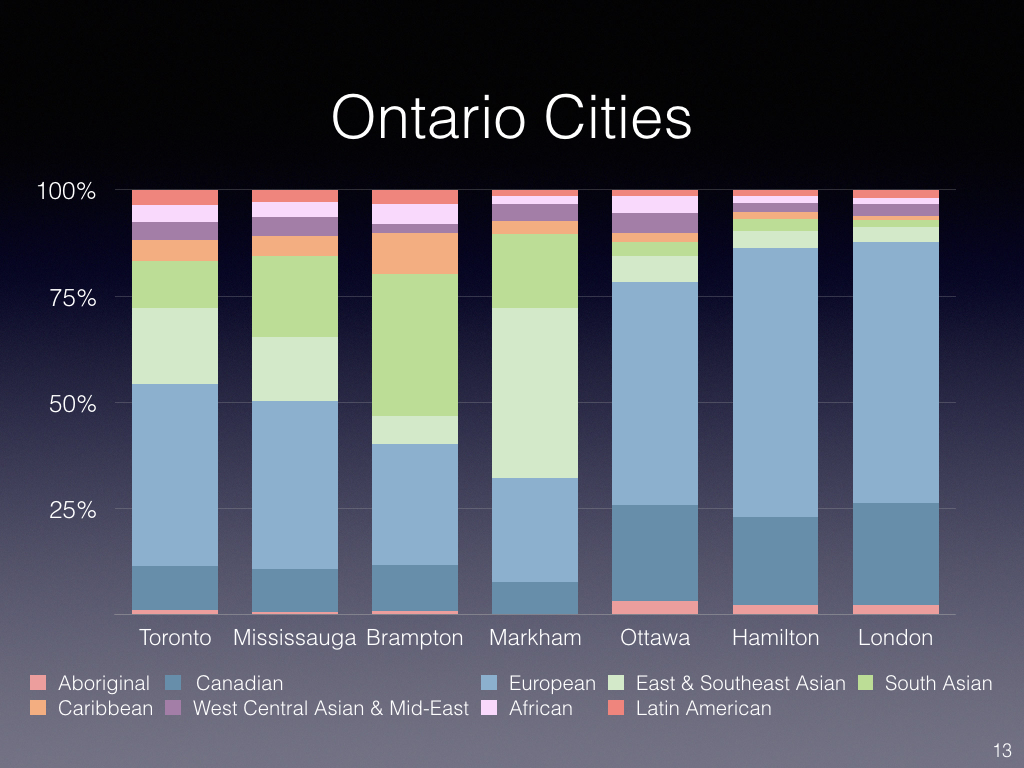
Almost seven of 10 Metro Vancouver residents will be visible minorities, or non-whites, in less than two decades, says Eric Kaufmann, a professor at University of London, Birkbeck, citing Statistics Canada projections.

In addition, Kaufmann said, University of Laval professor Patrice Dion has worked with Statistics Canada officials to develop projections that suggest Canada as a whole, at the current rate of immigration, will be almost 80 per cent non-white in less than a century.

While the rapid pace of change likely will not  hurt Canada’s economy, Kaufmann said, it will continue to have great effect on the ethnic make-up of cities such as Greater Toronto and Metro Vancouver.

These two Canadian cities and others will, in just a few years, become “majority minority,” a term describing places in which one or more ethnic minority (relative to the country’s population) make up a majority of the local population.

 A 2017 Statistics Canada report, titled Immigration and Diversity: Population Projections, forecasts the number of Canadians with visible minority status will “increase more rapidly than the rest of the population” and “could more than double by 2036 to between 12.8 million and 16.3 million.”

The cities that will have the highest levels of visible minorities by 2036 will be Greater Toronto, Metro Vancouver, Calgary, Abbotsford-Mission, Edmonton and Winnipeg.

Non-whites already make up almost half the residents of Greater Toronto and Metro Vancouver.

…Meanwhile, Canada is undergoing “the fastest rate of ethnic change of any country in the Western world,” Kaufmann said, describing how 300,000 immigrants are arriving each year in a country of 35 million people, with four in five of those immigrants being visible minorities.

“The United States’ per capita immigration rate is only one-third to one-half as fast as Canada’s. … At the same time (U.S. President Donald) Trump has promised to reduce America’s inflows by half,” Kaufmann said.

“Europe is also generally tightening inflows and only 300,000 non-Europeans enter the European Union, population 510 million, each year. Most immigrant-receiving Western European states will be at least three-quarters European origin in 2050.”

In Canada, whites currently make up about 80 per cent of the population.

Kaufmann, however, drew attention to a study led by the University of Laval’s Patrice Dion and Statistics Canada official Eric Caron-Malenfant that projects that by 2106, the vast majority of Canada’s population will be descendants of immigrants who arrived after 2006.

Assuming that four in five immigrants during that time period will continue to be non-white, Kaufmann projected that by 2106 whites will account for between 12 to 38 per cent of the population.

“I think a reasonable middle conclusion is that Canada will be 20 per cent white, 65 per cent non-white and 15 per cent mixed race by 2106,” he said.

“Canada will probably become a ‘majority-minority’ country around 2060.”

Source: Almost 7 in 10 Metro residents will be non-white in two decades | Vancouver Sun

StatCan report: Immigration and Diversity: Population Projections for Canada and its Regions, 2011 to 2036 (91-551-X2017001)

You’re Not Going to Change Your Mind – The New York Times

As someone who is always interested in how we think and process information, and a great fan of Kahneman, Thaler and Sunstein’s work on behavioural economics and nudges, found this article on the desirability bias of interest:

But what if confirmation bias isn’t the only culprit? It recently struck us that confirmation bias is often conflated with “telling people what they want to hear,” which is actually a distinct phenomenon known as desirability bias, or the tendency to credit information you want to believe. Though there is a clear difference between what you believe and what you want to believe — a pessimist may expect the worst but hope for the best — when it comes to political beliefs, they are frequently aligned.

For example, gun-control advocates who believe stricter firearms laws will reduce gun-related homicides usually also want to believe that such laws will reduce gun-related homicides. If those advocates decline to revise their beliefs in the face of evidence to the contrary, it can be hard to tell which bias is at work.

So we decided to conduct an experiment that would isolate these biases. This way, we could see whether a reluctance to revise political beliefs was a result of confirmation bias or desirability bias (or both). Our experiment capitalized on the fact that one month before the 2016 presidential election there was a profusion of close polling results concerning Donald Trump and Hillary Clinton.

We asked 900 United States residents which candidate they wanted to win the election, and which candidate they believed was most likely to win. Respondents fell into two groups. In one group were those who believed the candidate they wanted to win was also most likely to win (for example, the Clinton supporter who believed Mrs. Clinton would win). In the other group were those who believed the candidate they wanted to win was not the candidate most likely to win (for example, the Trump supporter who believed Mrs. Clinton would win). Each person in the study then read about recent polling results emphasizing either that Mrs. Clinton or Mr. Trump was more likely to win.

Roughly half of our participants believed their preferred candidate was the one less likely to win the election. For those people, the desirability of the polling evidence was decoupled from its value in confirming their beliefs.

After reading about the recent polling numbers, all the participants once again indicated which candidate they believed was most likely to win. The results, which we report in a forthcoming paper in the Journal of Experimental Psychology: General, were clear and robust. Those people who received desirable evidence — polls suggesting that their preferred candidate was going to win — took note and incorporated the information into their subsequent belief about which candidate was most likely to win the election. In contrast, those people who received undesirable evidence barely changed their belief about which candidate was most likely to win.

Importantly, this bias in favor of the desirable evidence emerged irrespective of whether the polls confirmed or disconfirmed peoples’ prior belief about which candidate would win. In other words, we observed a general bias toward the desirable evidence.

What about confirmation bias? To our surprise, those people who received confirming evidence — polls supporting their prior belief about which candidate was most likely to win — showed no bias in favor of this information. They tended to incorporate this evidence into their subsequent belief to the same extent as those people who had their prior belief disconfirmed. In other words, we observed little to no bias toward the confirming evidence.

We also explored which supporters showed the greatest bias in favor of the desirable evidence. The results were bipartisan: Supporters of Mr. Trump and supporters of Mrs. Clinton showed a similar-size bias in favor of the desirable evidence.

Our study suggests that political belief polarization may emerge because of peoples’ conflicting desires, not their conflicting beliefs per se. This is rather troubling, as it implies that even if we were to escape from our political echo chambers, it wouldn’t help much. Short of changing what people want to believe, we must find other ways to unify our perceptions of reality.

Colby Cosh: Thought Canada solved its census problems by booting Harper out of office? Think again

I found this piece by Cosh of interest as it indicates some of the less known challenges to the Census (and I am never bored by Alberta stories…):

Wow, this interim report on Alberta electoral boundaries is fascinat—

All right, I can already hear some of you saying “It’s called the NATIONAL Post, you hayseed; don’t bore us with trivia from your crummy Alberta backyard.” Well, everything happens in someone or other’s backyard. And this boundary reshuffle is an unusually consequential one—not just for the next Alberta election, but for the New Democrat cause across the country, and for the chess game of “right-wing unity” that continues to be a subplot of Canadian history.

But it really is interesting in its own right, if only for one reason. Much of the city of Fort McMurray, as you know, was destroyed by fire on May 3, 2016. The date of our country’s quinquennial census fell on May 10, 2016. This has presented an unprecedented problem for the five-person Alberta boundaries commission. And its interim report, designed to be discussed more before being finalized in October, admits that the commission does not yet have a good solution.

Door-to-door enumeration of Fort Mac on the May 10 date was impossible. A census is supposed to be a near-perfect snapshot of the country, taken at the same moment across the land. But such a snapshot of Ft. McMurray on May 10 would have returned a population of near zero, which would have obviously been useless for any policy purposes. Census respondents in the scorched city were therefore asked to report personal data pertaining to May 1, and so the figure in the census (66,573 persons) is not very realistic either—it may be little more than an accountant’s tribute to Fort Mac at a peak that it may never quite regain.

So how many Fort McMurrayites are there now? The boundaries commission asked the Alberta treasury for its own estimate—but that one is implausible too: it’s just the census figure minus about 9,000—an inference that “arises solely from the fact that 2,000 homes were destroyed in the fire.” This figure assumes that everybody who lost a home is gone from the city for good—an assumption that is patently untrue, and not much use for a commission that has to make reasonable election maps to last a decade.

So the present population of Ft. McMurray turns out to be irritatingly uncertain, and even if we knew it, no one can guess how much the city will rebound within the next year, or two, or five. The commission, trapped in a dead end of data, begs the public for “specific, reliable information upon which it could act.”

Fortunately, this problem mostly effects how two particular northern ridings will be split up, so the commission was able to devise provisional election boundaries for most of the province without worry. The rest of the report tells the typical story of a decade of Alberta population evolution. The cities of Edmonton and Calgary gain one extra seat apiece: Calgary was eligible for almost exactly one and a half, but is getting just one. The strongly Edmonton-centric NDP government will like that, but the fast-growing commuter zone between Calgary and the Rockies—a picturesque land of cowboy hipsters that is not quite “suburbia”—is also getting an extra seat.

One of the commissioners, the Carstairs businesswoman and artist Gwen Day, has filed a minority report arguing against this small (but possibly important) shift of voting power to the cities. Normally any sign of dissent within a boundaries commission is taken as a bad sign, but in this case one detects a simple determination to ignore the making of an embarrassing scene. Rural ridings everywhere in Canada often have a little extra power because of travel considerations, which ought to be weaker in abundantly-paved Alberta than they are almost anywhere else. But Day offers an entertaining novelty: “The concept of ‘one person, one vote’ is not a Canadian construct,” she argues.

She comes awfully close to saying that the votes of rural residents should count for more because rural people are more important humans. Day declares that Alberta has three kinds of economic activity: “primary industries” mostly in the countryside, “service industries” allegedly “driven by” the primary ones, and industries funded by tax dollars. I am not quite sure how department stores or Chinese restaurants fit in to this scheme, but it leads her to proclaim that “Rural Albertans control the land, access to the land and provide a significant portion of the labor force that most of our primary industries depend on.”

It is a wonder, one is left thinking, that city folk are allowed to vote at all; fortunately, the other commissioners chose not to embrace petro-agrarian fascism. I also appreciated that the majority is calling a halt to the odious practice of naming election constituencies after well-liked dead politicians, which is how we have ended up with a “Calgary-Klein” and a “Dunvegan-Central Peace-Notley” commemorating the father of the current premier.

Some Calgarians wanted to create a “Calgary-Bhullar” to commemorate Manmeet Bhullar, the young MLA killed in a road accident in 2015 while helping victims of an earlier collision. The commission said an apologetic no, noting that a school named for Bhullar is under construction, and states that electoral ridings should be given party-neutral, geographically descriptive names from now on. Manmeet Bhullar was a gem, but the commission’s suggested rule is the proper one, and its members’ resistance to sentiment should be applauded.

Evil Soros; Invisible Finkelstein-Orban’s Anti-Semitism – The Forward

Good long read on the complex relationships between Orban, Soros and Finkelstein:

At the time, conservatives and liberals from across the spectrum hailed Soros’s work.

In the difficult years of post-communist transition, Soros’s foundations provided humanitarian assistance in the form of school breakfasts and hospital equipment. Today, his foundations still provide some funding to nongovernmental organizations in Central and Eastern Europe — in particular in the human rights field. CEU, in the heart of Budapest, was designed as an English-language magnet school for Central and Eastern Europe’s best and brightest, and has become world-renowned.

 Soros, Konrád observed in his open letter to the prime minister, “devoted a considerable part of his fortune to young students’ needs, allowing the state to direct its resources elsewhere. He established a number of outstanding institutions in Hungary, even though in 1944 this land dealt with him so callously that it nearly cost him his life.”

Yet despite Orbán’s bristling against Soros as a foreign influence, his Fidesz party has been working for nearly a decade with Finkelstein, a New York-born secular Jew who is not afraid of embracing the very stereotype that Orbán deploys against Soros. Asked by Ronald Reagan biographer Craig Shirley early on in their friendship whether he pronounced his last name as “Finkelsteen” or “Finkelstine” (with a long ‘i’), the consultant replied, “If I was a poor Jew, it would be Finkelsteen, but since I am a rich Jew, it’s Finkelstine.”

Finkelstein, moreover, is a gay rich Jew, long married to a male partner. Nevertheless, the self-professed libertarian, who first imbibed his ideology as a Columbia University student directly from libertarian icon Ayn Rand, has been critical to putting in office as prime minister a man with the declared goal of converting Hungary from a liberal democracy into a more authoritarian, government-heavy “illiberal state,” one with restricted rights for gay men and lesbians. In 2014, Orbán praised Russia, Turkey and China as “successful nations…none of which is liberal and some of which aren’t even democracies.”

“I don’t think that our European Union membership precludes us from building an illiberal new state based on national foundations,” he said.

Over the decades, Finkelstein, who worked early on for Richard Nixon’s 1972 presidential campaign, has rarely let his ideology interfere with his choice of clients, as long as those clients were on the right. Some estimate that at one point in the 1980s, half of Republican U.S. senators were Finkelstein clients. But over the past two decades, Finkelstein’s focus shifted abroad, where he did his most high-profile work for Israel’s Netanyahu.

GEB International, a consultancy under the leadership of Finkelstein and fellow strategist George E. Birnbaum, has taken credit for the election of Ariel Sharon and the success of Avigdor Lieberman’s Yisrael Beiteinu party in 2009. Finkelstein also reportedly orchestrated the 2012 alliance between Likud and Yisrael Beiteinu.

Through GEB International, Finkelstein has been providing consulting services to Fidesz since 2008, helping shape the party’s strategy in both local and national elections, including its control of a two-thirds majority in parliament.

Finkelstein’s successes — in the United States, Israel and Central Europe — can be attributed in large part to his approach to political communication.

“He likes campaigns that have signature issues, where the candidate would be known for one issue or a series of related issues,” Shirley said.

This approach has been evident in Orbán’s campaigns, which often focus on one simple message repeated over and over again — as has been the case with the prime minister’s repeated attacks on Soros.

…Orbán’s relationship with Hungary’s Jewish community, estimated at roughly 120,000 people in a country of 10 million, is complex. According to a recent survey, about 37% of Hungarians hold anti-Semitic views, telling pollsters that they “agree” or “completely agree” that “there’s too much Jewish influence in Hungary.” This was an increase from previous years: In 2013, only 27% gave positive replies to this question.

Growing up outside Budapest, Orbán likely had little exposure to Jews, who reside primarily in Budapest, before he moved to the capital to attend university. When he initially began his political career as a young, liberal anti-Communist in the late 1980s, however, he befriended Jewish Hungarian intellectuals and dissidents. Unusual for a Hungarian not of Jewish origin, Orbán’s eldest daughter, born in 1989, was given the Hebrew name Ráhel.

But very few Hungarian Jews supported Orbán’s nascent political party, and as Orbán began moving more and more to the right and adopting a nationalist stance, he alienated much of the Jewish community.

“During the [2013] World Jewish Congress in Budapest… Orbán spoke about ‘us’ the Hungarians and the ‘Jews,’” Pfeifer recalled. In the United States, he pointed out, it would be unimaginable for a sitting president to refer to “Americans” and “Jews” as separate groups.

For many Hungarian Jews, Orbán crossed a red line in 2014, when his government constructed a memorial to the “victims of German occupation” that many, including the U.S. State Department, saw as rejecting Hungary’s own complicity in the Holocaust. The Jewish community has since set up a permanent informal memorial to the victims of the Holocaust as a protest against what it sees as the government’s distortion of history.

But Orbán’s rhetoric on Soros over the past months has raised new concerns about government-sponsored anti-Semitism.

Konrád told Orbán in his open letter, “The real turning point for me was that, in the interest of the arbitrary extension of your power, you dipped into the hypocritical repository of political anti-Semitism and pulled out its shrill slogans with both hands.”

Not everyone shares this view.

“Prime Minister Viktor Orbán’s policies aren’t anti-Semitic at all,” the Federation of Hungarian Jewish Communities, known as MAZSIHISZ, said in a statement to the Forward. “His government supports the large Jewish organizations in achieving their goals, the Jewish community is not a victim of any kind of official discrimination, and there’s no real chance that it will change in the foreseeable future.”

Similarly, Slomó Köves, executive rabbi of EMIH Unified Hungarian Jewish Congregation, an affiliate of Chabad, told Hungarian state media May 12 that he “does not know of an internationally accepted norm” by which anti-Soros rhetoric is considered anti-Semitism.

Both Köves’s Chabad operation in Hungary and MAZSIHISZ receive significant funding from the government. Köves did not respond to emailed questions from the Forward.

Source: Evil Soros; Invisible Finkelstein-Orban’s Anti-Semitism – The Forward

Douglas Todd: Some immigrants’s values contrast with ‘Canadian’ values

The fallacy in Todd’s article and related analysis is his assumption that values are static, not dynamic. Values can and do change  over time and over generations.

The Canadian benchmark in the World Values Survey includes the 20 percent of the population which is foreign-born as well as the 17 percent who are second generation immigrants. In other words, the Canadian baseline is not “old-stock” white Canadians but a mix of “old” and “new” stock.

So what he presents as a duality is actually a more complex mix that emerges through the Hegelian integration dynamic between immigrants (first and second generation) and the increasingly diverse “host” society.

Todd’s analysis also assumes that first generation immigrants have completely identical values than the population of their country of origin, which may or may not be true given that Canada tends to select more highly educated immigrants.

That is not to say that there are no value differences among groups on any range of issues, but just caution against overly simplistic depictions and assumptions:

In his unscientific yet credible book, McGoogan considers how the nine million Canadians who claim Scottish or Irish heritage have strengthened certain values in Canada — such as “independence” (exemplified by rebel Michael Collins), pluralism (exemplified by gay writer Oscar Wilde and mixed-race B.C. governor Sir James Douglas) and “democracy” (exemplified by egalitarian poet Robbie Burns and prime minister Sir John A. McDonald).

“Did the ancestors of more than one-quarter of our population arrive (in Canada) without cultural baggage? No history, no values, no visions?” McGoogan asks. “Surely the idea is ridiculous.”

Indeed, it’s absurd many Canadians assume people arrive from Ireland, Egypt or China without both individual and ethno-cultural traits.

So it’s especially worthwhile to learn about values widely held in Canada’s biggest immigrant-source countries.

The top sources of immigrants to Canada include China, India, South Korea, Iran and the Arabic-speaking countries of the Middle East, all of which have had their values measured by the WVS.

How do the values emphasized in these countries play out in Canada’s major cities, where the potential for inter-cultural exchange is high in schools, businesses and neighbourhoods?

We’ll start with Montreal, where one of five residents is foreign born, many from Arabic-speaking countries.

A particularly valuable question the WVS asks parents is: “What qualities would you most like to see in your children?”

As The Vancouver Sun and Province’s online interactive chart shows, it turns out more than 65 per cent of parents from Arabic-speaking countries, such as Egypt, Jordan and Iraq, strongly stress “obedience.”

However, only 30 per cent of Canadian parents name “obedience” as an important quality, suggesting the contrast could make for intriguing interactions in Montreal schools.

What do we discover when we turn to Metro Vancouver and Toronto, where foreign-born people make up almost half the population and two of the largest immigrant-source countries are China and India?

It turns out only 16 per cent of parents in China strongly emphasize obedience. But the stress on obedience rises to 56 per cent among mothers and fathers in India.

What about “hard work?” It can determine success in the competitive fields of education and business, not to mention in whether a potential friend goes skiing?

The WVS found 90 per cent of parents in China say hard work is a crucial value. That emphasis declines slightly among the parents of India. Meanwhile, the proportion of all Canadian parents who want their children to work hard is only 54 per cent.

However, Canadian parents are not too different from the parents of China and India in regards to “unselfishness.” While 47 per cent of Canadian parents emphasize unselfishness, so do 35 per cent of Chinese and Indian parents. That’s unlike South Korean parents, only 12 per cent of whom stress the virtue of self-sacrifice.

The lesson of the WVS is that values are all over the map, literally.

And it’s especially true when it comes to religion.

More than nine of 10 parents in the Muslim-majority countries of Egypt and Iraq, for instance, strongly emphasize “religious faith.”

But fewer than one in 10 parents in Germany and China — and just three in 10 in Canada ­— care if their children believe in God.

The World Values Survey, like all polls, is imperfect, missing subtleties and regional variations. But it’s a reminder the sooner we take ethnocultural differences seriously, the sooner we become knowledgeable about why people are the way they are.

The implications can be significant. We may start to recognize, for instance, why people with roots in China tend to vote for certain Canadian political parties, while those linked to India are inclined to vote for others.

And — unless we’re utter moral relativists — the sooner we understand ethnocultural differences, the sooner we might take seriously the values we ourselves are ready to stand for, reject or tolerate.

Source: Douglas Todd: Some immigrants’s values contrast with ‘Canadian’ values | Vancouver Sun

Whether it’s a nick or full circumcision, female genital mutilation is about control: Paradkar 

Paradkar on FGM and the Dawoodi Bohras, a small sect of Ismaili Shia Muslims from India and Pakistan:

Circumcision of boys, a controversial and emotionally charged topic, is almost always by medical doctors (and not by a razor blade in a dark room), so you could say there is some comfort in a reduced risk of harm.

Science scrambled to catch up with that cultural practice and has thrown up contradictory results.

Female circumcision has no known medical benefits.

Then there is an added insult in the Bohra community. Circumcision of boys is openly celebrated. For girls, “it’s a very secretive practice,” says Doctor. “Often, the men don’t even know it’s happening to their daughters.”

So shrouded is it in secrecy that a celebration held after the cutting doesn’t even mention the girl has undergone khatna, the circumcision.

Get wounded, then hide in shame.

Like parents who circumcise their boys, women do this to their girls believing it to be in their interest.

In reality, in whose interest is it?

“It does damage to nerve endings,” says Doctor. “There’s psychological harm that makes them (women) afraid of sex. There’s pain during sex, risk of infections.”

Stories by affected women indicate it’s about male sexual insecurities.

“When a woman’s urge is moderated, many sins are eliminated from society,” says a young woman in A Pinch of Skin.

Urge to do what? To seek attention? To have sex? To have orgasms?

There’s no clarity on this, because talking about sex is taboo, as is talking about genitals.

The taboo allows for vagueness to conveniently mask what is essentially a caging of female desire.

Circumcision, whether it’s a symbolic nick, as some now claim, or a removal of the clitoral hood or clitoris, is a mark of sexual control over female bodies in this traditionally entrepreneurial culture where men travelled far as traders and were away from their wives and families for a long time.

It’s an interference that hoodwinks women into confining little girls in a chastity belt.

No such restraints for the travellers.

Source: Whether it’s a nick or full circumcision, female genital mutilation is about control: Paradkar | Toronto Star

Manchester attack: It is pious and inaccurate to say Salman Abedi’s actions had ‘nothing to do with Islam’ | The Independent

Patrick Cockburn on Salafism and Saudi Arabia’s role in spreading fundamentalism. Bit over the top in terms of wording used, but basic point about Saudi Arabia’s role valid:

In the wake of the massacre in Manchester, people rightly warn against blaming the entire Muslim community in Britain and the world. Certainly one of the aims of those who carry out such atrocities is to provoke the communal punishment of all Muslims, thereby alienating a portion of them who will then become open to recruitment by Isis and al-Qaeda clones.

This approach of not blaming Muslims in general but targeting “radicalisation” or simply “evil” may appear sensible and moderate, but in practice it makes the motivation of the killers in Manchester or the Bataclan theatre in Paris in 2015 appear vaguer and less identifiable than it really is. Such generalities have the unfortunate effect of preventing people pointing an accusing finger at the variant of Islam which certainly is responsible for preparing the soil for the beliefs and actions likely to have inspired the suicide bomber Salman Abedi.

The ultimate inspiration for such people is Wahhabism, the puritanical, fanatical and regressive type of Islam dominant in Saudi Arabia, whose ideology is close to that of al-Qaeda and Isis. This is an exclusive creed, intolerant of all who disagree with it such as secular liberals, members of other Muslim communities such as the Shia or women resisting their chattel-like status.

What has been termed Salafi jihadism, the core beliefs of Isis and al-Qaeda, developed out of Wahhabism, and has carried out its prejudices to what it sees as a logical and violent conclusion. Shia and Yazidis were not just heretics in the eyes of this movement, which was a sort of Islamic Khmer Rouge, but sub-humans who should be massacred or enslaved. Any woman who transgressed against repressive social mores should be savagely punished. Faith should be demonstrated by a public death of the believer, slaughtering the unbelievers, be they the 86 Shia children being evacuated by bus from their homes in Syria on 15 April or the butchery of young fans at a pop concert in Manchester on Monday night.

The real causes of “radicalisation” have long been known, but the government, the BBC and others seldom if ever refer to it because they do not want to offend the Saudis or be accused of anti-Islamic bias. It is much easier to say, piously but quite inaccurately, that Isis and al-Qaeda and their murderous foot soldiers “have nothing to do with Islam”. This has been the track record of US and UK governments since 9/11. They will look in any direction except Saudi Arabia when seeking the causes of terrorism. President Trump has been justly denounced and derided in the US for last Sunday accusing Iran and, in effect, the Shia community of responsibility for the wave of terrorism that has engulfed the region when it ultimately emanates from one small but immensely influential Sunni sect. One of the great cultural changes in the world over the last 50 years is the way in which Wahhabism, once an isolated splinter group, has become an increasingly dominant influence over mainstream Sunni Islam, thanks to Saudi financial support.

The culpability of Western governments for terrorist attacks on their own citizens is glaring but is seldom even referred to. Leaders want to have a political and commercial alliance with Saudi Arabia and the Gulf oil states. They have never held them to account for supporting a repressive and sectarian ideology which is likely to have inspired Salman Abedi. Details of his motivation may be lacking, but the target of his attack and the method of his death is classic al-Qaeda and Isis in its mode of operating.

The reason these two demonic organisations were able to survive and expand despite the billions – perhaps trillions – of dollars spent on “the war on terror” after 9/11 is that those responsible for stopping them deliberately missed the target and have gone on doing so. After 9/11, President Bush portrayed Iraq not Saudi Arabia as the enemy; in a re-run of history President Trump is ludicrously accusing Iran of being the source of most terrorism in the Middle East. This is the real 9/11 conspiracy, beloved of crackpots worldwide, but there is nothing secret about the deliberate blindness of British and American governments to the source of the beliefs that has inspired the massacres of which Manchester is only the latest – and certainly not the last – horrible example.

Source: Manchester attack: It is pious and inaccurate to say Salman Abedi’s actions had ‘nothing to do with Islam’ | The Independent

Australia: Turning statistics into art: Exhibition explores multiculturalism, changing landscapes through numbers | SBS News

Interesting approach and exhibit, and link to Indigenous peoples:

A new art exhibition will explore the changing faces – and numbers – behind one of Australia’s biggest multicultural districts.

The exhibition ‘looking at me through you’ enlisted a group of artists to incorporate statistics from Deloitte Access Economics into a series of contemporary art pieces that reflect and challenge people’s perceptions of greater Western Sydney.

Campbelltown Arts Centre will showcase the works from May 27 to July 23.

“We asked 12 artists to look at Western Sydney through statistics, which are very neutral and subjective, and come up with some ways to tell the Western Sydney story through contemporary art,” director Michael Dagostino said.

“Rather than looking at the negative stereotypes that are portrayed in the media and other people’s lenses, we look through it and say ‘look, there’s different possibilities’.”

The pieces include models, portraits and short films exploring multiple themes unfolding throughout Campbelltown and beyond, ranging from urban development to political and cultural identity.

Artist James Nguyen chose to focus on the changing nature of land usage by creating a communal herb garden in the Arts Centre’s amphitheatre, inspired in part by his Vietnamese heritage.

“When you’re a migrant one of the first things to prove that you’re a contributing member of society is to acquire land, to build your own home, start your family,” he said. “So it’s that whole thing of linking success to settlement.”

But Nguyen added that many migrants ignore the history of the land they now occupy.

“A lot of migrants feel they don’t have the responsibility of acknowledging Aboriginal sovereignty,” he said.

“The reality is you have to deal with the histories that are already there. As migrants, I think there’s a role for us to acknowledge that sovereignty.”

Damien Shen, an artist of Chinese and Indigenous descent, was also keen to illustrate Campelltown’s Indigenous history and legacy.

After meeting with local elder Aunty Glenda Chalker, he painted portraits of her, along with her son and grandson.

“I’ve always been fascinated with people’s faces,” he said. “The history is often in the skin.

“You see the face, you’re looking into the eyes, and you can almost get a sense of what someone’s soul is like. I find it quite gripping.”

Source: Turning statistics into art: Exhibition explores multiculturalism, changing landscapes through numbers | SBS News

Smothering the burning embers of terrorism: Sears 

Good and balanced commentary:

Canada had been astonishingly blessed to be mostly free of all but a few murders by angry young men mimicking serious terrorists — so far. But that is surely not a predictor of our future. Those more brutally stung by repeated attacks have moved far ahead of us in radicalization prevention, at-risk youth outreach, monitoring and countering incitement rhetoric online, in school, and in the community.

It is way past time that we made compulsory again the study of civics, in every elementary school year. A program of learning on the responsibilities of citizenship, on why a socially tolerant Canada is the only path to a safer Canada, on the story of the giants of our history on whose shoulders we stand, having been bequeathed this blessed, but always fragile, new nation.

This is not about attacks on other communities, other cultures, disguised as a “discussion about Canadian values.” Nor is it jeremiads like Supreme Court Justice Abella’s against “narcissistic populism” as powerful as they have been. It’s about demonstrating to everyone the meaning of the shared responsibilities of citizens in our democracy, and those we have to each other. What Toronto political sage Bill MacDonald has so elegantly dubbed the “Canadian culture of mutual accommodation.”

As we celebrate our 150 years of success in building a new form of nationhood, we cannot let our pride blind us to its perennial fragility. Canadian religious and public safety leaders, for example, need to deepen their conversations about the boundaries between acceptable and illegal hate speech, develop stronger models of shared engagement focused on mutual education and prevention, not merely surveillance and arrest.

Perhaps most important of all, Canadian business, civic, and community leaders need to make it clear to politicians and pundits who use racial, religious and ethnic divisions for votes or clicks, just how certain will be the destruction of their reputations and careers.

For it is not insensitive to the suffering of the Manchester families of the children who were victims of this latest atrocity to remember this: it is how we react to attack that is the path to less terror. We invest in prevention, we make punishment certain, and we double down on the peddlers of hate.

Perhaps with a deeper commitment to prevention our day will never come. But as the Japanese cliché has it, “People don’t learn from experience, only from catastrophe.” If, despite all our efforts, the one-time we fail leads to tragedy, we must ensure that our defiance in the face of attack includes a resolute commitment to the open inclusive Canada that so much blood was shed to build and to guarantee.

Source: Smothering the burning embers of terrorism: Sears | Toronto Star

USA: Why Colleges Already Face Race-Related Challenges In Serving Future Students : NPR

Good analysis, showing ongoing stratification in post-secondary education and an interesting nuance of the Asian American ‘myth of being a model minority’:

Today, more Americans graduate high school and go on to college than ever before. But as the country becomes more diverse — the Census Bureau expects that by 2020 more than half of the nation’s children will be part of a minority race or ethnic group— are colleges and universities ready to serve them?

“If you look at the past 50, almost 60 years, you see we have made a lot of progress as a country in terms of high school seniors deciding to go to college in the 1.5 years after graduating,” says Andrew Nichols, director of higher education research and data analytics at the Education Trust, a nonprofit. “And that isn’t just white students. It’s also for black and Latinos. You’re seeing that increase for everybody.”

The National Center for Education Statistics reports that in 2015, 88 percent of seniors – nearly 3 million students – graduated high school. By the following October, 69 percent of them – or more than 2 million people – were enrolled in college.

But where are they attending? And do they graduate?

The same is true for Asian Americans, says Robert Teranishi, a professor of education at UCLA and the director of the National Commission on Asian American and Pacific Islander Research in Education (CARE). The largest concentration of Asian-American students – about half – attends community colleges, he says. It’s also where enrollment of Asian Americans is increasing the fastest.

But because community colleges have low six-year graduation rates (39 percent according to a report by the American Association of Community Colleges), this means that few of those students will actually earn degrees. “The problem is there’s not a lot of expansion in higher education,” Teranishi says. As a result, some students end up in subpar schools where they may never earn a degree. “A lot of students are relegated to two-years or they’re ending up in four-year institutions that are not doing a good job at helping students succeed and earn a degree,” he says. “They’re being set up in a bad situation.”

Meanwhile, the nation’s selective institutions — the Ivy Leagues and flagship public universities — are becoming even more selective, and remaining mostly white. According to the 2013 report “Separate & Unequal” from the Georgetown Center for Higher Education and the Workforce, since 1995, 80 percent of America’s white college students have enrolled in the country’s 468 most well-funded, selective four-year colleges and universities. These schools spend two to nearly five times as much per student as do the 3,250 less resourced, open-access colleges (which do not require applications) where students of color are concentrated.

The study also found that while inequalities of race and class overlap quite a bit, race has a distinctive negative effect. Even after controlling for academic achievement in high school, black and Latino students attend selective institutions at far lower rates and drop out of college more often.

As a result, whites have higher graduation rates and are more likely to attain advanced degrees and higher future earnings, even among equally qualified students. Anthony Carnevale, the director of the center and one of the authors of the report, told NPR in 2013 that, “We found … that while more and more minorities are going on to college, that the system itself was becoming even more unequal. That is, we were getting more and more access, and access was bringing more and more inequality, and the inequality mattered.”

For Asian Americans, a false perception persists that they’re universally high achieving. Teranishi says that they’re treated as a homogenous group even though there are many ethnic subgroups, and that there’s not enough data tracking subgroups. A 2011 report by CARE found that up to two-third of Southeast Asians and Pacific Islanders in the United States don’t have any form of post-secondary education and that for the ones who do enter college, half drop out.

“They’re generally overlooked and underserved when it comes to college opportunity programs, college access, or even student services or programs on campus,” Teranishi says. “And really, it’s rooted in this model-minority myth. There’s not a lot of understanding about their actual experiences or outcomes.”

Teranishi finds it disconcerting that Asian Americans are used as a wedge group against other people of color and says these claims of discrimination have scant evidence. “It’s not like Harvard can admit every student who is in the top of their class with a 4.0 GPA or who has a perfect SAT. That outnumbers the number of students Harvard admits each year. There’s a lot more criteria involved in the selection process,” he says.

“The other thing that concerns me is that this narrative … removes Asian Americans from the broader discourse about the importance of diversity and equity in higher education. So that’s concerning because Asian Americans, like other students, they benefit from being exposed to students of other racial backgrounds.”

Several studies have shown that diverse student bodies benefit students of all races by improving intellectual engagement, citizenship, and cognitive skills. The positive effects stay with them even after they graduate college.

Source: Why Colleges Already Face Race-Related Challenges In Serving Future Students : Code Switch : NPR