Working at Anheuser-Busch, I Saw What Went Wrong With the D.E.I. Movement

Although written by someone connected to anti-DEI republicans, a cautionary note on the need to understand brand values and identity in any DEI initiatives.

But of course, it neglects the risks associated with not broadening values and identity, not to mention the ethnics and morals of just catering to the base:

I still remember the day I realized Anheuser-Busch InBev was no longer the company I thought it was.

I had crunched the numbers and believed the company could make millions of dollars if we agreed to distribute canned coffees made by Black Rifle Coffee Company. I knew Black Rifle’s pro-military and pro-law-enforcement messaging could ruffle some progressive feathers — the company vowed to hire 10,000 veterans after Starbucks announced it would hire 10,000 refugees — but I also knew many of our drinkers shared those values and had grown fed up with the way Starbucks and other coffee companies seemed to cater to coastal, latte-loving elites.

The proposal was rejected. It was early 2022, two years after the George Floyd protests, and I was told that being associated with Black Rifle was too politically provocative, especially in progressive circles.

I should have seen it coming. Many corporations were flexing their credentials in the growing diversity, equity and inclusion movement. But for me, the incident was a particularly telling example of what was going wrong with Anheuser-Busch — and an early sign that too many American corporations had forgotten who their customers were.

To be clear, I believe that an employee base that has a diversity of thought — which is naturally associated with a diversity of ethnicities and backgrounds — is good for business. Different employees can better solve existing problems or identify new opportunities. But the massive corporate embrace of D.E.I. was always destined to fail, in large part because the movement was never well defined to begin with.

In 2019, I learned about the concept of D.E.I. at a meeting in Chicago from Frances Frei, a professor at Harvard Business School. I had no issue with what she described. Anheuser-Busch’s work force had become more diverse over the past decade, and I had watched employees of many backgrounds be given opportunities to grow based on their talents and contributions. If D.E.I. was about continuing this trajectory — being authentic to company culture and mission, listening and responding to customer needs and deploying logical processes — there was nothing to object to.

Unfortunately, the D.E.I. policies that followed at Anheuser-Busch were none of the above. In 2021 the company started using online dashboards that gave managers a breakdown of their employee base by demographic characteristics.

Then the company created annual performance targets linked to the company’s environmental, social and governance strategy, of which D.E.I. was one component, for thousands of employees. It was clear to me that if teams didn’t check the right boxes, managers could be punished. Promotions could be withheld. Bonuses could be lost. That year, senior executives, including me, attended weekly meetings to discuss D.E.I. initiatives. These meetings often distracted from more critical business matters, like the fact that the company risked losing employees as the Great Resignation set in. (Anheuser-Busch declined to comment for this article.)

Anheuser-Busch was hardly alone. At least 70 big companies — from Airbnb to G.E. — had set public targets for gender diversity hiring. Among the worst examples of efforts to accomplish D.E.I. goals was a diversity training course offered to Coca-Cola employees via a third-party platform that urged workers to “be less white,” which the presentation helpfully defined as being “less oppressive,” “less arrogant” and “less ignorant.” A course in Kentucky reportedly told nurses that “implicit bias kills,” that white privilege is a “covert” form of racism and that nurses may contribute to “modern-day lynchings in the workplace.”

I was already considering leaving Anheuser-Busch before the Black Rifle distribution idea was turned down. Once it was, I was certain it was time to go.

I accelerated efforts to start a fund with my high school friend Vivek Ramaswamy (who would become a Republican candidate for president). As many big asset managers were pushing D.E.I. onto the companies they were investing in, we decided to start a fund that would help its companies avoid the mistakes I’d seen at Anheuser-Busch. Raising money from Bill Ackman, Peter Thiel and others, we finalized our seed investment round at the end of February 2022, and I resigned from the company in March.

A year later, Anheuser-Busch became the poster child of what went wrong with the D.E.I. movement. In April 2023, the transgender influencer Dylan Mulvaney promoted Bud Light on social media by dressing up like Audrey Hepburn and drinking from a can of the beer.

While it was a small sponsorship by Bud Light standards, it was still puzzling. Transgender rights were a political lightning rod in many states, especially red ones, where Anheuser-Busch enjoyed high market share. And while Bud Light was in decline at the time and needed new marketing strategies to regain customers, it became America’s biggest beer brand largely by keeping its marketing away from political controversies. It was enjoyed by Democrats and Republicans for precisely that reason.

But what about Black Rifle? That was a distribution deal — trucks that delivered Bud and Bud Light would also carry Black Rifle to retailers like Walmart and 7-Eleven. That is very different from a sponsorship, in which a brand chooses to publicly associate itself with something or someone to burnish itself. Many know that Pepsi sponsored Beyoncé’s Super Bowl performance, but far fewer can probably identify which products its trucks deliver. Black Rifle’s sales have grown since I suggested that deal; loyal fans rewarded its authenticity and dedication to its mission. These days, its products are carried in Dr Pepper trucks.

The Mulvaney promotion generated enormous conservative ire. Commentators called for boycotts that hurt the company’s sales. Yet the company also caught flak from some on the left who felt the company should have been more vocal in its support of Ms. Mulvaney.

Bud Light couldn’t win. The sponsorship never should have happened. Ms. Mulvaney herself said, “For a company to hire a trans person and then not publicly stand by them is worse in my opinion than not hiring a trans person at all.”

I’m not saying that hiring a transgender influencer is wrong. The ice cream maker Ben & Jerry’s, for example, is famously, proudly progressive. Its customers wouldn’t bat an eye at a Mulvaney sponsorship, and the company could have stood by Ms. Mulvaney if conservatives complained, strengthening both its mission and the L.G.B.T.Q. rights movement.

And that’s a good thing. I have no issue with companies having a progressive mission and authentically sticking to it. Capitalism allows, even incentivizes, companies to compete for customers with different tastes.

But the D.E.I. movement demanded that companies pursue the same progressive goals, regardless of their mission and culture. When Anheuser-Busch embraced D.E.I., the partnership felt inauthentic. And that’s why it backfired.

Since he took office, President Trump has wasted no time dismantling D.E.I. policies in the public and private sectors. Many companies, including Tractor Supply Company and Harley-Davidson, began rolling back D.E.I. policies before he was elected. Meta, Target, Goldman Sachs and others have followed suit, and hiring quotas, racial equity audits and exclusionary benefits programs seem to present stronger legal risks to companies still pursuing them.

You can see how performative many companies were in their imposition of D.E.I. policies simply by how quickly they have retreated from those policies. And their demise was well underway before the election. No one wanted to become the next Bud Light.

I believe Mr. Trump is off to a good start. But it is much easier for him to issue an executive order ending D.E.I. programs in government than it is to end them in the private sector. Much of that work will have to come from corporate America.

The principles that built great American companies are simple: Hire the best people, serve your customers well and let merit and financial results determine success. While expanding opportunity and making employees feel welcome are worthy goals, how D.E.I. policies were carried out often strayed from these foundational principles and might have even created other forms of discrimination.

Today companies have an opportunity to demonstrate how true inclusion works: by judging people as individuals, not as members of groups.
Source: Working at Anheuser-Busch, I Saw What Went Wrong With the D.E.I. Movement

Quebec: Les immigrants décrochent une note presque parfaite au test des valeurs 

Not surprising, as persons prepare for these tests, just as they do for the Canadian citizenship test. But it does weaken the political argument that immigrants do not share common values:

Le test des valeurs imposé aux candidats à l’immigration permanente continue de battre des records de réussite au Québec. Bon an mal an, depuis son instauration, le taux de réussite de l’évaluation frise les 100 %.

Depuis le 1er janvier 2020, les personnes qui souhaitent obtenir leur résidence permanente à travers les programmes d’immigration économique du Québec doivent obtenir une attestation d’apprentissage des valeurs démocratiques et des valeurs québécoises. Ces programmes représentaient environ 70 % de toutes les admissions planifiées en 2023.

Il y a deux manières d’obtenir cette attestation, soit par un cours appelé Objectif intégration, soit par l’évaluation en ligne, préférée par la grande majorité des candidats à l’immigration.

Des 28 571 personnes qui ont fait l’évaluation en ligne entre avril 2023 et janvier 2024, c’est 99,79 % d’entre elles qui l’ont réussie. Les trois années précédentes, ce taux était encore plus élevé, à quelques centièmes de pourcentage près, selon une demande d’accès auprès du ministère de l’Immigration, de la Francisation et de l’Intégration (MIFI). Les données pour 2024-2025 doivent être dévoilées dans les prochaines semaines.

Les immigrants et les membres de leur famille ont droit à trois essais pour réussir le test, ce qui se fait en obtenant 15 bonnes réponses sur 20 questions (75 %). En cas d’échec à la deuxième tentative, un candidat peut assister à une session d’Objectif intégration. Ce cours dure 24 heures et donne souvent droit à une aide financière de 230 $ du MIFI. Ceux qui suivent toute cette formation obtiennent automatiquement l’attestation à présenter dans leur demande de Certificat de sélection du Québec.

Les questions de l’évaluation sont tantôt théoriques, tantôt des mises en situation, et offrent toujours des choix de réponse. On peut par exemple y demander si, vrai ou faux, les femmes et les hommes ont les mêmes droits au Québec. Une question présentée en exemple dans le guide pratique du MIFI pour aider à la préparation évalue les connaissances sur la discrimination : « Identifiez la ou les situations où il y a discrimination. Refuser un emploi : – À une femme en raison de sa grossesse. – À une personne qui n’a pas le diplôme requis. – À une personne à cause de son origine ethnique. »

Vers une révision ?

Le projet de loi 84, appelé « Loi sur l’intégration nationale », a été déposé à la fin janvier et il est présentement à l’étude en commission à l’Assemblée nationale. Lors du dépôt, le ministre de l’Immigration, Jean-François Roberge, avait évoqué que le test des valeurs pourrait « être révisé, être mis à jour ».

Le cours d’intégration, actuellement une autre option que le test, pourrait aussi être refait, voire devenir obligatoire. « On reverra les modalités, le contenu du cours. Est-ce que ces cours seront obligatoires ? Combien de temps ça prend ? Il pourra y avoir des obligations, on va les détailler plus tard, mais je ne l’écarte pas », avait-il déclaré devant les médias lors du dépôt.

À ce jour, une minorité de candidats à l’immigration a préféré le cours au test des valeurs. Entre 2020 et 2024, ce sont 6677 d’entre eux qui y ont assisté en vue d’obtenir leur attestation d’apprentissage des valeurs démocratiques et des valeurs québécoises.

M. Roberge a défendu le projet de loi devant les critiques, en disant vouloir créer un nouveau « contrat social », une « responsabilité partagée », au sein desquels les nouveaux arrivants auraient à contribuer aux principes fondamentaux du Québec.

LES VALEURS EN QUESTION

Elles ont été regroupées autour de cinq clés pour « mieux comprendre le Québec », explique aussi le cahier de préparation :

  1. Le Québec est une société francophone.
  2. Le Québec est une société démocratique.
  3. L’égalité entre les femmes et les hommes
  4. Les droits et les responsabilités des Québécoises et des Québécois
  5. Le Québec est une société laïque.

Source: Les immigrants décrochent une note presque parfaite au test des valeurs

Wright: Canadians don’t want to be the 51st state – and Americans don’t really want us

Another cathartic column for Canadians:

Canadians owe Donald Trump a debt of thanks. His musings about Canada becoming the 51st state have reminded us why we are Canadians in the first place and why we want to remain Canadians.

Still, it’s worth thinking about some of the legal steps to, and political implications of, a possible Canadian statehood.

First, Canada is a constitutional monarchy. To join the United States, it would have to become a republic. While that’s not impossible, it wouldn’t be easy. Amending the Canadian Constitution in relation to the King or Queen requires unanimous provincial consent. When was the last time all 10 provinces agreed on anything?

And what about Indigenous Peoples

Meanwhile, there are 634 First Nations governments – each with their own relationship with Canada or the Crown. Indeed, one of the mandates of the Department of Crown-Indigenous Relations and Northern Affairs is to recognize and implement “treaties concluded between the Crown and Indigenous Peoples.”

If it’s difficult to imagine Indigenous Peoples agreeing to give up their treaty rights, it’s equally difficult to imagine the U.S. negotiating new treaties and nation-to-nation relationships with 634 First Nations.

For its part, Quebec will never agree to give up the substantial power and real sovereignty it has as a province, even if every other province agreed to – which they won’t. In defence of their borders and the French language, Quebecers would likely secede from Canada long before any serious move towards Canadian statehood – and who could blame them?

Of course, this assumes that American lawmakers want a 51st state – and they don’t. Certainly, Republican lawmakers don’t, for the same reason they don’t want Puerto Rico and Washington, D.C. to become states.

Each state has two senators and it’s a safe bet that both Canadian senators would be Democrats or be from a separate party that would caucus with the Democrats. The GOP cannot risk becoming a minority in a closely divided Senate.

When Hawaii joined as the 50th state in 1959, there was a lot of handwringing, especially in the Jim Crow South. For example, a Mississippi senator insisted that Hawaii’s admission would mean “two votes for socialized medicine, two votes for government ownership of industry, two votes against all racial segregation and two votes against the South on all social matters.”

Canada: A potential Republican wasteland 

Republican senators have similar arguments against admitting Canada – two votes for universal, single-payer health care, two votes for abortion rights, two votes for LGBTQ+ rights, two votes for multiculturalism, two votes for science, two votes for vaccines, two votes for climate policies and two votes against tax cuts for the wealthy.

Each U.S. state also has members in the House of Representatives, according to its population. If Quebec doesn’t secede, Canada would be the most populous state in the U.S., giving it as many as 55 seats in the House which, with Canada’s admission, would have about 490 seats. If Quebec does secede, Canada would be the second most populous state, giving it as many as 45 seats.

Not all Canadian representatives would be Democrats or from a party that would caucus with them, but the majority would be, providing the Democratic Party with control over the House of Representatives into the foreseeable future.

Finally, the White House: Does anyone really think that Canadians would vote for the Republican Party in its current incarnation? Some would, but the majority wouldn’t.

In the last federal election, about 60 per cent of Canadians voted for the Liberals, the NDP, the Bloc Québécois or the Green Party – all centre and centre-left parties. Even if Quebec secedes, most Canadian voters still lean centre or centre-left.

In America’s winner-takes-all presidential election, Canada’s roughly 50 electoral college votes would go to the Democratic candidate, not enough to guarantee a Democratic victory when approximately 590 electoral votes would be up for grabs, but enough to permanently narrow the GOP’s path to victory.

If Canada does become part of the United States, it won’t be as a state. It will be as an occupied territory and occupations never end well for the occupier – something Americans understand after 20 years in Afghanistan and Iraq.

Bottom line: Canadians don’t want to become the 51st state and the Americans don’t want us anyways, which leaves us with Donald Trump, a troll with a large following on social media trying to own the libs and get under our skin.

My advice? Ignore him and get on with the related tasks of peace, order and good government and managing the economic fallout of his tariffs.

Source: Canadians don’t want to be the 51st state – and Americans don’t really want us

Jamie Sarkonak: Federal bureaucrat-activists strike again with ‘Understanding Islamophobia’ guide

Unfortunate but typical framing by the NP.

It is valid for the federal government to prepare such a primer, just as it was valid for the government to prepare its Canadian Handbook on the IHRA Working Definition of Antisemitism.

One of the omission in these types of documents is that they tend to discount, arguably overly so, the extremist elements within communities and their impact on the social fabric. Given the nature of some of the Gaza demonstrations and rhetoric, the primer should be more nuanced and note the presence of extremists (not unique to Muslims).

Unfortunately, I do not have the time to do a comparative analysis, side-by-side of the Islamophobia and Antisemitism primers but hopefully some others will do so (would make great undergrad essay!):

…It concludes by asking that more Canadians do more to assist the good image of Islam in Canada: audit workplaces and engage in “anti-racist leadership”; collect data on the religion of one’s employees; launch awareness campaigns for religious rights; provide workplace training; include Islam as an identity promoted within diversity, equity and inclusion practices.

The report altogether sends the message that any cool sentiment towards Islam, or at least lack of warmth, is a problem that needs to be fixed, just like anti-Muslim violence. But, it’s not the government’s job to ensure that a satisfactory number of people like any certain religion. This is Canada. While discrimination is wrong, and hate-motivated violence should be fully prosecuted by the law, individuals are allowed to have opinions, negative or positive, about religious groups.

It also maligns non-Muslim Canadians as a collective for the wrongdoing of individuals, which, hypocritically, is exactly what it asks Canadians not to do of Islam.

No other religious group gets this level of treatment from government, with dedicated federal appointees, equity initiatives, and heaps of funding for community groups and phobia-dispelling initiatives: not Sikhism, or Judaism, or Hinduism. Not even Christianity, even though it’s engrained into Canadian society as a result of history and forms the moral foundation of the West. Indeed, anyone with eyes knows that Christianity is frequently bashed in the public sphere for all sorts of reasons.

This report is an attempt at progress, but it’s anything but. It’s up to the public to think what it thinks, it’s up to employers to treat employees of all religions fairly, and it’s up to the government (and its courts) to punish violent, hateful criminal activity.

Source: Jamie Sarkonak: Federal bureaucrat-activists strike again with ‘Understanding Islamophobia’ guide, The Canadian Guide to Understanding and Combatting Islamophobia

The Alliance of Canadians Combatting Antisemitism, however, did note:

….But there was a shadow over the Forum that did not go unnoticed in the impromptu discussions taking place. The Prime Minister said he is a Zionist and we cannot normalize treating Zionism as a pejorative term. However, shortly before the Forum was held, the Canadian Guide to Understanding and Combatting Islamophobia was released by the Federal government. 

The Guide was led by the Special Representative on Combatting Islamophobia, Almira Elghawaby. Much of it is unproblematic. But it devotes a section to anti-Palestinian racism (APR) noting that, in Canada, the understanding of APR is growing, with initiatives like the Arab Canadian Lawyers Association’s 2022 framework. It also states that “some school boards have also developed or are in the process of developing their own definitions of anti-Palestinian racism to address this issue and its harmful effects.” 

These passages are footnoted to include, among other things, the Arab Canadian Lawyers Association’s report that defines APR in a way that makes all Zionists racists. For example, it claims that those who “fail to acknowledge Palestinians as an Indigenous people with a collective identity, belonging and rights in relation to occupied and historic Palestine” are racists. We also know that there is a call for filmmakers on Instagram respecting a film project on anti-Palestinian racism. It appears to be sponsored by the Arab Canadian Lawyers Association, the authors of the troubling definition of APR discussed above and funded by the Government of Canada (Employment and Social Development Canada).

A Call for Consistent Policies

No one should condone or permit discrimination against Palestinians because they are Palestinian, against Arabs because they are Arabs, or against Muslims because they are Muslim. Nor should anyone discriminate against those who wish to express “pro-Palestinian” views or criticize Israel in the same way that other countries are subjected to criticism. The IHRA definition of antisemitism and its illustrations make that clear. 

However, the federal government cannot have it both ways. Issuing a guide that incorporates by reference a definition of APR that demonizes all Zionists and Israelis is incompatible with what the Prime Minister told those assembled at the Forum, and incompatible with true Canadian values. If the Canadian government truly wishes to show its commitment to combatting antisemitism, it should immediately withdraw the objectionable passages of the Guide to Combatting Islamophobia and reconfirm its commitment that Zionists and Israeli-Canadians will not be demonized for their beliefs.

Source: The National Forum on Antisemitism and Mixed Messages

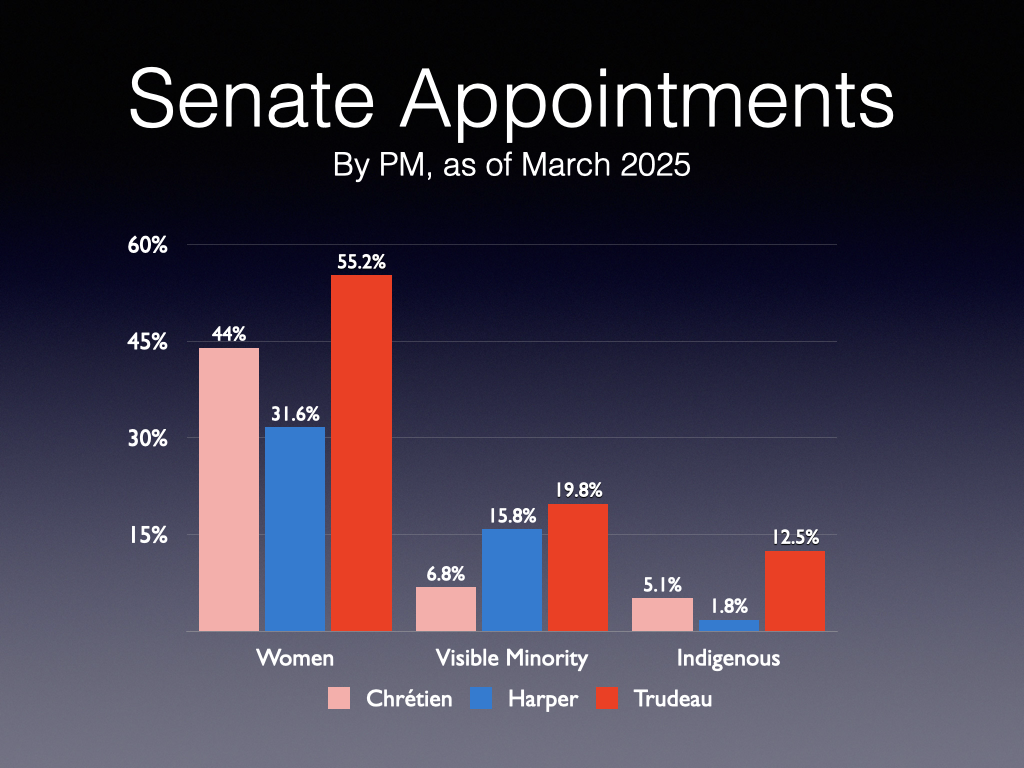
All Senate vacancies now filled as Trudeau makes 5 new appointments

Of note. My analysis of the diversity of appointments below across three prime ministers:

With just days to go until Prime Minister Justin Trudeau leaves federal politics, his office says five new appointments have now filled all the vacancies in the 105-seat Senate.

The Prime Minister’s Office says in a news release that the Governor General has appointed former Moncton mayor Dawn Arnold for New Brunswick and former MLA Tony Ince for Nova Scotia.

Non-profit executive Katherine Hay, charity CEO Farah Mohamed and former provincial politician Sandra Pupatello have been appointed for Ontario.

There were 22 vacancies in the Senate when Trudeau became prime minister in 2015 and launched what his government called a “new, non-partisan, merit-based process” to advise on appointments.

There have been 100 independent appointments to the Senate made on the advice of Trudeau, with a dozen in 2024 and 10 this year.

Source: All Senate vacancies now filled as Trudeau makes 5 new appointments

Snyder: Antisemitism in the Oval Office

Interesting and credible take:

..And so I can’t escape that first reflexive response to that scene in the Oval Office: here is a person of Jewish origin being treated in a very particular and familiar way by non-Jews. I get the dissidents’ comparison to an interrogation or trial, and can imagine the cell or the courtroom. But what struck me was the circle of bullying gentiles — as in Europe in the 1930s, and in other places and times, at the particular moment when the mob felt that power was shifting.

But is it? In writing about antisemitism here I am obviously making a moral point. I am asking us, Americans, to think seriously about what we are doing, about Russia’s criminal war against Ukraine, in which we are now becoming complicit. That Russia’s war is antisemitic is one of its many evils; taking Russia’s side in that war is wrong for many reasons, including that one. At a time when antisemitism is a growing problem around the world, I would like for us to be able to see the obvious examples, especially when we Americans are so closely involved in them. There is a certain mobbish mindlessness in the growing circle of American voices calling for Zelens’kyi to leave office, and I think it has a name and a history. I would like for us to recall that history and remember that the name can apply to us.

In writing about antisemitism I am also making a political claim. The antisemite really believes that the Jew must defer, that the Jew cannot fight, that a state led by a Jew must duly crumble. This was one of Putin’s mistakes, two years ago. And now, I suspect, it is also Trump’s, and Musk’s. America does have the power, of course, to hurt Ukraine. Just as Russia does. The combination of American and Russian policy is killing Ukrainians right now. The costs of the emerging Russian-American axis will be terrible for Ukraine. But Ukraine will not immediately collapse, nor will the Ukrainian population turn against Zelens’kyi. What he will personally do I couldn’t say and won’t try to predict: and that, of course, is my point.

In the world of the antisemite, all is known in advance: the Jew is just a deceiver, concerned only with money, subject to exclusion, intimidated by force. As soon as he is humiliated and eliminated, everything else will fall into its proper place. Consider the smirks in the Oval Office last Friday: the antisemite thinks that he has understood everything. But in the actual world in which we actually live, Jews are humans, perilous and beautiful like the rest of us. The United States has never elected a Jewish president, and perhaps never will. But Ukraine has; and that president represents his people, facing challenges that those who mock him will never understand. Those Americans have chosen to add their own to the evil he must confront. But that does not mean that they will control what happens next…

Source: Antisemitism in the Oval Office

McWhorter: An Unkind Policy for a Nonexistent Problem [English as official language]

More good commentary by McWhorter:

“You come here, you speak our language!”

That is the elevator-pitch version of one of President Trump’s latest executive orders.

In form, it undoes the requirement, instituted under the Clinton administration, that government agencies and organizations offer services and documents in various languages.

In spirit, it does much more — and much worse.

The “English only” idea goes way back. Benjamin Franklin worried about there being too much German spoken in our country. Theodore Roosevelt was on board as well, proclaiming in 1919, “We have room for but one language in this country, and that is the English language, for we intend to see that the crucible turns our people out as Americans, of American nationality, and not as dwellers in a polyglot boarding house.” The organization U.S. English, founded by Senator S.I. Hayakawa and the anti-immigration activist John Tanton in the 1980s, has been especially persistent. The group argues that elevating English to official status gives us a common means of communication, encourages immigrants to assimilate and “defines a much-needed common-sense language policy.”

This is nonsense, because we already have a common means of communication: English.

Other languages are spoken in America as well, some even passed down through generations. But Americans use English as their lingua franca regardless of whatever else they speak.

In 19th-century Italy, it was a different story. Piedmontese to the north and Sicilian to the south had so little in common with Tuscan in the middle that they qualified as different languages altogether. What Italians had was what the Strother Martin character in the film “Cool Hand Luke” famously called a failure to communicate. So when the regions were unified into a single nation, elevating one dialect — Tuscan — above the others was necessary.

Not here. For one thing, it is unclear just where in this country Trump thinks people are being raised without the ability to communicate in English. All I can think of is Haredi Jewish communities, where life is conducted in Yiddish and some children do not really learn to speak English. But something tells me they are not the ones on Trump’s mind.

Then there’s the claim that this order will compel immigrants to learn English, and the implication that people who fail to do so are shirking a basic American duty. This attitude is based on ignorance about how people acquire language.

In our midteens — after the end of what linguists call the critical period — our ability to master a new language starts to atrophy. I once lived next door to a couple that had just arrived from Israel. Their 2-year-old knew no English at all and used to squeak “khatul!” whenever he saw the cute black cat I had back then. A few years later he sounded like Macaulay Culkin. That’s how it is for little kids. Those who start living in English at, say, 16 will learn to speak fluently but probably retain a slight accent, and when tired might flub the occasional idiom. Adults starting from zero encounter almost inevitable limits. A brilliant Slav I know came to North America at about 50. His English was great, but with a strong accent and a tendency now and then to render things the way his native language would, such as designating me “an early-waking-up person.” This was normal.

Learning a new language, after all, isn’t just a matter of dutifully memorizing the words for things; you also have to learn how to put them together. Example: A native Spanish speaker is learning English. She’s at an American club and wants to say, “The guy who brought me can’t dance!” (Quick, show music geeks, what’s that from?) First she has to know that the past tense of “bring” is not “bringed” but the hopelessly random “brought,” and that in English we put the direct object (“me”) after rather than before the verb. Or, the woman is a native English speaker at a club in Beijing, new to Mandarin but trying to say the same thing. In Mandarin she’d have to say, “The take-me-come-in-guy can’t dance.”

That’s all part of why immigrants in late middle age or beyond, if they live in communities where almost everyone speaks their native language, may never really find their footing in English. In my neighborhood, where I am frequently assumed to be Dominican, barbers address me in Spanish and older Latinos, especially women, approach me asking me to point them in the right dirección. According to the English-only idea, those older ladies are a problem in some way. How?

Imagine a native Mandarin speaker who is new or newish to English. Let’s say she can get by just fine while navigating a menu or engaging in brief exchanges. Grand. But if she were being admitted to a hospital, taking a citizenship test, voting or doing anything else involving detail or urgency, she would want to be able to use, hear or read her native language. To deny her that is pointless and unfeeling.

But that is precisely what Trump’s executive order will do. In all those settings where ordinary people interact with government functions, nonnative speakers will be forced to muddle through in English alone, regardless of whether that produces any clarity for them — or for the government branch in question.

The only silver lining to all this is that to a considerable extent, modern technology will render the new rule powerless. Google Translate and other apps can now translate straight from the page, as well as interpret between you and another speaker in real time. The executive order “Designating English as the Official Language of the United States” will largely kneel to the power of the iPhone.

But what matters is the spirit of the thing. The English language is under not the slightest threat in America, and providing services in other languages for adults past the critical period is kindness, not disloyalty. A punitive yawp that English be “official” in this country is jingoistic trash talk in the guise of statesmanship.

By the way (alerting the Oxford English Dictionary as well as the upcoming Oxford Dictionary of African-American English!), we now have an even earlier example of the use of “woke” than the one my colleague Emily Berch unearthed two weeks ago. On Sept. 12, 1925, the Black journalist C.F. Richardson wrote, “Until we wake up, ‘stay woke’ (meaning to stay on the job at all times) and exert our full strength and power for our best interests, we shall forever be regarded, and treated as human slaves by the governing class and those in official positions.” Thanks to Fred Shapiro for this discovery (and check out his New Yale Book of Quotations).

Oh — and as for the origin of “The guy who brought me can’t dance!” the answer is the 1941 musical “Best Foot Forward,” with songs by Hugh Martin and Ralph Blane and book by John Cecil Holm.

Source: An Unkind Policy for a Nonexistent Problem

Municipalities, rights groups voice concerns about Quebec bill on integrating immigrants 

As expected, as the practicalities of what would be required are raised:

Quebec municipalities and human rights groups are voicing concerns about proposed legislation that would require newcomers to abide by a set of common values.

They say the new bill on cultural integration could foster anti-immigrant sentiment and impose a heavy administrative burden on communities.

The bill, tabled in January by Quebec’s right-leaning Coalition Avenir Quebec government, would have immigrants adhere to shared values including gender equality, secularism and protection of the French language. The legislation is the latest in a series of bills that aim to reinforce Quebec identity, following the province’s secularism law and its overhaul of the language law.

It’s intended as Quebec’s answer to the Canadian model of multiculturalism that promotes cultural diversity, which the government believes is harmful to social cohesion in Quebec. Immigration Minister Jean-Francois Roberge has said he wants to avoid cultural “ghettos.”

It would also allow the government to make public funding contingent on adherence to a forthcoming integration policy. Roberge has suggested, for example, that festivals could have their funding cut if they don’t promote Quebec’s common culture. That part of the bill has prompted concerns from organizations representing Quebec municipalities, which say it encroaches on municipal autonomy. The Union des municipalites du Quebec is calling on the government to scrap that part of the legislation outright.

Meanwhile, the Federation quebecoise des municipalites wants the funding requirement to be limited to cultural programs and those related to integrating immigrants. They say it would be difficult to review every funding application for adherence to the policy. Pierre Chateauvert, policy director with the federation, told a legislative committee last week that municipalities are already struggling under the weight of laws and policies they have to apply.

“The burden causes you to become paralyzed. You paralyze the system,” he said. “This is what we are currently experiencing.”

The federation says it supports the objectives of the cultural integration bill. But it also wants the government to increase spending on French-language classes for immigrants, many of which were cancelled last fall due to lack of funding. Critics have said those cuts run counter to Quebec’s goals of integration.

Source: Municipalities, rights groups voice concerns about Quebec bill on integrating immigrants

Wells: Ira Wells on book banning

Peel Region never fails to disappoint in its excesses:

In one, [Ira] Wells was invited to take part in a “library audit” at his child’s Toronto school, led by a principle who said that if it were up to her, they’d get rid of “all the old books.” In another, all books published before 2008 were removed by the armful from Peel Region school libraries west of Toronto, on the general understanding that justice was invented in 2008 and that before that year, we were mostly just pummeling one another with rocks and other tools of oppression. I paraphrase.

Here’s a paragraph from the manual Peel Region school librarians used to guide them in this work of moral uplift. For my money, the word “therefore” is being asked to carry more than its fair comic weight:

Source: Ira Wells on book banning

Le modèle caquiste d’intégration est interculturaliste, dit Gérard Bouchard

More on Bill 84 and the caution regarding its assimilationist tendencies rather than integration, particularly regarding “common culture, and that integration is a joint responsibility of the host society and newcomers:

Pour le sociologue Gérard Bouchard, un des pères de l’interculturalisme au Québec, il était « grand temps » que le gouvernement consacre son modèle d’intégration des immigrants dans une loi.

Dans un mémoire d’une quinzaine de pages qu’il déposera mardi en lever de rideau de l’étude du projet de loi 84 « sur l’intégration nationale », l’historien et sociologue donne sa bénédiction — non pas sans nuances — à l’avenue empruntée par le ministre de l’Immigration, de la Francisation et de l’Intégration, Jean-François Roberge, pour écrire un nouveau « contrat social » avec les personnes immigrantes. S’il le « félicit[e] » pour sa proposition législative soumise il y a un mois à l’Assemblée nationale, il l’incite du même souffle à éviter les dérives « assimilationnistes ».

« Je suis heureux de constater que des notions essentielles de l’interculturalisme ont trouvé place dans l’énoncé du projet de loi 84 », souligne M. Bouchard, qui avait fameusement codirigé les travaux de la commission Bouchard-Taylor en 2007 et 2008.

“Il est grand temps que le Québec se dote d’un modèle de gestion de la diversité qui s’écarte à la fois du multiculturalisme canadien et de tous les modèles assimilationnistes ou à tendance assimilationniste », écrit-il.

Dans son mémoire, Gérard Bouchard, qui avait écrit en 2014 un essai intitulé L’interculturalisme. Un point de vue québécois, se réjouit que le ministre Roberge se soit rattaché dans son projet de loi à une série de principes phares de l’interculturalisme à la sauce Québec — la « culture commune », la « réciprocité », la « promotion du français » et la « nécessité de l’intégration ». Il ne se prive pas, toutefois, d’effectuer une mise en garde. « Il manque [au projet de loi] quelques composantes et celles qui sont mentionnées devront être complétées, sinon reformulées », soutient-il.

Selon lui, il faudra par exemple éviter de définir la « culture commune » du Québec, un concept qui apparaît dans la première phrase du projet de loi, « comme la fusion de toutes les cultures ». « [Cela] relèverait de l’assimilation », peut-on lire.

L’État québécois aura en outre à « prévenir la discrimination et le racisme » et à « financer des cours de francisation et d’initiation à la culture et à la société québécoise » s’il veut bel et bien respecter le principe de réciprocité prévu au projet de loi.

« L’intégration assigne des responsabilités aux immigrants et aux minorités, mais aussi d’importants devoirs à l’État et à la société d’accueil », écrit M. Bouchard, qui recommande d’ailleurs que les entreprises et les organismes privés soient incités à appliquer les pratiques interculturelles dans leur quotidien, comme devront le faire les institutions publiques si le projet de loi est sanctionné comme tel.

« Vision étroite »

À la mi-février, dans une lettre ouverte publiée dans Le Devoir, une trentaine de personnalités publiques, dont les anciennes ministres Louise Beaudoin (Parti québécois), Louise Harel (Parti québécois) et Kathleen Weil (Parti libéral du Québec), avaient dit du projet de loi 84 qu’il était « loin de s’inscrire dans [la] continuité » de l’interculturalisme.

« Avec son approche aux accents assimilationnistes, il s’agit d’une nette rupture par rapport au modèle hérité de la Révolution tranquille. Affirmer les spécificités de l’approche québécoise est essentiel pour offrir une option de remplacement à la fois crédible et juste au multiculturalisme canadien. L’initiative caquiste ne va pas dans ce sens », pouvait-on y lire.

À la veille de son passage en commission parlementaire pour commenter le projet de loi, la Table de concertation des organismes au service des personnes réfugiées et immigrantes (TCRI) tenait le même discours, lundi.

« Il est manifeste que le PL-84 rompt avec l’approche interculturelle de l’intégration, au profit d’une approche assimilationniste », affirme l’organisme dans un document transmis au Devoir et contenant ses « commentaires préliminaires » sur le texte de loi caquiste.

Selon la TCRI, qui fédère plus de 150 organismes œuvrant auprès des personnes immigrantes, la définition de la « culture commune » dans le projet de loi « occulte la diversité qui façonne le Québec d’aujourd’hui ».

« Elle passe sous silence la richesse des nations, cultures et langues présentes sur le territoire, notamment celles des Premières Nations et des Inuits ou de la minorité historique anglophone, qui ne sont mentionnées que dans le préambule du projet de loi. En parlant d’une “culture commune” qui ne reconnaît pas ces contributions, le gouvernement semble vouloir imposer une vision étroite de la culture québécoise », peut-on lire.

En ne s’attachant qu’à la dimension culturelle du processus d’intégration, le projet de loi 84 passe par ailleurs sous silence « d’autres dimensions de l’intégration, comme l’intégration socioéconomique », soulève la TCRI.

Les consultations particulières entourant le projet de loi sur l’intégration nationale s’amorcent mardi à l’Assemblée nationale. En plus de Gérard Bouchard et de la TCRI, plusieurs groupes, comme la Commission des droits de la personne et des droits de la jeunesse, le Mouvement laïque québécois et la Ligue des droits et libertés, seront entendus d’ici le 18 mars.

Source: Le modèle caquiste d’intégration est interculturaliste, dit Gérard Bouchard

For sociologist Gérard Bouchard, one of the fathers of interculturalism in Quebec, it was “it was high time” for the government to enshrine its model of integrating immigrants into a law.

In a brief of about fifteen pages that he will deposit on Tuesday in the lifting of the curtain of the study of Bill 84 “on national integration”, the historian and sociologist gives his blessing – not without nuances – to the avenue taken by the Minister of Immigration, Francisation and Integration, Jean-François Roberge, to write a new “social contract” with immigrants. If he “congratulated” him on his legislative proposal submitted a month ago to the National Assembly, he encouraged him in the same breath to avoid “assimilationist” excesses.

“I am pleased to see that essential notions of interculturalism have found a place in the statement of Bill 84,” emphasizes Mr. Bouchard, who had famously co-directed the work of the Bouchard-Taylor commission in 2007 and 2008.

“It is high time that Quebec has a diversity management model that departs from both Canadian multiculturalism and all assimilationist or assimilationist models,” he writes.

In his memoir, Gérard Bouchard, who had written an essay in 2014 entitled L’interculturalisme. A Quebec point of view, is pleased that Minister Roberge has attached himself in his bill to a series of key principles of interculturalism with Quebec sauce – the “common culture”, “reciprocity”, the “promotion of French” and the “need for integration”. He does not hesitate, however, to give a warning. “There are [a few components missing from the bill] and those mentioned will have to be completed, if not reformulated,” he says.

According to him, it will be necessary, for example, to avoid defining the “common culture” of Quebec, a concept that appears in the first sentence of the bill, “as the fusion of all cultures”. “[This] would be a matter of assimilation,” we can read.

The Quebec State will also have to “prevent discrimination and racism” and “finance francization and initiation courses into Quebec culture and society” if it does want to respect the principle of reciprocity provided for in the bill.

“Integration assigns responsibilities to immigrants and minorities, but also important duties to the State and the host society,” writes Mr. Bouchard, who also recommends that companies and private organizations be encouraged to apply intercultural practices in their daily lives, as public institutions will have to do if the bill is sanctioned as such.

“Close vision”

In mid-February, in an open letter published in Le Devoir, about 30 public figures, including former ministers Louise Beaudoin (Parti québécois), Louise Harel (Parti québécois) and Kathleen Weil (Parti libéral du Québec), had said of Bill 84 that it was “far from being part of [the] continuity” of interculturalism.

“With its approach with assimilationist accents, it is a clear break with the model inherited from the Quiet Revolution. Affirming the specifics of the Quebec approach is essential to offer a replacement option that is both credible and fair to Canadian multiculturalism. The Caquist initiative does not go in this direction, “we could read.

On the eve of its passage in the parliamentary committee to comment on the bill, the Table of Concertation of Organizations Serving Refugees and Immigrants (TCRI) gave the same speech on Monday.

“It is clear that the PL-84 breaks with the intercultural approach to integration, in favor of an assimilationist approach,” says the organization in a document sent to Le Devoir and containing its “preliminary comments” on the Caquiste law.

According to the TCRI, which brings together more than 150 organizations working with immigrants, the definition of “common culture” in the bill “hides the diversity that shapes today’s Quebec”.

“It ignores the richness of the nations, cultures and languages present on the territory, especially those of the First Nations and the Inuit or the historical English-speaking minority, which are only mentioned in the preamble of the bill. Speaking of a “common culture” that does not recognize these contributions, the government seems to want to impose a narrow vision of Quebec culture,” we can read.

By focusing only on the cultural dimension of the integration process, Bill 84 also ignores “other dimensions of integration, such as socio-economic integration,” raises the TCRI.

Special consultations on the draft law on national integration begin on Tuesday in the National Assembly. In addition to Gérard Bouchard and the TCRI, several groups, such as the Commission des droits de la personne et des droits de la jeunesse, the Mouvement laïque québécois and the Ligue des droits et libertés, will be heard by March 18.