How innovative news outlets are meeting the needs of immigrant communities

Ethnic media in the USA study:

At a time when all of journalism is in an existential crisis, the financial pressure on resource-deprived immigrant outlets is greater than ever. Yet the pandemic, and the protests over the killing of George Floyd, Breonna Taylor and dozens of others, have put innovative immigrant-serving digital outlets into overdrive, as reporters squelch rumors via WeChat and Facebook Live and beam interviews with local officials into living rooms via Roku and JadooTV boxes.

The most successful of these outlets – as measured by ballooning audience numbers – rely on tireless reporters and anchors with a direct line to listeners and viewers. Journalists like Mario Guevara with Mundo Hispánico in Atlanta have made it their business to maintain contact with immigrants using social media. Guevara listens to their questions, hears their complaints, and then gives them the critical information and support they need. That, rather than news flashes or push notifications, has become the lifeblood of immigrant media. Guevara, with nearly half a million Facebook followers on his personal account, recently livestreamed as he took a rubber bullet to his leg while interviewing Latino kids on why they were out protesting against the police.

For many immigrant communities, these outlets provide information they just can’t get from other sources. “The local media landscape is predominantly white,” said Mukhtar Ibrahim, the Somali-American editor of Sahan Journal in St. Paul. When he went to report on the protests and looting in Minneapolis, which occurred essentially in the backyard of many Somali residents, he was struck by how few journalists of color were covering the story. But he was not surprised. Most newsrooms in Minnesota, said Ibrahim, are “slow in making news coverage more inclusive, despite the increasing diversity and the rapid growth of Minnesota’s immigrant population.”

In contrast, immigrant outlets are vital sources of information for people from indigenous farmworkers to Chinese engineers to Somali Uber drivers. On the Chinese social media app WeChat, Houston Online documented empty Chinese-owned businesses well before most U.S. outlets were paying attention to the pandemic’s reach. Punjabi Radio USA in Northern California reported on dangerous rest stop conditions for truckers, one of their main listener groups. And as Queens emerged as an epicenter of coronavirus in the U.S., TBN24, a Bangladeshi digital television outlet with more than 2.7 million followers on Facebook alone, informed viewers about everything from how to get a stimulus check to how to connect with funeral homes.

The technology may be new, but today’s immigrant outlets build on a long history of serving their communities in crisis. During the 1992 Los Angeles civil unrest and riots, Radio Korea shut down all broadcasting operations and became a control center fielding hundreds of calls for help as businesses burned and police were nowhere to be found. These days, when the station does live programs, hosts will often collect comments and poll listeners via KakaoTalk, a social media popular in Korea, as well as run a YouTube live chat.

Radio Korea connects with listeners via KakaoTalk and live broadcasts on YouTube where there is active commentary.

Wielding new technologies can generate huge followings for immigrant media outlets, but these followers are not paying the bills. In coming months, while some immigrant outlets will surely go out of business, the nimble and the scrappy may yet show the way to survive and even thrive. They’ve embraced virtually cost-free digital platforms and delivery systems, so there’s not much room to slash expenses. On the revenue side, ads have plummeted dramatically. Still, glimmers of hope can be found in new models, from going the non-profit route to building auxiliary businesses that aren’t journalism, but fund it.

For the past year, the Center for Community Media has been studying news outlets serving immigrant communities for models of growth and innovation. The cross-currents that have battered community media outlets across the nation threaten their sustainability, and the Center for Community Media has responded by redirecting its mission to help outlets develop survival skills. This report is part of that effort. [A shorter “preview” version of this report was published by CCM in early April.]

We interviewed and surveyed more than 150 people in 30 states to identify outlets that are in the vanguard. The editors and reporters we spoke with come from around the world and have different strengths in radio, broadcast, print, and digital. Yet we found that the best of them have been successful at converging around multiplatform practices. In particular, we found that immigrant-serving news outlets are evolving in four key ways:

  • Wielding social media for community engagement. In recent years the internet decimated classified ads, shrinking revenues for many immigrant-serving newspapers, while social media that trafficked in rumors decimated their audiences. Now, successful immigrant-serving outlets are using social media as a way to offer verified information, cultivate community conversations, and respond to concerns. Live broadcasting is booming, with the unparalleled immediacy and shareability of bringing viewers to a news conference, community festival, or a drive-through coronavirus testing station. Some outlets are even operating primarily on social media platforms like WeChat, WhatsApp, YouTube, and Facebook.
  • Leveraging a small staff to reach big audiences. Media outlets serving immigrant communities have historically been relatively small operations, but with delivery technologies like livestreaming on Facebook or “micro-TV stations,” being small is no longer an impediment to being timely, and may even work in an outlet’s favor. One-person operations can report, produce and broadcast – and consequently boost audiences substantially at very low cost at a time when revenue models are challenged.
  • Globalizing both production and audiences. Increasingly, outlets are hiring staffers overseas to cut costs, while stateside reporters serve both the diaspora in the U.S. and home country audiences. The geolocation of audiences has shifted dramatically in recent years, as reverse migration, press restrictions overseas, and far-flung diasporas boost audiences for immigrant media based in the U.S. Dynamic outlets are becoming transnational enterprises. One Brazilian newspaper in Massachusetts reported it has 60% of its audience in the U.S. and 30% in Brazil while a Hmong outlet in Wisconsin reported 40% of its audience comes from outside of the U.S.
  • Diversifying business models and revenue streams. Even before the pandemic, immigrant media was feeling the pain of ad cuts. Now, though, a few are reporting that their funding sources are stable or even growing modestly. That’s thanks to a grab-bag of strategies, from operating as a non-profit to lining up grant funding to getting government advertising to targeting supplement funding sources. Our database shows 13 out of 50 outlets are non-profit, while a handful have put up e-commerce sites, developed a consulting business and even launched English-language classes to boost the bottom line.

You can read the Center For Community Media’s full report here, plus find case studies and a database.

Source: How innovative news outlets are meeting the needs of immigrant communities

Kerr: Renaming Dundas Street, or other landmarks, won’t help Black people

Agree. The symbolic is easier than the substantive, where the focus should be:

Would renaming COVID-19 make it less deadly? You know the answer.

But what about Dundas Street? Renaming it might “correct” a historical wrong – but would doing so make the underlying issue of systemic racism go away?

More than 14,000 people have signed a petition to rename the major arterial road named after Henry Dundas, a Scottish politician who obstructed the abolition of slavery in the late 18th century. The effort is serious enough that the city of Toronto will form a working group to examine the issue.

But the events that galvanized this movement to rename Dundas Street, along with other landmarks in Canada, are exactly why renaming efforts shouldn’t happen, at least not right away. We are still reckoning with racism and the many forms it takes, from workplace discrimination to police brutality, as seen in the deaths of George Floyd and Breonna Taylor. These killings have ignited protests and important conversations. Toronto’s board of health just declared anti-Black racism a public health crisis.

There are bold proposals in the zeitgeist to fix things: defund the police, give descendants of African slaves reparations, hire more Black people in leadership roles. Like them or not, these ideas would actually do something to change Black people’s lives. Renaming Dundas Street won’t.

Andrew Lochhead, who started the petition, argues that this is not an either-or situation. We can rename the street and implement policy to address systemic racism.

“I don’t want the issue of renaming streets to necessarily overtake that conversation, because I think they’re inextricably linked,” Mr. Lochhead told me over the phone.

“While I understand it’s a largely symbolic gesture … it’s not outside of investing in communities, it’s not disconnected from other causes like defunding the police.”

There is a connection, but until city councils can freeze time and print money, there is always a question of what to prioritize. With COVID-19 putting significant pressure on municipal budgets, the only option is to be pragmatic and focus on implementing policies that will have a tangible impact on Black lives. One way to do this is to give Black voices the authority to make change.

“Black people have been warning about police brutality for decades … it’s not the folks who were perpetuating the system who are going to lead,” Cheryll Case, an urban planner based in Toronto told me. Ms. Case wants to see the city hire a Black consultant to audit its planning process.

“The issue in planning is that it is not confronting privilege, nor is it confronting discrimination. And by ignoring those topics, you actually further deepen the wounds of discrimination and subjugation.”

In a city gasping for more affordable housing, Ms. Case suggests creating an incentive for developers that would defer certain costs if they build affordable units. According to Toronto’s 2016 census, Black people make up 9 per cent of the population, but account for 13 per cent of the residents of low-income neighbourhoods.

The Parliamentary Black Caucus made the need for better policy clear in a recent statement.

“This is not a time for further discussion – the Afro-Canadian community has spoken for many years and is no longer interested in continued consultation,” it read.

“Black Canadians are in a state of crisis: it is time to act. Words and symbolic gestures, while important, are not enough.”

The Caucus proposes that the government ban racial profiling from the RCMP, invest in Black heritage organizations and increase the number of government procurement contracts for Black-owned businesses.

These ideas look pretty on paper, but it might not be easy to turn them into laws, which is why political resources must be focused on policy, not symbolism. The true cost of renaming Dundas Street is all the time, effort and money that could have been spent helping Black communities in more tangible ways.

What about the financial costs? Mr. Lochhead told me he hasn’t “taken the time to look into” the price of renaming Dundas Street. I don’t know how much it will cost either, but last year, Toronto spent just under $2-million to change the names of two arts centres under its purview. In the city of Toronto, Dundas Street stretches from Etobicoke in the west end, all the way to the Beaches neighbourhood in the east end, and features some of the city’s busiest shopping districts. The cost of changing the street’s signage is going to add up, and those dollars are better spent elsewhere.

Every breath politicians waste on a renaming debate should be spent discussing how to combat racism in schools, or how to address discriminatory fare enforcement officers on the TTC. If Dundas Street or other roads in Toronto are renamed, but Black people are still being harassed on the streetcar routes that traverse them, what has really changed?

Source: https://www.theglobeandmail.com/opinion/article-renaming-dundas-street-or-other-landmarks-wont-help-black-people/

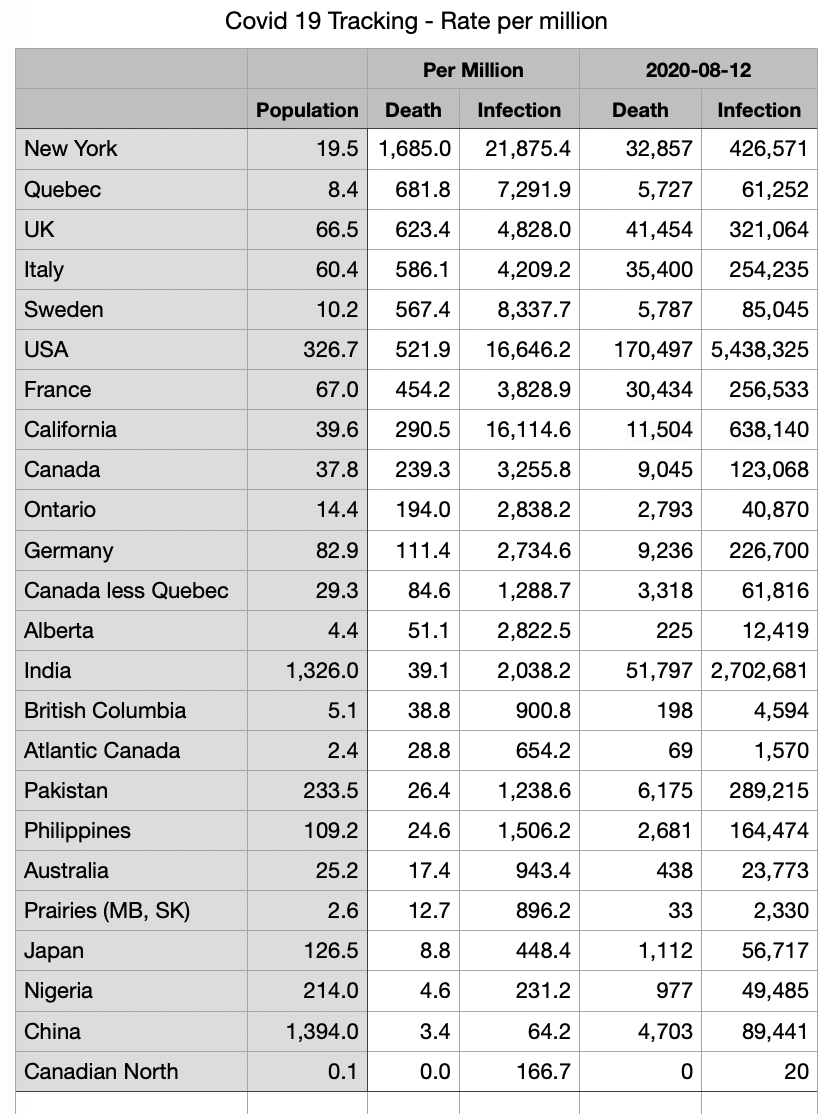
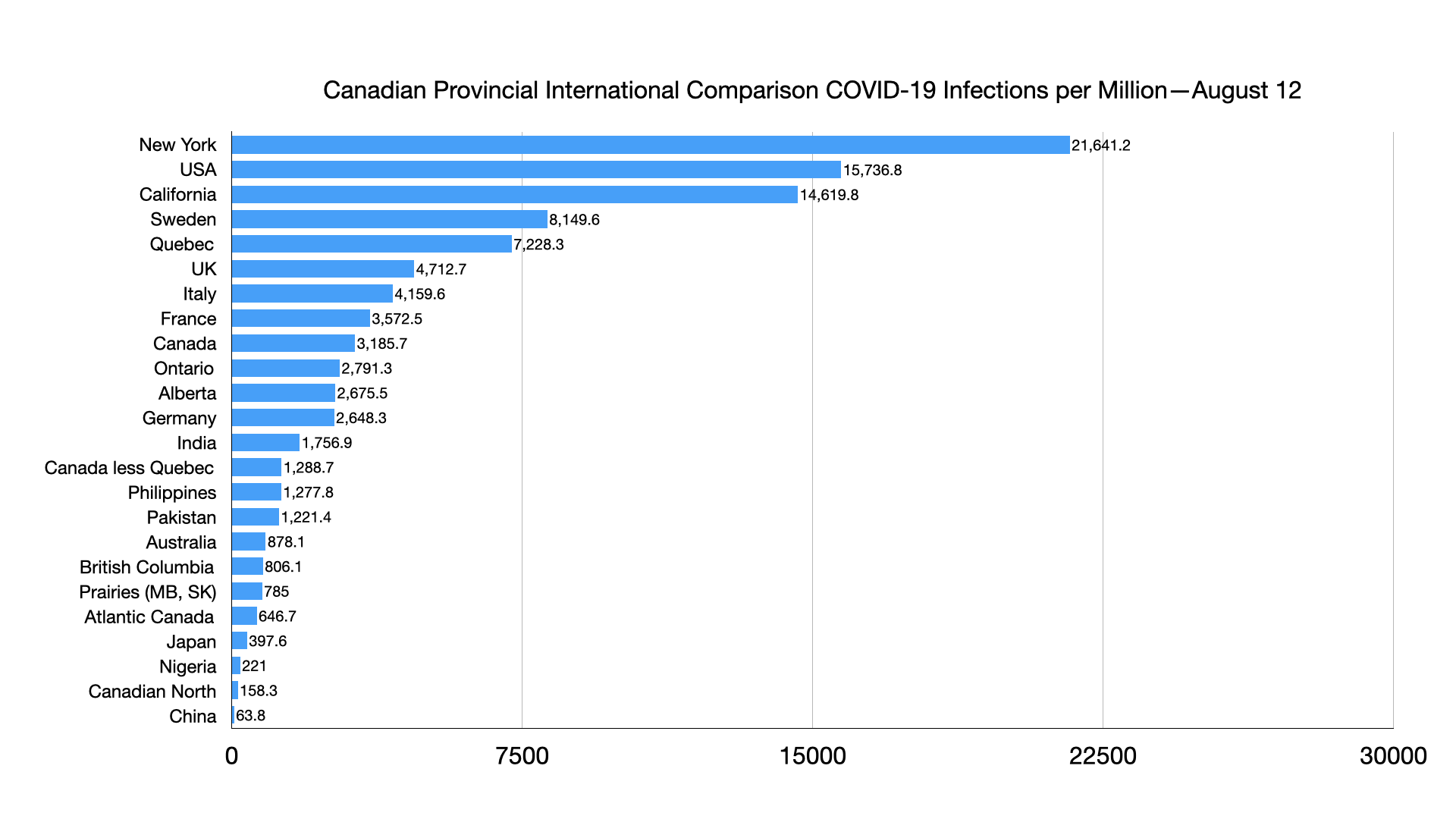
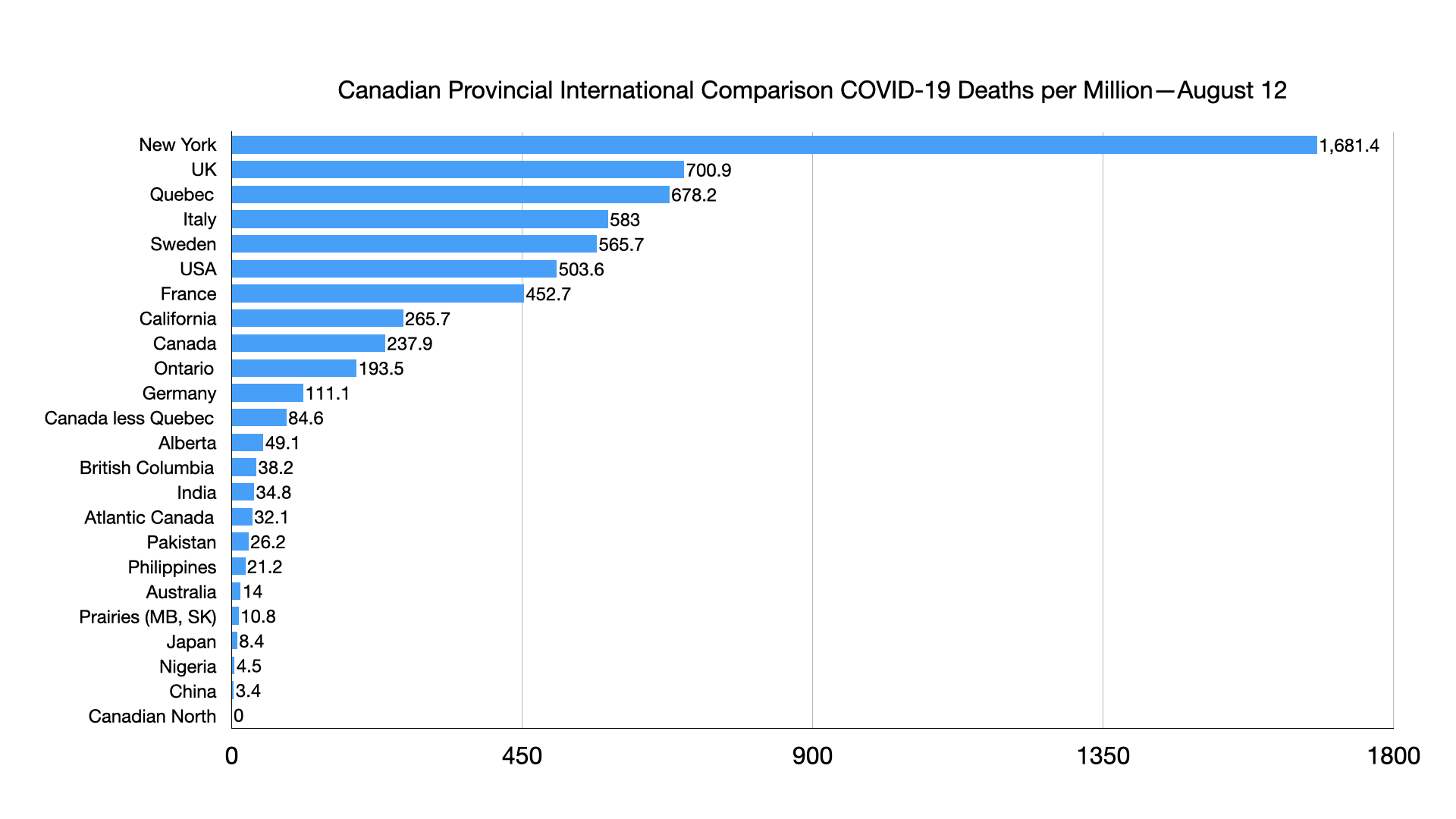
#COVID-19: Comparing provinces with other countries 24 June Update – Quebec deaths higher than UK

Latest update:


Online registrar threatens to drop anti-immigration website

Of note.

Brimelow, if I recall correctly, was mentioned by Paul Wells in his The Longer I’m Prime Minister as having an influence in his decision to replace the 2011 Census with the less accurate National Household Survey:

An internet registrar is threatening to delist a website that is a leading promoter of white nationalist and anti-immigration views, a move that could make the site accessible only to diehard users willing to use a special browser to find it on the dark web.

Network Solutions’ parent company, Web.com Group, notified a civil rights group on Friday that it has “taken steps” to terminate the company’s account for VDARE.com, which would make it unreachable on the public internet unless it can find another provider willing to register the domain name.

VDARE remained online Monday. The website has until Thursday to transfer the domain before Network Solutions may delete its services, a parent company lawyer said in a letter to a VDARE attorney last week.

In April and in May, the head of the Lawyers’ Committee for Civil Rights Under Law sent letters urging Network Solutions to drop VDARE. Kristen Clarke, the Washington, D.C.-based group’s president and executive director, wrote that VDARE peddles “anti-immigrant and anti-Black hate,” spreads misinformation about the coronavirus and encourages violence against migrants.

“This is part of our ongoing work to confront the ways in which hate activity festers online,” Clarke said Monday. “We know that many white supremacists and extremists are not organizing in basements. They are using these platforms and websites to spread their dangerous ideologies, target victims and incite violence.”

In Friday’s response to Clarke, a company attorney said VDARE’s content “does not represent the values of our organization” and violates its “Acceptable Use Policy.” The policy bars customers from using its domains “to display bigotry, racism, discrimination, or hatred in any manner whatsoever,” the same company attorney said in a letter to a VDARE lawyer last week.

VDARE founder and editor Peter Brimelow said his site’s content hasn’t changed in the 20 years that it has been a Network Solutions customer.

“Censorship is just intensifying,” he wrote in an email on Monday. “We’re still working on a replacement, but there is certainly a chance we’ll have to go dark for at least a couple of days. And anyway we have no confidence that any US-based site will stand up to the PC lynch mob for long.”

Many websites that publish white nationalist, white supremacist or anti-Semitic material have struggled to stay online or been booted off mainstream internet platforms, often after violent attacks by far-right extremists.

Google and GoDaddy yanked The Daily Stormer’s web address after the neo-Nazi website’s founder, Andrew Anglin, published a post mocking the woman killed when a man drove a car into a crowd of counterprotesters at a 2017 white nationalist rally in Charlottesville, Virginia.

Social media platform Gab, where the suspect in the Pittsburgh synagogue massacre spewed anti-Semitic messages before the 2018 shooting rampage, was briefly knocked offline after registrar GoDaddy and others dropped the site. Gab returned after a Seattle-based company, Epik, agreed to register it.

Users spewed anonymous hate on 8chan, an online message boar d, until a string of mass shootings by gunmen who posted manifestos on the site led to it getting forced offline in August 2019. The disruption ended when the imageboard relaunched in November under the new name 8kun.

This isn’t the first time VDARE has been dropped by a technology company. Facebook announced last month that it removed accounts linked to VDARE and other groups, including pages devoted to the QAnon far-right conspiracy theory.

Brimelow sued The New York Times Company in January, claiming the newspaper defamed him by referring to him as an “open white nationalist.” The suit seeks at least $5 million in damages.

Last Thursday, newspaper lawyers urged a federal court in New York to throw out the lawsuit, accusing Brimelow of playing “word games about how his fringe views should be characterized.”

“Brimelow has promoted theories at the heart of white nationalism and white supremacy, including that certain races are predisposed to commit crime and that IQ is linked to race,” they wrote.

Brimelow has denied that his website is white nationalist but acknowledged it publishes works by writers who fit that description “in the sense that they aim to defend the interests of American whites.”

Brimelow also operates a Connecticut-based nonprofit, VDARE Foundation, which raised more than $1.8 million in tax-exempt gifts, grants and contributions between 2014 and 2018, according to an IRS tax filing.

Source: Online registrar threatens to drop anti-immigration website

Police Researcher: Officers Have Similar Biases Regardless Of Race

Interesting study. But watching the visible minority officers doing nothing during the Floyd killing …:

One common recommendation for reducing police brutality against people of color is to have police departments mirror a given area’s racial makeup.

President Obama’s Task Force on 21st Century Policing recommended that law enforcement “reflect the demographics of the community”; the Justice Department and Equal Employment Opportunity Commission said diversity on police forces can help build trust with communities.

Rashawn Ray, a fellow at the Brookings Institution and a sociology professor at the University of Maryland, studies race and policing. He says that diversity helps but that “officers, regardless of their race or gender, have similar implicit biases, particularly about Black people.” Ray says it’s not enough to have Black cops in a Black neighborhood if they don’t know the area.

Ray and his University of Maryland colleagues have amassed policing data through tests and interviews with hundreds of officers. He talked with Morning Edition‘s Noel King about this research. Here are excerpts of that interview:

What kind of biases do police officers — implicit, explicit — say that they have?

The first big thing is that when officers take the implicit association test, they exhibit bias against Black people. They are more likely to make an association between Black people with weapons than they are with white people with weapons. We also know that officers speak less respectfully to Black people during traffic stops as well as during other sorts of settings. And they are particularly less likely to respect Black women in these encounters, even if they’re more likely to slightly use more force on Black men relative to other people.

I was talking to a former police officer whose job is now to recruit more Black and brown police officers into [the Minneapolis] force. It sounds like what you’re saying is if she is recruiting Black and brown officers from Phoenix or from Houston and bringing them over to Minneapolis, that is not likely to solve the problem.

That’s exactly right. So the optics look good, but we can’t make the assumption that simply because a person is Black that they’re going to know about the neighborhood. Part of the fundamental problem when it comes to policing that I’ve noticed is that when police officers interact with a white person, there is a pause, a slight pause, a slight benefit of the doubt. The reason why that exists is because subconsciously, implicitly, when they interact with that person, they see their neighbor, a parent at their kids’ school, and when they interact with a Black person, they are less likely to have what we call in sociology those “social scripts” that allow them to view people in those multitude of ways.

And if we’re going to change this, one big recommendation I have: Police officers need housing assistance that mandates that they live in the metropolitan area where they are policing. Because community policing isn’t about getting out, playing basketball with a kid in uniform. Community policing oftentimes is what you do when you’re not on duty. The way that you’re investing in a neighborhood.

Source: Police Researcher: Officers Have Similar Biases Regardless Of Race

Construction of Austrian Holocaust victims’ memorial begins

Long overdue:

Construction of Austria’s first public monument naming all the country’s Holocaust victims began on Monday, a further step by Adolf Hitler’s native land towards confronting an issue it has long struggled with.

For decades after World War Two, Austria denied responsibility for crimes committed by the Nazis, arguing that it was their first victim despite the enthusiasm with which many citizens had welcomed annexation by Hitler’s Germany in 1938.

The country now recognises that Austrians were perpetrators as well as victims of Nazi crimes but it has not confronted that chapter of its history as openly or directly as Germany.

“Berlin has one. Paris has one. Vienna had none. But the day has finally come today,” Oskar Deutsch, president of the Jewish Community (IKG), the body officially representing Austria’s Jews, said at a ceremony marking the start of construction work.

The new monument, located in a park next to Austria’s central bank, will comprise a ring of upright stone slabs around an island of trees, and will name all 64,259 Austrian victims of the Holocaust. It is due to be inaugurated in a year’s time.

“Remembering means commemorating the victims of the Shoah. This remembering and our history increase our responsibility, the responsibility daily and together to do everything to ensure that something like this never happens again,” said Deutsch.

Ironically, the project was first backed in 2018 by a previous coalition government of current Chancellor Sebastian Kurz’s conservatives and the far-right Freedom Party (FPO), which was founded in the 1950s by former Nazis and whose first leader had been an SS officer.

Although the FPO says it has abandoned its anti-Semitic past and now denounces the Holocaust, it has been plagued by racism and anti-Semitism scandals, and the IKG still refuses to deal with party officials. The FPO crashed out of government last year and Kurz now governs in coalition with the Greens.

There are Holocaust memorials in Vienna but the only one naming the Jews who lived in Austria and were murdered is in the city’s main synagogue.

Source: Construction of Austrian Holocaust victims’ memorial begins

Pauline Hanson built a political career on white victimhood and brought far-right rhetoric to the mainstream

Of note. Bernier tried (and continues to try) to play a similar game:

Pauline Hanson and her party have only achieved modest electoral successes. Yet, she is undoubtedly Australia’s most successful populist politician and has had a profound impact on the way the country talks about issues like multiculturalism and immigration.

Hanson’s entire political career can be seen as a denial and rejection of the realities of whiteness in Australia – that is, the unearned benefits and privileges afforded to white people in settler-colonial countries.

Hanson has benefited from – and helped to shape – the normalisation of racism and xenophobia in Australia. She has pushed the boundaries of what can be “acceptably said” in public discourse and has had a disproportionate influence on the national debate.

In doing so, she has also created the political space for other far-right figures like Fraser Anning to emerge and become more a part of the political mainstream.

The birth of One Nation

Hanson first emerged on the political landscape in 1996 when she was disendorsed as the Liberal Party candidate for Oxley following racist comments she made about Indigenous people in a letter to the Queensland Times.

She contested the election anyway, running as an independent on a self-described nationalist, populist and protectionist platform, and won the seat with a large swing against the Labor incumbent.

In her maiden speech to the House of Representatives, Hanson claimed to speak on behalf of “mainstream Australians” and promised a “common sense” approach to politics.

Most controversially, Hanson warned Australia was “in danger of being swamped by Asians”, called for the abolition of multiculturalism and railed against Indigenous rights, so-called “political correctness” and “reverse-racism”.

The times suited Hanson. After 13 years of Labor government, John Howard and the Liberal Party looked to exploit a sense of resentment and grievance on the issues of multiculturalism and immigration, which arguably opened up the space for Hanson and helped to legitimise her views.

Indeed, in a 1996 speech delivered to the Queensland Liberal Party, Howard celebrated the idea people felt able to speak a little more freely and could do so without living in fear of being branded as a bigot or racist.

Hanson’s One Nation party was formed the following year and performed well at the 1998 Queensland state election, winning 11 seats.

Hanson’s downfall and political resurrection

One Nation’s initial success, however, was short-lived. Hanson failed to win the newly redistributed seat of Blair at the 1998 federal election. Her party then began to suffer from internal divisions, poor leadership and Hanson’s personal and financial scandals.

She was subsequently convicted of electoral fraud in 2003. (It was later overturned on appeal.)

After a number of failed federal and state campaigns (including under the rebranded Pauline’s United Australia Party), Hanson finally succeeded in being elected to the Senate in 2016, along with three other One Nation candidates.

This represented a high point for the party at the federal level and gave it considerable influence over government policy.

Hanson’s populist, nativist beliefs

Hanson can best be described as a populist radical right politician, alongside such figures as Donald Trump, Nigel Farage, Marine Le Pen and Viktor Orbán.

For populist figures, politics are seen as a struggle between everyday, ordinary people and a corrupt, illegitimate and out-of-touch elite.

But more importantly, the populist radical right also uses the language of “us-versus-them” and portrays immigrants and refugees as existential threats to the safety, security and “culture” of a particular society.

In Hanson’s view, non-natives must either assimilate and embrace “Australian culture and values” or “go back to where they came from”.

Hanson has consistently drawn on a sense of grievance and victimhood – in particular, white victimhood. She has espoused a belief in the existence of so-called “reverse-racism” or “anti-white” racism since the outset of her political career.

Hanson has even gone so far as to claim the most downtrodden person in this country is the white Anglo-Saxon male.

The mainstreaming of the far-right

Hanson’s resurgence in 2016 occurred in a very different political climate than her first stint in parliament in the late 1990s.

Political scientist Cas Mudde refers to the 21st century as the “fourth wave of the far-right”. It is a time when far-right ideas are becoming increasingly tolerated, debated and normalised in the mainstream and the boundaries of what can be said are shifting.

Emboldened by years of normalised Islamophobia in Australia and the electoral successes of far-right parties globally, Hanson’s maiden Senate speech warned Australia was now in danger of being swamped by Muslims, who bear a culture and ideology that is incompatible with our own.

She called for a “Trump style” immigration ban, a Royal Commission into Islam and the “banning of the burqa”.

Hanson’s resurgence has clearly cemented Muslims as the new “dangerous other”, though her racist attitudes towards First Nations people and Asian immigrants have also remained a constant.

Her claims of “anti-white racism” have also gained traction in the mainstream. For example, when Hanson put forth a Senate motion declaring “it’s OK to be white” in 2018, a surprising number of Coalition members voted for it and later defended it on Twitter.

It was only later, after a vocal outcry, that the Coalition backed down and claimed the votes were made in error.

The media have played a key role in the mainstreaming of Hanson and One Nation by consistently giving them a platform to voice far-right ideas.

Hanson’s legacy and impact on society

There are a couple of ways to think about Hanson’s legacy and impact on society.

The first is to gauge her direct influence on government policy through her role as a parliamentarian. There’s no doubt she has wielded considerable influence as one of a number of senators to hold the balance of power in recent years.

Yet, despite some success in influencing legislation and her recent appointment as deputy chair of the family law inquiry, Hanson has been largely unsuccessful in seeing her signature policies realised.

And while acknowledging Hanson’s role in mainstreaming far-right ideas, it’s important to note these ideas have existed before her maiden speeches and will exist well beyond her time in politics.

Exclusively focusing on Hanson’s individual acts ignores the systemic nature of racism and the role of the mainstream political class in reproducing and upholding these racist structures.

When assessing Hanson’s legacy, it may be comforting to view her as an aberration and reflection of a bygone era, but she remains very much a product of the Australian settler-colonial story.

It’s perhaps more accurate to think of Hanson as a symptom of racism and xenophobia in Australia, rather than its cause.

Anti-Chinese racism is Canada’s ‘shadow pandemic,’ say researchers

Disturbing that so many appear not to be able to distinguish between the Chinese regime, with all its abuses, and Chinese Canadians:

Many Chinese Canadians fear that Asian children will be bullied when they return to school due to racial tension arising from the COVID-19 pandemic.

A survey of more than 500 Canadians of Chinese ethnicity by the Angus Reid Institute and the University of Alberta has found that anti-Chinese racism is rife in our society, what the researchers call a “shadow pandemic.”

That parents are afraid to send their children to school is “heartbreaking,” said ARI executive director Shachi Kurl. “Racism is the secondary virus that has had an outbreak since the pandemic was declared.

“We have this notion of Canada as an endlessly accepting, embracing country because we are multicultural,” she said. “It’s not the case and it’s never been the case.”

“The data show that these micro-aggressions are frequent and plentiful,” said Kurl. “People say they are being treated as though they are somehow carriers of COVID-19.”

More than 60 per cent of those surveyed said they have adjusted their daily routines because of the threat of racial backlash and about half fear that Asian children will be bullied if they return to school.

Vancouver-born Gloria Leung says her daughter of mixed race has been jeered by other children for her Chinese ancestry just steps from their home.

“We have informed our daughter’s teacher without naming any names and her teacher has shared that information with school staff so they can increase awareness of racism and bullying,” she said.

Her daughter’s harassers are from just two families in an otherwise diverse and welcoming neighbourhood, but the seven-year-old has felt anxious and stressed since the incident.
“We understand that everyone is struggling and hurting in this pandemic,” Leung said. “Our hope in sharing these lived and uncomfortable experiences is not to shame people, but to provide insight into systemic racism and shed light on how we can learn from these experiences.”

The survey also found that just 13 per cent of respondents feel that people in Canada view them as fully Canadian “all the time.”

“There’s a notion that because our schools are diverse and our workplaces are diverse that racism isn’t a thing anymore,” said Kurl. “It’s one thing to hear about this anecdotally, but it’s important to ask these questions to see just how widespread this is.”

About 30 per cent of the respondents say they have been exposed to anti-Chinese sentiment in the news, on social media or through graffiti.“Just this weekend (U.S. President Donald) Trump used a pejorative term for the virus, calling it the ‘kung flu,” noted Tung Chan, a former Vancouver city councillor and former chair of the Canadian Museum of Immigration at Pier 21.

“The parents learn from the media, the children learn from the parents and you have this fear that extends into schools,” he said.

Chan was particularly discouraged to learn that 60 per cent of people surveyed changed their daily routine to avoid negative interactions and “unpleasant encounters.”

“I have always chosen my words carefully when talking about racism, because I don’t want to make people feel insecure,” said Chan. “But looking at these numbers I think that I was too mild in my remarks. This is far worse than I thought in terms of people fearing for their personal safety.”While it is important to hold the government of China to account for its belligerence and human rights abuses, news media need to distinguish between the actions of the People’s Republic of China, the Communist party of China, and the Chinese people.

“The term Chinese is too all-encompassing and it reflects the actions of the Chinese government back on the people in our community,” said Chan.

“I am proud of my Chinese heritage and I won’t walk away from that, but if you ask me who I am I always say I am Canadian,” he said.

The survey was conducted online between June 15 and 18 among a randomized representative sample of 516 adults who identify as ethnically Chinese. The margin of error is +/- 4.3 per cent, 19 times out of 20.

Source: Anti-Chinese racism is Canada’s ‘shadow pandemic,’ say researchers

Social Media Giants Support Racial Justice. Their Products Undermine It. Shows of support from Facebook, Twitter and YouTube don’t address the way those platforms have been weaponized by racists and partisan provocateurs.

Of note. “Thoughts and prayers” rather than action:

Several weeks ago, as protests erupted across the nation in response to the police killing of George Floyd, Mark Zuckerberg wrote a long and heartfelt post on his Facebook page, denouncing racial bias and proclaiming that “black lives matter.” Mr. Zuckerberg, Facebook’s chief executive, also announced that the company would donate $10 million to racial justice organizations.

A similar show of support unfolded at Twitter, where the company changed its official Twitter bio to a Black Lives Matter tribute, and Jack Dorsey, the chief executive, pledged $3 million to an anti-racism organization started by Colin Kaepernick, the former N.F.L. quarterback.

YouTube joined the protests, too. Susan Wojcicki, its chief executive, wrote in a blog post that “we believe Black lives matter and we all need to do more to dismantle systemic racism.” YouTube also announced it would start a $100 million fund for black creators.

Pretty good for a bunch of supposedly heartless tech executives, right?

Well, sort of. The problem is that, while these shows of support were well intentioned, they didn’t address the way that these companies’ own products — Facebook, Twitter and YouTube — have been successfully weaponized by racists and partisan provocateurs, and are being used to undermine Black Lives Matter and other social justice movements. It’s as if the heads of McDonald’s, Burger King and Taco Bell all got together to fight obesity by donating to a vegan food co-op, rather than by lowering their calorie counts.

It’s hard to remember sometimes, but social media once functioned as a tool for the oppressed and marginalized. In Tahrir Square in Cairo, Ferguson, Mo., and Baltimore, activists used Twitter and Facebook to organize demonstrations and get their messages out.

But in recent years, a right-wing reactionary movement has turned the tide. Now, some of the loudest and most established voices on these platforms belong to conservative commentators and paid provocateurs whose aim is mocking and subverting social justice movements, rather than supporting them.

The result is a distorted view of the world that is at odds with actual public sentiment. A majority of Americans support Black Lives Matter, but you wouldn’t necessarily know it by scrolling through your social media feeds.

On Facebook, for example, the most popular post on the day of Mr. Zuckerberg’s Black Lives Matter pronouncement was an 18-minute video posted by the right-wing activist Candace Owens. In the video, Ms. Owens, who is black, railed against the protests, calling the idea of racially biased policing a “fake narrative” and deriding Mr. Floyd as a “horrible human being.” Her monologue, which was shared by right-wing media outlets — and which several people told me they had seen because Facebook’s algorithm recommended it to them — racked up nearly 100 million views.

Ms. Owens is a serial offender, known for spreading misinformation and stirring up partisan rancor. (Her Twitter account was suspended this year after she encouraged her followers to violate stay-at-home orders, and Facebook has applied fact-checking labels to several of her posts.) But she can still insult the victims of police killings with impunity to her nearly four million followers on Facebook. So can other high-profile conservative commentators like Terrence K. Williams, Ben Shapiro and the Hodgetwins, all of whom have had anti-Black Lives Matter posts go viral over the past several weeks.

In all, seven of the 10 most-shared Facebook posts containing the phrase “Black Lives Matter” over the past month were critical of the movement, according to data from CrowdTangle, a Facebook-owned data platform. (The sentiment on Instagram, which Facebook owns, has been more favorable, perhaps because its users skew younger and more liberal.)

Facebook declined to comment. On Thursday, it announced it would spend $200 million to support black-owned businesses and organizations, and add a “Lift Black Voices” section to its app to highlight stories from black people and share educational resources.

Twitter has been a supporter of Black Lives Matter for years — remember Mr. Dorsey’s trip to Ferguson? — but it, too, has a problem with racists and bigots using its platform to stir up unrest. Last month, the company discovered that a Twitter account claiming to represent a national antifa group was run by a group of white nationalists posing as left-wing radicals. (The account was suspended, but not before its tweets calling for violence were widely shared.) Twitter’s trending topics sidebar, which is often gamed by trolls looking to hijack online conversations, has filled upwith inflammatory hashtags like #whitelivesmatter and #whiteoutwednesday, often as a result of coordinated campaigns by far-right extremists.

A Twitter spokesman, Brandon Borrman, said: “We’ve taken down hundreds of groups under our violent extremist group policy and continue to enforce our policies against hateful conduct every day across the world. From #BlackLivesMatter to #MeToo and #BringBackOurGirls, our company is motivated by the power of social movements to usher in meaningful societal change.”

YouTube, too, has struggled to square its corporate values with the way its products actually operate. The company has made stridesin recent years to remove conspiracy theories and misinformation from its search results and recommendations, but it has yet to grapple fully with the way its boundary-pushing culture and laissez-faire policies contributed to racial division for years.

As of this week, for example, the most-viewed YouTube video about Black Lives Matter wasn’t footage of a protest or a police killing, but a four-year-old “social experiment” by the viral prankster and former Republican congressional candidate Joey Saladino, which has 14 million views. In the video, Mr. Saladino — whose other YouTube stunts have included drinking his own urine and wearing a Nazi costume to a Trump rally — holds up an “All Lives Matter” sign in a predominantly black neighborhood.

A YouTube spokeswoman, Andrea Faville, said that Mr. Saladino’s video had received fewer than 5 percent of its views this year, and that it was not being widely recommended by the company’s algorithms. Mr. Saladino recently reposted the video to Facebook, where it has gotten several million more views.

In some ways, social media has helped Black Lives Matter simply by making it possible for victims of police violence to be heard. Without Facebook, Twitter and YouTube, we might never have seen the video of Mr. Floyd’s killing, or known the names of Breonna Taylor, Ahmaud Arbery or other victims of police brutality. Many of the protests being held around the country are being organized in Facebook groups and Twitter threads, and social media has been helpful in creating more accountability for the police.

But these platforms aren’t just megaphones. They’re also global, real-time contests for attention, and many of the experienced players have gotten good at provoking controversy by adopting exaggerated views. They understand that if the whole world is condemning Mr. Floyd’s killing, a post saying he deserved it will stand out. If the data suggests that black people are disproportionately targeted by police violence, they know that there’s likely a market for a video saying that white people are the real victims.

The point isn’t that platforms should bar people like Mr. Saladino and Ms. Owens for criticizing Black Lives Matter. But in this moment of racial reckoning, these executives owe it to their employees, their users and society at large to examine the structural forces that are empowering racists on the internet, and which features of their platforms are undermining the social justice movements they claim to support.

They don’t seem eager to do so. Recently, The Wall Street Journal reported that an internal Facebook study in 2016 found that 64 percent of the people who joined extremist groups on the platform did so because Facebook’s recommendations algorithms steered them there. Facebook could have responded to those findings by shutting off groups recommendations entirely, or pausing them until it could be certain the problem had been fixed. Instead, it buried the study and kept going.

As a result, Facebook groups continue to be useful for violent extremists. This week, two members of the far-right “boogaloo” movement, which wants to destabilize society and provoke a civil war, were charged in connection with the killing of a federal officer at a protest in Oakland, Calif. According to investigators, the suspects met and discussed their plans in a Facebook group. And although Facebook has said it would exclude boogaloo groups from recommendations, they’re still appearing in plenty of people’s feeds.Rashad Robinson, the president of Color of Change, a civil rights group that advises tech companies on racial justice issues, told me in an interview this week that tech leaders needed to apply anti-racist principles to their own product designs, rather than simply expressing their support for Black Lives Matter.

“What I see, particularly from Facebook and Mark Zuckerberg, it’s kind of like ‘thoughts and prayers’ after something tragic happens with guns,” Mr. Robinson said. “It’s a lot of sympathy without having to do anything structural about it.”

There is plenty more Mr. Zuckerberg, Mr. Dorsey and Ms. Wojcicki could do. They could build teams of civil rights experts and empower them to root out racism on their platforms, including more subtle forms of racism that don’t involve using racial slurs or organized hate groups. They could dismantle the recommendations systems that give provocateurs and cranks free attention, or make changes to the way their platforms rank information. (Ranking it by how engaging it is, the way some platforms still do, tends to amplify misinformation and outrage-bait.) They could institute a “viral ceiling” on posts about sensitive topics, to make it harder for trolls to hijack the conversation.

I’m optimistic that some of these tech leaders will eventually be convinced — either by their employees of color or their own conscience — that truly supporting racial justice means that they need to build anti-racist products and services, and do the hard work of making sure their platforms are amplifying the right voices. But I’m worried that they will stop short of making real, structural changes, out of fear of being accused of partisan bias.

So is Mr. Robinson, the civil rights organizer. A few weeks ago, he chatted with Mr. Zuckerberg by phone about Facebook’s policies on race, elections and other topics. Afterward, he said he thought that while Mr. Zuckerberg and other tech leaders generally meant well, he didn’t think they truly understood how harmful their products could be.

“I don’t think they can truly mean ‘Black Lives Matter’ when they have systems that put black people at risk,” he said.

Source: Social Media Giants Support Racial Justice. Their Products Undermine It.

Meera Nair: Bombing of Air India Flight 182 an attack on Canadian families but few cared then and few aware now

Good and needed reminder. The contrast of how the Air India bombing was not viewed as a Canadian tragedy and how the shooting down of PS752 with many Iranian Canadians aboard by Iran was perceived as a Canadian tragedy shows progress:

June 23, 2020, will mark 35 years since Air India Flight 182 was blown up off the coast of Ireland, killing all 329 people on board. It was a targeted attack on Canadian families. Among the dead were over 80 children.

Two years ago, I wrote to many MPs and asked that, before departing for their summer recess, which officially begins on June 23, they observe a moment of silence in memory of those victims. Parliamentarians who look forward to returning home, to be with family and friends, should not forget that those boarding Air India 182 had the same longing, the same expectation.

From Rae’s report, Lessons to be Learned (2005): “Let it be said clearly: the bombing of the Air India flight was the result of a conspiracy conceived, planned, and executed in Canada. Most of its victims were Canadians. This is a Canadian catastrophe, whose dimension and meaning must be understood by all Canadians.”

Exacerbating the grief experienced by families of the victims was the blatant disinterest of successive Canadian governments in their pain and plight. In Major’s final report, Air India Flight 182: A Canadian Tragedy (2010), he was blunt: “In stark contrast to the compassion shown by the Government of the United States to the families of the victims of the 9/11 terrorist attacks, for all too long the Government of Canada treated the families of the victims of the terrorist attack on Flight 182 as adversaries. The nadir of this attitude was displayed when the families’ requests for financial assistance were met by the Government’s callous advice to seek help from the welfare system.”

The lack of recognition that this was a Canadian tragedy was again noted: “The fact that the plot was hatched and executed in Canada and that the majority of victims were Canadian citizens did not seem to have made a sufficient impression to weave this event into our shared national experience. The Commission is hopeful that its work will serve to correct that wrong.”

Thirty-five years on, the commission’s goal appears even more distant.

Last year, the government of Canada issued a statement on June 23 to mark the National Day of Remembrance for Victims of Terrorism, and invoked the bombing of Air India 182: “This despicable act of terror left families and friends grieving the loss of loved ones, and shook our country to its core.”

Shook our country to its core. If only that were true. The reality is that few Canadians cared then, and few are aware of the bombing now. Dr. Angela Failler, a Canada Research Chair at the University of Winnipeg, has written that most of her undergraduate students have never heard of Air India 182. As to why this may be, Canadians connected to this tragedy and those who grew up in its shadow, have never been given reason to doubt that Canada’s unwillingness to weave the loss of lives into a shared national experience was, in large part, due to the colour of the victims.

That successive governments of Canada operated under the same logic as the Air India bombers, that June 23 is a good day to start a holiday, without meaningful acknowledgement of the lives lost and lives ruined, is beyond irony. A statement issued after Parliament has shuttered for the summer is not enough.

This is not a partisan issue — it is a Canadian issue. Let every summer recess be preceded with one moment of silence by parliamentarians in memory of the victims aboard Air India 182 on June 23, 1985.

Even without a full complement of MPs, those in attendance could offer comfort and acknowledge that 35 years of inattention does not diminish pain, it only compounds it.

Source: Meera Nair: Bombing of Air India Flight 182 an attack on Canadian families but few cared then and few aware now