David Polansky: Kind, tolerant Canada is failing the antisemitism test

Captures some of the dynamics at play:

…To explain: though antisemitism is frequently referred to as the “oldest hatred,” these latest developments are, if not wholly new, at least a new variation, for which prior instances offer minimal guidance. The classic problem is that of the persecuted and supposedly unassimilable minority, exemplified in Canada by the notorious “None is too many” policy or Duplessis’ campaign for the premiership of Quebec during the Second World War. But Jews are no longer a unique minority in a country that has prioritized global immigration and multiculturalism for many decades, and in which “visible minorities” are expected to approach half the population by the middle of this century.

At the same time, Jews remain very much a minority unto themselves, with just under 400,000 total across the country. What makes the present dilemma distinctive is that it stems not from a hostile majority population but from other minority populations that view Canadian Jews as convenient extensions of Israel (and thus as legitimate targets), along with assorted radicals operating under the same logic.i

It is thus the perfect moral shell game: you can harass and even harm Jews under the belief that you are functionally fighting Nazis. All of the fun of antisemitism (venting one’s anger and resentment upon a minority group) with none of the burdens of conscience that might otherwise come with it (because you are in fact venting your anger and resentment upon a minority group). More broadly, the prevailing liberal institutions have removed many of the safeguards that might have once checked these tendencies.

Consequently, this sort of vandalism—much like the idiot yelling antisemitic slurs at (the admittedly irritating) Dave Portnoy the other week—is both unprecedented and precedented. It is in a broad sense unprecedented in a country like Canada known for its mild political culture with a tradition of hospitableness for its Jewish communities. But it is in a narrower sense preceded by 18 months and more of fraying civic threads and the suspension of ordinary laws and norms for the champions of politically favoured causes.

For example, prior to the vandalism of the Holocaust Memorial, Mohamed Fakih, a highly successful entrepreneur and recipient of the Order of Canada, posted on X that, given their affiliations with the state of Israel, synagogues were perfectly legitimate targets of protest—a sentiment echoed by left-leaning academics. That is to say, unless they satisfy certain political and ideological conditions, Jews can continue to expect to be targeted in their neighbourhoods and places of worship. This was remarkable in its own right, but also for what it signified: a willingness to dispense with the modern liberal agreement concerning tolerance and coexistence, exchanging it for a new model of increasingly comprehensive politicization.

Now, it should be noted that Canada has already seen a disturbing spate of church-burnings over the past several years, seemingly triggered by the false reports of mass murder at residential schools. This itself was a highly worrisome development, though the public response to this on the part of both media and elected officials was to downplay it rather than excuse it, though that was really bad enough. What we are seeing now, however, is something new: the attempt to legitimize behaviour that was once completely outside the boundaries of political order in liberal societies. This is a matter of concern not just for Canada’s Jews, then, but for everybody.

None of this is to suggest that Jews should be entitled to special protections; but contemporary liberalism has largely abandoned traditional notions of political legitimacy in favour of offering precisely such protections to preferred groups under its coalition. It is particularly in light of its own record, then, that the present situation of Jews stands out.

The reality is that the world is not always such a nice place, and nasty things are bound to happen from time to time, even in “nice” countries. Any one of these incidents could have been chalked up to that same inevitability, but taken together, it is increasingly difficult to avoid the conclusion: these things didn’t use to happen here; now they do. The inability to properly respond to—or even recognize—this development is yet another test that Canada’s governments at all levels are presently failing.

Source: David Polansky: Kind, tolerant Canada is failing the antisemitism test

Canada ‘must remain vigilant’ about Indian foreign interference, CSIS report cautions

Along with other countries listed: China, Russia, Iran, and Pakistan:

Canada’s spy agency is warning that India’s government continues to be a foreign interference concern a day after the two countries agreed to reinstate their top diplomats.

The Canadian Security Intelligence Service (CSIS) released its annual report on Wednesday, outlining some key concerns and threats to Canada’s national security.

India was listed as a potential source of foreign interference activities, alongside Russia, China and Iran.

“Canada must remain vigilant about continued foreign interference conducted by the Government of India, not only within ethnic, religious and cultural communities but also in Canada’s political system,” the report reads.

Source: Canada ‘must remain vigilant’ about Indian foreign interference, CSIS report cautions

La mairesse de Longueuil balise le «vivre-ensemble»

No major difference between interculturalism and multiculturalism as both forms of civic integration with minor differences at the operational level:

La Ville de Longueuil vient d’adopter une politique de « vivre-ensemble » basée sur l’interculturalisme, qui mise sur la primauté du français et de la laïcité dans l’espace public. Cette mesure vise aussi à rendre la cinquième ville en importance au Québec plus « inclusive » envers les minorités culturelles, qui forment le tiers de la population longueuilloise.

Cette politique considère la diversité comme une richesse et un « moteur d’innovation, de cohésion et de développement social et économique ». En énonçant des valeurs communes à tous les citoyens de Longueuil, ce plan se distingue du multiculturalisme canadien, qui « valorise la diversité culturelle dans une optique de cohabitation entre les groupes, sans affirmation d’un pilier majeur », précise le document, adopté la semaine dernière par le conseil municipal.

Signe des temps, la moitié du conseil municipal est formée d’élus issus de la diversité depuis le scrutin de 2021 — une première en plus de 360 ans d’histoire, souligne la mairesse de Longueuil, Catherine Fournier. Un Conseil interculturel a été mis en place en 2022. Le Conseil a mené des consultations en vue d’élaborer cette politique d’interculturalisme. Plus d’une quinzaine de citoyens et d’experts ont témoigné.

La politique sur le vivre-ensemble instaure les principes d’équité, de diversité et d’inclusion (EDI), dénoncés par ses critiques comme étant « wokes ». Il n’y a pourtant rien de scandaleux là-dedans : il s’agit simplement de garantir pour tout le monde l’accès aux ressources et aux occasions en matière d’emploi, de justice, de services et de logement, indique le document de la Ville.

Une approche « intersectionnelle », permettant d’identifier les citoyens selon leur genre, leur âge, leur orientation sexuelle ou leur handicap, fait aussi partie de la stratégie longueuilloise.

La mairesse précise qu’il est hors de question d’instaurer des « quotas » d’emplois réservés aux représentants de la diversité dans l’administration municipale. Les hommes blancs peuvent postuler pour tous les postes affichés par la Ville.

Inclusion en français

La politique prévoit néanmoins que l’interculturalisme soit « institutionnalisé » dans le fonctionnement de la Ville, « en intégrant la diversité culturelle dans toutes les sphères d’action municipale, des politiques aux services quotidiens ».

Par exemple, la Ville compte renforcer ses partenariats avec les organismes communautaires pour franciser les nouveaux arrivants. La Ville communique uniquement en français avec ses citoyens, mais Catherine Fournier prône la patience face aux immigrants qui peinent à maîtriser la langue officielle du Québec.

« On doit inclure les nouveaux arrivants en français », dit la mairesse. La Ville compte encourager la tenue d’événements, de festivals ou de spectacles mettant en valeur la diversité longueuilloise, pour rassembler les gens de toutes les origines. Des formations sur la diversité culturelle seront aussi offertes à des employés municipaux.

La politique prévoit une série d’autres initiatives pour valoriser la diversité longueuilloise. En matière de toponymie, l’apport de femmes ou de personnalités issues des minorités sera reconnu.

Source: La mairesse de Longueuil balise le «vivre-ensemble»

The City of Longueuil has just adopted a “living together” policy based on interculturalism, which relies on the primacy of French and secularism in public space. This measure also aims to make the fifth largest city in Quebec more “inclusive” towards cultural minorities, which make up a third of the population of Longueuil.

This policy considers diversity as a wealth and an “engine of innovation, cohesion and social and economic development”. By stating values common to all citizens of Longueuil, this plan is different from Canadian multiculturalism, which “values cultural diversity with a view to cohabitation between groups, without affirming a major pillar,” says the document, adopted last week by the city council.

Sign of the times, half of the city council has been made up of elected officials from diversity since the 2021 election – a first in more than 360 years of history, underlines the mayor of Longueuil, Catherine Fournier. An Intercultural Council was set up in 2022. The Council conducted consultations with a view to developing this policy of interculturalism. More than fifteen citizens and experts testified.

The policy on living together establishes the principles of equity, diversity and inclusion (EDI), denounced by its critics as being “wokes”. However, there is nothing scandalous about it: it is simply a matter of guaranteeing everyone access to resources and opportunities in employment, justice, services and housing, says the City’s document.

An “intersectional” approach, making it possible to identify citizens according to their gender, age, sexual orientation or disability, is also part of the Longueuil strategy.

The mayor specifies that it is out of the question to introduce “quotas” of jobs reserved for representatives of diversity in the municipal administration. White men can apply for all positions posted by the City.

Inclusion in French

Nevertheless, the policy provides for interculturalism to be “institutionalized” in the functioning of the City, “by integrating cultural diversity into all spheres of municipal action, from policies to daily services”.

For example, the City intends to strengthen its partnerships with community organizations to Frenchize newcomers. The City communicates only in French with its citizens, but Catherine Fournier advocates patience in the face of immigrants who struggle to master the official language of Quebec.

“We must include newcomers in French,” says the mayor. The City intends to encourage the holding of events, festivals or shows highlighting the diversity of Longueuil, to bring together people of all origins. Training on cultural diversity will also be offered to municipal employees.

The policy provides for a series of other initiatives to enhance the diversity of Longueuil. In terms of toponymy, the contribution of women or personalities from minorities will be recognized.

Keeney:Restoring Canada Special SeriesPart III: National Sovereignty in the Age of Mass Migration

A conservative view of immigration, citizenship and belonging, overly nostalgic and assimilationist rather than the more balanced approach of integration and accommodation into a shared history and evolving identity:

…Scruton, Vance, Williams and Stove offer a much-needed corrective to the moral confusion that pervades Canada’s immigration debate. They remind us that a nation is not a moral abstraction to be administered by technocrats, nor a blank canvas upon which to project fashionable ideals of universal justice. It is, instead, a concrete inheritance – a web of affections, memories and obligations – into which we are born or invited and to which we owe fidelity. A healthy polity depends not on the erasure of boundaries but on their moral intelligibility. Only within the thick texture of family, neighbourhood, language, tradition and the other elements collectively making up community life do our ethical duties take on substance and meaning.

Canada’s immigration crisis is, ultimately, a crisis of meaning. The liberal vision imagines a world of rights-bearing individuals, untethered from history or place, free to roam wherever they will and with as much claim upon their destination as the locals. But real nations are not weightless constructs. They are moral communities.

Prioritizing the needs of distant strangers – recall the “telescopic philanthropy” of Dickens’ Mrs. Jellyby – over those of one’s fellow citizens is not, as our political class would have it, the peak of moral enlightenment; rather, it is the abdication of the responsibilities that make moral life possible. Such a stance reflects not compassion and generosity but forgetfulness: forgetfulness of the fragile bonds that sustain our civic life and the quiet duties we owe one another. In the name of unlimited kindness, we risk dissolving the forms of life that make kindness more than sentiment. At stake is more than simply a policy debate, but a philosophical one: What does it mean to belong? What do we owe, and to whom? If the answer is to be serious, it must begin in the ordered loves that bind us to home, history and each other.

Canada’s immigration crisis is, ultimately, a crisis of meaning. The liberal vision imagines a world of rights-bearing individuals, untethered from history or place, free to roam wherever they will and with as much claim upon their destination as the locals. But real nations are not weightless constructs. They are moral communities. Canada must rediscover the ethical grammar that views obligation not as descending from metaphysical abstraction but beginning with the individual and radiating outward. It must affirm that to love one’s own is not to hate or ignore the other, but to honour the structure of human affection and duty. This is not a call for exclusion, but for rootedness; not for parochialism, but for prudence.

Canada’s globalist supporters have grown frustrated with the increasing discontent of Canadians who perceive that relentless immigration is increasingly unravelling the nation’s cohesion. Although this unrest is real, it should not be read as a rejection of compassion but as a plea to restore a moral order that values the immediate bonds of community and country over the abstract claims of universalism. Canada faces a defining choice: continue eroding its identity for a borderless vision or reaffirm the deep loves that sustain a moral community. Only by grounding itself in these concrete affections can Canada maintain its humanity and act with true justice in a divided world.

Patrick Keeney is a Canadian writer who divides his time between Kelowna, B.C. and Thailand.

Source: Restoring Canada Special Series Part III: National Sovereignty in the Age of Mass Migration

Gearey: In the federal public service, simple gender parity isn’t enough

Remarkably limited in scope. It’s not just gender parity but representation of visible minorities and Indigenous peoples, along with the intersectionality with gender.

The overall public service record has become much more representative over the years, as any cursory reading of employment equity reports and related data tables demonstrates.

Women visible minorities are slightly greater than the overall percentage of women: 57.8 percent, while Indigenous peoples women are much more strongly represented, 63.4 percent compared to 56.9 percent.

To put departmental diversity variation in context, out of the 31 departments with over 1,000 employees, only 6 do not have gender parity:

Partnership is collective; it doesn’t “give” women anything but rather frees everyone. True gender partnership is architectural — it’s not just paint on the walls. Partnerships must create space for trans women too, whose representation is even more marginal. Broadening partnerships in this way, even beyond binary gender lines, creates more durable and valuable culture change.

This kind of partnership culture-building is especially needed in portfolios such as National Defence, Innovation, Science and Economic Development, and STEM-related departments such as Natural Resources — areas where women remain under-represented and influence is unevenly distributed.

Departments that prioritize inclusion will not only improve productivity and retention, but also align more closely with the values of younger generations entering the workforce.

Still, not all mechanisms for achieving equity have kept pace with the progress they helped achieve. Some public service job postings continue to include criteria restricted to equity groups that include women. If true equity had been realized, women wouldn’t need to tick a box to be counted.

Not all equity groups have progressed at the same pace, so we’re not at a one-size-fits-all approach. Equity must begin with presence before it can refine process.

Tying this up, the risk card — “Diminished Male Relevance” — wasn’t just hypothetical. It captured a fear that progress must come at someone’s expense. Real partnership, however, isn’t subtraction, it’s about choosing to evolve together. If that feels uncomfortable, it likely means we’re getting somewhere.

Source: Gearey: In the federal public service, simple gender parity isn’t enough

Idées | La montée du wokisme… de droite

Along with “snowflakes:”

Dès son assermentation, Donald Trump a signé un décret intitulé « Pour restaurer la liberté d’expression », mais peu après, des mots et des expressions comme « équité », « genre » et « discours haineux » ont disparu des sites Web fédéraux. Après avoir fustigé la fixation du wokisme sur l’identité de genre et de race, le président états-unien a accueilli comme réfugiés des fermiers blancs soi-disant victimes de racisme en Afrique du Sud. Le vice-président Vance a quant à lui accusé les Européens de bafouer la liberté d’expression en malmenant les médias de droite, alors que Trump écartait les journalistes qui s’opposent à ses politiques ou qui, simplement, refusent d’employer l’expression « Gulf of America » pour parler du golfe du Mexique.

Ce ne sont là que quelques exemples. La liste des assauts de Trump contre le wokisme est longue. Mais quand on l’examine, on constate que ceux-ci ne font en fait que substituer une forme de wokisme à une autre. « Trump is going woke », écrivait d’ailleurs Thomas L. Friedman dans le New York Times.

Des mesures « antiwoke » ayant tous les attributs du wokisme minent la liberté d’expression chez nos voisins depuis quelques années déjà. Des professeurs ont été menacés de renvoi en Floride s’ils soutenaient de leur témoignage la contestation d’une loi électorale restrictive. Des législatures républicaines ont adopté des lois qui « encadrent » l’enseignement de certaines matières. Un rapport de PEN America signale que plus de 10 000 bouquins ont été bannis des écoles publiques en 2023-2024, la plupart concernant les personnes de couleur et issues de la communauté LGBTQ+.

Le phénomène a attiré le regard d’observateurs de divers horizons avant même que Donald Trump n’entame son second mandat. Sous le titre « The Regrettable Rise of Right-Wing Wokeism », The Imaginative Conservative remarquait que la droite woke utilise l’histoire exactement de la même façon que la gauche woke, « la réinventant pour nous éloigner de nos mythes fondateurs dans l’espoir que nous embrassions sa vision de l’avenir ».

La revue The Atlantic titrait pour sa part « How the Woke Right Replaced the Woke Left ». Thomas Chatterton Williams y stigmatisait les dérives linguistiques du wokisme de gauche, mais il ajoutait qu’en dépit de son décret sur la liberté d’expression, Trump avait imposé sa propre liste de mots et d’expressions à bannir. « Cette fois-ci, disait-il, les règles ont la force du gouvernement. »

Dans un article paru dans Le Devoir il y a quelques années, le linguiste Gabriel Martin expliquait que le mot « wokisme », qui décrit une idéologie de gauche radicale structurée en fonction de questions identitaires, désignait à l’origine une sensibilisation accrue à la justice sociale.

En dehors du milieu concerné, on ne s’est pas formalisé de cette récupération qui dénaturait le sens original du mot. En revanche, l’expression « wokisme de droite » illustre les nouvelles dérives de la droite américaine sans dénaturer le sens courant du mot, puisque le wokisme repose sur des enjeux identitaires et qu’il se manifeste par l’intolérance, la censure et en corollaire, la rectitude. La droite américaine a simplement remplacé les enjeux identitaires de genre et de race par ceux de l’homme blanc, de préférence chrétien. Pour le reste, le wokisme de droite se manifeste lui aussi par l’intolérance, la censure et la rectitude, et c’est sans retenue qu’il embrasse la culture de l’annulation.

L’ex-chroniqueuse du New York Times Bari Weiss affirmait il y a quelques années que les gens sont toujours plus nombreux à s’autocensurer par crainte d’être attaqués par une horde woke. Aujourd’hui, ce sont aussi les sanctions du gouvernement que ses concitoyens risquent de s’attirer s’ils négligent de s’autocensurer.

Ce wokisme de droite qui touche nos voisins a aussi des effets chez nous. Parce que des chercheurs de l’Université de Montréal en font les frais, le recteur Daniel Jutras considère cet « autoritarisme à la Trump » comme une menace plus grande à la liberté académique que ce qu’il nomme le « wokisme interne ». Le recteur ne nie pas pour autant le danger de ce wokisme interne, « une menace réelle — disait-il en entrevue au Journal de Montréal —, mais qui a parfois été exagérée par certains commentateurs ».

On nous répète que le « wokisme interne », ou de gauche, est né dans les universités américaines avant d’essaimer chez nous. Le wokisme de droite, né dans l’esprit des gouverneurs et des législateurs de certains États américains, est maintenant embrassé par le gouvernement Trump. Ainsi soutenu par le pouvoir, il est d’autant plus efficace… et dangereux ! Il mérite donc d’être surveillé avec la même vigilance et dénoncé avec la même vigueur que sa contrepartie de gauche. « On a fermé la lumière aux États-Unis sur plusieurs sujets dont l’étude permet de faire progresser la société […] Il ne faut pas que la même chose se produise ici », disait la rectrice Sophie d’Amours, de l’Université Laval, lors d’un récent colloque sur la liberté académique.

Source: Idées | La montée du wokisme… de droite

Upon his swearing-in, Donald Trump signed a decree entitled “To restore freedom of expression”, but soon after, words and expressions such as “fairness”, “gender” and “hate speech” disappeared from federal websites. After criticizing the fixation of wokism on gender and racial identity, the US president welcomed white farmers so-called victims of racism in South Africa as refugees. Vice-President Vance accused Europeans of flouting freedom of expression by mistruting the right-wing media, while Trump dismissed journalists who oppose his policies or who simply refuse to use the expression “Gulf of America” to talk about the Gulf of Mexico.

These are just a few examples. The list of Trump’s assaults against wokism is long. But when we examine it, we see that they are in fact only substituting one form of wokism for another. “Trump is going woke,” wrote Thomas L. Friedman in the New York Times.

“Anti-woke” measures with all the attributes of wokism have been undermining freedom of expression among our neighbors for a few years now. Teachers were threatened with return to Florida if they supported their testimony to challenge a restrictive electoral law. Republican legislatures have adopted laws that “frame” the teaching of certain subjects. A PEN America report reports that more than 10,000 books were banned from public schools in 2023-2024, most of them concerning people of color and people from the LGBTQ+ community.

The phenomenon attracted the attention of observers from various backgrounds even before Donald Trump began his second term. Under the title “The Regrettable Rise of Right-Wing Wokeism”, The Imaginative Conservative noted that the right woke uses history in exactly the same way as the left woke, “reinventing it to take us away from our founding myths in the hope that we embrace its vision of the future”.

The Atlantic magazine headlined “How the Woke Right Replaced the Woke Left”. Thomas Chatterton Williams stigmatized the linguistic drifts of leftist wokism, but added that despite his decree on freedom of expression, Trump had imposed his own list of words and expressions to be banned. “This time,” he said, “the rules have the strength of the government. ”

In an article in Le Devoir a few years ago, linguist Gabriel Martin explained that the word “wokism”, which describes a radical left-wing ideology structured according to identity issues, originally referred to increased awareness of social justice.

Outside the environment concerned, we have not formalized this recovery which distorted the original meaning of the word. On the other hand, the expression “right-wing wokism” illustrates the new drifts of the American right without distorting the common meaning of the word, since wokism is based on identity issues and is manifested by intolerance, censorship and in corollary, rectitude. The American right has simply replaced the identity issues of gender and race with those of the white man, preferably Christian. For the rest, right-wing wokism is also manifested by intolerance, censorship and rectitude, and it is without restraint that it embraces the culture of cancellation.

Former New York Times columnist Bari Weiss said a few years ago that more and more people are self-censoring for fear of being attacked by a woke horde. Today, it is also the government’s sanctions that its fellow citizens are likely to attract if they neglect to self-censorship.

This right-wing wokism that affects our neighbors also has effects on us. Because researchers at the University of Montreal pay the price, Rector Daniel Jutras considers this “Trump-style authoritarianism” as a greater threat to academic freedom than what he calls “internal wokism”. The rector does not deny the danger of this internal wokism, “a real threat – he said in an interview with the Journal de Montréal -, but which has sometimes been exaggerated by some commentators”.

We are told that “internal wokism”, or leftist, was born in American universities before swarming at home. Right-wing wokism, born in the minds of the governors and legislators of some American states, is now embraced by the Trump government. Thus supported by the government, it is all the more effective… and dangerous! He therefore deserves to be monitored with the same vigilance and denounced with the same vigor as his left-wing counterpart. “We have closed the light in the United States on several subjects whose study makes it possible to advance society […] The same thing must not happen here,” said Rector Sophie d’Amours, of Laval University, at a recent symposium on academic freedom.

Out of sight, out of mind: underrepresentation of racialized faculty in Canadian psychology

Solid analysis and data, likely reflecting historical trends.. One question that remains is the degree to which students from visible minority groups choose psychology versus other areas of medicine as well as the degree that faculty diversity influences that choice. Visible minority students overall are over-represented in medical schools, save for Black and Indigenous:

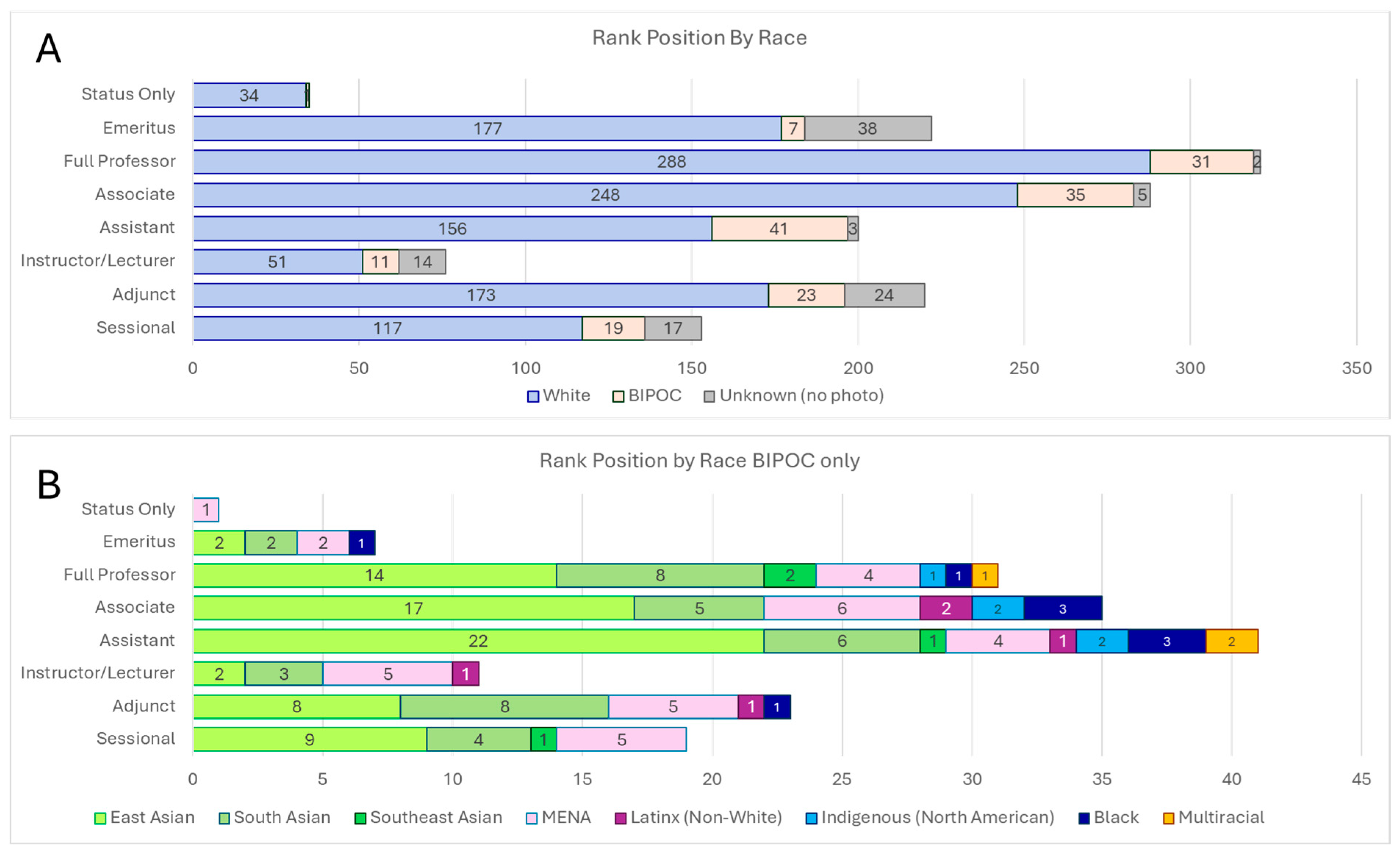
Psychologists of colour (herein referred to as BIPOC—Black, Indigenous, and People of Colour) contribute to diverse perspectives and also conduct critical research that addresses the significant disparities and challenges faced by communities of colour in accessing mental healthcare services. There has been some concern that BIPOC psychologists are underrepresented in academia, but this issue has yet to be evaluated in a Canadian context due to a lack of available data. This study examined the racial demographics of psychology faculty across 23 major universities in Ontario, Canada (n = 1421), the province with the largest number of universities. White psychologists are overwhelmingly overrepresented compared to BIPOC psychologists, reflecting significant underrepresentation relative to the province’s population. White faculty predominantly hold secure academic positions (tenured, tenure track) while BIPOC faculty are concentrated in precarious roles (adjunct, sessional, lecturer). Professors of East Asian heritage constituted the largest group among BIPOC faculty. Additionally, BIPOC psychologists are underrepresented across all professional subspecialties. Systemic racism, historical biases, and exclusionary practices were identified as major barriers. Our findings call for urgent reforms in university hiring practices and psychology training programmes to reflect the diversity of the population they serve and to dismantle systemic barriers that perpetuate racial inequalities in academia. 

Figure 2

Rank position by race and within race. (A) Depicts numbers of psychology faculty by their job seniority. White faculty are shown in blue and aggregate BIPOC faculty in pink. (B) shows numbers of faculty by job seniority excluding White faculty but including breakdown by race for the BIPOC group.

media/image002.png

Source: Out of sight, out of mind: underrepresentation of racialized faculty in Canadian psychology

Jamie Sarkonak: He mildly questioned DEI. His law school calls that ‘misconduct’

Of note. May not have been from a neutral position but nevertheless a cautionary tale. Court case to watch:

…Tim Haggstrom’s crime? Writing an open letter to his fellow students, from a neutral position, to foster dialogue and attempt to inject reason into the debate. His punishment? A campaign by other students to sabotage his career, culminating in an official finding of misconduct by a spineless university that appears to have forgotten its role in protecting free expression on campus.

That campaign, at least, didn’t work. Now a lawyer (and the national director of the Runnymede Society, whose local chapter events I often attend) Haggstrom, via his legal team at civil liberties charity Freedoms Advocate, is asking the Saskatchewan Court of King’s Bench to have the misconduct ruling thrown out — along with the university policies that work to deny procedural fairness to those who don’t emphatically agree with diversity, equity and inclusion.

For the university’s own sake, Haggstrom better win.

He alleges unfair, Charter-infringing treatment in his court filings, and he’s got a strong argument. At the time Haggstrom expressed the need for discussion over affirmative action at the law school, the University of Saskatchewan had already adopted an identity-based worldview, aimed at elevating certain groups in the university.

The institution had, since 2020, a diversity, equity and inclusion policy that implored the entire campus to uphold DEI values, cementing identity-based thinking — and with it, the idea that procedures are only fair when they result in equal outcomes between groups — into campus culture. That year, the university president committed himself to the “dismantling of institutional structures, policies and processes that contribute to inequalities faced by marginalized groups.”

In 2021, the university signed a memorandum of understanding with the student union, committing to deliver anti-oppression and anti-racism training to staff, which was being rolled out by the next year. That initiative was led by anti-racist scholar Verna St. Denis, who has openly called for biasing university education to favour her own progressive, deeply racial worldview. St. Denis also contributed to the university’s Indigenous strategy, also released in 2021, which planned for institution-wide decolonial change.

Further, according to the originating application filed in court by Haggstrom, the university had made training materials available on the topic of “power and privilege.” The materials are no longer on the university website, but were archived online. They teach a hierarchical understanding of race (specifically, that white people have better access to education and success); they characterize meritocracy as a feature of “settler mindsets”; they state that internalized colonialism causes oppressed people to commit sexual assault; they instruct readers to “refute colonialism” (that is, the very basis of our nation) to assist in making Canada “the friendly, open, welcoming country it espouses to be.” They remark that anti-oppressive education “ought to be uncomfortable as white students begin to unlearn what they have been taught through their previous learning experiences.”

The course ends on a question: “As an individual how can you decolonize yourself and what can you do with your power and privilege to help in the betterment of Canada?”…

Source: Jamie Sarkonak: He mildly questioned DEI. His law school calls that ‘misconduct’

Treasury Board reports gains on diversity and equity in public service, but will cuts hamper progress?

Good question:

The federal public service continued to increase the number of women, Indigenous people, visible minorities, and people with disabilities in its ranks between 2023 and 2024, according to the latest report on employment equity. But as the federal public service now begins to shrink for the first time in over 10 years, some have raised concerns that job cuts will hamper progress for equity-seeking groups….

Source: Treasury Board reports gains on diversity and equity in public service, but will cuts hamper progress?

TBS publishes some rich infographics and infographics: Employment Equity Demographic Snapshot 2023–2024

Figure 33: Representation trends for members of visible minorities by subgroup – percentage

Text version below:


Is addressing anti-Black racism in Canada still a policy priority?

Suspect it will become a lower priority given more pressing issues but hopefully become more focussed on results and outcomes and more in-depth evaluations on which government programs are more effective:

…Placating the anti-equity backlash has left Canada unable to achieve or sustain the goal of employment equity. The federal government and its institutional post-secondary partners should instead commit to following more transformative paths laid out by Black scholars. These recommendations include: 

  • Redressing anti-Black racism and supporting Black inclusion in universities and colleges by following actions set out in the Scarborough Charter
  • Advancing equitable participation of Black researchers by upholding the SSHRC’s action plan. 
  • Heeding Blackett’s call to meaningfully pursue equity by affirming the quasi-constitutional status of employment equity legislation. This would include focusing attention on removing barriers for Black workers. 

Much Black effort has gone into showing us what policies and actions are needed to address anti-Black racism. The question is do Canadian institutions have the moral fortitude to follow through in the face of mounting anti-EDI backlash? 

Source: Is addressing anti-Black racism in Canada still a policy priority?