Seeing more accounts of caste discrimination here and in the USA:
When Gurpreet Singh packed his bags last fall and arrived in Ontario from India, he soon learned there was one thing some fellow Indians in Canada hadn’t left behind in their home country — their prejudices.
The human resource management student at Durham College in Oshawa, Ont., said he is viewed as an outcast in the ancient South Asian social structure known as the caste system, but faces more discrimination from Indians in Canada than he did in India.
“I have been here for roughly five months and I have faced it in a way more aggressive or aggravated form in this country from my own Punjabi community,” Singh said. “They beat their chest with pride that they come from this caste or that caste.”
India is a main source of immigrants to Canada. It’s also a huge pipeline for international students both to Canada and the United States, and some universities are taking note of concerns around discrimination based on caste.
California State University, the largest four-year public university system in the U.S., specifically added caste to its non-discrimination policies in January. In Ottawa, the academic staff association at Carleton University passed a motion in November to include caste-based discrimination in its policies.
Singh recalled a conversation with an acquaintance in Oshawa that shocked him after she used a casteist slur to address him.
“I confronted her that you’d be behind bars if you were in India right now … The girl who uttered that word acted as if she didn’t know anything, why it’s offensive, etc.,” Singh said. “To put it in her brain in the easiest possible way, I equated the word with the N-word.”
He said it was “strange” that she knew the N-word was a slur for Black people, “but even after living in India for 23 years, she had no idea, or at least pretended to have no idea, about the thing she just said so casually.”
The Hindu caste system divides people into four sub-communities based on ancestry — Brahmins, Kshatriyas, Vaishyas and Shudras — and the caste of a person can often be identified by their last name. The four main castes are further divided into 3,000 castes and 25,000 sub-castes.
The caste tradition transcends religion. Many Indians with Hindu lineage whose ancestors adopted Sikhism or Christianity retained their last names, and their caste designations.
Singh belongs to a scheduled caste, members of which are also known as Dalits. According to the caste system, scheduled castes are outcasts and do not belong to the social order.
According to the 2011 census, scheduled castes made up for 16.2 per cent of the Indian population. From 2018 to 2020, India’s National Crime Records Bureau recorded 50,202 registered cases of crimes or “atrocities” against scheduled castes. Activists from the community have long fought against caste oppression.
Singh’s last name was originally Badhan, which indicated his caste. He stopped using it, even on official documents, but he said in Canada he’s been asked for his full name so people could identify his community.
“I have had to hide my identity a number of times,” Singh said. “I had to lie twice. I told them I come from the Jatt community and my surname is something else because I felt that I might be isolated, and no one wants to feel that way when you are so far away from home.”
Casteism can cause harm
Chinnaiah Jangam, an associate professor in the department of history at Carleton University and an advocate for the rights of people from scheduled castes, believes casteism can hurt immigrants long term.
“A student or an employee coming from these backgrounds will not feel comfortable to express their own identity and they won’t feel comfortable being themselves,” said Jangam, who is the author of Dalits and the making of modern India and spearheaded the push to add caste to the anti-discrimination policies of Carleton’s academic association.
Meera Estrada, the Toronto co-host of the pop culture show kultur’D on Global News radio, was born in Canada but said she was aware she was a Dalit since childhood. She often hid her identity because other people of Indian background looked down on her community.
She recalled going to Gujarati language classes and people asking what samaj, or community, she belonged to. “And people were quite proud in saying which group they belong to, but it was always the Brahmin group or the so-called upper caste,” Estrada said.
India passed a law in 1955 to abolish “untouchability,” a term once used to describe the practice of ostracizing scheduled castes. But Estrada believes the social stigma against Dalits remains, something that became more apparent to her in her 20s.
“Aunties in mandirs [temples] trying to play matchmakers would always say, ‘Oh, this is a good boy from a good family.’ The implication there was that he is from a higher caste, and I would just feel like if that is the equivalent of good, who am I? Am I not good?”
Brahmin-only group
One matchmaking Facebook group, the Samast Brahman Society of Canada, has 4,100 members. The group’s description says its “goal is to unite all Brahmins under one roof while they can serve in all other Brahmin organizations.”
Its administrator, Jagruti Bhatt, said in an interview in Gujarati that the Facebook group only accepts members of the Brahmin caste, although she later added that all castes are allowed at events organized by the group.
“We only allow Brahmins to enter the group. Different organizations exist to address different communities. Likewise, ours is only for one particular caste,” Bhatt said. She refrained from commenting on accusations casteism is promoted through her group.
Estrada said it’s “quite disgusting” that such groups exist. “Imagine, for example, it was a whites-only kind of thing. I almost don’t even see the difference there,” she said.
Sailaja Krishnamurti, associate professor of religious studies and women and gender studies at Saint Mary’s University in Halifax, said the impact of such networks is concerning.
“It’s a well-known, well-established reality that people often use their community and family networks to help get employment as they are migrating. So, that can have a direct impact on what happens in terms of access to employment,” she said.
It’s long been predicted that with migration, caste would reach beyond South Asia.
Bhimrao Ramji Ambedkar, an Indian jurist who would chair the committee that drafted the Indian constitution, warned in 1916 that caste could potentially become a global issue. He was opposed to the concept of untouchability and burned a copy of the Manusmriti, an ancient Hindu law book.
“If Hindus migrate to other regions on earth, Indian caste would become a world problem,” Ambedkar wrote in his thesis Castes in India.
Sharp contrast with Canada where 18.2 percent of candidates in the 2021 election were visible minorities:
Of the more than 1,200 candidates in the federal election running for the House of Representatives, just 100 (8%) come from backgrounds other than Anglo-Australian, according to lists compiled by the Asian Australian Alliance and the Centre of Multicultural Political Engagement, Literacy and Leadership (Compell). There are a further 38 diverse candidates running for the Senate.
According to a report from the Australian Human Rights Commission, 21% of Australians have a non-European background and 3% an Indigenous background. Over 300 ancestries were identified in the 2016 census.
Less than 40% (458) of House candidates are women, with the majority of both diverse and female candidates running as challengers in safe or fairly safe seats.
The most commonly self-identified occupations of House candidates – aside from existing members of parliament – are managers, retirees and businesspeople. Some unique occupations listed by only a single candidate include a showman, firearms dealer, humanitarian and a carbon farmer.
Although the lists are largely crowdsourced via public statements and may not be comprehensive, as the Australian Electoral Commission does not release extensive data on candidates’ backgrounds, they nevertheless highlight a troubling lack of diversity in the electionwhich “is not representative of multicultural Australia”.
Most diverse candidates are challenging safe seats
Of the 100 House candidates identified as having backgrounds other than Anglo-Australian, just three are incumbents in safe seats: the Coalition’s Ian Goodenough and Labor’s Linda Burney and Peter Khalil. Labor’s Cassandra Fernando is contesting in Wills, where the incumbent Labor MP Anthony Byrne is retiring.
The majority of diverse candidates identified (57%) are challengers in safe or fairly safe seats. There are five diverse candidates in marginal seats currently held by their parties, including Dave Sharma, Marion Scrymgour, Gladys Liu, Anne Aly and Ken Wyatt.
Tharini Apolline Rouwette, the CEO of Compell, says the makeup of parliament and the candidates isn’t reflective of Australian society. “Our parliament is not representative of multicultural Australia, hence why we need diversity in parliament and also to normalise people of colour in leadership roles,” she says.
“There’s about 4% of people of colour in parliament today which is hardly reflective of the Australian population that is increasingly becoming multicultural. The information collected, together with my follow-up surveys/interviews will hopefully be the beginning of a long journey towards collecting information that will inform us as to what we need to do to get more people of colour elected in government.”
More candidates in marginal seats are women
Men make up over 60% of the 1,204 candidates in the AEC list, according to data compiled by Ben Raue at the Tallyroom. There are four non-binary candidates and two whose gender is unknown.
Both major parties have more male than female candidates, but a slightly higher percentage of Labor candidates are women.
Women make up a disproportionate share of candidates in marginal seats – they represent 38% of all candidates, but 41.6% of candidates in marginal seats. Some 263 women (56%) are running as challengers in safe or fairly safe seats.
Occupations
Guardian Australia compiled a list of occupations from the AEC candidate list, identifying around 254 unique occupations – an approximation, since there can be a number of names for the same occupation, and some candidates wrote expansive job titles such as “finance” or “business”.
Aside from member of parliament, lawyers, directors, consultants, managers, retirees and the unemployed are among the biggest occupations for candidates in the major parties. Some candidates who quit their jobs to contest the election are listed as unemployed.
The most common occupations for Coalition members are lawyers and directors (nine each), followed closely by consultants and managers. Union officials and unemployed are the top occupations for Labor candidates.
Students and retirees make up the top occupations for the Greens. Managers and businesspeople top the list for the United Australia Party, and retirees is the most common occupation listed for One Nation.
Reminds me of Holocaust denier David Irving suing Deborah Lipstadt for libel in her book, Denying the Holocaust: The Growing Assault on Truth and Memory, and the legal strategy involved which ensured that she herself would not take the witness stand to maintain the focus on Irving:
Sidney Zoltak, who has spent a significant part of his life recounting his experiences as a child survivor of the Holocaust, says he’s not sure how he would characterize the effort by some to deny the historical genocide.
“I don’t know what to call it … whether it’s a crime, a shame, a lie — what would be more appropriate,” said Zoltak, 91. As a child, he, along with his family, escaped the Jewish ghetto set up by Nazis in his Polish hometown and went into hiding.
“But what kind of a crime it is, I am not a legal person, not a lawyer, so I wouldn’t know how to legislate that.”
Yet, that’s what the federal government will attempt to do, and join several countries in Europe, including Germany, that make Holocaust denial a crime. However, like any legislation that seeks to curb expression, it could be subject to Charter challenges.
‘Probably unconstitutional’
The Holocaust refers to the state-sponsored initiative by the Nazi government during the Second World War that led to the murder of more than six million Jews and millions of others, such as Roma.
The government’s plan to criminalize denial of those events — outside of private conversation — was first unveiled inside this year’s 280-page federal budget. Along with a number of initiatives to fight antisemitism, including $20 million for a new Holocaust museum in Montreal, the budget also revealed the government’s intent to amend the Criminal Code. Currently the Criminal Code makes it illegal to communicate statements in public that wilfully promote hatred against any identifiable group.
The amendment would “prohibit the communication of statements, other than in private conversation, that willfully promote antisemitism by condoning, denying or downplaying the Holocaust.”
But while many advocates welcome the legislation, some legal experts question its constitutionality.
“I think it’s problematic to criminalize Holocaust denial,” said Cara Zwibel, lawyer and director of the Fundamental Freedoms Program at the Canadian Civil Liberties Association. “That’s not to say that that kind of expression is not harmful. But the truth is, we don’t criminalize lying for the most part.”
“I think if it adds things that sort of go beyond the narrow definition of what the court has said is hate speech, then it’s probably unconstitutional.”
‘Reliable predictor of radicalization’
The news was welcomed by the Centre for Israel and Jewish Affairs, which said the amendment would “provide the necessary legal tools to prosecute those who peddle this pernicious form of antisemitism.”
“Denying the Holocaust is a reliable predictor of radicalization and an indication that antisemitism is on the rise,” Gail Adelson-Marcovitz, chair of the national board of directors of the Centre for Israel and Jewish Affairs, said in a statement.
Sarah Fogg, a spokeswoman for the Montreal Holocaust Museum, said while the organization was surprised to see such a measure in a federal budget, they welcomed the news as an “important step.”
“It’s a really meaningful legislative effort to combat antisemitism,” she said. “I think this this sort of makes that link really obvious between Holocaust denial and antisemitism.”
Putting the Holocaust on trial
But Zwibel warned the legislation could give Holocaust deniers a platform.
She cited the case of Holocaust denier Ernst Zundel, who was tried twice in the 1980s for publishing the pamphlet Did Six Million Really Die? The Truth At Last. Although convicted, Zundel was eventually acquitted when the Supreme Court of Canada struck down the country’s laws against spreading false news as a violation of free speech.
His trials also put the Holocaust on trial, with the crown bringing in Holocaust researchers and survivors to support their case, while the defence put noted Holocaust deniers on the stand.
“What being prosecuted did for [Zundel] was give him a big platform and basically allow him to parade a bunch of witnesses in court to try and prove that the Holocaust didn’t happen and have the government put survivors before the court. It’s atrocious,” Zwibel said.
Zwibel also suggested there could be problems with how the amendment would define terms such as “condoning’ and “downplaying” in relation to the Holocaust.
“There’s a lot of different questions to try and figure out what would be caught here.”
Geneviève Groulx, a spokeswoman for the Department of Justice, said ultimately, the courts will assess what words like “downplay” mean
“But generally it is understood to encompass actions that try to make (something) appear smaller or less important than in reality and to minimize (something). A court would have to conclude that the downplaying wilfully promotes antisemitism,” she said in an email.
Richard Moon, a University of Windsor law professor whose research focuses on freedom of expression, said any such law that restricts speech will likely be challenged at some point to determine whether that limitation can be justified under Section 1 of the Charter.
But Moon questioned whether the proposed amendment would add anything to what is already covered in the Criminal Code, other than to potentially specify or clarify in some way.
“So one possibility, it’s not actually doing anything new,” he said.
“The way this is framed, it sounds like someone being prosecuted under it, the prosecution would have to establish what they already have to establish under the existing Criminal Code.”
Zoltak and his family were some of the lucky few to survive the Holocaust. His family was on the run for two years, staying with different villagers, forced to change locations every few months. They eventually found one Polish family that hid them for 14 months in an underground bunker, where they did not see daylight for half that time.
When they were liberated and returned home, only 70 Jews remained in their village from the 7,000 prior to the war.
“We know a number of nations around the world have made Holocaust denial a crime,” Zoltak said. “And they have been living with that for quite a while. And it works for them. And why should we be shying away from that?”
‘Has to be bulletproof’
Bernie Farber, chair of the Canadian AntiHate Network, said while any tool that can deal with antisemitism is worthwhile, the legislation will have to be carefully thought out.
“It has to be kind of bulletproof in terms of the constitutionality test,” he said. “I think it’s all going to be in the wording of the legislation.
“I accept this in principle. I think it’s a long time coming. But people do have the right to be stupid and offensive. And if people want to say that the Holocaust didn’t happen, that’s kind of their business. But that said, we know that these are, antisemitic dog whistles. And it’ll be really important in terms of the wording of the legislation on how it traces back to antisemitism.”
Zoltak and his family were some of the lucky few to survive the Holocaust. His family was on the run for two years, staying with different villagers, forced to change locations every few months. They eventually found one Polish family that hid them for 14 months in an underground bunker, where they did not see daylight for half that time.
When they were liberated and returned home, only 70 Jews remained in their village from the 7,000 prior to the war.
“We know a number of nations around the world have made Holocaust denial a crime,” Zoltak said. “And they have been living with that for quite a while. And it works for them. And why should we be shying away from that?”
Misleading article given that it leaves out the important qualification of the first generation limit on parents passing on their citizenship to their children if they themselves were born outside of Canada.
Surprising, given that this provision has been in place since 2009:
Canada allows the children of its citizens to apply for Canadian citizenship.
If you have at least one biological or legal parent who was a Canadian citizenship at the time of your birth, you can submit a Proof of Citizenship application to Immigration, Refugees and Citizenship Canada (IRCC). The fee is only $75 CAD.
You are able to claim Canadian citizenship at any time in your life. You are also able to apply for Proof of Citizenship even if your Canadian parent is deceased.
IRCC requires evidence of your Canadian parent. This can come in the form of your parent’s birth certificate, Canadian citizenship card, or citizenship certificate.
Once IRCC receives your application, it will send you an “acknowledgment of receipt.” They will then send you a Canadian citizenship certificate once your application has been approved.
Becoming a Canadian citizen is beneficial for many reasons. Canada is a stable country with a diverse society and strong economy. The country offers safety, security, universal healthcare, and high quality education. In addition, the Canadian passport is one of the world’s strongest, offering visa-free travel to 185 countries.
An experienced and trusted Canadian immigration lawyer can help submit your Proof of Citizenship application. They will use their expertise to ensure you submit a complete and accurate application. This is important since the pandemic has slowed down IRCC’s processing. Pre-pandemic, it took IRCC five months to process Proof of Citizenship applications. Now its website is reporting an average processing time of 17 months. A lawyer can help you avoid waiting any longer than necessary to gain Canadian citizenship.
The good news is Canada is making greater investments in technology to improve its immigration processing. Moreover, the wait to get Canadian citizenship is worth it in the end, due to the plethora of advantages Canada has to offer.
Interesting account. Remember from my days in multiculturalism following the UK’s PREVENT inititiatives to counter radicalization and extremism, and this article highlights one of the think tanks involved. Others with more experience in countering violent extremism may have some comments on this account:
In the wake of the calamity of the Iraq invasion of 2003, one might have supposed that the ideology which lay behind Tony Blair and George W Bush’s bloody misadventure would have been discredited. This has not happened. Neo-conservatism has continued to set the parameters for a great deal of policy discourse, and its supporters have continued to occupy many of the most prominent positions in British (and American) public life.
There are a number of reasons for this resilience. In the UK, Policy Exchange, a London-based think tank, is one organisation which kept the neo-conservative flame burning. Though its public profile is small, it has exerted prodigious influence in political circles. In conventional politics, Policy Exchange was at first associated in particular with ‘marketisation’, an ugly word which describes how the disciplines of the private sector have been introduced into the education system and the wider civil service. The think tank’s most enduring achievement, however, has probably been the reshaping of government policy towards British Muslims.
To simplify a rather complicated story, the British government, police and intelligence services originally saw their job as enforcing the law rather than policing ideology or personal beliefs. Abu Hamza, the notorious one-eyed cleric who made no secret of his sympathies with al-Qaeda, provides a fascinating illustration of this approach. Hamza, who used his position as imam of the Finsbury Park mosque to preach violent jihad, was skilful at ensuring that his public pronouncements stayed just within the law. There was general amazement and surprise when his eviction was suddenly brought about not apparently by the British state, but by his own congregation, who locked the doors of the mosque against him. The Metropolitan Police were, however, involved in Abu Hamza’s downfall. Its policemen built up close relations with the mosque’s faithful and were unobtrusively stationed nearby on the day of the imam’s eviction in case of trouble. This sensitive operation was a model of old-fashioned intelligence work and community policing.
However, the Muslim congregation who threw out Abu Hamza themselves held views which many sections of British society would find offensive. The congregation included sympathisers with Hamas, the Palestinian resistance group. Probably without exception, they were hostile to the invasions of Afghanistan and Iraq, and were dismayed by the Israeli occupation of the West Bank and Gaza. Many worshippers at the mosque held socially conservative views about homosexuality and women which, while by no means unknown among the Conservative Party membership, are no longer mainstream opinions in the modern UK. None of these views bothered the Metropolitan Police. They were happy to work with the Muslim community for the removal of a figure who they rightly saw as a menace.
This kind of ‘multicultural’ approach lay at the heart of what was then the British way. As long as they obeyed the law, immigrants were allowed to bring with them the traditions and customs of the countries they had left behind. This approach fitted in naturally with the national tradition of letting in dissidents and exiles from abroad, from the Huguenots expelled from France in the seventeenth century to the Jews who made their way to the UK as refugees from the Russian pogroms before the First World War, or later as refugees from National Socialism.
Policy Exchange dismantled the British approach of tolerance. Its analysts naturally agreed that the police should counter violence. But they disagreed profoundly with any tolerance of the ideas which (so they maintained) might become gateways to this violence. Policy Exchange’s connections were second to none. It was set up in 2002, in the wake of heavy Conservative Party defeats in the 1997 and 2001 general elections, by a group of Conservatives who feared their party was destined to perpetual opposition. These were the self-proclaimed Tory ‘modernisers’. They greatly admired Blair and had supported the Iraq War. These modernisers believed that their mission was to help the Conservatives copy Blair’s achievements in making the Labour Party electorally successful. Michael Gove, at the time of writing a senior member of the Boris Johnson government, was the first chairman of Policy Exchange.
When David Cameron ran for the Tory leadership after the 2005 general election defeat, he looked to Policy Exchange for ideas. The organisation – defined by the Evening Standard as “the intellectual boot camp of the Tory modernisers” – helped shape his thinking. At its heart, Policy Exchange spoke of a political philosophy which appeals almost as deeply to the Blairite or Starmer wing of the Labour Party as it does to David Cameron or Boris Johnson’s Conservatives. Better than any comparable organisation, it has come to articulate what was rapidly becoming the philosophy of the British governing class in the 21st century.
Policy Exchange and British Muslims
When the think tank was founded, it contained a ‘Foreign Policy and Security Unit’. As far as can be ascertained, its publications focused on foreign policy, but displayed no interest in domestic ‘extremism’. This changed with the arrival of Dean Godson with the title of research director of international affairs in 2005. Godson, who had worked as chief leader writer for the Daily Telegraph, appeared to interpret his international brief as a mandate to generate domestic policy towards British Muslims. This should never cause surprise: the political right in the UK has a habit of discussing British Muslims as if they were a foreign policy issue.
Godson came from a family with a tradition of interest in Cold War intelligence work, propaganda and covert action. His father Joseph Godson was Labour attache at the United States embassy in London in the 1950s and used his influence to promote the interest of the pro-US wing of the Labour Party.
From 2005 onwards, Godson seems to have been on a mission to rip up the counter-terrorism strategy adopted by successive British governments. He promoted the new approach to Muslims through research papers, seminars and, not least, media muscle. In particular, he argued that methods used by the British state against terrorism – above all against the IRA during the Troubles – were no longer relevant. In Ireland, British ministers were happy to work with Catholic communities in order to isolate the gunmen and bring about reconciliation.
Confronted with the threat of terrorism in the aftermath of the 9/11 attack on the Twin Towers, the first instinct of the British state was to copy the Irish experience. The police identified leaders who they felt they could trust with links into local communities. They sought to draw these figures into British politics, inviting them on to public platforms and making public funds available. In this way, they hoped to single out and segregate those individuals with an inclination to violence while gaining intelligence about their activities.
Policy Exchange argued that this strategy was wrong because, so it claimed, the British government was not merely confronting terrorists. Something much bigger was afoot: a confrontation of ideologies. For Policy Exchange, the UK was one of a band of free states, led by the US, that were engaged in a mortal battle against a set of deadly foes dedicated to a project to destroy Western civilisation. These foes were called ‘Islamists’ and they subscribed to a murderous ideology called Islamism. Policy Exchange acknowledged that not every Islamist was violent. However, over the long term that was irrelevant: Islamism had to be fought and ultimately it had to be defeated.
Islamism, said Policy Exchange, is a worldview which teaches its adherents that Islam is a comprehensive political ideology and must be treated as such. According to Policy Exchange, the Islamist outlook is one that essentially divides the world into two distinct spheres: ‘Muslim’ and ‘the rest’.
There could therefore be no negotiation. Islamists could never accept democracy, the rule of law, political institutions or the nation state. There was therefore no point in bringing Muslims into politics unless they renounced Islamism, in which case they could be welcomed.
According to Policy Exchange’s analysis, the core aim of counter-terrorism policy was no longer just protecting British citizens against violence. It was also the assertion of what Policy Exchange claimed to be Western values against so-called Muslim ‘extremism’. This grand battle of ideas demanded a return to the strategy of counter-subversion employed against the Soviet Union during the Cold War. My close reading of Policy Exchange publications has led me to conclude that Godson was, in essence, arguing that British Islamists should be isolated, never embraced and treated as suspect.
Twenty years ago I would attend the Telegraph leader conference. Godson, as chief leader writer, held court. He was a good mimic, an art he used to mock or denigrate political opponents or, if feeling cheerful, merely to entertain. He welcomed acolytes, but I took the liberty of challenging Godson. That evening I received a message through a mutual friend, who had arranged a dinner so that we could get to know each other better, that Godson was offended and no longer wanted to come across me socially. He was as good as his word.
A survey of his work at Policy Exchange suggests Godson had three objectives. First, he sought to weaken – or, better still, wreck – the alliance between the British left and British Muslim organisations. This he did by portraying Islamism as an outlandish far-right movement, with features in common with fascism. Secondly, Policy Exchange sought to challenge multiculturalism both as an idea and, more especially, as a basis for government policy. Above all, Godson was determined to break the link between so-called Islamist movements and the British state.
Godson was successful in all these objectives. His excellent Whitehall and Westminster connections may well have helped. These connections endure. Policy Exchange can whistle up a Cabinet minister for an event, an op-ed in a newspaper or access to Downing Street, while its authors are sought as experts on Islam on radio and television. The organisation’s reports tell the Conservative Party exactly what its leaders want to hear. At least six special advisers in the Boris Johnson government previously worked for Policy Exchange.
Godson’s first publication for Policy Exchange targeted British government collaboration with what was coming to be termed ‘radical Islam’. The author, Martin Bright, was a left-leaning journalist and then political editor of the New Statesman. This in itself sent out the important message that Policy Exchange worked with both political persuasions. Bright’s analysis was based on leaked material, courtesy of a Foreign Office source alarmed at the government’s relationship with Muslim organisations both in the UK and overseas. “It depresses me deeply,” wrote Bright, “that a Labour government has been prepared to rush so easily into the arms of the representatives of a reactionary, authoritarian brand of Islam, rather than look to real grassroots moderates as allies.”
Bright’s document took aim at two targets: the Muslim Brotherhood and the Muslim Council of Britain. Policy Exchange (and Bright) present the Muslim Brotherhood as an Islamist movement guilty of propagating a dangerous ideology at odds with the West. As for the Muslim Council of Britain, that was condemned as guilty of being Islamist too. Bright’s document was an important blow in a campaign which would eventually lead to the severing of relations between the British government and the MCB. Policy Exchange can claim a large part of the credit.
Godson was an acute talent-spotter. Munira Mirza wrote his second publication and later worked with Boris Johnson when he was mayor of London, before moving to the crucial role of head of the Downing Street policy unit. Mirza demanded an end to “institutional attacks on Britain and its culture”, arguing that “the preoccupation with Muslim vulnerability and Islamophobia has skewered our understanding of why such problems exist, and in many ways, has made things worse for Muslims.” Mirza asserted that this reflected a “victim mentality” which was “given social credence by institutions, politicians, the media and lobby groups”. Her report also claimed Islamophobia has been ‘exaggerated’ by some British Muslims. Policy Exchange has a long history of questioning the idea of Islamophobia and has a record of recruiting members of minority groups to do the questioning.
The invention of non-violent extremism
In 2009, Policy Exchange published a report which explicitly presented the demand for the British state to apply to British Muslims the same counter-subversion regime used against trade unionists, socialists and others during the Cold War. This well-written and powerful polemic probably represents – more explicitly than any other Policy Exchange publication – the full Godson agenda. It was written by two Cambridge scholars. Martyn Frampton was a fellow of Peterhouse, the high Tory Cambridge college. His co-author Shiraz Maher was a former member of Hizb ut- Tahrir, having worked for the organisation as a regional officer in the north- east of England.
Frampton and Maher’s report called for the government to reinstate the 1989 Security Service Act, which would give MI5 the power to investigate subversion. As far as the British government was concerned, this involved a giant conceptual leap. The ‘Preventing Violent Extremism’ initiative was rebranded as, simply, ‘Preventing Extremism’.
This was also a profound change of policy because it implied that the state should target not just violence but opinion as well. It criticised the government for “stressing law enforcement and strict security concerns over and above everything else’” Instead, it should deal with “non- violent radicals” who were “indoctrinating young people with an ideology of hostility to Western values”.
In other words, Policy Exchange wanted to create a new relationship between the British state and Muslims. This project meant creating a different kind of British citizenship. It led to a new concept in British public discourse: non-violent extremism. Policy Exchange was urging that Muslims should be obliged to sign up to a set of beliefs that fell within a state prescribed remit. In order to become British, Muslims were being asked to deny, or at least modify, their own identity and heritage. Until that moment, British citizens had generally been allowed to think and conduct themselves as they wanted, as long as they stayed within the law. The invention of the concept of non- violent extremism meant citizens could now be harassed, put on secret lists or barred from public life for offences which they often did not even know they had committed. It lies at the heart of the Prevent doctrine.
Prevent was used to fund organisations that would promote the government line on terrorism and extremism. But there was another component to the programme, which the Cameron government adapted to target “non-violent extremism” rather than just violent extremism. In 2015, Prevent became a legal duty for public sector institutions – including hospitals, schools, and universities. Under Prevent, public sector workers were and are (at the time of writing) expected to report anyone they suspect of extremism to the programme.
Extremism, according to the government, constitutes “vocal or active opposition to British values”. This means that people whose views may be mainstream or illiberal, but certainly not illegal, can be targeted as a threat to British society.
In a school context, Prevent demands that any teacher who suspects a pupil of having been radicalised must report them to the programme. The policy has failed at the crucial test of effectiveness. From April 2020 to March 2021, 86 per cent of referrals to the programme were false positives – representing people who were wrongly referred. Prevent only occasionally catches the people that it wants to. Even these individuals, however, have never committed a crime. There is, moreover, no evidence that they will ever commit a crime in the future, or that they would have committed a crime were it not for being identified by Prevent. Government statistics, meanwhile, do not illuminate the full picture: there are thousands of cases within schools, universities and hospitals where innocent people, often children, are needlessly interrogated and harassed over suspected extremism. Their cases are dismissed before being officially referred to Prevent and are left out of the official statistics.
Muslims are disproportionately affected by the policy, which relies on profiling. Over 70 per cent of Muslims in England and Wales live in ‘Prevent Priority Areas’ (PPAs), compared with just over 30 per cent of the general population. By requiring public sector workers to report people they find suspicious, moreover, Prevent effectively compels them to act on their prejudices and makes Muslims subject to majoritarian biases.
The development of the concept of extremism, pushed by think tanks like Policy Exchange, has had a material impact on the lives of ordinary British Muslims, pressuring them to assimilate by downplaying their distinctiveness from other Britons.
The idea of non-violent extremism thus brought with it a particular conception of national belonging: if foreigners wanted to become British, why shouldn’t they be like Britons? But this wasn’t a British logic. This country has always had a generous and capacious identity. You can be British at the same time as being Welsh, Jamaican, Cornish, Black, Jewish, Hindu, Muslim or Scottish. The biggest problem is that nobody can be certain who is – or who is not – a non- violent extremist. That is why all attempts to establish a legally secure definition have so far failed.
Policy Exchange’s proposals have shifted the UK towards an American model of citizenship where new arrivals are expected to abandon old identities and join a common melting pot. Policy Exchange’s project to save Britishness was therefore also an attempt to destroy it. But Policy Exchange could not have won its argument without powerful allies, and the most important of these was the Conservative Party. The Fate of Abraham: Why the West is Wrong about Islam is published on 12 May by Simon & Schuster. Peter Oborne won best commentary/blogging at the Drum Online Media Awards in both 2022 and 2017 for articles he wrote for Middle East Eye. He was also named as British Press Awards Columnist of the Year in 2013. He resigned as chief political columnist of the Daily Telegraph in 2015. His latest book, The Assault on Truth: Boris Johnson, Donald Trump and the Emergence of a New Moral Barbarism, was published in February 2021 and was a Sunday Times Top Ten Bestseller. His previous books include The Triumph of the Political Class, The Rise of Political Lying, and Why the West is Wrong about Nuclear Iran.
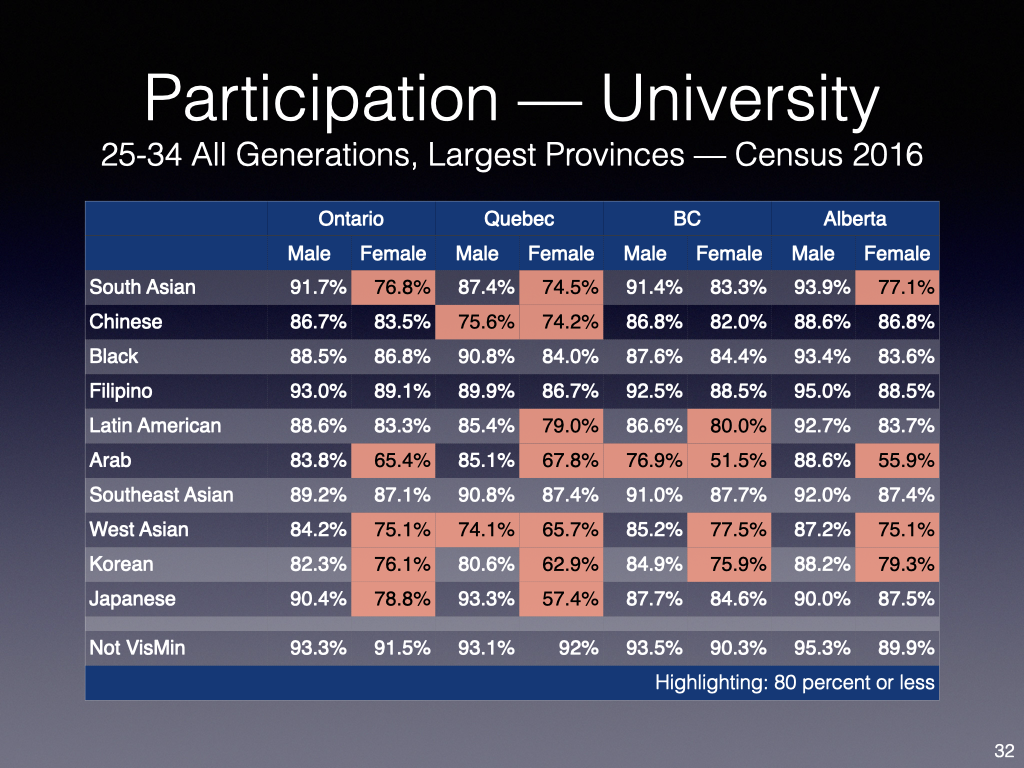
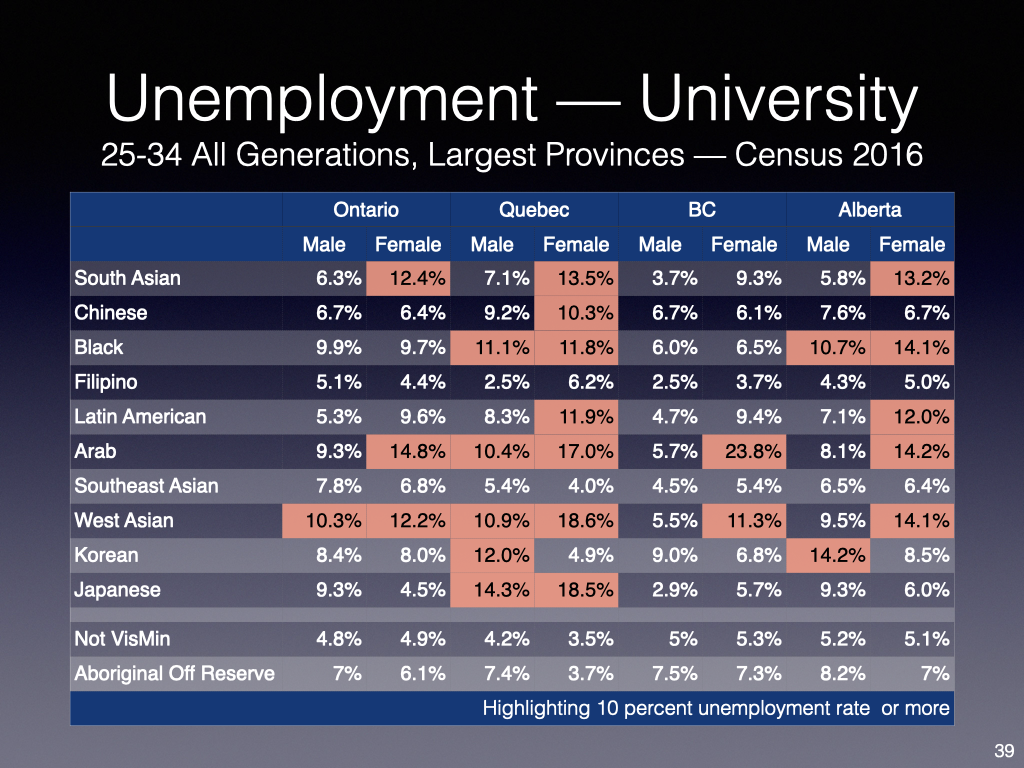
For some context, 2016 census data (not public opinion research) for the younger 25-34 year old cohort. Some of the issues flagged in the study are common to other visible minority groups. Income data is relatively strong for Arab women, lower participation may reflect the impact of family caring, with higher unemployment reflecting in part bias. Regional variations, in particular the relatively poor outcomes for women in Quebec, are notable:
The Canadian Arab Institute released a report last week that attempts to explain why some Arab women aren’t succeeding in Canada’s workforce. It’s compelling reading for anyone invested in the nation’s overall prosperity and success.
The new study titled, “Employment barriers facing Arab Women in Canada”, combines surveys collected by Abacus Data, focus groups and interviews conducted in Ontario, Quebec, and Alberta (provinces with the highest populations of Arab-Canadians). The result is a helpful list of recommendations that would help any newcomer or immigrant trying to navigate the job market.
“Overall, social exclusion describes a state in which individuals are unable to participate fully in economic, social, political and cultural life,” points out the United Nations.
Some Arab-Canadians are having a hard time participating economically, despite the historic presence of these diverse communities in Canada dating as far back as 1882, as chronicled by academic Houda Asal in her book, “Identifying as Arab in Canada: a Century of Immigration History.”
As one of the fastest growing immigrant communities in the country, with seven out of 10 who are first generation immigrants, dreams of success are too often stalled by systemic barriers threatening to “push Arab-Canadians further into poverty and social isolation,” notes the report.
During the fall of 2020, Arab-Canadians had one of the highest unemployment rates in the country at 17.9 per cent, compared to a national unemployment rate of 9 per cent. Fast forward to today, Arab-Canadians continue to be among those with the highest unemployment rates, according to the March 2022 Labour Force Survey.
And Arab women are among the worst off.
“ … why do Arab women have a higher unemployment rate than most non-Arab women?” question the report’s authors. “Our main objective in this study is to understand the knowledge gaps behind the ever-increasing employment barriers facing Arab women and filling these gaps with evidence that inform policy recommendations.”
The researchers approached the question by dividing an individual’s career into different chronological stages. The result is helpful in understanding how those seeking work tend to experience obstacles at various junctures in their journey — information gathering about the local labour market, looking for job opportunities, during the recruitment process, while gaining work experience and being better integrated in the workplace, and in further career development and future growth.
The most significant impediments identified included inadequate employment services, lack of recognition of foreign credentials and opportunities to upgrade, lack of opportunities to gain Canadian experience, language/communication obstacles (not based on proficiency in either of the official languages, but due to a lack of knowledge of industry-specific terms), and discrimination based on one’s identity.
The report’s concluding recommendations would improve the chances of most newcomers and immigrants in finding and retaining employment commensurate with their professional skill-set. These include:
Creating central portals of information about the labour market so it’s easier to access information about the job market.
Encouraging the federal government to work with the provinces to provide information to immigrants about degree equivalency processes before their arrival to Canada so they can better prepare.
Encouraging workplaces to implement standardized performance evaluations to remove concerns about bias in performance reviews and fears of reprisals when individuals report microaggressions or blatant discrimination.
More funding for organizations that provide mentorship and social networking for newcomer and racialized women.
Tailored communication and soft skills training opportunities in industry-specific terms and language.
Measuring the success of employment support services not on whether newcomers or immigrants have secured survival jobs, but whether employment matches the skills of their clients.
These recommendations won’t come as a major surprise to those who have long worked with immigrant and newcomer communities. What should surprise all of us is how long it’s taking to address these hurdles.
Toronto police say there has been a 22 per cent increase in hate crimes in the city.
The force says there were 257 hate-motivated incidents in 2021, up from 210 such incidents the year before.
Police say the pandemic and geopolitical events are believed to be contributing factors in the increase.
The force says religion, ethnic or national origin were the dominant motivating factors in the incidents.
It says east and southeast Asian communities were the most targeted.
Toronto police say they are expanding their hate crime unit.
Police Chief James Ramer says hate crimes are increasing year over year.
“Hate crimes victimize not only the person, but also the communities they identify with and the negative effects can be long-lasting,” Ramer said in a written statement.
“We know hate crimes often go unreported and we are committed to working alongside our community partners to break down barriers and develop relationships so that more people will feel comfortable coming forward to report these crimes.”
East and southeast Asian communities were the predominant victims of assaults, followed by the Black community while Jewish and Black communities were the predominant groups targeted for mischief incidents, police said.
Black and LGBTQ communities were the dominant group for being threatened, the force said.
Similar analysis to that of The Economist. Biggest surprise to me is the inclusion of the USA in the top 10 – but perhaps I shouldn’t be:
The COVID-19 pandemic directly or indirectly caused 14.9 million deaths in 2020 and 2021, the World Health Organization said on Thursday, in its newest attempt to quantify the outbreak’s terrible toll.
That’s around 2.7 times more than the 5.42 million COVID-19 deaths the WHO says were previously reported through official channels in the same 2-year period.
Here’s a rundown of four main points in WHO’s report:
Overall, deaths are far higher than those in official reports
In its tally, WHO aims to quantify “excess mortality,” accounting for people who lost their lives either directly, because of contracting COVID-19, or indirectly, because they weren’t able to get treatment or preventive care for other health conditions. The figure also takes into account the deaths that analysts say were prevented because of the pandemic’s wide-ranging effects, such as curtailing traffic and travel.
The pandemic’s current reported death toll is 6.2 million, according to Johns Hopkins University’s COVID-19 tracker.
India is seen suffering a much deeper loss than reported — a finding that India disputes
In some cases, WHO’s figures depict a shockingly wide gulf between official figures and its experts’ findings. That’s particularly true for India, where WHO says millions more people died because of the pandemic than has been officially reported.
India reported 481,000 COVID-19 deaths in 2020 and 2021. But William Msemburi, technical officer for WHO’s department of data and analytics, said on Thursday that the toll is vastly higher, with 4.74 million deaths either directly or indirectly attributable to the pandemic — although Msemburi said that figure has a wide “uncertainty interval,” ranging from as low as 3.3 million to as high as 6.5 million.
The data behind the staggering figures promise to expand the understanding of the pandemic’s true effects. But the findings are also a flashpoint in debates over how to account for unreported coronavirus deaths. India, for instance, is rejecting WHO’s findings.
India “strongly objects to use of mathematical models for projecting excess mortality estimates,” the country’s health ministry said on Thursday, insisting that WHO should instead rely on “authentic data” it has provided.
10 countries accounted for a large share of deaths
Deaths were not evenly distributed around the world. The WHO says about 84% of the excess deaths were concentrated in three regions: Southeast Asia, Europe and the Americas.
And about 68% of the excess deaths were identified in just 10 countries. WHO listed them in alphabetical order: Brazil, Egypt, India, Indonesia, Mexico, Russia, South Africa, Turkey and the United States.
Overall, WHO found the number of excess deaths was much closer to reported COVID-19 deaths in high-income countries than in lower income countries.
Many countries still lack reliable health statistics
The WHO says it relied on statistical models to derive its estimates, looking to fill in gaps in official data.
“Prior to the pandemic, we estimate that 6 out of every 10 deaths were unregistered” worldwide, said Stephen MacFeely, director of WHO’s department of data and analytics. “In fact, more than 70 countries do not produce any cause of death statistics. In the 21st century, this is a shocking statistic.”
By creating its report on excess mortality, WHO is pursuing several goals, such as urging governments to improve their health-care interventions for vulnerable populations and to adopt more rigorous and transparent reporting standards.
“Knowing how many people died due to the pandemic will help us to be better prepared for the next,” said Samira Asma, WHO’s assistant director-general for data and analytics.
The “grandmother perspective” to data collection, which I first learned from Gwen Phillips of the Ktunaxa Nation, suggests that government should collect data as a grandmother would collect information about her family: to better care for them, rather than exercise control with a big-brother mentality. This perspective formed the basis for the recent recommendations on disaggregated data collection from British Columbia’s Office of the Human Rights Commissioner to the provincial government.
A grandmother collects her grandchildren’s stories like pencil marks on the wall, measuring their growth. Data can also tell a story – one that helps us to understand people’s needs at a community level. Policy makers, too, need good information to design good law, policy and services.
This week, the B.C. government introduced the Anti-Racism Data Act, new legislation to collect disaggregateddemographic data. The new law, if passed, facilitates the collection of personal information for the purposes of identifying systemic racism and advancing racial equity.
Disaggregated demographic data are information based on different aspects of our identities: for example, information broken down by race, gender or educational status. While the Statistics Canada census already collects disaggregated data in relation to the general population, this new law will facilitate the collection of such data in relation to government policies, practices and services, such as health care. Comparing statistics based on these two datasets can reveal patterns and inequalities. Information about inequalities, in turn, can help us design better policies to tackle systemic discrimination. We can’t act on what we don’t know.
Importantly, data must be collected on more than just racism in order to be effective. If we can’t understand how gender, race, age and other factors work together or intersect to inform our experiences in the world – and more accurately, how sexism, racism, ageism, ableism and so on inform our experiences – then we won’t be able to create good public policy that meets people’s real needs.
Race-based data only tell part of the story. For example, we know that in Canada, racialized men earn 78 cents for every dollar earned by white men, according to a 2019 Canadian Centre for Policy Alternatives report. But that gap widens significantly for racialized women, Indigenous women, transgender women and women with disabilities. Indeed, racialized women earn only 59 cents for every dollar earned by white men.
Treating all racialized people as a homogenous group not only obscures the problem, but it also reinforces it by leading to solutions that are only tailored to the experiences of the dominant subgroup within that category.
We may identify racist stereotypes as being one of the barriers contributing to the wage gap. But we also need to understand that stereotypes of racialized women may be quite different than stereotypes of racialized men. Ignoring these gendered differences silences and omits the experiences of racialized women. We need to truly understand the scope and complexity of the wage gap in order to solve it; intersectional data collection and analysis is key to that end.
However, there is a serious downside to collecting all this information. Despite its power to focus the gaze of policy makers on real world inequities, data also have the power to reinforce negative stereotypes, and some people have legitimate concerns about sharing this information.
In recent recommendations from my office, we called on the provincial government to put control over data in the hands of those from whom the data are being collected. For example, disaggregated demographic data about a First Nation should only be collected in service of that community and upon the consent of that Nation, and used at their direction. The new legislation creates advisory roles for those who are directly impacted to embed this democratic approach to data and to counter any harms it may cause.
For decades, racialized communities, scholars and activists have been calling for this kind of legislation. Over the last two years, the public calls for disaggregated-data collection have grown louder. Protests against police brutality, a growing awareness of the ways in which racism impacts health outcomes, including those of COVID-19, and a movement to push back on the mainstream emergence of white nationalism have brought systemic racism into the consciousness of the masses. While data may not be the most glamorous call to action, they may be one of the most fruitful.
The new legislation is an important marker of our growth toward a more equal society. However, data collection is just one pencil mark on the wall; the next milestone to measure will be whether we are able to use it to create real social change. Implementation requires using intersectional data and a meaningful community governance model to turn information into action.
Kasari Govender is British Columbia’s first independent Human Rights Commissioner. BC’s Office of the Human Rights Commissioner exists to address the root causes of inequality, discrimination and injustice in the province by shifting laws, policies, practices and cultures.
In March, at the annual Conference on College Composition and Communication, one panel presentation was of particular interest: It concerned requirements in first-year college composition classes and discussed the idea that for students whose home dialect is Black English, or another nonstandard dialect, requiring them to write in standard English is a potentially unjust, if not flatly racist imposition, forcing some students to suppress their true selves in favor of a hegemonic artificiality. This school of thought holds that writing instructors should allow — encourage — such freshmen to write either purely in their home dialect or to engage in “code-meshing,” mixing the home dialect and the standard.
It’s an approach that accomplishes the feat of both underserving Black English speakers and diminishing Blackness.
During the panel’s Q. and A., an attendee presented this question: “What do we do when the resistance to code-meshing, for example, in our writing classrooms, comes from our BIPOC students? I ask because, of my attempts to encourage students to use their home dialects in writing, Black students in particular often resist those practices as setting them up for failure. Which only reflects how ingrained they are in a system that is inherently racist.”
The question and the panelists’ answers were quite revealing, including one from Asao Inoue, a rhetoric and composition professor at Arizona State University, who responded that when he hears that kind of objection from a student, he asks himself:
Is it that I have to say, or I have to create a classroom, and a learning experience, that demeans the linguistic history of that student in order for that student to go into the world and go into unfair racist, white supremacist systems and succeed? … Because if that student says, “You’re setting me up for failure,” what they’re saying is, “I want to succeed in that unfair system. I want to game that system.”
But, Inoue continued:
You’re always still going to be Black, or you’re always still going to be Latinx, or you’re always still going to be something else. … you can mouth the words that are white, but they’re coming from a body that’s something else, and you may be read that way. And so, for me, my goal as an educator is to change the system.
Because, he said:
What they’ve been exposed to is capitalist-inflected [expletive] about education being the way in which we, you, become a nice little cog in the system and you get skills. So you can go out in the world and make Microsoft more money.
While not all writing professors would go that far, in terms of appending a critique of capitalist reality to teaching freshman composition, just the notion that standard English is exterior to Black students’ real selves requires a closer look, because it tracks with worrisome currents in the way we are encouraged to think about race, especially lately.
Few familiar with today’s academic world will find Inoue’s opinions especially surprising. The idea in education circles that standard English functions as an unjust “gatekeeper,” holding back students of color, has been around for a long time. Related has been the idea that at the grade-school level, Black students whose home dialect is Black English should be taught as bilinguals of a sort. Adherents of this philosophy don’t say standard English should be withheld but suggest that standard English and Black English should be presented as different languages, as it were. Recall the “Ebonics” debate that gained national attention in the 1990s.
In 1993, English Leadership Quarterly, a publication of the National Council of Teachers of English, published a piece by two Indiana University of Pennsylvania English professors, Donald A. McAndrew and C. Mark Hurlbert, arguing that:
Writers should be encouraged to make intentional errors in standard form and usage. Attacking the demand for standard English is the only way to end its oppression of linguistic minorities and learning writers. We believe this frontal assault is necessary for two reasons: (1) it affords experienced writers, who can choose or not choose to write standard English, a chance to publicly demonstrate against its tyranny and (2) if enough writers do it regularly, our culture’s view of what is standard and acceptable may widen just enough to include a more diverse surface representation of language, creating a more equitable distribution not only of the power in language and literacy but also, ultimately, of the power in economics and politics that language and literacy allow.
Later, as The Washington Times reported in 1995, the N.C.T.E. discussed eliminating “English” from its name. That year, a delegate to its annual convention said, “If we are to offer diversity, there can be a conversation about language arts, but not about English.”
But in the same way that the idea of eliminating references to “English” strikes most as overboard, the idea that for Black people standard English is something wholly apart is simply inaccurate. For most Black Americans, both Black and standard English are part of who we are; our English is, in this sense, larger than many white people’s. In “The Souls of Black Folk,” W.E.B. Du Bois wrote, “I sit with Shakespeare and he winces not … I summon Aristotle and Aurelius and what soul I will, and they come all graciously with no scorn nor condescension.” On a less exalted level, a great many Black people toggle endlessly between standard and Black English, day in and day out — we code-switch. I always liked how Gloria Naylor was able to get this across, as in this scene from her novel “Mama Day”:
“We ain’t staying long,” Ruby says, pulling up a chair. “But I thought it would be nice for us to meet Cocoa’s new husband.”“It’s a pleasure,” George says.“Doubly mine,” says Ruby. “And this here is my new husband, Junior Lee.”“Pleasssurre.” Junior Lee manages a nod. “Hear you a big railroad man.”“No, I’m an engineer.”
In that exchange, the characters aren’t dipping in and out of what they think of as a cold, alien dialect. They are sounding subtly different notes according to which dialect they render each thought or gesture in. Standard English forms are as much theirs as Black English ones.
Communicating in this way, Black Americans are doing what other people do worldwide, living between two varieties of a language. Swiss people’s formal Hoch Deutsch is almost a different language from the Swiss German they speak informally. The Arabic speaker typically controls both the Modern Standard Arabic derived from the language of the Qur’an and used in formal settings and a local dialect used for real life, like Egyptian or Moroccan.
People in these countries and beyond would find familiar Maya Angelou’s observation in “I Know Why the Caged Bird Sings,” couched as completely unremarkable:
In the classroom we all learned past participles, but in the streets and in our homes the Blacks learned to drop s’s from plurals and suffixes from past-tense verbs. We were alert to the gap separating the written word from the colloquial. We learned to slide out of one language and into another without being conscious of the effort. At school, in a given situation, we might respond with “That’s not unusual.” But in the street, meeting the same situation, we easily said, “It be’s like that sometimes.”
To give some credence to those freshman-comp panelists, we might say that Angelou could have turned away from the “That’s not unusual” and that Du Bois could have considered that in real life Shakespeare, Aristotle and Marcus Aurelius might have looked down on him as some kind of “Aethiope.”
But subordinated and even despised people can, over time, with full awareness of the unjustness of racism, embrace even a foreign language, as opposed to a dialect, that is initially forced upon them. They can come to process it as a part of who they are, as people existing at a particular time, amid a dynamic synergy between the then and the now, the us and the them, the imposition and the resilience.
Many Indians, for instance, cherish English as one facet of the expression of modern Indianness, despite its imposition under colonial rule. Not long ago, I took in Netflix’s Bollywood romantic comedy “Love Per Square Foot,” in which the characters speak “Hinglish,” a neat blend of English and Hindi, a common linguistic phenomenon among many people in India and throughout the Indian diaspora. In the movie, there is nary a suggestion that the English feels to the characters like a spritz of cold water on every second sentence from a mustachioed British imperialist. In the same way, Congolese people go back and forth between French, their African lingua francas such as Lingala (memorably featured in, for example, the documentary “When We Were Kings”) and local indigenous languages few have heard of beyond where they are used.
Too often, what we’re presented with as authentically Black is a kind of essentialization. The idea that people’s authenticity stops at their home dialect does not reflect how people operate linguistically or their experience. Foisted on Black Americans, this idea of the standard dialect as a quiet menace, whatever its progressive intentions, is limiting. Even if the idea is not to ban the standard from a curriculum, if standard English is presented with an eye roll as the province of The Man, this is based in a conception of Blackness needlessly smaller than the reality of it.
Linguistically, Black Americans can and do walk and chew gum at the same time, like countless people around the world — and like it.