Canadian government comes to the defence of Nazi SS and Nazi collaborators but why?

Good question:

In late April more than 50 members of the U.S. Congress condemned the government of Ukraine’s ongoing efforts to glorify “Nazi collaborators.”

The letter, signed by both Republicans and Democrats, outlined concerns about ongoing ceremonies to glorify leaders of the Ukrainian Insurgent Army as well as 14th SS Galizien Division (aka 1stGalician/Galizien or the 1st Ukrainian Division). “It’s particularly troubling that much of the Nazi glorification in Ukraine is government-supported,” noted the letter to U.S. Deputy Secretary of State John Sullivan. The letter was initiated by Democratic Reps. Ro Khanna of California and David Cicilline of Rhode Island.

Contrast that to how the Canadian government handled a related issue last year when the Russian Embassy in Ottawa tweeted out that, “There are monumets (sic) to Nazi collaborators in Canada and nobody is doing anything about it.”

A monument in Oakville commemorates those who served with the 14th SS Galizien Division. Another monument in Edmonton honors Roman Shukhevych, the leader of the Ukrainian Insurgent Army.

As my Postmedia colleague Marie-Danielle Smith discovered, the Russian tweet sent bureaucrats at Global Affairs Canada into overdrive as they tried to defend the SS unit and Ukrainian Nazi collaborators. Documents she received through the Access to Information law show government officials were under a lot of pressure from the “Centre” (the Privy Council Office and the Prime Minister’s Office) to counter the news about the monuments to Nazi collaborators. The bureaucrats came up with a strategy. The would label the tweet as “disinformation” and they came up with a plan to spread the word to the news media as part of their efforts to defend Ukraine’s Nazi collaborators.

Now as I have written before, the Russians are more than happy to try to embarrass the Canadian government, which has steadfastly stood behind the Ukrainian government in the ongoing conflict in the region. Suggesting that Canada allows monuments to Nazi collaborators seems to fit that bill.

But in this case the Russian tweets aren’t “fake news” or “disinformation.” They are accurate.

As those members of the U.S. Congress have pointed out, the Ukrainians who served in the SS Galizien Division were indeed Nazi collaborators.

So too was Roman Shukhevych.

Before going to the Ukrainian Insurgent Army, Shukhevych was commander of the Ukrainian battalion called Nachtigall. The men of Nachtigall rounded up Jews in Lviv in June 1941, massacring men, women and children. The Simon Wiesenthal Center estimates that the Nachtigall Battalion, along with their German military counterparts, managed to murder around 4,000 Jews in Lviv. Other historians put the estimate at around 6,000.

Shukhevych was later assigned to a new unit whose role in Germany’s war, according to one Holocaust expert, was “fighting partisans and killing Jews.” Shukhevych later turned against the Nazis.

Then there is the SS Galizien Division. They were eager Nazi collaborators. Some 80,000 Ukrainians volunteered to join the SS but only those who could meet the strict requirements were selected.

The SS used some of its most seasoned killers to oversee the development of its new division. SS Gen. Jurgen Stroop, who would later be executed as a war criminal for his brutal destruction of the Jews in the Warsaw Ghetto, was brought on as an advisor.

Other commanders of the division were all versed in the murder of Jews throughout occupied territories in eastern Europe. “Many of the Ukrainian officers, like SS- Haupsturmfuhrer Michael Brygidryr, had previously served in SS Schuma battalions, routinely used to kill partisans, burn down villages and, when the opportunity arose, murder Jews,” wrote award-winning author Christopher Hale in his 2011 ground-breaking book, Hitler’s Foreign Executioners.

SS Galizien Division was used by the Nazis in a variety of operations, one of the most controversial being the 1944 destruction of the village of Huta Pieniacka. Huta Pieniacka was considered a “Polish” village that just months before had been the shelter for several hundred Jews, Hale noted. The SS units surrounded the village. Men, women and children, who had taken refuge in the village church, were taken outside in groups and murdered. Kids were executed in front of their parents, their heads smashed against tree trunks, one witness testified. Others were burned alive in houses. Around 850 people were murdered.

Some Ukrainians dispute that the SS Galizien Division took part in the killings or they argue that only small elements from the unit – and under Nazi command – were involved.

A Ukrainian military board heard testimony in 1944 that members of the Galizien Division did take part in the attack. But that action was justified, the board was told since the inhabitants of Huta Pieniacka had been killing Ukrainian peasants. “By the way, the Jews were hiding in the village,” a Ukrainian officer added in his testimony describing the destruction of the village inhabitants.

Some Ukrainians see Shukhevych and SS Galizien Division members as heroes. They argue that those individuals served the Nazis because they saw them as liberators from the Russians. Their ultimate goal was an independent Ukraine.

But to claim that these individuals were not Nazi collaborators is something else. They served Hitler.

In May 1944, SS leader Heinrich Himmler addressed the Ukrainian SS recruits in a speech.  “Your homeland has become more beautiful since you have lost – on our initiative, I must say – the residents who were so often a dirty blemish on Galicia’s good name – namely the Jews,” said Himmler. “I know that if I ordered you to liquidate the Poles, I would be giving you permission to do what you are eager to do anyway.”

Himmler speech was greeted with cheers from the Ukrainian recruits.

Equally disturbing are the details contained in the book, The Holocaust Chronicle, published in 2003 and written by 7 top scholars in the field of Holocaust studies. They noted that Ukrainian SS were also sent to help kill Jews during the Warsaw Ghetto uprising. The Chronicle published a photo of two of Ukrainian SS members standing over the bodies of Jews murdered during that uprising. See the photo below:

But this issue of Ukrainian collaboration with the Nazis is not new. Since 1986 the Nazi-hunters with The Simon Wiesenthal Center have warned about efforts from those in Ukraine and in the Ukrainian community in Canada who want to deny involvement of the SS Galizien Division with the Nazis.

The Latvian government is also trying to use the “fake news” label to whitewash the reality of Latvian collaboration with the Nazis.

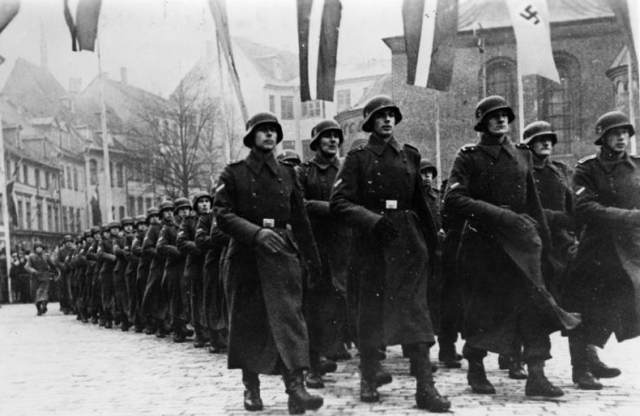
My colleague Scott Taylor has recently written several articles about the Latvian Legion (15th Waffen Grenadier Division of the SS (1st Latvian) et al) and Latvian killers like war criminal Herberts Cukurs as well as the members of the Arajs Kommando, who murdered an estimated 26,000 Jews.

According to Karlis Eihenbaums, Latvia’s Ambassador to Canada, Taylor is spreading “fake news” and “disinformation.” Eihenbaums has also tried to smear Taylor by suggesting that he is under the “influence” of the Russian government.

Taylor’s research into the Latvian SS Legion and the Latvian murderers of Jewish men, women and children is solid.  It is a well-documented historical fact that many of the killers from the Arajs Kommando went to the Latvian Legion. These Latvians served Hitler. No number of claims of “fake news” can change that fact.

Photo below shows Latvian SS:

The controversy over the Latvian Legion and the annual parade held in Riga to celebrate these Nazi collaborators is well known and has been going on for two decades, long before the term “fake news” was even coined. In 1998 the parade caused a storm of protests around the world, particularly in Israel, where Holocaust survivors couldn’t understand Latvia’s desire to celebrate such ruthless killers. German Chancellor Helmut Kohl and French President Jacques Chirac were among those that year to protest the Latvian parade. The Times of Israel reported on this year’s Latvian SS parade in Riga, which took place mid-March.

So much for “fake news.” Did Helmut Kohl and Jacques Chirac spread “disinformation” when they denounced the SS parade in Latvia? Of course not.

This whole issue isn’t about “fake news” or Russian “disinformation.” It is about nations trying to whitewash their Nazi collaboration and rewrite history, while attacking journalists who don’t want to let that happen.

It is a positive development that members of the U.S. Congress could see through these efforts to glorify members of the SS. They are speaking out.

But in Canada, the federal government is more than happy to play along with defending Himmler’s SS divisions and Nazi collaborators.

What would our soldiers who fought during the Second World War to help rid the world of this scourge think about that?

Source: Canadian government comes to the defence of Nazi SS and Nazi collaborators but why?

Given all its other apologies, when will Ottawa finally apologize to the Jews? Farber

Bernie Farber on the need for an apology (one apology understandably leads to another ….). The Conservative government-funded projects under the Community Historical Recognition program to commemorate the MS St. Louis (along with funding to other communities affected by wartime internment or immigration restrictions); the Liberal government has focused more on apologies (e.g., to Indo-Canadians for turning back the Komagatu Maru):

Ethical nations must confront their history with moral rectitude. It is time for Canada to offer an official apology to Jewish Holocaust survivors, their families and the families of those who were murdered. Because our hands are not clean.

May 13th will mark 79 years since the ill-fated MS St. Louis set sail from Hamburg, Germany, on a journey to Havana, Cuba. Aboard the ship were 937 passengers, mostly desperate Jewish refugees fleeing Germany, a country consumed by vicious anti-Semitism, controlled by a raving, genocidal dictator who vowed to rid the world of its “Jewish problem.” Each passenger possessed a valid travel visa to enter Cuba. They had every reason to believe they’d escaped.

As the St. Louis made its way across the Atlantic Ocean, unbeknownst to the passengers, the Cuban government, facing a huge anti-Semitic backlash and beset by a corruption scandal relating to visas, cancelled the entry permits for the refugees. When they finally arrived, after a week at anchor offshore, the vast majority of the passengers were told they would not be permitted to disembark.

Their choices were limited. The MS St. Louis was barely a 90-minute sail from the shores of Miami. Surely, thought the ship’s German captain — Gustav Schroeder, a decent man who understood the plight of his distraught travellers — the United States, a country which held the hope of sanctuary for so many, would extend a hand of freedom and safety to his passengers.

A photo of Jews aboard the MS St. Louis.

Instead, the American government rejected any request for asylum. To ensure that this message would not be misunderstood, a Coast Guard vessel was ordered to very visibly follow the ocean liner.

Like today, the media became the moral watchdog of a willfully blind nation. The New York Times wrote in a heartfelt editorial, “We can only hope that some hearts will soften somewhere and some refuge be found. The cruise of the St. Louis cries to heaven of man’s inhumanity to men.”

Prominent Canadians began calling for the refugees be admitted here. But the prime minister, William Lyon McKenzie King, accepted the position of his director of immigration: “No country could open its doors wide enough to take in the hundreds of thousands of Jewish people who want to leave Europe: the line must be drawn somewhere.” The St. Louis, although only two days from Halifax on its way back across the Atlantic, sailed on, forced by necessity to return to Europe. Some passengers allowed into the United Kingdom found safety. The others landed in Holland, Belgium and France,. Those countries were later overrun by the Nazis. They rounded up the Jews and send them to concentration camps. More than 250 of those passengers that Canada, and others, refused to help, were murdered.

Professors Irving Abella and Harold Troper have studied this grim part of our history, and noted our anti-Semitic immigration policies during the Holocaust in their seminal study None is too Many. “It was a Canada,” as Abella wrote elsewhere, “with immigration policies that were racist and exclusionary, a country blanketed by an oppressive anti-Semitism in which Jews were the pariahs of Canadian society, demeaned, despised and discriminated against.”

Today we have a different Canada, one that values diversity and pluralism. Canada today is offering official apologies for policies that were bigoted, racist and homophobic. It has been a steep learning curve for Canadians. Yet with historic apologies to Indigenous peoples for a cultural genocide committed against them through the residential school system, and with  similar national apologies to the Sikh, Japanese and LGBTQ communities for historical wrongs, Canada has become a leader in teaching the world of the power of a simple phrase: “We’re sorry.”

A recent poll by The Conference on Jewish Material Claims against Germany, a respected Jewish organization, shows that fully “one-fifth of millennials either haven’t heard of or are not sure if they have heard of the Holocaust.” And recently released hate crimes statistics collected by Canadian police have once again placed the Jewish community on top of the haters lists. An official national public apology for Canada’s actions against Jewish refugees during the Holocaust would be a powerful lesson for all, especially the young Canadians who are most at risk of forgetting the painful historical lessons we were supposed to have learned. Owning up to the errors of our past will help ensure that such evil, discriminatory policies never again see the light of day.

Source: Given all its other apologies, when will Ottawa finally apologize to the Jews?

Canadian historian joins uproar in Israel over Polish Holocaust law

There is so often a Canadian connection given the number of immigrant and ethnic communities:

University of Ottawa history professor flew to Israel this week, right into the eye of a brewing diplomatic storm involving the Jewish state and Poland over a controversial bill dealing with remembering the Holocaust.

Jan Grabowski has spent years examining the Holocaust in Poland, where he was born, focusing on Polish-Jewish relations. His research has brought death threats against him and his family and angry letters to his employer demanding he be fired.

But in an interview with CBC News hours after arriving from Canada, Grabowski vowed to press on with his work, outlining the focus of his next book, which will examine the role of the Polish Blue Police during the Second World War.

“It’s about 20,000 people who were armed and who inflicted horrific suffering on the Jews,” he said.

Controversial Polish legislation

Israeli leaders are leading the charge against a piece of legislation passed by the Polish Parliament earlier this month that made it illegal to assert that Poland bore any responsibility for atrocities committed by Nazi Germany.

Six million Jews were killed during the Holocaust, and many of those victims were Polish. Some of the most notorious extermination camps — Auschwitz-Birkenau and Treblinka to name two — were built on Polish soil.

DV1949535

Many Poles have long complained when atrocities committed by Nazi Germany, such as the killings at the Auschwitz death camp, have been linked to the Polish nation. ( Janek Skarzynski/AFP/Getty Images)

But for decades Poles have chafed at references linking their nationals to the crimes of the Holocaust. Former U.S. president Barack Obama issued an apology in 2012 when he used the term “Polish death camp”.

While most scholars, including those at Yad Vashem, the official Israeli memorial to the Holocaust, agree that labelling concentration camps as Polish is misleading, critics say what’s more worrisome is the crux of the new Polish law that imposes fines or prison terms of up to three years for linking “the Polish nation” to crimes committed during the Holocaust.

‘No Polish bystanders’

Grabowski notes that the prison sentence is the same duration Poles could expect to serve behind bars before the Second World War for “insulting the Polish nation.”

At his Tel Aviv press conference. the Polish-Canadian dual citizen discussed a newspaper article from 1936, detailing the case of a Jewish woman who was evicted from a Polish university.

“As she was evicted, she shouted ‘Polish animals.’ They beat her up, but she was the one the police arrested,” Grabowski said. “She was put in prison for two months for insulting the Polish nation.”

Grabowski, who is in Israel for a conference on Holocaust history, has faced much criticism from some Polish historians for his years of research, including his controversial conclusion that 200,000 Polish Jews were killed — directly or indirectly — by Poles during the war.

“There are no Polish bystanders to the Holocaust,” he told reporters.

Poland’s embassy to Canada, in Ottawa, has criticized Grabowki for offering “groundless opinions and accusations.”

“In reality, there was no free Poland during the Second World War, and the Holocaust was the murder by Nazi Germany of six million Jews,” the mission wrote in a statement to Macleans magazine. “Poland, unlike many countries, was never an ally of Nazi Germany and never had a collaborative regime.”

While he questioned the legal effect of the new Polish legislation, calling it “nonsense,” Grabowski does worry about a chilling effect.

“This law was an embodiment of the growing frustration of nationalists in power [in Poland] who simply are trying to find tools with which to freeze the debate, knowing that they cannot refute historical evidence,” he said. “What they can do is they can try to silence people who would like to undertake research in these areas.”

Hey, Mike Pence, the Holocaust Didn’t Happen for Your Benefit

Sharp and warranted commentary:

Nothing good came out of the Holocaust. The mass murder of Jewish people, Roma, gay people, the disabled, and other targeted groups was an atrocity of unimaginable proportions, an orgy of needless suffering, cruelty, grief and horror. Genocide doesn’t make the world a better place; it makes the world a worse place.

That should be obvious, you’d think. And yet, in America, we compulsively try to turn the Holocaust into a moral lesson or an inspirational parable. Yes, we say, the Holocaust was evil. But look at the good that came out of it! Hitler’s crimes, we insist, gave us all the chance to be better people. The piles of corpses are an abomination, of course; but even so, if we climb them together, we will ascend to a new moral awakening.

Vice President Mike Pence provided a particularly repulsive example of this logic in a tweetover the weekend commemorating Holocaust Remembrance Day. “A few days ago, Karen & I paid our respects at Yad Vashem to honor the 6 million Jewish martyrs of the Holocaust who 3 years after walking beneath the shadow of death, rose up from the ashes to resurrect themselves to reclaim a Jewish future,” Pence declared. Pence turned the Holocaust into a triumphant story of bravery, a monument to Israeli nationalism. The Holocaust here is not a tragedy, but a triumph.

Many Jews have pointed out that Pence, who is an evangelical Christian, imposes a Christian narrative on the Holocaust, comparing victims of the Holocaust to Jesus. His tweet also paints Jewish victims of the Holocaust as martyrs for Israel, as if every Jew who died was an ardent Zionist, deliberately laying his or her life down for a future Jewish state. Pence treats the Holocaust as a holy validation of evangelical support for Israel. Many American evangelicals believe that Israel has a role to play in the apocalyptic end times. The Holocaust, then, for Pence becomes a kind of providential working out of God’s divine plan for the Jews. Israel makes the Holocaust worth it, at least from an evangelical perspective. Hallelujah.

Pence is unusually blunt in framing the Holocaust as Christian resurrection narrative, but he’s not the only one to try to turn Auschwitz into inspiration porn. The majority of high-profile films and fictional narratives about the Holocaust focus on upbeat endings and salvation. Films like Defiance (2008), The Zookeeper’s Wife ( 2017) and, most famously Schindler’s List (1993) all tell stories about people who saved Jews during the Holocaust. They all end, ritually, with text informing the viewer how many people the protagonists rescued from death in the camps.

“Pence is unusually blunt in framing the Holocaust as Christian resurrection narrative, but he’s not the only one to try to turn Auschwitz into inspiration porn.”

All these films are based on true stories; Otto Schindler and others did save some Jews. Every life saved is precious—but every life that wasn’t saved is precious, too, and there were, horribly, a nightmarish number of people who weren’t saved from the Holocaust. The obsessive focus on the handful who escaped gives the Holocaust, over and over, a happy ending. The main characters dodge the Nazis; Israel rises up. The death camps may have been horrible, but they gave good people a chance to demonstrate their goodness.

That’s the message of Lois Lowry’s hugely influential Holocaust novel Number the Stars (1989). The book tells the fictional story of Annemarie, a Danish girl who (like many in Denmark) helps a Jewish friend escape the Nazis. “Young people rejoice when Annemarie takes a deep breath, enters the woods, faces the danger, stands up to the enemy, and triumphs,” Lois Lowry wrote in an introduction. The Holocaust gives young people the chance to vicariously brave danger and do the right thing. It’s heartwarming. But should we really be always be looking to the Holocaust to warm our hearts?

The impulse to find lessons in the Holocaust is natural and almost unavoidable. We’re meaning-making creatures, and the Holocaust was so huge and so terrible that we feel like it must have some sort of moral takeaway, some nugget of truth we can pass on to our children. Even the much-repeated mantra “Never forget” suggests that the Holocaust has some use. If we keep the camps in mind, we hope, it will help us to make better choices, or at least enable us to defend ourselves against similar threats.

Ruth Klüger, a Holocaust survivor, rejects this logic in her memoir Eline Jugend, or Still Alive (1992). “Auschwitz was no instructional institution…” she writes. “You learned nothing there, and least of all humanity and tolerance. Absolutely nothing good came out of the concentration camps…They were the most useless, pointless establishments imaginable. That is the one thing to remember about them if you know nothing else.”

Similarly, survivor Alain Rensais’ documentary Night and Fog (1956) treats the Holocaust as a horrible, bemusing puzzle, a bleak, heavy lock without a key. “We survey these ruins with a heartfelt gaze, certain the old monster lies crushed beneath the rubble,” the voice over of the film muses. “We pretend to regain hope as the image recedes, as though we’ve been cured of the plague of the camps.”

As Resnais says, much discussion of the Holocaust seems designed to provide a cure, or offer some sort of world-historical closure. The Holocaust was terrible—but Israel rose up, and (the Christian) God is great. The Holocaust was terrible—but some people saved some victims, and children can learn valuable lessons from that. It was terrible but—it’s done now, and we’ve learned from it, and we’re moving on. Isn’t that inspiring?

The answer, again, is no. The Holocaust was not inspiring. The people murdered by Hitler did not die to advance some greater cause, or to teach us courage. Remembering the Holocaust is a moral imperative, because to forget evil is to collaborate with evildoers. But while memory is a necessity, it’s not clear it protects us. There have been other genocides since Hitler’s. Trump flirts with anti-Semitism and fascist demagoguery while his Vice-President dragoons Holocaust dead for his own political purposes. Evil people still take inspiration from the Nazis; they marched in Charlottesvile and murdered yet another woman there. Hitler’s been dead for 70 years, but his death toll keeps mounting.

We aren’t wiser because of the Holocaust. We aren’t kinder, or braver, or more noble. Evil diminishes us—not least when, like Pence, we act as if the senseless death of millions of people somehow made the world a better place.

via Hey, Mike Pence, the Holocaust Didn’t Happen for Your Benefit

‘One cannot change history’: Israel slams bill that would send people to prison for blaming Poles for Holocaust

Rightfully so. Poland continues to decline in recognizing its past and antisemitism. Those who do not acknowledge their history …:

Israeli leaders angrily criticized pending legislation in Poland that would outlaw blaming Poles for the crimes of the Holocaust, with some accusing the Polish government of outright denial Saturday as the world marked International Holocaust Remembrance Day.

Prime Minister Benjamin Netanyahu called the proposed law “baseless” and ordered his country’s ambassador to Poland to meet with Polish leaders to express his strong opposition.

“One cannot change history, and the Holocaust cannot be denied,” he said.

The lower house of the Polish parliament on Friday passed the bill, which prescribes prison time for using phrases such as “Polish death camps” to refer to the killing sites Nazi Germany operated in occupied Poland during World War II.

A group of children at the Auschwitz Nazi concentration camp on Jan. 27, 1945, just after the liberation by the Soviet army.

Many Poles fear such phrasing makes some people incorrectly conclude that Poles had a role in running the camps. But critics say the legislation could have a chilling effect on debating history, harming freedom of expression and opening a window to Holocaust denial.

The bill still needs approval from Poland’s Senate and president. However, it marks a dramatic step by the country’s current nationalist government to target anyone who tries to undermine its official stance that Poles only were heroes during the war, not Nazi collaborators who committed heinous crimes.

Netanyahu’s government generally has had good relations with Poland, which has been recently voting with Israel in international organizations.

At Auschwitz on Saturday evening, Israel’s ambassador to Poland, Anna Azari, abandoned a prepared speech to criticize the bill, saying that “everyone in Israel was revolted at this news.”

In Israel, which was established three years after the Holocaust and is home to the world’s largest community of survivors, the legislation provoked outrage.

Israeli President Reuven Rivlin, noting that exactly 73 years had passed since the Auschwitz death camp on Polish soil was liberated, cited the words of a former Polish president about how history could not be faked and the truth could not be hidden.

“The Jewish people, the State of Israel, and the entire world must ensure that the Holocaust is recognized for its horrors and atrocities,” Rivlin said. “Also among the Polish people, there were those who aided the Nazis in their crimes. Every crime, every offence, must be condemned. They must be examined and revealed.”

Today’s Poles have been raised on stories of their people’s wartime suffering and heroism. Many react viscerally when confronted with the growing body of scholarship about Polish involvement in the killing of Jews.

In a sign of the sensitivities on both sides, Yair Lapid, head of Israel’s centrist Yesh Atid party and the son of a survivor, got into a heated Twitter spat Saturday with the Polish Embassy in Israel.

“I utterly condemn the new Polish law which tries to deny Polish complicity in the Holocaust. It was conceived in Germany but hundreds of thousands of Jews were murdered without ever meeting a German soldier. There were Polish death camps and no law can ever change that,” Lapid wrote.

That sparked the Embassy to respond: “Your unsupportable claims show how badly Holocaust education is needed, even here in Israel.”

“My grandmother was murdered in Poland by Germans and Poles,” Lapid responded. “I don’t need Holocaust education from you. We live with the consequences every day in our collective memory. Your embassy should offer an immediate apology.”

To which the embassy retorted: “Shameless.”

Israel’s foreign ministry said the deputy Polish ambassador to Israel had been summoned for a clarification.

For decades, Polish society avoided discussing the killing of Jews by civilians or denied that anti-Semitism motivated the slayings, blaming all atrocities on the Germans.

In this photo provided by the United States Holocaust Memorial Museum, people walk on a commercial street in the Lublin ghetto near a sign forbidding entry, in Warsaw, Poland.

A turning point was the publication in 2000 of a book, “Neighbours,” by Polish-American sociologist Jan Tomasz Gross, which explored the murder of Jews by their Polish neighbours in the village of Jedwabne. The book resulted in widespread soul-searching and official state apologies.

But since the conservative and nationalistic Law and Justice party consolidated power in 2015, it has sought to stamp out discussions and research on the topic. It demonized Gross and investigated whether he had slandered Poland by asserting that Poles killed more Jews than they killed Germans during the war.

Holocaust researchers have collected ample evidence of Polish villagers who murdered Jews fleeing the Nazis. According to one scholar at Israel’s Yad Vashem Holocaust memorial, of the 160,000-250,000 Jews who escaped and sought help from fellow Poles, about 10 per cent to 20 per cent survived. The rest were rejected, informed upon or killed by rural Poles, according to the Tel Aviv University scholar, Havi Dreifuss.

The memorial issued a statement Saturday night opposing the Polish legislation and trying to put into historical context the “complex truth” regarding the Polish population’s attitude toward its Jews.

“There is no doubt that the term ‘Polish death camps’ is a historical misrepresentation,” the Yad Vashem memorial said. “However, restrictions on statements by scholars and others regarding the Polish people’s direct or indirect complicity with the crimes committed on their land during the Holocaust are a serious distortion.”

Source: ‘One cannot change history’: Israel slams bill that would send people to prison for blaming Poles for Holocaust

Holocaust must be bigger part of migrant courses: German minister

Will be interesting to see how the revised Canadian citizenship study guide portrays antisemitism, Islamophobia, and other forms of racism and discrimination:

More emphasis should be placed on the Holocaust in integration courses for migrants, Germany’s justice minister said, reflecting heightened unease among leading politicians about a spate of anti-Semitic acts including Israeli flag burnings.

More than a million migrants have arrived in Germany in the last three years, many of them fleeing conflict in the Middle East, causing concern that anti-Semitism could increase.

German police have reported protesters setting Israeli flags ablaze and using anti-Semitic slogans in Berlin and other cities in demonstrations against US President Donald Trump’s decision to recognise Jerusalem as Israel’s capital.

In a piece for weekly magazine Der Spiegel, Justice Minister Heiko Maas wrote that the Holocaust, in which the Nazis killed six million Jews, and its significance needed to become an even more important part of integration courses and migrants should be tested on it in the examination at the end of their course.

“The lessons from the Holocaust need to be one of the guiding ideas in those lessons and not just some chapter of German history,” he said.

“Racism has no place in Germany, so everyone who wants to stay in Germany for the long term needs to be clear that we fight the Neonazis’ anti-Semitism and we won’t tolerate any imported anti-Semitism from immigrants either,” Maas added.

Jens Spahn, a senior member of Chancellor Angela Merkel’s Christian Democrats (CDU), told Der Spiegel he thought immigration from Muslim countries was one of the causes of recent anti-Semitic demonstrations in Berlin.

via Holocaust must be bigger part of migrant courses: German minister

When Hitler’s Henchman Called the Shots in Hollywood

Fascinating:

When Germany, Japan, and Italy formed the Axis alliance in November 1937, four months after Japan invaded China, the Berlin-Rome-Tokyo partnership appeared poised to take on the rest of the world.

With the Reich on the move, propaganda minister Joseph Goebbels tightened his command over his government’s image at home and abroad. In April 1937, he transferred control of all German film companies to the government and appointed himself as overseer of all productions. Henceforth, the content of domestic films would “fulfill with distinction the National Socialist idea.” As Fritz Wiedemann, now vice president of the Reich Film Chamber, boasted, “There is no such thing as public taste; we can shape that as we will. We have determined political taste; we can do the same with artistic taste.”

Goebbels wanted to keep the United States neutral for as long as possible. That meant stopping Hollywood from producing films intended to sway American public opinion against the Hitler regime. The propaganda chief knew there were many kinds of battles to be fought during the course of war, and he considered the battle to control the mind among the greatest. Goebbels understood a basic truth about the power of cinema: Movies matter the most about the things that people know the least. Many Americans got their first glimpse of what a Nazi rally or storm trooper looked like by watching movies or newsreels. Whether they thought of these people and their ideas as good or bad might well be determined by what they saw and heard on the screen.

By shaping the content of American films, Goebbels hoped to shape the ways in which Americans thought about Hitler and his policies.

With movies being seen by 88 million Americans a week in 1937, and by 150 million people throughout the world, Goebbels feared that a powerful anti-Nazi campaign by Hollywood studios could prove disastrous to German ambitions. Consequently, the propaganda minister turned to Georg Gyssling, German general consul in Los Angeles, for help in manipulating the American psyche. Gyssling cajoled, threatened, and did everything in his power to ensure that the Jewish-dominated studios followed Production Code Administration (PCA) regulations and made no film attacking Hitler or his government.

By 1937 the motion picture business reigned as the nation’s fourth largest industry, with over $2 billion in capital investments. Lavishly paid movie industry leaders accounted for 40 of the 63 Americans earning more than $200,000 in 1937. Topping the list was Louis B. Mayer at $1.3 million, making him the highest paid employee in America. The MGM head earned more in salary that year than the entire U.S. Senate combined. As the number of American films shown in Germany steadily dropped from 61 in 1933–34 to 36 in 1936–37, the moguls were forced to deal with Gyssling if they wanted to protect their studios’ bottom lines and their own high salaries.

During his first three years as consul, Gyssling repeatedly used the threat of imposing Article 15, which refused permits for any film deemed “detrimental to German prestige,” to hammer the moguls into compliance. As German military aggression increased after the 1936 Berlin Olympics, Gyssling became even more aggressive with Hollywood, intimidating individual actors and studio employees. When he heard that Malvina Pictures was preparing to release I Was a Captive of Nazi Germany in July 1936, Gyssling contacted the Motion Picture Producers and Distributors Association and demanded they stop the filming. Based on a true story, the movie recounts the harrowing experience of American journalist Isobel Steele, who was arrested and imprisoned by Nazi authorities on charges of espionage in August 1934. Steele spent four months in solitary confinement at Berlin’s infamous Moabit prison and was deported only after the intervention of the U.S. State Department. Upon her return home, the celebrated journalist wrote numerous stories describing her experiences in Nazi Germany.

via When Hitler’s Henchman Called the Shots in Hollywood

Holocaust Museum Director Faces Rising Anti-Semitism – The Forward

Good, thoughtful interview:

Sara Bloomfield joined the United States Holocaust Memorial Museum in its early stages, years before the project turned into one of the nation’s most visited landmarks on the National Mall in Washington.

Now, after serving as director of the museum for 18 years, Bloomfield, 67, is tasked with leading the institution during a time when anti-Semitism is on the rise in America, and when political forces are slow to condemn manifestations of racism.

In the past year, the Holocaust museum has found itself stepping into the debate over the response to white supremacist marches and speaking out against acts of vandalism directed at Jewish institutions. At the same time, it has entered another political minefield after issuing, and then retracting, a report critical of the Obama administration’s response to the Syrian civil war.

Bloomfield talked with the Forward’s Nathan Guttman about these developments and how the Holocaust museum has responded.

Nathan Guttman: How do you see the responsibility of the Holocaust museum in light of the wave of anti-Semitism America is experiencing?

Sara Bloomfield: There’s no doubt we’re experiencing a resurgence of anti-Semitism in the United States and in Europe and in the Middle East. The most important thing we can do right now is to get our message about Holocaust education to an even broader audience and reach people that we’ve never reached before, whether they are in the United States, Europe or the Middle East. We want people to look, not just at the fact that the Holocaust happened, but what made it possible. And obviously anti-Semitism is key to that. Another important lesson we as Holocaust educators have here is not only about what happens when anti-Semitism goes unchecked — obviously the Holocaust being the ultimate example of that — but also Holocaust history teaches that the hatred started with the Jews, but it did not end with the Jews. That’s a very important lesson for all societies in all times, but obviously we’re experiencing a unique moment in American and world history right now.

Does the fact that young Americans were marching in the streets of Charlottesville, Virginia, chanting “Jews will not replace us” indicate a failure of the Holocaust education system?

Anti-Semitism has been appropriately called “the longest hatred.” That it never really goes away, that it will always be around, that it’s a very convenient explanation. If you look at Nazism, the Jews became the simple answer to complex questions. They were the perfect scapegoat to their problems. I think Jews will always serve that role, unfortunately. Anti-Semitism never goes away, because it serves this useful function in times of great fear and huge dislocation and change. So, I’m not optimistic that anti-Semitism will ever be eliminated; I think it’s an ineradicable disease. I don’t think the Holocaust museum alone can end this problem, but I think we’re an important institution that must contribute to the addressing of it. I think we must always be vigilant.

It’s very shocking. I don’t want to minimize what we’re seeing, but for us, Charlottesville wasn’t only shocking, it was a moment to educate the public on the historical significance of what happened in Charlottesville. They were chanting “Blood and soil”; I don’t think many well-meaning Americans understood what that meant. But if you study Holocaust history you understand exactly what that means. It was an opportunity for us — what do they call it? A teachable moment.

Has your work become more difficult, given the questions of anti-Semitism and Holocaust denial that became intertwined in the political debate?

I’ve been at the museum 31 years and a lot has changed in America, and my observation is that the Holocaust transcends partisan issues. Everybody recognizes that it is a moment of utter failure in human history that we must all learn from, and I think that’s why there’s a Holocaust museum on the National Mall, because people believed that this was such an unprecedented event in Western civilization, it happened in a country that was highly educated and had a democratic constitution, and yet, look what happened there. So this is a lesson, certainly about what happened to the Jews of Europe, but this is also a lesson for humanity that is timeless. We were timeless when we opened 25 years ago, we’re very timeless today and I believe we will be timeless in 25 years, because I always say “The world always changes, but human nature never does.”

Do you feel constricted by politics when speaking out about Charlottesville, about anti-Semitism in the political campaign?

There is no place in American society for neo-Nazism, absolutely no place in this society, and we’ve said so after Charlottesville, and we also issued a second statement because within 48 hours after Charlottesville, the Holocaust memorial in Boston was vandalized. There was a trend and we were concerned about that trend. We don’t issue a lot of statements, we’re very careful and judicious because we realize we’re a memorial for the victims and we want to use that voice very, very carefully, and I’m not sure I remember a time when we issued two statements so closely, but we felt that at that moment we had to speak out twice.

We’re educators, we’re not advocates. We believe that education is the important way to get people to understand the consequences of unchecked anti-Semitism, of what Nazism really wants, what are the historical roots.

Another political issue the museum found itself involved in was the report about the Syrian civil war. What is the lesson you have drawn from this experience?

Our goal was to generate a constructive conversation on the Syrian catastrophe. It became clear to me early on that we really missed the mark on achieving this goal because our study was conceived to be politicized, it was insensitive to the victims. I deeply regret that. So the minute I saw it was clear we are not achieving our goal, I said we have to take the study down and we have to reassess it and we’re in a reassessment process. We had a miss here and we have to look at what went wrong with our process; we need to engage more stakeholders internally and externally, but I’m very committed we will learn from this experience. We are not going to be deterred from our work on Syria. We have an exhibit opening in November and we will move forward.

I think about Elie Wiesel and his vision for the museum, which was to try to do for victims today what was not done for the Jews of Europe, and we won’t be complacent in that, we will continue to work on it. I feel badly that we missed the mark on this, but we will not let it deter us, and we will learn from it.

via Holocaust Museum Director Faces Rising Anti-Semitism – The Forward

Holocaust-denying prof reinstated at University of Lethbridge – The Canadian Jewish News

Questionable decision but appears that investigation ongoing (B’nai Brith appears to have been overly political in their initial reaction compared to CIJA):

The University of Lethbridge has reinstated a professor who had been suspended more than one year ago for questioning the Holocaust and suggesting there was a Zionist connection to the 9/11 terrorist attacks.

Anthony Hall, a tenured professor in the university’s globalization studies program, was reinstated following a hearing before a labour arbitrator.

Published reports stated that the university’s board of governors and the faculty association issued a joint statement saying that issues concerning Hall’s activities will be addressed in a faculty handbook.

Contacted by The CJN, the faculty association stated that, “It’s a personnel matter and its confidential.”

Hall was originally suspended in October 2016 over his Holocaust denial and conspiracy theories. At the time, the university issued a statement saying, “From the findings of that assessment, the board has decided to proceed with a complaint to the Alberta Human Rights Commission against Dr. Hall for publishing statements, alone and in collaboration with others, that could be considered hateful, contemptuous and discriminatory.”

The faculty association contested the suspension and, following a court decision in September, an arbitrator was appointed and a hearing was held earlier this month.

B’nai Brith Canada slammed Hall’s reinstatement and blamed the government of Alberta for passing legislation that brought faculty under the province’s labour-relations laws.

“Premier (Rachel) Notley and her government bear direct responsibility for placing a discredited conspiracy theorist back in a university classroom,” said Michael Mostyn, CEO of B’nai Brith Canada. “We repeatedly warned the government of the likely outcome of its actions, but they sadly chose to ignore our warnings and expose Alberta university students to anti-Semitism and discrimination instead.

“Despite this setback, we expect the University of Lethbridge to continue fighting anti-Semitism on campus, and to do whatever it takes to ensure that Hall has no podium for his unhinged anti-Semitic nonsense.”

In an email cited in a news release by the Centre for Israel and Jewish Affairs (CIJA), Premier Notley stated, “There is no question that the views of this individual are repulsive, offensive and not reflective of Alberta. Our classrooms are a place for freedom of speech and expression but that does not mean individuals get to stand at the head of the class and spread lies and conspiracy theories. I am terribly disappointed to learn that this individual has been reinstated, but let me be clear that legislation that our government introduced did not give him his job back. I can confirm that this individual is now under investigation by a committee at the university.”

For its part, CIJA stated that Hall’s reinstatement was “a direct result of an agreement between Hall, the faculty association and the university. We have also confirmed that Hall will not be teaching or interacting with students. He is continuing to be investigated by the university and his future is far from certain.”

via Holocaust-denying prof reinstated at University of Lethbridge – The Canadian Jewish News

Austria accepted its Holocaust guilt. So why is its far right on the rise? | Jewish Telegraphic Agency

Good long read:

When it comes to the Holocaust, Austria has made a lot of progress assuming responsibility.

In recent years, Austrian officials have consistently acknowledged their country’s support of Adolf Hitler, an Austria native, and his war of annihilation against Jews. In the early 2000s, the government dropped the claim that the country was mostly a victim of German Nazism, citing “the special responsibility imposed on Austria by its recent history.” Instead, teaching about the Holocaust has become mandatory, with visits to former death camps and teacher training in Israel.

The government has paid nearly $1 billion since 2005 in compensation to Holocaust victims, and since 2012, Holocaust memorial projects have popped up at an unprecedented rate. They include the opening of a learning center at the Mauthausen former death camp, a monument for Vienna’s deported Jews and an international exposition, commissioned by the national railway firm, on its own role in murdering some 65,000 Austrian Jews.

Yet in spite of this increased sensitivity, nationalism still has a firm grip on Austrian society: The far-right Freedom Party, which was founded in 1956 by a former Nazi SS officer, is on the rise. In last month’s national elections, the party garnered 26 percent of the vote with a platform that included denouncing “forced multiculturalism, globalization and mass immigration.

As a natural ally of the center-right People’s Party, which won the most votes, the Freedom Party is poised to enter Austria’s government for the second time — it was part of the governing coalition in 2000.

Amid the ascendancy of far-right populism across Europe, its revival in Austria is seen as particularly alarming, as it suggests a failure by society to learn from its recent history. After all, if a country that does nearly everything “right” when it comes to Holocaust education can fail to inoculate itself to the kind of hatred that makes genocide possible, what hope is there for other countries in the region, such as Hungary and Poland, which face rising nationalism amid complicated reckonings with their own Holocaust legacies?

Experts on Austria say the rise of its xenophobic far right is connected to fears over Muslim immigration, as well as a perceived need to protect the nation’s sovereignty from an increasingly interventionist European Union. But it’s also connected to the Austrian government, which deflected its guilt for decades and failed to purge Nazi supporters from positions of influence.

Unlike neighboring Germany, Austria did not have an organized, judicial denazification effort in the aftermath of World War II — in fact, no one has been convicted of Nazi war crimes in Austria in more than 35 years.

“In Germany, and quite a few of the countries that were under Nazi occupation, many people involved in Nazism were convicted or at least not permitted to be civil servants, teachers, police officers, etc.,” said Tina Walzer, a Vienna historian. “But this has never happened in Austria and we are witnessing the results of this crucial difference.”

This has entrenched populist ideas in a way that has seemed resistant to increased Holocaust awareness.

“When you look at the population as a whole, you don’t feel there has really been a change,” said Milli Segal, founder of the newly opened For the Child museum in Vienna honoring the young Holocaust refugees who fled to Britain through an arrangement known as the Kindertransport.

“Well, there’s change, but in very, very small steps,” she added after a pause. “It makes you feel voiceless.”

Many in Austria share Segal’s feeling of powerlessness over the Freedom Party’s recent successes. Its strong showing last month follows an even greater electoral feat in last year’s presidential elections in which the party’s candidate, Norbert Hofer, won 49.7 percent in the first round of voting. Hofer lost in the second round to the left-leaning candidate Alexander Van der Bellen, 53 percent to 46 percent.

The close election indicates that far-right populism is a “ticking political bomb,” warned Barbara Wesel, a senior Europe correspondent for Germany’s Deutsche Welle broadcaster.

The Freedom Party, for its part, rejects claims that it plays on Nazi and other racist sympathies. Party leader Heinz-Christian Strache has vowed to kick out members caught engaging in racist rhetoric, and has indeed done so to a former lawmaker who supported online the assertion that “Zionist money-Jews worldwide are the problem.”

The Jewish Community in Vienna considers the Freedom Party a racist entity, according to Oskar Deutsch, the community leader, who has called on Chancellor-elect Sebastian Kurz to prevent the Freedom Party from reaching power.

“It’s a facade,” Deutsch told JTA of Strache’s statements against anti-Semitism and racism. “Despite this talk, they position themselves as the go-to address for people with Nazi sympathies.”

A case in point: On Nov. 9, when the outgoing chancellor, Christian Kern, spoke in parliament to commemorate the 79th anniversary of Kristallnacht — a series of pogroms that the Nazis carried out in Germany and Austria — the Freedom Party’s lawmakers were the only ones who demonstratively did not applaud.

“These subtle signs are how they signal and excite their supporters,” Segal said. “If the Freedom Party will be part of the government, it will become difficult to commemorate the Holocaust in the same dignified way that we have now in Austria.”

The dissonance between Austria’s Holocaust commemoration efforts and the far-right’s popularity can be unsettling.

On Oct. 19, for example, a Vienna city official inaugurated a Holocaust memorial installation outside the Herminengasse subway station, near an alley in which the Nazis imprisoned hundreds of Jews during the war. From there they were taken to be deported as non-Jewish locals watched from their balconies. The inauguration ceremonies were held during election season; nearby hung a giant poster of a smiling Strache bearing the slogan “Fairness.”

Does the party’s recent success suggest that such commemoration projects are ultimately failing to make a difference politically?

“You might say so,” Deutsch said. “But the Jewish community will not remain silent.”

To Efraim Zuroff, a hunter of Nazis and historian for the Simon Wiesenthal Center who is based in Israel, the success of the far right in Austria reflects how Holocaust commemoration projects in urban areas hardly reach people who live in smaller towns — the Freedom Party base.

“Holocaust education, which only recently really began developing in Austria, happens there in pockets — in the big cities, in the artists’ scene,” he said. “It has big visibility but isn’t penetrating the way it has in Germany, where the effort was much more robust.”

Zuroff said this has a lot to do with Austria’s failure to prosecute Nazis.

“Holocaust education efforts in Austria are having limited impact because they are done in two voices,” he said. “There was a belated admission of guilt by politicians. But the judiciary, whose work sends a much stronger message in society, was a total failure.”

To some activists against racism, the Freedom Party’s rise is motivation to invest even greater efforts in Holocaust commemoration.

The far-right’s success in Austria “only strengthens our resolve,” said Brigitte Prinzgau, an artist who designed the newly inaugurated Aspang Railway Station Memorial, near where 47,035 Austrian Jews were dispatched from Vienna to death camps. “Now educators and artists will make even more monuments confronting fascism and xenophobic populism.”

via Austria accepted its Holocaust guilt. So why is its far right on the rise? | Jewish Telegraphic Agency