Of note even if the proposed solutions are modest and unlikely by themselves to make a significant difference although encouraging minorities and others to increase reporting would be a good step:
As Muslim chairs of police boards in Ontario, we are sadly familiar with hate-motivated crimes, and with the reality that no country is immune. Police services across Canada have been grappling with these issues for some time, and we are vividly aware that we cannot look away from the hatred that stole the lives of four fellow Canadians who died simply because they were walking while Muslim.
While the particulars of criminal investigations cannot be released, London Police Services were clear that our beloved community members were murdered and targeted for their Islamic faith. As hard as that is to hear for many Canadians, the truth is this is not a singular event. Islamophobic incidents happen all the time in Canada.
In the City of London and Peel Region, both of which are home to diverse communities with large numbers of racialized citizens, police-reported hate-crime numbers have remained consistent over the last few years. According to Statistics Canada, London’s numbers rose by more than a third from 2015 to 2019, and in four of those five years, the city’s rate per 100,000 population was higher than the national average. In 2019, London police reported that Black, Muslim, Jewish, Middle Eastern and LGBTQ2+ peoples constituted the five most targeted groups for hate crimes. In Peel, meanwhile, crimes motivated by race or nationality increased by 54 per cent from 2018 to 2020, with Black and South Asian people being the most targeted by race or ethnicity. Muslims and Jews experienced the most targeting based on faith.
Yet, despite these numbers, our justice system continues to have an incredibly high threshold for anyone to be prosecuted under hate-related laws, and as a result, it is not achieving its desired aims. There remains no specific definition of a “hate crime” in the Criminal Code as a chargeable offence, and what is laid out only provides a judge the ability to hand down harsher sentences based on his or her ruling around a given perpetrator’s motivations. In Peel, only a third of the Criminal Code offences designated by police as hate- or bias-motivated crimes resulted in Criminal Code charges in 2020.
This outdated model emboldens hateful behavior while doing little to dissuade perpetrators, which in turn normalizes their hate-filled rhetoric and actions. Perpetrators such as Alexandre Bissonnette, for instance, have reaped the benefit of loopholes such as concurrent sentences; Mr. Bissonnette murdered six people in Quebec City in 2017, yet serves time for only one murder. We cannot let this injustice continue in the case of the family killed in London, Ont.
Reporting mechanisms are also a challenge. Far too often, verbal threats and assaults are not brought to the police because victims don’t feel like they’ll be taken seriously, simply don’t want the trouble, or are concerned that their reporting will only further agitate the perpetrators, putting the victims and their families at further risk. This means that any hate-crime numbers are almost certainly underestimated, masking the magnitude of the problem.
Earlier this week, community leaders called for action at the vigil for the family killed on the streets of London, but political gesturing and posturing won’t be enough to help prevent the next hate-fueled mass murder. We must name hate for what it is, stare it down, and work with the affected communities to prioritize change over pandering for votes. All parties must work together to get tougher on hate and extremism. We must end the minimization and denial that has become commonplace in our system and in our discourse. Our politicians and legislators can get the ball rolling by changing hate-crime laws to better protect victims who do report, while holding those responsible maximally accountable.
We must also work with our communities to increase the reporting of such crimes so that we can both identify and engage the perpetrators and provide victims with a sense of safety and support. In addition, our laws must also reflect our society’s values and priorities. If hate crimes are difficult to prosecute and carry minimal odds of conviction, this sends the wrong message.
It’s time to take bolder action against anti-Muslim hate, and all other forms of hate and bigotry that continue to terrorize our communities. It’s time to arm our justice system with the necessary tools to root out hatred, and to hold accountable those who perpetrate hate crimes. It’s time to remind far-right extremists and terrorists that our country will not tolerate their hate-motivated crimes and rhetoric. The human cost of our inaction would be too great to bear.
Javeed Sukhera is the chair of the London Police Services Board and an associate professor of psychiatry and paediatrics at Western University. Ahmad Attia is the chair of the Peel Police Services Board and the CEO of Incisive Strategy.
As I reflect on vile attack on five members of the beautiful Azfaal family — Salman, Madiha, Yumna, Talat and Fayez — I was initially deeply angered by how quick some were to use this vile, hate-motivated act of terrorism to confirm their political priors.
And yet.
The fact that the alleged attacker, Nathaniel Veltman, is a young Dutch blond boy who could well have come from my own religious community hit close to the heart.
Now let me be clear. I apportion no blame for this act on Conservatives, religion, or even the Dutch privilege in which I assume Veltman, like me, grew up in. If guilty of this crime, Veltman is a hate-motivated terrorist who committed multiple murders. That would be on him. May the justice system rain down.
And yet.
My reflection called to mind times when, as a religious social conservative, I should have felt more uncomfortable with some of the things my fellow conservatives have said in recent years about terrorism, culture and religion. Times when we too easily crossed lines that conservatives — and religious conservatives in particular — should not have crossed.
The line got crossed when some seemed to weigh their critique of a terrorist act based entirely on the motivation for that terrorist act. To put it another way, they became more interested in combatting terrorism motivated by some beliefs than terrorism motivated by other beliefs. Compare, for example, the disgustingly light-hearted condemnation of the far-right, neo-Nazi terrorist act in Charlottesville by the same populist U.S. president that proposed banning all Muslim immigration as part of an effort to prevent domestic terrorism. Or those who called for a “values test” to root out radical Islam one day — and then stood with a street preacher who flagrantly breaks the law the next.
The line got crossed when we got more concerned with the actions of individuals within the institutions of our liberal capitalist democracy than the ideas underpinning those institutions. As a religious social conservative I hold freedom of religion extremely dear. In my world of competing rights, religious freedom comes out near the top. But that means holding expressions of other religions — like a turban, kirpan, hijab or burka — as dear as holding symbols of one’s own religion. Banning or restricting any of these things should make me deeply uncomfortable. Religious freedom should be religion blind.
The same goes for religious practices. If something is a criminal act, call it a criminal act and treat it as such. If something is a part of one’s religious practice or tradition, leave it at that and leave it alone. Blurring the lines by referring to “barbaric cultural practices” crosses the line. The use of the word “cultural” kind of gives it away.
The line got crossed when some tried to use the power of the state to impose their own religious views. Now let me be clear. I attend a Christian church — honestly, I need it more than most — and I hold my religious views as truth. I’d not be much of a religious person if I didn’t. I don’t go to a mosque, a synagogue, a temple, or a Richard Dawkins book club to practice my religion. Yet I want my public square to have room for all of these, and many more.
The investigation into the horrible attack in London continues. If the early information is confirmed, it appears that Veltman alone is responsible for the hate-inspired terrorism of which he is accused.
But an act this vile, particularly when its perpetrated by a member of your own community also warrants deep reflection.
I spent the afternoon writing down the lines I have crossed. I pray others do the same.
The pandemic has been a major source of disruption in the lives of Canadians for more than a year, leaving many of us frightened. For some people, that fear means opportunity.
In 2008, epidemiologists developed models of the “coupled” dynamics of epidemics and the fear generated by them, showing that behavioural changes engendered by fear can spread as a parallel epidemic, making the infectious disease worse. When two such epidemics interact, the process is referred to as a “syndemic.”
The pandemic, then, has undoubtedly been a syndemic of infection and fear, preyed upon by well-known internet influencers who sat at the core of hate networks that existed before the first outbreak. Now, we have to reckon with a syndemic of infection and hate in a system too vulnerable to both – or face very real consequences.
According to a recent report in The New York Times, many experts now believe the United States may never reach herd immunity. This is largely due to hesitancy around safe and effective vaccines, which is being driven in part by anti-science and pro-conspiracy beliefs. These movements have only sown confusion as people navigate the informational minefield that is a public-health crisis, and they threaten to keep us all in pandemic limbo for the foreseeable future.
Indeed, since the beginning of the global outbreak, conspiratorial anti-establishment movements have only gained momentum, finding common cause in opposing mask mandates and lockdown measures and sucking up oxygen by undermining valid criticisms of government health orders. Rallies and protests have been organized almost every weekend across the country, and those who have found fame in the process bill themselves as defenders of our freedoms. They march with a list of grievances and conspiracy theories, but all believe they are standing up against their misguided idea of tyranny.
Outdoor rallies may not in and of themselves confer much risk on attendees; COVID-19 is some twentyfold less infectious outdoors than indoors as a result of dominant aerosol transmission. However, these gatherings undermine confidence in public-health guidance and promote messaging that is likely to further damage communities already hard-hit by this pandemic.
Ekos Research has found that 8 per cent to 20 per cent of Canadians have views that could be characterized as being distorted via disinformation, with men, minorities and lower-income individuals more likely to be disinformed. We know that minority and lower-income communities in Canada have already been the hardest-hit by COVID-19, and now we’ve seen the promotion of disinformation deepening the problem. Vaccine hesitancy also tracks closely with being disinformed; the promotion of disinformation will continue to injure communities even if it becomes possible to move beyond the pandemic via vaccination.
The principal actors of the anti-lockdown movement have either been or rubbed elbows with some significant haters on the scene. Vancouver neo-Nazi Brian Ruhe, who at one point organized a mock book burning, was involved in its earliest iteration. Quebec’s far-right conspiracy streamer Alexis Cossette-Trudel, a big name among France’s QAnon following, is an important mouthpiece of the francophone anti-lockdown movement. Neo-Nazi Paul Fromm is a fixture at rallies in both Ontario and in Kelowna, B.C. Antimask activist Chris Saccoccia’s social-media feeds feature Holocaust denial and racist posts.
Perhaps one of Canada’s most persistent agitators is Kevin Johnston, who made national headlines in 2017 when he was charged with the willful promotion of hatred against Muslims. In 2019, he lost a $2.5-million judgmentfor his role in racially motivated defamation against Toronto philanthropist Mohamad Fakih in which he repeatedly accused him of being a terrorist; the judge called his comments about Mr. Fakih “hate speech at its worst.” Now, Mr. Johnston is running for mayor of Calgary and has shifted gears by portraying himself as an anti-lockdown and antimask influencer.
The fact that an anti-public health agenda aimed at undermining the Canadian economy and the health and well-being of Canadians has been taken up by a rogues’ gallery with a long track record in disinformation and promotion of hatred should give us all pause. And with our country now approaching 25,000 dead due to COVID-19, Canadians should ask themselves whether the promotion of disinformation – and the undermining of the tools and measures that will permit a return to normalcy – has crossed the line from mere grotesque opportunism to active, malicious harm.
Online conspiracy theories about COVID-19 and protests against public health orders are helping to spread dangerous ideas laden with racism and bigotry, says a network monitoring hate groups in Canada.
The executive director of the Canadian Anti-Hate Network said since last year people espousing hateful beliefs have linked themselves to conspiracy and anti-lockdown movements around the novel coronavirus.
“We have two pandemics: We have the actual pandemic and then we have this pandemic of hate,” Evan Balgord said.
“Things are kind of getting worse both online and offline … with maybe one pandemic, we have kind of a solution for, but the hate thing, we don’t have a vaccine for that.
Federal New Democratic Party Leader Jagmeet Singh was the latest on Monday to note a connection between anti-mask and anti-lockdown protests and far-right extremism.
His comments came as rallies against COVID-19 health orders are being staged across the country while many provincial doctors battle a deadly third wave of the pandemic.
“To brazenly not follow public-health guidelines puts people at risk and that is something that we’ve seen with extreme right-wing ideology, ” he told reporters.
These demonstrations have been met with frustration from some in the public over what they say appears to be a lack of police enforcement, and a few premiers have promised stiffer fines for COVID-19 rule-breakers.
The far right has become adept at integrating populist grievances into its own narratives and exploiting them to enhance membership, said Barbara Perry, director of the Centre on Hate, Bias and Extremism at Ontario Tech University, in a recent interview.
As a result, members of the far right have turned up at virtually all of the recent anti-lockdown gatherings, “trying to lend their support to that movement, and thereby garner support and sympathy, or solidarity, with their more extreme movement,” she said.
Mr. Balgord said such events make for “fertile hunting” for new recruits because hateful ideas are not being policed, and once someone believes in one conspiracy theory, it’s easy to believe in others.
“We now have a greatly increased number of people who are coming into close contact with racists and bigots of all stripes with more conspiracy theories,” he said.
And more than a year into the pandemic, Mr. Balgord said, organizers behind anti-lockdown protests in Vancouver, Toronto and the Prairies know figures from the country’s “racist right” are involved in their movement.
More recently, he said, some protesters have started showing up with Nazi imagery to depict themselves as being persecuted by the government.
“The racist right that we monitor and the COVID conspiracy movement are inseparable from each other at this point. We monitor them as if they are the same thing because they involve all the same people,” Mr. Balgord.
He said the network’s information is based on what it observes and the far-right figures it follows, but there is a lack of data tracking how conspiratorial thinking around COVID-19 has moved across Canada.
After Mr. Singh’s comments, Bloc Québécois Leader Yves-François Blanchet played down the idea of a connection between the protests and far-right extremism, saying arguments suggesting a correlation were politically motivated.
“I am absolutely certain — absolutely certain — that people which have been involved in such discussions in the last hours and days know very well that there could be no link between … two things that should not be what they are, but are not related,” he said.
The NDP leader said he sees a link between those refusing to follow public-health advice and the ideologies of the extreme right because both show a disregard for the well-being of others and put people at risk.
“There is a connection, certainly.”
Mr. Singh said declining to listen to COVID-19 health orders is dangerous and needs to be called out.
Calgary Mayor Naheed Nenshi earlier called such demonstrations “thinly veiled white nationalist, supremacist anti-government protests” on Global’s “The West Block.”
The head of an organization tasked with combating racism in Canada says the group is building a collaborative strategy to tackle the issue, but some advocates say more government support is needed to directly address the rise of anti-Asian racism.
Mohammed Hashim, executive director of the Canadian Race Relations Foundation (CRRF), said a centralized plan is needed to create real change, and that his group will consult directly with community organizations across the country to hear what supports are needed.
April’s federal budget allocated $11-million over two years to the CRRF to combat racism and empower racialized Canadians affected by racism during the pandemic. The budget document also specifies that the money can go towards establishing a “national coalition to support Asian-Canadian communities.”
Though many advocates see the funding as a positive step, some say the government is not doing enough to ensure the safety and well-being of Asian-Canadian communities.
“It’s a good start,” said Avvy Go, director of the Chinese and Southeast Asian Legal Clinic, “but it’s just as important for the government to support organizations that have a more specific mandate to address anti-Asian racism as an issue.”
Amy Go, president of the Chinese Canadian National Council for Social Justice (CCNC-SJ), said she agrees the funding falls short. “Given that people’s lives are still being threatened – that we are still targeted, that we are being attacked and assaulted – hopefully the government would do more than just the $11-million,” she said.
A report released in March by the CCNC’s Toronto chapter and other advocacy groups found that 1,150 racist attacks against Asian-Canadians took place across Canada between March, 2020, and February, 2021, compiled from incidents reported to online platforms Fight COVID Racism and Elimin8hate. One thousand thirty-two incidents have been reported to date through Fight COVID Racism alone. Verbal harassment, targeted coughing and spitting, and physical aggression made up the majority of the incidents.
The CCNC-SJ’s Ms. Go said while the report presented a starting point for understanding anti-Asian racism during the pandemic, the incidents are underestimated because many cases go unreported. “That’s just the tip of the iceberg,” she said.
She added that the creation of a national coalition, as suggested in the budget, risks erasing the differences between Asian communities and not addressing their diverse needs and concerns. “We are not one monolith,” she said, adding that many heritages and backgrounds exist within Asian-Canadian communities.
Mr. Hashim said the CRRF’s plan is to consult with local groups across the country to understand their needs, and also empower them to do their own work. The $11-million in funding will go towards researching and developing a strategy to combat racism, with a portion also allocated to community organizations.
“A Crown corporation is not going to solve racism,” he said. “It’s going to work in collaboration with community groups, who are deeply connected to the people that they serve.”
Xiaobei Chen, a sociology professor at Carleton University, said she wants to see the government invest in public education on the existence of anti-Asian racism and rising hate crimes against Asian-Canadians during the pandemic.
“People don’t think it’s serious,” Prof. Chen said. “People don’t think that it’s something that we actually need to think about, what we can do to actually invest seriously in solving.”
Investments to combat anti-Asian racism should take many forms, CCNC-SJ president Ms. Go said, adding that money isn’t the only thing Asian communities need from the government.
“We need to think more broadly – along the lines of the systemic policies that will bring about long-term change.”
Germany recorded a 72.4 percent increase in anti-immigrant crimes in 2020 – up to 5,298 total cases – as officials warned Tuesday that the country is experiencing a dangerous rise in far-right violence.
Interior Minister Horst Seehofer said in total, far-right crimes rose 5.65 percent in 2020, and accounted for more than half of all “politically motivated” crimes.
“This shows again that right-wing extremism is the biggest threat for our country,” Seehofer said Tuesday, according to the Associated Press.
In February 2020, the country saw its deadliest anti-immigrant attack when nine immigrants were killed near Frankfurt, Germany, after a gunman opened fire and called for the “complete extermination” of many “races or cultures in our midst,” the AP reported.
Authorities have since raised concerns that the far-right Alternative for Germany party, or AFD, which placed third in the country’s 2017 election and has grown in influence, has played a role in stoking a climate of hatred toward immigrants and the government.
German security agencies have warned of the growing threat of violent far-right extremism. In July 2019, a regional politician from Chancellor Angela Merkel‘s party was killed by a neo-Nazi; three months later, a gunman tried to force his way into a synagogue on Yom Kippur, killing two people.
Seehofer said antisemitic crimes in Germany were up 15.7 percent in 2020 over 2019 with 2,351 total incidents — 94.6 percent of which were committed by a far-right suspect.
Of the total, 62 were acts of violence while the majority were antisemitic hate speech and other related crimes, frequently on the internet or over social media, Seehofer said.
“This development in Germany is not only troubling, but in view of our history, deeply shameful,” he said.
Moshe Kantor, president of the European Jewish Congress, said the German numbers highlighted a broader issue.
“This is a wake-up call, not just for Germany, but for the whole world,” he said. “These figures should ring alarm bells, because we are seeing similar trends across the Western world.”
Many in the AfD have expressed support for, and participated in, the regular protests in Germany against lockdown measures, organized by the Querdenker movement. The demonstrations have become increasingly violent, and the country’s domestic intelligence service last month said it had put some members of the movement under observation.
The protests have brought together a broad range of demonstrators, including people opposing vaccinations, those who deny the existence of the coronavirus, mask opponents, conspiracy theorists and others.
Seehofer said the protests have also attracted neo-Nazis and other right-wing extremists, and have regularly become violent, targeting police and the media. Seehofer said of the 260 reported crimes against journalists, 112 were related to protests against coronavirus restrictions.
“I want to say here very clearly: These acts of violence are no longer about exercising a constitutional right (to demonstrate), but are acts of violence of a criminal nature that I condemn in the strongest possible terms,” he said.
Seven months after 58-year-old Mohamed-Aslim Zafis was brutally slain outside a Rexdale mosque, Toronto police have released a new report that details statistics and specific types of hate-motivated offences committed against individuals in 2020.
Zafis’s killing is not among those crimes.
The glaring omission of the slaying is striking — especially consideringZafis’s family and the community itself pleaded with police to treat it as a hate crime.
When the suspect’s name was released, the Canadian Anti-Hate Network immediately reviewed his social media. Our findings suggested that the suspect is someone who subscribes to the most dangerous hate-promoting conspiracy theories, including “the Great Replacement.”
The theory dangerously asserts that white Europeans — and North Americans — are being intentionally replaced through immigration and low birth rates. While the original theory focused on an alleged Muslim invasion, more recent proponents of the theory overlay it with antisemitism.
In August 2017, it inspired over 200 American neo-Nazis to march in Charlottesville, Virginia, in a torch light parade bellowing “Jews will not replace us,” injuries, and the tragic murder of anti-racist Heather Heyer by one of the white supremacists.
In March 2019, another hate-monger attacked the Al Noor Mosque in Christchurch, N.Z., murdering 51 innocent Muslims and leaving 40 injured. The New Zealand government’s Royal Commission on the attack singled out the terrorist’s belief in the Great Replacement as one motivating racist factor.
While the story of Zafis’s death made worldwide news, the issue of police not treating what are arguably self-evident hate crimes as hate crimes is not new.
An Angus Reid survey, released in mid-2020, revealed that almost one-third of Chinese Canadians report being physically attacked during the COVID-19 pandemic. Yet only 12 incidents of hate-motivated crimes against Chinese Canadians are included in the report.
Studies tell us that only one to five per cent of hate incidents in Canada are reported to police. The real number of hate crimes and incidents is actually 20 to 100 times higher.
Members of communities targeted by hate-motivated attacks often don’t report them. In some cases, the number of victims who don’t report is over two-thirds. When attacks are reported, the police treat many as unfounded — they either don’t believe the victim, don’t see the point in pursuing the report, or are unsuccessful in their investigations. They only report forward a small subset that they have at least partially successfully investigated.
Laudably, Toronto police made an arrest within a week of Zafis’s slaying. So why was his death not included in the 2020 hate crimes report? Some answers may lie in a new study by Barbara Perry of Ontario Tech University’s Centre on Hate, Bias and Extremism that involved interviewing police officers in Ontario.
Officers expressed frustrations with the process. The only hate crime under the Criminal Code is wilful promotion of hatred. Other offences, such as assault or vandalism, could be subject to enhanced sentencing provisions if the offence is hate-motivated, with police providing evidence to the Crown. Officers told Perry that they are usually not successful and cases just “disappear into a vacuum.”
Some officers candidly admitted that they feel police departments are falling short in their obligations to ensure communities feel comfortable coming forward.
“I don’t think we do enough to ensure the community feels that it will be taken seriously,” one officer noted.
So, then, what does this tell the Muslim community when Zafis’s slaying is not counted among hate crimes?
The alleged killer’s YouTube channel had saved xenophobic videos perpetuating the myth of roving migrant gangs, and clips from Russian propaganda outlets about the “Belgian Muslim State.”
And, of course, the Great Replacement.
It isn’t hard to draw the line between those toxic ideas and the cold-blooded killing of a Muslim man serving his community in front of his neighbourhood mosque.
Surely one can understand the fear within racialized communities when self-evident hate crimes like the Zafis death is not seen as such.
According to the new report, hate crimes in Toronto have risen 51 per cent. But considering only 1 to 5 per cent of hate incidents and crimes are reported, the question remains: what about the other 95 per cent?
On a recent episode of his livestreamed show, the 22-year-old extremist Nick Fuentes repeated a formula that has won him a following with some of the youngest members of the far right. He went on an extended, violent and misogynistic rant, only to turn to the camera and add with a smirk, “Just joking!”
In this case, from the April 22 edition of Fuentes’ show, America First, a viewer wrote in to ask Fuentes for advice on how to “punish” his wife for “getting out of line.”
Fuentes responded, “Why don’t you smack her across the face?”
The rant continued for minutes.
“Why don’t you give her a vicious and forceful backhanded slap with your knuckles right across her face — disrespectfully — and make it hurt?” Fuentes went on. At one point, he pantomimed punching a woman in the face.
He then added, “No, I’m kidding, of course. Just kidding. Just a joke.”
Fuentes was following a playbook popular among domestic extremists: using irony and claims of “just joking” to spread their message, while deflecting criticism.
Researchers who track domestic extremism say the tactic, while not new, has helped several groups mask their danger, avoid consequences and draw younger people into their movements.
Irony as “cover” for extremism
Fuentes is best known for using cartoonish memes to spread white supremacist propaganda. His followers refer to themselves as “Groypers” — a reference to a mutated version of the Pepe the Frogcartoon that was co-opted by the far right. Though Fuentes exists on the fringes of the extreme right, Rep. Paul Gosar, R-Ariz., spoke at a political conference that Fuentes hosted, drawing widespread criticism.
But Fuentes has said himself that he uses irony and “jokes” to communicate his message without consequences.
“Irony is so important for giving a lot of cover and plausible deniability for our views,” Fuentes said in a 2020 video. He specifically cited Holocaust denial — or what he termed Holocaust “revision” — as a topic that is too fraught to discuss earnestly, even on the far right.
Far-right extremist Nick Fuentes, seen here in a screenshot from his livestreamed show, has said he uses irony because it provides “plausible deniability” and cover for some of his most incendiary statements.
“When it comes to a lot of these issues, you need a little bit of maneuverability that irony gives you,” Fuentes said.
And, in fact, after Fuentes questioned the death toll from the Holocaust in one rant, he later claimed to The Washington Post that it was just a “lampoon.”
Researchers who track domestic extremism say Fuentes is not the only figure to adopt these tactics, particularly among far-right content creators, who encourage their audiences to follow suit.
“A lot of these content creators will tell the audience explicitly, ‘When people say you’re racist for liking this or thinking this, just laugh at them. They can’t handle it — they’re sensitive babies,’ ” said Jared Holt, a resident fellow with the Atlantic Council’s Digital Forensic Research Lab.
Concern on campus
In early 2020, Oona Flood started getting more and more worried about a classmate at the University of California, Los Angeles.
The classmate, a 22-year-old named Christian Secor, was already well-known for his self-proclaimed “love” of guns. Around that time, he was also posting racist and antisemitic memes and tweets, attacking immigrants online and publicly supporting Fuentes. Often, Secor adopted the kind of “trolling” style that’s prevalent on the internet.
When one student called Secor out for a tweet that the student found offensive, Secor responded that he was using “post irony.”
“It’s called a joke and the fact that you think that these posts are anything more than that is telling,” added Secor.
Flood, who is Japanese American, said they wanted to speak up.
“I definitely felt that sense of threat,” Flood told NPR recently. “And, like, I really hate to say, [because] it sounds so much like, overblown, ‘snowflake,’ that we’re just overreacting, you know?”
And throughout 2020, students told NPR, UCLA took no action against Secor despite his escalating rhetoric, likely because of free speech concerns. (As a public university, UCLA is legally bound to follow the First Amendment, which protects hate speech.)
In retrospect, Flood’s concern does not seem like an overreaction.
Secor is currently facing federal criminal charges for allegedly storming the U.S. Capitol on Jan. 6. Prosecutors have cited his support for Fuentes in charging documents. Secor has pleaded not guilty.
In addition to Fuentes and his followers, other experts point to the extremist group known as the Proud Boys, which has embraced outlandish rituals. The group’s name was inspired by a song from the Broadway version of Disney’s Aladdin, and one of the group’s initiation rites involves members listing breakfast cereals while they get lightly punched in the stomach. Yet that same group is known for its involvement in violent street fights. At least 25 members of the group are facing federal criminal charges related to the Capitol riot, including, in some cases, conspiracy.
Gavin McInnes, the group’s founder, said in an email that the media, including NPR, “willfully ignores” jokes to paint the group in a more negative light. The Proud Boys are “funny dudes, not Nazis,” McInnes wrote.
But Cassie Miller of the Southern Poverty Law Center said the group’s use of “jokes” is strategic. “It distracts from what their actual political ideology is and from their violence,” said Miller. “Because if you point it out, it’s, like, ‘well, they’re so goofy.’ ”
Similarly, the far-right, pro-Trump conspiracy theorist Alex Jones is often so over the top on his InfoWars broadcasts that his own attorney likened him to a “performance artist” during a court hearing about Jones’ divorce.
The appeal to young people
Humor has always been crucial to building social movements, experts say, because it serves to define the people who are “in on the joke” and those who “just don’t get it.”
And online extremists have adopted irony because it is, in many ways, the native language of the internet.
“I’m speaking the language of other zoomers,” said Fuentes in 2020. “If you’re a young person online, I mean, this is the language of our generation.”
“Every kid naturally wants to push away from their parents,” said Joanna Schroeder, a writer based in California.
Schroeder was troubled when she saw a pro-Hitler meme pop up in one of her kids’ Instagram feeds. Memes that merely pushed boundaries were mixed in alongside outright racist and antisemitic content.
“The problem is that all of this kind of trolling behavior, some of it is harmless and goofy,” said Schroeder, “and others of it is designed to look harmless and goofy but will drive our kids’ social media and YouTube algorithms toward alt-right and even more extremist content.”
Schroeder has since collaborated with the Western States Center to develop a guide for parents who see their kids share online extremist content.
Historic parallels
Violent domestic extremism in America long predates the internet, however, and so does the tactical use of irony.
Historians have documented how the early iterations of the Ku Klux Klan were portrayed by group members and their allies as outlandish, rather than as a dangerous terrorist group. The KKK put on racist minstrel shows and created its own songs.
This drawing from 1868 depicts early members of the Ku Klux Klan. Historians have documented how the group used absurdity to mock its opponents and to try to mask the seriousness of the KKK’s atrocities.
Descriptions of attacks by men in hoods, who had titles like “dragon,” “ghoul,” and “wizard,” were often seen by white Americans as tall tales and ghost stories. Newspapers that supported the KKK played up those aspects of the group and mocked their opponents for supposedly taking the KKK too seriously, said Elaine Frantz, a historian at Kent State University.
Pro-KKK newspaper editors would often “talk jokingly about what the klan has done,” said Frantz, “in order to be deniable.”
And at first it seemed to work. Frantz cites the testimony of a Georgia congressman who tried to play down klan murders and other racist atrocities.
“Sometimes, mischievous boys who want to have some fun go on a masquerading frolic to scare the negroes,” testified U.S. Rep. John H. Christy of Georgia in the early 1870s. Christy insisted that stories of klan attacks were “exaggerated.” In fact, he claimed, the group did not exist at all. Frantz said there were also documented instances in the Reconstruction era of white Northerners dressing up in klan robes as a supposedly boundary-pushing “joke.”
But eventually, Frantz said, the testimony of Black Americans who witnessed these atrocities — published widely by newspaper reporters and in government investigations — so thoroughly demonstrated the KKK’s campaign of lynchings and assassinations that it became undeniable. They pulled back the klan hood to see the terrorism and violence it masked.
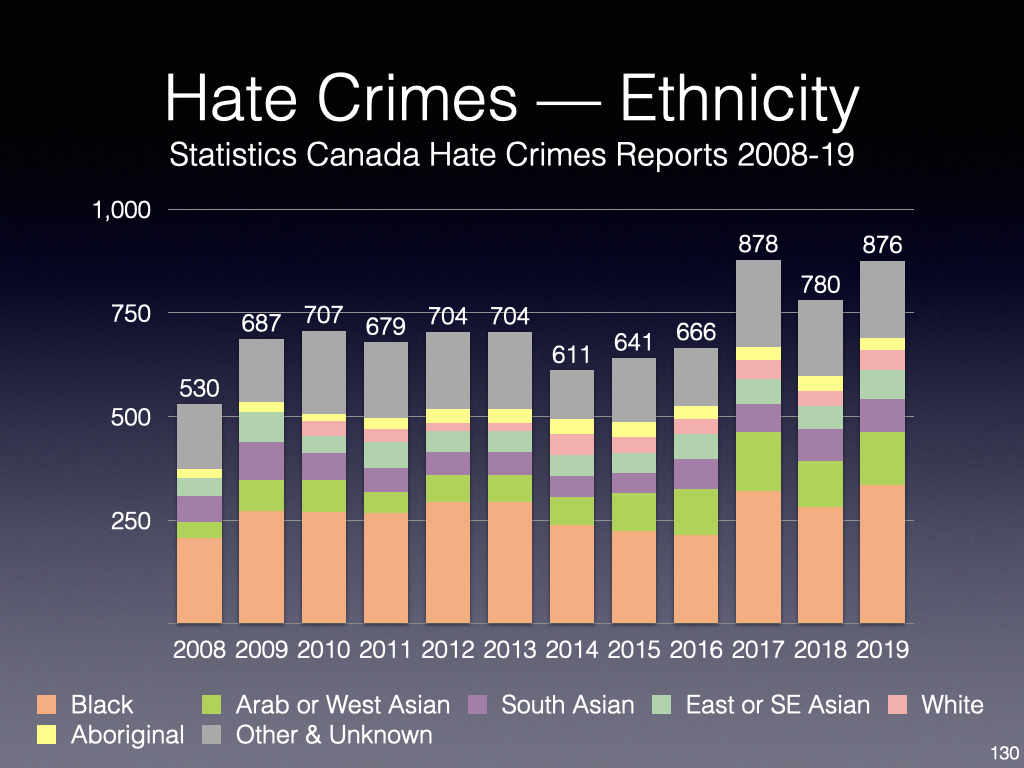
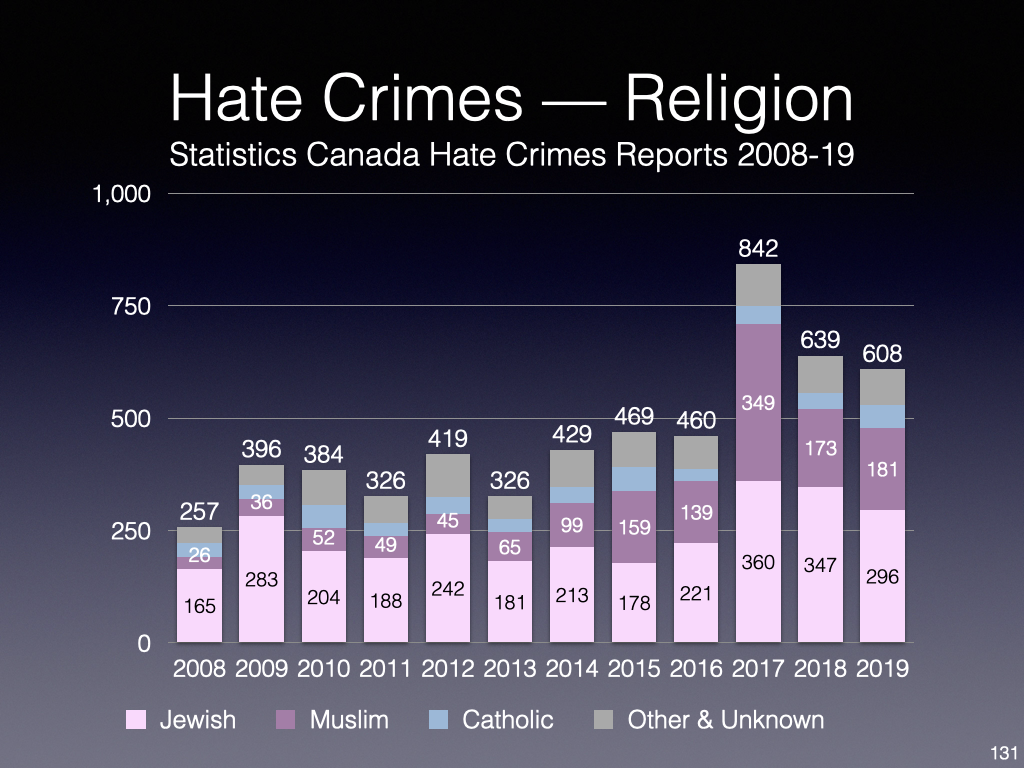
2017 marked a major change since when these statistics were collected as shown in the above charts. Pre-COVID so recent spike in anti-Asian hate crimes not captured but largely post Black Lives Matter (but pre-George Floyd killing):
There were 1,946 police-reported hate crimes in Canada in 2019, up 7% from a year earlier. Other than a single peak of 2,073 hate crimes in 2017, police-reported numbers are the highest since 2009.
Statistics Canada collects data on the number and nature of hate crimes reported to police in any given year and monitors trends over time. The following statistics from 2019 do not reflect the large-scale societal impacts, both nationally and globally, of the COVID-19 pandemic, as this information is not yet available. The 2019 police-reported hate crime data will, however, be a key reference point for 2020, to identify possible changes in Canadian crime patterns as a result of factors related to the pandemic.
Results from a recent crowdsourcing survey show that, since the start of the pandemic, the proportion of participants designated as visible minorities who perceived an increase in race-based harassment or attacks was three times larger than the proportion among the rest of the population (18% versus 6%). This difference was most pronounced among Chinese (30%), Korean (27%), and Southeast Asian (19%) participants. In addition, some police services and media outlets, such as those in Vancouver(PDF 1,787 KB), Ottawa and Toronto (PDF 1,702 KB), have indicated significant increases in hate crime incidents in 2020.
Hate crimes target the integral and visible parts of a person’s identity and may disproportionately affect the wider community. A hate crime incident may be carried out against a person or property and may target race, colour, national or ethnic origin, religion, sexual orientation, gender identity or expression, language, sex, age, mental or physical disability, or any other similar factor. In addition, four specific offences are listed as hate propaganda or hate crimes in the Criminal Code of Canada: advocating genocide, public incitement of hatred, willful promotion of hatred and mischief motivated by hate in relation to property used by an identifiable group.
Hate-motivated crime up from 2018 and remains higher than previous 10-year average
The number of police-reported hate crimes in Canada was up 7% in 2019, rising from 1,817 incidents to 1,946. Since comparable data became available in 2009, the number of hate crimes has ranged from 1,167 incidents in 2013 to 2,073 in 2017. On average, 1,518 hate crime incidents have been reported annually by police since 2009.
Chart 1 Number of police-reported hate crimes, Canada, 2009 to 2019
As with other crimes, self-reported data provide further insight into hate-motivated crimes. According to the 2014 General Social Survey on Canadians’ Safety (Victimization), Canadians reported being the victim of over 330,000 criminal incidents that they perceived as being motivated by hate in the 12 months that preceded the survey (5% of the total self-reported incidents). Two-thirds of these incidents were not reported to the police, a rate similar to that for victimization overall.
Hate-motivated crime accounts for a small proportion of all police-reported crime (around 0.1% of all non-traffic-related offences). However, police data on hate crimes reflect only those incidents that come to the attention of police and are classified as hate crimes. As a result, fluctuations in the number of reported incidents may be attributable to a true change in the volume of hate crimes, but they might also reflect changes in reporting by the public because of increased community outreach by police or heightened sensitivity after high-profile events.
Most provinces and all territories report increases in hate crimes
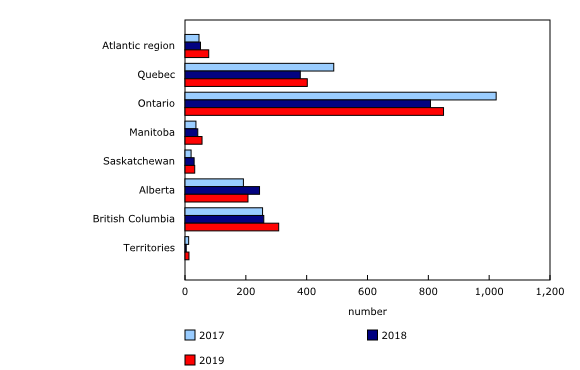
In 2019, eight provinces and all three territories posted increases in police-reported hate crimes. The largest contributors to the national increase were British Columbia (+49 incidents), Ontario (+43 incidents) and Quebec (+23 incidents). Alberta reported 38 fewer incidents and Nova Scotia had no change from the previous year.
Accounting for population size, hate crime rates were highest in British Columbia (6.1 incidents per 100,000 population), Ontario (5.9 incidents), Quebec (4.8 incidents) and Alberta (4.7 incidents). While the vast majority (84%) of hate crimes occurred in a census metropolitan area (CMA), non-CMA areas (small cities, small towns and rural areas) accounted for two-thirds (67%) of the increase in hate crime incidents in 2019. Stated another way, areas outside CMAs recorded 86 more incidents in 2019, while CMAs recorded 43 more incidents.
Police-reported hate crimes targeting race or ethnicity and sexual orientation were up compared with the previous year, accounting for most of the national increase. Hate crimes targeting religion were down because of fewer incidents targeting the Jewish population. There were more incidents targeting the Muslim population.
Chart 2 Police-reported hate crimes, by region, 2017 to 2019
Non-violent and violent hate crimes up in 2019
Non-violent hate crime accounted for over half (56%) of all hate crimes in 2019, the same proportion as in 2018. Both non-violent (+6%) and violent (+8%) hate crimes increased in 2019, contributing nearly equally to the overall increase in hate crime.
The increase in non-violent hate crime was largely the result of more incidents of general mischief (+7%). The rise in violent hate crime was driven by more incidents of common assault (+24%) and uttering threats (+12%).
As is typical of police-reported hate crime historically, mischief (general mischief and mischief towards property used primarily for worship or by an identifiable group) was the most common hate crime-related offence, accounting for almost half (45%) of all hate crime incidents.
Police-reported hate crimes motivated by hatred of a race or an ethnicity increase
Individuals designated as visible minorities generally report higher levels of discrimination than the non-visible minority population (20% versus 12%). Specifically, those who identified as Arab or Black were most likely to report having experienced discrimination, with four in five Black Canadians who had experienced discrimination indicating that their race or skin colour was the basis of the discrimination.
Almost half (46%) of all police-reported hate crime was motivated by hatred of a race or an ethnicity in 2019. Police reported 876 crimes motivated by hatred of a race or an ethnicity, up 10% from 2018, and 2 fewer than the record high in 2017. The rise was largely attributable to 40 more hate crimes targeting the Black population (+14%) and 35 more incidents targeting the Arab and West Asian populations (+38%).
With 335 police-reported incidents, hate crimes targeting the Black population reached their highest number recorded dating back to 2009. Hate crimes targeting the Black population accounted for 18% of all hate crimes in Canada, and this population was the most targeted group overall in 2019. Ontario (+29 incidents) and British Columbia (+16 incidents) accounted for the largest increases in hate crimes against the Black population, while Alberta (-19 incidents) reported the largest decrease.
The number of police-reported hate crimes against the Arab and West Asian populations rose from 93 to 128, following a 35% decrease a year earlier. This was the second-highest number dating back to 2009. These crimes accounted for 15% of hate crimes targeting race or ethnicity, and 7% of all hate crimes in 2019.
While the number of hate crimes targeting race or ethnicity rose in 2019, victimization data from the same year suggest that population groups designated as visible minorities were significantly less likely to report having a great deal of confidence in the police (35%), compared with non-visible minorities (44%). Perceptions of personal safety, prior victimization or discrimination, and confidence in the police can all impact the likelihood of an individual reporting a crime to the police.
Hate crimes targeting the Indigenous population continue to account for relatively few police-reported hate crimes
Incidents against Indigenous people—those who are First Nations, Métis or Inuit—continued to account for a relatively small proportion of police-reported hate crimes (2%), decreasing from 39 incidents in 2018 to 30 incidents in 2019.
Police-reported violent hate crimes against Indigenous people are more likely than most other hate crimes to involve female victims. From 2010 to 2019, 45% of victims of violent hate crimes against Indigenous people were female, compared with 32% of all victims of violent hate crimes.
According to the most recent victimization information, Indigenous victims of non-spousal violence were less likely to report the crime to police than their non-Indigenous counterparts. Furthermore, Indigenous people were less likely to report having a great deal of confidence in the police compared with their non-Indigenous counterparts. Previous research has described the relationship between Indigenous people and the police as one of mistrust because of a range of systemic issues that have contributed to experiences of social and institutional marginalization, discrimination, violence, and intergenerational trauma. It is therefore unclear how the number of police-reported hate crimes may be impacted.
Record high number of hate crimes targeting sexual orientation
According to the 2018 Survey of Safety in Public and Private Spaces, an estimated 1 million people in Canada are sexual minorities—that is, they reported their sexual orientation as gay, lesbian, bisexual or a sexual orientation that is not heterosexual. Compared with heterosexual Canadians, sexual minority Canadians were more likely to report having been violently victimized in their lifetime and were more likely to have experienced inappropriate behaviours in public and online. At the same time, sexual minority Canadians were less likely to report having been physically assaulted to the police.
Police reported 263 hate crimes targeting sexual orientation in 2019, up 41% from a year earlier. This was the highest number of hate crimes targeting sexual orientation dating back to 2009. Nearly 9 in 10 (88%) of these crimes specifically targeted the gay and lesbian community, while the remainder comprised incidents targeting bisexual people (2%); people with other sexual orientations, such as asexual, pansexual or other non-heterosexual orientations (6%); and people whose sexual orientation was unknown (4%).
As was the case in previous years, violent crimes accounted for more than half (53%) of hate crimes targeting sexual orientation. In comparison, just over one-quarter (27%) of hate crimes targeting religion and just over half (52%) of hate crimes targeting race or ethnicity were violent.
Hate crimes targeting religion down for the second year in a row, with fewer anti-Semitic hate crimes
In 2019, 608 hate crimes targeting religion were reported by police, down 7% compared with 2018. Although this was the second year-over-year decrease in a row, following a peak of 842 incidents in 2017, the number was higher than those recorded prior to 2017. Victimization information has shown that people affiliated with a non-Christian religion were significantly more likely than Christians to report having experienced discrimination on the basis of their religion (11% versus 1%).
Following a 63% jump in 2017 and a 3% increase in 2018, the number of incidents targeting the Jewish population decreased 20% in 2019, from 372 to 296. The decline was the result of fairly widespread decreases, including fewer incidents in Alberta (-29), British Columbia (-20), Ontario (-19) and Quebec (-18). While police-reported metrics indicate a decrease in hate crimes targeting the Jewish population, an annual audit conducted by B’Nai Brith Canada reported a record number of anti-Semitic incidents for the fourth consecutive year.
In contrast, following a large decrease in hate crimes against the Muslim population in 2018, police reported 15 more incidents in 2019, for a total of 181 (+9%). The increase in police-reported hate crimes against Muslims was largely the result of more incidents in Quebec (+15 incidents).
Violent incidents targeting the Muslim population were more likely than other types of hate crimes to involve female victims. From 2010 to 2019, almost half (47%) of victims of violent hate crimes targeting the Muslim population were female, compared with one-third (32%) of all hate crime victims.
Of note. Shameful, whether directed against Asian Canadians or other minorities. Still waiting for 2019 police-reported hate crimes data to see what they captured (only have general by motivation and most serious violation, no breakdowns by group or religion):
Avvy Go was walking home from work on a summer day in Toronto last year when a group of young people blocked her route on the sidewalk.
Without a word, one person spat at her, the spittle landing at Go’s feet.
Horrified, Go yelled, “Excuse me!” but the group continued on, laughing among themselves.
“I was just taken aback. I was just stunned,” said Go, director of the Chinese and Southeast Asian Legal Clinic. “For some of us, every time we step out, we have to worry if we will be targeted again.”
Go’s fears are common: anti-Asian racism has been growing across the country, according to a new report released Tuesday by the Chinese Canadian National Council (CCNC) Toronto chapter, which for the first time details the nature of attacks that seem to have intensified during the COVID-19 pandemic.
From verbal insults to physical assaults, including being spat upon, 643 complaints were submitted to the council’s online platforms from March 10 to Dec. 31, 2020. Overwhelmingly, these incidents were fuelled by false and racist beliefs about the spread of COVID-19, according to the study’s authors.
“In addition to the ways we know COVID transmits, the spitting and coughing symbolizes a revenge, as if an act of ‘Go back where you came from, where the virus came from,’” said Kennes Lin, a social worker and co-chair of the CCNC Toronto chapter, who was one of the report’s authors.
The document’s release comes just days after six Asian women were shot dead at multiple massage parlours in Atlanta, Ga. The March 16 killings prompted protests against anti-Asian racism in major cities in North America, including Montreal.
Canada has also witnessed an increase in anti-Asian racism. Last July, Statistics Canada reported that more than 30 per cent of Chinese Canadians perceive themselves to be at a higher risk of possible violence or harassment. In February, data released by Vancouver police showed a 717 per cent increase in anti-Asian hate crimes in the city last year.
While the majority of incidents in the CCNC report involved verbal harassment, close to 11 per cent of victims reported physical force being used against them and nearly 10 per cent said they were coughed or spat upon.
Notably, youth under 18 and adults age 55 and older were 233 per cent and 250 per cent more likely to be coughed and spat upon during a hate incident. Attacks described in the report range from a young child being thrown off a bicycle to an older woman being punched in the eye on public transit. https://datawrapper.dwcdn.net/M4w0F/1/
Other findings in the report include:
About 73 per cent of those who reported incidents said they suffered emotional harm or mental distress from what occurred. About eight per cent reported physical injuries.
Individuals who reported an incident in a Chinese language as opposed to English were 34 per cent more like to suffer emotional distress from the incident and 100 per cent more likely to have experienced a physical assault.
Close to 50 per cent of incidents occurred in public spaces (park/street/sidewalk), while another 17 per cent took place in grocery stores or restaurants.
Though Go chose not to report the incident she experienced, as she felt nothing would come of it, hundreds of Asian Canadians have turned to community organizations like the CCNC and their partners to report racist incidents.
The council launched a web portal in March 2020 specifically because it was being inundated with calls about disturbing attacks across Canada in a way it hadn’t seen prior to the pandemic. Many said they were not comfortable reporting to law enforcement as there is a lack of trust or they feel they won’t be heard.
Another 507 hate incidents were logged on the site from Jan. 1 to Feb. 28 this year, but were not included in the analysis.
Go said the prevalence of spitting and coughing toward Asian people in Canada is due to the false, racist belief that Asian people are responsible for bringing COVID-19 to the country.
“It’s almost like this is the way of saying: You give me the virus, I’m giving it back to you,” she said. Go was one of many individuals who provided an initial review of the CCNC report.
Spitting or coughing on someone deliberately, while a deadly virus continues to devastate the population, is done not only to infect Asian Canadians, but also to follow through on a warped sense of vengeance that feeds into long-standing stereotypes around Asian people and disease, said Lin.
“It means an intense level of dehumanizing, disrespect, scorn and disregard,” said Lin.
Building the railroad in the late 19th century in Canada, Chinese migrants had to live in crowded, substandard housing that led to people falling ill, fuelling stereotypes about Asian people being “diseased.” A head tax was in place from the late 19th to early 20th centuries to deter immigration, throwing migrants into poverty before they even arrived.
Meanwhile, the British had characterized Chinese people as “full of diseases” during the Opium Wars in the mid-19th century and those stereotypes rooted in colonialism show up in the hate incidents Asian Canadians are experiencing during the pandemic, said Josephine Pui-Hing Wong, a professor at the Dalla Lana School of Public Health at the University of Toronto, who specializes in health disparities.
Wong says the Atlanta shootings last week evoked memories of racist incidents she faced growing up in Canada. She recalls classmates comparing her to sexualized Asian women in western movies, or men accosting her, claiming they had an “Asian fetish.”
“(Racism) is in the Canadian psyche because for hundreds of years, white supremacy has constructed this kind of knowledge that racialized people are inferior,” she said. “But then when COVID-19 comes out, when the United States president says racist things, people feel that they’ve been given a permit to go out and be violent,” she added, referring to statements made by former president Donald Trump.
The fetishizing of Asian women and the targeting of migrant women, specifically sex workers, as some of the more vulnerable groups amid rising anti-Asian hate incidents is an element the CCNC is highlighting as well, said Kate Shao, a lawyer and board member.
The report shows about 60 per cent of the incidents have impacted Asian women. The Atlanta shootings, resulting in the deaths of Asian women, struck a chord on that data point, she said.
“There’s an additional impact that women feel, and especially women in precarious immigration status. A lot of that is heightened because of the hypersexualization, fetishization that we’ve seen,” she said, referring to the treatment of women during the Vietnam and Korean wars.
Children are also emotionally impacted by the racism they’ve experienced in schools, said Lin. The CCNC had reports of hand sanitizer being sprayed at Asian children, she said. https://datawrapper.dwcdn.net/tVKGS/1/
In the wake of the Atlanta shootings, Ontario Education Minister Stephen Lecce released a statement acknowledging that “anti-Asian racism is on the rise” and said he’s working to curb hate incidents occurring in the school community.
The CCNC report shows that most incidents have occurred in public places. For places like local businesses such as restaurants and grocery stores, their report recommends implementing specific anti-Asian racism policies to protect employees and customers, said Shao.https://datawrapper.dwcdn.net/vuLM7/1/
It’s disheartening that the Atlanta attacks are what has caused some institutions or groups to finally speak out on anti-Asian racism, when groups like the CCNC have been speaking on it for months, she said.
In order to create their data analysis, the CCNC used one-time funding from the Canadian government that ends this month.
“We have over 1,000 reports of racism, and where do we go from there?” she asked. “There’s a lot the government needs to do to step up and fill in these gaps.”



 Multicultural Meanderings