Urback: Canada’s hate speech laws don’t need a rewrite. They need to be enforced

Agree:

…Whether that was a reasonable conclusion is a matter of debate (who, I wonder, was Mr. Charkaoui referring to when he called for the killing of Zionists?), but the religious exemption under the Criminal Code is not what got him off the hook. And even if Mr. Charkaoui was charged with hate speech and he decided to lean on 319(3)(b) as a defence, the Crown could still make the case that his statements were not a “good faith” reading of a religious text, and that he was willfully promoting hatred with an intention that went well beyond an interpretation of scripture. It seems the problem here – as with many other instances of, for example, protesters intimidating people outside of their homes or places of worship, or individuals spreading hateful messages at public events – is one of enforcement of existing laws and a willingness to prosecute, and not of a subsection defence in the Criminal Code.

It is easy to see why many people would think scrapping the religious exemption is a good thing. Why wouldn’t we want to remove any crutch upon which bigots can rely to get away with spreading messages of hate? But on principle, we should demand government restrictions on speech to be as narrow as possible, so that the law doesn’t end up criminalizing good-faith readings of religious texts. In his capacity as chair of the House of Commons Standing Committee on Justice and Human Rights, Marc Miller, now the Minister of Canadian Identity and Culture, cited Bible verses he personally considers “hateful.” That’s fine as a matter of personal opinion, but alarming when the government is opening the door to criminal conviction. 

Source: Canada’s hate speech laws don’t need a rewrite. They need to be enforced

Conservatives blast removal of religious exemption in hate-speech laws as ‘assault’ on freedom of speech

Arguably not needed given existing laws but recent occupations, obstructions, demonstrations supporting Palestinians have veered into explicit antisemitism and harassment of Jewish communities. The exemption should not be akin to a “get out of jail” card:

Opposition Conservatives say a deal between the governing Liberals and the Bloc Québécois to remove a religious exemption from Canada’s hate-speech laws, in exchange for passing a bill targeting hate and terror symbols, is an “assault” on freedom of speech and religion….

The Conservatives on Monday slammed the removal of that exemption as an attack on freedom of religion and of free speech, with the party quickly putting together a petition, which was circulated by its Members of Parliament.

“Liberal-Bloc amendments to C-9 will criminalize sections of the Bible, Quran, Torah, and other sacred texts,” Poilievre wrote on social media. “Conservatives will oppose this latest Liberal assault on freedom of expression and religion.”

Conservative Calgary MP Michelle Rempel Garner called on all other parties to oppose the amendment.

“I think it’s an unabashed attack on religious freedom,” Rempel Garner said.

Ontario MP Marilyn Glaudu, who serves as the Conservative critic for civil liberties, in a video on X, said the proposed change amounted to an “attack on people of faith.”

Fortin, the Bloc MP, agreed that the change will curb freedom of expression. However, he argued there must be limits on speech that propagates hate.

“I think this freedom of expression needs to be limited. You’re free to do what you want until you start harming others,” he said.

The bill itself seeks to create new offences around the intimidation and obstruction of sites used by an identifiable group, such as a religious or cultural centre, as well as make it a crime to promote hate by displaying hate symbols like a swastika, or those linked to listed terrorist entities.

The proposed amendments come amid widespread criticism about the Liberals’ bill, with the Canadian Civil Liberties Association (CCLA) and the Canadian Muslim Public Affairs Council calling for it to be withdrawn, along with dozens of advocacy groups. Critics warn that the new offences create the risk of police cracking down on lawful protests, and could lead to a targeting of Muslim and other racialized groups.

When it comes to the proposed removal of religious defences from hate speech laws, Anaïs Bussières McNicoll, director of the CCLA’s fundamental freedoms program, said it raises concerns.

She pointed to how that defence is only available to criminal law dealing specifically with the wilful promotion of hatred and no other offence, even speech-related ones, such as public incitement to hatred, or uttering threats.

“The speech that needs to be criminalized in Canada is already criminalized, and there is no religious exemption applying to that,” she said.

She said the association has for years held concerns around the provision, targeting “the wilful promotion of hatred,” given how broadly it can be applied.

“The concept of hatred is subjective,” she told National Post in an interview on Monday, “so we are always worried about risks of abuse and censorship of unpopular or offensive opinions through this provision. So we fear that removing this religious exemption might gradually erode the protections and increase the scope of this provision.”

Steven Zhou, spokesman for the National Council of Canadian Muslims, said in a statement on Monday that it was “gravely concerned and surprised” about the reported deal to remove the exemption for religious beliefs, saying that doing so “opens the door to a deeply troubling censorship regime.”

Khaled Al-Qazzaz, executive director of the Canadian Muslim Public Affairs Council, said in a statement that it rejects the removal of the religious exemptions, saying it considers doing so “an attack on all places of worship and religious schools.”

Derek Ross, executive director and counsel for the Christian Legal Fellowship, a national association for lawyers and law students who identify as Christian, said removing the exemption for religious opinions could lead individuals to self-censor and create an overall “chilling” effect.

The law must balance competing interests, he said, but pointed to how it must protect those who are fearful of becoming “vilified or detested” because they express viewpoints held by a minority.

Khaled Al-Qazzaz, executive director of the Canadian Muslim Public Affairs Council, said in a statement that it rejects the removal of the religious exemptions, saying it considers doing so “an attack on all places of worship and religious schools.”

Derek Ross, executive director and counsel for the Christian Legal Fellowship, a national association for lawyers and law students who identify as Christian, said removing the exemption for religious opinions could lead individuals to self-censor and create an overall “chilling” effect.

The law must balance competing interests, he said, but pointed to how it must protect those who are fearful of becoming “vilified or detested” because they express viewpoints held by a minority.

“It is a significant change to the law, and one that was not previously the subject of a great deal of discussion or debate by Parliament,” Ross said on Monday. “We hope that further consideration is given before such a move is made.”

As part of the deal with the Bloc, the Liberals are also expected to back off plans to eliminate the need for a provincial attorney general’s sign-off to pursue a hate-propaganda prosecution. The move will likely be supported by both the Bloc and Conservatives.

Fortin, Bussières McNicoll and Al-Qazzaz all said they agreed with maintaining the additional check and balance before charges are laid, which could have a cooling effect on freedom of expression.

Quebec’s Justice Minister Simon Jolin-Barrette, who has called on the federal government for years to remove the religious exemption defence, celebrated the deal between Liberals and Bloc on social media.
Source: Conservatives blast removal of religious exemption in hate-speech laws as ‘assault’ on freedom of speech

Liberal deal with Bloc means hate-speech laws will lose exemption for ‘sincerely held’ religious belief

This will create considerable debate and will likely lead to court challenges. A good faith or “sincerely held” clause should not be a “get out of jail” card, but in the end, it will depend on context and specifics, and would to extreme religious extremists and positions:

The Liberals have agreed to remove religious exemptions from Canada’s hate-speech laws to secure Bloc Québécois support to help pass its bill targeting hate and terror symbols, National Post has learned through a source close to the talks.

Currently, the law exempts hateful or antisemitic speech if it based in good faith on the interpretation of a religious text, but that immunity is set to be removed. Additionally, the Liberals are expected to back off plans to eliminate the need for a provincial attorney general’s sign-off to pursue a hate-propaganda prosecution.

The removal of the religious exemption is expected to come via an amendment to the Criminal Code in the form of Bill C-9 at the parliamentary justice committee that will be supported by both the Liberals and Bloc, a senior government source confirmed.

The source was granted anonymity because they were not authorized to discuss party negotiations publicly.

“We do have Bloc partnership,” the source said. “The bill is in a place now, even with those Bloc amendments, that everyone is happy,” they added in reference to Liberal and Bloc MPs.

Bill C-9, which fulfilled a campaign promise Prime Minister Mark Carney made during the spring election, was his minority government’s first major justice bill introduced earlier this fall by Justice Minister Sean Fraser.

It seeks multiple changes to the Criminal Code to confront the issue of hate, with the Liberals citing a rise in police-reported incidents in recent years, particularly in the wake of sustained anti-Israel protests over the last two years.

Chief among the proposed changes is creating a new offence for intimidating someone to the point of blocking their access to a place of worship or another centre used by an identifiable group, as well as criminalizing the act of promoting hate by displaying a hate or terror symbol, such as one tied to a listed terrorist organization or a swastika.

The Opposition Conservatives have lambasted the current effort as censorship, saying provisions already exist within criminal law to counter hate, and that the bill’s proposal to remove the requirement for a provincial attorney general’s (AG) consent to lay a hate propaganda charge took away an “important safeguard,” according to the party.

The Liberals are now expected to accept another amendment eliminating that change from the bill entirely. That, too, was a Bloc request.

When the bill was first presented back in September, the Liberals argued that removing the AG requirement would help streamline the process of laying hate propaganda charges, while critics said it was an additional check on a charge with serious implications for free speech.

Once the amendments are passed, the Liberals and Bloc are expected to vote the bill through committee and the House of Commons. However, it is unclear when the justice committee will debate clause-by-clause amendments to the bill.

The House is scheduled to rise on Dec. 12.

The original text of the bill did not contain changes to the existing religious defences for hate speech, but the Bloc has consistently raised the need for it to be addressed.

Currently, Section 319 of the Criminal Code contains an exemption stating no person shall be convicted of promoting hateful or antisemitic speech if they expressed “in good faith” an opinion “based on a belief in a religious text.”…

Source: Liberal deal with Bloc means hate-speech laws will lose exemption for ‘sincerely held’ religious belief

New hate-crime bill must confront the enforcement gap

As in most areas, implementation and enforcement are important in themselves as well as for government credibility. Some of these suggestions are more realistic than others. Linguistic expertise may be less important given ongoing improvements in translation software for some languages:

…To have real impact, Ottawa’s new hate-crime bill must establish, fund and train specialized prosecution units, specifically on sections 318–320 of the Criminal Code and on digital evidence so that prosecutors are less inclined to vacillate when faced with complex hate-crime files.

For instance, developing linguistic expertise so investigators can examine hate content in minority languages would greatly help in properly translating, transcribing and admitting key evidence in court. Protection under the law should not be weakened by the legal system’s linguistic blind spots.

Finally, the upcoming reforms must guarantee support for victims and witnesses all the way through prosecution to verdict — not just during the initial complaint stage. Otherwise, communities that face repeated targeting cannot be expected to engage with enforcement efforts.

Such fundamental steps are what transform recognition of hate crime into deterrence.

The case of the Montreal man being found not criminally responsible after a Jewish man was attacked reinforces that communities will accept humane outcomes if they also see consistent deterrence. Right now, they don’t.

Unless enforcement is prioritized, the new bill could amount to a replay of ambition without results.

Beyond any doubt, Canada has become proficient at counting hate. Lawmakers now have the chance to prove we can also punish it. Victims have shown courage by reporting; it is time for Parliament to show equal valour by closing the enforcement gap.

Daniel Robson is an independent Canadian journalist specializing in extremismterrorism and crime, focusing on national and community security, and the legal, institutional and policy dimensions of public safety. X: @DanielRobs77090

Source: New hate-crime bill must confront the enforcement gap

Islamic preacher barred from entering Canada for speaking tour, months after being banned from U.K.

Seems like the right call. Question about a religious exemption for hate speech as proposed by the Bloc much more thorny as one looks at the potential impact across many religions and sects:

…Mr. Blanchet said his party plans to table an amendment to the government’s Combatting Hate bill to stop religion from being used as a defence for hate speech. 

The proposed change to the Criminal Code would abolish a defence allowing a person who incites hatred to escape prosecution if their words are based on religious beliefs or a religious text.

Canadian Identity Minister Steven Guilbeault replied that the Liberals shared the Bloc’s aim to combat hatred and would welcome amendments to the bill.

“We will hear from experts, subject-matter experts, and are willing to work with the Bloc Québécois, with all parties in this House to ensure that hate speech is not in Canada,” he replied. 

Jeremy Bellefeuille, spokesperson for Justice Minister Sean Fraser, said in a text message that the minister “is open to hearing expert testimony in committee.”…

Source: Islamic preacher barred from entering Canada for speaking tour, months after being banned from U.K.

Fewer Canadian companies disclosing DEI records, study finds

Of interest:

Fewer Canadian public companies are trumpeting their records on diversity, equity and inclusion, though many are quietly pressing ahead with the initiatives despite the DEI backlash in the United States, a study by a national law firm has found.

U.S. President Donald Trump signed a number of executive orders aimed at stamping out the practice of promoting diversity in workplaces, saying hiring and promotion should be done solely on merit. These actions could be influencing Canadian companies to pull back on reporting data, Osler, Hoskin & Harcourt LLP said in its annual diversity disclosure report.

The shift halts a years-long trend of increasing reporting for metrics such as the percentages of women on boards of directors and executive teams, the report said. 

The report found the percentage of female directors among Toronto Stock Exchange-listed companies increased, rising above 30 per cent of board seats for the first time to 30.5 per cent. But the rate of increase fell to 0.7 percentage points from midyear 2024, the slowest in the 11 years Osler has conducted the study.

Despite reduced public disclosure, institutional investors still demand this information from companies in their portfolios, and many corporations see maintaining DEI programs as key to attracting top talent they will require as demographics change, said John Valley, chair of Osler’s corporate governance practice and co-author of the report.

Source: Fewer Canadian companies disclosing DEI records, study finds

From warning to reality: Canada’s escalating hate crisis demands action

Not sure how realistic or effective these proposals are and there does not appear to be much assessment of the effectiveness of similar already existing programs:

…5 ways to take concrete action

1. Online platforms must be held accountable.

The European Union’s Digital Services Act offers a useful model for regulating harmful online content, emphasizing transparency and responsibility. Canada should adopt similar measures, ensuring tech companies prioritize public safety over profit. 

At the University of Ottawa conference, speakers highlighted Canada’s proposed Online Harms Act (Bill C-63), underlining the need for balanced, carefully defined legislation that safeguards free expression while effectively combating online hate.

2. Police and prosecutors need better training.

At the Ottawa conference, Mariam Musse of the Office of the Federal Ombudsperson for Victims of Crime, along with policy and legal researcher Hannan Mohamud, explained that police often lack the necessary cultural sensitivity and trauma-informed approaches. 

Implementing mandatory anti-bias and human rights training can help build trust between law enforcement and communities. Positive examples in Toronto and Ottawa shed light, but need guaranteed, long-term funding.

3. Canada must focus its response on victims.

Strengthening the 10-year-old Canadian Victims Bill of Rights, increasing funding for culturally sensitive support services and improving access to compensation can empower victims and help communities heal. Collecting detailed demographic data is critical to understand the full impact of hate crimes and tailor effective solutions.

4. Community-led dialogue initiatives are essential.

Investing in grassroots organizations that regularly bring diverse groups together can build genuine relationships and reduce prejudice. This must begin in schools.

5. Addressing socio-economic inequalities is crucial.

At the Ottawa conference, Victoria Kuketz of the Public Policy Forum’s Democracy Project pointed out that financial pressures, housing crises and political opportunism fuel resentment and radicalization. Tackling these issues through inclusive social policies will reduce the appeal of hateful narratives.

Our shared responsibility

Effective activism requires a clear, hopeful vision, not just resistance to threats. Without a positive vision for society, efforts risk becoming reactionary rather than transformative.

Canada is long past the warning stage: hate and polarization are palpably threatening our democracy, social cohesion and public safety every day. The path forward is clear: collective, sustained and compassionate action through means and approaches that are proven to work.

So far, Canada’s response is inadequate, hesitant and late. 

Policymakers need to take action, including establishing a dedicated national body to address all hate-motivated crime, working with provincial authorities to support local programs across Canada and promoting community-wide actions tailored to specific needs. 

By embracing dialogue, strengthening communities and implementing systemic reforms, the rich diversity that defines Canada will be protected and a safer future will be secured for everyone. But it requires investing in the proven methods of countering hate and polarization and ending the blight with determination and urgency.

Frederick John Packer, Associate Professor of Law and former Director of the Human Rights Research and Education Centre (2014-2025), L’Université d’Ottawa/University of Ottawa

Source: From warning to reality: Canada’s escalating hate crisis demands action

Khan: We shouldn’t turn a blind eye to assaults on Muslim women 

Agree:

…The scourge of hate is corrosive. It cannot be effectively addressed in a siloed fashion, where each affected group stands alone. Here’s an idea: next time when there’s a hateful incident against one group, let’s have a few representatives of all affected groups stand together to condemn the hate. There are fundamental disagreements between affected groups, but all agree that no member of our Canadian family should be subject to intimidation, threats or violence.

Source: We shouldn’t turn a blind eye to assaults on Muslim women

Hate crimes 2024

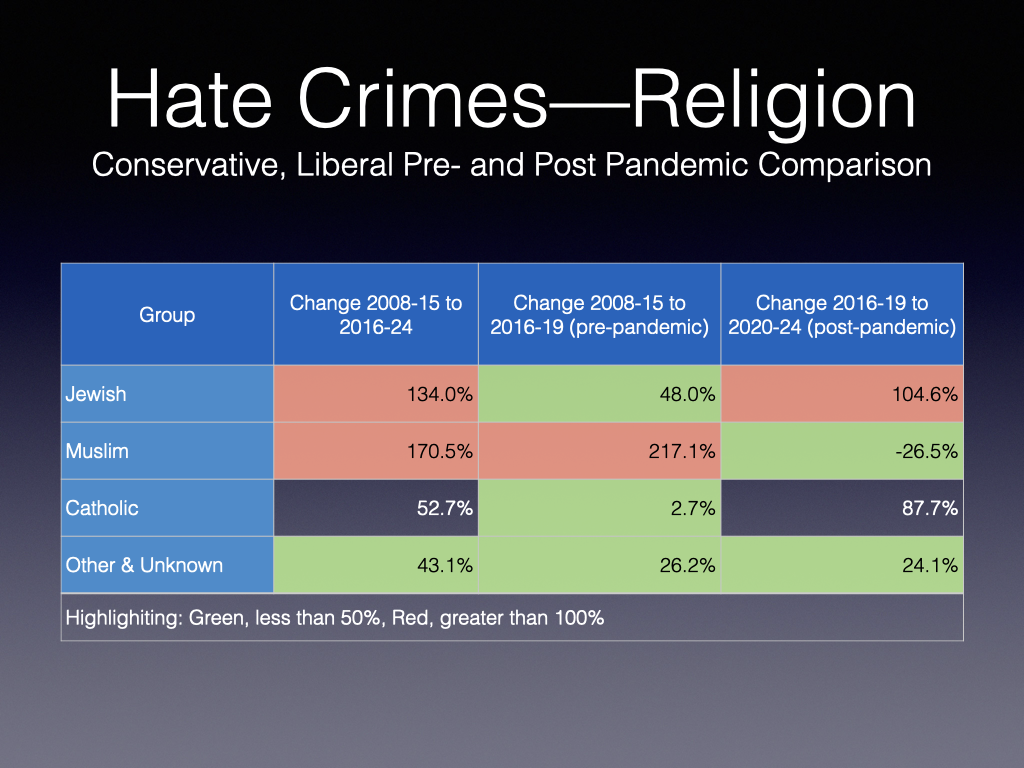
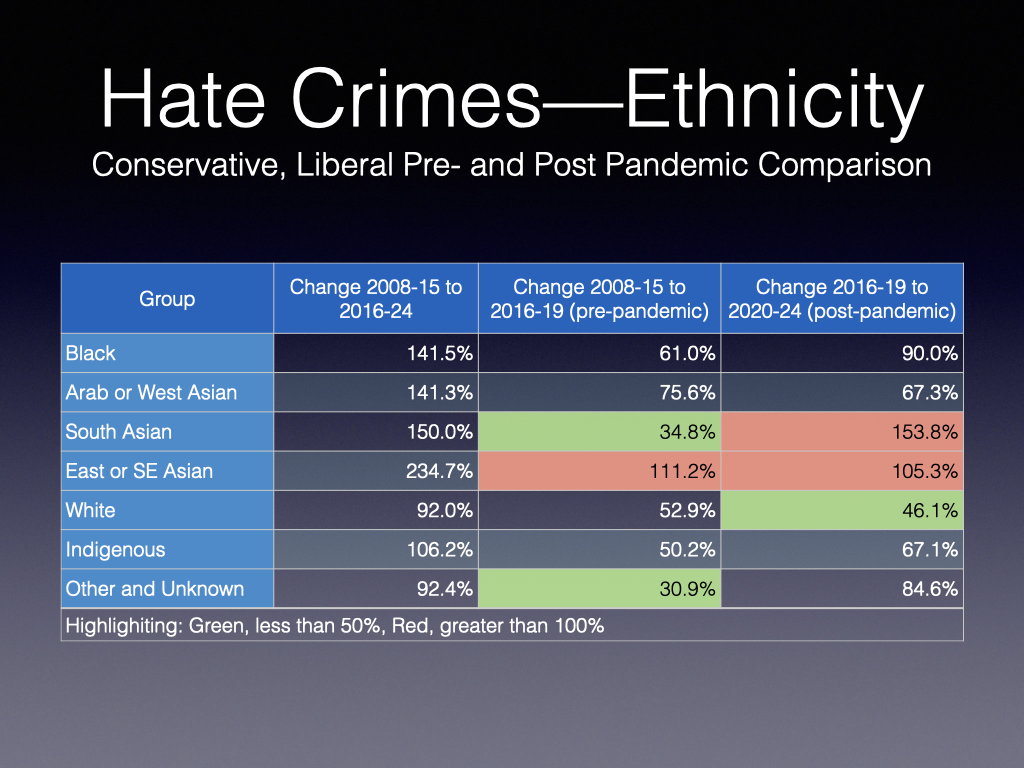
My latest analysis of the data, 2008-24. This year I have broken the data into three periods: Harper government, Trudeau government pre-pandemic, and Trudeau government post-pandemic and the ongoing increases save for anti-Muslim hate crimes post-pandemic.

The two key comparison slides are below:

StatsCan link: https://www150.statcan.gc.ca/n1/pub/71-607-x/71-607-x2023026-eng.htm?utm_source=mstatcan&utm_medium=eml&utm_campaign=statcan-statcan-mstatcan

Gaps in how justice system responds to hate crimes need to be addressed, report finds

Of note:

Numerous gaps in how the justice system responds to hate crimes must be addressed with more strategic investment to help police, and also legislative reform, a federal watchdog’s report concludes.

The Office of the Federal Ombudsperson for Victims of Crime released its latest report Tuesday, saying the under-resourcing of police hate crimes units, victims’ hesitancy to report crimes and failures in successfully prosecuting or deterring crimes create a system where victims feel left behind.

“The justice system fails survivors consistently. It validates hate and feelings of exclusion,” said Benjamin Roebuck, the victims’ ombudsperson.

The report discusses the impact of hate on Indigenous, Black, Asian and LGBTQ+ communities, and discusses gender-based hate as well as hate targeting people with disabilities, seniors, those of different economic classes and those who don’t have homes….

But, in the study’s detailed review of how hate affects different communities, it leaves out explicit discussion of the group that police say has become the most targeted in Canada for the last two years: Jewish Canadians.

Police-reported hate crimes rose 32 per cent in 2023 compared with 2022, an increase police agencies across the country link explicitly to the outbreak of war between Hamas and Israel in October, 2023. There were 900 crimes targeting Jews in Canada in 2023, compared with 527 the year before.

Data collected by Statistics Canada so far in 2024 show Jews remain the most targeted group this year. Black Canadians are the second-most targeted, followed by those targeted on the basis of their sexual orientation….

Source: Gaps in how justice system responds to hate crimes need to be addressed, report finds

Report link: Strengthening Access to Justice for Victims of Hate Crime in Canada