Refugees and anti-Semitism: is it a problem? | Germany

More about antisemitism and refugees in Germany:

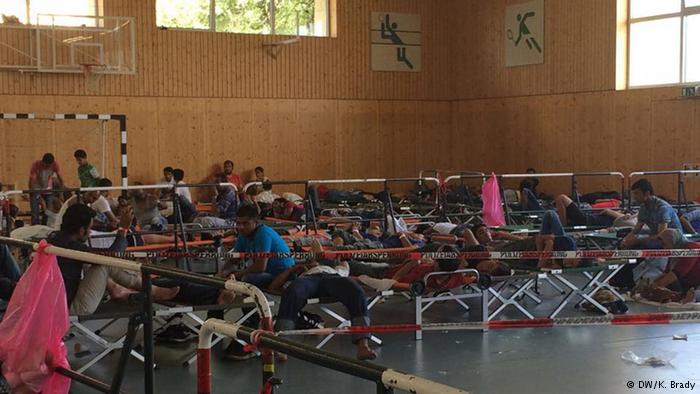
First, there were the images on TV of desperate, scared people climbing out of tiny boats and marching slowly along motorways and through woods. Then, not long after, the refugee crisis arrived on Shaked Spier’s doorstep in Berlin: overcrowded gyms, people waiting for weeks to be registered, overwhelmed officials.

“I knew immediately: If refugees are now in the country that my grandparents had to flee, and if they need help and protection, then I have to do my part,” Spier said. For him, there was absolutely no doubt. Since then, Spier, a Jew whose grandparents once fled the Nazis, has been volunteering at a refugee shelter in Friedrichshain, a hip district of Berlin filled with bars and cafes. Spier, 30, is a well-spoken man who works as a project manager at an IT company, and gives long, reflective answers when asked questions. At the refugee shelter, he helps to serve meals, plays with the kids and talks to the parents about the trauma they’ve experienced.

He is one of many Jews who’ve been helping refugees by donating clothes, working in shelters, or taking refugees into their homes. Spier says he hasn’t had any negative experiences. He says his identity, background and sexual orientation – Spier is openly gay – have never played a big role in his encounters with refugees. If someone notices the Hebrew tattoo on his arm or his accent, the reaction is typically one of, “Oh, you’re from Israel? Cool, I’m from Afghanistan.” He laughs.

Deutschland Rosenheim Grenze Österreich Turnhalle Lager Asylbewerber More than 1 million refugees came to Germany in 2015

No research to support the claims

But then he grows serious. It makes him angry, he says, when other people accuse refugees of being anti-Semites or harboring hate towards Israel simply because they come from countries whose governments espouse such sentiments. The head of Germany’s Central Council of Jews, Josef Schuster, has frequently spoken about the danger of importing anti-Semitism along with refugees. In a recent newspaper interview, he said that “a considerable proportion of Arabs have grown up with anti-Jewish, anti-Israeli stereotypes. These people cannot simply leave their prejudice behind at the border.”

Spier says he has experienced no hostility while working with refugees

Dervis Hizarci, a history and political science teacher in Berlin, also finds such generalizations problematic. There is no research on the extent to which refugees may be bringing anti-Semitism with them to Germany, he said. Hizarci is the head of KIGA, an initiative against anti-Semitism based in the Berlin neighborhood of Kreuzberg. The initiative has launched a project about anti-Semitism among refugees; he expects to have the initial results by the end of the year. Until then, Hizarci says people shouldn’t make generalizations about the issue, as that would only stir up anti-Islam and anti-foreigner sentiment. However, he points to research showing that between 15 and 20 percent of the German population harbor latently anti-Semitic views. “Of course there are Muslims among these people, even in the second and third generation, but they’re by far not all Muslims!”

Hizarci doesn’t deny that young German Muslims are susceptible to anti-Semitic views, fueled by the horrors of the Middle East conflict they see on their smartphones and televisions. Hizarci and his colleagues give workshops and lead debates about anti-Semitism, but also about hatred of Islam. He says his work requires a lot of time and resources. “Just like when it comes to fighting homophobia or right-wing extremism, you can’t change such views with a single workshop; it doesn’t happen overnight.” After the Easter holidays, the initiative wants to start a model project that, among other things, will offer welcome workshops on the topic.

Mosques are overwhelmed

But often, it’s individual people engaged in such efforts to promote tolerance: German mosques are often overwhelmed with the problem, in part because they are led by volunteers who also have to commit their time and energy to other problems facing members of their community, such as exclusion, anti-Islam sentiment and joblessness. There are barely any resources left for confronting the problem of anti-Semitism, said an insider who asked to remain anonymous due to the contentious nature of the topic. The source added that many young Muslims are not an integrative part of the mosque community: “When that’s the case, there’s no way to reach them.”

Source: Refugees and anti-Semitism: is it a problem? | Germany | DW.COM | 12.03.2016

Helmut Oberlander, Ex-Nazi Death Squad Member, Still Keeping His Canadian Citizenship

This case drags on and on, legal ragging the puck (as is his right):

The federal government has hit another roadblock in its decades-long effort to strip Canadian citizenship from a now 92-year-old man who was once a member of a brutal Nazi death squad.

In its decision, the Federal Court of Appeal set aside a ruling against Helmut Oberlander and ordered the government to take another look at the case.

Oberlander, an ethnic German born in Ukraine, has argued he had no choice when German forces conscripted him at age 17 in 1941 to serve as an interpreter in Einsatzkommando 10a. The unit was part of a force responsible for killing more than two million people. Most were civilians, and most were Jewish.

“The appellant was entitled to a determination of the extent to which he made a significant and knowing contribution to the crime or criminal purpose of the Ek 10a,” the Federal Court of Appeal said in its recent decision.

“Only then could a reasonable determination be made as to whether whatever harm he faced was more serious than the harm inflicted on others through his complicity.”

In making its decision, the court noted the Supreme Court in 2013 ruled that individuals cannot be held liable for a group’s crimes only because they associated with the group or passively acquiesced to its criminal purpose.

Source: Helmut Oberlander, Ex-Nazi Death Squad Member, Still Keeping His Canadian Citizenship

Antisemitism: Latest figures from UK and France

Latest data from UK and France:

The number of antisemitic incidents in Britain fell by more than a fifth last year — but 2015 was still the third worst year on record.

Figures published by the Community Security Trust revealed there were 924 incidents of Jew hatred last year.

It represented a drop of 22 per cent compared to 2014, when, following the Gaza conflict, there was a significant spike resulting in 1,179 reported cases.

cst_incidents
Home Secretary Theresa May said there were “still too many cases” of antisemitism in Britain in 2015. CST chief executive David Delew warned that the latest figures were worse than had been expected.

Incidents included two telephoned bomb threats to Jewish schools in London and Manchester, Jewish schoolboys being spat at while visiting a friend at a Manchester hospital, a cyclist throwing a stone at a Jewish man, a swastika being daubed on a Jewish home in Bournemouth, and similar graffiti at a Liverpool cemetery.

CST said there had been no major trigger incident last year, but January and February 2015 saw the most reports of antisemitism following the murders at the Hyper Cacher supermarket in Paris and the attack on a synagogue in Copenhagen.

The charity, which has charted antisemitism in Britain since 1984, said it was unclear whether better reporting mechanisms or a genuine rise in Jew hatred played a bigger role in the total number, which ranked 2015 behind only 2014 and 2009 for total incidents.

Source: CST figures reveal 2015 was third worst year for antisemitism | The Jewish Chronicle

From France:

A total of 59 per cent of French people think members of the Jewish community are at least partially responsible for anti-Semitism, a survey conducted by the Fondation de Judaisme Français and Ipsos has suggested.

The foundation surveyed 1,005 people who “constituted a sample representative of the French population” online over nine days.

Respondents were asked whether they thought Jews held part of the responsibility for anti-Semitism in France.
​Jews leave France at record rate as Isis-inspired anti-Semitism rises
German Jews ‘no longer safe due to rising anti-Semitism’
Video showing Jews and Arabs kissing disappears from Facebook
Of the 59 per cent that answered yes, three per cent thought they had ‘a very important part’ and 14 per cent said they had a ‘significant’ part.

Over half of respondents said Jewish people had a lot of power and were richer than the average French person.

A total of 13 per cent of respondents thought there were too many Jewish people in France, despite the Jewish community only making up one per cent of the population.

Reported anti-Semitic crimes in France have more than doubled between 2014 and 2015 according to a report by Human Rights First, who stated that the crimes were becoming “increasingly violent”.

Approximately 8,000 French Jews migrated to Israel last year, making France the highest source of immigrants to Israel, and many more have migrated to the UK and Canada.

Board of Deputies of British Jews Senior Vice President Richard Verber said: “it is troubling to consider that more than one in 10 French people believe there are ‘too many Jews’ in the country.

“The sad reality today is that visibly-Jewish French citizens are subject to a range of disturbing reactions, from latent anti-Semitism to acts of extreme violence – a number of which have resulted in deaths. For many, this has led to a decision that Jewish life is no longer viable in the country.

http://www.independent.co.uk/news/world/europe/6-in-10-french-people-think-jews-are-responsible-for-anti-semitism-survey-finds-a6848911.html

The York mural controversy: when art and politics collide – Yakabuski

Yakabuski on the YorkU mural controversy:

It is entirely legitimate to criticize Israel’s defiant construction of Jewish settlements in the West Bank, which UN Secretary-General Ban Ki-moonagain this week called “an affront to the Palestinian people and the international community.” But there is nothing uncomplicated about the Israeli-Palestinian conflict, yet the terms “apartheid,” “racism” and “war crimes” steamroll over its discussion on campus.

The settlements are an obstacle to peace and the creation of a Palestinian state. They call into question Israeli Prime Minister Benjamin Netanyahu’s commitment to a two-state solution. But the settlements are not the cause of the conflict. And, as the U.S. ambassador to the UN, Samantha Power, reminded the Security Council this week, “settlement activity can never in itself be an excuse for violence.”

Only the mural’s artist, Ahmad Al Abid, knows what he intended to convey in his painting. Personally, I see Palestinian frustration and impotence more than the “purely anti-Semitic hate propaganda” Mr. Bronfman sees. But since he’s far from alone in his view, York should seize on this controversy to do what universities are supposed to do: open minds.

“The response of college officials can make a difference,” Prof. Saxe [Brandeis University Jewish Studies professor whose survey of 3,000 Jewish students revealed hostility towards Jews] explained “Each incident should be seen as an opportunity to educate students, not merely referee a dispute.”

Source: The York mural controversy: when art and politics collide – The Globe and Mail

Israel, Antisemitism and Terrorism: Gurski

Phil Gurski on Israel and the tendency to label any criticism as antisemitism (the former heads of Shin Bet, the interior intelligence agency, make similar points regarding the continued occupation in the documentary, The Gatekeepers):

There is no question that Israel faces significant security challenges in its dangerous neighbourhood (although I would stop short of calling those threats existential for the simple reason that Israel’s humongous technological superiority, not to mention its undisclosed nuclear arsenal, makes it more than a match for any state stupid enough to attack it) .  And Israel is, and should be, an ally of this country.  It is a vibrant, albeit unwieldy, democracy that serves as an all too rare example for the region.

On the other hand, it has been increasing settlement activity in the Occupied Territories for decades, a clear and flagrant violation of international law. It is beholden to fanatic religious zealots who are no different than the religious extremists we find elsewhere in the region. It has cracked down on freedom of association, but only for groups that are critical of the Israeli government.  All in all, some of what it does can be seen as kindling for the extremist fire.  No, terrorism does not spring solely from Israeli policies, but some of those policies are counterproductive.

Israel likes to complain that the world holds it up to a higher standard than that of its neighbours and that there are much more egregious actors who are a lot worse.  True, but as a democracy, and one that gets gazillions in subsidies from its main ally, the US, it has to put on its big boy pants and accept criticism. Without pouting and calling those that disagree with it Jew haters.

Israel has to acknowledge that its policies in the West Bank are inimical to its long term security and stop kowtowing to fundamentalist religious kooks.  We will work beside Israel to keep it safe and prosperous.  In exchange it has to accept sometimes harsh words.  Friends tell friends when they err.  Canada is Israel’s friend.  It’s time for the latter to listen.  Because it will hear more honest talk from Canada under the Trudeau government than it did under the previous one.

Source: Borealis Threat & Risk Consulting

Turkey commemorates Holocaust, vows to fight antisemitism

Now if the Turkish government could be more open about the Armenian genocide… Also wonder whether this appeared in Turkish-language media or only in English:

Turkey has voiced resolve in continuing its fight against anti-Semitism, racism, xenophobia and Islamophobia in a message to mark International Holocaust Remembrance Day.

“We commemorate with respect millions of people who lost their lives in the Holocaust which is one of the darkest and most painful eras in the history of humanity,” the Turkish Foreign Ministry said, recalling that Jan. 27 had been chosen by the United Nations to commemorate victims of the Holocaust during World War II.

“As it has done so far, our country will continue to fulfill its responsibility to ensure such atrocities are not experienced again and will continue its fight with determination against phenomena, such as anti-Semitism, racism, xenophobia and Islamophobia which have unfortunately been observed and strengthened,” the ministry said in a written statement released late Jan. 26.

Source: Turkey commemorates Holocaust, vows to fight anti-Semitism – DIPLOMACY

Angela Merkel opens Holocaust art show with warning on antisemitism

Making the lessons of the past relevant to today:

The German chancellor, Angela Merkel, has opened a major exhibition in Berlin featuring works by Jewish concentration camp prisoners, as she pledged to combat a feared rise in antisemitism in Germany linked to a record influx of refugees.

The show, Art from the Holocaust, brings together 100 works on loan from Israel’s Yad Vashem memorial. They were created in secret by 50 artists between 1939 and 1945 while they were confined to the camps or ghettos.

Twenty-four of the artists did not survive the second world war.

The drawings and paintings on display at the German Historical Museum depict the suffering, drudgery and terror endured by the detainees.

But about a third of the collection shows artists’ attempts to escape their plight with their imaginations, putting to paper treasured memories and dreams of freedom beyond the barbed wire.

Merkel, looking ahead to Wednesday’s commemorations of the 71st anniversary of the Auschwitz liberation in her weekly video podcast, said such exhibitions served as a crucial tool for educating younger generations.

She cited in particular the fears of German Jewish leaders that the need to impart the lessons of the Holocaust has grown more urgent with the influx of a record 1.1 million asylum seekers to Germany in 2015, many from the Middle East.

“We must focus our efforts particularly among young people from countries where hatred of Israel and Jews is widespread,” she said.

The head of Yad Vashem, Avner Shalev, called the works on loan irreplaceable “treasures”, many of which were hidden by their creators and only discovered after the war.

They are “the expression of human beings under these unique circumstances to try and prevail … above the atrocities and deaths”, he told reporters at a press preview of the exhibition.

“After thinking and rethinking, we thought it might be the right time, the right place, to bring this collection to Germany.”

Merkel noted later at the opening that the collection had been sent to Berlin in two shipments “in case something happened, so that they would not all be damaged”.

Source: Angela Merkel opens Holocaust art show with warning on antisemitism | World news | The Guardian

German Jews ‘no longer safe’ due to anti-Semitism and ‘deteriorating security’ – The Independent

Worrisome:

Jewish people no longer feel safe living in Germany, it has been claimed.

The leader of Hamberg’s Jewish community, Daniel Killy, told the Jerusalem Post: “We no longer feel safe here.”

He went on to explain how a combination of extreme right-wing forces, deteriorating security, and Germany welcoming of refugees brought up in cultures “steeped in hatred” for Jews were resulting in anti-Semitism.

Hamburg has a 2,500-strong Jewish population, and there are around 118,000 in Germany overall. One million Muslim refugees arrived in Germany over the last year.

Mr Killy referenced a report published on tagesschau.de, authored by expert in extremist ideology Patrick Gensing.

In the report he said: “Anti-Semitic sentiments have diverse manifestations in Germany. [There are studies that point to] “historical defensive guilt [about the Holocaust], obsessive criticism of Israel, National Socialist racism, Muslim anti-Semitism [and] Christian anti-Semitism.”

An article published on dw.com included an interview with 22-year-old Jewish man, Elliot Reich, who took part in a pro-Israel demonstration in 2014.

Reich said he was surprised at the animosity against the marchers, claiming counter-protesters shouted things like: “’Hamas, Hamas! Jews into gas!’ Words like this have nothing to do with Israel – they are purely anti-Semitic.”

Source: German Jews ‘no longer safe’ due to anti-Semitism and ‘deteriorating security’ | Europe | News | The Independent

Anti-Semitism review: The flaw at the heart of Frederic Raphael’s argument

Richard King on how Raphael’s conflating criticism of Israel with antisemitism undermines his account of the history of antisemitism:

Rejecting the argument that anti-Semitism owes as much to the Enlightenment as it does to Christianity, Raphael suggests that the Jews’ original crime was the historically unique one of deicide, which is to say the murder of God Himself. It is this that led to their reputation for treachery and furnished the world with a reliable scapegoat for everything from epidemics to economic catastrophe.

From the death of Jesus to the Black Death, it is on the heads of the Jews that blame falls – a trend that reaches its apogee with the “stab in the back” myth of post-First World War Germany and the “last crusade” of Nazism (a subject so large, as Raphael notes, that its history has a history of its own).

All of this is perfectly sound. But Raphael runs into serious problems when he tries to expand the phenomenon of Jew-blaming to include criticism of modern Israel. For while it is undoubtedly true that the miasma of anti-Semitism surrounds much dark talk about the Israel “lobby”, and true too that many liberals and left-wingers are apt to downplay the anti-Semitism extant within the Muslim community for fear that they will sanction anti-Muslim prejudice, it is not true to say that Israel is “the sole licensed target for unguarded malice” in the West.

Disproportionate our emphasis on Israel may be, but this imbalance stems as much from a desire to highlight Western hypocrisy as it does from any loathing of “the Judas state”. As for Raphael’s suggestion that the images of Palestinian children injured or killed in the Gaza war were a modern version of the “blood libel” according to which Jews used the blood of Christian children to make the matzo bread eaten at Passover – such a thought is unworthy of an intelligent author.

Though Raphael is right to say that anti-Semitism and “anti-Zionism” cannot always be neatly separated and that criticism of modern Israel is not without its sinister elements, his determination to make these things identical is profoundly wrong-headed. Intended or not, its effect is to make Prime Minister Benjamin Netanyahu’s crimes against the Palestinians into the expression of Jewish identity. Many are the Jews (not all of them “self-hating”) who would regard that proposition as evil.

Source: Anti-Semitism review: The flaw at the heart of Frederic Raphael’s argument

Islamophobia and AntiSemitism: Equally Abominable – Intifada Palestine

Kourosh Ziabari on the parallels between antisemitism and islamophobia:

Ostracizing and defaming the followers of divine faiths, because people or entities associated or supposedly aligned with that faith commit appalling and vicious crimes, should not be made a tolerable convention: this holds true for the Muslims, Jews, Christians or the people of other faiths. I’m always dismayed and troubled when people, especially my fellow citizens, begin denigrating the Jewish people once Israel launches an offensive into the Gaza Strip and kills a large group of people. The derogatory language used against the Jews and the desecration of their synagogues is utterly obnoxious. Clearly, there’s no justification to the Israeli violence and aggression, but it’s undoubted that the Jewish people are not responsible for what Benjamin Netanyahu decides to do to the suppressed Palestinians overnight. That’s why I reject anti-Semitism in the strongest terms and firmly believe that the Jewish people should be treated courteously, first because they’ve historically undergone discrimination, and the discriminatory measures should come to an end at one point, and also because bigotry against people under the pretext that we don’t like the way they worship or dress, or because a perverted minority has hijacked their ideology and justifies its cruelty through resorting to their sacred beliefs is in my view tantamount to theft in the daylight. For the same reason, I was always disturbed when the statements of my former President Mahmoud Ahmadinejad fueled a vitriolic anti-Semitic discourse in the Iranian society: totally indefensible.

Equally, I believe spreading Islamophobia and fabricating a Muslim demon which everybody should be scared of is not a reasonable way of dealing with 1.5 billion people who bemoan the mayhem and carnage caused by the ISIS terrorists similarly as the people in the United States, Canada, Australia and Europe do. Yes, it’s true that the “ISIS” stands for the words “Islamic State in Iraq and Syria,” but as the British Prime Minister David Cameron, former Australian PM Tony Abbott and the Obama administration officials have accurately argued, ISIS is neither Islamic nor a state. Islamophobia and anti-Semitism are equally abominable. We simply alienate and isolate people by profiling and accusing them over the wrongdoing of a minority that struggles to attribute itself to the nonviolent teachings and principles of an overwhelmingly peaceful majority.

Source: Islamophobia and Anti-Semitism: Equally Abominable – Intifada Palestine