When The ADL Promotes Anti-Semitism | The Daily Caller

Over reach:

Earlier this week, the Anti-Defamation League (ADL) added the cartoon character and internet meme Pepe the Frog to its “Hate On Display” database, saying it promoted “anti-Jewish, bigoted and offensive ideas.” The announcement gained major media coverage, from The New York Times to The Washington Post to TIME Magazine.

But the symbol was previously unknown to the vast majority of Americans, largely limited to the youthful-skewing hardcore followers of Internet message boards.

Thanks to the ADL, though, all of America’s anti-Semites have a new, cuddly mascot to use in their attacks on Jews.

Last year, the decade-old amphibian was one of the most popular symbols on the social networking site Tumblr. Pepe the Frog has been associated with bigotry for less than a year, as the “alt-right” gained strength during the presidential election. Those who present Pepe as anti-Semitic generally hide behind anonymous names like mashr445, and it can be impossible to tell if they are junior high school girls, an automatic computer program, or even disgruntled Jews. When anti-Semites use their own names, then I get nervous.

 Since historically the character has only rarely represented hateful ideas, the ADL’s categorization is like calling white sheets racist. Yes, the KKK has used white sheets to terrorize blacks and when they do, it’s terrible. But white sheets themselves are hardly a hate symbol. Yet the ADL also lists (I’m not kidding) the numbers 12, 13, 14, 18, 28, 38, 43, 83, and 88 as hate symbols. (Watch out for those bigoted pianos with their 88 keys.)

What’s the upside here for the ADL? What does it think it’s achieving by disseminating information about bigoted use of a cartoon character by a fringe segment of American society? How are their press releases and databases going to save a single Jew from being harassed, fired, or assaulted for his faith?

They won’t. But they will raise money for the ADL.

The organization’s very raison d’être is fighting anti-Semitism, so they can’t continue to replicate themselves without a perception of widespread – and growing – prejudice against Jews. That’s why their 2014 survey of global anti-Semitism was designed to encourage anti-Semitic answers  and even beliefs among respondents. It’s why the organization will try to squelch any dialogue or artistic expression that doesn’t meet its checklist of approved modes of discourse about Jews, Israel, race, sexual orientation, and more.

But this time they’ve gone too far. In order to get its name in the papers, the ADL is aiding and abetting America’s Jew-haters in a concrete way by handing them Joe the Camel of anti-Semitism on a silver platter. The swastika is so darned angular and abstract, whereas Pepe the Frog would make for good temporary tattoos, stuffed animals, or trading cards.

The Pepe episode is a great example of how reckless “educational efforts” by anti-tolerance organizations can be counter-productive. I remember a shocking display at the Museum of Tolerance in Los Angeles that invited participants to match the hate slur to the group being targeted, including some fairly obscure ones. I literally added new spiteful terms for Asians and lesbians to my lexicon. Why is that a good thing?

In an almost certain parody of that exhibit, the 2002 South Park episode “The Death Camp of Tolerance” has the boys visit the Museum of Tolerance and walk through the “Tunnel of Prejudice,” in which voices shout things like “Queer” and “Chink” and “Heeb.”

Most of the fourth-graders are understandably startled by the put-downs – save crudely bigoted Cartman, who calls the exhibit “awesome,” and hops up and down: “I want to ride again! I want to ride again!”

No matter how lucrative, publicizing new ways to persecute Jews is rarely a good idea. The ADL should have plenty to do coping with the anti-Semitism that already exists in the broader society without taking a minor phenomenon and making it mainstream.

Source: When The ADL Promotes Anti-Semitism | The Daily Caller

The danger in Poland’s frontal attack on its Holocaust history: Jan Grabowski

Worrisome:

Last year’s presidential and parliamentary elections in Poland gave power to a right-wing, nationalistic and populist party, called Law and Justice. The ensuing changes on the political scene were nothing short of dramatic—and deeply troubling. Those who thought that the constitution was the supreme law of the land, were in for a nasty surprise: the new Polish government, with the help of the president, immediately started to dismantle and muzzle the Constitutional Court (an equivalent to the Canadian Supreme Court), the only remaining obstacle to its complete control of the state. The court is now paralyzed, and its most important verdicts are simply ignored by the authorities.

Elsewhere, the journalists of the state radio and television have been purged and those less sympathetic to the new regime were fired. Not surprisingly, the European Parliament took a dim view of the dismantling of democracy in one of its member states and repeatedly expressed its deep and growing concern over the situation in Poland.

However, the departure from democratic practices also goes hand in hand with a frontal attack on Polish history. “Who controls the present, controls the past,” wrote George Orwell, and the Polish authorities seem to have taken Orwell’s words to heart.

Earlier this month Zbigniew Ziobro, the Polish minister of justice, introduced new legislation intended to “defend the good name of the Polish nation.” The new set of laws, already approved by the cabinet, would impose prison terms of up to three years on people “who publicly and against the facts, accuse the Polish nation, or the Polish state, [of being] responsible or complicit in Nazi crimes committed by the III German Reich.” In the governmental narrative, the recently approved law is a penalty for those who talk about the “Polish death camps” of the Second World War. In reality, however, the new law, with its ambiguous and imprecise wording, is meant to freeze any debates which might be incompatible with the official, feel-good, version of the country’s own national past.

 This “feel good” narrative, which the new Polish authorities espouse, is, however, based on historical lies and revisionism masquerading as a defence of “the good name of the Polish nation.” Just a few weeks ago Anna Zalewska, the Polish minister of  education, declared herself unable to identify the perpetrators of the notorious 1946 Kielce pogrom. It is a matter of very public record that in 1946, in Kielce, in the center of Poland, one year after the end of the war, an enraged mob, incited by tales of blood libel, murdered close to 50 Jewish survivors of the Holocaust; women, men and children. Unfortunately, the minister was unable to admit that much. “Historians have to study the issue further,” she said, before finally declaring “it was perhaps anti-Semites.”

Her words were echoed Jaroslaw Szarek, the new chief of the Institute of National Remembrance, a state institution that aspires to be the guardian and custodian of Poland’s national memory. He flatly denied Polish involvement in, and responsibility for, the communal genocide in Jedwabne in 1941. Again, it is a matter of historical record that in July 1941 Polish citizens of Jedwabne herded hundreds of their Jewish neighbours into a barn and then set the barn on fire, burning their neighbours alive. The new law will, quite likely, make further debates surrounding these unpleasant events unlikely.

It so happens that the list of “unpleasant” historical themes, which could soon become a topic of interest to the police and to state prosecutors, is long. For instance, in the face of the new legislation, historians who argue that certain segments of Polish society were complicit in the extermination of their Jewish neighbours in the Second World War will now think twice before voicing their opinion. What about those who would like to study the phenomenon of blackmailing of the Jews, known in Polish as shmaltsovnitstvo? What about those who would like to talk about the role of the Polish “blue” police who collaborated with the Germans in the extermination of the Polish Jewry? What about those who want to shed light on the deadly actions of the Polish voluntary firefighters involved in the destruction of Jewish communities? Or on the involvement of so-called “bystanders,” who might have been much more involved in the German policies of extermination than had previously been thought?

Those are but a few of the who questions that have not yet been tackled by historians. Now, it’s the minister of justice and his prosecutors will probably decide what is a historical fact and what is not.

In the light of the clear message sent by the authorities, the new law, which should be adopted by the Polish parliament any day now, becomes a clear and present threat to the liberty of public and scholarly discussions. It is also a dramatic departure from the democratic principles and standards which govern the laws of other members of the European Union. Finally, introducing prison terms for people who dare to tackle some of the most difficult questions of the country’s past puts Poland right next to Turkey, infamous for its laws against “slandering of Turkish identity,” which is a code word for denying the Turkish responsibility for the Armenian genocide.

Unfortunately for Polish authorities—and fortunately for those involved in the study of the past—the history of the Holocaust, which is at stake here, is not the property of the Polish government. The history of the destruction of the European Jewry is, actually, the only universal part of the national history of Poland, one which resonates in the minds and hearts of people around the world. Any attempt to muzzle debate and to stifle academic research into the various aspects of the history of the Shoah can, should and, hopefully, will be seen as a form of Holocaust distortion, or Holocaust denial—something to be vigorously protested by the international community.

Source: The danger in Poland’s frontal attack on its Holocaust history – Macleans.ca

Anti-Defamation League Creates Post To Combat Online Anti-Semitism – Forward.com

Makes sense, with hopefully some broader lessons for combatting hate speech of all kinds on the Internet:

The Anti-Defamation League has created a position dedicated to fighting anti-Semitism and bigotry on the internet.

The hiring of Brittan Heller, a lawyer who has prosecuted cyber crime at the U.S. Department of Justice and the International Criminal Court in The Hague, follows the ADL’s formation of a task force earlier this year to combat online harassment of Jewish journalists.

Heller will be the group’s first director of technology and society, the ADL announced Monday.

From her base in Northern California’s Silicon Valley, Heller will work to reduce hateful rhetoric on the internet in collaboration with technology companies and law enforcement.

Heller, a graduate of Yale Law School, has herself been a victim of cyber harassment. In 2009, she and a fellow Yale alumna settled a high-profile lawsuit against a group of online commenters who posted sexually explicit comments about them on an internet forum.

“As the use of social media and technology to marginalize Jews and other communities increases, Brittan’s new role is at the forefront of the fight against anti-Semitism and all forms of bigotry,” ADL head Jonathan Greenblatt said of Heller’s position in a statement.

The ADL had created the task force to deal with anti-Semitic and racist harassment of journalists on social media platforms.

This election season has seen a number of high-profile cases of Jewish journalists being harassed by supporters of Donald Trump, notably in May, when reporter Julia Ioffe was flooded with anti-Semitic death threats after she wrote a critical profile of the Republican nominee’s wife, Melania.

Holocaust historian Yehuda Bauer blasts Labour and says it DOES have anti-Semitism problem | Daily Express

Article more nuanced than the headline (as is Bauer who I got to know during my time as Canadian head of delegation to the International Holocaust Remembrance Alliance):

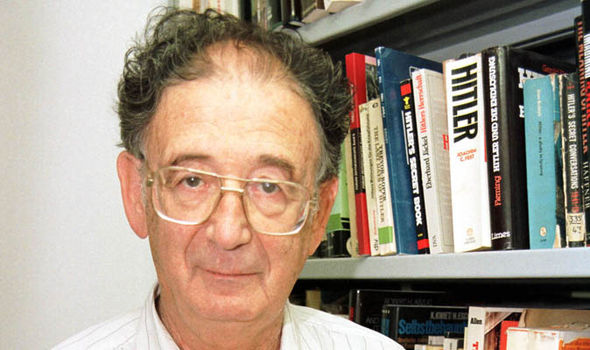
Yehudi Bauer, the 90-year-old academic, was speaking at a lecture about anti-Semitism in the modern age at the London School of Economics.

One of the world’s leading Holocaust historians, Professor Bauer, condemned the current situation in the Labour Party saying: “I think there is a problem in the UK’s Labour Party, but there is not in every left-wing party – not in Scandinavia or Germany.

“There has been an unease about Jews in European society for hundreds of years.”

Professor Bauer said Shami Chakrabarti’s report on anti-semitism and racism in the Labour Party which concluded it was “not overrun by anti-semitism, Islamophobia, or other forms of racism” was “wishy washy” and “turned horses into camels”.

The Czech-born author of dozens of books about the Holocaust said that it is a “shame on society” that Jewish people in Europe and America still need to have security to protect them.He said: “Anti-semitism is not just a European phenomenon and it is usually matched by anti-liberal tendencies.”He said even Shakespeare and Chaucer wrote anti-semitic statements when there were hardly any Jewish people living in the UK.

He said: “There is not a European Government that is anti-semitic, although they may not be effective in fighting it.”

Yehuda BauerGETTY

Bauer has written dozens of books on the Holocaust 

Professor Bauer said that whenever society has gone through a crisis, it has turned against Jewish people as they have been in the minority.He also said Jewish people can not live in non-liberal places.The academic stated that even when there is no conflict in societies and anti-semitism will continue as Jewish culture is based on controversy and is “different” and “complicated”.

Earlier this year, the professor said if he were British Jewish, he would be worried claiming Ken Livingstone was a “violent antisemite” and Jeremy Corbyn “has a problem”.

Mr Livingstone has been suspended from the Labour Party for claiming that Hitler supported Zionism but has repeatedly denied accusations of anti-Semitism.

Speaking about Islam, Professor Bauer said that the “integration of Muslims is an action against anti-Semitism” as when Muslims are not integrated, they can turn against Jewish people.

He said: “Radical Islam is a danger to the whole world. Non-radical Muslims need to fight it.”

Source: Holocaust historian Yehuda Bauer blasts Labour and says it DOES have anti-Semitism problem | World | News | Daily Express

My Parents’ Mixed Messages on the Holocaust – The New York Times

Good long read on the lessons of the Holocaust as told by Jason Staley whose parents escaped. Nicely nuanced:

My parents explained to me that these pasts meant that they were not Holocaust survivors. My mother told me that in her labor camp, they were hungry, they were put to work, but no one was shooting or gassing them. When they went back to Poland, it was hard, and Jews were hated. But this, she explained, was the fate of Jews. Anti-Semitism was a permanent feature of the world, not special to the Holocaust.

My father’s reaction to describing him as a Holocaust survivor was more severe. He angrily questioned my motivations. Was I seeking a special status as a victim? He urged me to reflect about how offensive this is to those who have to actually live under oppression. He argued powerfully against the stance of the victim. It was morally dangerous, he said, using the actions of Israelis and Palestinians toward one another as an example. He was scornful when he saw signs that I was taking the Holocaust to mean that Jews were special. “If the Germans had chosen someone else,” he often said, “we would have been the very best Nazis.”

Most frequently and passionately, he would reprimand me for taking the Holocaust to be about me, or about my family. The Holocaust was about humanity. It was about what we are capable of doing to one another. It could happen again, it could happen here. The Holocaust was about everyone. Helping to prevent such events from occurring required agency and good moral sense, and good moral sense was not consistent with preferring one’s own people.

My mother’s most frequent advice was about knowing when to get out of a dangerous situation. The moment where one must accept that a situation is genuinely dangerous is usually well past the time when one can exit it. Her advice would come out especially during any patriotic moment. She was afraid I would develop an attachment to a country and would not flee early enough.

My mother and father both believed that normal people could do unimaginably terrible things. As a court stenographer in criminal court, my mother witnessed the racial injustice of the American legal system up close. I remember her sometime in the late 1980s saying to me with a rather flat affect, “They are targeting black people in this country.” That didn’t mean she was about to march out on the street in protest of injustice. That would be a completely incorrect interpretation of my mother. My mother believes that injustice is the normal, unchangeable state of things. My mother believes trust is foolishness. She thinks it is not only naïve to live as if justice were an attainable ideal; it is self-destructive. My mother believes they will kill you if they can.

My father was always critical of Israel’s policies toward Palestinians, convinced that the establishment of the state of Israel was implicated in the horrors of colonialism. He was equally abhorrent of Palestinian violence toward Israeli citizens. I grew up hearing other American Jews speak of Palestinians in pre-genocidal ways; that Palestinians have always wanted to kill the Jews, and must therefore be kept locked away and controlled. Regular exposure to such talk has made me permanently afraid for the safety of the Palestinian people. Comparisons between Israeli treatment of Palestinians and Nazi treatment of Jews are absurd. But my background has made me sensitive to the grimmest of even remote future possibilities. I have exactly the same reactions when I hear such rhetoric directed against Israeli citizens.

I am a philosopher. My calling, at its very basic level, obligates me to question the beliefs with which I was raised. But on this topic — how to live — I was given two answers. Which view do evidence and reason command?

I accept the legacy of my father. But it is impossible for me to shut out my mother’s concerns. Maybe the reality is that all groups are at war for power, and that to adopt an ethic of common humanity is a grave disadvantage. Maybe we should do what we can, but prioritize the safety of our families.

History speaks strongly on my mother’s side. So does my anecdotal evidence. I am white Jewish-American; my sons and wife are black Americans. I cannot retreat from my commitment to these groups. Being interested in the equal dignity of other groups is an additional burden.

It takes work to feel the suffering of Palestinians when I hear of the anger they bear toward my fellow Jews, even though I recognize its clearly justifiable source. It takes much more work to feel the suffering of poor white Americans when I hear it coupled with a thoroughly unjustifiable racism directed against my children. Is it work that I should be doing? Or should I be doing the work of attending primarily to the flourishing of mychildren?

A world in which this ideal is realized is no doubt far-off. The temptation to surrender it is strong. But history has provided us with too many events that show how important it is not to be complicit in making it unattainable.

Source: My Parents’ Mixed Messages on the Holocaust – The New York Times

Not just anti-Semitism: New boss seeks to broaden ADL’s reach

Overdue, both on substantive grounds – bias, discrimination and prejudice happen to many groups – as well as political and tactical, given the ongoing demographic growth of minorities.

For more than a century, the Anti-Defamation League has been known as a group that combats anti-Semitism. But one year after taking the group’s helm, Jonathan Greenblatt wants it to focus on more than just the Jews.
Greenblatt’s predecessor as ADL national director, Abraham Foxman, became known during his decades at ADL’s helm, as an arbiter of what was and was not anti-Semitic, as well as a pro-Israel advocate who did not hesitate to criticize Jewish groups he saw as damaging Israel. Upon his retirement in July 2015, some called him “the Jewish Pope.”

But to woo millennials to the ADL, Greenblatt wants to stress the group’s work among other minority communities, which has long been a part of its agenda. This emphasis comes as the Jewish community’s relations with minority groups has become strained by anti-Israel sentiment among many left-wing activists. Just this week, the main movement opposing police violence against black communities, Black Lives Matter, released a platform accusing Israel of genocide against the Palestinians.

While the ADL focuses on many issues Black Lives Matter addresses, it has not collaborated with Black Lives Matter, and called the genocide accusation “repellent and completely inaccurate” in a blog post on Medium on Thursday.

As part of its renewed outspokenness on issues beyond those directly impacting Jews, the ADL has emerged in the past year as the only legacy Jewish organization to consistently criticize Republican presidential nominee Donald Trump by name when he makes controversial statements about Mexicans, Muslims or other groups. And Greenblatt wants the ADL to take a leading role in addressing mass incarceration and police violence in black communities.

“By delivering great programs and making an impact in the communities that we serve, by speaking up and using our voice to call out intolerance in any form, I think those things, I hope, will appeal to younger people,” Greenblatt said in an interview in his Manhattan office Wednesday. “This is one of those institutions with the scale and the scope where you really, truly can make a dent in the universe.”

http://www.timesofisrael.com/not-just-anti-semitism-adl-boss-seeks-to-broaden-groups-reach/

A Swedish Muslim takes on anti-Semitism | Religion News Service

From one minority community to another:

When Derakhti speaks, the criticism — and unnerving threats — come from many quarters.

The most potent anti-Semitism in Sweden and Europe today comes from Muslim immigrant communities, where some have called Derakhti a traitor and told him he should fear for his life. Some ultra right-wing Swedes nurse their own brand of prejudice, rooted in historic European anti-Semitism. And on the left, many are staunchly anti-Israel and extend their disdain to Swedish Jews. Some Swedes say the liberals among them have failed to denounce anti-Semitism on the part of the country’s Muslim minority for fear of appearing Islamophobic.

This apathy and vitriol seems only to deepen Derakhti’s empathy. “I feel like I am a Jew,” he said.

But he comes off as a cool young Muslim.

Derakhti is a hip dresser, accessorized with earbuds, an earring and tattoos — including a prominent one in Arabic. He talks cool — in both English and Swedish — and quickly admits that, to his parents’ chagrin, he was no student. He and David fought off anti-Semites, but Derakhti also casually mentions how, in their teenage years, they had fun smoking pot, and generally driving the adults around them crazy.

Derakhti’s image can only help him convince more young people to summon the courage to confront bigotry, said Silberstein, a well-educated, middle-aged Jewish man who has been working on the issue far longer than Derakhti.

“I’m pretty used to speaking in public,” Silberstein said. “But when I went into a school with Siavosh, when I spoke they hardly listened. When he got up and spoke, that’s when they really started listening.”

Derakhti has lost count of the number of times he has taken a busload of Swedish teenagers to Auschwitz and other concentration camps. He thinks it’s close to 20. He has also toured them through Srebrenica, the site of the worst massacre in Europe since the Holocaust, where Bosnian Serbs in 1995 slaughtered more than 8,000 Muslim men and boys during the Bosnian War.

His Jewish friend David was not the only one to inspire the trips he now leads to concentration camps and killing fields. His parents — persecuted in their native Iran as members of the Azerbaijani minority — moved the family to Sweden, where Derakhti was born. His father took him to Bergen-Belsen when he was 13, and Auschwitz when he was 15, to show him where hatred can lead.

“My father told me that if you’re in a minority, you always have to stand up for a friend,” Derakhti said.

Growing up in Malmo, a city with a reputation for intolerance in a country known for just the opposite, Derakhti saw its tiny Jewish minority — including its Chabad rabbi — attacked by members of the city’s much larger Muslim community. Many Malmo Jews fear wearing a yarmulke or other symbol of Jewishness. In the capital, Stockholm, Jews feel safer, but still wonder about their future in Sweden, particularly when Israel is at war, as it was during the summer of 2014 against Hamas in Gaza.

Source: A Swedish Muslim takes on anti-Semitism | Religion News Service

ICYMI: Labour anti-Semitism inquiry academic on being caught in a storm

Interesting and thoughtful reflection:

What is it like for academics to try and bring scholarly analysis to issues that are at the centre of fierce public debate?

On 29 April, Jeremy Corbyn appointed Shami Chakrabarti to chair an inquiry into “anti-Semitism and other forms of racism including Islamophobia, within the [Labour] party”, after a series of incidents involving Ken Livingstone, Naz Shah and others.

It soon attracted comment from both “sides”. There were those who believe that the Labour Party is riddled with anti-Semitism and feared that the inquiry would be a whitewash. Others suggested that the issue was just a storm in a teacup, an attempt to curb legitimate criticism of the state of Israel or part of a coordinated campaign against Mr Corbyn’s leadership.

One of those caught in the crossfire was David Feldman, vice-chair of the inquiry, and director of the Pears Institute for the Study of Antisemitism at Birkbeck, University of London.

“My role in the Chakrabarti inquiry was announced at a time of great controversy and concern around the allegations of anti-Semitism in the Labour Party,” he told Times Higher Education.

“The sort of complexities and nuance that academics can bring to an argument are not always listened to – people are not at their most receptive. I didn’t recognise some of the views that were attributed to me.”

Most of the attacks, Professor Feldman went on, came from “the Jewish communal leadership, figures and institutions who strongly identify with Israel”. He was taken to task for distancing himself from what he calls the “subjective” definition of racism, that “if a group or an individual regards something as racist, then it is”.

Some also called attention to the fact that he had signed a declaration by Independent Jewish Voices, a group which has raised concerns about “the proliferation in recent weeks of sweeping allegations of pervasive anti-Semitism within the Labour Party”, although he responded that the particular declaration he signed was “very uncontroversial: in favour of human rights, international law, Israelis and Palestinians living in peace and security; against racism and especially anti-Semitism”.

“When one is misrepresented in the public sphere,” reflected Professor Feldman, “that is unpleasant and not something that academics are used to in their day-to-day job. And being in that situation is still something I am coming to terms with.”

The launch of the report on 30 June was overshadowed by controversy over Mr Corbyn’s comments that “our Jewish friends are no more responsible for the actions of Israel or the Netanyahu government than our Muslim friends are for the self-styled Islamic states or organisations” and by the verbal abuse of the Jewish Labour MP, Ruth Smeeth, who left the room in tears.

Professor Feldman takes comfort in the fact that the report itself “has been very well received across a broad spectrum of opinion…It is striking that groups and institutions [such as the Board of Deputies of British Jews and the Jewish Labour Movement] who did express concern are among those who have welcomed the report as a step forward.”

It has led him to “reflect on how the histories of racism and anti-Semitism have shifted in recent decades, and that is something that will feed into my research and academic publications”.

Source: Labour anti-Semitism inquiry academic on being caught in a storm | THE News

‘I didn’t get anti-Semitism as racism,’ says Labour MP Naz Shah | UK

Incredible but at least her words were better than the usual “I am worry if my remarks offended anyone.” Actually, given the nature of her comments, one wonders how a MP could be so ignorant and unaware:

Naz Shah has said the comments which resulted in her suspension from the Labour party were anti-Semitic but, at the time, she “didn’t get anti-Semitism as racism”.

Ms Shah, the Bradford West MP, was suspended from the party in April amid controversy over a social media post appearing to endorse the relocation of Israelis to the US. Labour’s governing body, the National Executive Committee, has since reinstated Ms Shah.

In a Facebook post in 2014, before she became MP for Bradford West, Ms Shah shared a graphic which showed an image of Israel’s outline superimposed onto a map of the US under the headline “Solution for Israel-Palestine Conflict – Relocate Israel into United States”, with the comment “problem solved”.

Asked by BBC Radio 4’s World at One what she thought when she now looked back at the posts, Ms Shah replied: “How stupid I was and how ignorant I was. At the time, I didn’t understand it.

“The language that I used was anti-semitic, it was offensive. What I did was I hurt people and…the clear anti-semitic language, which I didn’t know at the time, was when I said the Jews are rallying. Now that is anti-semitic.

“I wasn’t anti-semitic, what I put out was anti-semitic,” she added.

“I didn’t get anti-Semitism as racism,” said Ms Shah. “I had never come across it. I think what I had was an ignorance.”

 Asked whether she thought “silly” for not knowing that it was anti-semitic, she added: “Of course. I will always own my ignorance and it was ignorant. Let’s be clear about it. It has been a journey that I’ve been on… I’ve had amazing compassion from the Jewish community. And I have to earn that trust. I have to be able to say ‘this is what I did’.

Ms Shah also explained her initial reaction to the furore: “One of the tough conversations I had to have with myself was about, God, am I anti-Semitic?

“And I had to really question my heart of hearts. Yes, I have ignorance, yes everybody has prejudice, sub conscious biases, but does that make me anti-Semitic? And the answer was no, I do not have a hatred of Jewish people.”

Source: ‘I didn’t get anti-Semitism as racism,’ says Labour MP Naz Shah | UK Politics | News | The Independent

Rise in anti-Semitism in Western Europe, decrease in Eastern Europe: poll | i24news

Interesting findings and linkage to concerns over large-scale arrival of migrants and refugees:

A recent survey has revealed a rise in anti-Semitism in Western Europe, while at the same time there has been a decline in anti-Jewish sentiments in Eastern European countries.

The survey was conducted by the EJA (European Jewish Association) ahead of a discussion Wednesday on anti-Semitism in Europe at the Israeli Knesset’s Committee for Immigration, Absorption and Diaspora.

The poll found that 19 percent of Jewish communities – the vast majority of them in Western Europe (mainly in France, Switzerland, Belgium, Germany, the Netherlands and Northern Ireland) – reported a rise in anti-Semitism.

In Antwerp, Belgium, one community reported a marked rise in antisemitism (5 on a scale of 5), while another community in the same city reported relative calm.

Communities in the Netherlands reported a rise in anti-Semitism (4 on a scale of 5), as did the Jewish community in Nancy, France.

However, some 9.5% of Jewish communities – the vast majority of them in Eastern Europe – reported a decline in anti-Semitism in the past year.

Around 66% of Jewish communities throughout Europe (East and West) reported a lack of real change in the level of anti-Semitism in the past year.

The survey was conducted last Thursday among a representative sample of communities in capital cities and outlying towns throughout Europe, from Belfast in Northern Ireland in the West to Tbilisi, Georgia in the East.

In cities where there are large concentrations of Jews (Paris and Antwerp, for example), the sample included a number of communities in the same city.

The survey comes just months after an annual study on global anti-Semitism found that the number of violent anti-Semitic incidents worldwide fell considerably in 2015, partly because the extreme right has been focused on Muslims.

Violent anti-Semitic incidents dropped more than 40 percent in 2015, but other kinds of anti-Semitic displays increased dramatically in Europe, stated the Annual General Analysis on Anti-Semitism Worldwide, published jointly by Tel Aviv University, Kantor Center for the Study of Contemporary European Jewry and the European Jewish Congress.

The report attributed the decrease to a number of factors, including an increase in security measures, the growing fear of terrorism that may increase sympathy for Jews targeted for violence, and the lack of a military confrontation involving Israel in 2015.

Another factor cited in the report was the flow of over a million immigrants and refugees to Europe in 2015, which caused a trend of anti-immigrant sentiment that has strengthened extreme right parties. In Scandinavian countries, extreme right sympathizers have been gravitating towards major centrist and right parties for practical reasons.

The extreme right has also in many cases pointed at Jews as the root cause of terrorism, claiming they fostered Muslim immigration in order to undermine European culture. “The Jews are depicted as directly responsible for the migration wave, either by causing the war in Syria and Iraq and by creating ISIS […] because of the wish to achieve the following goals: to destroy European racial identity, to incite Christians and Muslims against each other, to create a Middle East devoid of Arabs and Muslims and even to destroy western democracies in order to control them – an accusation which is a derivative of conspiracy theories. Jews are guilty of the Islamization of Europe by bringing in the refugees, and of the opposite as well, of Islamophobia, by allegedly misusing the anti-Muslim rhetoric in order to invoke support for Israel,” said the report.

Source: Rise in anti-Semitism in Western Europe, decrease in Eastern Europe: poll | i24news – See beyond