Holocaust row: Abbas accused of anti-Semitism – BBC News

Not helpful:

Remarks by Palestinian leader Mahmoud Abbas about the Holocaust have been condemned as anti-Semitic by Israeli politicians and rights activists.

Mr Abbas told a meeting in the West Bank the Nazi mass murder of European Jews was the result of their financial activities, not anti-Semitism.

He described their “social function” as “usury and banking and such”.

Israeli Prime Minister Benjamin Netanyahu’s spokesman said the remarks were “anti-Semitic and pathetic”.

Michael Oren, Israel’s deputy minister for diplomacy, remarked in a tweet: “Mahmoud Abbas says money-lending Jews provoked Holocaust… Now there’s a peace partner.”

In New York, the Anti-Defamation League condemned Mr Abbas’s “anti-Semitic assertions”.

In its attempt to annihilate the Jews of Europe during World War Two, Nazi Germany murdered some six million of them, building death camps to expedite the mass slaughter.

Driven by fanatical nationalism, the Nazis regarded Jews as a threat to Germany’s “racial purity”.

What did Abbas say exactly?
He was addressing a rare meeting of the Palestinian National Council, the legislative body of the Palestine Liberation Organisation (PLO), in the West Bank town of Ramallah on Monday.

It was a rare meeting of the PLO’s legislative body

Carried live on Palestinian TV, the 90-minute speech in Arabic included a section on the Palestinian leader’s view of the history of European Jewry, based on what he said were books by “Jewish Zionist authors”.

Jews in eastern and western Europe, he said, had been periodically subjected to massacres over the centuries, culminating in the Holocaust.

“But why did this used to happen?” he asked. “They say, ‘It is because we are Jews.’ I will bring you three Jews, with three books who say that enmity towards Jews was not because of their religious identity but because of their social function.

“This is a different issue. So the Jewish question that was widespread throughout Europe was not against their religion but against their social function which relates to usury [unscrupulous money-lending] and banking and such.”

Mr Abbas also denied that Ashkenazi Jews – Jews from Germany and north-eastern Europe – were actually Semitic, saying, “They have no relation to Semitic people.” Ashkenazi Jews make up one of Israel’s biggest communities, giving the state a long line of prime ministers, including Mr Netanyahu.

It is not the first time the Palestinian leader’s views on the Holocaust have caused offence.

A student dissertation he wrote in the early 1980s argued there had been a “secret relationship between Nazism and Zionism” before the war, and appeared to question the death toll of six million.

He later played down allegations of Holocaust denial, saying in 2003: “The Holocaust was a terrible, unforgivable crime against the Jewish nation, a crime against humanity that cannot be accepted by humankind.”

How did the Anti-Defamation League respond?

Jonathan Greenblatt, chief executive officer of the ADL, which campaigns to “stop the defamation of the Jewish people”, dismissed the Palestinian leader’s “ahistorical and pseudo-academic assertions”.

“The Palestinian President’s latest diatribe reflects once again the depth and persistency of the anti-Semitic attitudes he harbors,” he said in a statement.

“With public speeches like these, it is not surprising that under Abbas’ leadership, the Palestinian Authority has failed to renounce and combat Palestinian anti-Semitic incitement, including narratives that Jews are to blame for the Holocaust and other anti-Semitic persecution, and which deny or diminish the millennial Jewish presence in and connection to the Land of Israel.”

via Holocaust row: Abbas accused of anti-Semitism – BBC News

My friend and Mid-East expert Arun recently posted on the Arte film, Israel-Palestine: one land, twice promised, link here, noting the balance and comprehensiveness of this two hour doc.

Articles on racism and discrimination that caught my eye

In terms of articles focussing on racism and discrimination, there was a mix of anecdote-based reports on the presence and impact of visible minorities (Immigration minister says he was target of racial profiling, calls on Liberals to fight racism, ‘We’re not immune’ on the Hill: Sen. Bernard launches Senate debate on anti-Black racism) and evidence (Indigenous, Black children over-represented in foster care and group homes, inquiry says, Experiences of violent victimization and discrimination reported by minority populations in Canada, 2014 – General Social Survey which I look forward to reviewing the data in more detail).

Commentary in favour of the anti-racism consults included Brittany Andrew-Amofah: Keep expectations high for antiracism consultations on the need to ensure meaningful results (some of which Budget 2018 addressed):

The plan to undertake these consultations deserves and requires scrutiny, but not because it may be designed to search for a racism that doesn’t exist (a possibility suggested by Globe and Mail Ottawa bureau chief Robert Fife during a CPAC interview). We should be scrutinizing the consultations to make sure that meaningful outcomes are actually achieved. We should expect to see, just to name a few examples, a ban on police carding on the federal level; targeted funding to fight Islamophobia and other forms of hate; tougher sentences for hate crimes; increased investments in housing, health and social programs; an accelerated plan for safe drinking water on all reserves; and stronger independent police oversight bodies for the RCMP and the Canada Border Services Agency.

The timing of these consultations is also significant. With a federal election coming in 2019, a tour to study systemic racism could be used as a ploy to engage and garner support from racialized and Indigenous communities, with no intention on acting on the information shared. The Liberals are lucky that much of the research has already been done, but that means we must set high expectations for policy changes following the consultations. If real change does not result, the time spent in consultations will be wasted and another opportunity will be missed.

The contrary argument that greater political power of African Americans is ineffective in improving outcomes is made here (Williams: Black political power means zilch), essentially ignoring the impact that political power had in reducing some institutional barriers and systemic racism:

Jason Riley, a fellow at the Manhattan Institute, tells how this surge in political power has had little beneficial impact on the black community.

In a PragerU video, “Blacks in Power Don’t Empower Blacks“, Riley says the conventional wisdom was based on the notion that only black politicians could understand and address the challenges facing blacks. Therefore, electing more black city councilors, mayors, representatives and senators was deemed critical.

…Riley says that the black experience in the U.S. has been very different from that of other racial groups. Blacks were enslaved. After emancipation, they faced legal and extralegal discrimination and oppression. But none of those difficulties undermines the proposition that human capital, in the forms of skills and education, is far more important than political capital.

Riley adds that the formula for prosperity is the same across the human spectrum. Traditional values — such as marriage, stable families, education and hard work — are immeasurably more important than the color of your mayor, police chief, representatives, senators and president.

As Riley argues in his new book — “False Black Power?” — the major barrier to black progress today is not racial discrimination. The challenge for blacks is to better position themselves to take advantage of existing opportunities, and that involves addressing the anti-social, self-defeating behaviors and habits and attitudes endemic to the black underclass.

As always, lots of antisemitism-related news, most notably France (‘Ethnic purging’: French stars and dignitaries condemn antisemitism), and the subsequent response by French Muslims (Accused of new anti-Semitism, French Muslims speak out) and Germany, where Rappers defend lyrics deemed anti-Semitic amid award backlash prompting Daniel Barenboim [to] return German music award in anti-Semitism row with the inevitable (?) result that Germany scraps music prize over antisemitism before ‘kippa march’).  As a show of public support, Germans of all faiths [participate] in ‘wear a kippa march’ against anti-Semitism. 

Some refreshing honesty from the former Anti Defamation League Director Abe Foxman (Former ADL Director: Trump has opened the ‘sewers’ of antisemitism.

John Ibbitson provides a thoughtful examination of the Canadian situation:

“The numbers stayed very high and are even up,” he said in an interview. “They’re not up as dramatically as they were last year, but they are higher than they were last year.”

An even bigger worry: While the lesser offence of harassment was the cause of the increase in 2016, in 2017 “the numbers of both violence and vandalism are up. The vandalism number is up quite significantly. It’s a serious proportional increase.”

But Ira Robinson, director of the Concordia University Institute for Canadian Jewish Studies, isn’t so sure. His book A History of Antisemitism in Canada, which was published in 2015, concluded that anti-Semitic activity in this country had greatly declined in recent decades. He continues to monitor the situation, and believes there has been no significant increase, despite what B’nai Brith says.

“In terms of the type of stuff that I see, it’s very much the same,” he reports. “There is very little new under the sun.”

Twenty-first-century anti-Semitism is in part a by-product of both right-wing and left-wing populism. Both groups detest globalization, which they blame for lost jobs at home. From there, it is only a small, noxious step to conjure a globalist Jewish conspiracy.

“The negative impacts of globalization are often laid at the feet of Jews and this global Zionist conspiracy,” said Barbara Perry, a sociologist at the University of Ontario Institute of Technology who specializes in hate crimes. “… It’s scarily similar from the left and the right, in that respect.”

Unfortunately, some Muslims harbour anti-Jewish thoughts, an import from their home countries. More often, though, Muslims and Jewish people are equally victims of racial hatred.

There is even an anti-Semitic variant that claims “Jewish privilege” contributes to systemic racism − though there is evidence that anonymous propaganda to that effect comes from the right, disguised as being from the left.

Anti-Semitism sometimes wears the mantle of anti-Zionism. But while criticism of the Israeli government’s treatment of Palestinians is entirely legitimate, the hate-filled rants that often accompany the BDS (boycott, divestment, sanction) movement, which depicts Israel as an apartheid state, are anti-Semitism cloaked in righteousness.

Too often, tensions between Israelis and Palestinians in the Middle East produce anti-Zionist screeds in Canada that can result in attacks on Jewish people. “Local, national and global effects come into play,” Prof. Perry observed.

If the rise of populism coincides with, and might contribute to, rising anti-Semitism, then the absence of a populist wave in Canada is encouraging. But this country is not immune from such waves. Mayor Rob Ford in Toronto begat Ontario Progressive Conservative Leader Doug Ford, his brother, who could well become a populist premier − although I am not suggesting in any way that Mr. Ford harbours racist sentiments of any kind.

But anti-Semitism can just as easily be found on university campuses as at right-wing rallies. It is present on the fringes of social democracy as well as conservatism. Elizabeth May has struggled to expunge it from the Green Party.

These are not harmonious times. Hatred of Jewish people is on the rise. It may be on the rise in Canada as well.

Vigilance.

Source: John Ibbitson: Could anti-Semitism be on the rise in Canada

Lastly,  J.K. Rowling Gave A Master Class In Identifying Anti-Semitism And It Was Magical:

“Most UK Jews in my timeline are currently having to field this kind of crap, so perhaps some of us non-Jews should start shouldering the burden,” she said. “Antisemites think this is a clever argument, so tell us, do: were atheist Jews exempted from wearing the yellow star? #antisemitism.”

Rowling’s head-smacking was almost audible as she sorted through responses to that tweet, including one that said arguing against anti-Semitism was “culturally insensitive” to Muslims.

“When you only understand bigotry in terms of ‘pick a team’ and get a mind-boggling response,” she said.

She also reacted with impatience — attaching a GIF of an exasperated Hugh Laurie — when someone argued that Arabs can’t be anti-Semitic because they are Semites. “The ‘Arabs are semitic too’ hot takes have arrived,” she said.

Split hairs. Debate etymology,” she said in a tweet attached to a definition of anti-Semitism as “hostility to or prejudice against Jews.” “Gloss over the abuse of your fellow citizens by attacking the actions of another country’s government. Would your response to any other form of racism or bigotry be to squirm, deflect or justify?”

The shame of antisemitism on the left has a long, malign history: Philip Spencer

Good historical context:

So, we’re back to the “Jewish Question”? The current antisemitism crisis on the left has not come out of nowhere. Instead, it has its roots in a tradition on the left itself, which, at best, has always had difficulty in responding swiftly to antisemitism and, at worst, excused or condoned, even promoted it. It is not, of course, the only tradition on the left, but unless we understand this history, we won’t get very far in resolving today’s crisis.

We need, above all, to think about why some on the left have always seen Jews as a problem and why they have helped the idea of a “Jewish Question” to re-emerge with such potency. At root is the thought that if antisemitism exists, it must have something to do with how Jews supposedly behave. That supposed behaviour may be described in different ways – sometimes it has an economic character, sometimes a social one, sometimes a political one. But what is common is the idea that Jews are to blame for antisemitism and that to protest against them is understandable, or even necessary.

This first became a serious problem on the left in the late 19th century, as antisemitism first became a political force in the modern world. Some on the left flirted with the response that there might be something progressive about antisemitism: that it was a kind of anti-capitalism, however crude, which could be harnessed to the socialist cause. They also thought that philosemitism was more of a problem, because it supposedly encouraged Jews to make too much of (or even fabricate) antisemitism and to resist assimilation. One criticism of this approach at the time was to call it the “socialism of fools”, a problematic formulation because it suggested that antisemitism was still some kind of socialism.

As antisemitism was radicalised by the Nazis – it no longer being enough to exclude Jews when they should be wiped off the face of the Earth – this way of thinking made it difficult for too many on the left to prioritise solidarity with Jews. Neither the Social Democrats nor the Communists in Germany made opposition to antisemitism a major issue, nor did the Resistance across Europe. The fear was that to highlight the fight against antisemitism would alienate potential supporters. This is not to ignore some wonderful examples of solidarity, though the repeated invocations of Cable Street can give a misleading picture. The Communist party soon switched to loyally supporting the Hitler-Stalin pact, which effectively delivered large numbers of Jews up to the Nazis.

When the Soviet Union was finally forced to fight the Nazis, the suffering of Jews was deliberately and repeatedly downplayed. But after the war, things got much worse. The Soviet Union not only suppressed knowledge of what had been done to Jews but launched its own vicious antisemitic project, one that would have culminated in another genocide had Stalin not died.

This campaign matters because it was around this time that some key elements of today’s antisemitism on the left were first formulated. The charge laid against Jews then was that they were cosmopolitans and Zionists. This may seem like a bizarre contradiction: how can one, after all, be both a cosmopolitan and a Zionist? But what connected them is the idea that Jews are a problem, that as cosmopolitans they are more loyal to each other across national borders and, as Zionists, are loyal to another, foreign state. The charge of cosmopolitanism is heard less frequently these days, though one finds echoes of it in the idea that Jews are responsible for the evils of globalisation. The charge of Zionism, though, has now become absolutely central to today’s version of the “Jewish Question”. What began as a Stalinist cry was taken up in some on the New Left, which helped shape the world view of Jeremy Corbyn and many of his supporters.

For both Stalinists and that part of the New Left, Zionism is a racist ideology that pits the interests of Jews against the interests of everyone else. Furthermore, the state of Israel is an integral part of the western imperialist power structure that exploits and oppresses the rest of the world and the Palestinians in particular, whose land Jews have plundered and colonised and whom they keep in a state of permanent subjugation.

The Soviet Union formulated its approach within the context of the cold war, when it often appeared to support anti-colonial, national liberation struggles, although only for strategic reasons. Those on the left who (rightly if often too uncritically) supported those struggles, especially in Vietnam, where the Americans were so clearly the enemy, slipped fatally, however, into embracing this anti-Zionism into their world view, even though the Israel-Palestine conflict had such clearly different roots.

At the same time, they found it unbearable to acknowledge what was glaringly obvious – that the establishment of the state of Israel was profoundly connected to the Holocaust, which had changed everything for Jews. To integrate anti-Zionism into an anti-imperialist, anti-western, anti-American world view therefore also meant either denying or (better) reinterpreting the Holocaust. Holocaust denial is not an accidental feature of today’s antisemitism, but it is more common to downplay what happened to Jews as Jews. So the Holocaust has to be thought about only in universal terms, as only one genocide among many and one that supposedly excludes the others. (Actually, of course, it is the other way around: thinking about the Holocaust helps people think about other genocides.) Indeed, some have gone further. Not content with accusing Israel of being like apartheid South Africa, it is supposedly guilty of genocide itself… against the Palestinians.

If such purported behaviour makes people antisemitic, it is understandable and part of a fundamentally progressive view of the world, which can be harnessed to the cause. We are back then to where we started, with Jews as the problem, only with this difference: what was previously attributed to Jews inside nation states is now attributed to the Jewish state on the international stage.

There has always been, though, another tradition on the left, which has never accepted the very idea of a “Jewish Question”. What it understands is that there is a question of antisemitism; that Jews are not responsible for antisemitism but antisemites are; that Jews are not a problem but antisemites are. Antisemitism is not something that should be excused or condoned. It has to be fought wherever it shows its face, even – and sadly now more than ever – when that face is on the left.

Jeremy Corbyn concedes Labour has failed to address antisemitism problem | The Guardian

Certain blindness to have let this issue fester for so long:

Jeremy Corbyn has issued his strongest condemnation of antisemitism so far as he came under intense pressure from his own backbenchers and the wider Jewish community over his failure to tackle antisemitism in the Labour party.

He was forced to step up his response during the day after an extraordinary open letter was published on Sunday night by the Board of Deputies of British Jews and the Jewish Leadership Council (JLC), accusing him of “siding with antisemites” and calling for supporters to stage a show of solidarity outside parliament as the parliamentary Labour party held its weekly meeting on Monday evening.

At the PLP meeting, backbenchers denied there was any kind of coup attempt. Wes Streeting MP, often a critic of Corbyn’s, said: “No one’s calling for a leadership election. We just want leadership.”

The pressure from backbench MPs began building on Friday when Luciana Berger challenged Corbyn over supportive comments he posted to the artist behind an antisemitic mural. It came to a head on Monday morning when John Mann, chair of the all-party antisemitism group, tweeted that the Labour party “ceases to have a reason for existence if it cannot stand up against discrimination and racism”. He said the party was “rotten to the core”.

His criticism was backed by the veteran former minister Dame Margaret Hodge, who said Corbyn had allowed himself to become “the poster boy of antisemites everywhere”.

As hundreds gathered at Westminster, including dozens of Labour MPs and peers, and a small group of rival demonstrators from Jewish Votes for Labour, Corbyn issued a “sincere apology” that acknowledged that his previous responses had been inadequate.

“I recognise that antisemitism has surfaced within the Labour party, and has too often been dismissed as simply a matter of a few bad apples,” he said on Twitter.

“This has caused pain and hurt to Jewish members of our party and to the wider Jewish community in Britain. I am sincerely sorry for the pain which has been caused, and pledge to redouble my efforts to bring this anxiety to an end.”

Corbyn’s previous apology merely recognised that there were “pockets” of antisemitism in the party. That was rejected as inadequate by Jonathan Goldstein of the JLC, who said the Labour leader had become a figurehead for antisemitism.

Speaking at the solidarity protest outside parliament, the former Labour MP Gillian Merron, who is now chief executive of the Board of Deputies, said Corbyn had only made concessions because he had been forced into it by their actions.

“People here are angry and sad,” she said. “Nobody dreamt they would be in this position. The Jewish community has had enough and we are joined in that feeling by many many people inside and out of the Labour party.”

Later, Louise Ellman, who is a former chair of the Jewish Labour Movement, told BBC Newsnight it was “unprecedented” that the mainstream Jewish community had to take to the streets to protest at antisemitism in a mainstream political party.

In the second letter, Corbyn expressly apologised for failing to study the content of the antisemitic mural in the East End of London before posting supportive comments to its artist.

Jewish leaders claimed in their letter, released on Sunday night, that the controversy proved the Labour leader “cannot seriously contemplate antisemitism, because he is so ideologically fixed within a far-left worldview that is instinctively hostile to mainstream Jewish communities”.

Countering the charge, Corbyn says in his letter: “While the forms of antisemitism expressed on the far right of politics are easily detectable, such as Holocaust denial, there needs to be a deeper understanding of what constitutes antisemitism in the labour movement. Sometimes this evil takes familiar forms – the east London mural which has caused such understandable controversy is an example.

“The idea of Jewish bankers and capitalists exploiting the workers of the world is an old antisemitic conspiracy theory … I am sorry for not having studied the content of the mural more closely before wrongly questioning its removal in 2012.”

In a much more nuanced recognition of the forms that antisemitism can take, the letter also accepts that anti-Zionism and antisemitism have become conflated.

“Criticism of Israel, particularly in relation to the continuing dispossession of the Palestinian people, cannot be avoided. Nevertheless, comparing Israel or the actions of Israeli governments to the Nazis… and using abusive phraseology about supporters of Israel such as ‘Zio’ all constitute aspects of contemporary antisemitism.”

He also promises that the party will implement in full the “overdue” recommendations of the Chakrabarti report,which was published nearly two years ago.

Andy McDonald, the shadow transport minister, insisted that action would be taken. He pledged to speed up the “far too slow” complaints process. He was unable to say how many complaints had been successfully dealt with.

via Jeremy Corbyn concedes Labour has failed to address antisemitism problem | Politics | The Guardian

A related article on the extent of antisemitism in the UK (CST report):

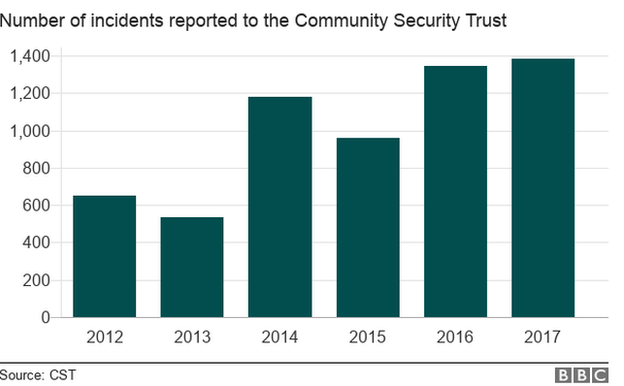
The Community Security Trust (CST), a charity that works with Jewish community organisations and police forces, recorded 1,382 anti-Semitic incidents in 2017 – the highest total ever.

Of these, 145 incidents were classed as “assaults” – up from 108 the year before. But the most common type of incident was “verbal abuse directed at random Jewish people in public” – being shouted at in the street.

Meanwhile, almost one in five incidents involved the use of social media.

One tweet sent to a Jewish charity appeared to show a rollercoaster above a concentration camp. Another social media user posted messages saying “Hitler was right”.

The CST said there had been three incidents involving damage to, or desecration of, a Jewish cemetery; eight involving stones or bricks being thrown; and eight involving eggs being thrown at property.

The charity also cited improvements in the reporting of anti-Semitic incidents – but said it believed there was still “significant under-reporting”.

Anti-Semitism incidents chart

Earlier this month, the former Chief Rabbi Lord Sacks told the Jewish News newspaper: “Any political party has to adopt a zero-tolerance to anti-Semitism. If they fail to do so, they are a danger not only to themselves but to the country and all inhabitants.”

Lord Sacks has previously said that anti-Semitism is an ancient hatred and a contemporary warning sign that community relations within a culture are endangered.

It is why the Jewish community is inviting members of other faiths, and of none, to join in the chorus: “Enough is Enough.”

Source: http://www.bbc.com/news/uk-43542305

Anti-Semitism in Germany: Are immigrants unfairly portrayed in the media? | DW

Good nuanced exploration of the issues and discussions:

There’s hardly a more explosive issue in Germany than the question of anti-Semitism among Muslim immigrant communities and in particularly the more than 1 million migrants and refugees who have arrived in the country since 2015. On Friday the director of the Simon Wiesenthal Center in Los Angeles, Meyer H. May, told a German newspaper that such anti-Semitism was spreading like a “tumor” in Germany.

May is by no means the first Jewish leader to make this claim, but is the situation really that bad? To better understand the issue, I went to a day of discussions, hosted by an initiative to inform journalists about migration issues, with experts, social workers, refugees and a member of a Jewish sports club in Berlin.

Empirical figures on the phenomenon are hard to come by. Definitions of what qualifies as anti-Semitism vary wildly, and it’s often difficult to tell whether anti-Semitic acts that are criminal in Germany — for example, painting a swastika on a synagogue wall — are committed by Muslims, right-wing extremists, or individuals or groups motivated by some other form of anti-Jewish aggression.

What struck me most was the skittishness of people charged with combating Muslim anti-Semitism, particularly in Berlin’s schools, with regard to their description of it as a Muslim problem. The experts were at pains to counter the idea that Germany had “imported” a “new” anti-Semitism. Hostility to Jews was a wider social phenomenon, they argued, and by no means were all Muslims anti-Semitic.

Fighting anti-Semitism in times of right-wing populism

Sina Arnold, the co-author of one of the few academic studies on the phenomenon, characterized the anti-Semitism she found among refugees she interviewed as “fragmentary.” Anti-Jewish stereotypes were common, she says, but it was extremely rare for refugees to view the entire world through the lens of anti-Semitism.

“What we’ve seen is that with the migrants of the past few years, people have entered the country who have anti-Semitic attitudes — as do some people who are already here,” Arnold told DW. “Not all of the migrants, but many of them. Many of them come from countries like Syria, in which an anti-Zionism that bordered on anti-Semitism was part of state ideology.”

Arnold was quick to add that attempts to combat such attitudes should not “tar-brush” Muslims with racist stereotypes and that the sort of anti-Semitism found among migrants and refugees is not new to Germany. Equating Islam with anti-Semitism is a tactic used by the far-right populist Alternative for Germany (AfD) party.

But surely the situation Germany currently faces is new, I thought, if only because this is the first time Germany has taken in over a million largely Muslim new arrivals in such a brief span of time. That fact alone means that measures to prevent anti-Semitism need to be tailored to this specific new audience.

“Prevention efforts always have to be targeted at groups,” said historian and rabbi Andreas Nachama. “For instance it makes a big difference if you’re talking to 20- or 60-year-olds. It makes no sense to put everyone in the same boat. We’ve had a different input in the past few years.”

Prevention or political correctness?

Don’t point fingers. Try to teach people to embrace multicultural values instead of teaching them not to embrace anti-Semitism. Those are two of the guiding principles of the Kreuzberg Initiative against Anti-Semitism, or KIGA, named after the heavily Muslim Berlin district where it is located. The group trains teachers, conducts workshops in schools and contributes to the political-education “welcome classes” refugees receive after arriving in Germany.

KIGA co-founder Aycan Demirel defines one of its main purposes as trying to prevent the radicalization of Muslim youths. At the same time, he warns against overreacting, telling the story of a school that was so alarmed at a very young Muslim boy using the word “Jew” as an insult that a series of authorities that led all the way up to public prosecutors were called in to consult on the case.

When it comes to understanding prevention and education methods, it’s very difficult for journalists to form their own opinions. Schools confronted with anti-Semitism incidents are understandably publicity-shy, and it would require a raft of parental consent forms for KIGA to take a reporter along with them to witness their work with schoolkids, who are still minors. Much of the fight against anti-Jewish hatred takes place away from the eyes of the fourth estate.

Hostility and hope

The conflict between Israelis and Palestinians complicates relations between Muslims and Jews in Berlin

It is impossible to quantify the level of anti-Jewish sentiment among Berlin Muslims, but it’s clear that there is hostility. At the same time, hatred is by no means the only response in what is a very heterogeneous community. Those two conclusions were born out by the other participants at the open day.

Evgeni Abramovych, from the Jewish sporting club TuS Makkabi Berlin, described football matches with heavily Muslim teams as being far more aggressive than with other opponents. Racist insults and spitting, he said, were not infrequent occurrences. On the other hand, Abramovych also told of Muslim clubs that had approached TuS Makkabi to play friendlies in a gesture of solidarity.

Sandy — a 25-year-old refugee from Syria who came to Germany in 2014 and who teaches in welcome classes for more recent arrivals — acknowledged that some of her compatriots did hold anti-Semitic views. But she also said that she had never encountered such attitudes in her interactions with new Muslim arrivals as part of the KIGA Discover Diversity program.

Sandy and her fellow Syrian refugee Samer both speak German and use their participation in KIGA projects to learn more about their new country and pursue their interest in politics, which began back in their homeland.

via Anti-Semitism in Germany: Are immigrants unfairly portrayed in the media? | Germany| News and in-depth reporting from Berlin and beyond | DW | 24.03.2018

Anti-Semitism Is Rising. Why Aren’t American Jews Speaking Up? – The New York Times

Valid points:

Anti-Semitic hate crimes are on the rise, up 57 percent in 2017 from 2016, the largest single-year jump on record, according to the Anti-Defamation League. That increase came on top of the rise in incidents in 2016 that coincided with a brutal presidential campaign.

I have personally seen the anti-Semitism, in online insults, threatening voice mail messages and the occasional email that makes it through my spam filter.

If not quite a crisis, it feels like a proto-crisis, something to head off, especially when the rise of anti-Semitism is combined with hate crimes against Muslims, blacks, Hispanics and immigrants. Yet American Jewish leaders — the heads of influential, established organizations like the American Jewish Committee and the Jewish Federations of North America — have been remarkably quiet, focused instead, as they have been for decades, on Israel, not the brewing storm in our own country.

But American Jews need to assert a voice in the public arena, to reshape our quiescent institutions and mold them in our image. And Jewish leadership must reflect its congregants, who are not sheep.

When the Anti-Defamation League, a century-old institution founded to combat anti-Semitism, released its guide to the “Alt Right and Alt Lite” last year, Ohio’s Republican state treasurer, Josh Mandel, who is Jewish, actually expressed support for two of the people on the list: Mike Cernovich and Jack Posobiec, conservative provocateurs who have found notoriety in the Trump era. “Sad to see @ADL_National become a partisan witch hunt group targeting people for political beliefs. I stand with @Cernovich & @JackPosobiec,” Mr. Mandel proclaimed on Twitter above a link to Mr. Cernovich’s screed charging that the league was trying to have him killed.

Mr. Cernovich advocates I.Q. tests for immigrants and “no white guilt,” and is an unapologetic misogynist. Last summer, he circulated a cartoon depicting H. R. McMaster, the White House national security adviser, as a dancing marionette with George Soros pulling his strings and a disembodied, wrinkled hand labeled “Rothschilds” controlling strings attached to Mr. Soros.

Mr. Posobiec has been one of the promulgators of fake news, including the “Pizzagate” story that claimed that Hillary Clinton helped run a child sex-trafficking ring out of a pizza parlor and the claim that a young Democratic National Committee staff member, Seth Rich, was murdered by the Clinton campaign.

For drawing attention to these men, the Anti-Defamation League was tarred as a partisan organization by an elected Jewish Republican. I did not see any organized effort to rally around the institution, one of the few major Jewish groups in the United States that is still not predominantly engaged in debate over Israel.

Institutions matter, but they do not survive on their own. At the moment, the Anti-Defamation League is an institution under concerted attack — and it is not being defended. And so far, nothing else has arisen to forcefully take a stand in the Jewish fight against bigotry.

Truth must also be defended, which is what groups like the league and the Southern Poverty Law Center try to do as they expose hate. To most of us, at least for now, the notion that Mr. Rich, who was fatally shot on a Washington street in 2016, was murdered by Democrats because he was leaking emails to WikiLeaks is absurd. Mr. Rich’s family, on Tuesday, filed a lawsuit against Fox News for promoting the conspiracy story.

But in the alternative universe of the alt-right, that theory was taken as truth, not because the ranks of the alt-right have found logic in such stories but because those stories feed the larger narrative of a debauched world of liberalism that needs cleansing by fire. The lies are too valuable to the larger movement.

For Jews, this is personal. Had ordinary Germans and Poles and Ukrainians and Austrians and Frenchmen not played along, had they continued to shop in Jewish establishments and visit Jewish doctors, the Final Solution may, just may, not have been quite so final. To stand up to creeping totalitarianism, we needn’t throw ourselves under the tank treads. We just need to not play the game.

And refusal to play that game can be collective. If the vinyl banners proclaiming “Remember Darfur” that once graced the front of many American synagogues could give way in a wave to “We Stand With Israel,” why can’t they now give way en masse to “We Stand Against Hate”?

Why can’t the domestic apparatus of the American Jewish Committee reconstitute itself at the request of Jewish donors and members, and the Anti-Defamation League assert itself, like the Southern Poverty Law Center, in the arena of bigotry without fear of being charged with partisanship?

In the early 1930s, as Hitler came to power, consolidated control and blamed the Communists for the Reichstag fire, the Brown Shirts of the Nazi movement clashed furiously with German Communists. The German people largely stayed silent, shunning both factions. That anarchic moment always comes to mind when I watch the black-clad, masked antifa protesters preparing for their showdowns with the khaki-wearing alt-right. Antifa cannot be allowed to represent the most vibrant form of resistance, not if the great mass of the American electorate is to join in.

When I was in high school in Georgia, I went to a small leadership retreat sponsored by Rotary International. Around a campfire, the other kids passed around a Bible and took turns reading — from the New Testament, of course. My dread grew as the Good Book drew nearer. Would I hide my Judaism, read a passage on the teachings of Jesus and pretend, or do something, anything, else? When the book was passed to me, I acted impulsively, slammed it shut and said, “This is a service organization, not a religious organization” and fled — to an empty cabin where I slept apart and alone.

The next day, one of the Rotarians took me aside and told me what I had done was brave, but suggested that I should have turned to my own part of the Bible — Psalms, Proverbs, Exodus or Genesis — and read something of personal significance.

Looking back, I believe he was right. What he suggested would mean embracing Judaism as a vital part of America pluralism — and finding the spiritual meaning in the religion. It’s what I should have done then and what I hope American Jews do now.

via Anti-Semitism Is Rising. Why Aren’t American Jews Speaking Up? – The New York Times

Has Ontario’s anti-Semitism subcommittee accomplished anything?

These processes take time. A more interesting article would compare the progress of the four subcommittees:

A year ago, Ontario’s Liberal government unveiled its three-year anti-racism strategy. A Better Way Forward included initiatives “to combat systemic racism and create equitable outcomes for indigenous and racialized communities.”

Anti-racism, the 60-page plan stated, “actively confronts the unequal power dynamic between groups and the structures that sustain it.”

Four subcommittees were set up last March under the province’s Anti-Racism Directorate, which was established in February 2016 by Premier Kathleen Wynne and Michael Coteau, the minister responsible for anti-racism. The subcommittees are tasked with studying racism directed at blacks, indigenous people, Muslims and Jews respectively.

The directorate’s goal is “to eliminate systemic racism in government policies, decisions and programs,” and to boost public education and awareness of racism.

On June 1, Ontario passed its sweeping Anti-Racism Act. Among other things, the law mandates a review of anti-racism strategies at least every five years.

The subcommittee examining anti-Semitism has been toiling in relative obscurity ever since. Its unpaid members, which were chosen on the basis of their expertise in the area, were confirmed last spring. The first meeting was held in October, with two more in December and February. A fourth meeting has not yet been scheduled.

The committee is co-chaired by Bernie Farber, formerly of Canadian Jewish Congress and the Mosaic Institute, and Andrea Freedman, president and CEO of the Jewish Federation of Ottawa and the Ottawa Jewish Community Foundation.

Its members are: Karen Mock, chair of the progressive Zionist group JSpace Canada; Len Rudner, formerly of the Canadian Jewish Congress and the Centre for Israel and Jewish Affairs (CIJA); Zach Potashner of the Friends of Simon Wiesenthal Centre; Pamela Divinsky, director of the Mosaic Institute; Madi Murariu from CIJA; Tom Henheffer, a journalist and media consultant; Hersh Perlis, director of the Legal Innovation Zone at Ryerson University and a former adviser at Queen’s Park; Nikki Holland, director of public affairs for the Carpenters’ District Council of Ontario; Brianna Ames, a volunteer with the Canadian Jewish Political Affairs Committee; and Amanda Hohmann, who at first represented B’nai Brith Canada, but now represents La’ad Canada, a new group focused on the next generation of Jewish Canadians. (B’nai Brith says it’s in the process of naming a new envoy to the committee).

In an email to The CJN, the anti-racism directorate explained that all four subcommittees are tasked with providing “population-specific and community perspectives on supporting and implementing … anti-racism initiatives” and providing input on “ongoing public awareness and education initiatives related to systemic racism.”

Asked what it has achieved, Farber said that even establishing an anti-racism directorate is an accomplishment, because it recognizes that within issues around racism, anti-Semitism “is seen individually and separately as a very impactful issue of discrimination that has to be dealt with on its own basis. That recognition has never been there before, officially.”

And “there’s a lot more to be done. We are just scratching the surface,” he added.

One hope is for the committee to reach out to FAST (Fighting Anti-Semitism Together), an activist group that opposes anti-Semitism, and Facing History and Ourselves, an educational organization that aims to engage students in issues of racism and genocide, Farber said.

Freedman told The CJN that the committee has narrowed its focus to education initiatives.

“One of our main areas is education and raising public awareness on anti-Semitism to ensure there’s a multi-faceted approach to the issue that involves all levels of government,” she said.

As for a definition of anti-Semitism, Freedman said that she and Farber will recommend that the committee adopt the one used by the International Holocaust Remembrance Alliance, which has also been adopted by the government of Canada. It says that anti-Semitism “is a certain perception of Jews, which may be expressed as hatred toward Jews. Rhetorical and physical manifestations of anti-Semitism are directed toward Jewish or non-Jewish individuals and/or their property, toward Jewish community institutions and religious facilities.”

The only times the anti-Semitism subcommittee has been in the news was when two groups, Independent Jewish Voices Canada (IJV) and the United Jewish People’s Order (UJPO), complained that they were deliberately excluded because they are openly critical of Israel and support Palestinian rights.

The organizations launched a petition on change.org, saying the directorate would “increase its credibility and effectiveness” by including “a greater range of Jewish voices, including those who are critical of Israel.” To date, it has nearly 900 signatures.

On Feb. 20, Teresa Armstrong, an NDP MPP from London, tabled the petition in the legislature.

Criticism of Israel’s government or policies “is not inherently anti-Semitic,” she said, quoting the petition, and confusing criticism of Israel’s government or policies with anti-Semitism “can have the adverse effect of silencing critical voices.”

Farber said that the two groups were not deliberately excluded, but that they focused on including “those Jewish organizations which deal specifically with anti-Semitism.” The focus of UJPO and IJV is not anti-Semitism, he said.

via Has Ontario’s anti-Semitism subcommittee accomplished anything? – The Canadian Jewish News

ICYMI: Ontario Anti-Racism Directorate’s anti-Semitism committee stuck on Israel – NOW Magazine

Good question:

The province’s Anti-Racism Directorate (ARD) has produced a clear and concise strategy to combat anti-Black racism. So why have they fumbled things so badly with their sub-committee on anti-Semitism?

Anti-racism is about giving voice to those who are outside the mainstream and ensuring broad representation in all public matters.

The ARD’s Strategic Plan, A Better Way Forward, states that its approach “actively confronts the unequal power dynamic between groups and the structures that sustain it [and] involves consistently assessing structures, policies and programs.”

Yet, the directorate has set up a sub-committee on anti-Semitism that consists solely of representatives from the Jewish establishment, including from the Centre for Israel and Jewish Affairs (CIJA), B’nai Brith Canada, and Friends of Simon Wiesenthal Centre (FSWC).

Independent Jewish Voices Canada (IJV) and the United Jewish People’s Order (UJPO) have requested to be included on the committee.

“Underlying our desire to participate is deep concern, shared by a growing number of Jews, that accusations of anti-Semitism are being used to suppress criticism of Israel,” says Rachel Epstein, executive director of UJPO’s Winchevsky Centre.

In a submission to the directorate last year, IJV campaigns coordinator Tyler Levitan expressed concern that the Boycott, Divestment and Sanctions Movement against Israel, also known as BDS, might also form part of the sub-committee’s mandate.

Sadly, limiting the committee membership to mainstream voices reinforces the systemic biases that the directorate has been set up to combat.

A broader, more balanced committee is essential, including representatives from non-establishment Jewish groups.

CIJA, B’Nai Brith and FSWC don’t measure up.

While they have decried Islamophobia, the groups have opposed M-103, a parliamentary motion passed last year condemning Islamophobia and all other forms of religious discrimination.

Bernie Farber, a former executive director of the Canadian Jewish Congress (who is a member of the sub-committee) criticized the groups in a column last February in the Canadian Jewish News.

“How can it be,” he wrote, “that fellow Jews … deny the very same protections they would rightly demand for themselves?”

One would expect the sub-committee would include those with a dedication to anti-racism generally.

But while the organizations represented on the sub-committee claim many criticisms of Israel as anti-Semitic, they have historically failed to take issue with blatant racism expressed by senior Israeli politicians and government officials.

Recently, that has included the Communications Minister calling African refugees a “sanitary nuisance” and the Justice Minister calling Palestinian children “little snakes.”

The Anti-Racism Directorate’s credibility will be seriously damaged unless it deals with the narrow membership on the sub-committee.

Premier Kathleen Wynne and Michael Coteau, the provincial Minister Responsible for Anti-Racism, need to act to preserve the directorate’s reputation as it carries out its important task of combatting racism in all its forms.

via Ontario Anti-Racism Directorate’s anti-Semitism committee stuck on Israel – NOW Magazine

‘Never Again’: Fighting Hate in a Changing Germany With Tours of Nazi Camps – The New York Times

Having visited Dachau, I can attest to the power of such visits:

It was not the execution wall or the electric fence or even the description of the smell of human flesh burning day and night that made the teenagers stop cold.

It was the bunk beds.

In their wooden ordinariness, they spoke to the 10th graders visiting the former Nazi concentration camp of Sachsenhausen as no history book had. “This is how they lived,” whispered Damian, 15, his eyes taking in the tightly packed rows of ladderless three-level bunks.

When Jakob Hetzelein, a history teacher in a working-class district of northeastern Berlin, decided to take his students to Sachsenhausen, a short suburban train ride from the German capital, he was not sure how it would go down.

His lessons on Nazi Germany had met muted enthusiasm. In a mock election in class, several students had supported the nativist Alternative for Germany party. One boy was recently caught scribbling a swastika on a friend’s jacket. Another does Hitler impressions when he thinks Mr. Hetzelein is not looking. Left index finger under his nose, right arm extended.

And then there are Mahmoud and Ferdous, recent refugees from Egypt and Afghanistan, where anti-Israel sentiment routinely blends into anti-Semitism and sometimes Holocaust denial.

Mr. Hetzelein, 31, who used to teach in a vocational school where nine in 10 students had Turkish or Arabic backgrounds, knows about casual anti-Semitism. “Jew” is a popular insult on some soccer fields in Berlin.

“It has become harder to teach history,” he said.

Teaching history is a pillar of national identity in postwar Germany. That is why Sawsan Chebli, a Berlin state legislator with Palestinian heritage, recently came up with an idea that is radical even by the standards of a country that has dissected the horrors of its past like no other: make visits to Nazi concentration camps mandatory — for everyone.

“This is about who we are as a country,” she said in a recent conversation in Berlin. “We need to make our history relevant for everyone: Germans who no longer feel a connection to the past and immigrants who feel excluded from the present.”

Ms. Chebli’s proposal comes at a time when Germany is grappling with the creeping rise of two kinds of anti-Semitism and as the Jewish community, now numbering about 200,000, is once again nervous.

Neo-Nazis have been emboldened by the arrival of Alternative for Germany, the first far-right party to break into Parliament since World War II. And there are concerns that the recent absorption of more than a million immigrants, many from the Middle East and many Muslim, has inadvertently created incubators of a different kind of anti-Semitism — one hiding behind the injustices of the Israeli-Palestinian conflict but often reverting to hateful old stereotypes, too.

It was the sight of Arab immigrants, including Palestinian-Germans like herself, burning an Israeli flag underneath the Brandenburg Gate in December while chanting “Death to Israel” that moved Ms. Chebli to speak up.

Since then, other disturbing stories have emerged in the German news media: an Afghan boy greeting his teacher with “Heil Hitler” and proclaiming that he, too, was Aryan. A group of Syrian refugees calling the Holocaust “a Jewish conspiracy,” explaining that they had learned that in school back home.

The reaction in Berlin, where there are strict legal prohibitions of Holocaust denial and Nazi propaganda, has been swift. The government announced that it was appointing its first-ever anti-Semitism coordinator. Some in Chancellor Angela Merkel’s conservative party have urged the immediate deportation of anti-Semitic Muslims.

Günter Morsch, the director of the Sachsenhausen memorial, says he does not think that is helpful. “We cannot allow this debate to create another form of racism,” he said. “What about the Germans who are anti-Semitic?”

Nine in 10 anti-Semitic hate crimes reported in Berlin are committed by German citizens. And for all the seeming contradictions, there is a common denominator between Muslims who espouse anti-Semitic views and those on the far-right (who also hate Muslims), Mr. Morsch said.

“Anti-Semitism correlates more closely with educational background than with ethnic background,” he said, citing empirical studies.

Ms. Chebli says that visiting a concentration camp is no panacea, but that it can help. She visited one as a young woman. The experience changed her, she said.

“It is a powerful way of keeping memory alive and giving meaning to our mantra of ‘never again,’ ” Ms. Chebli said. “But we need to get back to the essence of what this is about: It’s about standing up for human rights and the rights of minorities — all minorities.”

Muslims, too

During their visit to Sachsenhausen, the teenagers huddled around their guide in the vast triangular courtyard of the camp, its perimeter still dotted with watchtowers.

Sachsenhausen was no death camp, although tens of thousands of inmates are believed to have died here; those were built by the Nazis outside Germany. But it was the nerve center of two dozen major concentration camps run by the Nazis.

From an inconspicuous office building in one corner of the camp, civil servants decided what kind of medical experiments would be conducted, how many executions would take place and how much cyclone B gas would be delivered to the gas chambers in Auschwitz. “Desk perpetrators,” the guide, Mariana Aegerter, calls them.

“Does anyone here know who was imprisoned here?” she asked the class.

Nelson, a boy with shoulder-length hair, tentatively raised his hand. “Jews?”

There were Jewish prisoners in Sachsenhausen. But unlike in the death camps, they were a minority. Of more than 200,000 inmates over the years, some 40,000 were Jewish. Many died here.

The Nazi regime targeted many, Ms. Aegerter explained, like communists, clerics, homosexuals, Roma and the disabled. But also those considered “antisocial”: The homeless, the jobless, those on social welfare, and boys with long hair — Ms. Aegerter’s eyes lingered on Nelson — or with too many girlfriends, or with a weakness for American music, like Jazz or swing.

By the time Sachsenhausen was liberated, she said, nine in 10 prisoners were foreigners, coming from 45 countries. There were Muslims, too.

“Muslims, too?” Ferdous said later. “I did not know that.”

Building bridges

Ms. Aegerter, a young historian, says her central aim during tours of the camp is to bring to life what is an empty space, to make students visualize life there, and ultimately to create a bridge between the visitor and the prisoner, between the present and the past.

“Our most powerful tool,” she said, “is identification.”

Recently, a young Syrian had asked a fellow guide, “Why do you turn your torture chambers into a museum?”

To make sure we will never have torture chambers again, he had replied.

The boy had thought this over for a while. “We have torture chambers in Syria,” he eventually said. “Maybe, when the war is over, we should turn them into a museum, too.”

It is not always easy. Once, a Palestinian schoolgirl asked Ms. Aegerter, “Don’t you think that what the Jews are doing with the Palestinians today is the same as what the Nazis did with the Jews?”

No, she had explained, but that did not mean one had to approve of everything the state of Israel was doing. The girl seemed unconvinced.

Ms. Chebli comes across this all the time, she said. “I have Palestinians tell me: I had to leave my country because of the Holocaust and you want me to worry about anti-Semitism?”

She recounted the lukewarm reaction of one young man to her concerns about growing anti-Semitism. Born and raised in Germany, he does not see himself as German because, he says, Germans do not see him as German.

“Of course, anti-Semitism is important,” he had told her, “but what about the racism I experience every day?”

To win over young Muslims for the fight against anti-Semitism, Ms. Chebli said, Germany has to fight Islamophobia, too.

“It’s much easier for me to persuade a young Muslim of the relevance of the Holocaust if I acknowledge their own experience of discrimination and create that link,” Ms. Chebli said.

Sometimes, creating a link with young Germans is just as tricky, Ms. Aegerter points out.

Now 34, she grew up in the eastern state of Brandenburg in the 1990s. Swastikas were a common sight in her town: Scrawled on the inside of toilet cubicles. Graffitied onto walls. A boy in her class had tattooed one on his shin. It was only after she and some friends had complained that the boy had been asked to wear long trousers during sports lessons.

These days, Ms. Aegerter has teachers on the phone who share their concerns about far-right tendencies among their students.

One teacher told her before a class visit that he had planned the trip specifically because he worried about three boys drifting into neo-Nazi territory. But on the day, all three called in sick.

“Sadly, that is no exception,” Ms. Aegerter said.

In some cases, she said, it is the parents telling teachers they do not want their children to visit a concentration camp.

When students do come, it can be transformative, said Mr. Morsch, who has been director of the memorial for 25 years.

“It would be naïve to expect a two-hour tour to turn neo-Nazis into anti-fascists,” Mr. Morsch said. “But give us a little time, and we can achieve a lot.”

He recalled a recent group of students from a vocational school that had a persistent problem with neo-Nazi graffiti. They spent several weeks in Sachsenhausen renovating one part of the memorial — but also working in small groups, dissecting drawings and letters of prisoners and creating their own exhibition.

“After they spend some time with us, the problem went away,” Mr. Morsch said.

Mr. Morsch still believes that camp visits should remain voluntary. He fears an obligation to come would take away from the learning experience.

Mr. Hetzelein disagrees. Whether schools or the law make the call, students rarely get a say. He grew up in Bavaria, the only German state where visiting a Nazi memorial is already required.

As a high school student, he went to Dachau, near Munich. Years later, he saw Auschwitz, the Nazi death camp in what is Poland today.

The cast-iron gates, the barbed wire and the sheer scale of it still haunt him. “It’s not enough to read books about it,” he said, “you need to feel it.”

A week after visiting Sachsenhausen, Mr. Hetzelein asked his students whether they thought their children should one day be made to visit a camp.

Of 22 students, 21 agreed. Among them: Ferdous, Damian and Nelson.

via ‘Never Again’: Fighting Hate in a Changing Germany With Tours of Nazi Camps – The New York Times

Is It So Hard to Denounce Louis Farrakhan’s Anti-Semitism?

Good question:

Two weeks ago, during a Saviours’ Day event to commemorate the life of Nation of Islam founder Master Fard Muhammad, Louis Farrakhan had some things to say about Jews. The “powerful Jews,” he told the audience inside Wintrust Arena in Chicago, “are my enemy.” The Jews are also “responsible for all of this filth and degenerate behavior that Hollywood is putting out turning men into women and women into men” — that is, for the existence of transgender people, which Farrakhan apparently views as a pressing moral concern. He issued a warning to a subset of the Jewish community — “Farrakhan has pulled the cover off the eyes of the Satanic Jew and I’m here to say your time is up, your world is through. You good Jews better separate because the satanic ones will take you to hell with them because that’s where they are headed.”

Under normal circumstances, sadly, none of this would come as a surprise. As the Anti-Defamation League and plenty of other organizations have amply documented, Farrakhan has been a hardened anti-Semite — not to mention a committed enemy of LGBT rights — for a long time, and the broader Nation of Islam movement has a longstanding problem with anti-Semitism (as the ADL noted, Farrakhan was not the only speaker to make wildly offensive remarks about Jews that day). This is a man who has described Adolf Hitler as a “very great man.”

What made this address different was one of the attendees: Tamika D. Mallory, co-president of the successful Women’s March organization that has served as an important part of the anti-Trump resistance movement ever since it was formed. During the portion of his speech not dedicated to recycling ages-old anti-Semitic conspiracy theories, Farrakhan explicitly praised both the March and Mallory herself. Mallory posted an Instagram video of herself at the event, and previously had posted a photo of herself with Farrakhan describing him as the “GOAT,” or “greatest of all time.”

Once Mallory’s attendance at the event was revealed, she was repeatedly asked to denounce Farrakhan’s rhetoric, and she declined to do so. When she addressed the controversy, she did so vaguely. In one tweet, she did denounce anti-Semitism and transphobia without explicitly mentioning Farrakhan; in another, she made the dispute out to be some sort of thorny moral dilemma entailing “nuance & complexities.”

The Women’s March followed a similar tack: not really addressing the controversy head-on at all. Yesterday, a full nine days after the controversy broke out, it finally posted a statement:

The phrasing is strikingly milquetoast: “Minister Farrakhan’s statements about Jewish, queer, and trans people are not aligned with the Women’s March Unity Principles, which were created by women of color leaders and are grounded in Kingian Nonviolence.” Also striking is the group’s explanation for why it took a week and a half for it to issue a statement: “Our external silence has been because we are holding these conversations and are trying to intentionally break the cycles that pit our communities against each other. We have work to do, as individuals, as an organization, as a movement, and as a nation.”

Who is being pitted against whom here? The only question is whether or not viciously anti-Semitic claims — claims that have historically led to the murders of millions of Jews — should be swiftly denounced. And there is no version of “social justice,” whatever one’s conception of that might be, where the answer isn’t obvious. There is nothing to discuss here.

But more than one member of the Women’s March has described Farrakhan’s rank anti-Semitism in exactly these terms: not as a decades-long pattern of bigotry to be denounced, but as a political maneuver (presumably from the right) that requires a deft, careful response. In January, for example, Women’s March co-chair Carmen Perez told Refinery29: “In regards to Minister Farrakhan, I think that is a distraction.” She continued: “People need to understand the significant contributions that these individuals have made to Black and Brown people… There are no perfect leaders. We follow the legacy of Dr. King, which is Kingian non-violence. We say we have to attack the forces of evil, not the people doing evil. We never attack people.” The view that this is a “distraction” slots neatly into Mallory’s desire not to “redraw the lines of division”:

To be fair, there are definitely situations in which nuance is required to evaluated complicated, flawed figures, particularly when it comes to the leaders of bygone eras where different social mores reigned. But in this case, the subject at hand is a man who, in 2018, continues to spout murderous propaganda against a group that was, in his lifetime, almost entirely removed, via gas and bullet and starvation, from the European continent. If you’re a Jew, it’s absolutely baffling and infuriating for anyone to meet this sort of rhetoric with “Look, it’s complicated,” or “But what if our political enemies use this divide against us?”

More broadly, it’s simply difficult to think of any other situation in the left-of-center universe where the response to hate speech would be anything like this, where the act of responding aggressively to that hate speech would be seen as a “distraction” or a political trap to be avoided. The Women’s March, throughout this whole controversy, just hasn’t come across as taking anti-Semitism very seriously.

via Is It So Hard to Denounce Louis Farrakhan’s Anti-Semitism?