Facebook Bans Holocaust Denial, Reversing Earlier Policy

Long overdue. Similar action needs to be take with respect to other forms of racism and hate on Facebook and other platforms:

Facebook is banning all content that “denies or distorts the Holocaust,” in a policy reversal that comes after increased pressure from critics.

Just two years ago, founder and chief executive Mark Zuckerberg said in an interview that even though he finds such posts “deeply offensive,” he did not believe Facebook should take them down. Zuckerberg has said on numerous occasions that Facebook shouldn’t be forced to be the arbiter of truth on its platform, but rather allow a wide range of speech.

In a Facebook post on Monday, Zuckerberg said his thinking has “evolved” because of data showing an increase in anti-Semitic violence. The company said it was also in response to an “alarming” level of ignorance about the Holocaust, especially among young people. It pointed to a recent survey that found almost a quarter of people in US aged 18-39 said they believed the Holocaust was either a myth, had been exaggerated or were not sure about the genocide.

“I’ve struggled with the tension between standing for free expression and the harm caused by minimizing or denying the horror of the Holocaust,” Zuckerberg wrote. “Drawing the right lines between what is and isn’t acceptable speech isn’t straightforward, but with the current state of the world, I believe this is the right balance.”

Facebook has been under increased pressure to act more aggressively on hate speech, misinformation and other harmful content. The company has recently strengthened its rules to prohibit anti-Semitic stereotypes, and banned accounts related to militia groups and QAnon, a baseless conspiracy theory movement.

This summer, a group of Holocaust survivors, organized by the Conference on Jewish Material Claims Against Germany, launched a social media campaign urging Zuckerberg to remove Holocaust denial from Facebook.

On Monday, the group tweeted: “Survivors spoke! Facebook listened.”

In addition to removing Holocaust-denying posts, Facebook will begin directing users who search for terms associated with the Holocaust or its denial to “credible information” off the platform later this year, Monika Bickert, head of content policy, said in a blog post. She said it would take “some time” to train Facebook’s enforcement systems to enact the change.

Critics say how effectively Facebook polices its rules is the big question.

“We are seeing a trend toward Facebook listening to their critics and ultimately doing the right thing. That’s a trend we need to encourage,” Jonathan Greenblatt, CEO of the Anti-Defamation League, which has been pushing Facebook to crack down on Holocaust deniers for years, told NPR.

“Ultimately, Facebook will be judged not on the promises they make, but on how they keep those promises,” he said.

Source: Facebook Bans Holocaust Denial, Reversing Earlier Policy

Anti-Semitic ex-mayor becomes magnet for Vienna statue protests

Of note, yet another controversial (deservedly so) statue:

A statue of an anti-Semitic former mayor of Vienna who inspired Hitler has become the focus of competing left- and right-wing protests, with anti-racist activists mounting a “shame vigil” around the monument.

The likeness of Karl Lueger, on a prime spot on Vienna’s imposing Ringstrasse boulevard, has been defaced several times in recent months with graffiti reading “Schande” (“Shame”).

Galvanised by protests around historical monuments elsewhere in the world and the Black Lives Matter movement, an artists’ collective took matters a step further and fixed two sets of concrete, gold-painted letters spelling “Schande” to the statue’s plinth on Sunday night.

The collective then set up a “shame vigil” at the site to prevent the city from removing the words.

Jewish and Muslim youth organisations, feminists and left-wing groups are also taking turns manning the vigil.

However, a group of men described by Austrian media as far-right activists removed the gold letters with a hammer and chisel on Monday.

The police then cordoned off the statue.

As a group of secondary school students passes by the statue in warm autumnal sunshine, their teacher explaining the controversy around the monument, Simon Nagy, one of the artists who started the vigil, tells AFP that Lueger “belongs on the manure heap of history” and that the statue should be in a museum.

But the city authorities are planning to clean the graffiti by Friday, an announcement that has galvanised the 25-year-old and his group.

Nagy says the artists want the graffiti to remain and are demanding that the city comes up with a plan to redesign the monument, but he is disappointed at the lack of action.

– ‘Aggressive’ anti-Semitism –

Karl Lueger was mayor from 1897 until his death in 1910 and oversaw a period of transformation in which Vienna’s population boomed to more than two million and much of its modern infrastructure was built.

He built up a cult of personality that lived on after his death, with the statue unveiled in 1926.

But his notoriety stems from his ascent to power.

In his rhetoric he railed against what he called Jewish influence over the press and sources of capital and called for the “liberation of the Christian people from Jewish dominance”.

This “particularly aggressive anti-Semitism” was central to his election as mayor, according to historian Florian Wenninger.

“He built his political career on the hatred of a minority,” according to Wenninger, even if he opportunistically tried to move away from this once in office.

Hitler used Lueger as an early role model and cited him approvingly in “Mein Kampf”.

After much controversy, a portion of the Ringstrasse — a circular boulevard in the city — previously named after Lueger was renamed in 2012.

Having served on a commission set up by the city authorities to look into potentially problematic street names, Wenninger is well aware of the sensitivities around historical monuments.

“Something which in and of itself doesn’t have any real-life relevance for people becomes a part of their identity when it’s attacked,” he explains.

“Then there is a reflex where people say: ‘Stop! This is crazy!'”

Wenninger says Austria’s tradition of consensual politics, even at a local level, has meant debates over controversial issues have often been avoided.

Long cast in the role of a victim of Nazi Germany, it is only in recent decades that Austria has begun to seriously examine its role in the Holocaust.

The discussion of Lueger’s place in history is part of this process of revision and comes ahead of city council elections on Sunday.

But the signs are that most of today’s politicians are seeking to steer clear of the controversy.

The Social Democrats, who are on course to remain in power at Vienna’s City Hall, said the monument had “already been appropriately contextualised”, referring to a small explanatory tablet erected near the rear of the statue in 2016.

As for the centre-right People’s Party, in power at a national level, they say they reject Lueger’s anti-Semitism but at the same time recall that he was “one of Vienna’s most influential mayors and an important moderniser of the city”.

Source: Anti-Semitic ex-mayor becomes magnet for Vienna statue protests

Ahead of November election, growing numbers of Jews consider leaving US

Of note even if anecdotal. Interest and intention are of course different from action:

By 11:42 a.m. on the morning after US President Donald Trump refused to condemn white supremacists during the presidential debate, Heather Segal had received four inquiries from Americans interested in moving to Canada. Two of them were Jewish.

Segal, an immigration lawyer in Toronto, knows there’s always a spike in inquiries during US election years. But in her 25 years of experience, it’s never been as big as it is now.

Source: Ahead of November election, growing numbers of Jews consider leaving US

Liberal, Conservative MPs join international task force to curb anti-Semitism online

Of note. Not an easy task and one that should aim to be also applicable to other forms of hate, whether anti-Black, anti-Muslim, anti-Indigenous, anti-LGBTQ or other minorities:

Two members of Parliament are joining forces with legislators in four other countries in an international effort to force web giants to curb the proliferation of anti-Semitic content online.

Liberal MP Anthony Housefather and Conservative MP Marty Morantz are part of a new task force that includes politicians from Australia, Israel, the United Kingdom, and the United States.

A report out of the U.K. this summer said online incidents of anti-Semitism were on the rise in that country, driven by conspiracy theories about Jews being responsible for the COVID-19 pandemic.

In Canada, advocacy group B’nai Brith has said anti-Semitic incidents are up overall, with an 11 per cent rise in online harassment that often advocates genocide.

But how different countries measure and define the problem is a barrier to convincing web companies to address it, said Housefather.

The point of the task force is to get like-minded countries to agree on how to define the problem, how to solve it, convince their respective legislatures to pass similar laws and then collectively pressure the companies to act, he said.

“If we can come up with something that’s common to everybody, it will make life much easier for the providers to co-operate with us,” he said.

The task force is getting underway just as the federal Liberals promised in last week’s throne speech to take more action to curb online hate as part an effort to address systemic racism.

Housefather said the task force’s initial work predates that pledge but he hopes it can support the government’s own efforts.

Social media companies have been under sustained pressure to do more to address online hate, and give users better tools for reporting instances of it.

Earlier this year, Twitter began flagging some tweets from U.S. President Donald Trump for violating its policies, saying they included threats of harm against an identifiable group.

But, both Housefather and Morantz said, Twitter does nothing when the Iranian leader Ayatollah Ali Khamenei puts out tweets calling for the destruction of Israel or uses violent or potentially racist language to describe the state.

Twitter said earlier this year in response to criticism over that approach that Khamenei’s remarks amounted to “foreign policy sabre-rattling.”

Morantz said while the task force is focused on anti-Semitism, the work also applies more broadly.

“Hate against one group online is really a concern to all groups,” Morantz said.

“We need to emphasize that if we can’t protect one minority we can’t protect any of them.”

The Liberal government has repeatedly pledged to do more to combat hate speech online.

During the last election, they promised new regulations for social media platforms, including a requirement that they remove “illegal content, including hate speech, within 24 hours or face significant penalties.”

Critics, including conservative media outlets like True North and The Rebel, have accused the Liberals of wanting to crack down on free speech.

Morantz said a distinction must be made between free speech and that which breaks existing criminal laws. The focus needs to be on the latter, he said.

In turn, he refused to comment on a fellow Tory MP who recently circulated a message on Twitter that was criticized for using an anti-Semitic trope.

In August, B.C. MP Kerry-Lynne Findlay share a video of Finance Minister Chrystia Freeland and liberal philanthropist George Soros, saying Canadians ought to be alarmed by their “closeness.”

Soros is often linked to anti-Semitic conspiracy theories. Findlay later took down the tweet and apologized for sharing content from what she described as a source that promotes “hateful conspiracy theories.”

Housefather was among those who spoke out about Findlay’s tweet. He said he accepts her apology, but the incident highlights the issue.

“People often innocently retweet something without understanding the implications of it,” he said.

What needs to happen is for social media platforms to step up and figure out a way the flag the content, he said.

“If the media platform lets them know that, they can make a conscious decision whether or not they want to retweet it, knowing that it’s been flagged as being anti-Semitic content or other types of racist, misogynistic, etc., content.”

Source: Liberal, Conservative MPs join international task force to curb anti-Semitism online

Scientists combat anti-Semitism with artificial intelligence

Will be interesting to assess the effectiveness of this approach, and whether the definition of antisemitism used in the algorithms takes a narrow or more expansive approach, including how it deals with criticism of Israeli government poliicies.

Additionally, it may provide an approach that could serve as a model for efforts to combat anti-Black, anti-Muslim and other forms of hate:

An international team of scientists said Monday it had joined forces to combat the spread of anti-Semitism online with the help of artificial intelligence.

The project Decoding Anti-Semitism includes discourse analysts, computational linguists and historians who will develop a “highly complex, AI-driven approach to identifying online anti-Semitism,” the Alfred Landecker Foundation, which supports the project, said in a statement Monday.

“In order to prevent more and more users from becoming radicalized on the web, it is important to identify the real dimensions of anti-Semitism — also taking into account the implicit forms that might become more explicit over time,” said Matthias Becker, a linguist and project leader from the Technical University of Berlin.

The team also includes researchers from King’s College in London and other scientific institutions in Europe and Israel.

Computers will help run through vast amounts of data and images that humans wouldn’t be able to assess because of their sheer quantity, the foundation said.

“Studies have also shown that the majority of anti-Semitic defamation is expressed in implicit ways – for example through the use of codes (“juice” instead of “Jews”) and allusions to certain conspiracy narratives or the reproduction of stereotypes, especially through images,” the statement said.

As implicit anti-Semitism is harder to detect, the combination of qualitative and AI-driven approaches will allow for a more comprehensive search, the scientists think.

The problem of anti-Semitism online has increased, as seen by the rise in conspiracy myths accusing Jews of creating and spreading COVID-19, groups tracking anti-Semitism on the internet have found.

The focus of the current project is initially on Germany, France and the U.K., but will later be expanded to cover other countries and languages.

The Alfred Landecker Foundation, which was founded in 2019 in response to rising trends of populism, nationalism and hatred toward minorities, is supporting the project with 3 million euros ($3.5 million), the German news agency dpa reported.

Source: Scientists combat anti-Semitism with artificial intelligence

Germany: Coronavirus protests increasing anti-Semitism

Of note:

The Central Council of Jews in Germany has warned of increased anti-Semitism due to the protests against coronavirus measures.

“For months, conspiracy theories with anti-Semitic tendencies have been deliberately stirred up in the coronavirus debate,” Council President Josef Schuster told German daily newspaper Bild.

“If, for example, the Rothschilds are blamed for the pandemic, then this is a synonym for Jews,” said Shuster.

He added that not everyone who protested in Berlin in August was anti-Semitic or racist, “but they walked among them.”

Two recent protests have drawn tens of thousands from across the country to Berlin. The demonstrations were mainly peaceful, but at one point, hundreds of demonstrators broke through a blockade in an attempt to storm the Reichstag building.

Police also see uptick

The police trade union, the GdP, said it has also seen a rise in radicalization of protesters against coronavirus protective measures.

“Since the first demonstrations, right-wing groups have influenced the corona protest movement,” GdP vice-chairman Jörg Radek told newspapers of the Funke Media Group. “The right-wingers are there and are about to completely take over the movement.”

Some protesters have used signs and flags associated with far-right politics, from the Reichskriegsflagge (Imperial War Flag) to costumes comparing themselves to Holocaust victims.

“Nobody can say they are just a follower now. Anyone who stays with the movement must ask themselves whether they want to join forces with right-wing extremists and combine personal concerns in the coronavirus crisis with the extremists’ anti-democratic goals,” said Radek.

Source: Germany: Coronavirus protests increasing anti-Semitism

Saunders: How was a neo-Nazi threat ignored for years? Because it looked so familiar

Worrisome:

For Berlin actor Idil Nuna Baydar, the past year has been a sequence of escalating shocks, at first private and horrific, which in recent weeks have been shared with millions of other Germans.

The first shock came last year, when she received a series of detailed death threats via private contact information known only to family members. The first was signed “SS Ostubaf,” a Nazi-era paramilitary rank. Other threats were signed “NSU 2.0,” a reference to the National Socialist Underground, a far-right terrorist cell that murdered at least 10 people across Germany between 2000 and 2011.

The threats became more specific, containing information (such as the name of Ms. Baydar’s mother) that was not known to the public. Dozens of other Germans, including lawyers and politicians, received threats from the same source, typically saying they would be killed because of their ethnicity or support for immigration. Ms. Baydar filed a police complaint; the investigation was dropped, without charges, at the end of 2019.

The second shock came when she learned this year that the threats had come from within the police. Her personal information had been obtained from an unauthorized query made on a computer database within a police station in Hesse, the western German state that includes Frankfurt. A newspaper later confirmed that the queries had been made by police officials.

Newspapers, and then public investigators, gradually found out that the “NSU 2.0” group is linked to a national chat network in which members exchanged messages of racial intolerance, extreme-right and neo-Nazi allegiance and sometimes threats of violence. Members of the group allegedly include active German police and military officials.

Some members of the group are allegedly also members of other known extremist groups, including one calling itself the Ku Klux Klan, the outlawed neo-Nazi group Combat 18, and a “prepper” group known as Northern Cross, which believes that there will soon be a complete societal breakdown, perhaps triggered by the group’s actions, and plans to implement something resembling the Third Reich in its aftermath.

Police and government officials until recently played down the incidents and organizational affiliations, claiming that no known far-right networks existed within the police and military.

Over the spring, this argument began to fall apart as investigations revealed just how extensive, and deeply infiltrated into German state institutions, these networks are. On June 14, the Hesse chief of police, Udo Munch, resigned over this.

The final shock for Ms. Baydar came during the past few weeks, when she, along with the rest of Germany, learned that these extremist networks were not just exchanging bigoted memes and making idle threats.

On July 1, German Defence Minister Annegret Kramp-Karrenbauer announced she would disband one of the companies of Germany’s most elite special-forces unit, the KSK, and forbid the entire unit from participating in any military operations, because it had become so infested with active neo-Nazis.

The military counterintelligence service revealed that at least 600 soldiers are being investigated for extreme-right activities, and that the chat network that united extremist groups had been set up within the KSK.

It emerged that 62 kilograms of explosives and 48,000 rounds of ammunition had disappeared from the KSK, allegedly taken by extreme-right groups. Other military officers were found to be storing huge caches of weapons and ammunition along with Hitler memorabilia.

The “prepper” group Northern Cross, previously seen as extreme but nutty, was said to have amassed tens of thousands of rounds of ammunition, built fortresses and training camps, and had drawn up lists of “enemies” to be executed on “Day X,” or the day of Germany’s societal breakdown; last week it emerged that they had purchased body bags and quicklime for this task.

Germans are now asking the question that has long alarmed Ms. Baydar and other targets: How, in a country where even the slightest hint of Nazi-era racial politics is highly illegal and unconstitutional, were they permitted to thrive for so long, when they did very little to conceal themselves?

It seems that it’s because their language and messages had become so commonplace and mainstream. The notion that people of other ethnic or religious groups are “invaders,” once an unmistakable signal of illegal extremism because it was the animating idea behind Hitler’s rise, is now uttered by members of a legal political party, the AfD, and is heard in mainstream right-wing media.

It has international sanction, too: The man chosen by Donald Trump to be the U.S. ambassador to Germany, Douglas Macgregor, has described religious-minority Europeans as “invaders” in language similar to that heard on the chat network.

It’s a situation Germany has seen before: a violent cancer went unnoticed within the state because its messages had become so numbingly familiar. What we need to be on guard for, in every country, is not just the threat of intolerance, but also the sense of numbness and indifference that allows it to thrive.

Source: https://www.theglobeandmail.com/opinion/article-how-was-a-neo-nazi-threat-ignored-for-years-because-it-looked-so/

Former BMO CEO Tony Comper revamps charity focused on anti-Semitism

Of note:

An educational organization launched by former Bank of Montreal chief executive officer Tony Comper and his late wife, Elizabeth, to combat anti-Semitism in Canada is bringing in new leadership as incidents of discrimination and hate in the community continue to rise.

Fighting Antisemitism Together or FAST launched in 2005 with backing from a coalition of more than 30 influential corporate leaders that included then-CEOs Ed Clark of Toronto-Dominion Bank, Dominic D’Allessandro of Manulife Financial Corp. and Michael Sabia of BCE Inc. Since then, the charitable initiative has built free education programs geared to middle schools and high schools, and has reached 4.4 million students at more than 22,000 schools.

FAST was conceived to push back against a rash of anti-Semitic incidents in 2004. But the number of such incidents has risen sharply since then, and a global movement protesting against systemic racism over the past several months has offered a “stark reminder” of the prejudices that still persist, Mr. Comper said.

Now FAST is joining with the Canadian Institute for the Study of Antisemitism, a scholarly organization that publishes the academic journal Antisemitism Studies. CISA founding director Catherine Chatterley, who teaches at the University of Manitoba, is taking over as FAST’s chair and president.

In 2004, B’nai Brith Canada’s League for Human Rights catalogued 857 incidents of harassment, violence and vandalism targeting Jewish people in Canada – the largest number in more than half a century. By 2019, the same audit tallied 2,207 incidents, an 8-per-cent increase from 2018 and the fourth consecutive year of record numbers. Some of that increase has been driven by increasing online harassment, which was up 11 per cent, according to B’nai Brith Canada.

“The obvious question is, if you’re doing such a wonderful job, why isn’t it having an impact on anti-Semitism?” Mr. Comper said. “The increase in the incidences justifies exactly why we’re doing what we’re doing and the need for it.”

FAST was Ms. Comper’s idea. The former elementary-school teacher was shaken by the rash of anti-Semitic incidents making headlines in 2004: “Kicking over tombstones, swastikas on garage doors, the burning of the [United] Talmud Torah school in Montreal,” Mr. Comper said.

Ms. Comper cornered her husband in the bathroom while he shaved and insisted they do something about it. Neither was Jewish, nor were the key backers Mr. Comper enlisted, who put up $10,000 each and added their names to the initiative. But non-Jewish leaders speaking out in support of Jewish communities became one of FAST’s distinctive features.

The Compers became convinced the best way to root out anti-Semitism was through the school system. They built educational materials, first on DVD and later online, and provided them to teachers free, tailoring the content to meet standards across different boards of education, in English and French.

“To fundamentally change, you need to focus on education of young people and equip them with an alternative narrative to what they’re hearing either at home, or in the street or in the school yard,” Mr. Comper said.

At its outset, Mr. Comper didn’t envisage FAST as a long-term project. “I thought, frankly, that it would burn out after maybe 18 months or two years,” he said. But its educational resources have been continually revamped and expanded as anti-Semitic incidents continue to rise.

The organization has been spearheaded by Ms. Comper, who died in 2014, Mr. Comper, who was BMO’s CEO from 1999 to 2007, and FAST’s executive director, Nicole Miller. Yet at the age of 75, Mr. Comper has been looking for a partner to whom he could pass the torch.

He has promised to fund FAST for the next two years, and plans to stay on as an adviser working with Dr. Chatterley to build a new, more sustainable structure for fundraising and administration. “We’re hopeful,” he said. “It’s early days.”

Source: Former BMO CEO Tony Comper revamps charity focused on anti-Semitism

When Senator Joe McCarthy Defended Nazis | History

Good long read over a lessor known incident near the end of WW II and how the role of former Senator Joe McCarthy in undermining the truth, not without parallels today:

Annihilate the enemy. That was Adolf Hitler’s standing order to his elite Waffen-SS as the Wehrmacht sought to break the Allies’ tightening grip in late 1944 by crashing through enemy lines in an audacious counteroffensive that would become known as the Battle of the Bulge. The Führer’s edict was enforced in the ice-encrusted fields outside the Belgian city of Malmedy. On the afternoon of December 17, a battle group of the armored First SS Panzer Division ambushed a band of lightly armed U.S. troops. The overwhelmed American GIs’ only option was to raise white flags.

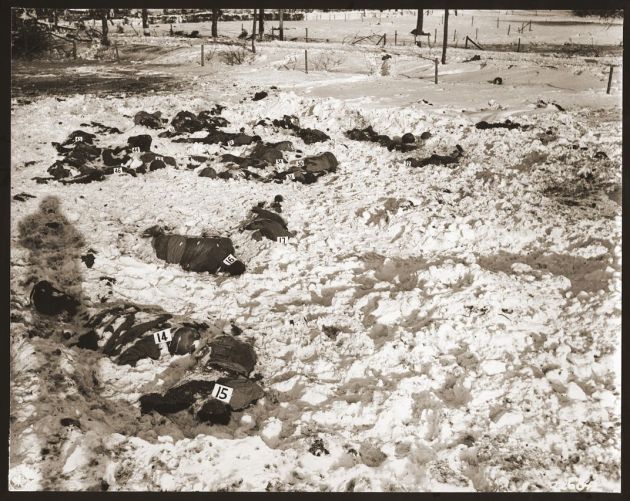
The Nazis accepted their surrender and assembled the American prisoners. Most, they mowed down with machine guns. They used their rifle butts to crush the skulls of others. Those seeking refuge in a café were burned alive or shot. Earlier that day, outside the nearby town of Honsfeld, an American corporal named Johnnie Stegle was randomly selected from a line of captives by an SS soldier who summoned his best English to yell, “Hey, you!” Then he raised a revolver to Stegle’s forehead, killing him instantly. By day’s end, the toll exceeded 150, with 84 murdered at the deadliest of those encounters: the ill-famed Malmedy Massacre.

The remains of American prisoners of war murdered in December 1944 near the Belgian city of Malmedy. The bodies were identified by number for use in war crimes trials brought against more than 70 Nazi soldiers by the U.S. military.
The remains of American prisoners of war murdered in December 1944 near the Belgian city of Malmedy. The bodies were identified by number for use in war crimes trials brought against more than 70 Nazi soldiers by the U.S. military. (United States Holocaust Memorial Museum, Courtesy NARA)

The Allies saw Malmedy as a metaphor for Nazi heinousness and American justice. The frozen corpses of slaughtered POWs had been retrieved and carefully autopsied. Intrepid U.S. investigators gathered evidence and conducted in-depth interviews of survivors from both sides. Military prosecutors laid out a vivid portrait not just of this act of barbarity, but of the modus operandi of the SS, the most savage of Hitler’s war-makers.

An alternative telling of the story arose during and after the proceedings, however, that made it the most controversial war-crimes trial in U.S. history. The new version of the incident flipped the script, casting as malefactors the Army investigators, prosecution team and military tribunal. In this story, American interrogators cruelly tortured the German defendants—they were said to have kicked their testicles and wedged burning matches under their fingernails—and the German confessions were coerced. The United States was out for vengeance, this theory held, which shouldn’t have been surprising given that some of the investigators were Jews. Yes, war was brutal, but any atrocities committed that December day in 1944 should be laid at the feet of the Nazi generals who issued the orders, not the troops who followed them. Yes, America had won the war, and it was imposing a classic victor’s justice. The primary advocates of this alternative narrative were the chief defense attorney, the convicted perpetrators and their ex-Nazi supporters, some U.S. peace activists and, most surprising, the junior senator from Wisconsin, Joseph R. McCarthy.

The trial, held from May to July 1946 in the former concentration camp at Dachau, Germany, charged German generals along with rank-and-file soldiers. All but one of the defendants was found guilty; within a decade, all walked free.
The trial, held from May to July 1946 in the former concentration camp at Dachau, Germany, charged German generals along with rank-and-file soldiers. All but one of the defendants was found guilty; within a decade, all walked free. (Ullstein Bild via Getty Images)

Three years after the verdicts, the Army appointed a commission to sort out the conflicting interpretations of the Malmedy prosecutions. That probe spawned more lurid news accounts of alleged coercion of testimony and mistreatment of the German inmates, which led the Army to name yet another review panel. With political pressure building, in March 1949 the Senate convened a special investigatory subcommittee made up of Raymond Baldwin of Connecticut, Estes Kefauver of Tennessee and Lester Hunt of Wyoming. McCarthy, who’d been intensely interested from the start, was granted special authorization by the panel to sit in as an observer.

At the time, McCarthy was less than halfway through his first term in the Senate, and he hadn’t yet launched the reckless crusade against alleged Communists that would turn his name into an “ism.” Relegated to the status of a backbencher after Democrats took control of the Senate in 1949, McCarthy was thirsting for a cause that would let him claim the spotlight. The cause that this ex-Marine and uber-patriot picked—as an apologist for the Nazi perpetrators of the bloodiest slaughter of American soldiers during World War II—would, more than anything he had done previously, define him for his fellow senators and anybody else paying close attention. But so few were paying him heed that no alarms were sounded, and in short order his Malmedy trickery was overshadowed by his campaign against those he branded as un-American, an irony that lends special meaning to this forgotten chapter in the making of Joe McCarthy.

* * *

Source: When Senator Joe McCarthy Defended Nazis | History

Construction of Austrian Holocaust victims’ memorial begins

Long overdue:

Construction of Austria’s first public monument naming all the country’s Holocaust victims began on Monday, a further step by Adolf Hitler’s native land towards confronting an issue it has long struggled with.

For decades after World War Two, Austria denied responsibility for crimes committed by the Nazis, arguing that it was their first victim despite the enthusiasm with which many citizens had welcomed annexation by Hitler’s Germany in 1938.

The country now recognises that Austrians were perpetrators as well as victims of Nazi crimes but it has not confronted that chapter of its history as openly or directly as Germany.

“Berlin has one. Paris has one. Vienna had none. But the day has finally come today,” Oskar Deutsch, president of the Jewish Community (IKG), the body officially representing Austria’s Jews, said at a ceremony marking the start of construction work.

The new monument, located in a park next to Austria’s central bank, will comprise a ring of upright stone slabs around an island of trees, and will name all 64,259 Austrian victims of the Holocaust. It is due to be inaugurated in a year’s time.

“Remembering means commemorating the victims of the Shoah. This remembering and our history increase our responsibility, the responsibility daily and together to do everything to ensure that something like this never happens again,” said Deutsch.

Ironically, the project was first backed in 2018 by a previous coalition government of current Chancellor Sebastian Kurz’s conservatives and the far-right Freedom Party (FPO), which was founded in the 1950s by former Nazis and whose first leader had been an SS officer.

Although the FPO says it has abandoned its anti-Semitic past and now denounces the Holocaust, it has been plagued by racism and anti-Semitism scandals, and the IKG still refuses to deal with party officials. The FPO crashed out of government last year and Kurz now governs in coalition with the Greens.

There are Holocaust memorials in Vienna but the only one naming the Jews who lived in Austria and were murdered is in the city’s main synagogue.

Source: Construction of Austrian Holocaust victims’ memorial begins