Future of Holocaust research in Poland hinges on libel case

Of note, ongoing disturbing trend:

Two Polish historians are facing a libel trial for a scholarly examination of Polish during World War II, a case whose outcome is expected to determine the fate of independent Holocaust research under Poland’s nationalist government.

A verdict is expected in Warsaw’s district court on Feb. 9 in the case against Barbara Engelking, a historian with the Polish Center for Holocaust Research in Warsaw, and Jan Grabowski, a professor of history at the University of Ottawa.

It is the first major legal test in the wake of a 2018 law that makes it a crime to falsely accuse the Polish nation of crimes committed by Nazi Germany. The law caused a major diplomatic spat with Israel.

Since it won power in 2015, the conservative ruling party, Law and Justice, has sought to discourage investigations into Polish wrongdoing during the wartime German occupation, preferring instead to almost exclusively stress Polish heroism and suffering. The aim is to promote national pride — but critics say the government has been whitewashing the fact that some Poles also collaborated in the German murder of Jews.

The Israeli Holocaust museum Yad Vashem said the legal effort “constitutes a serious attack on free and open research.”

A number of other historical institutions have condemned the case as the verdict nears, with the Paris-based Foundation for the Memory of the Shoah describing it Tuesday as a “witch hunt” and a “pernicious invasion into the very heart of research.”

The case on a 1,600-page, two-volume historical work in Polish, “Night Without End: The Fate of Jews in Selected Counties of Occupied Poland,” which was co-edited by Grabowski and Engelking. An abridged English version is due to be published in a few months.

Grabowski and Engelking say they see the case as an attempt to discredit them personally and to discourage other researchers from investigating the truth about the extermination of Jews in Poland.

“This is a case of the Polish state against freedom of research,” Grabowski told The Associated Press on Monday.

Grabowski, a Polish-Canadian whose father was a Polish Holocaust survivor, has faced considerable anti-Semitic harassment by nationalists, both online and at lectures in Canada, France and elsewhere.

The niece of a man in the village of Malinowo, whose wartime is briefly mentioned, is suing Grabowski and Engelking, demanding 100,000 zlotys ($27,000) in damages and an apology in newspapers.

According to evidence presented in the book, Edward Malinowski, an elder in the village, allowed a Jewish woman to survive by helping her pass as a non-Jew. But the survivor is also quoted as saying that he was an accomplice in the deaths of several dozen Jews.

The niece, Filomena Leszczynska, has been backed by a group, the Polish League Against Defamation, which receives funding from the Polish government.

That organization argued that the two scholars are guilty of “defiling the good name” of a Polish hero, whom they claim had no role in harming Jews, and by extension harming the dignity and pride of all Poles. The lawsuit was filed in court free of charge as allowed under the 2018 law.

Mark Weitzman, director of government affairs for the Simon Wiesenthal Center, called “Night Without End” a “meticulously researched and sourced book … that details thousands of cases of complicity by Poles in the murder of Jews during the Holocaust.”

“The proceedings against these two scholars of international repute are nothing more than an attempt to use the legal system to muzzle and intimidate scholarship on the Holocaust in Poland,” Weitzman said.

Germany occupied Poland in 1939, annexing part of it to Germany and directly governing the rest. Unlike other countries occupied by Germany, there was no collaborationist government in Poland. The pre-war Polish government and military fled into exile, except for an underground resistance army that fought the Nazis inside the country.

Yet some people in Poland collaborated with the Germans in hunting down and killing Jews, in many cases people who had fled ghettos and sought to hide in the countryside.

Grabowski said “Night Without End” is “multi-faceted, and it talks about Polish virtue just as much. It paints a truthful picture.”

“The Holocaust is not here to help the Polish ego and morale, it’s a drama involving the death of 6 million people — which seems to be forgotten by the nationalists,” he said.

A deputy foreign minister, Pawel Jablonski, described the case as a private matter.

“It is everyone’s legal right to seek such a remedy before (a) court if they feel that their rights have been infringed by (another) person or entity,” Jablonski told the AP in an statement Monday. “The government is not involved in the proceedings, it is a private matter to be decided by the court.”

Yet those who fear that the case could stifle independent research take a different view.

“The involvement in this trial of an organization heavily subsidized with public funds can be easily construed as a form of censorship and an attempt to frighten scholars away from publishing the results of their research out of fear of a lawsuit and the ensuing costly litigation,” said Zygmunt Stepinski, director of the POLIN Museum of the History of Polish Jews in Warsaw.

Source: Future of Holocaust research in Poland hinges on libel case

Thirty-nine words about antisemitism are splitting the Jewish community

Of note:

There’s a storm brewing in the American Jewish community over a definition of antisemitism that appears, upon first glance, quite banal.

“Antisemitism,” it reads in part, “is a certain perception of Jews, which may be expressed as hatred toward Jews.”

But the language, adopted by the International Holocaust Remembrance Alliance in 2016, comes packaged with a host of examples that describe various criticism of Israel as antisemitic. As much of the Jewish establishment makes federal adoption of the IHRA definition a top priority for the Biden administration, it has become a proxy for a wider rift in the Jewish community over the politicization of antisemitism.“These are not people I trust to go after antisemitism.”

“The Jewish community is pushing this because they see it as a tool that they want to use to stop certain speech they don’t like,” said Ken Stern, director of the Bard Center for the Study of Hate, who helped draft the language on which the IHRA definition is based.

“I can’t totally speak to their intent,” Morriah Kaplan, strategic director at IfNotNow, which is focused on opposing the Israeli occupation, said of the organizations backing the definition, “but these are not people I trust to go after antisemitism.”

The Conference of Presidents, established in the 1950s to give American Jews a unified voice to communicate with the White House and world leaders, sent a letter on Jan. 12 to now-President Joe Biden urging him to use the IHRA definition to combat antisemitism on campuses.

But that letter was only signed by five member-groups and it is unclear how many of the 51 organizations that joined the Tuesday conference statement also support the call for Biden to use it.

In fact, several conference members had joined a competing Jan. 12 statement by the Progressive Israel Network, which cited “strong potential for misuse” of the definition. The Reform movement, the largest Jewish denomination in North America, announced Monday that it had adopted the IHRA definition but simultaneously opposed codifying the language in federal law. Bend the Arc, a major liberal Jewish group, also came out against government use of the definition late Monday.

The White House did not respond to a request for comment about whether Biden supports use of the IHRA definition.

Identifying the threat

As the establishment groups ramp up their lobbying for federal adoption of the definition, IfNotNow and Jewish Voice for Peace, another left-wing activist group, plan to launch lobbying and educational campaigns to oppose the definition in the coming months.

Kaplan, with IfNotNow, and others on the left argue that after four years of the Trump administration, during which the antisemitic far-right gained new power, the most urgent threat to the Jewish community clearly comes from violent white nationalists.

Public opinion polls suggest that most American Jews agree: 75% said in an American Jewish Committee survey last year that the political right posed a serious antisemitic threat, compared to 32% who said the same about the political left.

Yet many mainstream groups continue to emphasize a need to fight antisemitism across the political spectrum. And the antisemitism that Jewish leaders call out on the left almost always refers to attacks on Israel that they believe cross a line. The IHRA definition, they say, helps clarify that line.“Nobody has a problem of defining antisemitism if it’s waving Nazi flags.”

“Nobody has a problem of defining antisemitism if it’s waving Nazi flags,” said Abe Foxman, the former director of the Anti-Defamation League. “The definition deals with a lot subtler issues of what antisemitism is, which today unfortunately includes attacking Israel’s existence.”

Foxman said the IHRA language can be used to deal with all forms of antisemitism, but critics say those promoting the definition are doing so at the expense of focusing on right-wing extremists.

They point to a November memo to Biden’s transition team from the Jewish Federations of North America outlining the organization’s priorities for fighting antisemitism. The document listed ISIS and Al Qaeda as threats to American Jews, but did not name right-wing antisemitism. Sandwiched between increased security grants and Holocaust education was promotion of the IHRA definition.

More outrage came following the Conference of Presidents letter, sent six days after a right-wing mob ginned up on antisemitic conspiracy theories stormed the U.S. Capitol.

“To go forward with a letter to Biden saying that college students advocating for Palestinian freedom are the greatest threat to American Jews was truly unconscionable to me,” said Rabbi Alissa Wise, deputy director of Jewish Voice for Peace, which is anti-Zionist and supports the BDS Movement.

Source: http://click1.e.forward.com/xsrkkdjvvqrtqqmktpblmtslydtpbbdbrlpqdjcpcjvdp_tzwbplvvklcllccbzww.html?a=Daily+Newsletter+USE+THIS+ONE&b=01%2F26%2F2021

Saudi Arabia Is Scrubbing Hate Speech from School Books. Why That’s a Win for the Trump Administration

Reality a bit more nuanced but yes, reflects progress:

Students in Saudi Arabia, like so many around the world, have traded in-person classrooms for logging onto an app during the COVID-19 pandemic. But they’re also experiencing other major shifts in Saudi Arabia’s official, country-wide curriculum, with new reforms stripping out lessons of hatred toward the “other” – whether Christian, Jewish, or gay – and dictats to defend the Islamic faith through violence.

The Kingdom’s latest batch of textbooks has for the first time removed sections calling for non-believers to be punished by death, and predicting an apocalyptic final battle in which Muslims will kill all Jews, according to a report released Tuesday by a Jerusalem-based think tank that analyzes global curricula for extremist and intolerant views.

The “trend line is cause for optimism,” says Marcus Sheff, CEO of the nonprofit Institute for Monitoring Peace and Cultural Tolerance in School Education, or IMPACT SE. “We do see a significant change…a real institutional effort … at the highest levels to make a change to modernize the curriculum to remove offense.”

That said, the books, which are used in the public K-12 curriculum and made freely available throughout the Arab world, still characterize Jews and Christians as “enemies of Islam.” They say that infidels “do not have any good deeds” and will spend eternity in hell, according to the report, made available exclusively to TIME prior to its publication. “No question about it, there is still a way to go,” says Sheff.

It’s a potentially critical change in a country that has been widely criticized for teaching and exporting its strict interpretation of Sunni Islam across the Muslim world. Roughly two-thirds of the Saudi population is under 30, but an old guard of Saudi royals, religious scholars and long-serving government officials remains both powerful and deeply conservative. The curriculum is taught at Saudi Arabia’s some 30,000 schools inside the country, available to all its citizens, as well as at Saudi schools overseas, according to the Saudi embassy in Washington’s website. The free textbooks are also downloaded by teachers throughout the Sunni Muslim world, reaching potentially millions of students every year.

Trump Administration officials say the changes are proof that Saudi Arabia is turning a corner on extremism, thanks in part to their quiet lobbying to put textbook reform near the top of Saudi Crown Prince Mohammed Bin Salman’s Vision 2030 plan to modernize the Kingdom. A former senior State Department official says President Donald Trump helped facilitate MBS’s reform drive by paying attention to the Kingdom’s fears of Iran’s regional ambitions. “By countering Iran, and engaging privately with them on human rights issues, we have expanded the space for MBS to modernize the Kingdom, and continue the reforms that he has wanted to make,” the former official says.

A State Department official tells TIME that the Trump Administration is “encouraged by the report that finds positive changes in influential textbooks used throughout Saudi Arabia,” adding that the Administration supports “textbooks free of intolerance and violence” and is also backing the development of a pilot Saudi teacher training program. Both officials spoke anonymously in order to describe sensitive and private conversations with the Saudis.

A Saudi official, asked to comment on the broad outlines of the IMPACT-SE report, tells TIME that “education reform is an ongoing process that will continue into the foreseeable future,” as part of Vision 2030, with the “development of more effective teachers and students … as one of its primary goals.” The official spoke on condition of anonymity to discuss the controversial subject.

Fahad Nazer, spokesman for the Saudi embassy in Washington, told a virtual audience in November that Saudi education officials have found “some material that was deemed objectionable … offensive” in the Kingdom’s textbooks, and made “a very concerted effort to remove all of it from the entire curriculum,” and replace “this offensive material with lessons that promote moderation, toleration and peaceful coexistence.” The IMPACT-SE report did not find new material had been added for the deleted sections in the latest revisions, however.

This is the second major revision of the nation’s textbooks during the Trump Administration. Last year’s version dropped many of the worst racist and anti-Semitic references but was still “suffused with extremism,” Sheff says, spreading the kind of hateful ideology that has fueled attacks on westerners from 9/11 to the 2019 shooting of U.S. personnel at Naval Air Station Pensacola by Saudi Second Lt. Mohammed Saeed Alshamrani, an officer of the Royal Saudi Air Force, who killed three Navy Airmen. Alshamrani, who was 21 when he carried out the attacks, would have studied the earlier, more extreme, unaltered version of the texts, in which Sheff says “the West was blamed for for every conceivable evil.”

One of the report’s peer reviewers, David Weinberg, Washington Director for International Affairs at the Anti-Defamation League, says “some of the most intolerant parts of the curriculum have now been removed, which is truly remarkable,” including the removal of passages calling for the death penalty for adultery, acts of homosexuality and perceived acts of magic. But he agrees problematic passages remain, including references to Jews who commit wrongdoing being turned into “real monkeys,” and passages that “encourage enmity and demonization toward infidels and polytheists,” a blanket term used for Jews, Christians, Shi’ite Muslims and other perceived nonbelievers, Weinberg says. “They’re not there yet.”

Ali Shihabi, a Saudi author and political analyst based in New York and Europe, says curricula reform in Saudi Arabia has been underway since 9/11, and “accelerated” under MBS, but that the effort has been “resisted by a ‘conservative deep state’” in the Saudi education ministry. “The process has been one of two steps forward, and one back, but forward nonetheless,” he says.

MBS has made landmark social reforms since taking power in 2017, advancing women’s rights in particular by allowing them to drive, get a passport and travel abroad without the permission of a male guardian. But for watchdog groups like Human Rights Watch, those reforms don’t offset acatalog of human rights abuses, including the military campaign against Houthis in Yemen that has killed scores of civilians, the jailing of women’s rights activists, and the killing of Washington Post journalist Jamal Khashoggi, who was dismembered and disappeared by Saudi officials at their consulate in Istanbul.

MBS had initially been feted as an agent of change, named one of TIME’s most influential people in April 2018. But Khashoggi’s brutal killing in October of that year drew widespread international condemnation and raised fundamental questions over the young Crown Prince’s commitment to basic human rights. MBS has denied knowledge of the plot, and in September, the Kingdom sentenced eight people to long prison terms for taking part in the brutal extrajudicial killing.

President-elect Joe Biden has vowed to “reassess” the U.S. relationship with Saudi Arabia, giving priority to “democratic values and human rights.” In a statement on the two-year anniversary of Khashoggi’s death, Biden said, “Saudi operatives, reportedly acting at the direction of Saudi Crown Prince Mohammed bin Salman, murdered and dismembered” him, adding that the Saudi journalist and his loved ones still “deserve accountability.”

‘Words and deeds have to match.’

The MBS-blessed reforms to the 2020 textbooks include removing most references to Jihad, broadly defined as the fight against enemies of Islam and interpreted differently across the Muslim world. The previous version included an example that declared violent Jihad as the pinnacle of Islamic teaching. Just a decade ago, Sheff says, the curriculum centered around preparing students for Jihad and martyrdom.

The texts no longer include the anti-Semitic trope that “Zionist Forces” run the world and are plotting to expand Israel’s territory from the Nile to the Euphrates, according to the IMPACT-SE report. And for the first time, a key Saudi religious teaching has been deleted that describes an end-of-days battle between Muslims and Jews in which all the Jews would be killed.

Ali Al-Ahmed, a critic of the Saudi government from the Washington, D.C.-based Institute for Gulf Studies, confirms the latest textbook editions no longer include references to this final battle, also called the fifth sign of Armageddon – which he said included the Jews being “annihilated” – nor the sections saying that apostasy, adultery and homosexuality are punishable by death. A chapter concerning Jihad was also removed, says Al-Ahmed, who has done his own independent review of Saudi textbooks. “The fact that the Trump Administration is in power made it easier, because they have a stronger relationship,” Al-Ahmed says. “I give them credit for it.”

But, he and others caution, simply removing the references is not enough. “If you don’t talk about Jihad, you leave it for others to interpret. You need to talk about it the right way,” and replace the hateful material with “more proactive instructions on how to deal with other faiths.” He points out that Saudi scholar Dr. Hassan Farhan al-Maliki is still jailed in Saudi Arabia and facing a possible death sentence for allegedly confessing to the crime of “calling for freedom of belief” and criticizing some of the more extreme practices of Saudi Salafi Wahhabism, the strict sect of Islam upon which Saudi Arabia was founded.

Farah Pandith, author of How We Win on how to defeat extremism, agrees the Kingdom’s “words and deeds have to match.” Pandith was part of efforts to encourage Saudi education reform during the Bush Administration and as the Obama Administration’s first Special Representative to Muslim Communities, after the attacks of 9/11, in which most of the hijackers were Saudi. Pandith says while the latest textbooks have removed “some horrifying things about homosexuality and sorcery” and altered language that called for violence against nonbelievers, the changes need to be matched by steps to counteract the “billions” the Kingdom has spent to export textbooks and clerics steeped in the uncompromising Wahhabi sect’s interpretation of Islam.

“You’ve got to be able to say it is okay for different countries…to have Muslims practice Islam the way they would like to,” Pandith says. The Saudis haven’t added anything to teach “respect for the diversity of Islam,” she says. “By omitting that, they’re already saying their way is the only way.”

Source: Saudi Arabia Is Scrubbing Hate Speech from School Books. Why That’s a Win for the Trump Administration

Coren: My fateful interview with Roald Dahl brought me face-to-face with anti-Semitism

Interesting account:

Children’s author Roald Dahl is in the news again, even though he died in 1990. Not because his books are constantly being made into movies and their rights still earn tens of millions of dollars, but because after decades of silence on the subject, the man’s family has apologized for his appalling anti-Semitism. The contrition is somewhat buried on the author’s website but it’s there. “The Dahl family and the Roald Dahl Story Company deeply apologize for the lasting and understandable hurt caused by some of Roald Dahl’s statements. Those prejudiced remarks are incomprehensible to us and stand in marked contrast to the man we knew and to the values at the heart of Roald Dahl’s stories, which have positively impacted young people for generations.”

The comments made by the author of Charlie and the Chocolate Factory, Matilda, The BFG and so many others were from an interview with Britain’s New Statesman magazine back in 1983. In it he said: “There is a trait in the Jewish character that does provoke animosity, maybe it’s a kind of lack of generosity towards non-Jews. I mean, there’s always a reason why anti-anything crops up anywhere.” And then, “Even a stinker like Hitler didn’t just pick on them for no reason.”

The interviewer was me.

I’d just turned 24, was recently out of journalism school, and working at one of the most important and influential magazines in Britain. I was overwhelmed as it was, and it was made far worse when I was asked by the editor to interview such a famous and respected man. The reason was that he’d just written a review of a book called God Cried, about Israel and Lebanon, in which his criticisms of Israel seemed to go far beyond geopolitics or state policy. He spoke of “a race of people,” meaning the Jews, who had “switched so rapidly from victims to barbarous murderers,” and that the United States was “so utterly dominated by the great Jewish financial institutions” that “they dare not defy” Israel.

I assumed that he would now clarify or explain, but instead he calmly and rather chillingly broadened his attack. He spoke of his time in the military during the Second World War and, implying cowardice, said that he and his friends didn’t see any Jewish soldiers or airmen, which is a grotesque distortion of the truth. I mentioned some of the Jewish war heroes from all of the Allied armies, and the large number of Jewish fighters, often numerically over-represented. Nothing.

I then said that my father’s family had won medals fighting in the British Army, and a more distant relative with the Soviets, and that they were Jewish. He certainly heard me, and registered the fact, but his tone remained the same. At one point I said that I considered his comments bizarre and repugnant, especially those about Jewish people having a “lack of generosity” toward non-Jews. I said I’d never witnessed this, for example, from my Jewish father to my non-Jewish mother. I’m not entirely sure what I expected – perhaps an apology, even just for him to stop. But he paused briefly, made some sort of coughing noise, and then continued with his diatribe, with comments about “them,” “they,” “sticking together” and so on.

This was an era when what is today often blithely dismissed as political correctness – but is, at its best, courtesy, awareness and sensitivity – was in its infant stages. Even so, the comments were profoundly jarring. I recall it all so well 37 years later because it left such an impression. I’d occasionally encountered anti-Semitism but that was from the unread and the unimpressive. Here it was from a deeply intelligent man who was elegant and persuasive. At the end of the interview he thanked me and said a polite goodbye, still in the same careful and even manner. I think I felt slightly sick.

The interview appeared, and in those pre-social media days made far less of an impact than it would have today. There was anger of course, and plenty of support, but indifference too. Even the now more common shrug of “get over it.” Sympathy for Jewish people is, alas, not always noticeably forthcoming among certain allegedly enlightened people, and sometimes that fact is exposed in all of its ghastly clumsiness.

I did wonder whether Mr. Dahl was ill, or in the early stages of some sort of emotional or mental disorder. But he subsequently refused to withdraw anything he had said even though given many opportunities. Then, seven years later, he gave another interview, not to me, in which he said, “I’m certainly anti-Israeli, and I’ve become anti-Semitic. … It’s the same old thing: We all know about Jews and the rest of it. There aren’t any non-Jewish publishers anywhere, they control the media – jolly clever thing to do – that’s why the president of the United States has to sell all this stuff to Israel.” If it was an illness, it was of the darkly political and ideological kind.

It’s taken a long time for this apology to be made and it only became front-page news when spotted by a journalist at Britain’s Sunday Times. In other words, it was hardly promoted as a means to start a conversation about anti-Semitism. Mr. Dahl will still be read, as is only right. His books will still be turned into movies, which is fine if they’re any good. And the oldest prejudice will, tragically, continue to infect those who know no better and also, God knows how, those who really should.

Source: https://www.theglobeandmail.com/opinion/article-my-fateful-interview-with-roald-dahl-brought-me-face-to-face-with-anti/

UK: How anti-Semitic and how Islamophobic are local politicians?

Interesting and revealing analysis. Suspect similar patterns between urban and rural areas in most countries:

In October 2020, the UK’s human rights watchdog found Labour to be ‘responsible for unlawful acts of harassment and discrimination’. Last year, the Muslim Council of Britain called for an enquiry into Islamophobia in the Conservative Party. Other critics have accused the latter of failing to tackle Islamophobia. The 2017 British Social Attitudes Survey showed that 33% of those who identify with the Conservative Party would describe themselves as somewhat racist, compared with 18% of those who identify with the Labour Party.

We set out to gather some evidence on the extent of bias by local politicians against their constituents, using a correspondence experiment. We sent ten thousand emails to councillors with a quick question, and randomised whether they came from a stereotypically Christian name (Harry or Sarah White), Jewish name (Levi or Shoshana Goldstein), or Muslim name (Mohammad or Zara Hussain). We kept the email short in order to minimise the burden placed on our busy objects of study.

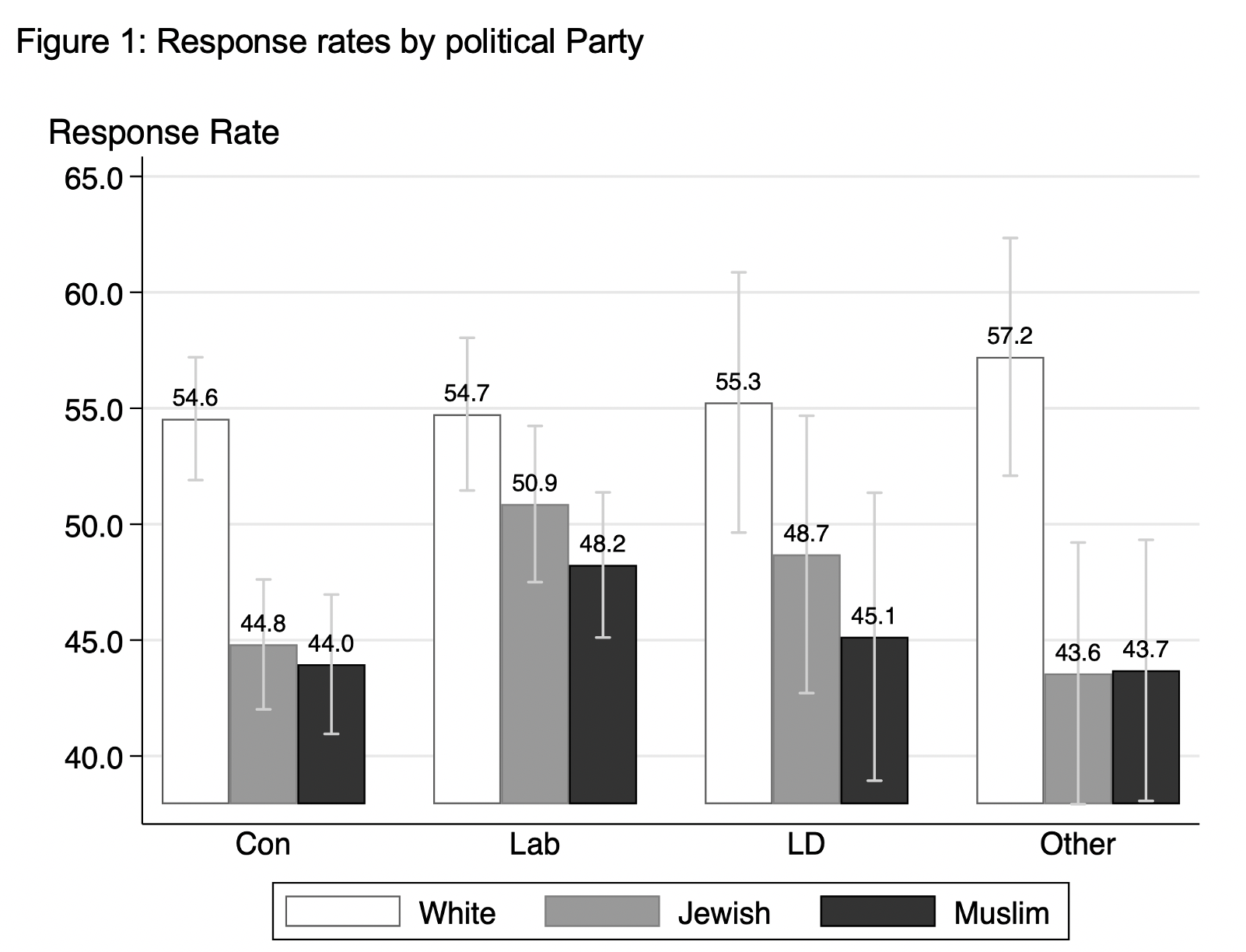
Response rates were six to seven percentage points lower to the Muslim and Jewish names – a clear evidence of bias. We don’t however see more bias against Jewish names by Labour councillors. Neither do we see more bias against Muslim names by Conservative councillors. Such discrimination in the provision of services based on race or religion is against UK law.  This form of discrimination by councillors may have substantive impacts for constituents. For example councillors set policy on access to the limited supply of social housing, policies which have been documented to disadvantage ethnic minorities.

Note: Response rates are estimated after removing council fixed effects, and standardising residuals to a response rate equal to the sample average of 55 percent for whites. Bars represent 95 percent confidence intervals.

In total we received 5,093 responses to 9,994 queries sent, for a 51% response rate. This is almost identical to the response rate found by a survey of real requests to councillors, in which 51% received a response within two weeks. Amongst those who responded to our queries, the median time to response was 12 hours, and the median length of responses was 228 words.

Compared to the male Christian name (Harry White), response rates to Jewish names are 5-6% points lower, and 6-9% points lower to Muslim names. Response rates are marginally higher to the female Christian name (Sarah) than to the male Christian name (Harry). Response rates are also higher to Zara Hussain than to Mohammad Hussain.

Name or Religion?

We randomise each councillor to receive one of two email scripts. The first email script makes a simple request in line with basic councillor responsibilities – ‘I have a question about local services and was wondering if you could tell me when your surgery is held?’. The second request explicitly indicates the religion of the emailer – ‘I’m  interested in organising a sponsored  walk in the local area to raise money for [Christian Aid/Islamic Relief/Global Jewish Relief]. Could you advise me if I need to get some kind of permit?’.

The two email scripts can be seen as different levels of intensity of the treatment. The response rate for white names to the first email was 61%, and 45% to the second email. Bias in response rates is similar across the two types of emails. This suggests that the discrimination occurs based on the name of the sender alone. Due to the high volume and low cognitive effort of checking emails, by not replying, councillors may be acting unconsciously when exposed to non-Christian/minority group names. Alternatively, councillors may simply be consciously discriminating against minority constituents, irrespective of their degree of self-identity. Because the identity of the sender is present in the email address itself, councillors might choose to not even open the emails from names associated with minority groups.

What explains the bias?

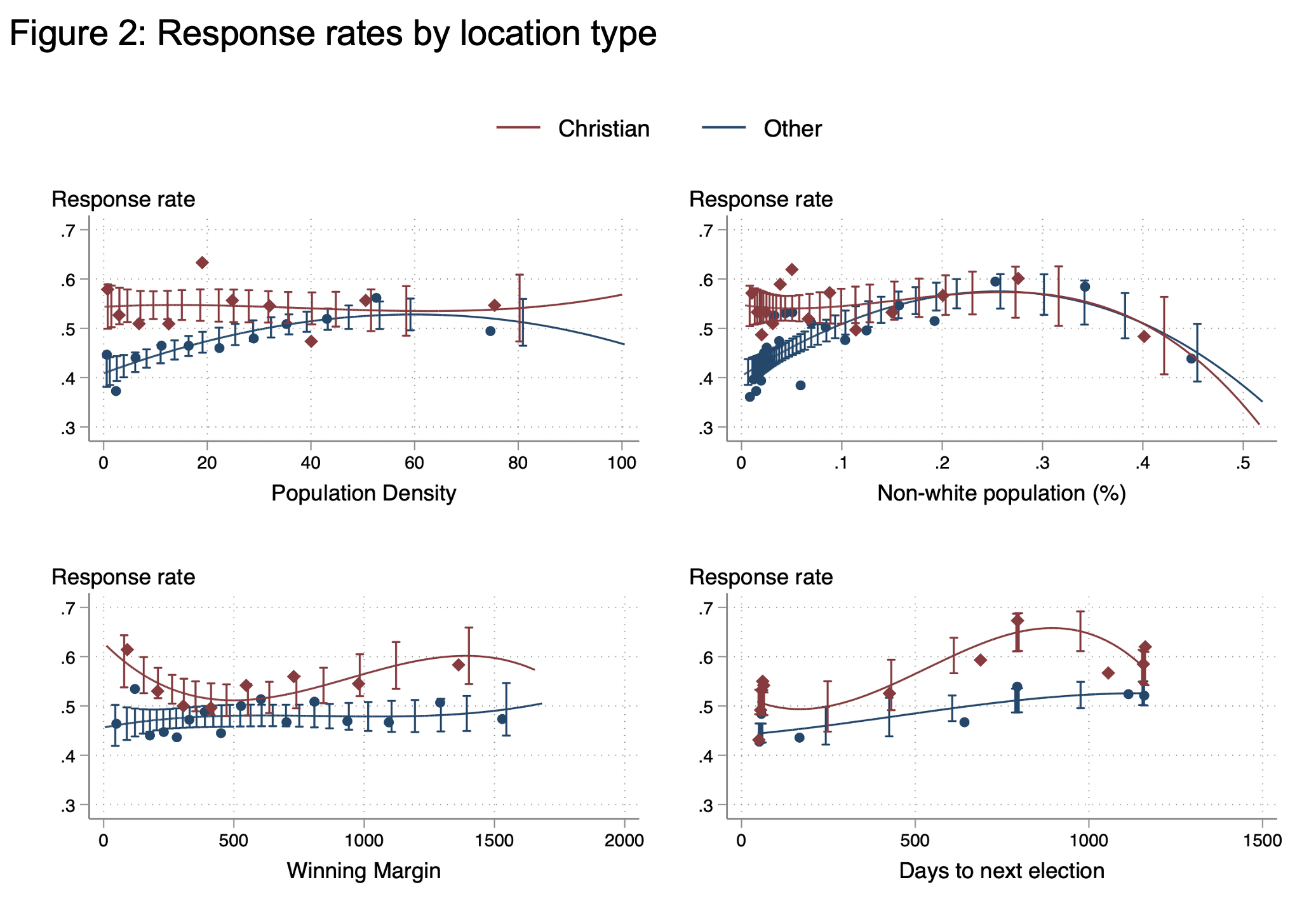
Bias in response rates is largest against Jewish and Muslim names in the least densely populated rural locations, with small non-white populations (Figure 2). One reason for this could be that councillors in white areas are more likely to be white themselves. On average we see much lower bias by councillors with names estimated to be Jewish or Muslim (though these estimates are imprecise due to the small number of such councillors). There may also be other differences in the selection of candidates with different levels of unobserved racial and religious bias in rural and urban areas. Alternatively, councillors may respond to political incentives and be less likely to respond to minorities in locations where minority groups are a small proportion of the electorate.

We test responses to electoral incentives directly by showing the relationship between response rates and two measures of competition – the margin of victory at the last election and the number of days until the next election. We see now less bias in close elections. Finally, lower bias could be attributed to the degree of ‘contact’ councillors have with different minority groups. Councillors in more diverse urban locations may show less discrimination through an erosion of prejudice as described by the contact hypothesis, though we are unable to test this hypothesis directly.

Note: The top-left figure shows a binned scatterplot of response rates against population density, by whether the sender name was Christian or non-Christian. The top-right figure shows response rates against the non-white population share. The bottom-left shows the response rate against the winning margin of the elected councillor at the last election. The bottom-right shows the response rate by the number of days until the next election. Fitted lines are polynomial regressions of order three, with bars showing 95 percent confidence intervals. Population density and non-white population shares are calculated at the ward (sub-council) level from 2011 census data. On average there are three councillors in each ward. Population density is expressed as residents per hectare.

Conclusion

We find evidence for bias from local politicians in response to requests for basic information from ‘Jewish’ or ‘Muslim’ constituents. Despite the media narrative of anti-Semitism in the Labour party and Islamophobia in the Conservative party, our results suggest that both parties are equally discriminatory to both minority groups. This discrimination seems to occur based on names alone, and is unchanged by the explicit identification of religious identity. These effects are largest in rural areas (with low population density) and with small non-white populations. Councillors in such areas may have fewer opportunities for positive interactions with minority groups.

This work demonstrates that even access to basic services are susceptible to forms of discrimination, and that minority group members may struggle to be heard through this process. Reducing councilor bias could be attempted through training designed to reduce implicit prejudice. The leader of the Labour Party has announced the party’s commitment to undergoing this type of training, though more research is needed into the effectiveness of such training. Future studies may benefit from further investigating the process through which politicians engage with their community, and identify ways in which to reduce these biases.

Lee Crawfurd and Ukasha Ramli measure the responsiveness of elected local representatives to requests from putative constituents from minority religious groups. They find that response rates are six to seven percentage points lower to stereotypically Muslim or Jewish names, with Labour and Conservative councillors both showing equal bias towards the two. Their results suggest that the bias may be implicit and that it is lower in more dense and diverse locations.

Source: How anti-Semitic and how Islamophobic are local politicians?

David Feldman: The UK government should not impose a faulty definition of antisemitism on universities

On the risks of universities applying the IHRA definition of antisemitism:

We all know how the path to hell is paved. But it is a warning worth repeating for Gavin Williamson. The secretary of state for education intends to rid universities in England of antisemitism, but his intervention not only threatens to provoke strife and confusion – it also places academic freedom and free speech on campus at risk.

In October, Williamson wrote to all university vice-chancellors “requesting” they adopt a particular definition of antisemitism: the “working definition” promulgated by the International Holocaust Remembrance Alliance (IHRA) in 2016. Williamson is not the first ministerto write to universities on this matter, but he has been more forceful than his predecessors. His letter demands action by Christmas, and threatens swingeing measures against refusenik institutions that later suffer antisemitic incidents. He threatens to remove funding and the power to award degrees from universities that do not share his faith in the efficacy of the IHRA working definition.

This is misguided, for a number of reasons. First, it misconceives the task universities face. As shown in a report released last week by Universities UK – Tackling Racial Harassment in Higher Education – structural racism in universities is profound, and racial harassment on campus is widespread. These are problems that universities must address. The imposed adoption of the IHRA working definition will not meet this challenge. It will, however, privilege one group over others by giving them additional protections, and in doing so will divide minorities against each other. For this reason alone, Williamson should pause and consider how best to protect students and university staff from racism broadly as well as from antisemitism.

Israel’s Pick to Head Holocaust Memorial Stirs International Uproar [petition includes 19 Canadian signatories, some notable non-signatories]

Striking and disappointing that none of the Canadian delegation to the International Holocaust Remembrance Alliance signed the petition, including the recently appointed head, Irwin Cotler nor any of the participating organizations. The 19 Canadian signatories are largely academics:

For years, his name was synonymous with intolerance and right-wing extremism.

So when Israel’s conservative-led government nominated Effie Eitam to be chairman of Yad Vashem, the country’s official Holocaust memorial and one its most hallowed institutions, it prompted an uproar.

Mr. Eitam, a 68-year-old retired brigadier general and former minister, has spent the last decade in the private sector. But his provocative statements from the early 2000s advocating the mass expulsion of Palestinians from the occupied West Bank and barring Israel’s Arab citizens from politics linger on the public record.

The appointment could have “devastating consequences,” said Israel Bartal, a professor of modern Jewish history at the Hebrew University of Jerusalem, who said he would be forced to cut all contacts with Yad Vashem’s research institute after years of cooperation. “An institute headed by a person with such extreme opinions and controversial human values will never be taken seriously within the global academic community,” Mr. Bartal said.

Holocaust survivors, Jewish organizations and an international array of historians have denounced the appointing of such a contentious figure to head Yad Vashem. They say that in addition to recognizing the Nazi genocide of six million Jews as a unique event, the institution is also responsible for upholding universal moral values and educating people about anti-Semitism and racism.

Yet despite the pushback, a government appointments committee vetted and approved Mr. Eitam’s candidacy in mid-November. Only a cabinet vote now stands between him and the post.

“This is more than a colossal mistake — it’s a tragedy,” said Deborah E. Lipstadt, a professor of modern Jewish history and Holocaust studies at Emory University in Atlanta who has written several books on the subject. “Appointing Eitam to this position would be a blot on Yad Vashem’s reputation and Yad Vashem’s record.”

Mr. Eitam and Yad Vashem declined to comment on the appointment.

But Mr. Eitam’s defenders say he is the victim of a kneejerk left-wing campaign purely because he is right-wing and religious. They view him as a war hero and an experienced manager who could steer Yad Vashem out of a severe financial crisis that has been compounded by government budget cuts and a drop-off in donations because of the coronavirus pandemic.

The upshot is that Yad Vashem, an almost sacred institution that world leaders are expected to visit while in Jerusalem, has gotten caught up in the political and culture wars of a polarized country where the dominant right-wing battles the liberal left and is increasingly at odds with the more liberal streams among world Jewry.

Worse, experts say, it comes at a time when anti-Semitism is resurgent and far-right forces in other parts of the world are promoting Holocaust denial.

“You don’t play politics with the Shoah, and this is playing politics with the Shoah,” Professor Lipstadt said, using the Hebrew term for the Holocaust.

Worse, experts say, it comes at a time when anti-Semitism is resurgent and far-right forces in other parts of the world are promoting Holocaust denial.

“You don’t play politics with the Shoah, and this is playing politics with the Shoah,” Professor Lipstadt said, using the Hebrew term for the Holocaust.

She is one of 750 historians, Jewish studies experts and cultural figures who signed a petition protesting the appointment, which was submitted to Yad Vashem’s board of trustees and Israel’s Parliament this month.

Yad Vashem’s current chairman, Avner Shalev, 81, is a respected, apolitical figurehead. He announced in June that he was stepping down after a 27-year tenure.

Zeev Elkin, the minister with responsibility for Yad Vashem from Prime Minister Benjamin Netanyahu’s conservative Likud party, chose Mr. Eitam with Mr. Netanyahu’s full support.

Still, government approval may not be imminent. Because of coalition infighting, all senior appointments are frozen, and Benny Gantz, who leads the centrist Blue and White party in Mr. Netanyahu’s coalition, is likely to block Mr. Eitam’s advancement by denying him a majority if it comes to a cabinet vote.

But Mr. Elkin and Mr. Netanyahu insist that he is still their sole candidate. 

Mr. Eitam, a resident of a settlement in the Israeli-annexed Golan Heights, grew up as a secular Jew and became observant after the 1973 Middle East war.

He was decorated for his role in one of the war’s most desperate battles and later took part in a raid to free mainly Israeli hostages in Entebbe, Uganda. Mr. Netanyahu’s older brother, Yonatan, a legendary figure in Israel, was killed while leading the raid.

But Mr. Eitam once compared Israel’s Arab citizens to a cancer and a “ticking bomb” and said Israel would ultimately have to expel most Palestinians from the West Bank.

During the first Palestinian uprising in the late 1980s, when he was a brigade commander, some of his soldiers were prosecuted for beating a Palestinian man to death. The soldiers said they had beat him on the commander’s orders.

Ultimately, Mr. Eitam received a severe reprimand, and his promotion to the rank of brigadier general was long stalled. Yet his military career spanned nearly three decades.

Mr. Elkin, the minister responsible for Yad Vashem, denounced what he called an “ugly” and “hypocritical” campaign spearheaded by political forces who never objected to appointments from the left wing of the political spectrum.

“True, he made a few unsuccessful remarks,” Mr. Elkin said of Mr. Eitam in a telephone interview, “but that was 15 or 20 years ago.” Mr. Elkin also said that some of those statements had been taken out of context.

Mr. Elkin cited as a reference point Joseph “Tommy” Lapid, a Holocaust survivor and acerbic leader of a liberal, secular, centrist party who went on to become chairman of Yad Vashem’s advisory council. Mr. Lapid once said that Palestinians “might begin to think” of the effects if 10 car bombs were to go off in 10 Palestinian cities and kill 500 Palestinians.

“That’s a more shocking statement to my mind,” Mr. Elkin said, “and nobody opposed his appointment.”

One leader of the campaign against the appointment is Colette Avital, a former Israeli diplomat and Labor party lawmaker who now chairs the Center Organizations of Holocaust Survivors in Israel, an umbrella group for 58 Holocaust organizations. She said she had suggested alternative candidates to Mr. Elkin from the political right.

“There are people who don’t represent the left but can project an image of tolerance, understanding and moderation,” she said. Regarding the claims against Mr. Lapid, she said, “Two wrongs don’t make a right.”

Other apolitical bodies have criticized Mr. Eitam’s nomination, including the Anti-Defamation League and some Yad Vashem donors.

“Yad Vashem should stay above Israeli politics and keep its irreproachable record and moral high ground,” Joel Herzog of the Swiss Friends of Yad Vashem wrote in an email.

Critics are baffled as to why Mr. Elkin settled on Mr. Eitam. But it might signal a desired shift that would bring the institution more in line with the government after some recent run-ins.

In 2018, Yad Vashem issued a stinging critique of a joint statement by the prime ministers of Israel and Poland that was meant to resolve a rift between the countries over a Polish law criminalizing some statements on the Holocaust. Complicating matters, Yad Vashem’s chief historian, Prof. Dina Porat, was involved in drafting the joint statement, apparently in a private capacity.

Supporters of Mr. Eitam said that he could project a more muscular, Jewish and Zionist-centric image from Yad Vashem for Israel’s battle against anti-Semitism. Mr. Elkin said Mr. Eitam’s whole army career had been devoted to the lesson of the Holocaust summed up by the phrase “Never again.”

“That is something fundamental in his character, the essence of his character,” Mr. Elkin said.

Source: https://www.nytimes.com/2020/11/28/world/middleeast/israel-yad-vashem-eitam.html?action=click&module=Latest&pgtype=Homepage

The Saturday Debate: Is the IHRA definition the right way to fight anti-Semitism?

Worth noting (I share some of the concerns regarding potential over broad interpretations regarding criticism of Israeli government practices and policies):

In late October, Ontario became the first province to officially recognize the “working definition of antisemitism” adopted four years ago by the International Holocaust Remembrance Alliance (IHRA). The IHRA wrote the definition in light of evidence that “the scourge of antisemitism is once again on the rise.” The first step involved creating “clarity about what antisemitism is.”

Here’s the definition: “Antisemitism is a certain perception of Jews, which may be expressed as hatred toward Jews. Rhetorical and physical manifestations of antisemitism are directed toward Jewish or non-Jewish individuals and/or their property, toward Jewish community institutions and religious facilities.”

That was accompanied by 11 contemporary examples of antisemitism to serve as illustrations.

Canada, and now Ontario, are among many governments and organizations around the world that have adopted this definition as part of strategies to fight antisemitism. At the same time, critics argue that the definition, along with the illustrations, has the effect of stifling legitimate criticism of Israel.

In this week’s Saturday Debate, Shimon Koffler Fogel argues the definition is needed, while Michele Landsberg and Avi Lewis say it’s unnecessary and may actually lead to more antisemitism.

Shimon Koffler Fogel

Over the last 70 years, antisemitism has adapted. Today, it is not limited to swastikas, racial slurs or shouts of “Heil Hitler,” though these odious examples persist. Certain perceptions of Jews are too often used to explain why “things go wrong” across all political ideologies, in public fora, and online spaces.

Lip-service to generic anti-racism is no solution. We need to move beyond a shallow understanding of antisemitism focused exclusively on history, which forces our community to continually justify its actual experience in ways that are not just exhausting, but demeaning. We need a shared definition of present-day antisemitism if we are to have any hope of combating it effectively.

The International Holocaust Remembrance Alliance (IHRA) working definition of antisemitism is the world’s most widely recognized tool for understanding contemporary Jew hatred. Following years of collaborative research by leading experts on antisemitism, the IHRA definition was adopted by international consensus. The definition includes 11 examples of antisemitism that can help Canadians understand the lived experiences of Jews and the hate and discrimination we face.

Some of the examples pertain to Israel, describing expressions of hate against Jews as a collective. This may sound complex, but complexity is no excuse for ignoring the problem. Nearly all Jewish Canadians describe their connection to Israel as a key component of their Jewish identity. Antisemitism targeting this facet of Jewish identity cannot be denied — it is real and must be understood and addressed. The IHRA definition is crucial in this regard.

Nonetheless, there are those who, to shield themselves from accountability for their hate, seek to limit Canadians’ understanding of antisemitism to the narrowest possible view. Their claim that hostility toward Israel can never be antisemitic is as ludicrous as the notion that criticism of Israel is always antisemitic.

When the leader of Canada’s white nationalist party claims “Canada has a Zionist occupied government,” that is antisemitism.

When Jewish students at the University of Toronto are denied access to kosher food because the Jewish campus club is deemed “pro-Israel,” that is antisemitism.

When Jewish members of Parliament are slandered as more devoted to Israel than Canada, that is antisemitism.

When students at a Peel Region high school recycle age-old anti-Semitic blood libels to attack Israel, that is antisemitism.

When a senior staff at the Privy Council Office states that Israelis are genetically predisposed to pedophilia, that is antisemitism.

When an anti-Israel protest in Mississauga descends into chants of “the Jews are our dogs,” that is antisemitism.

How can detractors of the IHRA definition claim these examples and dozens more like them are not antisemitism?

The IHRA definition is the consensus standard, in Canada and around the world.

More than 30 democratic countries, including Canada, have endorsed it. Muslim-majority countries, such as Bahrain and Albania, and the Iraq-based Global Imams Council, have too. Hundreds of municipalities, the European Union, the United Nations, the Canadian Human Rights Commission, and the Canadian Race Relations Foundation all support it.

Most recently, the Government of Ontario adopted the definition in response to an unprecedented call for urgent action from hundreds of Jewish community organizations across the province. This outpouring spanned the political and religious spectra. From left to right. From atheist to ultra-Orthodox.

Of course, no community is monolithic. There are Jewish detractors, but this is nothing new. At the height of devastating Soviet persecution of Jews there were Jewish Stalinists egging the authorities on, whitewashing the regime’s crimes.

Much of the criticism of the IHRA definition focuses on the motivation of Jewish groups that support it. Many allege an ulterior motive, a hidden objective to stifle criticism of Israel. The insinuation of a nefarious Jewish plot to advance the interests of a foreign government at the expense of the local population is, in itself, classic antisemitism. For centuries, these twisted theories of Jewish disloyalty, dishonesty, and conspiracy have incited devastating bloodshed. 

The IHRA definition states unequivocally that “criticism of Israel similar to that levelled against any other country cannot be considered antisemitic.” Applied correctly, the IHRA definition protects the freedom to criticize Israel and provides a framework for understanding how and when political expression can become a vehicle for hate.

Antisemitism is a mutating virus. No person, place or time is immune. If left unchecked, antisemitism will tear apart the fabric of our society, undermining our values and democratic institutions. Freedom of speech does not mean freedom from accountability. Those who dismiss the Jewish community experience of antisemitism do not get to dictate terms that conveniently protect their own bigoted attitudes from criticism.


Michele Landsberg and Avi Lewis

The International Holocaust Remembrance Alliance definition of antisemitism is vague, confusing and utterly unnecessary. We already have working definitions of hate speech and acts that cover all kinds of racism — we don’t need one custom-made for Jews. 

In fact, no matter how many governments are persuaded to adopt this definition (through fear of being deemed antisemitic if they don’t) it doesn’t make us, as Jews, one iota safer, or acts of antisemitism any less likely. It provides not a single new tool to fight antisemitism.

So what is this debate all about? Israel. 

Just like the scorpion’s, the sting of the IHRA definition is in its tail, an appended list of 11 examples of antisemitism. Seven of them are focused on criticism of Israel. This points to what is really going on: pro-Israel organizations are campaigning for the IHRA definition so they can use it to shut down legitimate debate of Israel’s policies and to harass and silence critics.

That’s not just our opinion. It’s shared by Ken Stern, the author of the definition itself. “The problem is … that right-wing Jewish groups took the ‘working definition’ and decided to weaponize it,” Stern told The Guardian last year. 

It is no coincidence that those groups in Canada have secured their first provincial victory in Doug Ford’s Ontario, just as Jared Kushner triumphantly watched his father-in-law, Donald Trump, sign it into law in the U.S. The Trump administration may soon declare Amnesty International, Oxfam and Human Rights Watch antisemitic organizations with the help of the IHRA definition. 

Let’s unpack how it works. One of the examples states that antisemitism includes: “Denying the Jewish people their right to self-determination, e.g., by claiming that the existence of a State of Israel is a racist endeavour.”

So if you feel that Canada is a racist endeavour (founded on stolen land, a history of genocidal policies from residential schools to the ongoing, fatal underfunding of services for Indigenous communities,) you’ll have plenty of company these days, and a healthy debate in mainstream media. 

If you argue that Israel is a racist endeavour (founded in the forced displacement of 750,000 Palestinians, still brutally enforcing the world’s longest illegal occupation, with countless discriminatory laws aimed at the Palestinian minority), the IHRA definition will be invoked to label you an antisemite.

This was always the strategy. The Centre for Israel and Jewish Affairs tipped its hand in an email to supporters in 2018: “We are launching a national campaign to have government and police adopt the International Holocaust Remembrance Alliance (IHRA) definition of antisemitism … because it explicitly confirms that anti-Zionism is antisemitism.” 

So: will adopting the IHRA definition make us Jews safer? Quite the opposite, thanks to the dangerous Jewish exceptionalism advanced by its proponents. 

Michael Levitt of the Friends of Simon Wiesenthal Center wrote in the Star this week: “Jews are the minority group most targeted by hate crime in our country …. Antisemitism has remained with us throughout history as the canary in the coal mine.” In other words: hatred against Jews is a unique form of racism, requiring special tools and a special priority.

This is outrageous at a time when anti-Black and anti-Indigenous racism is raging in Canada, when BIPOC folks are dying at the hands of the police and through overt racism in hospitals and other institutions, when migrant workers who keep us fed during the pandemic are dying from lack of access to health care themselves. 

Jews do have a role to play — helping to build a multiracial, multi-generational movement against racism, in solidarity with those on the front lines. We should be putting our societal privilege at the service of other communities, not singling ourselves out for special definitions and narratives of uniqueness.

Vigorous advocacy for the human rights of Palestinians is not antisemitism. Many of us know the difference. Despite our different generations, we both grew up bathed in bigotry. We have looked in the ugly face of hate, stared down the swastika carved on the front door of the public school, heard the slurs and epithets that trace their toxic lineage back to before the Holocaust. 

That history can either be the ground on which we help build anti-racist solidarity across all communities, or it can be cynically used to silence legitimate debate about Israel. The latter is much more likely to stoke antisemitism.

Source: https://www.thestar.com/opinion/contributors/the-saturday-debate/2020/11/07/the-saturday-debate-is-the-ihra-definition-the-right-way-to-fight-anti-semitism.html

After Ottawa monument is vandalized, Ontario adopts International Holocaust Remembrance Alliance’s ‘working definition of anti-Semitism’

Of note despite some of the valid concerns that the definition may be interpreted too broadly with respect to legitimate criticism of Israeli government policies:

The Ontario cabinet has adopted the International Holocaust Remembrance Alliance’s “working definition of anti-Semitism” after recent vandalism at the Tomb of the Unknown Soldier in Ottawa.

Government House Leader Paul Calandra said Premier Doug Ford’s ministers “took swift and decisive action” Monday to recognize the definition even before the passage of legislation currently before the house.

“After a heinous act of anti-Semitism at the Tomb of the Unknown Soldier in Ottawa … it is crucial that all governments be clear and united in fighting anti-Semitism and our adoption of the working definition has done just that,” Calandra said Tuesday.

“The government of Ontario is proud to adopt and recognize the working definition of anti-Semitism. We stand with Ontario’s Jewish community in defence of their rights and fundamental freedoms as we always have and always will,” he said.

Four years ago, the IHRA, an intergovernmental organization with 34 member nations, including Canada, adopted the definition that reads: “anti-Semitism is a certain perception of Jews, which may be expressed as hatred toward Jews.”

“Rhetorical and physical manifestations of anti-Semitism are directed toward Jewish or non-Jewish individuals and/or their property, toward Jewish community institutions and religious facilities,” the definition continues.

While MPPs are currently reviewing Bill 168, the proposed Combating anti-Semitism Act, Calandra said the cabinet wanted to move more quickly with a largely symbolic gesture.

Ontario is the first province in Canada to use the working definition.

In a statement, Michael Levitt, president and CEO of the Friends of Simon Wiesenthal Center for Holocaust Studies, said “we applaud the government of Ontario for joining the dozens of other governments around the world in adopting the IHRA definition of anti-Semitism, a vital tool in the ongoing fight against hatred and discrimination targeting the Jewish community in Ontario.”

“Jews continue to be subjected to vile rhetoric and propaganda and still remain the minority group most targeted by hate crime, which is nothing less than an affront to our basic democratic values as Ontarians,” said Levitt, a former Liberal MP.

Not everyone was happy with the move.

While the New Democrats supported Bill 168, they expressed concern that the “government secretly adopted the definition, behind closed doors and passed it by Ford edict instead of by democratic vote.”

“Anti-Semitism and anti-Semitic acts of hate are growing in Ontario, and we need to take concrete actions as a province to stomp out this growing, racist movement,” said NDP MPP Gurratan Singh (Brampton East).

Source: After Ottawa monument is vandalized, Ontario adopts International Holocaust Remembrance Alliance’s ‘working definition of anti-Semitism’

When Covid-19 rules are flouted by ultra-Orthodox Jews, it isn’t anti-Semitism to call it out

Of note:

As authorities scramble to confront a second wave of Covid-19 building across America, anger is mounting against government efforts to stop the spread within a population among those hardest hit by the pandemic: the sprawling ultra-Orthodox Jewish community of metropolitan New York.

For the ultra-Orthodox to complain that they’re being discriminated against when they come under extra scrutiny is essentially to complain that it’s anti-Semitic to notice what they’re doing.

With the pandemic in its eighth month and restrictions cutting into the religious practices of the tight-knit, strictly observant subculture, it’s understandable that weariness and impatience would set in. Unfortunately, that’s leading to a growing sense in the community that it is being singled out unfairly for deprivation of its religious rights, often accompanied by open complaints of anti-Semitism as the cause for the lockdowns.

It’s a dangerous misperception, for both the ultra-Orthodox and their neighbors. The virus doesn’t single out groups by religion, race or national origin; it’s an unbiased scourge. Nor are New York officials’ containment efforts guided by any such bigoted motives. Enforcement goes where the germs are. And the germs, tragically, are hitting ultra-Orthodox Jews with special fury.

From the beginning of the crisis in March, densely populated ultra-Orthodox neighborhoods in Brooklyn, Queens and key suburbs emerged as leading viral hot spots in hard-hit New York. Their outsize vulnerability was due in large part to a traditional religious culture built on a continuous cycle of obligatory, large-scale gatherings for prayer, study, weddings and funerals, all cherished rituals that can and apparently did serve as super-spreader events.

Compounding these risks has been the mundane physical structure of the insular ultra-Orthodox lifestyle, built on large families’ living in cramped homes packed into dense neighborhoods, making social distancing extraordinarily difficult.

But because those are religious obligations and cornerstones of their Jewish identity structure, government-mandated lockdowns and social distancing can and too often did look from an ultra-Orthodox perspective like government assaults on the religion itself.

It might seem surprising that the community’s behavior hasn’t been dictated from start to finish by the fundamental Jewish principle known as “protection of human life” — the commandment that nearly all religious rules be suspended if a human life is the balance. And, indeed, while many respected rabbis urged members of the community to follow that guidance, it appears that the principle was hard to visualize when the threat wasn’t an enemy gun or a car crash — events that Jews regularly violate religious restrictions to address — but an invisible bug.

That difficulty wasn’t helped by a small but influential minority within the community that has been nodding toward a competing principle — that of sanctifying God’s name by openly defying oppressors’ bans, even at risk to one’s own life and limb. While rarely stated aloud right now, this notion has been encouraged by a handful of well-known rabbis, most of them Israelis with strong followings in the United States, and, more subtly, by a deep-seated distrust of the modern world and its dictates, which often take the form of medical directives.

After a long spring of cat-and-mouse police chases after clandestine synagogue services and other attempts by the ultra-Orthodox to evade quarantine, followed by the summer slowdown in infections, the New York City health department reported startling new statistics in late September showing that certain neighborhoods in Brooklyn and Queens, most of them featuring large ultra-Orthodox populations, were reporting virus test results averaging 4.7 percent positive, compared to just over 1 percent in the rest of the city. Two weeks later, the average jumped to more than 6 percent.

The nine “red zone” ZIP codes on the state map of the highest infection rates at that time — which carried the heaviest public restrictions as a result — were nearly all major ultra-Orthodox population centers. Among other things, houses of worship in red zones were limited to 10 attendees at a time under a policy announced by Gov. Andrew Cuomo.

Ultra-Orthodox community leaders maintain — and government authorities largely agree — that most ultra-Orthodox Jews are following government mandates and that violators represent only a minority. That minority, however, seems to be large enough to push the entire community into vastly disproportionate infection territory, given that observance by a vague “most” isn’t sufficient to stop the virus.

Yet the reaction of much of the ultra-Orthodox community has been to protest the lifesaving government restrictions — sometimes violently — and to paint them as anti-Semitic. In a typical example, a weekly tabloid with a mostly Orthodox readership touted on its front page an essay headlined “De Blasio And Cuomo Have Declared War On Us,” which accused the governor and New York Mayor Bill de Blasio of “treachery and blatant anti-Semitism” and claimed that they “want to destroy our schools and way of life.”

And in a toned-down critique, Agudath Israel of America, the main advocacy body representing ultra-Orthodox Jews, argued that while the ban on large services “discriminates against all religions,” it “disproportionately impacts the religious services of Orthodox Jews,” who would be shut out from traditional synagogue observance of two major religious holidays.

But for the ultra-Orthodox to complain that they’re being discriminated against when they come under extra scrutiny is essentially to complain that it’s anti-Semitic to notice what they’re doing. And in this case, defiantly maintaining tradition doesn’t risk just their own lives, which is their prerogative, but their neighbors’ lives, as well. The trap they’re caught in is tragic, but society has a right and an obligation to protect its people’s welfare.

Indeed, the greater anti-Semitism threat likely comes not from failing to defend Jewish rights but from trying too hard. When Jewish communities, Orthodox or not, ask for special accommodations to meet their particular needs, it’s often seen by other communities as cutting in line, wheedling extra privileges while broader needs go unmet.

To be sure, part of the ultra-Orthodox misperception that anti-Semitism is at work comes from memories of long centuries when anti-Jewish powers forced Jews to give up their traditions or take them underground. These memories, and the alarms they trigger, are familiar to Jews of every religious and ideological stripe.

Throughout their history, Torah-observant Jews have faced emergencies that have forced them to compromise and bend some laws, sometimes permanently.

At the same time, it’s precisely this history that should serve as a guide for the ultra-Orthodox community today in combating Covid-19. Throughout their history, Torah-observant Jews have faced emergencies that have forced them to compromise and bend some laws, sometimes permanently.

Disasters, usually in the form of anti-Semitic persecution, have forced them to drop some practices and amend others to survive until better times returned. So it was after the Roman destruction of Solomon’s Temple in ancient Israel and during the Spanish Inquisition, the medieval Polish-Ukrainian pogroms, the Soviet era and the Holocaust.

But America isn’t any of those things. Instead, it is the ultra-Orthodox community itself that right now poses the most danger to its own continuity.

Source: When Covid-19 rules are flouted by ultra-Orthodox Jews, it isn’t anti-Semitism to call it out