ICYMI: Jihad and the French Exception: Farhad Khosrowkhovar – The New York Times

Good, thought-provoking explanation of some of the reasons for France’s “exceptionalism” and the arguable failure of its integration model:

France’s distinctiveness arises in part from the ideological strength of the idea the nation has had of itself since the French Revolution, including an assertive form of republicanism and an open distrust of all religions, beginning, historically, with Catholicism. This model has been knocked around over the years, first by decolonization, then by decades of economic hardship, the growing stigmatization of cultural differences, the fervent individualism of new generations and globalization, which has narrowed the state’s room for maneuver.

Above all, France hasn’t been able to solve the problem of economic and social exclusion. Its system, which is too protective of those people who have jobs and not open enough to those who don’t, breeds angst all around. Young people in the banlieues, marginalized and with few prospects, feel like victims. They become prime targets for jihadist propaganda, often after a stint in prison for petty crimes.

Neither Germany nor Britain faces the banlieues phenomenon, at least not on such a scale. The German town of Dinslaken, which is partly ghettoized, has become a hotbed of Islamist radicalization. The same goes for Dewsbury, in West Yorkshire, and the Molenbeek district of Brussels. But France seems to alienate many more of its citizens and residents, well beyond those who actually join the Islamic State.

One reason is that France’s vision of citizenship, which strongly insists on adherence to a few exalted political values, has seriously eroded over time. By the 1980s, the republican ideal was floundering: It had promised equal opportunity, and that now seemed to be in short supply. The French Communist Party, which had long brought dignity to disadvantaged groups by proposing to fight injustice through class struggle, also greatly weakened during that period, partly because of the demise of the Soviet Union.

Postwar Germany, on the other hand, chose a far more modest and prudent vision: economic progress. Today, Germany has a rather muted foreign policy toward the Muslim world, and it displays no desire to unite all its citizens around universal principles. Britain isn’t trying to create a monocultural society either. It has opted for multiculturalism, which can abide hyphenated identities and communal behavior.

France, however, remains resolutely universalist and claims it still has both the desire and the power to enforce inclusion. Yet its assimilationist ambitions are increasingly at odds with everyday reality, and this growing gap is a source of pervasive distress.

And so the strength — the weight — of France’s national identity has become a problem. It only heightens the discontent of young people with foreign origins, especially North Africans or their descendants, all the more so because the Maghreb’s decolonization occurred in pain and humiliation: When France withdrew from Algeria, it left behind hundreds of thousands dead and created scars in the collective unconscious that remain to this day. British decolonization seems almost painless in comparison.

Certainly, Britons and Germans also express fears about immigration and Islam. Such concerns help explain Brexit. Acts of sexual harassment in Cologne around the new year, apparently committed by immigrants, sparked a heated debate in Germany (and beyond). But both Britain and Germany give non-local minorities ample leeway to publicly express and practice their religious and communal preferences.

France insists — in the name of republicanism — that religion should remain a strictly private affair. An ideological nation par excellence, it focuses on symbolic issues like wearing headscarves or holding collective prayers in public places. But restricting such practices causes wounds that go much deeper than the prohibitions themselves: It allows Islamists to exaggerate the implications and accuse France of Islamophobia. In fact, France is no more Islamophobic than its neighbors; it’s just more frontal in the way it handles Islam in the public sphere.

French-style integration has had some successes. Most notable among them is a high rate of mixed marriages. The French public school system, by helping uplift the lower classes and, therefore, many children of North African parents, has also been a tool of integration (although lately it has seemed less effective). Sometimes precisely because they have faced prejudice in the job market, which has long been stifled by unemployment, children of immigrants have found refuge in state institutions like the army and the police, which recruit through anonymous competitive exams.

Although France has managed to integrate many immigrants and their descendants, those it has left on the sidelines are more embittered than their British or German peers, and many feel insulted in their Muslim or Arab identity. Laïcité, France’s staunch version of secularism, is so inflexible it can appear to rob them of dignity. An additional factor is France’s muscular foreign policy, which seems to target mostly Muslim countries, such as Libya, Syria and Mali.

Source: Jihad and the French Exception – The New York Times

Samara initiative to increase political engagement of new Canadians

Another good and interesting initiative:

What happens when you ask newcomers to Canada what they care about, add a question about democracy, and then give everyone some playdough? 

They talk, discuss, collaborate, and create. Ultimately, they build confidence in their democratic voice.

For the last year, that is exactly what has been happening in one of the most diverse regions of Canada. North York Community House (NYCH) and Samara, with the support of the Ontario Trillium Foundation, have undertaken a major initiative to strengthen democratic engagement by training almost 50 staff members and engaging over 600 community members. 

NYCH_Collage_1.jpgServing newcomers and residents of northwest Toronto for over 25 years, NYCH has come to recognize that improving democratic engagement is essential to helping build strong, healthy communities. By helping participants of all ages and backgrounds find and develop their political voice, Samara’s Democracy Talks has proven an effective tool for engaging and empowering NYCH’s diverse membership.

Democracy Talks takes a different approach than many civic education programs. Instead of inviting participants to a class to learn about Canada’s political system, Democracy Talks activities are integrated into a wide range of existing programs – English conversation circles, citizenship classes, youth programs, and even cooking classes.

NYCH_Collage_2-1.jpg

As a result, in North York alone, the program has engaged participants from over 34 different countries and ages 13 to 65. Many participants reported that, prior to this initiative, they had no opportunities to discuss issues they care about in a non-partisan and safe environment. What participants learned was simple but profound. In the words of two participants:

“It’s not just the Prime Minister that has the power, we have the power too.” 

“I learned that things can change.”

Most heartening of all, we have begun to witness a shift in culture such that both NYCH staff and community members value democratic life and have confidence in their political voice. Illustrating this shift on a beautiful evening in May, over one hundred community members packed into the Change Fair, hosted by NYCH and Samara, to talk with each other, share what they had learned, and make sure their political voice was heard. (For more on the event, check out our blog.)

Douglas Todd: Immigrant workshops in Vancouver face up to difficulties of integration

Good initiative on the “soft knowledge” concerning integration:

When Mohamed Ehab arrived in Vancouver from Egypt six years ago, he knew nothing about Pride parades or the Grouse Grind.

The 40-year-old pharmacist, who now enjoys hiking up North Vancouver’s Grouse Grind trail, wishes other immigrants and refugees would get up to speed earlier on such cultural matters — so that they can avoid self-isolation and integrate more fully into Canada’s liberal-democratic culture.

Aware that many immigrants and refugees arrive in Canada from patriarchal societies in the Middle East and Asia, outgoing Ehab and his philanthropic supporters are gearing up to have him lead workshops that would ease newcomers’ often-difficult transitions.

“When I arrived in Canada I wanted to become part of the Canadian community, not just the immigrant Arab or Egyptian communities,” says Ehab, who has for the past few years used Facebook to organize informal foreign-film events in Vancouver.

While Ehab intends his workshops to be enjoyable and practical guides to Metro Vancouver and Canada, they will also take on some of the serious issues that he believes sometimes push newcomers into confining themselves to ethno-cultural “pockets.”

Ehab’s course will explain Canadian customs regarding such things as homosexual couples, trusting police officers, accepting common-law relationships, paying a fair share of taxes, wearing revealing clothes and sexist behavior.

“New immigrants and refugees don’t have to agree with everything they will find here. But they should know that those things are part of what it means to be in Canada,” Ehab said.

The Vancouver workshops, which will run for four hours a day for a week, loosely echo programs in European countries such as Norway and the Netherlands.

That’s where some asylum seekers are learning in classes to discuss such things as Western women, mini-skirts, sexual boundaries and domestic violence, with the refugees often reporting they take the programs so they will find it easier to fit in.

Homosexual relationships in the West, Ehab says, are especially difficult for many immigrants and refugees to comprehend.

Mohamed Ehab (centre) is a pharmacist originally from Egypt, now residing in Vancouver. He helps immigrants and newcomers to Canada helping them try to understand the Canadian way of life. Ehab is pictured on the Grouse Grind in North Vancouver, BC Wednesday, July 20, 2016. Ehad is pictured with Farooq Al-Sajee (left) and Farzin Jamatlou.

“In the Middle East, if somebody comes out as gay, they will be thrown in jail. It’s a crime there,” he says.

Ehab knows of an isolated couple from the Middle East, who have lived in an ethnic enclave in Ontario for almost five years, who recently asked, “What’s the LGBT community?”

Similarly, many immigrants from the Middle East and elsewhere could gain from being informed about heterosexual sex outside marriage, divorce and women and men sharing public spaces, including exercise classes.

“We would inform newcomers about how dating works here, for instance. That it’s not taboo,” said Ehab.

Many immigrants, he noted, come from nations where it’s almost unheard of to engage in male-female relationships beyond one’s own ethno-cultural or religious group.

Asked about recent refugees from Syria who are refusing to be seen by Canadian doctors of a different sex, or to work with language interpreters of a different sex, Ehab said it’s better for newcomers to “not be surprised” about Canadian expectations about such things.

The workshops, which will operate out of immigrant-support organizations, are being paid for by people who have long worked with institutions devoted to multicultural understanding, such as the Laurier Institute, SUCCESS and outreach arms of the RCMP.

“The sponsors of these workshops are immigrants who feel there is a lack of education about the understanding of the Charter of Rights and Freedoms and about the need for people to reach out beyond their communities,” says one sponsor, Farid Rohani, who recently chaired the Laurier Institute and the Institute of Canadian Citizenship.

“Many Canadians feel immigrants seem to live in their own castles. The new arrivals on the other hand are afraid of making contact; they fear making a mistake or offending someone,” said Rohani, whose family arrived from Iran.

Rohani said the trouble with the way many new immigrants meet each other in Canada — in English-as-second-language classes — is that they often tend to form into “cliques of uninformed people. They often don’t learn how to integrate.”

Clarence Cheng, former chief executive of the SUCCESS Foundation, which supports immigrants, said the workshops will include guest speakers such as police officers, judges and tax department officials.

The speakers’ tasks, among other things, is to educate immigrants that they have come to a new land where it’s worthwhile to generally trust agents of the government and to cooperate with them.

Ehab readily acknowledged it’s common, for instance, for people in Middle Eastern countries to be deeply suspicious of the police, and fear police favouritism and brutality. “In many Middle Eastern regions, the police are a country unto themselves.”

Despite the gravity of some of the issues that will be explored, Ehab said a goal of the workshops will be on finding ways to overcome the alienation and sense of “coldness” immigrants often feel in new countries and cities.

“We want to offer practical advice on finding jobs and new ways to make friends. And we want to make the workshops a fun and happy experience. I’m very excited.”

Source: Douglas Todd: Immigrant workshops in Vancouver face up to difficulties of integration

Québec dit avoir été trop «passif» | Le Devoir

Suspect the reasons are deeper than what a small advertising campaign can fix:

La désaffection des immigrants envers les cours de francisation est en partie la faute de Québec, a reconnu lundi la ministre Kathleen Weil, qui dit que le gouvernement « a été passif ». Pour corriger la situation, Québec mise sur une campagne estivale de promotion des cours.

Québec investira 250 000 $ d’ici le 30 août en publicité dans différents journaux, radios et sites Internet — de même que dans le métro et les autobus de Montréal — pour inciter les immigrants à s’inscrire à des cours qui, souligne-t-on, ne coûtent rien. « Apprendre le français, c’est gratuit et c’est gagnant », vante ainsi le slogan de la campagne.

L’objectif est d’augmenter de 10 % le nombre d’immigrants qui suivent des cours de francisation, a indiqué la ministre de l’Immigration. Selon le rapport annuel de gestion 2014-2015 du ministère de l’Immigration, de la Diversité et de l’Inclusion [MIDI], 26 109 personnes ont participé à un ou des cours de français l’an dernier.

C’est là une baisse de 6,1 % par rapport à l’année précédente — résultant notamment d’un recul de fréquentation des cours de français à temps plein (-6,3 %) et des cours en ligne (-30 %). Dans les faits, si l’objectif est atteint, Québec retrouvera le niveau atteint en 2011-2012, mais demeurera sous celui de 2012-2013 (29 200 personnes).

En janvier, Le Devoir révélait que près de 60 % des immigrants adultes qui ne connaissent pas le français en arrivant au Québec refusent de suivre des cours. Or, si l’apprentissage du français est évidemment important pour l’intégration à la société québécoise, il l’est aussi pour aider à la rétention des immigrants. Une étude du MIDI dévoilée en avril montrait que 46 % des immigrants admis entre 2004 et 2013, sélectionnés en raison de leurs qualifications professionnelles et ne parlant pas français à leur arrivée, avaient quitté le Québec en 2015.

Méconnaissance

« Nous avons noté que pas assez de personnes immigrantes se prévalaient de notre offre en francisation », a indiqué Mme Weil. Elle a fait valoir que cette offre est « complète, variée et flexible » en fonction des besoins et des horaires, et que le gouvernement offre jusqu’à 115 $ par semaine à ceux qui sont inscrits à temps plein et ne peuvent donc pas travailler en même temps. « Ces éléments sont méconnus », pense Mme Weil.

Source: Québec dit avoir été trop «passif» | Le Devoir

A Close Look at Brussels Offers a More Nuanced View of Radicalization – The New York Times

Interesting contrast between Turk and Moroccan-origin communities, and the impact of failing to deliver on integration expectations:

At a Turkish mosque in Molenbeek run by Diyanet, Turkey’s state-controlled religious affairs agency, the imam, who speaks only Turkish, expressed revulsion at the March attacks in Brussels and said that he and his worshipers never tolerate extremist views. He stressed that his congregants respect and follow the law.

Worshipers at a nearby Moroccan mosque angrily shooed away reporters, accusing them of fanning “Islamophobia” and stigmatizing their neighborhood as a haven of jihadists.

In contrast to Belgium’s Turks, the Moroccan community is far more divided and resistant to authority, in part because many of the early immigrants came from the Rif, a rebellious Berber-speaking region often at odds with the ruling monarchy in Morocco. “When emigration to Europe started, the king was happy to get rid of these people,” said Bachir M’Rabet, a youth worker of Moroccan descent in Molenbeek.

Another source of anger in his community, he added, is that many Turks often speak poor French and no Dutch, Belgium’s two main languages, and cling to their Turkish identity, while most Moroccans speak fluent French and aspire to be accepted fully as Belgians. This, he said, means that many Moroccans feel discrimination more acutely and, at least in the case of young men on the margins, tend to view even minor slights as proof that the entire system is against them.

Philippe Moureaux, who served for two decades as Molenbeek’s mayor, described this as “the paradox of integration.” A less-integrated Turkish community has resisted the promise of redemption through jihad offered by radical zealots. Yet, a Moroccan community that is more at home in French-speaking Brussels has seen some of its young fall prey to recruiters like Khalid Zerkani, a Moroccan-born petty criminal who became the Islamic State’s point man in Molenbeek.

“The Turks suffer much less from an identity crisis,” Mr. Moureaux said. “They are proud to be Turks and are much less tempted by extremism.”

Suspicion of and hostility toward authority, particularly the police force, run so deep among some North African immigrants in Molenbeek that when the police mobilized in the area this month to prevent a group of anti-immigrant right-wing hooligans from staging a rally, local youths, mostly young men of Moroccan descent, began hurling abuse and objects at the police.

Molenbeek immigrants of Turkish or other backgrounds generally have a less hostile view of the police. A Turkish shopkeeper who runs a general store near the police station said he feared not the police but aggressive North African youths who accuse him of being a bad Muslim because he sells alcohol. He noted that the youths steal, which is also forbidden.

Emir Kir, the Belgian-Turkish mayor of Saint-Josse-ten-Noode, a heavily immigrant Brussels borough that is worse off economically than Molenbeek, said the only Turk he knew about who had tried to go to Syria was a young man who had fallen in love with a girl of Moroccan descent. He got as far as Istanbul before being sent back. “This was a love affair, not an act of extremism,” he said.

Source: A Close Look at Brussels Offers a More Nuanced View of Radicalization – The New York Times

Is Canada A Nation Of Immigrants? | Jack Jedwab

Jack and I have a disagreement here, with significant policy implications.

The issue is not, in a labelling sense, of creating multiple classes of Canadians. We are now back in the world of “a Canadian is a Canadian is a Canadian,” whether born here, born abroad or children of immigrants.

In contrast to earlier waves of mainly white and Christian immigrants, with many similar integration challenges, today’s immigrants are largely visible and religious minorities.

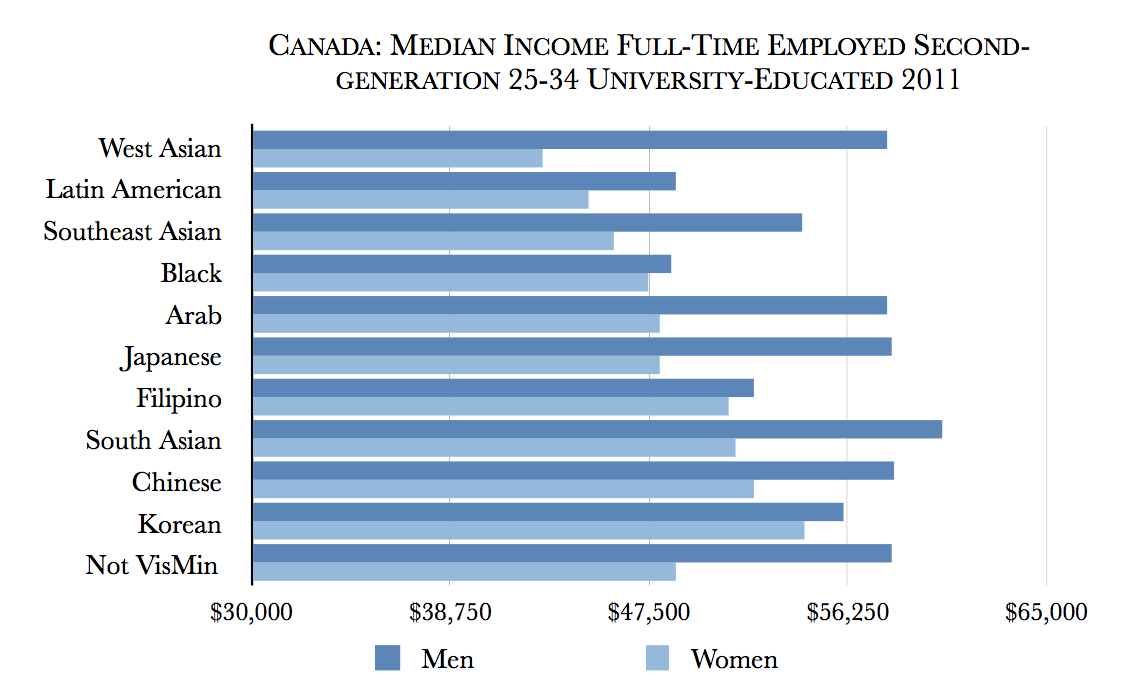
Without looking a the different experiences between first and subsequent generations of immigrants, we overlook the very real differences in outcomes for different groups of the second-generation compared to non-visible minority Canadians (or “old-stock” Canadians).

2G_University_Educated_25-34In some cases (i.e., percentage university-educated), the second-generation does significantly better than non-visible minority Canadians. And those that find employment have comparable median salaries.

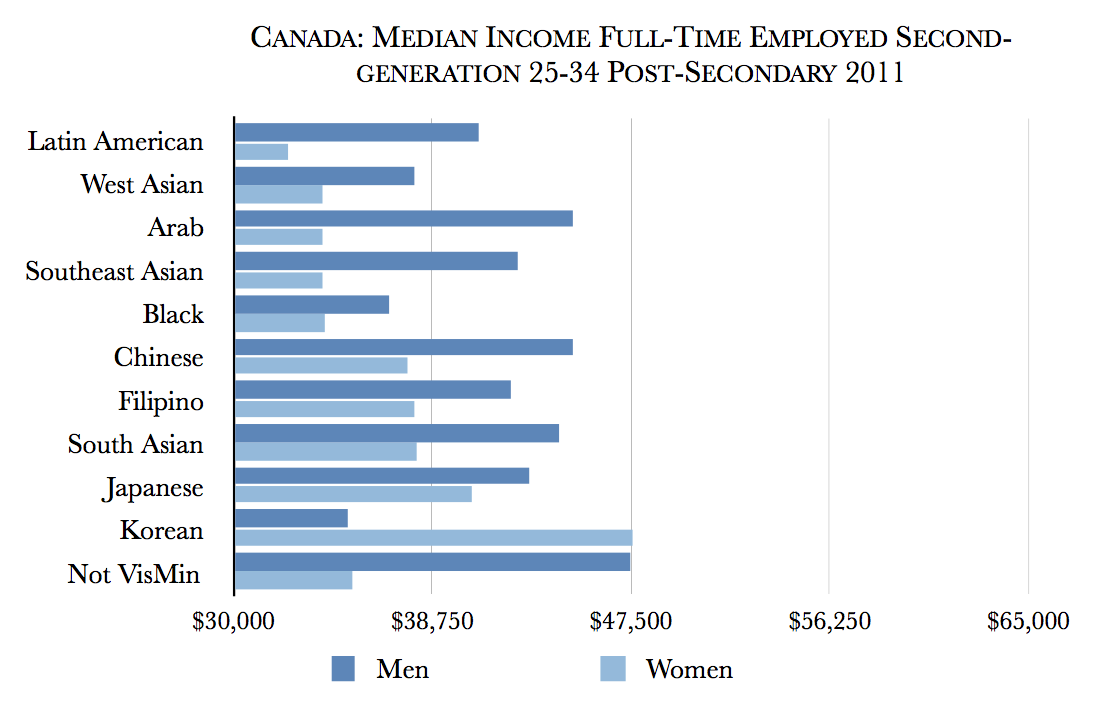
However, the second generation has higher unemployment rates than non-visible minority Canadians. Those that are not university educated have lower median incomes, as shown in the chart below:

2G_Non-Univ_Educated_25-34This is not to mentioned the well-documented instances of discrimination in hiring, police carding and other areas that show significant differences between visible minorities and others.

So while as a ‘value statement,’ one may prefer to refer second-generation immigrants as non-immigrants, this effectively masks some of the ongoing integration challenges that some elements face.

And while I fully agree with Jack that comparisons with Europe are often inappropriate given our differences in history, geography and identities, we do, like other ‘new world’ countries, view ourselves as countries of immigrants, unlike Europe. And this, with the exception of the USA, both reflects and influences how we deal with integration.

Measuring and contrasting the outcomes of both first and second generation outcomes provides useful international and internal benchmarks allow us to identify ongoing integration challenges with a view to overcoming them. Not making the distinction obscures them:

But there a significant segment of the Canadian-born population that sometimes wrongly gets labeled as immigrants. I refer specifically to persons born in Canada of foreign-born parents (a group to which I belong). Much social science literature in Europe refers to these children of immigrants as “second generation immigrants”. To many North American observers the term must seem like an oxymoron. It nonetheless gets employed by a number of Canadian scholars.

There are statistical breakdowns in the census of Canada on the basis of generational status. Immigrants are generally designated as the first generation, their children as second generation and there is a category for third generation or more. It’s inaccurate to refer to second generation Canadians as something other than non-immigrants with whom they are grouped in the census question on immigrant status.

The confusion that is created by designating them as “second generation immigrants” is sometimes influenced by European analysis with the practice in several EU countries of not automatically conferring citizenship on persons born in the country. For example, children born in France of foreign-born parents do not become citizens until reaching the age of the majority. Switzerland does not automatically extend citizenship to a child that is born in the country. Rather, a person is automatically Swiss if at least one of the child’s parents is Swiss.

Relatively few Canadian scholars that use the term second generation immigrants necessarily think of such individuals as immigrants. Rather most simply echo terminology that is used in some of the Canadian literature on immigration and citizenship and/or seek to engage with European policy-makers or scholars by employing a common vocabulary. But the Canadian-European comparisons can be problematic and regrettably they sometimes don’t make for good scholarly work.

Is Canada a nation of immigrants? It is certainly a nation with many immigrants who have played a critical role in the process of nation-building. But it is simply too limiting a concept when “the nation of immigrants” conveys the idea that immigration is the country’s principal defining characteristic.

Source: Is Canada A Nation Of Immigrants? | Jack Jedwab

When Integrating A School, Does It Matter If You Use Class Instead Of Race?

Interesting article on the latest US thinking on integration:

Stronger Together is not the name of the latest social-media fitness app. It’s a grant proposed in President Obama’s new budget, reviving an idea that hasn’t gotten much policy attention in decades: diversity in public schools. If the request is approved, $120 million will go to school districts for programs intended to make their schools more diverse.
As a new pair of reports from the progressive Century Foundation shows, integration policies have seen a resurgence: In 2007, 40 districts pursued integration. Today that number has more than doubled, to 83, plus nine charter schools or networks. That adds up to a total of 4 million students in classrooms that are more diverse than they’d otherwise be.

This new wave of integration has come with one big difference that sets it apart from the busing battles of the past. These programs rely on family income, not race, as the driver.

To be clear, there’s evidence that socially as well as racially integrated schools benefit all students. When a school reaches a stable level of about 30 percent middle-class students, the lower-income students achieve at higher levels and the privileged students do no worse, says Halley Potter, the author of one of the Century Foundation reports. Similarly, the racial achievement gap shrinks in schools that have less than a “supermajority” of 60 percent of any one race.

But the real case for diverse schools is a lot bigger than test scores, says Amy Stuart Wells, who teaches at Teachers College, Columbia University, and is the author of the second report. “The qualitative and quantitative evidence is powerful enough to say, ‘We should do this.’ ”

It’s worth pointing out that because of the legacy of discrimination and institutionalized segregation in the United States, in most communities mixing up students by class also means mixing them up by race.

“Diversification by socioeconomic status also means by race,” says Mercedes Ebanks, an associate professor in the school of education at Howard University. “The movement towards socioeconomic integration will lead to racial integration and educational equality.”

http://www.npr.org/sections/ed/2016/02/29/466543209/when-integrating-a-school-does-it-matter-if-you-use-class-instead-of-race?utm_medium=RSS&utm_campaign=news

Action Canada: Barriers to Belonging Report and Municipal Voting

Attended the presentation of the Action Canada report 5 Feb (I had been one of the people consulted in its preparation)Citizenship and Selection).

Well attended, including the Parliamentary Secretary for Immigration, Refugees and Citizenship, Arif Virani, who signalled the change and tone of the new government.

The one part of the report that I have a friendly disagreement with is the push for municipal voting.

The main arguments used – Permanent Residents use municipal services, pay taxes, live in the communities – apply also to provincial services (e.g., healthcare and education) and federal services (e.g., Service Canada and related employment programs). Comparisons with Europe are largely irrelevant given the barriers to or length to obtain citizenship in most European countries.

And I have never seen – readers to correct me – any convincing data or evidence on whether extending municipal voting to non-citizens will make a marked difference in voting participation or overall integration.

Recommendations as follows:

  1. Recognize and facilitate permanent immigration and citizenship acquisition as critical to nation building in selection, citizenship, settlement and integration policies. Avoid policies that risk leading to long-term residence without permanent status or citizenship.
  2. Factor the settlement and integration needs of immigrants into selection policy, alongside the long-term social and economic needs of the country.

Designing smarter services:

  1. Engage stakeholders to identify information gaps, design usable data formats, and create platforms for consolidating evidence on what works. Include, at a minimum, settlement service providers, and provincial and municipal governments.
  2. Create a $10M pay-for-success fund – about 1% of the total settlement and integration budget – focused on immigrant inclusion outcomes. This could be modeled on the UK DWP Innovation Fund.
  3. Expand eligibility criteria for settlement services.

Building Bridges to Employment

  1. Engage employers to develop demand-driven employment solutions.
  2. Work with small and medium-sized enterprise business support programs, accelerators, incubators and innovation hubs to create entrepreneurship training, mentorship, loan and venture capital programs targeted to recent immigrants.

Strengthening Political Engagement

TARGET AUDIENCE: PROVINCIAL AND TERRITORIAL GOVERNMENTS

  1. Amend provincial and territorial legislation to remove barriers to non-citizens voting in municipal elections, including school board elections.

TARGET AUDIENCE: PROVINCIAL, TERRITORIAL AND MUNICIPAL GOVERNMENTS

  1. Remove barriers to non-citizens becoming members of municipal governance bodies.
  2. Publish an annual report card on the extent to which municipal governance bodies reflect the diversity of the communities they serve. The Federation of Canadian Municipalities should spearhead this initiative, alongside leading municipalities.

View Report


Needs of some Syrian refugees higher than expected, analysis finds

While this data is not totally surprising, it does highlight the integration challenges being faced by some refugees:

While the report says the government doesn’t foresee the need for widespread changes to existing programs, here’s a look at what it found, and some of the implications for resettlement providers.

  • Government-assisted refugees have bigger families: 53 per cent of approved cases listed five to eight people on the application, compared with seven per cent of privately sponsored cases. This highlights the current housing crunch — it’s harder to find apartments to accommodate that many people within available budgets.
  • They’re younger: 55 per cent of approved applicants were 14 years of age or younger, compared with 27 per cent of privately sponsored ones. The report notes that services directly targeted at children will need to be stepped up and the report notes they’ve often only gone to school in Arabic.
  • They speak little English or French: 67 per cent of approved applicants reporting speaking neither language, compared with 37 per cent of privately sponsored ones. Resettlement agencies have previously highlighted that in some cities, wait lists for language training are over a year long.
  • How much education they have is unclear: The analysis says anecdotal reports suggest the average level of schooling for adult Syrian government-assisted refugees is six to nine years. Of cases coming from Jordan, 90 to 95 per cent have not finished high school. The report notes that many kids are also a year or two behind their peers, putting new demands on the school system.
  • Their most recent jobs may not reflect their skills: Many refugees can’t legally work in their host countries, and often find general labour jobs. “Anecdotally, reports from visa officers abroad indicate that work experience is largely low-skilled and almost entirely limited to males,” the analysis said.
  • They are generally healthy: The brief says the health of refugees runs from entirely health to those with severe diseases such as cancer. But only 12 per cent of the medical assessments had at least one condition listed. The most common were hypertension, diabetes and vision or hearing impairment. “While mental-health issues were not identified as one of the most frequent conditions at the time of the (medical exam), it is a condition that can arise soon or several months after arrival in Canada,” the brief says.

The data shows that 15,157 Syrians landed between Nov. 4 last year and Jan. 31 this year. Of these, 8,767 were government-assisted, 5,341 were privately sponsored and 1,049 are part of a program that combines the two.

Source: Needs of some Syrian refugees higher than expected, analysis finds – The Globe and Mail

Le français, non merci – Language of Immigrants in Quebec

Interesting study on the degree to which Quebec immigrants integrate to French or English-speaking environments (the vast majority of immigrants settle in Montreal where this is an option).

Not totally surprisingly, Latin American and Arab immigrants tend to integrate into francophone environnement, those from China, South Asia and the Philippines remain more anglophone in orientation:

Plus de 200 000 Néo-Québécois, soit 20 % de la population immigrée au Québec, ne parlent pas français. La plupart de ces immigrants, soit 160 000, parlent anglais. En dépit de la sélection prioritaire de candidats connaissant le français — 60 % du total —, l’immigration continue de contribuer au déclin du français, surtout dans la région de Montréal.

C’est ce que signale un portrait des efforts du Québec en matière de francisation et d’intégration intitulé Le Québec rate sa cible. Commandité par la CSN, le Mouvement national des Québécois, la Société Saint-Jean-Baptiste de Montréal et le Mouvement Québec français, le document exhaustif de 130 pages, rédigé par le chercheur Jean Ferretti de l’Institut de recherche en économie contemporaine (IREC), s’appuie sur des données du ministère de l’Immigration, de la Diversité et de l’Inclusion (MIDI) et de Statistique Canada ainsi que sur diverses études de chercheurs comme Marc Termotte, Paul Béland, Michel Pagé, Brahim Boudarbat, Gilles Grenier, Patrick Sabourin et Guillaume Marois.

« On dirait que par négligence, le gouvernement du Québec refuse de voir l’impact de l’immigration sur le français à Montréal », a affirmé Jean Ferretti au Devoir.

« La politique migratoire menée depuis 1991 ne permet pas d’atteindre l’objectif du [ministère] de pérenniser le français. Les efforts de sélection ont permis de hausser la part d’immigrants connaissant le français, mais ne sont pas suffisants pour endiguer le déclin du français », écrit Jean Ferretti.

Concurrence linguistique

Le Québec est dans une situation particulière par rapport à d’autres sociétés, note-t-il. « L’adoption de la langue de la majorité par les immigrants ne va pas de soi. À Montréal, la possibilité de vivre dans la langue de son choix et la forte présence des anglophones du Québec créent une situation de concurrence linguistique qui limite les transferts linguistiques vers le français. »

Jean Ferretti cite Paul Béland, qui a démontré que les immigrants de langue maternelle latine ou originaires de la Francophonie, quelle que soit leur langue maternelle, sont enclins à adopter le français, alors que c’est l’inverse pour les immigrants de langue maternelle non latine. Depuis 1971, la proportion des immigrants de langue latine qui adoptent le français a augmenté à 87 %, tandis que le transfert vers le français des immigrants de langue non latine est resté le même en 30 ans, à 15 %.

Ainsi 88 % des Latino-Américains et 90 % des Arabes installés au Québec connaissent le français, alors que plus de 40 % des Chinois et des Sud-Asiatiques ne connaissent pas le français. Dans le cas des Philippins, 58 % d’entre eux ne parlent pas français.

Pour préserver le caractère français du Québec, il importe non seulement de recruter une forte proportion d’immigrants qui connaissent le français, mais il faut choisir parmi les immigrants qui ne connaissent pas le français ceux qui sont les plus aptes à adopter la langue commune, estime l’auteur.

Si le gouvernement du Québec poursuit la même politique en matière d’immigration qu’à l’heure actuelle, le poids démographique des francophones continuera de diminuer. Reprenant les projections des démographes Guillaume Marois et Marc Termotte, les francophones ne représenteraient plus que 75 % de la population du Québec dans 40 ans, contre 82 % en 2006. Si le seuil d’immigration de 50 000 à l’heure actuelle était porté à 65 000 — Philippe Couillard a déjà indiqué son intention d’augmenter le nombre d’immigrants reçus au Québec —, le poids des francophones s’élèverait à 73 %.

De son côté, Marc Termotte évalue qu’avec un seuil de 60 000 immigrants par an, la proportion de francophones sur l’île de Montréal passerait de 52,4 % [donnée de 2011] à 42,3 % en 2056. Ces projections, qui montrent un accroissement de la présence des allophones (de 23 % à 34 %) ne tiennent pas compte des transferts linguistiques au terme de la deuxième génération d’immigrants.

Source: Le français, non merci | Le Devoir