COVID-19 Immigration Effects – January 2024 update

Regular monthly data update.

Overall normal post December increase across programs with the exception of asylum claimants and students.

The percentage of former temporary residents transitioning to permanent residency was the highest to date, 78 percent of all Permanent Residents.

Asylum claimants continue at about 15,000 per month.

The impact of the cap on international students is not yet apparent in the February website data (possible leading indicator). February operational data on applications and permits issued will likely indicate impact.

Full 2023 settlement services now included, showing 53 percent increase compared to 2022.

Full 2023 citizenship application data now included, showing 20 percent increase compared to 2022, with the January number of new citizens increasing by a comparable on a year-over-year basis.   

Only two universities are offering programs for people stuck in citizenship limbo. Why aren’t there more?

Given the recently announced caps on international students and other funding constraints, unlikely these programs will expand significantly. And suspect that university admistrations would run by their legal experts the assertion that “charges and prosecutions using these provisions are highly unlikely,”:

…According to a 2023 York U paper on the issue, without programs like the ones at York and TMU, after students with precarious status turn 18, they are often “blocked from accessing postsecondary education either because they do not have study permits or because they cannot afford prohibitively expensive international tuition fees.”

This is made worse by the fact that “in recent years the Canadian government has ‘increasingly relied on temporary status to manage migration’, which, in turn, ‘facilitates multitude forms of temporariness’,” the paper states.

“You’re stuck in that point in time because you can’t go forward, and you definitely can’t go back,” says Vernetta, who had been waiting “many years” for her PR application to be processed. “It’s a kind of permanent temporariness.”

Tanya Aberman, who coordinates both programs, says “that’s why it became so important to create this pathway: as people are trying to navigate the immigration system, they are still able to pursue their education and pursue their dreams.”

To Vernetta, it made “a world of a difference.”

“The sanctuary scholars program allows you to move forward, even though it’s just within the space of education, but at least you have that sense of control over your life,” she says. “It’s something in your life that you can control, that you’re making progress in.”

Aberman says students are officially categorized with the province as “Non-Canadian, status unknown (refugees and other foreign students in Canada whose status is unknown).”

In its answers to NCM, IRCC said students considered to be foreign nationals and studying without a study permit “may be determined inadmissible to Canada on the basis of non-compliance with the Act and/or Regulations.”

“As well, the CBSA may conduct criminal investigations when it is determined that organizations/individuals have deliberately circumvented the Immigration and Refugee Protection Act.”

However, Aberman assures the program is based on absolute confidentiality and students only report their status to her. In fact, she says, professors and other staff aren’t even aware of which students are in the program.

This is absolutely key, says Vernetta, because “when you have precarious status, that fear of exposure, of being found out, is very real … Just one unfortunate encounter and you’re going to be exposed.”

That’s why Aberman says “it would be wonderful” and “a positive thing” to expand the programs nationwide.

Yet, outside of those two institutions — which have limited spaces (TMU’s fall cohort, for instance, only admitted 20 students) — people with precarious status continue falling through the cracks.

According to a The Varsity news report from last October, the administration for Toronto’s other major institution — University of Toronto — is “dragging its feet,” avoiding direct questions as to when a similar program might be implemented there.

“We are engaging in conversations and consultations to understand the particular educational barriers that people with precarious immigration status face and possible models to address them. Discussions on this issue are ongoing and no decisions have been made,” a U of T spokesperson is quoted as saying.

The York U academic paper notes that institutions may be fearful that by admitting students without a study permit — which is a violation under IRPA — they may be culpable too.

But “charges and prosecutions using these provisions are highly unlikely,” the authors argue. “Moreover, if such charges were pursued, there is a good argument to be made that the Courts would find the relevant provisions unconstitutional.”

Even if an institution is penalized for breaking the law, they argue, “this is one of the limited sets of circumstances where pushing back against the law — and even breaking the law if necessary — would be warranted.”

Ontario’s Ministry of Colleges and Universities did not reply to NCM’s multiple requests for comments as to their position on such programs and what legal or other barriers institutions might face in implementing them.

Immigration, Refugees and Citizenship Canada (IRCC) replied through email, saying provinces and territories are “responsible for education.” It added that “most people attending elementary or secondary schools in Canada are minors and have the right to study while in Canada. Not all of them require a study permit.”

Source: Only two universities are offering programs for people stuck in citizenship limbo. Why aren’t there more?

StatsCan: Use of Government COVID-19 Liquidity Support Programs by Immigrant-owned Businesses and Those Owned by Canadian-born Individuals

Of interest, with the same standard factors – gender, education, landing year and language skills – playing a role:

“Immigrant-owned businesses were more likely to be affected by the COVID-19 pandemic than other businesses, as they were more concentrated in industries requiring in-person contact and were smaller in scale. To support businesses affected by the pandemic, the Government of Canada launched various COVID-19 liquidity support programs, including the Canada Emergency Wage Subsidy (CEWS), the Canada Emergency Commercial Rent Assistance (CECRA), the Canada Emergency Rent Subsidy (CERS) and the Canada Emergency Business Account (CEBA). These programs were designed to help affected businesses by partially covering their main expenses, such as wages, rent and property expenses. This paper combines data from the Canadian Employer–Employee Dynamics Database with data from these four support programs to study the use of the programs by immigrant-owned businesses and to compare the results with those of businesses owned by Canadian-born individuals. The results indicate that businesses majority-owned by immigrants were more likely to receive the CEBA and the CECRA or the CERS and less likely to receive the CEWS than businesses owned by Canadian-born individuals after controlling for other factors. However, businesses majority-owned by immigrants received slightly higher dollar values than those owned by Canadian-born individuals, regardless of the program. Among immigrant-owned businesses, the characteristics of the owners, such as gender, education, landing year and language skills, played an important role in the use of the liquidity support programs. For example, businesses whose owners arrived in Canada more recently were less likely to receive the CEWS, and they received a lower dollar value. Businesses whose owners spoke neither English nor French were less likely to receive the CERS, the CECRA or the CEWS, and they received the lowest dollar value when all the programs were combined.”

Read the full report: https://doi.org/10.25318/11f0019m2024002-eng

Immigration rule changes needed to stop jobs-for-sale scam, experts say

More on a broken immigration system and the incentives to game the system of international students and LMIAs. Blaney’s suggestion to no longer provide points to students with a LMIA job worthy of consideration:

…Immigration consultant Earl Blaney said the College the needs to do more to hunt down and discipline its members involved in LMIA fraud.

Mr. Blaney said “the huge volume of international students” wanting to stay and work in Canada was fuelling the sale of LMIA jobs, which could bring with them 50 or more points toward gaining permanent residence.

He suggested, to deter the buying of jobs, international graduates applying for permanent residence should be disqualified for including points accrued from an LMIA job. Mr. Blaney said the scam, which requires employers to advertise jobs and prove that a Canadian is not available to do them, is also robbing Canadians of employment.

“They are not advertising jobs to Canadians in any way,” he said. “Canadians come last for sure.”

Source: Immigration rule changes needed to stop jobs-for-sale scam, experts say

Ottawa pourra contourner les seuils de Québec en réunification familiale [Ottawa says it will bypass Quebec’s immigration cap to speed up family reunification]

Provocative move but understandable given the impasse:

Impatient devant les retards en réunification familiale, le fédéral menace maintenant de contourner les seuils imposés par Québec. Un « affront direct » à la nation québécoise et à l’Accord Canada-Québec sur l’immigration, rétorque le gouvernement de François Legault.

Le ministre fédéral de l’Immigration, Marc Miller, a envoyé dimanche une lettre à son homologue québécoise, Christine Fréchette, pour l’avertir de ses intentions. Affirmant avoir « le devoir moral de trouver une solution à cet enjeu », il écrit que les fonctionnaires d’Immigration, Réfugiés et Citoyenneté Canada (IRCC) auront désormais l’autorisation de traiter les demandes en réunification familiale, même si le plafond de 10 400 personnes appliqué par Québec pour 2024 est dépassé.

« J’aurais idéalement souhaité trouver une solution en collaboration avec votre gouvernement », souligne l’élu libéral dans sa missive. « Cependant, étant donné que nous n’avons pas trouvé un terrain d’entente à la suite de votre refus de revoir vos seuils à la hausse pour réunir les familles plus rapidement, […] j’ai décidé de donner l’instruction à mon ministère de traiter les demandes de résidence permanente des demandeurs du regroupement familial ayant reçu un CSQ [certificat de sélection du Québec] émis par votre ministère. »

Environ 20 500 personnes correspondent actuellement à cette description. Marc Miller assure pouvoir traiter leurs dossiers en concordance avec les quotas de Québec, mais seulement si le gouvernement Legault n’augmente pas le fardeau du fédéral en émettant de nouveaux CSQ….

Source: Ottawa pourra contourner les seuils de Québec en réunification familiale, Ottawa says it will bypass Quebec’s immigration cap to speed up family reunification

Près de 60 000 dossiers d’immigration approuvés s’empilent à cause des cibles de Québec

A noter:

Alors que les ministres de l’Immigration se défient et se déchirent, la pile de dossiers d’immigration déjà approuvés pour la résidence permanente ne cesse de s’épaissir à Ottawa. Créé par la divergence entre les demandes acceptées et les seuils de Québec, le goulot d’étranglement s’épaissit aussi de plus en plus vite.

La mécanique peut paraître complexe entre les deux ordres de gouvernement, mais il reste que le ministère fédéral de l’Immigration, des Réfugiés et de la Citoyenneté (IRCC) s’efforce « de respecter les demandes du Québec quant au nombre de nouveaux résidents permanents », nous écrit-on. Une personne qui a été jugée éligible à la résidence permanente par toutes les instances est donc en attente d’une place parmi les seuils de la province.

Il y a ainsi 38 000 réfugiés déjà reconnus qui vivent au Québec pour un seuil maximum de 3700 places fixé par le gouvernement de François Legault pour 2024 et 2025. Au rythme actuel, il leur faudra donc plus de 10 ans pour avoir accès à la résidence permanente pleinement. Entretemps, ces personnes ont accès aux services et peuvent travailler, mais elles ne peuvent pas demander de carte de résidence permanente. Ces années compteront-elles avant d’obtenir la citoyenneté ? IRCC reste muet sur ces éléments malgré nos questions.

« Il n’existe aucun délai maximal », nous écrit aussi ce ministère.

Il ne s’agit plus d’une simple antichambre de l’immigration, puisque la personne a déjà vu sa demande d’asile acceptée par Commission de l’Immigration et du statut de réfugié (CISR). Après une décision favorable, le demandeur d’asile approuvé se tourne vers le ministère provincial de l’Immigration, qui lui décerne un certificat de sélection du Québec.

La personne est donc ironiquement « sélectionnée » par Québec, mais sa demande de résidence stagne à Ottawa, car le ministère respecte les maximums établis par la province. Cet arriéré de résidents permanents en attente a aussi augmenté de 8000 individus en six mois, selon les chiffres déjà publiés par Le Devoir en août dernier….

Source: Près de 60 000 dossiers d’immigration approuvés s’empilent à cause des cibles de Québec

Biden’s Unlikely Better on Immigration: Canada’s Trudeau

Funny to see American conservatives using Trudeau to attack Biden on Mexican migration:

While President Biden was engaging last week in border-security political theater on the Rio Grande, Canada actually took concrete measures to stem the flow of Mexican asylum seekers. Even Prime Minister Justin Trudeau can act to protect his country’s national interest from out-of-control migration. Meanwhile, the immigration and border policies of the Biden administration are reaching new lows.

Like the United States, Canada is overwhelmed with economic migrants who are exploiting a poorly designed national asylum process. Our northern neighbor’s asylum system is currently at its breaking point with about 144,000 claims filed in 2023. This number might seem modest, even negligible, compared to the backlog the United States is facing, but, in the context of Canada’s population size, the equivalent number for the United States would be well over a million claims.

Remarkably, Trudeau ordered his government to return to the sensible policy that requires Mexicans to qualify for a Canadian visa before simply buying an airplane ticket, flying to Canada, and filing an asylum claim.

Trudeau, although rhetorically committed to his own version of open-borderism, is for the moment retreating in the face of political reality. Of the 144,000 asylum claimants in Canada in 2023, some 24,000 were Mexicans. In 2016, the corresponding number of Mexicans was just 260. Even our easy-going neighbors to the north know when enough is enough.

Trudeau was facing pressure from Canadian conservatives as well as from provincial authorities in Quebec, where his own family is rooted and easy immigration, particularly from the francophone world, has always been encouraged. Quebec province is about as politically conservative as is New York City, but as Mayor Eric Adams has discovered, basic common sense is rearing its head everywhere these days—except in the White House.

Even abstract open-border ideology melts in the face of trying to actually accommodate, in winter, tens of thousands of uninvited “newcomers,” who arrive with their elderly parents and children, speaking a different language, adhering to different mores, with limited capacity to work and little financial means.

Americans are still waiting for Biden to act a la Trudeau as our national crisis spins out of control. Amazingly, after his recent visit to Brownsville, Texas, it seems that the U.S. open-border lobby, whose smiling face is DHS Secretary Alejandro Mayorkas, still controls the waning political judgment of our aging 81-year-old president. …

ICYMI: Canada’s immigration loophole abused by an airline employee who allegedly admitted Indians with no visa

Ever wonder why there are secondary checks from CBSA officials or contractors?

A former British Airways employee has allegedly fled to India after being arrested for allegedly helping Indian citizens get around immigration laws so they could claim asylum in Canada.

As initially reported in The Times of London on Tuesday, the employee who worked at Heathrow airport in London, U.K., is said to have enabled people without proper documentation to get on flights to Canada so that they could claim asylum upon entering the country. He allegedly charged £25,000 per person or about $43,000. The alleged scam is estimated to have made 3 million pounds or over $5.1 million.

After taking the money from the Canada-bound asylum seekers, the 24-year-old former employee allegedly told them to fly from India to the U.K. on a temporary visa.

According to the Times of London, Canadian immigration officials raised concerns after noticing an influx of people flying to Toronto or Vancouver without proper documentation, and claiming asylum.

Normally, airline employees would check if passengers are eligible to fly to their destination, but, using his position at British Airways, the 24-year-old was allegedly able to falsely claim that his victims had the proper documentation for travel to Canada. The former employee’s process was allegedly to make sure that the prospective immigrants came to his check-in desk at the airport. Later, he would allegedly meet them again during the boarding process and falsely report they had the correct documents a second time.

The former British Airways employee was arrested on Jan. 6, but after making bail, he and his partner, who also worked for British Airways, allegedly fled to India, where he reportedly owns multiple properties and is still on the run from U.K. and Indian authorities. If he is captured, India and the U.K. have an extradition treaty.

British Airways, said in a statement to National Post that they “are assisting the authorities with their investigation.”

This is not the first time that Indian citizens have entered Canada on false pretences. Over the past half-decade, dozens of Indian students faced deportation after unknowingly using falsified acceptance letters to Canadian universities.

National Post reached out to Immigration, Refugees and Citizenship Canada for comment, but did not hear back before publication.

Source: Canada’s immigration loophole abused by an airline employee who allegedly admitted Indians with no visa

ICYMI: Federal minister calls ‘garbage’ on Ontario’s complaints it was blindsided by international student cap

Not diplomatic but he is a relatively direct speaking politician and largely correct on this and some of this other comments like “puppy mill” colleges:

Immigration Minister Marc Miller said his government gave provinces ample notice that international student numbers would be capped and any suggestion otherwise is “complete garbage.”

This after Ontario’s College and Universities Minister Jill Dunlop told the London Free Press Monday she was “very disappointed” with what she said was the federal government’s “unilateral decision, without any consultation” to limit international students.

“This was dropped on us,” Dunlop said.

Miller announced a cap on international student numbers earlier this year. Universities and colleges across the country have brought in increasing numbers of international students in recent years, rising to nearly 900,000 this year.

On Tuesday, Miller rejected any suggestion provinces weren’t fully informed.

“That’s complete garbage,” he said. “We said quite clearly they need to get their houses in order. We spoke specifically about Ontario that has the largest number of international students. They should have known it. They’ve had auditor general reports. We’ve spoken quite publicly about it.”

Miller said his government invited provincial counterparts to meetings that they did not attend.

“It’s beneath me to share text messages with journalists, but the reality is that there was communication that just was never followed up on,” he told reporters….

Source: Federal minister calls ‘garbage’ on Ontario’s complaints it was blindsided by international student cap

La capacité d’accueil, un concept qui rebondit à travers l’histoire

Good discussion and analysis of absorptive capacity. Le Devoir’s Champagne is one of the few Quebec journalists focussing on immigration with considerable understanding and nuance:

Il n’y a pas de consensus scientifique sur la capacité d’accueil, une expression qui résonne de plus en plus souvent à Québec. À travers l’histoire et les idéologies politiques, des concepts analogues ont souvent été utilisés pour poser des limites à l’immigration et exprimer des malaises, voire de l’hostilité, disent deux politologues et un historien.

« Le concept est remis au goût du jour, ça revient cycliquement dans les débats, mais c’est vrai que ce n’est pas nécessairement nouveau », dit d’emblée Mireille Paquet, politologue à l’Université Concordia.

La capacité d’accueil n’appartient pas qu’au domaine mathématique, elle oscille plutôt entre « des discours d’opinion et des dialogues qu’on voudrait baser sur les données », selon elle. Au-delà de l’obsession pour les chiffres ces dernières années, c’est aussi une manière de « projeter beaucoup d’insécurité par rapport à l’immigration, sans utiliser les mots ou les concepts moins acceptables dans le discours public ».

C’est avant tout une expression liée à l’émotion, selon l’historien Pierre Anctil. « Souvent, les perceptions, les notions abstraites sont cachées sous un vocable rationnel, mais au fond, il y a une émotion négative. » Avec les expressions autour de « l’accueil », « on cherche une manière de déclarer notre hostilité sans être hostile », souligne aussi ce professeur émérite de l’Université d’Ottawa. Il y a aujourd’hui un amalgame de cette capacité avec des mots lourdement chargés, comme « menace », mais cette fois, elle est tournée principalement vers la langue.

Historique

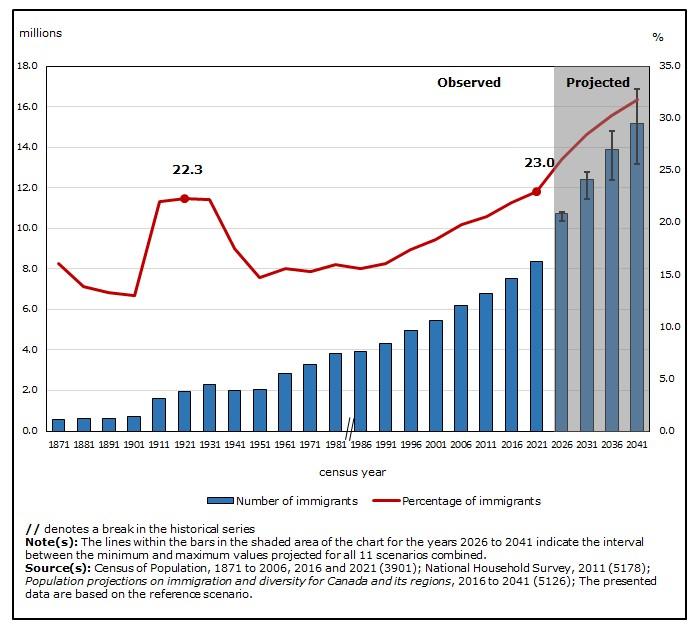
Durant la première décennie du XXe siècle, la plus importante vague migratoire se déploie au pays, et Montréal y participe vigoureusement. Il arrive alors plus de deux millions de personnes au Canada. Entre 1911 et 1931, la proportion d’immigrants dans la population est alors de 22 %, et il faudra près d’un siècle (en 2021) pour retrouver un pourcentage aussi élevé.

Les communautés non catholiques et non chrétiennes sont alors perçues comme « menaçantes », explique M. Anctil, et il n’est pas besoin d’aller très loin pour comprendre « cette hostilité générale à toute forme d’immigration ». Cette méfiance est particulièrement exprimée dans Le Devoir, et de façon parfois très virulente, comme sous la plume du directeur Georges Pelletier dès 1913. Les Juifs sont alors décrits comme « les déchets de l’Europe » qui « vont nous nuire et qu’on ne réussira jamais à assimiler », raconte l’historien. Même à l’aube de la Seconde Guerre mondiale et après, les élites et la population ne souhaitent pas recevoir les victimes du régime nazi.

Il n’y a alors aucun effort qui est fait pour la francisation ou pour intervenir auprès des populations immigrantes afin de les aider à trouver un emploi ou un logement, « parce qu’essentiellement, on jugeait que c’était impossible », note M. Anctil. Il faudra attendre la Révolution tranquille, la création d’un ministère provincial de l’Immigration et la loi 101 pour que le Québec tente de trouver des solutions. Une fois le « quotient religieux retiré », il devient possible de devenir Québécois sans devoir se convertir. La situation globale du français s’est aussi améliorée, soutient le professeur. On le voit lorsque l’on compare les statistiques d’aujourd’hui avec celles des années 1970 et 1980, dit-il.

De concept en concept : absorption, intégration, accueil

Mais pour arriver à l’expression « capacité d’accueil », il faut encore reculer dans le temps. Cette idée que la société, le territoire ou le gouvernement peut recevoir un volume donné de nouveaux arrivants a surgi dans les années 1930 sous l’expression « absorptive capacity ». Elle est principalement utilisée par Mackenzie King, premier ministre du Canada durant trois mandats entre 1921 et 1948, qui cherche à justifier des limites posées à l’immigration.

Mais le terme est alors « vague et indéfini » et prend en compte les naissances en plus de l’immigration, signale Catherine Xhardez, professeure de science politique à l’Université de Montréal. Il n’est alors pas question de tenter d’en faire la comptabilité.

À l’époque, l’expression est aussi tout près des discours sur la possibilité ou non « d’assimiler » culturellement de grandes populations (voir l’encadré). « Dans l’histoire, ce concept de capacité d’absorption se basait sur l’ethnicité, sur la capacité à absorber ces gens non anglo-saxons dans la culture, par exemple », expose quant à elle Mme Paquet, aussi directrice scientifique de l’Équipe de recherche sur l’immigration au Québec et ailleurs (ERIQA).

Ce n’est qu’en 1962 que le Canada élimine les critères raciaux explicites dans sa politique d’immigration. Celle-ci devient alors encore plus foncièrement économique, même si elle cherche déjà depuis la fin du XIXe siècle à pourvoir des emplois précis. Dans ces mêmes années apparaît aussi peu à peu le concept de « capacité d’intégration », surtout au travail, dans le discours. Le taux idéal dépend alors du pouvoir de l’économie à fournir des emplois aux immigrants aux salaires qui ont cours.

En 2010, c’est au tour du Vérificateur général du Québec de reprocher au ministère provincial de l’Immigration de ne pas utiliser « d’indicateurs socioéconomiques pour bien cerner la capacité réelle » d’accueil de la province. « Vous n’évaluez pas les programmes d’immigration et il n’y a pas de suivi », disait en gros le rapport, selon Catherine Xhardez.

« Évidemment, il y a tout un champ d’évaluation des politiques publiques », rappelle-t-elle à propos de sa discipline. Les immigrants ont-ils accès aux mêmes emplois que les natifs ? Ont-ils les mêmes perspectives ou la même qualité de vie ? « Il y a des programmes qui fonctionnent très bien et des résultats sur le terrain. […] Moi, je crois à l’évaluation », dit la professeure.

Mais le débat sur la capacité d’accueil « semble dire autre chose », à savoir qu’un calcul permettrait de faire une prédiction, et non pas d’évaluer des politiques passées. « Il y a des politiques qui fonctionnent bien, il faut le dire, il y a des résultats sur le terrain. Mais il faut aussi pouvoir évaluer des systèmes qui ne fonctionnent pas et dire : “Ici on a investi, mais ça ne donne pas de résultats” », expose-t-elle.

L’insistance sur la capacité d’accueil « vient surtout chercher notre rêve de se dire : l’immigration, c’est compliqué, mais peut-être que si on trouvait la bonne formule, la bonne équation, ce serait mieux », explique Mireille Paquet.

Dans la littérature scientifique, rien ne semble indiquer qu’un « seuil magique » existe ou non, notamment quant à la réaction de la population. « Les backlashs ou les retours de flamme, ce n’est pas un nombre absolu à partir duquel les gens sont fâchés », note Catherine Xhardez. C’est plutôt le rythme d’arrivée, les augmentations subites, et surtout leur médiatisation accrue.

Politisation plutôt que calcul

Les partis politiques jouent un grand rôle en influençant et en donnant les termes du débat, disent ces deux spécialistes. Ensemble, elles ont étudié les programmes des partis politiques entre 1991 et 2018. Elles ont conclu que la Coalition avenir Québec (CAQ) a été un « agent de politisation » de l’immigration dès 2012, lorsque le parti a introduit dans son programme l’idée de diminuer les niveaux d’immigration.

La réduction proposée est de 20 %, pour que ces seuils reflètent « notre capacité d’accueil et d’intégration », est-il inscrit dans son programme.

Dès 2018, la CAQ reproche aussi au gouvernement libéral d’avoir « ouvert la porte à une forte remontée des immigrants temporaires, sans planifier d’aucune façon leur accueil et les impacts sur la langue, le logement ou les infrastructures ». Ce sont d’ailleurs les mêmes critiques qui sont maintenant adressées au gouvernement, alors que les résidents non permanents ont atteint des records.

Ces mêmes critiques leur sont maintenant adressées puisque le sujet de l’immigration temporaire rattrape le gouvernement depuis au moins un an, le nombre de résidents non permanents ayant atteint des records.

Y a-t-il une manière de sortir de la politisation ? La plupart des experts consultés sont incertains quant à la possibilité de calculer la capacité d’accueil. Doit-on la calculer sur une année ? Sur 10 ans ? Jusqu’à quel point les indicateurs peuvent-ils devenir objectifs ? L’appel récent aux projets de recherche diffusé par le ministère de l’Immigration répondra peut-être à certaines de ces questions, mais pour l’instant, ni Mme Xhardez ni Mme Paquet ne connaissent de chercheurs qui se sont lancés.

Source: La capacité d’accueil, un concept qui rebondit à travers l’histoire