Senators challenge name, need for Conservatives’ forced marriage bill

Valid questions:

Senators are questioning both the need for and the name of a new Conservative bill aimed at barring polygamous and forced marriages.

Bill S-7, entitled the Zero Tolerance for Barbaric Cultural Practices Act, makes amendments to immigration and criminal laws.

Immigration Minister Chris Alexander has told a Senate committee studying the bill it is focused on providing added legislative power to stop violence against women.

But Conservative Senator Raynell Andreychuk says if that’s the goal of the bill, perhaps the word violence should have been in the title as too much focus is now on the word barbaric.

Liberal Senator Art Eggleton says that by using barbaric in the title the government is calling cultural communities barbarians, a politically loaded term.But Alexander says it’s the violence against women that is barbaric, not entire communities.

As I noted in an earlier post, a more accurate name would be: Craven Pandering to the Conservative Base and anti-Muslim Sentiment.

Senators challenge name, need for Conservatives’ forced marriage bill | Toronto Star.

Express entry immigration points system revealed before Jan. 1 launch

Factors

Maximum Points

Permanent Job Offer 

600

Core Human Capital

500

– Includes Age

110

– Includes education

150

– Official Languages – First

34

– Official Languages – Second

24

– Canadian work experience

80

Skill transferability factors

100

– Combination of language and Canadian work experience

50

– Combination of Canadian and foreign work experience

50

The details on Express Entry and some of the commentary:

A detailed list explaining how candidates will be ranked and selected based on the factors listed above was published in the Canada Gazette on Monday.

“Research shows these criteria will help ensure newcomers participate more fully in Canada’s economy and integrate more quickly into Canadian society,” Alexander said.

Richard Kurland, an immigration lawyer and policy analyst, has been supportive of some immigration changes made by the Conservatives, including the recent reform to the caregivers program.

However, when it comes to express entry, Kurland is concerned about the lack of openness.

“It is worth a try, but the design flaw is there is no transparency, oversight, or accountability for the operation of the new system. It is a recipe for political interference.”

“The result can be justified in any case, but you will never know why one identically qualified person was selected over another.”

Kurland said the government will in effect have full control in picking the winners and losers rather than processing applications on a first-come, first-served basis — as is the case now.

Morton Beiser, a professor of distinction at Ryerson University and founding director of the Centre of Excellence for Research on Immigration and Settlement CERIS based in Toronto, has been raising questions about the governments shift in policy for some months now.

After reviewing the governments new points system on Monday, Beiser said certain aspects are still unclear.

“Under the old regulations, it was clear that if someone scored above a certain threshold, they were considered eligible to be granted an immigration visa.… Under the current provisions, it’s less clear.”

While Beiser welcomed the say provinces will have about which immigrants come to Canada, hes skeptical of the role employers will play.

“It’s probably a good thing to give provinces more say in the process, but industry? This means that the immigration office becomes a recruitment office,” he said.

Like all policy and program changes, we shall only see in a number of years how well it works, both in an operational sense (6 months to entry) as well as outcomes (how well these immigrants do in the short and medium-term).

And why the Government doesn’t present the system in an easy to read table format as well as the more bureaucratic form in the Canada Gazette is beyond me (I created this simplified table to help me understand how it would work).

Express entry immigration points system revealed before Jan. 1 launch – Politics – CBC News.
CFIB wants temporary foreign workers program replaced by special visa

Interesting change in tone, and linkage to permanent residency:

The Canadian Federation of Independent Business is calling on Ottawa to replace its controversial temporary foreign worker program with a visa that would provide a path to permanent residence for entry-level employees from abroad.

The organization says in a report released today it’s proposing the Introduction to Canada Visa that would address labour shortages for small businesses.

CFIB president and CEO Dan Kelly says the temporary foreign worker program has been legitimately criticized for using TFWs to fill permanent labour market needs.

He adds that small businesses would much rather hire permanent workers, but the immigration system doesn’t allow them to hire people with entry-level skills. The Canadian economy needs workers at all skill levels, Kelly says.

But still hard to see why we need to encourage low-skilled immigration.

CFIB wants temporary foreign workers program replaced by special visa – Macleans.ca.

Chris Alexander’s rocky journey from Kabul to cabinet | Toronto Star

A largely sympathetic portrait of Minister Alexander, balanced with supporters and critics (Konrad Yakabuski’s earlier portrait was sharper in tone Chris Alexander balances his portfolio and power):

But even the brightest and most independent minds must work within the party system in Parliament. “The best ministers are always independent of spirit,” says [ Former PM Joe] Clark. “That doesn’t mean they take on their party or their leader regularly in public debate. I think it’s a characteristic of really any strong minister I’ve encountered and I think Chris brings that capacity to the table.”

Alexander’s response to the question about whether his independent spirit chafes under the parliamentary and party system is deliberate. “We go into caucus, into cabinet, and not everyone agrees. And no one who has been part of a team expects their vision or their priorities to prevail. But this is a strong team because we do work together; we do support each other and we have moved a huge number of issues forward, especially in the area of immigration.

“I have to say there is nothing more satisfying than to be part of Canada’s democracy . . . I think this is the best government we’ve had in Canadian history. And I’m proud to be part of it.

”So does Alexander think he’s reached political superstardom?

“I will leave it to others . . . Voters get the chance to do that every four years.”

Listening to his more inclusive language at the recent Canadian Race Relations Foundation symposium was an interesting contrast to some of his more churlish language when defending government positions (e.g., refugee claimant healthcare coverage, Syrian refugees).

Chris Alexander’s rocky journey from Kabul to cabinet | Toronto Star.

New rules for federal live-in caregivers program

Changes to the live-in caregivers program and reaction from some of the caregiver advocacy groups:

The changes are bad news for caregivers, says Pura Velasco, a spokesperson with the Caregivers Action Centre, a Toronto-based group with 1,000 plus members.

“The pathway to permanent residency has been revoked,” says Velasco, a former caregiver herself. “It’s gone.”

Under the terms of the old program caregivers had a “guaranteed pathway to permanent residency,” Velasco says. But not anymore, thanks to the annual cap.

The caregivers advocacy group says what’s needed is permanent residency upon arrival for all caregivers. It’s the only thing that would protect workers from abuse and allow them to speak up about abuses without risk of deportation.

According to the group’s website, the annual average of caregivers who have come to Canada over the past five years is over 8,000 — well above the cap Ottawa has set.

To qualify for permanent residency caregivers must now have one year-post secondary study in Canada or a foreign diploma or certificate that has been given equivalency here.

Caregivers must also pass stringent language requirements — a Level 5 language test in either English or French, or if the caregiver is a registered nurse or a psychiatric nurse he or she must pass a Level 7 language test.

Under the new program Ottawa has removed the requirement that caregivers must live in — a move that has pleased some.

Level 5 language test is not that stringent (Level 5 – Centre for Canadian Language Benchmark) but the removal of a pathway to permanent residency and the caps will likely have a larger impact.

New rules for federal live-in caregivers program | Toronto Star.

Leaving anti-Semitism and unemployment behind, French Jews make Montreal home | Haaretz

Interesting:

Although up-to-date data on French Jewish immigration does not exist, Monique Lapointe, director of Agence Ometz, Montreal’s primary Jewish social services and resettlement organization, told JTA she has noticed a significant increase in newcomers, especially over the past year. Inquiries, Lapointe said, have poured in through Ometz’s email system and Facebook page — including from French Jews currently living in Israel.

“I wouldn’t say it’s a huge number of [immigrants],” Lapointe said. “But it’s a trend. We’ll be anticipating more.”

Lapointe described the average immigrant as single, between the ages of 25 and 35, “very well educated and looking for a new kind of life.”

The wider Montreal Jewish community, Lapointe said, is now in the early stages of crafting a coordinated approach to handle the inflow. Thus far, it has been difficult to track newcomers, she added, partly because French Jews keep looser ties to Jewish community organizations than do their North American counterparts.

“In France, people don’t talk about Jewishness,” Lapointe said. “They’re not used to community organizations. Some will never come to see us. They don’t have this reflex.”

…The data, however, suggests that Quebec anti-Semitism is on the wane. Last year the province saw its number of reported anti-Semitic incidents fall to 250, a nearly 26 percent drop from 2012, according to B’nai Brith Canada, which tracks anti-Semitic activity across the country.

Leaving anti-Semitism and unemployment behind, French Jews make Montreal home – Jewish World Features Israel News | Haaretz.

Why immigrant kids become homeless: study finds cultural clash with parents is the top reason

Interesting study:

One-third or 65,000 of Canada’s homeless population are youths, and of those, nearly one-quarter were born outside Canada. The study’s definition of homelessness include those staying outside, staying in a shelter or transitional housing, having no fixed address, “couch-surfing” or staying at a friend’s or family’s home.

“Age, gender, race and sexual orientation are among the multitude of factors that shape a young person’s experience of and pathway into homelessness,” says the report, Hidden in Our Midst: Homeless Newcomer Youth in Toronto.

“For newcomer youth, however, it is the juncture of these factors, in addition to the presence of language and cultural barriers, lack of status, personal ties and history in Canada that uniquely situate them amongst the most vulnerable of homeless youth.”

Through partnerships with community groups, researchers interviewed 74 homeless immigrant youth in Toronto — 45 per cent women, 55 per cent men — and surveyed service providers to get a better picture of their needs and support available.

Among the sample of participants, 36 per cent of the youth were from the Caribbean, followed by Africa 27 per cent, the Middle East 10 per cent and South America 9 per cent.

More than half were permanent residents, with 37 per cent being Canadian citizens, 27 per cent somewhere in the asylum process and 7 per cent here on visitor or student visas. Many started becoming homeless at age 17, and the average length of homelessness was 30 months.

More than a quarter of the youth reported previous experience of trauma, such as war and political unrest in their country of origin, while 45 per cent said they had suffered physical abuse and one-third sexual abuse.

Why immigrant kids become homeless: study finds cultural clash with parents is the top reason | Toronto Star.

And the follow-on piece:

Co-ordinated services urged to help young homeless immigrants

Express entry immigration system starts Jan. 1, leaving employers uncertain

Like any new way of doing things, it will take some time to know how well it is working, and whether there are some unforeseen side-effects or changes in behaviour:

The [Canadian Chamber of Commerce’] Anson-Cartwright said that while the government has given employers a first-hand look at the new online system, it will be some time before businesses can say how well the system works at matching skilled immigrants with open jobs.

“The reality is, until we actually have employers experiencing the process, we don’t really know — and neither does the government — how well it will work,” she said.

Employers will not have the same “privileged access” as the provinces and territories, she added.

The provinces will have the option to search the express entry pool, while employers will have to rely on the government to identify potential workers.

“Youd rather see more detail and have a chance to make your own assessment, rather than waiting on individuals to pop up through virtue of how they’ve designed the job system.

“That’s the big uncertainty is how this job-matching system will actually work,” Anson-Cartwright said.

Express entry immigration system starts Jan. 1, leaving employers uncertain – Politics – CBC News.

Douglas Todd: Lessons from U.K. migration debate

One take on the UK’s immigration and related debates in a lengthy discussion between Douglas Todd and Eric Kaufmann, professor of politics at Birkbeck College, University of London:

Where is successful integration occurring in Britain?

The proportion of mixed-ethnicity households doubled between 2001 and 2011, Kaufmann says. “The fastest-growing group in England are those of mixed race who share English descent with the majority.”

Many second-generation immigrants are also integrating. “A significant share of the children of European immigrants and some of mixed-race background come to identify as white British, melting into the majority.”

Also, opposition to immigration is lower in neighbourhoods where a large share of minorities has been present for over a decade, giving people time to habituate to each other.

It is the rapid pace of change, rather than diversity itself, Kaufman says, that is causing most Britons to want to reduce immigration levels.

Douglas Todd: Lessons from U.K. migration debate.

New Canadian immigrants spend 54% more time per day on mobile devices than the national average

Yahoo_Immigrant_JourneyInteresting:

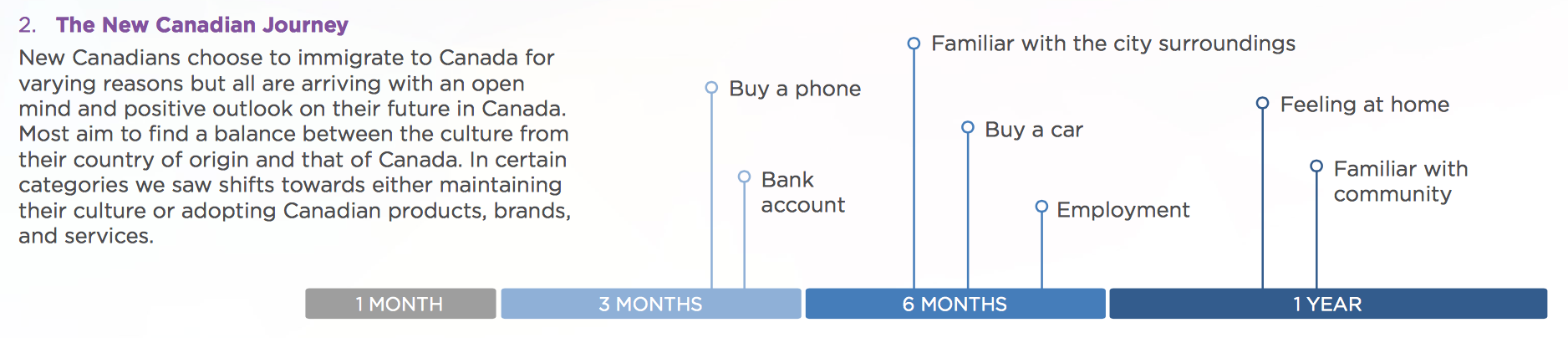
Yahoo Canada has published the results of a study it conducted on mobile usage amongst “new Canadians” – immigrants who have come to Canada in the past five years. According to Yahoo Canada, new Canadians spent four hours per day on their mobile devices, which is 54% higher than the national average of 2.6 hours per day. New Canadians also happen to spend slightly timer per day on tablets as well 1.9 hours compared to 1.5.

New Canadian immigrants spend 54% more time per day on mobile devices than the national average | MobileSyrup.com.