19th-century Toronto Irish immigrants a lesson in upward mobility

A good piece on the history of the Irish in Toronto, the original public fears, and how the Irish community eventually blended in, emerged from poverty, and was no longer was perceived as threat to the majority population:

So how did the Irish emerge from a climate of poverty, hostility and violence that too often defined their lives in Toronto? A range of factors contributed, of course, some hard to replicate in modern-day Toronto, but others more readily at hand.

It surely helped that the Irish spoke English, allowing them to sidestep the language barrier that would slow the integration of later generations of newcomers.

Physical mobility was another Irish advantage. Corktown and neighbourhoods like it may have served as landing pads for the new immigrants, but they rarely stayed in one place for long.

“By the 1890s, they’re everywhere,” said McGowan, himself descended from famine refugees. “If you went to an American city, there would be these long-standing Irish enclaves. You don’t have that here.” This geographic dispersal helped bring Catholics and Protestants into closer contact, driving mutual understanding and even encouraging intermarriage. “Cupid was probably more important than denomination at a certain point,” McGowan said.

At the same time, immigrants from other parts of the world began trickling into Toronto, loosening the Irish monopoly on the fears and resentments of the WASP majority.

“From the 1880s, Toronto started getting immigrants who were even more scary from the majority perspective,” said Allan Levine, author of Toronto: Biography of a City.

“Number one, Catholic Irish immigration peters out, so there are fewer paddies with cloth caps and accents in the downtown area,” said William Jenkins, a professor of North American Irish history at York University, and himself the proud owner of a lilting Irish accent. “People basically just forget about the Irish.”

In the meantime, the community was working doggedly to improve its lot. Mutual aid societies, church parishes, sports teams, card parties, and temperance leagues created a thick support net for Catholics trying to climb the social ladder or simply to avoid destitution.

“They created their own infrastructure,” said Levine. “They looked after themselves.”

19th-century Toronto Irish immigrants a lesson in upward mobility | Toronto Star.

The EKOS poll: Are Canadians getting more racist?

Interesting contrast with annual CIC tracking survey which continues to show stable support for current levels of immigration as per chart below:

CIC_Tracking_Survey

Questions of race and religious dress have rarely been ballot box issues in Canada. Now, however, they appear to be the key factors behind major shifts in the voter landscape.

Visible minorities and Immigration - Ekos

Canada has absorbed a large number of visible minority immigrants over the past twenty years, turning us from a largely white society with ancestry drawn from Britain and France to an extremely heterogeneous one. Initial deep reservations about immigration dropped consistently over that period as we became more diverse. The public embraced the ideal of multiculturalism; dire warnings about ethnic enclaves and a fading national identity never came true. Our research over that period shows national attachment remained very high in Canada, while ethnic identifications actually dropped.

It’s useful to remember how far apart public opinion in Canada and the United States was following the 9/11 terrorist attacks. In both countries there was a sharp, immediate rise in opposition to immigration. In Canada, however, that trend soon dissipated, reaching an all-time low around 2005 — when only 25 per cent of us said there were too many immigrants and less than one in five said that too many immigrants were visible-minority. In the U.S., the level of opposition to immigration was nearly three times higher. Canada remained a nation open to the world: pro trade, pro-immigration and pro-diversity. This seemed to confer both social and economic advantages.

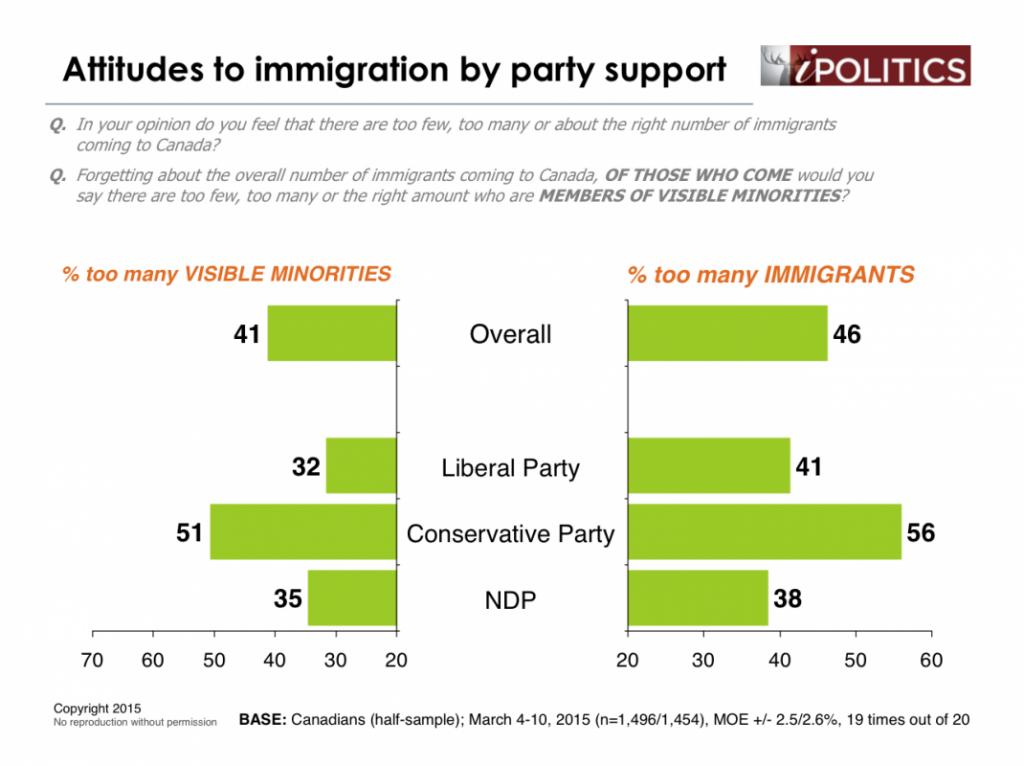
Recent polling shows opposition to immigration has nearly doubled since 2005 and is threatening to crack the 53 per cent level we saw in 1993. Not only is opposition to immigration in general scaling heights not seen in twenty years but the number of Canadians saying we admit too many visible minorities has just cracked the 40-point ceiling for the first time ever.

…When we look at how attitudes on immigration and race spread out among the main federal parties, a pattern emerges. Liberals and New Democrats have no cause to be smug; fully one-third of their supporters think too many of those coming to Canada are visible minorities.

But it’s the Conservative party — which owes much of its current success to wooing votes from new Canadians — that seems to have the problem. Jason Kenney, to his credit, wants new Canadians in his party’s corner. But half of the people who support his party would prefer to see fewer non-white immigrants.

Frank Graves of EKOS polling has some startling new numbers

Germany looks to Canadian model for immigration policy inspiration

More on the debates within Germany and how Canada continues to be looked at as a model – even as the model changes:

For Germany, the debate over how to manage immigration is critical to its future. The country is facing a demographic chasm as the population ages and families shrink. The working-age population will contract by nearly seven million over the next 10 years, according to the proposal by the Social Democrats. Businesses are already complaining about the difficulty of finding highly skilled employees.

For now, Germany is benefiting from a stroke of luck, say immigration experts. As the strongest major economy in the region, it has drawn in skilled workers seeking opportunity from the rest of the 28-member European Union. But if other major European economies start to rebound, such flows will diminish. And that means Germany will have to look beyond the EU for future sources of immigrant talent.

In recent years, Germany has become the second-most popular destination for immigrants worldwide behind the U.S. The country absorbed 437,000 immigrants in 2013, the highest such total in more than 20 years. That figure continued to climb in the first six months of 2014, according to the latest available statistics from the German government.

Yet there is a sense in Germany that the country’s approach to immigration is neither transparent nor efficient. Most new arrivals come from other EU countries, whose citizens face no restrictions on entering Germany or working there. The number of refugees flowing into the country is also rising. Last year the number of new applications for asylum jumped nearly 60 per cent from 2013 to 173,000.

“There is a feeling that the system we have now is not satisfactory,” said Orkan Koesemen, a migration expert at the Bertelsmann Foundation. But the talk of adopting a point system similar to the one in Canada is less about the policy merits than about sending a message, he said. People believe a points-based approach is the equivalent of “let’s select the best and the ones we want.”

While a majority of Germans say they embrace diversity, immigration remains a sensitive topic. A poll released last month by the European Commission found that 61 per cent of Germans held negative views of immigration from non-EU countries. One new way of expressing that unease came in the form of Patriotic Europeans Against the Islamization of the West – or PEGIDA, after its German acronym – a previously unknown right-wing movement that began drawing thousands to its weekly demonstrations.

Looking to Canada, German politicians see an immigration system that is open about its priorities, attracts a large pool of qualified applicants and, most importantly, enjoys widespread domestic support. When the Harper government raised the quota for immigration to Canada for 2015, for instance, it caused barely a ripple.

The Social Democrats, the junior partner in Chancellor Angela Merkel’s coalition government, have formally proposed adopting a points-based system for would-be immigrants. A group of young legislators within Ms. Merkel’s Christian Democratic Union party have also voiced support for such a system, as have the Greens, with some variants. Even a new, conservative euro skeptic party, Alternative for Democracy, says it endorses the Canadian approach. (The far left party in Germany’s parliament, however, rejects it.)

Ms. Merkel reacted coolly to the latest plan, calling the issue of refugee flows more urgent than immigration. And Thomas de Maiziere, the Interior Minister, said the questions raised by the proposal could be addressed with existing laws.

A council of migration experts has asserted that Germany doesn’t actually need a points system like the one Canada has. There is already a way for highly skilled workers from non-EU countries to immigrate, through what’s known as the EU’s “Blue Card” program. Plus, since 2012, the council noted, Germany has relaxed some of its rules: For instance, the country now allows certain kinds of immigrants to enter and search for employment, rather than requiring a job offer ahead of time.

What Germany does need, experts say, is a more welcoming image. To that end, an overhaul of Germany’s immigration law might be a good idea. “I think it’s needed for symbolic reasons, not for factual reasons,” said Christian Joppke, an expert on comparative immigration at the University of Bern. He noted that Germany’s last major legislation in this area, which came into effect in 2005, is officially entitled the Act to Control and Restrict Migration.

Prof. Joppke added that Canada’s government has actually moved its policy a little more in the direction of Germany by placing more emphasis on whether would-be immigrants have job offers.

Germany looks to Canadian model for immigration policy inspiration – The Globe and Mail.

Les immigrantes veulent se faire entendre | Quebec Consultations

On the need for better gender-based analysis and the needs of women immigrants in Quebec:

Les femmes immigrantes ne l’ont jamais eu facile et leur situation ne s’améliore pas. Elles maîtrisent moins le français, sont moins présentes sur le marché du travail, occupent des emplois au bas de l’échelle et sont moins bien rémunérées. « On a l’impression que l’égalité entre les hommes et les femmes prônée au Québec ne s’applique pas quand il s’agit de personnes immigrantes », déplore Yasmina Chouakri, vice-présidente par intérim et ancienne présidente du Réseau d’action pour l’égalité des femmes immigrées et racisées du Québec (RAFIQ).

En février, l’organisme a publié une longue lettre ouverte où il réclame une meilleure prise en compte des besoins des femmes dans les politiques et les programmes d’immigration et d’intégration, de même qu’un financement adéquat pour lutter contre les inégalités dont elles souffrent. Signée par plus d’une vingtaine de groupes de défense des droits des femmes, la lettre se veut un moyen de se faire entendre par le gouvernement québécois, qui tient actuellement des consultations publiques pour son projet de nouvelle politique en matière d’immigration, de diversité et d’inclusion. « À notre connaissance, aucun organisme de femmes immigrantes n’y a été invité », explique Mme Chouakri.

Le RAFIQ demande au gouvernement de mettre en oeuvre une véritable « analyse différenciée selon les sexes », qu’on appelle communément ADS, une approche qui intègre les différences entre les hommes et les femmes au cours de l’élaboration de politiques, de programmes ou de toute autre mesure. Si le ministère de l’Immigration, de la Diversité et de l’Inclusion fait déjà des efforts dans ce sens, tout reste encore à faire, selon Yasmina Chouakri. « Le gouvernement ventile toutes sortes de statistiques pour mettre en relief les disparités hommes-femmes, ce qui demeure important, constate-t-elle. Mais il ne propose rien de concret pour y remédier. »

Les immigrantes veulent se faire entendre | Le Devoir.

What You Need to Know about Changes in the Canadian Immigration Policy : TamilCulture.ca

In the Tamil Canadian press, focus on refugee reform, Temporary Foreign Workers, and the caregiver program:

However, since in power, the Conservative government has incrementally and at times drastically implemented ideologically based policy that has deteriorated core programs and policies that have come to symbolize two aspects of Canada’s national identity: multiculturalism and humanitarianism.

The Conservative governments changes to the refugee determination process, temporary foreign workers program and caregiver program, will have a significant impact not only on refugees, migrant workers, caregivers and immigrant communities, but on also on the demographical landscape of Canada that is reminiscent of past exclusionary policies from a century ago. Instead of moving forward, the Conservatives have decided to take us backwards by eroding fundamental humanitarian programs and migration policies.

What You Need to Know about Changes in the Canadian Immigration Policy : TamilCulture.ca.

New Poll Says Newcomers Outpace Canadian-Born In Saving Their Money | Link Newspaper

Not completely surprising given the risks newcomers take coming to Canada and likely the savings culture that they bring with them. Nice counterpart to the Grubel and Grady studies arguing immigrants are a drain on the economy:

Half (50 per cent) of  those who have lived in Canada for five years or less, say they save more than 10 per cent of their income, compared with 19 per cent of those born in Canada. Only two per cent of newcomers said they save less than one per cent of their income, whereas 28 per cent of those born in Canada make this claim. The research is based on poll respondents who reside in British Columbia or Ontario, two provinces that attract many newcomers.

“Newcomers have a healthy approach to saving, and regardless of income, seem to have a greater focus on putting money away,” says Christine Shisler, Director, Client Strategy, RBC. “While balancing a new life in Canada, newcomers place a priority on savings and financial planning – a solid start to their journey in a new country.”

According to the research, newcomers and those who are Canadian-born share common financial goals for the next five years, such as having enough money to cover daily expenses (77 per cent of newcomers, 75 per cent of Canadian-born) and saving for retirement (67 per cent and 59 per cent respectively). Both groups also aim to pay down non-mortgage debt (52 per cent versus 54 per cent).

While both prioritize saving money to cover daily expenses as a primary goal, the two groups differ when it comes to their financial behaviour:

Not only do newcomers save more of their income, they also have very different savings goals. Newcomers are more likely to place a priority on starting a small business (41 per cent) and education for their children (61 per cent) than Canadian-born respondents (9 per cent and 21 per cent respectively).

New Poll Says Newcomers Outpace Canadian-Born In Saving Their Money | Link Newspaper.

Refugees reporting more income than investor-class immigrants

More evidence on the design flaws of the immigrant investor program. Not sure that the changes will correct the overall picture of lack of commitment and a more instrumental view of immigration and citizenship:

According to CIC, business immigrants have accounted for seven per cent of Canada’s total immigration since 1980 and in 2010 investor-class immigrants — who, as a condition for entrance, were required to prove net worth in the millions and invest $800,000 in Canada — accounted for 88 per cent of all business immigrants.

According to CIC, investor immigrants reported average earnings of about $18,000 in their first year and just $28,000 after 15 years. After three years, only 47 per cent of such immigrants reported any income. The Canadian average is 67 per cent.

After five years, only 39 per cent reported income, suggesting investor immigrants may leave the country (or declare non-residency) after the citizenship process is complete.

Meanwhile, refugees (those who come to Canada under hardship) reported first-year average incomes of $20,000 and after 15 years those incomes rose to $30,000. Two-thirds of refugees reported income by their fifth year, on par with Canada’s average.

More troublesome for Young is that similar rates of income after 15 years are found with the spouses and children of the initial, principal applicant.

“It’s particularly worrisome considering that the biggest cohort (40 per cent) of dependents upon arrival is made up of children aged 10 to 19. These (children) would be 25-34 after 15 years, and should be earning good money. But they aren’t.”

As well, Young adds, “the same phenomenon of a decline in tax-reporting rates could be seen in spouses and children, suggesting some of them, too, head for the exits.”

“The issue is not with immigrants or immigration in general, it is with wealth migration schemes in particular. …Should Canada wait for the grandchildren of investor immigrants to join the workforce before seeing the supposed benefits of millionaire migration?” asked Young on his blog.

Refugees reporting more income than investor-class immigrants

Changing the rules on immigration changes Canada’s narrative – Omidvar

Good commentary by Ratna Omidvar on some of the likely longer-term implications of Express Entry to the Canadian integration and citizenship model, and noting how the selection by employers of immigrants will reflect the same biases as Canadian recruiters:

Enter the Canadian employer who has a job at hand and has permission from the federal government to troll through this pool for a candidate because there is no one else in Canada who can fit the particular bill. The employer picks this one candidate from a pool of many, based on an assessment of the candidate’s profile which includes education, competencies, experience etc. A bit like a blind date, but not quite, because the employer knows where the applicant went to school, where he graduated and where he worked. And so the employer lands on Nigel, because Nigel appears to fit the bill. Whether the employer acknowledges this or not, the fact that Nigel happens to be from a jurisdiction similar to Canada’s, the fact that his mother tongue is likely English, plays a role in the selection. And so apparently does his name.

We know this from research on Australia’s express entry system on which Canada’s model is based. Two researchers, one in Melbourne and one in Waterloo, Ont., found that Australia screened in more immigrants who were strong English speakers. The researchers concluded that the reason express entry immigrants perform better in Australia appears to be because they are Anglophone and because the Australian work force, like Canada’s, is structured to favour the language proficient. Other research from Phil Oreopoulos and Diane Dechief of the University of Toronto, a study titled “Why do some employers prefer to interview Matthew, but not Samir?”, found that English-speaking employers in Montreal, Toronto and Vancouver are about 40 per cent more likely to choose to interview a job applicant with an English-sounding name than someone with an ethnic name, even if both candidates have identical education, skills and work histories.

Let’s get back to Nigel. We know from the evidence that someone like Nigel will hit the ground running and will contribute more quickly to our economy, his own independence and the needs of his employer. But after some time, let’s say six years, Nigel begins to consider whether he really wants to stay. After all, in his own country (likely the U.S., U.K., Australia or New Zealand), he has access to a relatively similar basket of public goods: good schools for his future children, relative peace, security, law and order, and public health care. He is now a citizen of both Canada and country X and so has the freedom of making a choice. Maybe he decides for Canada, and maybe not. If he decides for Canada, bully for us. But that option of returning for him and for his children is always there for him to exercise.

Now let’s get back to our young candidate from Bangladesh and let’s assume he is allowed to stay in Canada because of his Canadian education. He has a more difficult time finding the first job and struggles to get accepted. But over time, and primarily because he does have a Canadian degree, he finds a job and starts to settle in. When he becomes a Canadian citizen roughly five years later, there is not an attractive “return ticket.” The standard of living in Canada is far and away higher. He commits himself to this country fully. He marries, and has children, and if we are to follow trends from the past, his children go on to become successful students at university and join the professional world.

The question is: who serves our needs better, Nigel or Sarmad?

With one we get immediate success and the least amount of pain. With the other, we get long term attachment. The narrative of Canada’s success and exceptionalism in immigration has always been the narrative of success over time. While immigrants struggle in the short term, be it when they came from Eastern Europe in the early 1900s to settle the West or more recently from countries like India, China and Philippines to work in a variety of jobs, it is the long term that is their friend. They become citizens, buy homes, their children go on to become successful and in time many of these children find partners from other ethnicities and races to create a whole new Canada. To a large extent, the hardships they endured in the early years makes their ultimate success as Canadians that much sweeter. They acknowledge in many different ways that it is Canada that has made them successful. And so a new middle class is born in one of many, as Doug Saunders called them, “arrival cities” in Canada.

Changing the rules on immigration changes Canada’s narrative – The Globe and Mail.

Critics call for fine-tuning of federal skilled immigration program (Express Entry)

Some initial comments and suggestions for improving Express Entry:

The decisive factor was securing a positive Labour Market Impact Assessment (LMIA) by a prospective employer to prove a candidate possesses skills that are in high demand.

Successful candidates were those who scored at least 886 points out of a maximum of 1,200. Securing a positive LMIA automatically earned applicants 600 points, while personal attributes such as education, language skills and work experience made up the other 600 possible points.

However, in the aftermath of Ottawa’s temporary foreign worker program controversy, critics say it has become too difficult to acquire an LMIA as officials tighten the screening for assessing if a foreigner’s skills are in demand.

“It’s the first draw under the new Express Entry program and the numbers were quite low. The pass mark was 35 per cent lower than the max. The kick of it is to get a positive LMIA,” said Toronto immigration lawyer Sergio Karas.

“But LMIAs are incredibly difficult to get. It’s such a laborious, time-intensive and complicated process for employers. Service Canada now looks for things to refuse an application. Why would employers spend the time and money on these applications?”

Karas also said that the pool of applicants should be widened by exempting some people from obtaining LMIAs, since workers from countries that have trade agreements with Canada don’t require the documents.

“That includes those who have graduated in Canada and currently hold postgraduate work permits, and those who are here under exempt categories, such as NAFTA professionals and intracompany transferees,” said Karas.

It will be interesting to watch whether or not the cut-off to be selected remains stable at 74% of the maximum number of points or declines (the second draw cut-off was 68 percent, but we need 6 months to start to see a trend line).

Critics call for fine-tuning of federal skilled immigration program | Toronto Star.

New immigration rules risk leaving international students behind

Curious and wonder what the rationale was:

“Students are the worst done by in this Express Entry system because, how do you prove for someone with [little] work experience that there is no Canadian to do the job?” said Evan Green, a partner and immigration lawyer at Green and Spiegel LLP in Toronto.

Students are still able to apply for permanent residence through other avenues, such as provincial nominee programs (PNP), which prioritize applications from international students with Canadian postsecondary credentials and professional work experience. The majority of Ontario’s 2,500 PNP spots are filled by international students, for example.

But tens of thousands of students have stayed in Canada as a result of the federal program, and those spots cannot be transferred to the provinces without negotiations.

The changes to how applications from those eligible under the Canadian Experience Class would be processed were announced last winter but the exact details were only released by Citizenship and Immigration Minister Chris Alexander in early December.

“This is a radical move that is devastating to international students that relied on policies that were put into place by this government to help post-graduate international students transition to permanent residence, based on their findings that these were the best people to adapt to life in Canada,” said Robin Seligman, a Toronto-based lawyer who has international student clients.

Along with removing credit for students for pre-permanent residency time for citizenship, likely reduces the attractiveness of Canada compared to other jurisdictions.

New immigration rules risk leaving international students behind – The Globe and Mail.