Only 1 in 10 candidates invited to immigrate under Ottawa’s new Express Entry system

Only_1_in_10_candidates_invited_to_immigrate_under_Ottawa’s_new_Express_Entry_system___Toronto_StarTeething pains or more substantial issues?

More than 112,700 people applied for permanent residency in Canada under a highly touted new system Ottawa introduced in January — but only one in 10 succeeded in getting an actual invitation to come.

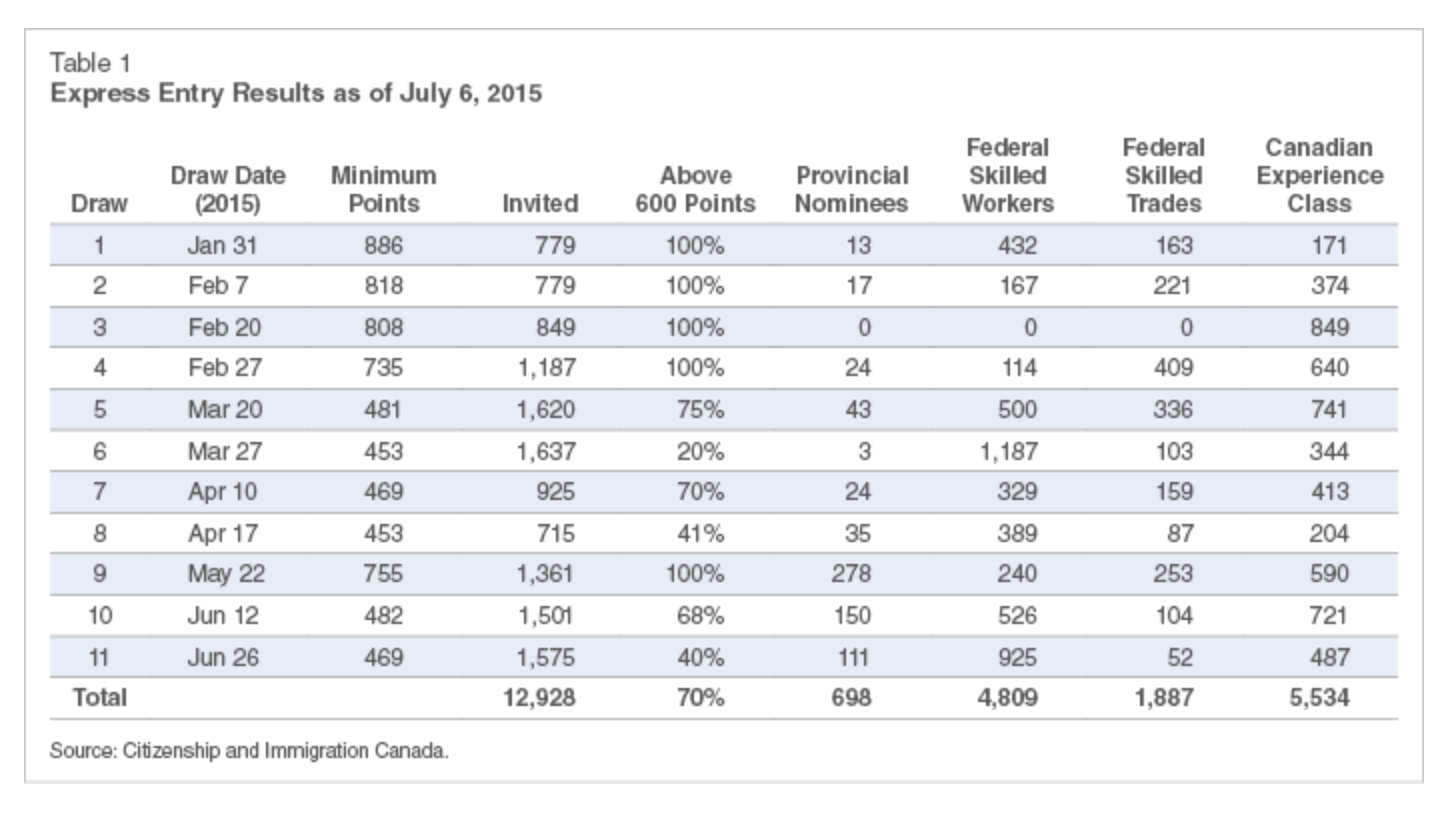
Despite a promise that Express Entry would allow expeditious processing within six months, only 844 permanent resident visas were issued, including both the principal applicant and family members, and 411 people had arrived in Canada as of July 6, according to the program’s six-month review.

More than 85 per cent of the 12,017 candidates selected from the pool were already in Canada on temporary permits at the time of the application. The top five source countries included India, the Philippines, the United Kingdom, Ireland and China.

“It is remarkable that only 844 visas have been issued for a program which has invited over 12,000 people to apply. Within the 844, only 411 have actually used their visas and been admitted to Canada as permanent residents,” said Toronto immigration lawyer Shoshana Green.

“Is 844 visas considered a successful program? With over 85 per cent of the invitations being made for applicants currently residing in Canada, is the world really interested in Canada anymore?”

…In the first six months of the program, 11 rounds of invitations were held, with the cutoff scores ranging from a low of 453 to a high of 886. Some 70 per cent of people receiving an invitation had a score above 600 points, meaning the majority would be coming with an approved job offer.

Critics have argued that meeting the selection cutoff score and being invited does not necessarily mean the best candidates are chosen, as the new system favours those who have obtained the LMIA.

For instance, someone with a total score of 649 can actually be a weaker candidate than someone with 599 points who earned the score strictly from his or her personal attributes — rather than with the boost of 600 bonus points that comes from an approved job opportunity.

According to Citizenship and Immigration Canada’s six-month review, 112,701 candidate profiles were created as of July 6. Some 48,723 were deemed ineligible, and 6,441 were withdrawn.

Among the 41,218 active candidates remaining in the pool, more than half, or 27,000 people, had a score between 300 and 399. Only 355 had a score over 600; 51 had a score above 1,000.

Only 1 in 10 candidates invited to immigrate under Ottawa’s new Express Entry system | Toronto Star.

Hungary’s future: anti-immigration, anti-multiculturalism and anti-Roma?

Commentary on Hungary’s increasing anti-immigrant and anti-multicultural policies and practices:

Hungary has recently passed new legislation tightening asylum rules and is now building a border fence along the Serbian border to keep migrants and refugees out. Hungary’s prime minister, Viktor Orbán, believes Hungary cannot cope with any immigration, as it has no experience of ‘multiculturalism’. But Hungary has always been multicultural, with Roma and other minorities making up 10-12% of the country’s citizens.

Viktor Orbán’s campaign against migrants to Hungary was already in full force before he started to build a 4 metre-high fence along the 110-mile border with Serbia. In May this year his government, Fidesz, sent a questionnaire to every household as part of a ‘National Consultation on Immigration’. This included skewed questions clearly linking immigrants to terrorism, such as: “There are some who think that mismanagement of the immigration question by Brussels may have something to do with increased terrorism. Do you agree with this view?” Reportedly costing 1 billion forints (EUR 3.2m), the consultation bizarrely cost far more than any money put aside for managing immigration.

New waves of migration are a contemporary issue for Hungary – Hungary has become a major transit country for migrants. In the last six months alone a reportedly 71,200 migrants entered the country. This article doesn’t question the scale or potential problem this poses for Hungary, what it does question is the speed and force with which Orbán’s governing party Fidesz has taken up an anti-immigration stance, and how this stance is being linked to anti-Roma (or anti-Gypsy) discourse.

This article argues that Orbán’s focus on immigration has emerged and become a diversion from the deep inequalities, extensive oligarchic type of state corruption and daily police and institutional harassment that many Hungarian citizens (whether Roma or not) are currently facing.[1] Racism against Roma – or ‘Romaphobia’ – adds a particular negative political and media sting that further destabilises Hungary’s already intercultural, but frequently divisive, society. Not facing these problems, we argue, will make any new migration flows and the potential for their future integration impossible to deal with.

Hungary’s future: anti-immigration, anti-multiculturalism and anti-Roma? | openDemocracy.

Millionaire migration to Canada didn’t fall after investor scheme’s axing – it rose, new data reveals | South China Morning Post

Millionaire_migration_to_Canada_didn_t_fall_after_investor_scheme_s_axing_-_it_rose__new_data_reveals___South_China_Morning_PostMore on the Investor Immigrant Program and how Quebec continues to encourage investor immigration through its own program:

Citizenship and Immigration Canada (CIC) spreadsheets demonstrate that, yes, immigrant investor visa approvals under the federal IIP plunged 42 per cent as the scheme  wound down, falling to a mere 2,541 applicants and family members in 2014.

Yet, astonishingly, overall investor immigrant approvals nationwide were up by 7.2 per cent, hitting 8,762 approvals, the most since 2011.

How? Because, even while Ottawa was hitting the brakes on millionaire migration, the province of Quebec (which runs its own IIP) was hitting the accelerator. And l’accélérateur was winning.

In 2014, Quebec approved a bumper 6,221 millionaire migrants and family members, a whopping 62 per cent increase compared to 2013. It was a near-record year, surpassed only by the 6,292 approvals in 2011.

Quebec’s programme matters to Vancouver, because 89 per cent of Quebec investor immigrants do not end up living there, according to federal data. Most likely end up in Vancouver, assuming those 89 per cent disperse in a fashion similar to their counterparts in the federal scheme.

At this point thanks should go to Richard Kurland, the Vancouver immigration lawyer who has been a relentless pursuer of data that CIC does not prefer to release as a matter of course. The CIC spreadsheets that he shared with me this week were only obtained under access to information requests.

The spreadsheets demonstrate in clear fashion how Quebec has historically approved a majority  of Canada’s millionaire migrants, and has likely approved a majority of those who end up in Vancouver. From 2002 to 2014, Quebec approved 65,151 investor migrants, compared to 45,294 okayed under the federal IIP.

Millionaire migration to Canada didn’t fall after investor scheme’s axing – it rose, new data reveals | South China Morning Post.

10 chiffres qui vont vous surprendre sur l’immigration en France

Apologies for the capitalization but the original site had these all in caps and I couldn’t find an easy way to reformat.

Good and interesting data:

  1. CHAQUE ANNÉE EN MOYENNE, ENTRE 2004 ET 2012, 200 000 IMMIGRÉS SONT ENTRÉS EN FRANCE, SOIT MOINS QUE LA MOYENNE DES PAYS DE L’OCDE.
  2. 226 FILIÈRES D’IMMIGRATION CLANDESTINE ONT ÉTÉ DÉMANTELÉES EN 2014
  3. 63 % DES IMMIGRÉS ENTRÉS EN FRANCE EN 2012 SONT AU MOINS TITULAIRES D’UN DIPLÔME DE NIVEAU BACCALAURÉAT
  4. 40% DES IMMIGRÉS DE PLUS DE 16 ANS, NON ÉTUDIANTS, ENTRÉS EN FRANCE EN 2012, DÉCLARAIENT AVOIR UN EMPLOI L’ANNÉE DE LEUR ARRIVÉE.
  5. DANS L’ENSEIGNEMENT SUPÉRIEUR FRANÇAIS, 289 274 ÉTUDIANTS SONT DE NATIONALITÉ ÉTRANGÈRE (⅛)
  6. LE “PASSEPORT TALENTS” OUVRIRA UN DROIT AU SÉJOUR VALABLE JUSQU’À 4 ANS
  7. LA FRANCE A ENREGISTRÉ 64 310 DEMANDES D’ASILE EN 2014 (Germany 202,815).
  8. LA RÉFORME DE L’ASILE PERMETTRA DE RÉDUIRE LE DÉLAI D’EXAMEN DES DEMANDES À 9 MOIS (reduction from current 2 years)
  9. EN 2014, 105 613 PERSONNES ONT ACQUIS LA NATIONALITÉ FRANÇAISE.
  10. PRÈS D’UN IMMIGRÉ SUR DEUX ENTRÉ EN FRANCE EN 2012 EST NÉ DANS UN PAYS EUROPÉEN, contre trois sur dix dans un pays africain.

10 chiffres qui vont vous surprendre sur l’immigration en France | Gouvernement.fr.

Foreign caregivers face lengthy wait for permanent status

More challenges for CIC:

It’s taking twice as long for foreign caregivers to get permanent resident status in Canada as it did a year ago despite Ottawa’s promise to expedite the process.

According to an immigration department internal memo titled “advice to minister,” the processing time for caregivers’ permanent residency reached a record 50 months in January, up from 26 months a year ago. That’s on top of having to work two years alone in Canada — separated from family — in order to meet the residency requirement.

Immigration officials are still wrestling with a huge backlog. As of February, more than 17,600 caregivers who had met the work requirement — down from a peak of 24,600 last year — were still waiting in the queue to be reunited with their spouses and children living abroad.

Delays in granting permanent status and reuniting families often lead to family breakups and cause other adjustment problems for caregivers’ children, including high school dropout rates, said immigration lawyer Richard Kurland, who obtained the government memo.

“Caregivers waiting for PR (permanent residency) are unfortunately subject to longer processing,” said Kurland. “In the long term, it’s going to have expensive consequences.”

Ottawa introduced two new caregivers programs in November to replace the decades-old live-in caregivers program. The two programs — designed to bring in caregivers for children and people with high medical needs — remove the live-in conditions but are limited to a combined 5,500 applications a year.

“We have improved the program to make it faster, safer and provide better career opportunities for caregivers across Canada,” Kevin Menard, spokesperson for Immigration Minister Chris Alexander, told the Star.

“We have taken aggressive action to reduce backlogs by planning 30,000 caregiver admissions this year alone, an all-time record, and we will completely eliminate it by the end of 2016.”

Foreign caregivers face lengthy wait for permanent status | Toronto Star.

Foreign students denied work permits over ‘distance learning’

Interesting example of how regulations have to respond to technological and business model changes (my bias is for physical over virtual presence as a means to obtain Canadian experience):

Foreign graduates from Niagara College who have taken many of their courses online are faced with having to leave Canada early because they’ve been deemed ineligible for post-graduate work permits.

With online courses becoming an increasingly mainstream part of higher education, their exclusion from the three-year work permit program for new graduates — meant to retain the talents of the best students coming to Canada — raises questions about how well immigration policy is adapting to evolving technologies.

The students in the school’s general arts and sciences program had high hopes of earning Canadian work experience after their study visas expired, given that the school is listed on Citizenship and Immigration Canada’s “designated learning institutions list” for the work permit program.

But they were told their studies failed to meet the requirements because the bulk of their classes were conducted online and considered “distance learning.”

“Immigration is not keeping pace with the changes of education,” said Toronto immigration lawyer Ravi Jain, who is representing more than 50 of the affected students. “These are highly attractive programs, and (foreign) students have to be careful about these online programs.”

Although the Immigration department states on its website that distance learning is ineligible for post-graduation work permits, it does not define what constitutes distance learning. Complaining students said the Niagara College program delivered three-quarters of its course work online, but they had to attend the program in-class at least once a week.

“We all came with a dream of getting a good education and getting work experience, and we made sure our school was recognized by immigration,” said Jagrit Sahni, 25, whose study visa expired in May.

“We checked with the college when we applied. It said we would qualify for a three-year work permit under the current immigration rules.”

Foreign students denied work permits over ‘distance learning’

Kolton Stewart helps Temporary Foreign Workers after fire | Simcoe Reformer

Nice story about the local community getting together to help temporary foreign agriculture workers from Jamaica rebuild their bunk house after a fire:

Some old-fashioned Canadian star power has been brought to bear on the unfortunate plight of six offshore workers who lost everything in a bunkhouse fire last week.

Actor-musician Kolton Stewart, 16, of Lynedoch, happened to be passing through Vanessa last Tuesday when he saw the smouldering ruins of a bunkhouse at the farm of Jim and Karen Atkinson.

It piqued his curiosity. Stewart later learned that the six men who lived in the structure lost everything they had accumulated since they arrived four months ago. Damage to the bunkhouse was pegged at around $20,000 while lost contents amounted to about $140,000.

Stewart – the star of the successful YTV sit-com Some Assembly Required – has lent his name to a Go Fund Me campaign whose goal is to reimburse the workers for their losses. Interested donors can learn more at Stewart’s Facebook page.

“It’s pretty devastating,” Stewart said at the scene Saturday. “We’re trying to raise awareness.”

Stewart has contributed $500. During his visit with the victims Saturday, he also gave the men pre-paid grocery cards.

The Atkinsons’ insurance company will cover the bunkhouse but not its contents. As for the latter, there was quite a bit.

Like many offshore workers, the six men from Jamaica plow most everything they earn into purchases that they ship to their families back home. Numerous plastic barrels inside the bunkhouse were loaded with clothing, electronics and non-perishable food items. All were destroyed.

Kolton Stewart helps workers after fire | Simcoe Reformer.

Catching up: Stories that caught my interest

While I have not been blogging over the past month, I have been following events and these stories and reports caught my eye.

From a general perspective, the Environics Institute latest Focus Canada annual survey showed continued strong support for immigration and multiculturalism, including some notable increases in support (e.g., general support for multiculturalism, reduced fear immigrants not adapting to Canadian values, that immigrants can be as good citizens as Canadian-born) along with increased recognition of discrimination and the need for policies and programs to address it.

Jeffrey Simpson in the Globe reminded us of just how successful the Canadian model of citizenship, immigration and multiculturalism has been.

Citizenship

The Canadian government launched its first revocation proceeding, selecting Hiva Alizadeh as the test case given that he is a dual national of Canada and Iran, was tried and convicted in a Canadian court where he pleaded guilty (avoiding many of the issues raised during C-24 hearings regarding due process in foreign courts).

The remaining provisions of the changes to the Canadian Citizenship Act came into force on June 11, provoking the usual stories about how some were affected by the date chosen (no matter which date was picked, there would always be some affected by the transition. The release of ATIP documents on the Citizenship Act consultations revealed that ethnic groups were particularly concerned about longer residency requirements and increased fees, with some concerned about revocation, and many questioned why advertising was focussed on revocation provisions rather than the changes they were concerned about.

Minister Alexander’s Canada Day message repeated the historic naturalization rate of over 85 percent, despite his department knowing that the recent rate is lower. His conflating of niqab-wearing women with terrorists and his highly selective citing of Liberal government restrictions on immigration and related discriminatory practices were savaged by some commentators.

CIC has yet to provide an explanation for the significant drop (over 30 percent) in the number of citizenship applications in 2013 and 2014 (Full 2014 Citizenship Statistics: Declining Applications).

The Australian government, despite a vigorous internal debate on citizenship revocation, appears committed to a fairly draconian approach, applying to both single and dual nationals and the children of those convicted.

Multiculturalism

The usual Multiculturalism Day messages by political parties, with the Government (Ministers Kenney and Uppal) emphasizing “peaceful pluralism and ordered liberty,” sport and “the values of freedom, democracy and the rule of law” (no mention of human rights), the NDP Multiculturalism Critic emphasizing “tolerance, understanding and equality” and the Liberal Party leader emphasizing “acceptance, fundamental freedoms, and mutual respect.”

The Government reversed a new policy requiring “pat-downs” of turbans, following protests by Canadian Sikhs (likely reflecting their political importance), leaving Minister for State for Multiculturalism Uppal to explain why an exemption for one form of religious headgear (the turban) and not another (the niqab). While there is a difference between covering one’s hair and covering one’s face, ironic that this decision took place in the same month as families of the Air India bombing commemorated the 30th anniversary, the largest terrorist attack in Canadian history with some families noting that some temples have pictures of the Sikh mastermind behind the bombing.

A thoughtful discussion of the challenges health care professionals face in dealing with accommodation requests for different groups, and the processes used to decide what can be accommodated and what not.

Declining support for immigration and multiculturalism post 9/11 and 7/7 in Britain was significant (56 percent in 2015 believe multiculturalism makes Britain worse compared to 32 percent in 2001).

Meanwhile, French Prime Minister Walls notes that Islam is “here to stay in France” while highlighting unacceptable behaviour (antisemitism and hate speech). In addition, despite the formal separation of church and state in France, some have initiated programs to have a more open approach to discussing religion in schools.

In a significant discrimination case, the US Supreme Court ruled that the actual results of policies and programs trumped the intent of these policies, providing a basis for challenging systemic racism and discrimination in future cases.

Canadian antisemitic incidents are reported as rising given B’nai Brith reports (which contrast with Statistics Canada police-reported hate crimes report which show a decline).

An interesting opinion piece that tries to assess the boundary between criticism of Israeli policies and antisemitism provided some nuance to debate on either side of the issue. As Israeli governments provide more support to the Israeli Rabinate, a divide may be emerging between American Jews and Israel.

A good discussion on some of the issues around providing Holocaust education to German Muslims, how it gets tied to the general Israel-Palestine issue, and the efforts by the German government to develop programs to reduce radical Islam by establishing centres for the study of Islam. Meanwhile, the Netherlands postpones the release of a report showing antisemitism among Dutch Muslim youth.

An account of how “trying white food” is part of the experience of children of immigrants, which complements the increased interest by “white people” in ethnic food, highlights one aspect of integration.

Google quickly learns the limits of its image recognition software when its software labels Blacks as gorillas, but quickly deletes the gorilla label as an interim step to ensuring better image recognition. Appears that software too can be subject to implicit bias and should be made to take the Implicit Association Test (IAT).

New Canadian Media held its first workshop for integration and settlement agencies on how to engage the mainstream media in ethnic community issues.

An amusing yet relevant discussion on when multiculturalism advertising can become offensive, using examples from the 1970s (particularly McDonalds and advertising targeted to Black Americans) and some tips to avoid crossing the line.

Following months of wedge and identity politics around Canadian Muslims (the most recent being the Bill tabled just before the House rose banning the niqab at citizenship ceremonies) and the threat of Islamic-inspired extremism, the PM makes a more positive gesture in hosting an Iftar dinner at 24 Sussex.

President Obama delivers one of his best, and arguably one of the best ever, speeches on racism in America and the need for action in his eulogy at the Charleston funeral for those gunned down by a white extremist. Worth taking the time to view in its entirety:

https://www.youtube.com/watch?v=RK7tYOVd0Hs

Nell Painter, recapping some of her insights of her book The History of White People, notes that “whiteness” is often defined by what it is not (“blackness”) and that we need to move beyond such binary expressions of identity.

Extremism

A reminder that right wing extremism has been a greater threat in North America than Islamic-inspired extremism provides again a note of nuance to current security and related debates.

A Canadian government-funded study demonstrated that there are various paths to radicalization, showing that despite rhetoric, the Government is sponsoring sociological research.

An interesting counterpoint to ISIS/ISIL’s destruction of non-Islamic (and non-Sunni) monuments can be seen in Israel considering restoring the historic Islamic site of Khirbat al-Minya, the ruins of an Umayyad palace complex on the northern shore of the Sea of Galilee.

Immigration

As been mentioned before, and as apparent in the analysis I did for my forthcoming book (Multiculturalism in Canada: Evidence and Anecdote), immigration is becoming increasingly dispersed beyond the larger urban centres, given housing costs and economic opportunities.

An ATIP request indicates profiling and bias in CIC’s review of potential marriage fraud, although the guide has subsequently been revised, with examples highlighting the extensive documentation required.

Following the Toronto police carding debate, and likely other but less high-profile debates elsewhere in Ontario, the Ontario government decides to develop and implement a province-wide policy.

The Quebec government provided fewer resources to organizations delivering integration courses as part of overall austerity measures.

Other immigration stories of interest included accusations of racial profiling of Roma travellers and the effective ending of the live-in-caregiver program and the impact on childcare needs,

Other

Rick Salutin wrote a good piece looking at the history and definitions of “barbaric cultural practices” providing perspective on the current government fetish to use the term for political marketing purposes.

Daniel Savoie had his usual biting commentary of some of the weaknesses of current governments and their apparent inability to deliver programs and policies effectively.

The issue of Saudi financing of Islamic religious schools in Canada was reported on, with little indication that this funding was influencing the curriculum and approach (largely appeared to be for buildings and other infrastructure).

As part of Canada Day reporting, CBC interviewed foreign academics on their views on how Canada was perceived abroad, highlighting their assessment that it had worsened, not surprising given their more centrist and left-wing perspective. The cut to the Canadian Studies Abroad program in 2012 was again lamented.

Sadly, but not surprisingly, the Government does not make any changes to the mandatory Census questions that would improve the quality of the data, and continues with the voluntary NHS approach.

Will be back to my regular posting schedule on Monday.

The wrong way to tackle forced marriages: Porter

Good commentary on how to address forced marriages — not by criminalization but by education, awareness and protection:

Besides being unenforceable (if proving rape is difficult, imagine proving beyond a reasonable doubt that a person knew the bride had not consented), survivors like Sajiha say the bill is potentially harmful.

“Even when I was 10 or 13, I wouldn’t have wanted to put my family in jail,” she said. “My family was my everything.”

That’s a common story among young women who have escaped forced marriages, said Deepa Mattoo, a lawyer with the South Asian Legal Clinic, who works on cases of young women concerned they will be forced into marriage, or struggling to return to Canada, having escaped a forced marriage “back home.”

“Lots of girls I’ve worked with, they don’t want to leave their families,” Mattoo said. “They just want the situation to go away.”

A study Mattoo co-led from 2010-2012 found 219 cases of forced marriage in Ontario over three years. The majority of victims were women between 18 and 34 years old. About half were citizens, while the other half were permanent residents. Most experienced other forms of family violence — threats, physical violence, sexual violence and stalking. Almost half of them were entirely dependent on their families financially.

While the majority were Muslim, many were Hindu, Sikh and Christian.

“The law in Canada creates a narrative that this is a problem about faith and community,” said Farrah Khan, a counsellor with the Barbra Schlifer clinic. “It’s violence. That’s the problem.”

For the past two years, Mattoo and Khan have been training social workers, guidance counsellors, police officers and other service providers across Canada about forced marriage — how to detect it and how to devise safety plans for young women who sense they’ll be victims.

The solution, they say, is public education and a safety net for women fleeing attempted forced marriages.

Money should be put into counselling services, they say.

If any laws are passed, they should be ones that insist shelters accept young women escaping attempted forced marriages (many still don’t, according to both Khan and Mattoo), and social workers bump them to the top of the waiting list for social housing, as women fleeing family violence. (It now depends on the worker, Khan and Mattoo said.)

Those were among the recommendations made at the end of Mattoo’s groundbreaking report.

What was the final recommendation?

“Do not criminalize forced marriage as a separate criminal code offence.”

That would create stigma and push victims underground, it said.

Funny that Alexander didn’t speak to the women he’s busy trying to save.

The Zero Tolerance for Barbaric Cultural Practices Act has passed through the Senate and two readings in the House of Commons. Alexander expects it to become law later this month, his spokesperson says.

The wrong way to tackle forced marriages: Porter | Toronto Star.

Why Reconciliation for Aboriginal Peoples Should Matter to New Canadians – New Canadian Media

Ranjit Bhaskar commentary on the TRC recommendations regarding new Canadians:

The broader hope is if Canadians have more knowledge of indigenous history, they will have a better understanding of the current policy disputes between governments and Aboriginal Peoples over natural resources, education and child welfare.

Of significant importance for new Canadians is the last two of the TRC’s 94 Calls to Action. The penultimate recommendation, “call[s] upon the federal government to revise the information kit for newcomers to Canada and its citizenship test to reflect a more inclusive history of the diverse Aboriginal [P]eoples of Canada, including information about the Treaties and the history of residential schools.”

Perhaps it is time for new Canadians themselves to insist on being better informed of an inconvenient truth to better appreciate the travails of indigenous people – essential because we cannot cherry-pick the history we inherit.

The last recommendation urges Ottawa to replace the current Oath of Citizenship with one in which new citizens swear to faithfully observe the laws of Canada, “including Treaties with Indigenous Peoples.”

A timely reminder of not just building a nation-to-nation relationship between Aboriginal Peoples and the Crown that respects the promises of historical treaties, but also for resetting relationships between the First Nations and the “latest nations.”

The two recommendations are a call to remember the injustices inflicted on one of the founding peoples of Canada now that we are slowly, but surely, coming to know about the other history. The part of our collective past not taught in schools, not part of the citizenship test and not part of the “Welcome to Canada” package.

Time to remember the more than 6,000 aboriginal children who never returned to their homes after being sent to residential schools by the Canadian government.

And perhaps it is time for new Canadians themselves to insist on being better informed of an inconvenient truth to better appreciate the travails of indigenous people – essential because we cannot cherry-pick the history we inherit.

…. Far too many Canadians, including many peoples of colour and First Nations themselves, are unaware of the Canadian history of colonization of the indigenous peoples and the exclusion of communities of colour. Instead, we need to invest in our collective understanding and put a halt to an enforced mass ignorance to change the way we look at each other, talk to each other and talk about each other.

Dialogue can hopefully foster positive relationships among indigenous peoples and newcomers to help bring about justice and equality for all. Reconciliation for indigenous people is an important first step towards that goal.

Why Reconciliation for Aboriginal Peoples Should Matter to New Canadians – New Canadian Media.