How Billionaire Techies Hope To Reshape The US Immigration Debate : NPR

Needed antidote to much of the rhetoric in the US, and a natural for the tech industry given their need for talent:

The immigration-reform advocacy group founded by Facebook’s Mark Zuckerberg — FWD.us (pronounced “forward U.S.”) — and funded by fellow Silicon Valley entrepreneurs including Microsoft’s Bill Gates and Yahoo’s Marissa Mayer — is rolling out a plan for the 2016 election that will include “substantial” investments in battleground states.

This primary campaign season, the immigration conversation has been dominated by hard-line rhetoric about border walls, mass deportations and birthright citizenship, and now Donald Trump’s Muslim immigration ban. FWD.us says it’s trying to refocus the conversation on comprehensive immigration reform.

“We are making the case over the next year that immigration reform needs to be something that gets done right away under the next presidency,” said
Todd Schulte, president of FWD.us. “That starts with making clear the awful and absurd policies of mass deportation that we’re hearing.”

FWD.us won’t be targeting a particular candidate. But with a focus on mass deportations, it’s clear one immediate target for these tech billionaires is a fellow billionaire — Donald Trump, and the immigration rhetoric his campaign has sparked this primary season.

“The stakes are incredibly high,” said Schulte. “Embracing this mass deportation agenda is absolutely toxic.”

Schulte said the rules of the game have changed since the 2014 midterms, and this election cycle, there’s a whole new side to the immigration debate.

FWD.us would not disclose its spending plans, but it is considered the most well-funded immigration reform group in the country.

In 2013 and 2014, FWD.us spent $10 million on digital, radio, tv and cable advertising, according to a spokesman with the group. Schulte said the group intends to spend similar amounts of money this election cycle. Records indicate it also spent $1.3 million on lobbying activities in 2013 and 2014.

“One role that FWD.us did is put a big voice out there on TV, with a serious amount of money behind it, to fill a void that otherwise exists on the campaign airwaves,” said Elizabeth Wilner, who tracks campaign ads with the research firm Kantar Media. “It’s not typical of something we’ve seen in the past,” she added. “It’s only fairly recently that business has made it their business to take a side.”

The group’s current mission this election season does not focus on huge ad expenditures; instead, FWD.us is working on voter education through research, engagement and polling, with just one lofty goal in Schulte’s words: “Pass immigration reform right out of the gate under the next president, plain and simple.”

FWD.us launched in 2013 with a splash (and an estimated $50 million). It was considered an ambitious big-money venture with the potential to legitimately move the dial on comprehensive immigration policy overhaul.

“In a knowledge economy, the most important resources are the talented people we educate and attract to our country,” Zuckerberg wrote in an op-ed announcing the group. “A knowledge economy can scale further, create better jobs and provide a higher quality of living for everyone in our nation.”

Source: How Billionaire Techies Hope To Reshape The Immigration Debate : NPR
Trump’s Anti-Muslim Plan Is Awful. And Constitutional. – Peter Spiro, The New York Times

Good piece by Peter Spiro on the constitutionality of race or religion-based immigration restrictions:

In the ordinary, non-immigration world of constitutional law, the Trump scheme would be blatantly unconstitutional, a clear violation of both equal protection and religious freedom (he had originally called for barring American Muslims living abroad from re-entering the country as well; he has since dropped that clearly unconstitutional notion). But under a line of rulings from the Supreme Court dating back more than a century, that’s irrelevant. As the court observed in its 1977 decision in Fiallo v. Bell, “In the exercise of its broad power over immigration and naturalization, Congress regularly makes rules that would be unacceptable if applied to citizens.”

The court has given the political branches the judicial equivalent of a blank check to regulate immigration as they see fit. This posture of extreme deference is known as the “plenary power” doctrine. It dates back to the 1889 decision in the Chinese Exclusion case, in which the court upheld the exclusion of Chinese laborers based on their nationality.

Unlike other bygone constitutional curiosities that offend our contemporary sensibilities, the Chinese Exclusion case has never been overturned. More recent decisions have upheld discrimination against immigrants based on gender and illegitimacy that would never have survived equal protection scrutiny in the domestic context. Likewise, courts have rejected the assertion of First Amendment free speech protections by noncitizens.

Nor has the Supreme Court ever struck down an immigration classification, even ones based on race. As late as 1965, a federal appeals court upheld a measure that counted a Brazilian citizen of Japanese descent as Asian for the purposes of immigration quotas.

In the context of noncitizens seeking initial entry into the United States, due process protections don’t apply, either. This past June, the court upheld the denial of a visa for the spouse of an American citizen based on the government’s say-so, with no supporting evidence.

The courts have justified this constitutional exceptionalism on the grounds that immigration law implicates foreign relations and national security — even in the absence of a specific, plausible foreign policy rationale. The 1977 Fiallo case, for instance, involved a father seeking the admission of his out-of-wedlock son from the French West Indies — hardly the stuff of national interest.

Indeed, contrary to the conventional understanding, President Trump could implement the scheme on his own, without Congress’s approval. The Immigration and Nationality Act gives the president the authority to suspend the entry of “any class of aliens” on his finding that their entry would be “detrimental to the interests of the United States.” President Obama has used this to the better end of excluding serious human rights violators.

But here’s the interesting thing: Just because Mr. Trump’s proposal has a judicial pedigree, that doesn’t make it “constitutional” in a broader sense. The Constitution and the courts are not synonymous, nor do the courts have a monopoly on constitutional interpretation. Politicians, the legal community, scholars and the public at large are all a part of our continuing constitutional conversation. Clear popular consensus can establish constitutional norms, with or without the courts.

The leading example comes out of the internment of Japanese-Americans during World War II. The Supreme Court upheld the internment in its 1944 Korematsu decision, and that ruling has never been judicially reversed. Technically, it remains good law. But it has been effectively overridden by other actors, and in the court of public opinion. A formal apology and payment of reparations, enacted by Congress and signed into law by Ronald Reagan in 1988, supplies the formal evidence. Korematsu continues to provoke popular shame.

We may be seeing that same shame at work today. Mr. Trump’s plan has triggered an uproar across the partisan divide. Perhaps a religion-based immigration bar may be consistent with court-made doctrine. But it doesn’t reflect our deeper, broadly assimilated understandings of the Constitution.

Source: Trump’s Anti-Muslim Plan Is Awful. And Constitutional. – The New York Times

Donald Trump’s no-Muslims immigration idea right in line with U.S., Canadian history

Canada, of course has its equivalents (Chinese head tax and related restrictions, World War 1 internment, Continuous Journey clause, Japanese World War 2 internment, restrictions on Jewish immigrants etc):

1.Chinese Exclusion Act of 1882

exclusion_act

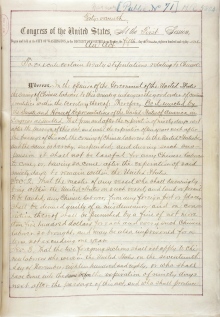
The first page of the Chinese Exclusion Act of 1882. (U.S. National Archives and Records Administration)

The first major law restricting immigration to the U.S. was the Chinese Exclusion Act, which barred all Chinese people from entering the United States.

Signed into law on May 6, 1882, the act came amid outcry from American-born citizens that Chinese workers were to blame for the high unemployment and declining wages plaguing the West Coast.

Not only did the law bar Chinese immigration, but it also prevented Chinese people already living in the country from gaining citizenship.

The law, originally written to last 10 years, was repeatedly amended and extended until its repeal in 1943, when China became an ally against Japan during the Second World War.

2. Immigration Act of 1917

This U.S. federal law was the first to restrict immigration to those who could pass a literacy test.

It also banned all immigration from the so-called “Asiatic Barred Zone,” which encompassed  India, Afghanistan, Persia (now Iran), Arabia, parts of the Ottoman Empire and Russia, Southeast Asia and the Asian-Pacific islands.

Furthermore, it expanded an already-existing category of barred “undesirables” to include sex workers, criminals, alcoholics, political radicals, contract labourers, “idiots, imbeciles, and [the] feeble-minded,” people with epilepsy, tuberculosis or contagious disease, as well as anyone else deemed “mentally or physically defective.”

3. Chinese Immigration Act of 1923

The United States wasn’t alone in discriminating against Chinese immigrants.

In Canada, the federal government imposed a $50 head tax on Chinese immigrants in 1885 after Chinese workers were no longer needed to work on the Canadian Pacific Railway. The amount was raised to $500 in 1903, the equivalent of about two years’ wages at the time.

On July 1, 1923, the head tax was replaced by the Chinese Immigration Act, which barred any Chinese immigrants — or ethnic Chinese people of other nationalities — from entering the country. There were some exceptions for merchants, diplomats and foreign students with proper documentation.

Canada also cast suspicion on those already living here, forcing all people of Chinese origin or descent to register with authorities and to obtain an identity certificate.

The act remained in effect until 1947.

4.Immigration Act of 1924

Travel-NYC-Holocaust Exhibit

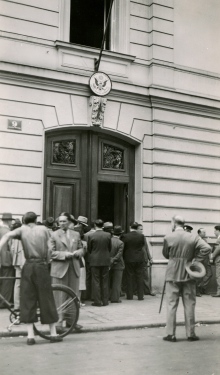
In this 1938 photo, prospective immigrants line up outside the U.S. consulate in Vienna after the German annexation of Austria. American Jews struggled to get refugees out of Nazi-era Europe due to strict immigration quotas in the U.S. (Museum of Jewish Heritage/ Franklin D. Roosevelt Presidential Library/Associated Press)

In an attempt to stem the tide of eastern European immigration to America, the U.S. enacted a quota system, stipulating that visas be provided only to two per cent of the total number of people of each nationality in the United States as of the 1890 national census.

Because so many eastern Europeans moved to the U.S. in the decades leading up to the First World War, lawmakers opted not to use the more recent census of 1910 to calculate the quotas.

The act also barred entry to “any alien who by virtue of race or nationality was ineligible for citizenship” — a provision aimed at the Japanese.

The effects of the quota system were particularly devastating for European Jews, who struggled to obtain visas leading up to the Second World War and the Holocaust.

5. ‘Excessive demand’

The Canadian Immigration and Citizenship Act states “a foreign national is inadmissible on health grounds if their health condition might reasonably be expected to cause excessive demand on health or social services.”

This wording has been used to bar entry of people with illnesses or disabilities.

In 2011, a South Korean family living in New Brunswick faced deportation because their teenage son is autistic. The deportation order was later reversed amid public outcry.

Again in 2012, the National Post reported that a University of Victoria professor from the U.S. and his family were denied permanent residency in Canada because their four-year-old son’s autism.

Source: Donald Trump’s no-Muslims immigration idea right in line with U.S., Canadian history – World – CBC News

Quebec: Difficile régionalisation de l’immigration

The ongoing problem of attracting and retaining immigrants outside of Montreal (Quebec retains relatively fewer immigrants compared to other provinces save Atlantic Canada):

Même si la très grande majorité des réfugiés syriens attendus au Québec en 2015 et 2016 s’établiront dans la grande région de Montréal, plus d’un millier d’entre eux atterriront en région. Y resteront-ils? Rien n’est moins sûr, car la rétention des populations immigrantes hors des grands centres demeure un défi considérable.

C’est une réalité qui n’est que trop familière à Henry Mbatika. Arrivé de la République démocratique du Congo avec sa famille en 2000, ce père de cinq enfants – dont deux sont nés à Sherbrooke – est maintenant seul de son clan au Québec.

Victime d’une fermeture d’entreprise, sa femme n’arrivait plus à trouver du travail et est partie pour l’Alberta en 2012, où elle travaille dans une usine de PepsiCo, à Lethbridge. Les enfants l’ont suivie et le couple est maintenant écartelé entre les deux provinces.

«On est bien à Sherbrooke: il n’y a pas de racisme, les maisons sont plus abordables qu’à Montréal et il y a beaucoup d’espace», dit M. Mbatika, chargé de projet à la Fédération des communautés culturelles de l’Estrie et candidat défait à un poste de conseiller lors des élections municipales de 2013. «Le seul problème, c’est l’insertion socioprofessionnelle. C’est le travail.»

Les efforts de régionalisation de l’immigration ont cours au Québec depuis le début des années 90. Et ils ont eu jusqu’ici des résultats mitigés, dit Michèle Vatz-Laaroussi, professeure au département de travail social de l’Université de Sherbrooke et auteure de plusieurs études sur le sujet.

«L’attraction vers les régions, on l’a pas mal travaillée, et ce n’est pas si mal, dit-elle. Mais la rétention [des immigrants et réfugiés] reste difficile. Les Québécois eux-mêmes quittent les régions, alors pourquoi les immigrants y resteraient-ils?» La régionalisation, dit-elle, a souvent des airs de «banlieuisation», la couronne de Montréal attirant un nombre considérable de migrants.

L’Estrie passe pour une des régions qui réussit le mieux à intégrer les populations venues d’ailleurs. Et pourtant, elle est parvenue à retenir à peine 21% de ses nouveaux arrivants entre 2006 et 2011, selon une étude faite au printemps par l’organisme sherbrookois Actions interculturelles de développement et d’éducation (AIDE).

«C’est tout à fait décevant pour la région, dit le directeur général de l’organisme, Mohamed Soulami. Mais le Québec en entier a de la difficulté avec la rétention des personnes immigrantes. Il y a un manque de soutien aux employeurs pour qu’il y ait une ouverture vers l’engagement d’immigrants.»

Subventions salariales

Et pourtant, comme l’a reconnu hier à Montréal le ministre du Travail, de l’Emploi et de la Solidarité sociale, Sam Hamad, «l’emploi, c’est le meilleur endroit pour s’intégrer».

Le ministre a lancé avec sa collègue titulaire du portefeuille de l’Immigration, Kathleen Weil, un appel aux employeurs pour qu’ils embauchent des réfugiés qui s’établiront au Québec dans les prochains mois.

«Les villes sont bien conscientes du défi de rétention. Il faut avoir des milieux accueillants. Ça commence par des entreprises qui disent: “On a besoin de vous”», a dit la ministre Weil.

Source: Difficile régionalisation de l’immigration | JEAN-FRANÇOIS BÉGIN | Politique québécoise

Liberals Urge 33 Of Harper’s Political Appointees To Resign Voluntarily

Interesting that of the 39 letters, 1 is to a citizenship judge (Roy Wong) and four to appointees to the IRB:

Liberal MPs urged dozens of Conservative political appointees Monday to follow the federal government’s request and voluntarily resign from positions to which they were appointed in the dying days of Stephen Harper‘s government.

Last summer, Harper’s cabinet approved the appointment or term extensions for 49 people, whose positions took effect only after the Oct. 19 election.

The Prime Minister’s Office is particularly incensed over the unusual, and extraordinarily high, $1-million-plus severance packages that some appointees negotiated with the Conservative government. In total, taxpayers could be on the hook for $18.5 million to break the contracts.

Thirty-eight people were appointed to terms that took effect between Oct. 20, 2015, and Dec. 30, 2015. Ten people were appointed to terms starting in 2016 and one extreme case was to start in 2019. But John Badowski, the chairperson of the Transportation Appeal Tribunal of Canada, resigned his future appointment last week before being formally asked. 

Given that the Government has expressed its lack of confidence in these appointees, it would be wise for them to voluntarily resign.

Source: Liberals Urge 33 Of Harper’s Political Appointees To Resign Voluntarily

Income and mobility of immigrants, 2013

Latest from Statistics Canada. Striking that median income differences are relatively small, save for Canadian Experience Class, Skilled Workers and Provincial Nominees (above the median), Business Class below the median and below Refugees):

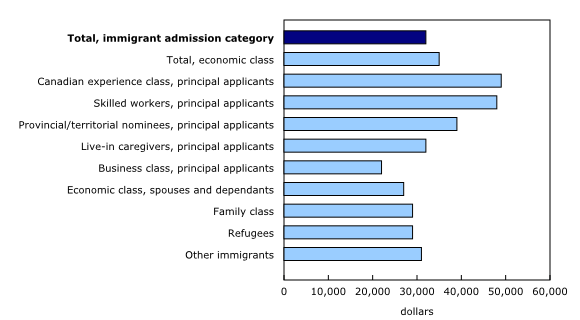
Employment income of immigrant taxfilers varies by the category under which they were admitted

The immigrant taxfilers who landed in Canada since 1980 as principal applicants under the Canadian experience class and skilled workers categories earned more in 2013 than other immigrants. Their median employment income was estimated at $49,000 and $48,000 respectively, while it was $29,000 for those admitted under the family and refugee classes.

Chart 1  Chart 1: Median employment income of immigrant taxfilers by immigrant admission category, 2013
Median employment income of immigrant taxfilers by immigrant admission category, 2013

Chart 1: Median employment income of immigrant taxfilers by immigrant admission category, 2013

Employment income of immigrant taxfilers increases over time since landing in Canada

The median employment income of immigrant taxfilers who landed in 2003 was estimated at $15,800 in 2004 (one year after landing). For the same cohort, it increased to $26,000 in 2008 and rose to $32,000 in 2013.

The median employment income of refugees who landed in 2003 also increased over the same period. While it was $13,800 in 2004, it increased to $18,600 in 2008 and rose to $23,000 in 2013.

The retention of immigrant taxfilers is lower in the Atlantic provinces than in other provinces

In 2013, 91% of immigrant taxfilers who had landed one year earlier filed taxes in their province of landing. The proportions were the highest in Alberta (96%) and Ontario (94%). The Atlantic provinces had lower retention: 79% in Nova Scotia, 70% in New Brunswick, 68% in Newfoundland and Labrador and 43% in Prince Edward Island.

Source: The Daily — Income and mobility of immigrants, 2013

No surprise here: Canada a turnoff for some refugees – Saunders

Doug Saunders on Canadian smugness:

It was only in the early 20th century, under Wilfrid Laurier’s leadership, that Canada learned to attract and keep people – by spending serious money on agencies and campaigns abroad, and giving people land and cash to come. No period has come close to the Laurier decade for keeping immigrants.

We soon fell back to our exclusionary patterns. With the exception of the 1910s and the 1950s, immigration in the 20th century contributed little to Canada’s population growth: In many decades people didn’t want to come; in others, people arriving barely outnumbered those departing. We spent much of that century turning away refugees and warning each other about the civilizational threats posed by southern and eastern Europeans and Asians. Only after 1999 did immigration, for the first time, overtake childbirth as the main source of population growth.

Still, we spend more money keeping newcomers out, and throwing obstacles in the way of their settlement and citizenship, than we do welcoming them. The mean-spirited politics of the past decade, the policies denying health care to asylum seekers and the cruel temporary-worker rules and family-reunification restrictions are well known overseas, and the best-qualified people would rather go elsewhere. We think we’re a hot date, but we really need to upgrade our Tinder profile.

Even in Britain, Canada has become a turnoff: We are currently the fourth-most-popular country for British emigration, far behind Australia (which receives twice as many people), the United States and Spain. In fact, it’s a net loss: During the past decade, an average of 5,200 British emigrants came here each year, while 8,500 moved the other way. Worse, the British Post Office surveyed British emigrants, and the happiest were those in France, Spain, the United States, Australia and Thailand – Canada didn’t make the list.

We should heed the lesson we learned a few years ago in Ireland: After the country’s economy collapsed in 2008, Ottawa hoped for a migration boom of skilled workers. But only about 1,000 a year came, and they complainedabout unfriendly conditions and unaffordable cities. Only after paying for a big advertising and outreach campaign did that rise to 5,000 – for a year, until things got better in Ireland.

Next time we have a months-long national debate about migrants, maybe it shouldn’t be about them, but about us – why we still seem so cold and unwelcoming, even to those we want.

Source: No surprise here: Canada a turnoff for some refugees – The Globe and Mail

Canadian Encyclopedia: 30 immigrant groups to Canada

Good list and background information (click on the story to see timeline and links):

To celebrate its 30th anniversary, The Canadian Encyclopedia created 30 lists of 30 things that make us proud to be Canadian, from famous people and historic events, to iconic foods and influential artists. Read more of their lists here.

The various waves of migration to Canada over the course of its history have made the country what it is — a mosaic of peoples of diverse backgrounds. In 2011, Canada’s foreign-born population was approximately 6.8 million people, or 20.6 per cent of the total population — the highest proportion among G8countries.

Canada’s checkered history of immigration has included instances of outright discrimination (see Komagata MaruChinese Head TaxMS St. Louis) as well as genuine humanitarian heroics; Canada is the only nation to receive the United Nations Refugee Agency’s Nansen Award, in recognition of its efforts to resettle 60,000 Vietnamese refugees.

Source: Canadian Encyclopedia: 30 migrant groups to Canada – Macleans.ca

Saunders: Avert extremism before it starts by building better neighbourhoods

Good in-depth piece by Doug Saunders on the lessons learned from an international study on integration, directed by Manjula Luthria of the World Bank, and how they may avoid future faultiness in Canadian multiculturalism and integration:

The first set of barriers is physical, involving housing, neighbourhoods and transportation.

It’s important to allow immigrants and refugees, after their initial settlement, to join clusters of other people from the same background, in places where they can help each other out. A strong body of research has shown that integration happens faster and more effectively when immigrants settle in common districts. Isolation tends to breed alienation (and, in English-speaking countries, extremism tends to emerge from isolated individuals in non-immigrant neighbourhoods; “ethnic” districts are less prone to extremism)..

The second group of barriers are institutional: those that prevent immigrants from having their credentials recognized, their health care and social crises addressed, and that stand in the way of their children getting the education and assistance they need.

Absolutely crucial here are schools: Too many school systems have built-in incentives for children – especially male offspring of immigrants – to drop out early. While Canadian cities have considerable experience with educating classes of mixed experience (and we know these mixes are good educationally, for both newcomers and established Canadian students), many school boards today are providing only one teacher per class. A larger class size with multiple teachers and teaching assistants offering several levels of education is a recipe for inclusion….

Third are economic barriers. Key here is small business. Previous immigrant groups have succeeded in Canada and other Western countries because they’ve been able to set up shop, in an ad hoc way, without many bureaucratic or legal barriers. This is tougher today: It is increasingly difficult for immigrants to find low-cost spaces on streets with pedestrian traffic, in which they can start a business; they often live in areas where there are few such spaces at all. When they do get a space, they discover that licensing, regulatory and hygiene requirements often impose impossible costs on a small-scale business: The need to install, say, a $40,000 ventilation system has scuppered many a promising immigrant food enterprise….

Fourth are citizenship and inclusion barriers, both legal (the ability to become a citizen) and de facto (the ability to participate in the community and have access to the resources of the government with or without citizenship). There is probably nothing more threatening to integration than having a large population living in your city on a more or less permanent basis without a pathway to full, legal citizenship…

Germany learned this the hard way, when two million Turks went 40 years without access to citizenship, and became an isolated, lost generation who couldn’t invest in their communities or futures. (In recent years, German Turks have become citizens in greater numbers, and now are becoming a success story.) The United States is still learning this with its 12 million long-term residents, many of them born in the U.S. These people are “illegal,” and thus lack the privileges of citizenship, including full education access. The result: an enormous lost opportunity.

Ambitious immigrants, if they don’t know they’ll become citizens, won’t invest in their communities, start legal businesses, put their kids in higher education or enter the financial or political system: They’ll be stranded. Whether we call them “illegal aliens” or “temporary foreign workers,” we’re risking failed integration – not just for them but for the wider community around them – if we put up barriers to citizenship, inclusion, voting and economic participation.

….

The most successful and non-controversial refugee groups are those that are transformed, as quickly as possible, into regular “economic” immigrants: If they’re included quickly in the employment, education and housing systems of the established immigrant community, they will be more likely to stabilize their lives, give up their temporary mindset and become valuable members of their communities.

If we fear for the futures of our newly settled refugees – or worry that the 300,000 immigrants who settle in our cities every year won’t live the Canadian dream of the previous millions – then we need to step back and look at what has worked. We need to follow the dotted line that leads from a faraway country, through a low-cost neighbourhood somewhere, into the centre of our economies and lives. And we need to see where that line may be interrupted, and restore its path. Integration is something that happens, naturally, if we provide the right footholds.

Source: Saunders: Avert extremism before it starts by building better neighbourhoods – The Globe and Mail

Douglas Todd: Immigration fraud on a grand scale

Douglas Todd on the recent immigration fraud trial and verdict (while fraud and misrepresentation need to be countered, the overall number in percentage terms is small – see earlier “Protecting Canadian Citizenship” – Citizenship Fraud Update – Numbers Still Small):

[Judge] Harris could not find another Canadian immigration scam that matched “the scale of that perpetrated by Mr. Wang,” a former insurance agent and father of two who previously had no criminal record.

In determining Wang’s sentence, the judge took into account the punishments meted out in a range of earlier migration scams.

One case involved a man who imported 6,000 fake Alberta drivers’ licences. Another Ontario man filed 150 tax returns falsely claiming his clients lived in Canada, so they could obtain child-tax credits.

A woman in another case counselled au pairs on more than 100 occasions to lie to work in Canada. A B.C. woman was convicted of 16 counts of “arranging sham marriages between Chinese nationals and Canadians.” An Ontario duo arranged impostors to take English-proficiency tests for would-be immigrants with no ability in the language.

But how could Wang have pulled off a covert scheme involving more than 1,000 illicit would-be immigrants for eight years?

Barry Cartwright, senior lecturer in Simon Fraser University’s criminology department, said immigration fraud is “hard to catch. It’s expensive. It’s time consuming. And it’s resource-consuming.”

Even though Cartwright is not aware of a criminal case as extensive as Wang’s, the immigration specialist said he knows of larger questionable schemes involving loopholes in the immigration policies of Ottawa and Quebec, especially those to do with investor-class immigrants.

While Cartwright doesn’t want to take away from the value of Canada welcoming what he estimated to be the “nine out of 10” immigrants who end up contributing to the country, he said it’s difficult for officials to carefully screen applicants when “you’re bringing in almost 300,000 immigrants a year, or 25,000 refugees in two months.”

At his sentencing hearing, Wang’s lawyer argued his client’s punishment should be lenient since there was no “breach of trust.” The lawyer said the people who enlisted Wang’s services did so with “their eyes wide open.”

The judge, however, countered that Wang did not mastermind “victimless” crimes. The innocent children of his clients, he noted, could now be deported.

The judge also suggested the country’s entire immigration and taxation systems were victims of Wang’s elaborate cheating.

Wang’s subterfuge, Harris said, undermines whatever confidence Canadians have in the immigration process and is keenly relevant to “today’s age of international terrorism” and people smuggling.

In weighing Wang’s contributions to mass tax avoidance, Harris quoted Supreme Court Justice Peter Cory, who maintained the vast majority of Canadians who pay income tax by way of payroll deduction have little or no opportunity for evasion.

“Those who do evade the payment of income tax not only cheat the state of what is owing to it, but inevitably increase the burden placed upon the honest taxpayers. It is ironic that those who evade payment of taxes think nothing of availing themselves of the innumerable services which the state provides by means of taxes collected from others.”

In further justifying Wang’s seven-year sentence, Harris quoted B.C. Appeal Court Justice Sunni Stromberg-Stein, who said those who facilitate illegal migrants into Canada put an “astronomical cost” on the Canadian taxpayer, “fuel racial prejudice and racial tension” and “adversely impact all aspects of Canadian society.”

Even though Wang pleaded guilty, he has launched an appeal of his jail sentence.

Source: Douglas Todd: Immigration fraud on a grand scale