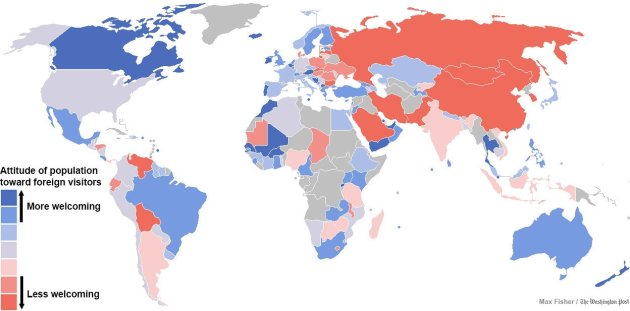
Good in-depth profile of some of the background and stories regarding mainland Chinese immigrants:
The mainlanders are the most recent of several waves of Chinese immigration to Vancouver. But they are not from the places familiar to Vancouverites for the past 160 years, like rural Guangdong, Hong Kong, Singapore and Taiwan.
The 139,890 who have arrived since 2000, according to federal statistics, are from Nanjing, Shanghai, Harbin, Beijing, Guangzhou, Qingdao.
And they are a kind of immigrant Canada has not seen before, at least not in these numbers. They are here with money and confidence after surfing the wave of one of the world’s biggest economic booms, the result of people from Regina to Rome buying stuff stamped “Made in China.” The boom produced 3.6 million millionaires by 2014, up from 2.4 million in 2013.
…But they wonder why Canadians are ready to take their money for their houses – perhaps more money than they thought they would ever get – and then complain.
“A woman I know, her house cost $400,000 19 years ago and she sold the house for more than $2-million. She was happy, she has a studio now for her painting,” Sherry Qin said over coffee at UBC’s Old Barn Community Centre with three of her friends, including Ms. Yin. They like to gather here because one member of the group lives in a townhouse nearby.
And they do not understand why, if Canadians do not like the way things are, their governments will not change the rules – for investment, for preserving old houses, for citizenship, for paying taxes, for charges on vacant houses – instead of blaming newcomers.
And they were as divided as others over B.C.’s new tax for foreign buyers. Sherry Qin said B.C. should remain a free market. Anita He said it will send a message to all Chinese: “We don’t like you.” Alan Yu said it was a good idea. “I think it’s good to suppress the speculation in the real-estate market and it helps to fulfill the needs of affordable housing. I hope it could lower the housing price in Vancouver.”
But such government regulation is not new to them.
Chinese cities, which control who can be defined as a legal resident, are imposing their own restrictions. Shanghai has strict rules. In February, after house prices had jumped by 21 per cent in the previous years, it tightened the approvals for non-resident buyers even more.
Vancouver’s new arrivals also are puzzled why Canadians complain about wealthy people moving here when their government decided which kinds of immigrants it wanted.
“The government just chose rich people so they have lots of money,” said Mr. Liu, who immigrated to Canada in 2005 through the skilled-worker stream, not as an investor, even though he owned a chain of Best Buy-like stores in China. He is doing well, with a home he bought in Kerrisdale so the family could be close to Crofton House, where his daughter went to school.
(The proportion of immigrant-investors to Canada never exceeded more than 4.1 per cent of the total number of permanent residents. About 8,500 immigrant investors came from mainland China to B.C. between 2000 and 2015, along with 23,000 family members. In the same period, B.C. accepted 23,000 skilled workers and their 33,000 family members.)
Another file to watch in terms of how the government makes any changes to Express Entry and the requirement for labour market impact assessments (LMIAs):
Canada’s emerging tech sector is stepping up pressure on the federal government to speed up the immigration process so firms can more readily recruit top foreign talent.
The Council of Canadian Innovators – a lobby group that represents about 50 fast-growing Canadian tech firms – met last Friday with Innovation, Science and Economic Development Minister Navdeep Bains at the Toronto headquarters of Wattpad, an online publishing-platform firm.
The group pressed its case for shortening visa approval times for in-demand foreign tech programming and executive talent to as little as three weeks from what is now a drawn-out, bureaucratic process typically lasting six months to a year.
“CCI is advocating a made-for-Canada fast-track visa program for tech, ideally in a less than two-month time frame to keep Canada’s technology scale-ups competitive with other countries” that have such programs, including Britain, Australia and Ireland, CCI executive director Benjamin Bergen said. The CCI is set to deliver a similar message to Immigration Minister John McCallum during two round tables in September.
Several of the roughly three dozen attendees said they were pleased with the reception from Mr. Bains. “I have not seen this much note taking in a meeting with a federal cabinet minister listening to CEOs before, so that was quite encouraging,” said J. Paul Haynes, CEO of digital-security firm eSentire Inc., based in Cambridge, Ont.
“It was a very constructive and meaningful dialogue,” Wattpad CEO Allen Lau said. “I’m very positive that our voice will be heard and the government would be able to understand the challenges we are facing.”
In an e-mailed statement, Mr. Bains called the conversation “very candid and thoughtful.” He discussed immigration and other concerns raised by the group, including their difficulties in getting government contracts, “in depth with the goal of how we can best work together to address them.” In an interview with The Globe and Mail last week, Mr. Bains indicated that changes to immigration policy favouring domestic tech employers were coming. “To make Canada a global centre for innovation, immigration will be key,” he said.
Mr. McCallum’s department is reviewing what is known as the “express entry” system, which has been plagued with delays. Under current rules, employers must show, when seeking to hire a foreign worker, that they have first made every effort to fill the job with Canadians. Many tech employers say this is a waste of time, money and effort when those they are looking to hire come from a very small pool of experienced global talent.
“We are acutely concerned about our ability to attract the best and the brightest around the world,” Mr. McCallum said recently. “Those are the people we want to attract.”
While I disagree with much of what Collacott argues – the European examples come from too different histories and geographies, the costs of immigration cited are based on the flawed Grubel-Grady study – I do share some of his cynicism with respect to the announced consultations.
It would be better to appoint an independent panel or commission to review the full range of citizenship, immigration and multiculturalism issues to have a serious and independent study to help guide longer-term policy (see my previous IRCC Discussion guide on immigration: What about citizenship?):
Canada has probably worked harder and had relatively more success than any other country in welcoming and integrating people of different backgrounds from around the world. The “national conversation’s” assertion that “Canada’s strength lies in its diversity” however does not correspond with reality.
While a well-managed and moderate increase in diversity can enrich a society in various ways, it is also clear that unlimited diversity has a negative effect on societal cohesion and national identity. This has been well-documented by scholars such as Harvard professor Robert Putnam, whose research found that, as urban communities become more and more diverse, the levels of social cohesion decline and there is less trust among residents.
This has been amply demonstrated in Europe, where the social as well as economic integration of many immigrants with very different cultural values and traditions from those of the host nations has been impeded as their numbers grew and they became heavily concentrated in urban areas.
The suggestion that Canada’s strength lies in its diversity, nevertheless, implies that our society will endlessly benefit from becoming more and more diverse.
The question then has to be asked why the Government is promoting its “national conversation” based on a slogan that doesn’t make sense.
The answer becomes clear from other sections of the conversation’s press release when it states that the government is committed to an immigration system that supports diversity and helps to grow the economy.
The fact is that, while immigration makes the economy larger, it doesn’t improve the standard of living of the average Canadian: it simply creates a larger pie that is divided into more, and usually somewhat smaller, pieces. Indeed the latest research indicates that recent immigration is very costly to Canadian taxpayers — to the tune of around $30 billion a year — in addition to raising house prices beyond the reach of most young Canadians in large cities such as Vancouver and Toronto, increasing congestion and commute times and putting heavy pressure on health care services.
While there been periods in our history when we have benefitted from large-scale immigration, this is not one of them. Canada does not face major labour shortages and has sufficient human capital and educational and training facilities to meet almost all of our needs from our existing resources.
The “national conversation” is clearly a public relations exercise designed to convince members of the public that they are providing serious input into how immigration can benefit Canada. The terms of reference, however, leave no doubt that its real purpose is to promote large-scale immigration and diversity in order to increase political support for the Liberal Party of Canada rather than to serve the interests of Canadians in general.
We very much need a comprehensive, well-informed and balanced review of immigration policy — but not the phony “national conversation” the government is attempting to foist on the public.
Will be interesting to review implementation over the course of the next few years:
Pour la première fois de l’histoire, les treize provinces et territoires ont entériné une cible d’immigration francophone à l’extérieur du Québec de 5 %, vendredi.
Réunis à Whitehorse dans le cadre du Conseil de la fédération, les chefs de gouvernements ont adopté à l’unanimité une résolution en ce sens, pressant Ottawa de les aider à atteindre cet objectif.
Près de 4 % des résidents des provinces canadiennes autres que le Québec ont le français comme langue maternelle. La cible de 5 % fixée vise à accroître cette proportion.
«Cette décision est majeure. Nos leaders ont […] pris la décision de donner un élan à la francophonie», a déclaré le ministre québécois des Relations canadiennes et de la Francophonie canadienne Jean-Marc Fournier.
Sommet sur l’immigration francophone Un sommet sur l’immigration francophone réunissant ministres provinciaux et fédéraux de l’immigration et des affaires francophones doit être tenu au printemps 2017, afin de «déterminer les moyens d’action à prendre» pour atteindre la cible de 5 %. Une rencontre préparatoire est également prévue en octobre 2016.
Cette cible d’immigration est une revendication de longue date des communautés francophones en milieu minoritaire. De nombreuses provinces, dont l’Ontario, ont établi leurs propres cibles, mais la plupart d’entre elles ne sont pas parvenues à atteindre leurs objectifs jusqu’à présent.
Ralston Saul’s take on where some improvement is needed. Should provoke some good discussion and debate:
What would this mean today? What are we not doing, or not doing enough?
First, we seem to forget that our society and our economy were built from 1850 on the wealth of public education.
Today that simple strategy is more important than ever. In an urban society, newcomers need to adjust much faster. Immigration often comes with language difficulties and cultural complexities. Both require much smaller classes for students. A monolithic group of middle-class children can get by in classes of 30 students. A complex school with many newcomers needs classes of 20 at the most and a greater emphasis on all those adjustment phenomena. That means more teachers. Many more.
And volunteer mentoring programs like Pathways to Education have a strategic role to play. Canada is a world leader in volunteerism, but these kids, whose parents are themselves struggling with language and adjustment, need the support of established citizens. This is about much more than simple tutoring.
And while it is true that new Canadians are above-average creators of companies and some of our large corporations have serious diversity programs, other companies as well as our schools, colleges, universities and governments are lagging behind in support programs.
There are not nearly enough courses available on how our bureaucracies work, on regulatory structures, on business law, on the culture of business in Canada. There seems to be little understanding in the big urban centres that new Canadian entrepreneurs often prefer to install themselves in suburbs or smaller cities. This requires a different approach to training programs.
As I looked through the many studies which have been done, the message keeps coming back to the lack of professional networks. I was left with the sense that basic things are not being done – or not done enough. Have chambers of commerce thrown themselves into helping new Canadians find their way? Are business schools – so obsessed with overcharging for their services – reaching out to help new Canadians get started? Who is providing easily available advice on professional norms, on how people act in business situations? Treat each other? In a very good Maytree and Metcalf Foundation report, we learn of initiatives being taken in the Netherlands and in Finland. In a Conference Board of Canada report, it is clear that businesses still do not take advantage of the language skills of new Canadians when it comes to international possibilities.
And despite enormous pressure to change over the years, professional self-regulating bodies continue to grumble and to obstruct when it comes to the equivalence of foreign qualifications. This can be seen as a way to protect their advantages. By limiting membership in their profession, they limit competition. This is classic protectionism.
Those old self-regulation models of the professions are increasingly an obstacle to maximizing the contributions of new Canadians. Germany – the champion of tough professional standards! – is now moving ahead of Canada by setting up clear, efficient equivalency rules for immigrating professionals.
In spite of all these problems, immigrants and new citizens continue to be important drivers of our economy. And they quickly become participants in society, and catch on to the volunteerism ethic. But Canada has never been a place of economic ease or easily shared well-being. If it works, it is because we have designed social agreements and public policies to support individual action.
It is fashionable to insist that everything changes. And some things do change. But social behaviour and its economic outcomes are pretty stable factors in all societies. The Canadian idea that an immigrant is a citizen in the making is tied to the idea of both public support and volunteerism. And all of this makes it possible and essential that we will adjust and act aggressively to ensure that new citizens get their chance. At this point, I would say that they are making their effort, while our constituted society is lagging behind.
Quebec’s cash-for-visa program, considered by critics as a factor in Vancouver’s housing affordability crisis, is one of the most generous investor-luring programs in the world, according to a U.S.-based think-tank.
The Migration Policy Institute, which analyzes global migration policies, completed a 2014 study that concluded investor programs are enticing in theory, but have results that are “modest at best.”
The study was published the same year that the Canadian government, then the Conservatives, shut down the national cash-for-visa program.
The federal program had offered immediate permanent resident status – and therefore immediate entitlement to Canada’s social program network and protection under the Charter of Rights – in return for an $800,000 investment in a government bond over a five-year period.
But Quebec has continued with its program, using identical financial criteria, and in 2015 accepted in a record number of applicants.
The program’s continuation has caused tension because while Quebec gets the lion’s share of the financial benefits, more than 80 per cent of new arrivals under the Quebec program settle immediately in Toronto or Vancouver – where critics say they play a role in fuelling the red-hot housing markets.
The institute’s founder, Demetrios Papademetriou, said it’s no surprise investors line up to use the Quebec program when there are similar schemes in the U.S., the United Kingdom, Australia, New Zealand and many European countries.
“It’s is among the most generous, particularly when you compare how desirable it is to make it to Canada,” Papademetriou said Tuesday in an interview from Washington, D.C.
Here is how the programs compare:
• Quebec: Requires a $800,000 bond investment for five years, with the interest (currently about $50,000) going into provincial government coffers. The investor, who must prove he or she has assets worth at least $1.6 million, gets immediate permanent resident status.
• United States: This program requires investors to put US$500,000 in a potentially risky corporate endeavour, meaning applicants can and sometimes do lose their investment. In return, the investor gets a temporary resident card and after two years can seek permanent residence status.
• United Kingdom: Requires applicants to invest two million pounds ($3.4 million Cdn.) in a government bond or stocks in return for a three-year resident visa that can be extended for another two years, followed by the possibility of obtaining permanent resistant status. One of the UK’s restrictions, however, prevents investors from putting their money into real estate.
• Australia: Requires a $1.5-million investment in a company, but the investor must also be under 45 years of age, have assets of $2.25 million, have a “vocational level of English-language” proficiency, and proof of business experience. Australia has other programs for older investors, though these have greater restrictions. For instance, those over age 55 can’t have dependents.
• New Zealand: Limits applicants to age 65 or younger, requires they can speak English and make a $1.5-million investment in a five-year government bond. They must also prove they intend to settle there, and have the ability to do so.
• France: Allows investors to live there for up to 10 years by investing at least 10 million euros ($14.4 million) in “industrial or commercial assets” in France. Other European countries are less stringent.
• Germany: Requires a one million euro investment that will create at least 10 jobs, but applicants must also prove they have health insurance and enough money to support themselves. Only after holding a five-year residency permit, and showing they can speak German, can they apply for permanent residency status.
Papademetriou said many countries rushed into the programs starting in the 1980s but have since toughened restrictions or, in the Canadian government’s case, cancelled the program after realizing the benefits were marginal.
One of the issues touching Vancouver, he said, is not unusual among countries that have launched investor programs and then faced pressures due to an influx of money, especially from Asia.
“When you have hyperinflation in housing, and you have the local population not getting on first step ladder to owning a home, that creates additional resentment.”
Pressure to end investor programs is often countered by financial interests that benefit, he said.
Lawyers and consultants, such as those acting as brokers in the Quebec program, “make a lot of money out of these things.”
Interesting. More smoke than fire in terms of the number of leads followed up and acted upon:
A small team in a secretive government office in the nation’s capital stands ready, 24/7, to hear from Canadians who want to squeal on their neighbours.
Working in 12-hour shifts, between two and four Canada Border Service Agency employees are assigned every day to monitor the agency’s Border Watch Tip Line, a creation of the Paul Martin Liberal government that gives Canadians a chance to report “suspicious immigration activity” to the government around the clock, in either official language.
“No information, however trivial it may seem, is too small,” according to the CBSA webpage for the tip line.
Most of those tips end up being deleted or filed away in government archives, as do those made to two of the government’s other immigration-related tip lines, according to statistics provided to The Hill Times by the federal government.
Many of the communications via the tip lines have actually been questions about how to file paperwork for visas or other routine and unrelated matters. Some are reports of illegal activity that falls outside of the CBSA’s jurisdiction—for example, financial fraud. Others simply don’t include enough information, or do include information “not substantiated” by database searches of CBSA officials, the agency says.
Many of the tips come from members of the public who suspect a business is employing illegal workers, a neighbour may be in Canada with an expired visa, or someone they know might be perpetrating marriage fraud, according to records from earlier this year obtained by The Hill Times.
Others read like the plot from an immigration-themed soap opera.
“Tipster called to report that her friends [sic] husband has sponsored another woman,” reads the summary of one tip received by the Border Watch Tip Line in January.
“Subject is legally divorced in Canada…but she believes that she is still married to her husband [censored] and would like to know if that is legal and if divorce in Canada also means divorce in the original country of marriage.”
That tipster was “advised that [the Border Watch Line] does not offer advice or information” on such matters and told to contact the federal Immigration Department.
Round-the-clock monitoring
Calls to the Border Watch Tip Line—1-888-502-9060—are fielded by officials at the CBSA’s Warrant Response Centre, a “24/7 operation” of 34 full-time CBSA employees who help officers from the CBSA’s regional offices and other law enforcement partners “throughout North America” to execute immigration warrants or look for previously deported persons, according to CBSA spokesperson Line Guibert-Wolff.
The Warrant Response Centre is located on the first floor of a CBSA building in the southeastern corner of Ottawa, but is not open to the public and does not receive tips in-person. The CBSA only confirmed the location of the centre, which it originally declined to disclose and which draws a $2.6-million annual budget, when it was identified by The Hill Times.
The Border Watch Tip Line yielded about 12,000 tips in 2015, though the CBSA took no action in response to about 65 per cent of those tips, according to information obtained through an access-to-information request.
When asked why the agency did not take action on those tips, Ms. Guibert-Wolff wrote that the tip line receives calls “that do not contain sufficient information, calls which are not substantiated by database queries, calls that contain duplicate information that were already referred to the appropriate section, and calls not pertaining to legislation enforced by the CBSA.”
Useful tips are forwarded to regional Immigration Department or CBSA offices for further action, and the CBSA does not track the results, wrote Ms. Guibert-Wolff.
Those regional offices determine the best course of action, which can include further checks of government databases, or referral to other authorities for investigation, in which case “it may be several years” before any results are achieved, wrote Ms. Guibert-Wolff.
Different lines, same tips
Immigration, Refugees, and Citizenship Canada and Employment and Social Development Canada each operate their own online tip-reporting systems; one is intended for suspected citizenship fraud and the other for misuse of the Temporary Foreign Worker Program.
Of 457 tips emailed to IRCC’s citizenship fraud email address during the month of January 2016, 37 were forwarded to the CBSA or Immigration Department offices for further action, while 59 that were classified as spam or duplicates were deleted, and 355 were filed away with no action taken. The six remaining were still pending review as of May, according to information obtained through an access-to-information request. An access-to-information official did not respond to a follow-up question seeking information on why no action was taken on many of the emails.
The 37 tips that were forwarded for further action were split between the 18 government offices or departments, including the CBSA, immigration case processing centres and visa offices everywhere from Lima, Peru to Islamabad, Pakistan.
Subject lines of those emails—the only portion the department disclosed—suggested that tips to the citizenship fraud email address were very similar to those made through the Border Watch Tip Line, including suspicion of people working in Canada illegally, living in Canada illegally, marriage fraud, as well as a handful of emails unrelated to the purpose of the tip line.
“Person currently harbouring an alien immigrant/illegal temporary foreign worker,” reads one; “victim of fraud after marriage,” reads another.
Employment and Social Development Canada also operates a tip line and online fraud reporting tool for people who want to report suspected abuses of the Temporary Foreign Worker Program.
A July, 2015 press release from ESDC said the department had received “thousands of complaints” at that point since the tip line and online reporting tool were launched in April and June 2014 respectively.
A sample of the TFWP tips received online during the months of October and November of 2015, acquired through an access-to-information request, shows that ESDC was acting on about 23 per cent of the tips it had received.
I had coffee this week with three Canadian friends — one of us was born in Egypt, one in Hong Kong, one in Iran and one in Canada (me) — and the subject arose: Is there a relationship between Metro Vancouver’s out-of-control housing prices and racism?
We battered around a few arguments, including that the hundreds of thousands of transnational migrants and investors who have discovered Metro Vancouver in the past decade cannot be morally blamed, individually, for the city’s astronomical housing costs. That is, except for those involved in corruption or tax evasion.
In most cases, transnational migrants, many wealthy and with dual citizenship, are simply doing what anyone in their situation would do if they could afford it: Investing in Canadian real estate to create a safe economic landing for their families outside their often-troubled countries of origin.
While our coffee group recognized some people might scapegoat migrants from certain countries, especially Mainland China, we acknowledged the most crucial thing is to get up to speed on the multiple factors behind runaway housing prices — so we can encourage governments to finally do something to ease them.
Our discussion led me to conclude that the debate over housing affordability does not need to be dominated by race or ethnicity.
It should zero in on public policies that will help Metro Vancouver be a real community — a place not only of ethnic diversity, but of economic diversity, where power is mostly in the hands of the people and the gap between the poor, middle class and rich does not widen more than it has already.
That means discussing policy options, such as whether and how to impose a tax on foreign speculators, tax empty houses, stop international money laundering and tax avoidance, curtail Quebec’s immigrant-investor program, enforce rules in the real-estate industry, add social housing, increase zoning density, adjust immigration levels, shift interest rates and stop foreign donations to B.C. politicians.
But many Canadians don’t seem comfortable with such debates, unlike many in Europe and elsewhere, where it’s generally expected one will be up for a rousing dinner-table discussion about politics, money and power.
Rather than talking about overriding issues such as economic equality and justice, Canadians seem to find it easier, more socially acceptable, to talk about so-called identity politics; which emphasizes ethnicity, gender and individual freedoms.
As a result, in Canada, racial discrimination, or the possibility of it, is often the go-to topic. That’s so even while international agencies continue to rank Canada the most “tolerant” country in the world in regards to immigration. See the recent global surveys by Britain’s respected Legatum Institute and the Social Progress Imperative, a U.S.-based non-profit.
When it comes to housing, why do a relative few British Columbian voices remain fixated on racial issues?
It’s easy to dismiss real estate industry lobbyists who accuse those worried about high housing prices as racist or xenophobic — since their vested interest for the past three decades has been to distract politicians from imposing policies that might cool the flow of foreign money into the market.
Some other Canadians concerned about racism don’t have such dubious motives, but I’m convinced much of their super-vigilance arises out of a misunderstanding of the definition of racism.
The Oxford Dictionary understanding of racism is quite specific. It’s not as sweeping as believed by some people, including the liberal arts academics who build their careers on alleging that “undertones” of racism exist where they may not.
The Oxford Dictionary defines racism as: “Prejudice, discrimination or antagonism directed against someone of a different race based on the belief that one’s own race is superior.”
While the housing crisis may trigger some hard-core racists — people who actually do discriminate based on the belief their ethno-cultural group is superior — there is no evidence such behaviour is widespread in Canada or Metro Vancouver.
Residents of Metro would have a right to be morally concerned no matter where the billions of dollars flooding into the city’s housing market was coming from.
If, theoretically, it were pouring in from tens of thousands of Caucasians based in Kelowna, strong feelings, including resentment, and ethical concerns, including in regards to equality, would be justified.
A number of prominent Canadians who are committed to ethnic diversity and social justice tend to agree.
Vancouver’s housing debate “is not about racism. It’s about a difference in economic power,” said Clarence Cheng, former chief executive officer of B.C.’s SUCCESS Foundation, which supports program for immigrants. “It’s about the rich becoming richer and the poor becoming poorer.”
Albert Lo, head of the Canada Race Relations Foundation, says there’s nothing wrong with collecting information on the national origins of people buying and selling houses in Metro Vancouver, in part because it could combat tax evasion.
“In Canada, we are so used to the idea of tolerance that we sometimes find it odd to look at nationalities. That causes some people to jump up and start using the word ‘racism.’ I don’t think it’s helpful,” says Lo.
Ujjal Dosanjh, a former federal Liberal cabinet minister, lambastes politicians and property developers who misuse the word “racist” to stifle debate over important issues. He says people have to acknowledge the great distance Canadians have come in overcoming bigotry of the early 20thcentury.
UBC planning professor emeritus Setty Pendakur, who has advised the Chinese government, says hyper-vigilant worries about inter-cultural tensions provide a convenient coverup for wealthy investors, whether Canadian-born or from abroad, who “park illegal money here or avoid Canadian taxes.”
Vancouver’s Justin Fung, a member of Housing Action for Local Taxpayers or HALT, says “cries of racism” sidetrack British Columbians from facing the hard policy decisions that will be necessary if we are to ever again link Metro Vancouver wages to housing costs.
So, if as a society we can manage to stay focused on the central issue, how do we institute policies that will help Metro Vancouver become a place where average families can afford to buy or rent decent housing?
Even though it’s ethically fine to collect data on the nationalities of buyers and sellers — and, more importantly, on the country in which they are “residents for tax purposes” — any policies to cool down the housing market must, of course, be universal.
We should expect colour-blindness in all policies designed to counter runaway housing prices — including those that deal with speculation, empty houses, international money laundering, real estate trickery, social housing, political party financing or immigration policy.
The problem is that some hyper-vigilant peoples’ understanding of racism is so sweeping that even after I wrote last week about how B.C. politicians should stop being among the few in the world to accept political donations from foreign companies — someone suggested such a ban may be “xenophobic.”
If that’s the case, virtually the entire world is xenophobic. That includes those who operate The Organization for Economic Cooperation and Development, which covers 35 countries, including Canada.
The OECD, a defender of democracy and sovereignty, recently made it clear that citizens of a nation have a perfect right to protect themselves from transnational powers and money.
As a February OECD report plainly said: “Political parties need to be responsive to their constituents and not influenced by foreign interests.”
For the first time in nine years, the cap on a prized US visa for the most skilled Chinese and Indian workers is set to be reached.
On July 11, the US State Department announced that it would soon stop accepting applications for the EB-1 visa, from Indian and Chinese nationals. This change could cause some highly-skilled immigrants to lose their current US work authorization.
The EB-1 is for immigrants of extraordinary ability, outstanding professors or researchers, and certain executives at multinational companies. In effect, it’s intended for the world’s “best and brightest” who wish to become permanent US residents, and even eventually citizens. Preliminary figures from the US State Department show that 12,253 Indians and 6,239 Chinese were granted EB-1 visas in 2015. The State Department was not able to provide how many of these visas have been issued so far this year.
As of July, the “priority date” for EB-1 approvals was “current”—meaning that all applications are being considered immediately. However, come August, the priority date will be set to Jan. 1, 2010, for EB-1 applications from Indian and Chinese nationals. That means applicants must have submitted their applications before Jan. 1, 2010, to be considered for the EB-1, this year.
Backdating the deadline, known as “retrogression,” is an administrative maneuver to keep the application queue orderly and manageable when there aren’t enough visas to go around. Since 1991, the priority date for EB-1 has retrogressed from “current” for India three times and for China six times.
Only a limited number of EB-1 visas are available each year, although the exact cap per country is hard to state with certainty because caps depend on a number of shifting factors. A surge in EB-1 applications from one country’s citizens, for example, could cause a decline in the number available to another nation.
For years, it was considered the fastest and most reliable way to gain authorization to permanently stay in the US for work. “The conventional wisdom is try to get into the EB-1 because you don’t have to worry about it,” Susan Cohen told Quartz. “It’s fastest employment-oriented way. Historically it’s always been the fastest.” Cohen is the chair of the immigration practice at Boston-based law firm Mintz Levin.
In the past, Cohen and others in the industry have advised clients to do everything they can to become eligible for an EB-1. A years-long strategy to obtain US citizenship can include getting published in more prestigious publications, working at more highly respected companies, or getting promoted to a managerial position outside the US, before applying. Cohen suspects this last tactic—savvy multinational companies promoting workers they want to transfer to the US—may have caused an increase in demand for the EB-1. [See this article on how Microsoft has adopted this strategy:
The implication for businesses on the whole should be small, since applicants for the EB-1 typically are already in the US, working on another, shorter-term authorization, according to Cohen. There are still risks, however. Employees currently working in the US on a non-extendable, time-limited visa who have been waiting for EB-1 approval could potentially find themselves forced to leave the US when their time runs out. Switching to permanent residency is desirable because it means not needing employer sponsorship of a visa and never having to renew or extend a visa. It also offers the first step toward becoming a US citizen.
Not completely a 180 given that it is a guest worker rather than immigration approach.
The experience with “guest workers” elsewhere in Europe, particularly Germany, indicates they tend not to return and thus governments are faced with longer-term integration challenges:
Faced with a severe labour shortage, the government is considering plans to invite non-EU “guest workers” to live in the country. “Guest workers” are usually allowed to stay and work in a country for a certain number of years but do not hold citizen rights.
Economics minister Mihaly Varga has supported demands voiced by the country’s Confederation of Employers and Industrialists to allow “hundreds of thousands of migrants from countries outside of the EU” into Hungary, according to Austrian newspaper Die Presse. Estimates predict that the nation will need tens of thousands of migrants to make up for its labour shortage and to prevent negative economic repercussions. However, the draft proposal specifies that the country wants “skilled, culturally integrable guest workers”— most likely implying that Muslims are not welcome.
Experts who know the country believe that the government is trying to avoid a public backlash over trying to attract foreigners by excluding those it considers not “culturally integrable.”
“[T]hey know it will be a hard sell to the Hungarians, given the way the government has staked its legitimacy on being nativist and xenophobic, suggesting that every foreign person who enters the country takes a job away from a native-born Hungarian,” said Holly Case, a Brown University professor focusing on eastern Europe, who added that she did not believe the country’s “guest worker” plans would succeed.
“Based on what’s happened thus far, I think if skilled younger workers have a choice between Hungary and other countries where the xenophobic rhetoric has not been so shrill, they will go elsewhere.”
Hungary’s labour shortage had long been anticipated: Each year, Hungary loses young workers to other EU countries such as Germany or France where wages are much higher. Restaurants and hotels especially have long been struggling to find Hungarians willing to stay.
“Many young Hungarians simply do not see a future for themselves in Hungary,” said Case. “The government has not managed to make staying attractive, in spite of all their nativist ‘Hungary for the Hungarians’ rhetoric.”
Moreover, birth rates in the country have been low for decades. Consequently, like in much of eastern Europe, the nation’s population is declining — and the share of older and retired people among the total population is increasing.
Other European countries, like Germany, face a similar problem which is why German Chancellor Angela Merkel often referred to the possibility that young refugees could ultimately make up for a lack of skilled workers in the country and prevent the collapse of its pension system. Whether or not Germany will become a role model in that regard is still uncertain, though. Since last year, only 30,000 refugees have found jobs — out of more than 1 million arrivals.
Hungarian Prime Minister Viktor Orban has chosen a different course: He supported programs aimed at attracting non-Muslim skilled workers to the country, while at the same time condemning the influx of refugees and provoking strong rebukes from other EU leaders for comments that some considered xenophobic.
“We shouldn’t forget that the people who are coming here grew up in a different religion and represent a completely different culture. Most are not Christian, but Muslim … That is an important question, because Europe and European culture have Christian roots,” Orban wrote in an op-ed published last September.
Calling Orban’s behaviour an example of “borderline political communication,” Gabor Bernath, a researcher at the Hungarian Academy of Sciences, said that the prime minister’s actions were also highly contradictory. “Just one year ago, Orban said [in front of] Arab investors: In Hungary, ‘the culture of respect’ still dominates.”