What can Canada teach the US about immigration?

Conclusion to the article that Michael Adams and I wrote for Policy Options:

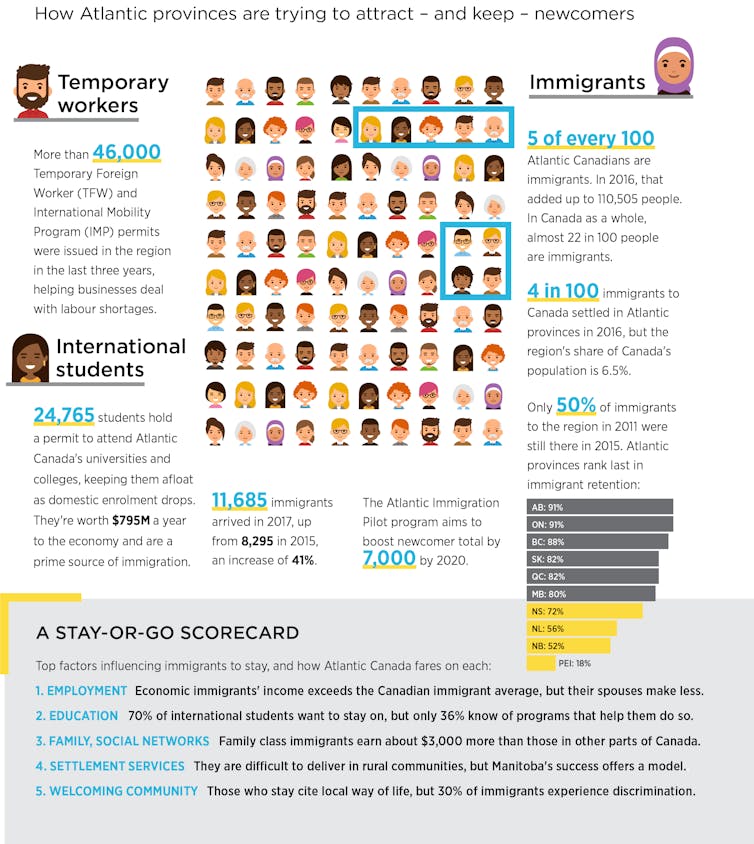
What might the United States learn from Canada? First, accept immigrants with skills and education that will benefit the American economy, but recognize that they need support to thrive and contribute. Allow immigrants to sponsor close relatives. Fund programs to help newcomers learn English and find employment. Encourage immigrants to become citizens, allow dual citizenship, and encourage new citizens to vote and become legislators who articulate the needs of their communities. One day, one of their children may become president of the great republic.

via What can Canada teach the US about immigration?

Metropolis Conference 2018 Reflections #Metropolisyyc

Overall, Metropolis remains a great venue to connect and reconnect with people active in immigration and integration. I thought I would share my overall impressions and reflections (these have also been shared with the organizers).

The plenaries were a mixed bag. One of them was excellent: a session with Calgary Mayor Nenshi, Brooks Mayor Morishita and Calgary Catholic Immigration Society’s Fariborz Birjandian on the role of the province and municipal governments, that provided lots of insights of integration at the local level. The contrast between a large city like Calgary and a small city like Brooks (population of 15,000) and how they approach similar issues was of particular interest.

The other plenary of note was on immigration futures, although it largely did not live up to its billing as most of the speakers were more in the here and now than in the future.

Irving Studin (Institute for 21st Century Questions) reiterated his 18th century geopolitical perspective on the need for a larger Canadian population,  Martha Hall Finlay (CEO Canada West Foundation) talked about the need for better immigrant preparation prior to landing, Senator Yuen Pau Woo provided a good overview of the politics of immigration, noted that anti-immigrant positions were sometimes cloaked in discussions on national security and housing prices and that immigration policy had to grapple with the fact that increasingly people have transnational lives, and Rubin Nelson (Foresight Canada) delivered a rambling almost end-of-days perspective on the need for a paradigm shift. Nelson was however the only dissident voice on the need for increased immigration levels, arguing for a return to 250,000 given that reflected current absorptive capacity.

I raised a question that has preoccupied me for some time: how do we factor into immigration policy the ongoing and increasing impact of automation and AI on labour force needs? Why do virtually none of those advocating increased immigration even acknowledge this aspect? Why do they assume that previous patterns of  “creative destruction” will repeat themselves? Both the audience and most panelists acknowledged the validity of these questions and I followed-up with some of the panelists.

The weakest plenary was the opener: a real yawn fest with most researchers talking about their projects and plans with no real results or lessons to share (Lori Wilkinson of U of Manitoba a rare exception as her remarks were more practical and Umit Kizilton, DG Research and Evaluation at IRCC brought home the relevance of this research far better than the researchers and SSHRC). This was more suited to a workshop for academics than the service provider organizations that form most of the attendees.

The other weak plenary was on the similarities and differences among NAFTA countries with respect to immigration. The session largely avoided the elephant in the room: the impact of Trump administration policies. The moderator ensured no questions from the floor by posing innocuous safe questions, possibly given risks that awkward questions or comments from the floor would occur. I also had the impression that the plenary was more of an infomercial for the second NAFTA country immigration conference.

One other comment: the diversity of plenary speakers (21 including moderators): 15 men, 6 women (in a conference where the majority of participants are women). Visible minorities representation was strong however: 6 out of 21.

The three workshops I organized — citizenship (data, narratives, and Focus Canada 2018 results), multiculturalism economic, social and political data, and how to debate immigration — had strong attendance and interest, particularly the immigration debate one with between 80-90 attendees (standing room only).

Citizenship: Nice contrast between my data rich presentation on Census citizenship data and the Canadian Race Relations Foundation’s Lilian Ma’s similarly data rich presentation of the Environics Institute Focus Canada 2018 public opinion tracking, and that of Yasmeen Abu-Laban, who discussed how citizenship narratives are changing as part of reconciliation with Indigenous peoples.

Needless to say, IRCC officials present challenged my interpretation of census naturalization data showing a decline which allowed me to explain the logic and data behind the analysis.

Lilian Ma was challenged on whether Canadians are honest in their replies to such surveys in which she replied, effectively, that not sharing xenophobic attitudes reveals something positive in terms of social norms; in the past, people were very willing to express openly racist views.

Presentations below:

Census 2016 and IRCC Data: What it Says About Naturalization

Environics Institute Focus Canada 2018 – CRRF Metropolis 2018 Presentation March 22-2018

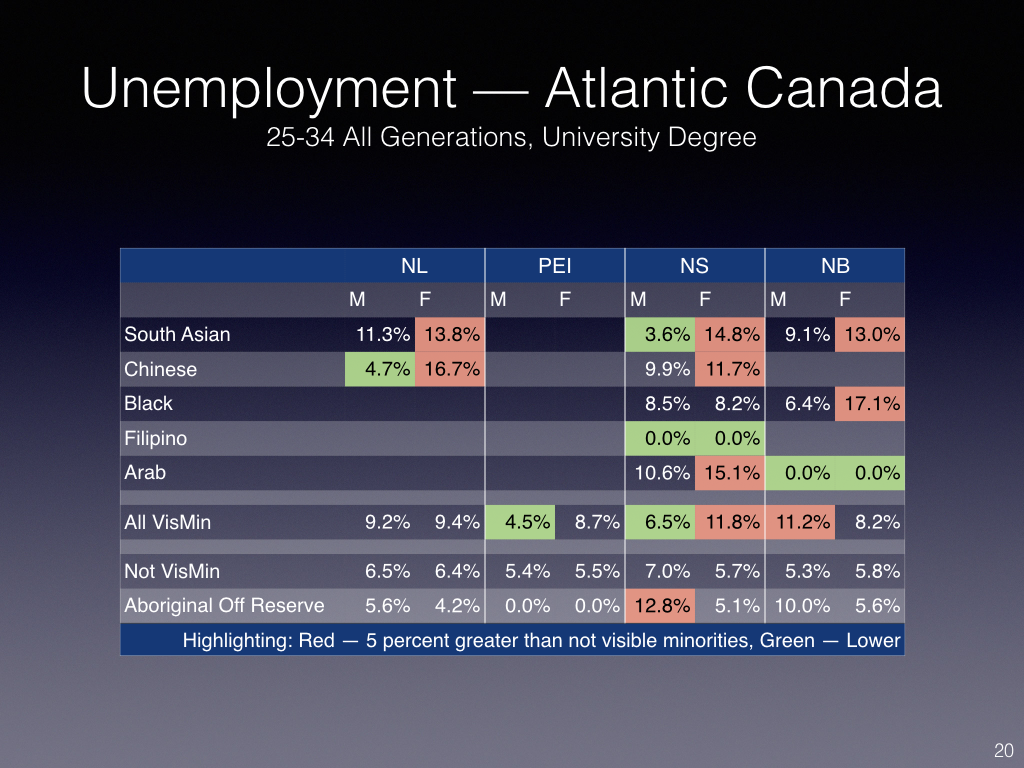
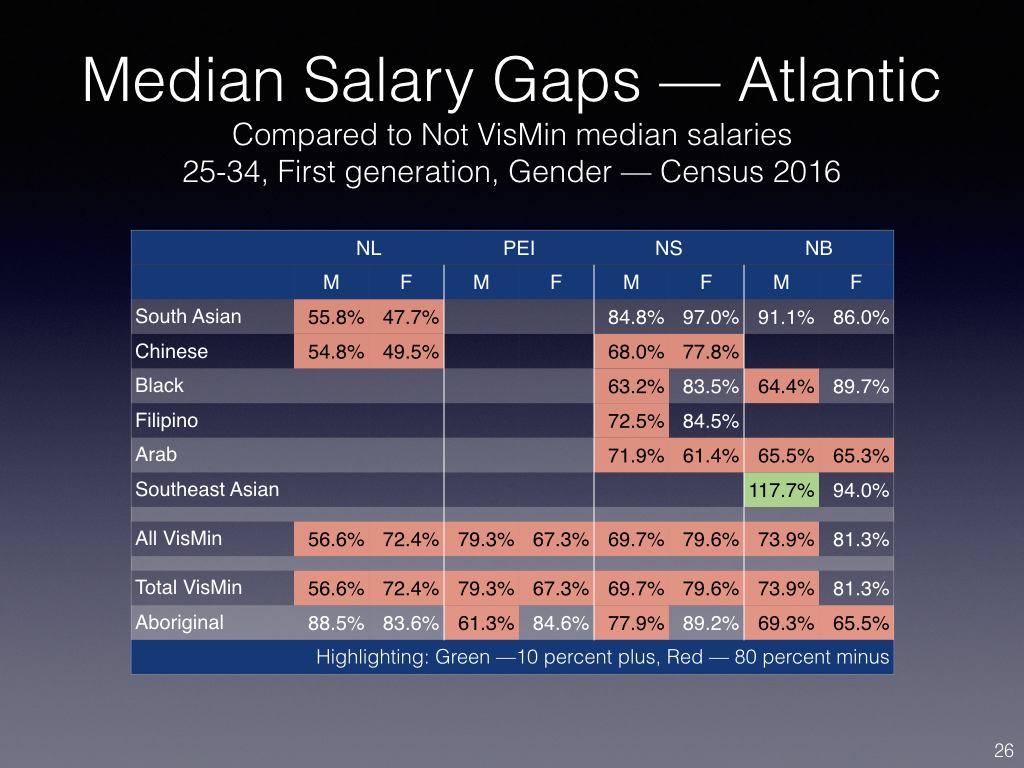
Multiculturalism: Considerable interest in the data I presented even though it was a lot to digest. Dan Hiebert nicely complemented my analysis by sharing some of his detailed neighbourhood mapping, again reinforcing his earlier hyper-diversity analysis of how mixed many neighbourhoods are. Annick Germain reviewed how Montréal-Nord has evolved over time as a lower-income area that has attracted many immigrants, including the recent wave of Haitians coming from the US, the impact of a younger immigrant population compared to an older non-immigrant population and the ongoing story of two Quebec’s, one diverse centred around Montreal and the more monolithic population elsewhere. Questions she raised included whether the relatively high unemployment rates for visible minority 25-34 year olds I highlighted reflected that many were still students, and what would be the impact of increased immigration and full employment on public opinion (and in which direction).

Multiculturalism in Canada: What Census 2016 and Other Data Tell Us (in process of being revised given some good feedback received prior to and during Metropolis.

Immigration debate: I was really pleased how this worked out as I had some worries in terms of how more conservative views on immigration of Mark Milke and to a lessor extent, Raj Sharma, might land on the pro-immigration crowd at Metropolis, with Annick Germain being the moderate voice. However, both Mark and Raj effectively used humour in making their points, without sugar coating, and exposed participants to their perspectives.

The audience challenged some of their assertions and positions but did so in a focused and respectful manner. Again, this was incredibly well attended, with lots of positive feedback from those I talked to.

A lesson that it is possible to get outside bubbles/echo chambers.  I believe we need to do more of these kind of conversations to improve our understanding of different perspectives.

ICYMI: The changing shape of Australia’s immigration policy | The Guardian

Good overview of the data and some of the issues and debates:

How many and whom? Australia is – again – seized by a debate about migration to this country, its size, shape and character.

“Immigration is a defining feature of Australia’s economic and social life,” the productivity commission argued in a 2016 report that found, on current projections, the country’s population would reach 40 million by the middle of the century.

From the post-war creation of an immigration department and the public catch-cry of “populate or perish”, successive waves of migrants, from different parts of the world, have shaped the country’s character, and influenced its development.

But Australia’s broader migration program has been revolutionised over a generation, and with little consultative public debate.

Australia does not have an explicit population policy or minister – it did briefly between 2010 and 2013 but the annual migration intake is set by government as part of the budget.

“Australia’s immigration policy is its de facto population policy,” the productivity commission says.

Since the prime ministership of John Howard, immigration experts argue, successive governments of both stripes have altered, almost beyond recognition from its post-war origins, the size, emphases, and nature of Australia’s migration program.

In Guardian analysis of migration data from the beginning of Howard’s premiership in 1996, several key trends emerge:

  • A massive increase in Australia’s annual permanent migration intake – from 85,000 in 1996 to 208,000 last year.
  • The emergence of India and China as the largest sources – by far – of migrants.
  • The movement away from family migration to skilled migration targeting national workforce needs. In 1996, family migration was about two-thirds of the program, and skilled one-third. Those ratios are now reversed.
  • A huge increase in temporary migration to Australia – through short-term work visas (the soon-to-be-replaced 457) and international students.
  • The rise of “two-step migration”, where those on short-term visas (usually 457 or student visas) gain permanent residency.
  • The emergence of migration, rather than natural increase (i.e. births) as the primary driver of population increase.

Publicly, the debate about migration rarely remains within the narrow confines of the number or origin of new people seeking to come to Australia to live.

Rather it spills, with increasing vituperativeness, into all areas of public debate: to arguments about road congestion and house prices, to the availability of resources such as land and water, to social debates about integration, religion, and English as Australia’s primary spoken language.

Migration is not just about those who arrive, but runs to national character: who is an Australian and who will become one.

The migration of the past 20 years has shaped the nature of today’s Australia. And today’s migration will create the Australia of the next generation.

https://interactive.guim.co.uk/embed/reusable-charts/line-chart/index.html?key=1Y6JLEXk6uzrqC6xmm4H4eW3COqqDWgR42HvtShNUDOg

The number of humanitarian migrants (mainly refugees being resettled) has remained fairly static since 1996, with a jump in 2012 and a trend upwards since 2015.

https://interactive.guim.co.uk/embed/aus/2018/mar/immigration/index.html

Over two decades, India and China have emerged as, by far, the largest countries of origin for permanent migrants. The number from India has grown from 3000 migrants in 1996 to more than 40,000 by 2013. Three countries, India, China, and the United Kingdom, provide the majority of migrants to Australia.

https://interactive.guim.co.uk/embed/reusable-charts/line-chart/index.html?key=1dONS7Yhk3IIf1uHdiwEwcDkzqe7jzReMN6qg_L3M7tA

Since 1996, the balance of permanent migration has moved from family towards skilled. This has come as successive Australian governments sought to tie migration more closely to the needs of the labour market.

https://interactive.guim.co.uk/embed/reusable-charts/line-chart/index.html?key=10lgs02rvbtGNf5R6DdtQNfmlqgBb4XF4aN5vcxtHFys

Temporary migration to Australia has risen sharply over the past two decades, largely through two channels – international students and temporary work visas (457). The number of international students has more than trebled since 1996, from about 113,000 a year, to more than 340,000.

https://interactive.guim.co.uk/embed/reusable-charts/line-chart/index.html?key=1mD5ddOiLkUT7n46tB35f94-xWF4CcPLidTm94vNwgBk

Natural increase – babies being born – is no longer the primary driver for Australia’s population increase. Twenty years ago, the split was broadly 60% babies, 40% arriving migrants in increasing Australia’s population. Today, the inverse is true. The number of babies being born has increased, roughly in line with the rise in population, but against a hugely higher level of migration, its proportion has shrunk.

The University of Technology Sydney professor Jock Collins has studied Australia’s migration trends for four decades. He told the Guardian that while Australia was indisputably a country of migration – 28% of Australia’s population was born overseas; of OECD nations only Luxembourg and Switzerland have higher proportions – migration has always been a matter of fierce public debate.

“There has always been an immigration debate, it’s been a major feature of our nation – it’s always been controversial.”

The profound changes to the size and shape of Australia’s migration program, began under the Howard government as he ramped up migration – permanent and temporary – in part as a response to the mining boom and a thriving economy. The trend has continued, both a result of and a factor in, Australia’s continuing economic prosperity.

Previously, Collins argues, debates about migration have been closely linked to economic downturns. Recessions in the early 80s, and then again in the start of the 90s, sparked widespread questioning of the size and nature of Australia’s immigration program.

“Now, economically, we are in this long-running boom, the argument is more about the social and environmental impact, instead of ‘they’re taking our jobs’, it’s about congestion and overcrowding, infrastructure and housing prices,” he says.

Temporary migration has changed the nature of Australia’s migration program, with an increasing number of migrants now coming to Australia on a temporary visa and, via “two-steps” or more, moving towards permanent residency.

“That is the big story of the last two decades of Australian immigration, the massive increase in temporary migration,” Collins says.

“From 1947, the emphasis was settler-migration, bringing in new people to build the nation. But now, temporary migration far outweighs permanent: 700,000 or so temporary visas compared to 200,000 on permanent visas. And this has occurred without much debate or concern, it’s only been with the Fair Work commission investigation into the exploitation of international students and working holiday visa holders, or the problems with 457 visas, that we are having this debate around temporary migrants.”

Debate, not demonisation

Collins believes a debate about Australia’s migration program – how large it is, which migrants are prioritised and why – is a legitimate public policy discussion.

“But I think the thing about the current debate, it becomes disturbing when you attack a particular ethnic group – ‘Chinese immigrants are destroying the housing market’, or talk about so-called ‘African gangs’.

“I think you can have a reasoned debate about population size and accompanying issues, if you don’t attach that to a particular group. If it’s about ‘the Chinese’ or ‘African gangs’, then it becomes emotive and not evidence-based and develops a momentum of itself.”

He says the debate Australia hasn’t yet had is around where immigrants move to. Australia is one of the most urbanised countries on earth, and the vast majority of immigrants settle in cities, overwhelming Melbourne and Sydney.

“But one thing I’ve found that’s interesting: there is a massive appetite in the bush for refugees and also for migration more broadly.

“I studied attitudes towards new immigrants to rural and regional, expecting to see some evidence of, to put it crudely, ‘redneck Australia’. But I found the opposite, the warmth of the welcome was overwhelming, towards both permanent migrants and humanitarian entrants.

“I think this can be a ‘win-win’ situation if it is well managed. Australia can maintain its large migration levels, even increase its humanitarian program, but you can diffuse the urban congestion and address the house price issue, as well as addressing population decline and economic stagnation in rural and regional areas.”

via The changing shape of Australia’s immigration policy | Australia news | The Guardian

As a citizen of Melbourne, don’t I have the right to question immigration? | Gay Alcorn | The Guardian

Similar concerns could be expressed in Vancouver and Toronto among other cities given that these quality of life concerns are valid and should not be labelled as xenophobic or otherwise dismissed. They are part of a needed conversation on immigration levels:

I’m a citizen of Melbourne. That’s all. Not an economist, nor a politician, a property developer, a demographer. Just a resident with an affection for the city, with all its flaws and idiosyncrasies.

As a citizen, nobody has been able to explain to me clearly why Melbourne, and Australia for that matter, should be absorbing so many new people every year, at a rate far higher than the OECD average, faster than other developed nations, with no feasible plan to cope with it.

The epicentre of what former New South Wales premier Bob Carr calls Australia’s “weird experiment” is Melbourne, my town. Melbourne is on the brink of being a city of 5 million and is growing at record rates (Victoria grew 2.3% in the year to June 2017, way above the national average of 1.6%, itself exceptionally high by developed nation standards).

Dear old Melbourne added a quarter of its population in just 10 years to 2016. At this rate – and projecting population growth is a wobbly science – it will be home to nearly 8 million by mid-century, overtaking Sydney as the country’s largest city.

The impact of this growth is the single most important issue in this town (and no doubt in Sydney, too, and to a lesser extent in Brisbane and Perth). As a lowly if curious citizen, the refusal of any major political party, let alone business groups, for whom the more people the better, to question the pace of growth, even to explain it, is astonishing.

I read report after report which assume with scant elaboration that “there is no alternative” to record population growth. The result is a rumbling backlash, and a justifiable one.

At least this debate is now being held, when for too long it was stuck in our debilitating culture wars, with many progressives wary that questioning immigration rates would give succour to racists.

We can ignore the Pauline Hansons who want to stop Muslims coming here. We can ignore, too, those elements of Tony Abbott’s argument that one reason for easing immigration is because in Melbourne, “ethnic gangs (are) testing the resolve of police.”That’s a dog-whistle.

But we can no longer ignore the tougher questions: the majority of our population growth is due to immigration, particularly in the past decade. Around three quarters of immigrants settle in big cities, where the jobs are.

Those cities, particularly Melbourne and Sydney, are not coping and this circular argument that all we need is better infrastructure and planning and all will be well is arguing backwards. Can we answer first why we want record population growth, and then discuss infrastructure?

The truth is that successive governments, state and federal, have not improved public transport and housing affordability and facilities for the booming outer suburbs anywhere near the rate that is needed for the current population, let alone for the hapless people who arrive each week.

Even with the will – and if the public were willing to pay for it – few state governments could cope with this level of growth. Some of Melbourne’s boom is because people are moving here from interstate – we can’t control that. Governments have little control over how many babies we have. But we can control immigration, which, absent a population policy, is our de facto population policy.

The case for easing immigration is compelling. Even if it’s just for a few years, from an annual permanent immigration intake of around 200,000 to 100,000, to catch up. Even if it’s just so we can take a breath and think about how big this country should be without having it decided for us by default.

Let me offer two examples from the world’s most liveable city, a wry joke if you live here. We are stuck in traffic, long lines of fumes and angry horns, for weeks of our lives. The state government is spending huge amounts on infrastructure, including Victoria’s biggest-ever public transport project, the Metro Tunnel, an $11bn underground rail project that will add five new stations and ease bottlenecks. When will it open? Around 2025.

Will our congestion get better? No way. The prediction is that in two decades, half of all car trips in Melbourne at peak times will be congested, up from a third now. And, according to Infrastructure Victoria, that’s taking into consideration the planned road and rail upgrades.

Let’s take schools. Daniel Andrews’ government a few days ago announced that it would spend nearly $240m to buy land for another 14 schools in suburbs with exploding population.

Education minister James Merlino boasted that 10 new schools opened last year, 11 would open this year and nine next year. That’s great. But the Grattan Institute a couple of years ago estimated that Victoria would need 220 news schools within a decade. The school where Merlino chose to make his announcement, the John Henry Primary School in exploding Pakenham, is at capacity and is taking no new enrolments. It opened just last year.

Businesses and property developers want more and more people because they want bigger markets and more consumers. Most economists seem to like it because they argue it’s great for the economy although, as a more sceptical Ross Gittins pointed out, the productivity commission has found its net impacts to be “negligible”.

And it is true that our migrant intake is skewed towards skilled migrants, with a smaller proportion of family reunions, plus this year, 18,750 people on humanitarian visas. There is nothing wrong with our system. The debate is about the sheer numbers, and whether that is serving us well now.

What is immigration for? Who is it for? The most curious argument in favour of large population growth is that, somehow, Australians – those here for generations and those recently settled – owe it to the rest of the world to populate quickly. Fairfax’s economics correspondent Peter Martin wrote that “the rest of the world has granted us a licence to use this continent on the implicit understanding that we populate it.”

Really? Says who? Fellow Fairfax columnist Jessica Irvine wrote that we need to weigh up the “needs of Australians versus foreigners” in the immigration debate and she had “never placed the hopes and dreams of Australians so far above those of foreigners that their needs become unimportant”.

That’s bewildering. Apart from our humanitarian intake – which is a duty for an affluent country like ours – the primary purpose of immigration is to benefit people who already live here, or at least not to worsen their quality of life. The Productivity Commission made that clear, concluding in a 2016 report that it had “taken the overarching policy objective of immigration to be maximising the wellbeing of existing Australian citizens and permanent residents”.

We have benefited enormously from immigration. We are a land of immigrants. We will, and should, keep growing and much of that growth will be newcomers settling here. That doesn’t mean we shouldn’t pause a tad now. Just for a bit. Just so mug citizens like me can ask a few questions about the city I love.

via As a citizen of Melbourne, don’t I have the right to question immigration? | Gay Alcorn | Opinion | The Guardian

ICYMI: Canadian attitudes toward immigrants, refugees remain positive – Environics Focus Canada 2018

The latest Focus Canada 2018 data, overall ongoing positive trends:

The arrival of Syrian refugees, as well as thousands of asylum seekers over the United States border, along with the global growth in anti-immigrant sentiment have barely moved the positive attitude most Canadians have toward new arrivals, a study has found.

Six-in-10 Canadians chose “disagree” when asked the question “Are immigration levels too high?” in the February survey by the Environics Institute for Survey Research – a finding that has remained relatively stable for a decade. Eight-in-10 said immigrants have a positive economic impact. Compared with last year’s survey, more respondents believed that immigrants adopt Canadian values. Most of the national results extended a steady 30-year trend toward greater acceptance of immigrants.

“I think some people felt retrenchment was happening, or at least feared it was happening, but since last year the change is pretty small and is still more positive than negative,” said Keith Neuman, executive director of the Environics Institute that conducted the survey of 2,000 Canadians.

Canadians also inched away from the polarization over immigration issues seen in Europe and in the United States under Donald Trump. Canadians were less likely to strongly agree or disagree with several poll questions and more likely to express uncertainty and doubt, according to Dr. Neuman. “It’s not a big change, but it’s enough to say opinions are a little less polarized than last year,” he said. “It’s dangerous to assume what’s happening in the United States or elsewhere is also happening here. ”

The trends, however, are not universally positive toward immigration. Albertans and, to a lesser extent, Quebeckers, expressed more doubt about the legitimacy of refugee claims than in the previous survey, lowering the national score slightly. Respondents in both provinces also expressed more doubt about whether immigrants are adopting Canadian values.

“It’s Alberta rather than Quebec that has the hardest attitudes toward immigrants and refugees, which is not what we tend to assume,” Dr. Neuman said. “But it’s too early to say it’s a trend.”

Some 49,775 people claimed asylum in Canada in 2017, including 20,593 who came in at irregular crossings, mostly in Quebec. About 300,000 landed in other immigrant categories.

The irregular crossings received enormous attention in Quebec, including a lot of commentary expressing doubts about the legitimacy of the asylum claims. The province also saw the rise in profile of small, far-right fringe groups hostile to immigration, but the phenomenon seems to have limited reach.

The poll showed 42 per cent of Quebeckers agreed with the statement “Many people claiming to be refugees are not real refugees.” That number is up three percentage points from last year. Forty-three per cent disagreed, down six points. Nationally, 38 per cent agreed, while 48 per cent disagreed.

In Alberta, 48 per cent said they agree that many refugee claimants are not real refugees, an increase of three percentage points, while 35 per cent disagreed, a drop of nine points. Sixty-two per cent of Albertans said too many immigrants don’t adopt Canadian values compared with the national score of 51 per cent.

Even before the results were shared with him, Fariborz Birjandian, chief executive of the Calgary Catholic Immigration Society, anticipated the Alberta difference.

Once he heard the numbers, Mr. Birjandian said the higher level of negative attitudes captured in the poll disguise an Alberta paradox: Some Albertans donate and volunteer to help settle refugees more than most Canadians while others express suspicion or hostility toward them.

“My conclusion is this: Albertans have stronger opinions on immigration. Those who support it support it wholeheartedly and those who have questions have stronger opinions, too. Albertans are more opinionated,” Mr. Birjandian said.

Alberta’s economy has also been in bad shape with the collapse of oil prices. Economic uncertainty often increases negative feelings about immigration, said Sarah Aimes, director of the immigrant-services department at Lethbridge Family Services. But, she said, positive sentiment about the Syrian refugees has tempered the negatives.

The Environics Institute poll of 2,000 Canadians, conducted by telephone between Feb. 5 and Feb. 17, has asked the same questions for three decades. It has a margin of error of 2.2 percentage points, in 19 out of 20 samples.

On a global scale, Canada still stands out for the public’s positive attitudes toward new comers and in the happiness that immigrants themselves report. When asked about their well-being, Canadian immigrants were ranked seventh-happiest out of 140 countries.

via Canadian attitudes toward immigrants, refugees remain positive: study – The Globe and Mail

Immigration alone can’t keep Canada young

Reminder that the demographic argument for large increases in immigration to address an aging population will not by itself reverse the demographic trends:

Canada is getting older. Not just us Canadians as individuals, but our population as a whole.

Our fertility rate dropped below the replacement rate of 2.1 required for population stability way back in 1971. Life expectancy at birth has increased by more than nine years since then.

One consequence of low fertility and increased longevity is that the number of people past what we traditionally consider working age is rising relative to the people of working age. The ratio of Canadians age 65 and older to Canadians age 18-64 rose by more than 10 percentage points over the past 40 years, and will rise by more than 10 percentage points again over the next 40.

An aging population puts pressure on living standards, dampens growth of government revenue and presents fiscal challenges – notably to public pensions and health care. Since immigration has become a major contributor to population growth, and immigrants are, on average, younger than already-resident Canadians, immigration can look like an antidote to aging – a kind of national elixir of youth.

This hope does not survive an encounter with real numbers, as we show in a recent publication.

Running the federal government’s recent targets, and the recommendation for an increase to 450,000 immigrants annually from the government’s Advisory Council on Economic Growth, through a demographic model reveals that higher immigration, by itself, does little to alleviate the pressure of aging.

Raising immigration, whether to an unchanging level of 450,000 a year, or to a permanently higher rate of 1.2 per cent of the already-resident population, does not stop the ratio of retirees to workers rising further, and has negligible impacts on living standards.

An immigration policy designed to stabilize the ratio of retirees to workers would require massive inflows – 1.5 million annually over the next decade alone – that are outside the realm of economic or political reality.

By contrast, projections involving later retirement – an increase in the age at which we typically consider people too old to work – present a markedly brighter picture. A projection in which the average age of retirement rises from 65 to 70 over 20 years produces a stable ratio of retirees to workers over the next decade and a half, and a decline after that. More workers per retiree means faster growth in living standards.

Encouragingly, combining later retirement with a permanently higher rate of immigration produces a bonus.

Not only does that mix lower the ratio of retirees to workers and boost living standards throughout the projection, but it demonstrates some happy timing.

In the next decade or so, when the pressure of aging on living standards will be most intense, later retirement improves the outlook – and as that boost begins to fade, the slower-acting impact of higher immigration gives us a second wind.

The later-retirement example highlights a more general point. Canada needs policies to complement higher immigration targets.

Slower growth and higher taxes will make us less attractive to potential immigrants than faster growth and lower taxes.

If living standards are growing relatively quickly in countries that are potential sources of immigrants, and in countries that compete with us as destinations for immigrants, we will have a tougher time attracting the quantity and quality of people envisioned by advocates for higher immigration – a vicious circle.

If longer work life and other responses to aging makes us more prosperous, however, we will more easily attract immigrants and retain workers who can contribute to our prosperity – a virtuous circle.

Higher immigration may be good for many reasons, but it cannot keep Canada young. Other policies to ease the demographic transition, notably encouraging people to work longer, hold out at least as much promise for boosting living standards.

And those changes would complement higher immigration targets, by improving Canada’s attractiveness to people willing and able to contribute to the Canadian economy.

via Immigration alone can’t keep Canada young – The Globe and Mail

How America Fell Behind the World on Immigration – POLITICO Magazine

Justin Gest of George Mason University’s Schar School of Policy and Government on American immigration policy:

In the world of immigration, the United States of America is a rogue state.

It wasn’t always so. There was a time in the early 20th century when the United States was viewed by the world as a paragon of immigration policy. Then a rising power that solidified its grip on a continent by settling immigrants from far and wide on disputed land, the United States established the world’s first federalized admissions restrictions in 1882. Other immigrant magnets such as Canada and Australia would follow its precedents in governance—however morally questionable—for generations. In those days, merely regulating human movement at all was pioneering.

However, thanks to decades of partisan brinkmanship and polarizing identity politics, it has now been 32 years since Congress passed a major piece of legislation governing immigration—a matter of pivotal social and economic consequence. It has been even longer since the landmark 1965 Immigration and Nationality Act abolished quotas based on national origins and focused American policy thereafter on the admission of people with family ties—principles that form the foundation of U.S. immigration policy today. Since then, other countries have put in place new regimes that admit and integrate immigrants as part of modern national strategies related to labor recruitment, business development and demographic aging. Australia’s Parliament passes tweaks to its immigration laws almost every month.

My co-author Anna Boucher and I have gathered admissions and citizenship data from 30 of the world’s most prominent destination countries. We found that the world has largely shifted to a model of immigration policy that approaches immigration more as an economic instrument than a statement of values. These policies reflect the logic of a global “gig economy” that views people as commodities to recruit, employ and dismiss at will. In contrast, U.S. regulations emphasize admissions for the purpose of family reunification, limit the admission of highly skilled migrants, limit temporary migration, and—relative to other countries—facilitate access to American citizenship.

Once the standard-bearer, the United States is now the outlier.

The U.S. military doesn’t use 1980s weaponry. The Securities and Exchange Commission doesn’t use 1980s financial software. Medicare doesn’t provide 1980s medicine. But America has settled on immigration regulations designed for an era that preceded the internet, free trade and the end of the Cold War.

Modernity, however, comes with trade-offs. Like the era before World War II, when governments crudely excluded ethnic groups in light of eugenicist ideologies about racial hierarchy, other countries’ 21st-century policies that pursue immigrants based on new ideals of merit neglect humanitarianism. They devalue family togetherness, ignore the potential for immigration to save lives and stimulate developing economies, and they treat immigrants as disposable labor. For the United States, one step forward has thus meant one step back.

By preserving anachronistic policies, American regulation both hinders our competitiveness but reflects the spirit of equality and humanity that infused the legal reforms of the late 1960s. Foolishly, new proposals from the Trump administration will only make us less economically competitive and less humane.

***

Our study of citizenship and immigration flows—the amount of foreigners a government admits each year—covers former settler states like the United States, but also Australia, Canada and New Zealand. We examine Japan and South Korea, the Nordic states and all continental European countries from Germany westward. We also include many countries from the developing world, where nearly half the world’s migrants go today. These include Bahrain, Brazil, China, Kuwait, Mexico, Oman, Russia, Saudi Arabia and Singapore. We have results for much of the past decade and complete data for 2011, a relatively ordinary year preceding the disruptions of the European migrant crisis.
With only a few exceptions, we find that three key trends characterize today’s immigration outcomes:

Temporary visas: Immigrants enter on more temporary visas that—while often renewable—limit their residency entitlement to a short term.

Labor migration: Most permanent visas admit immigrants for their labor or under regional free movement agreements designed to facilitate labor mobility.

Fewer naturalizations: These policies mean fewer immigrants are able to access citizenship and the full set of freedoms, rights and protections it entails.

With these priorities, other countries have evolved to recognize immigration as a crucial strategy to combat demographic aging, recruit innovators, attract highly skilled professionals and fill labor gaps with limited new membership. Some like Canada, Australia and the United Kingdom have devised points-based systems that admit migrants based on the extent to which they fulfill “merit” criteria related to language proficiency, skill, employment and recognized educational credentials. Other countries, like those on the Arabian Peninsula, have established overseas labor recruitment offices to promote and facilitate temporary migration. Many countries in Europe and Latin America have struck agreements with each other to permit the mobility of human capital.

These governments have identified the specific ways that immigration benefits their economies and their populations, and have proactively sought to design systems that deliver immigration in the manner they wish. The United States, unfortunately, has largely left immigration to the inertia around an outdated system and assumed that America’s magnetic power will override the benefits of considered strategy for recruitment, admissions and retention.

So the United States has been stuck in a sort of policy formaldehyde. Since the reforms of the 1960s, the U.S. has insisted that all foreign students at American universities take their new skills and leave within a year of graduation if they cannot find a company to sponsor them. Meanwhile, the U.S. has rigidly capped the admission of highly skilled engineers, scientists and programmers from China and India. The U.S. economy is structurally reliant on the cheap, flexible labor of undocumented immigrants, particularly in the construction, agricultural and service industries that build, nourish and comfort American society. It is costly and difficult for companies to justify the hiring of foreign people with extraordinary talent. And it is relatively easy for people to overstay their visas unbeknownst to the U.S. government. Congress has voted against laws that condition hiring on documented status checks, and refused to implement a system of exit stamps that confirm the departure of immigrants at ports. Congress has also refused to fund the agencies that process applications for citizenship and entry, as if the U.S. government is doing immigrants a favor and not redeeming any benefits of its own.

As a result, the United States stands out. About 65 percent of our permanent visas are granted for the purposes of family reunification. No other country is higher than 50 percent, and nearly all other countries are under 30 percent. The share of all visas granted to family members and refugees is higher than all other countries as well—more than 11 percentage points higher than the nearest countries, Ireland and Sweden. People who immigrate for family and refuge—non-economic reasons—are typically placed on a path to citizenship; and yet American naturalization rates are lower than numerous other countries with a greater emphasis on economic migrants, especially Canada. Further, while other countries have regularized undocumented immigrants, the United States features the highest estimates of undocumented immigrants in the world—between 10 million and 12 million people.

From the perspective of many moderate Republicans and moderate Democrats, American policies are makeshift and haphazard. We turn away millions of highly skilled professionals, patent filers and young contributors to the tax base. We are an anachronism that fails to compete at the international level for the best and the brightest and fails to manage flows responsibly. The costs are immeasurable because the counterfactual is unknown, but it is qualitatively clear that American economic admissions policies hinder high-skilled migration more than other countries.

On the other hand, many advanced countries elsewhere have devalued humanitarianism, ignored the benefits of family migration and greater diversity, and pursued economic strategies without consideration for their ethical implications. Singapore deports certain classes of immigrants if they become pregnant. Countries on the Arabian Peninsula grant almost nobody citizenship and deport immigrants’ children if they don’t get a job by the time they are adults. And European countries have refused to equally share the responsibility of resettling humanitarian migrants; the Dublin Agreement shifts all responsibility to the countries of first arrival on the Mediterranean Sea.

During the decades since its last major immigration legislation, the U.S. government vetted, resettled and promoted the integration of more refugees than any other country worldwide—until the Trump administration’s recent Muslim ban and 60 percent cut in refugee admissions. American policies provided citizens with the right to reunify with their spouses, children of any age, parents and siblings by sponsoring them for admission. Even though these migrants’ entry was not justified by the economic gains they were expected to bring, employment and entrepreneurship data do not suggest an appreciable difference between them and labor migrants. Though successive administrations have created and maintained obstacles to acquiring citizenship (such as tests, fees, bureaucratic drag and waitlists), rates of naturalization remain relatively high. The United States has also run a unique “diversity lottery” that vets and randomly selects qualified immigrants from underrepresented countries for admission—solidifying America’s reputation as a country of dreams that is open to all peoples.

From this perspective—shared by liberal and mainstream Democrats—the United States’ inability to evolve has meant that it has maintained among the more humane admissions systems in the world. Until Trump’s executive orders, the United States was a beacon of openness—a laissez-faire country that with each generation reinvents itself thanks to the infusion of innovative, intrepid, industrious newcomers.

The problem is that our failure to modernize this relatively humane system has led to unquantifiable, missed economic opportunities and gross inefficiencies that have inflamed political conflict.

When the U.S. did not facilitate temporary work permits and seasonal visas for unskilled laborers, migrants chose to meet employer demand without authorization, and employers eagerly ignored their legal status.

When Congress did not act on the plight of the innocent children who accompanied these undocumented labor migrants, President Barack Obama issued an executive order that circumvented the legislative process. Separately, scores of municipalities refused to cooperate with federal immigration enforcement agents.

When the public grew frustrated with a perceived inability to govern borders, they supported President Donald Trump and his promise of greater order.

However, the Trump administration’s draconian crackdown on undocumented immigrants and their families and its recently announced plans are retrenching the United States, when we need to be catching up.

And what about Trump’s wall? This expensive boondoggle will not prevent the visa overstays and visa violators that constitute the vast majority of the undocumented migrants. His proposed termination of the diversity lottery and limits on family migration reduce total admissions rather than creating space for highly skilled professionals. And if Democrats and moderate Republicans will agree to these measures, only then will the president agree to do the humane (and practical) thing and make the children of undocumented immigrants eligible for citizenship—albeit not for another decade.

And yet, the U.S. can be both humane and economically sensible at the same time.

It is possible to design a points-based system of admissions that identifies “merit” in economically desirable credentials, but also in American family ties, in multiple language proficiencies, in underrepresented origins, in vulnerable circumstances, in the presence of a financial guarantor, in previous visits to the United States that featured on-time exits. What if this whole package was considered the way employers holistically screen résumés, the way universities evaluate prospective students?

The United States can lead the world on immigration again. But putting up walls, metaphorical or real, is not the way to do it.

via How America Fell Behind the World on Immigration – POLITICO Magazine

Australia: Being cruel to refugees doesn’t strengthen multiculturalism

I find Minns somewhat over the top. There is a correlation between confidence in immigration and border management, to deny this is counter to the Canadian experience.

This does not justify some of the anti-immigration and anti-refugee rhetoric (and some of the Australian government’s initiatives) but denying any link and not taking border management seriously is another matter:

There are now dozens of statements from United Nation bodies, condemning Australia’s refugee policies as harsh, inhumane and detrimental to the health and safety of the refugees.

In the face of this criticism, over the last two years, the Australian government has developed a new rationale for this extremely harsh treatment. They now claim that the measures used against boat arrivals – mandatory detention, permanent exclusion and being sent (now for five years for some) to Nauru and Manus Island – are, paradoxically, the very things that reinforce public support for immigration and multiculturalism.

The Prime Minister’s website quotes him as saying that: “Strong borders allow the government to maintain public trust in community safety, respect for diversity and support for our immigration and humanitarian programs.”

His blog reiterates the message: “Strong borders are the foundation of our high-immigration multicultural success”. Peter Dutton made the same point in a speech in London last year.

In fact, government figures have shown few reservations about wading into Pauline Hanson’s territory when they have felt it is in their political interest to do so. In November 2016, Dutton claimed that Malcolm Fraser made a mistake in allowing Lebanese Muslims into the country – not fundamentally different to Hanson’s call in the election that year for a total ban on Muslim immigration. In the same year he said that “illiterate and innumerate” refugees would take Australian jobs or “languish” on the dole and Medicare. Hanson’s 1996 maiden speech said that “immigration must be halted in the short term so that our dole queues are not added to by, in many cases, unskilled migrants not fluent in the English language.”

Citizenship Minister Alan Tudge suggested earlier this month that mulitculturalism is at risk unless tougher English-language tests are introduced for potential migrants. He argued that those from a non-English-speaking background are often concentrated “in particular suburbs… with a considerable absence of English being spoken or understood.” Again, Hanson, speaking then of Asian migrants, said that “they have their own culture and religion, form ghettos and do not assimilate.”

Last April Dutton introduced a bill to require permanent residents to wait four years, instead of one, to apply for citizenship. He plans to reintroduce it this year. It is another signal to the electorate that we should be suspicious and fearful of new arrivals. It is a move in the direction of Cory Bernardi’s Australian Conservatives, who are opposed to multiculturalism and want to extend the waiting time for permanent residents before applying for citizenship to ten years.

Both Turnbull and Dutton raced to condemn Sudanese youth gangs in Melbourne in January. Although the Federal government has no jurisdiction over the matter and despite the fact that crime in Victoria was down nearly 5 per cent in the year to last September, Dutton claimed that people were afraid to go out to restaurants. Again, fear is stoked, insecurity deepened and small, easily identifiable, non-Anglo groups blamed. In this soil, it is inevitable that broader hostility to immigration will grow – something that Tony Abbott, ever the opportunist, has noticed and taken advantage of with his call for deep cuts to immigration.

The claim that our government is staunchly defending a tolerant multiculturalism by taking necessarily harsh action against asylum seekers is difficult to sustain.

The international record on such action and its effect on the broader society is also informative. When the years spent in squalid refugee camps in Turkey, Jordan and elsewhere finally became too much and exploded into large refugee flows into Europe in 2015 and 2016 some governments took brutal and exclusionary actions. Hungary sent troops to force refugees back from its border. Today its Prime Minister Viktor Orban rejects taking any refugees in coordination with other EU countries, calling them “Muslim invaders.”

The Polish Law and Justice Party fought and convincingly won the 2015 election on the basis that it would not accept even one Muslim refugee. In so doing it has legitimised racism and Islamophobia. As many as 60,000 took part in a march in Warsaw last November organised by a movement called “White Poland”. With banners such as “White Europe” and “Clean Blood” they outnumbered the official Independence Day celebrations.

In Austria, Sebastian Kurz became Chancellor late last year after campaigning on a hard anti-immigrant policy, including seizing money from asylum seekers to pay for the costs of their temporary accommodation. Now, he has joined in coalition with the far-right Freedom Party (FPÖ). Its leader, and now Vice-Chancellor Heinz-Christian Strache has continued the attack, calling for asylum seekers to be shut up in conditions which some have described as chillingly reminiscent of concentration camps. The party’s General Secretary Herbert Kickl has spoken of plans to create “camps” for refugees “to keep them concentrated in one place”.

The evidence from Europe is consistent with our experience in Australia. Right-wing populism, anti-immigrant sentiment, suspicion of and hostility to people simply because they are Muslim, cannot be effectively challenged by cruelty towards refugees. On the contrary, such refugee policies legitimise the fears on which that brand of politics thrives. These policies not only harm the refugees, they also harm the society in which we live.

There are alternatives to the current Australian refugee policy which do not amount to open borders. We know this is the case, because, in this country, we implemented many of these alternatives for decades very successfully. Thousands of Canberrans plan to march on this Palm Sunday to call for our leaders to do so again.

via Being cruel to refugees doesn’t strengthen multiculturalism

Social conservatives savour victory, thank immigrants: Konrad Yakabuski

Yakabuski picks up on the Pricker-Ibbitson theory in The Big Shift towards more conservative social policies as a result of more religious and socially conservative new Canadians.

The reality is more nuanced as new Canadians, like most voters, are not single issue candidates; after all, the Liberals won the vast majority of ridings in which visible minorities form the majority despite more liberal social views:

Canada has accepted about five million new immigrants in the past 25 years and they have irreversibly changed our political dynamics.

Twenty-five years ago, Quebec’s place within the Canadian federation was almost all we ever talked about. Today, the Quebec question has faded from the national agenda. All we seem to talk about now is diversity.

For most of us, this means ensuring that more women and minorities are represented in all spheres of Canadian life. We have branded ourselves as an immigrant nation that embraces people of all origins. “Diversity is our strength” has become our national motto, replacing A Mari Usque Ad Mare (from sea to sea) everywhere but on our country’s official coat of arms.

What our political elites have a hard time admitting, however, is that diversity is not a one-way street toward harmonious living – what the French call le vivre-ensemble – but a multilane expressway of competing and often colliding values, norms and ideas. Nowhere has this become as apparent as in the emergence of social conservatism as a political force in Canada.

Doug Ford’s election as the leader of Ontario’s Progressive Conservative Party would not have been possible without the mobilization of social conservatives. That a strident anti-abortion activist – Tanya Granic Allen – was even on the ballot was proof in itself that this is no longer your father’s PC Party. That Ms. Granic Allen captured almost as much first-ballot support as the centrist Caroline Mulroney, and that her supporters propelled Mr. Ford over the top on the final ballot, was especially sweet for social conservatives.

The latter are now celebrating their new-found political clout — in dozens of languages. Immigration has swelled the ranks of Canada’s social conservatives. Polls shows that Canadian-born voters are less religious than ever, even when they claim to belong to a particular faith. That is not true of immigrants, who often identify more with their religion than their country.

Immigrants have increasingly shaped our communities, our schools and our self-conception as a country. So, it was only a matter of time before they began shaping our politics, too. It is unlikely Ontarians would be debating the province’s new sex-education curriculum at all if only Canadian-born voters were concerned. Resistance to the new curriculum has been strongest among immigrant parents. Some even pulled their kids out of school in protest.

Ground zero for the anti-sex-ed movement is Thorncliffe Park, in Toronto’s inner suburbs, where 70 per cent of the population was born outside Canada and almost 60 per cent of residents speak neither English nor French at home. They’re far more likely to speak Urdu, Farsi and Tagalog.

Campaign Life Coalition, the anti-abortion activist group that has led the fight against Liberal Premier Kathleen Wynne’s update to the sex-ed curriculum, publishes some of its literature in 10 languages. The group claims to have signed up 9,000 new PC Party members during the leadership race to support Ms. Granic Allen as their first choice and Mr. Ford as their second.

“New Canadians are extremely important to CLC. It is probably our fastest growth segment in terms of general supporters and activists,” CLC spokesman Jack Fonseca said in an e-mail. “I do believe that their mobilization could shift public policy momentum on life and family issues.”

Not all social conservatives are religious. Chinese immigrants, whom Mr. Fonseca said have accounted for “a lot of growth” in his group’s membership, are among those least likely to practise a religion. But for most social conservatives, religion is the motivating factor in their political mobilization.

More than half a million Muslims immigrated to Canada in the 20 years to 2011, according to Statistics Canada’s National Household Survey. The 2016 census showed that Canada accepted more than 150,000 immigrants from Pakistan, Iran, Iraq and Syria— all Muslim-majority countries – between 2011 and 2016. Tens of thousands more came from Algeria, Morocco, Tunisia and Egypt.

Almost 200,000 Filipino immigrants came to Canada in the five years to 2016, replenishing the pews of the country’s Catholic churches. As with most Canadian Muslims, these Filipino newcomers take their faith ultraseriously.

A 2016 Environics poll showed Canadian Muslims voted overwhelmingly for Prime Minister Justin Trudeau’s Liberals in 2015. But that was likely a result of the uproar surrounding Conservative attempts to ban the niqab at citizenship ceremonies and the party’s pro-Israel foreign policy. The same poll found that, among Canadian Muslims, “religious identity and practice are important and growing, in contrast to the broader secularizing trend in Canada.”

How long can these two trends co-exist without colliding? Doug Ford’s leadership win may just have given us the answer.

via Social conservatives savour victory, thank immigrants – The Globe and Mail

Liberals say immigration enforcement is racist, but the group most likely to benefit from it is black men

Not quite sure whether the studies cited represent a consensus view or not. Look forward to any comments by those more familiar with the various studies:

President Trump’s election victory over Hillary Clinton seemed to herald a new era for border security and immigration enforcement. But his polarizing and occasionally ignorant comments about immigrants have handed his adversaries a convenient pretext for stymying compromise on immigration reform: racism.

Left-leaning advocacy groups and a host of Democrats all too often shy away from the specifics of the debate and instead lean on cries of bigotry, resorting to claims like that of House Minority Leader Nancy Pelosi, who has described Trump’s approach to immigration reform as an effort to “make America white again.”

Claims that immigration enforcement equals racism ignore the reality that the group most likely to benefit from a tougher approach to immigration enforcement is young black men, who often compete with recent immigrants for low-skilled jobs.

This dynamic played out recently at a large bakery in Chicago that supplies buns to McDonald’s. Some 800 immigrant laborers, most of them from Mexico, lost their jobs last year after an audit by Immigration and Customs Enforcement. The Cloverhill Bakery, owned by Aryzta, a big Swiss food conglomerate, had to hire new workers, 80% to 90% of whom are African American. According to the Chicago Sun Times, the new workers are paid $14 per hour, or $4 per hour more than the (illegal) immigrant workers.

In this case, and in many others, the beneficiaries of immigration enforcement were working-class blacks, who are often passed over for jobs by unscrupulous employers.

The labor force participation rate for adult black men has declined steadily since the passage of the 1965 Immigration and Nationality Act, which ushered in a new era of mass immigration. In 1973, the rate was 79%. It is now at 68%, and the Bureau of Labor projects that it will decline to 61% by 2026.
The beneficiaries of immigration enforcement [are] working-class blacks, who are often passed over for jobs by unscrupulous employers.

In 2016, the Obama White House produced a 48-page report acknowledging that immigration does not help the labor force participation rate of the native-born. It concluded, however, that “immigration reform would raise the overall participation rate by bringing in new workers of prime working age.”
Although the report used the term “new workers,” Democrats may also be tempted by the prospect of new voters. But they should be aware that in courting one group, they risk losing others.

African Americans tend to be a reliable voting bloc for the Democratic Party, but they have repeatedly indicated in public opinion surveys that they want significantly less immigration.

A recent Harvard-Harris poll found that African Americans favor reducing legal immigration more than any other demographic group: 85% want less than the million-plus we allow on an annual basis, and 54% opted for the most stringent choices offered — 250,000 immigrants per year or less, or none at all.

These attitudes are rational.

In a 2010 study on the social effects of immigration, the Cornell University professor Vernon Briggs concluded: “No racial or ethnic group has benefited less or been harmed more than the nation’s African American community.”

The Harvard economist George Borjas has found that, between 1980 and 2000, one-third of the decline in the employment among black male high school dropouts was attributable to immigration. He also reported “a strong correlation between immigration, black wages, black employment rates, and black incarceration rates.”

In a 2014 paper on neoliberal immigration policies and their effects on African Americans, the University of Notre Dame professor Stephen Steinberg argued that, thanks to the Immigration and Nationality Act of 1965, “African Americans found themselves in the proverbial position of being ‘last hired.'” Steinberg also noted that “immigrants have been cited as proof that African Americans lack the pluck and determination that have allowed millions of immigrants from Asia, Latin America and the Caribbean to pursue the American dream.”

The struggles of black men obviously cannot all be linked to immigration, but it’s clear that the status quo does not benefit them.

As elected leaders consider changing our immigration laws, the interests of America’s most vulnerable citizens shouldn’t be overlooked. The first step toward honest reform is for the Democratic Party to admit that while liberal immigration enforcement might help them win new voters, it also harms and disenfranchises their most loyal constituency.

via Liberals say immigration enforcement is racist, but the group most likely to benefit from it is black men