Trump’s $5 million Gold Card offers the rich a fast lane to residency

Good assessment of this harebrained scheme, unlikely to attract the worthy. Lack of details on how it would work also cause for concern. Silver’s comment at the end sounds about right:

Lawyers’ phones are ringing with wealthy foreigners wanting to know more about how to score a “Gold Card” – a glorified green card that would allow them to live and work in the U.S. without going through the usual hassle or red tape. Apparently, the card’s $5 million price tag is not scaring off the jet-setters looking to make the U.S. home. Or at least one of their homes.

“$5 million to these people is jet fuel cost. It means nothing to them,” says Matthew Kolken, an immigration lawyer from Buffalo, NY, who has Canadian clients asking about the Gold Card. The clients declined to comment, but Kolken says he thinks the Gold Card is underpriced, if anything, considering the time and hassle it would save foreign multi-millionaires.

“It allows them to potentially buy their way into the United States,” says Kolken. “They would just be able to throw down their Amex Black Card.”

And plenty are interested.

“I have one from India, one from Pakistan, and two from Egypt. And a colleague who has a few [clients] from Russia,” says immigration attorney Mona Shah. Most are drawn to the offer of an express lane to permanent residency, plus more favorable tax implications; foreign nationals living in the U.S. on a Gold Card would only be taxed on their U.S. earnings.

Shah says the security — and the status — of being able to flash that “Gold Card” to get waved into the U. S. is also a big draw, as well as what Trump has described as “privileges – plus.” The president hasn’t elaborated on what that means, but Shah says clients are imagining VIP perks that range from easy loans to a special fast-track lane through Customs at U.S. airports.

“They seem to believe that this is going to be some kind of separating first class from economy class, and that this is some kind of ‘red carpet’ visa and they will be treated like a VIP everywhere,” says Shah.

But whether any such perks – or obligations – will come with the Gold Card remains far from clear, and the administration is not offering any more details some three months after President Donald Trump first started hyping the idea.

“It’s a great thing, the Gold Card. Remember the words ‘the Gold Card!'” he proclaimed to reporters in the Oval Office in February. “Wealthy people will be coming into our country by buying this card. They’ll be wealthy and they’ll be successful and they’ll be spending a lot of money and paying a lot of taxes and employing a lot of people. And we think it’s going to be extremely successful, never been done before anything like this.”

Trump added that he’d be happy to call it the “Trump Gold Card.” In fact officials say a government website is now using the name TrumpCard.gov, and Trump has since revealed a sample card with a picture of his face on the front.

Trump has said the proceeds of the Gold Card would go to help pay down the budget deficit, and possibly even chip away at the massive $36.2 trillion national debt.

“We’ll be able to sell maybe a million of these cards, maybe more than that,” Trump said. “A million cards would be worth $5 trillion. And if you sell 10 million of the cards, that’s a total of $50 trillion. We have $35 trillion in debt. That’d be nice.”

But most immigration experts and attorneys see that figure as wildly unrealistic. They expect sales to be in the low thousands.

Immigration lawyer Darren Silver says he’s received a flurry of calls about the Gold Card, but interest wanes as soon as he explains this program is not like the existing EB-5 visa program, which requires an investment of something closer to $1 million in a business that creates jobs or $800,000 for investments in a lower-income ‘targeted employment area.’

Silver says his clients are surprised when he tells them the Gold Card is not an investment that might offer any returns. It’s effectively just a donation.

“I had to explain to them, ‘you’re gifting the U.S. government $5 million. That’s all you’re doing.'” says Silver. “And once I explain that to them, they’re out.”

Source: Trump’s $5 million Gold Card offers the rich a fast lane to residency
Snubbing Trump, Immigration Nominee Would End Student Practical Training

Similar to PGWP in Canada. Our daughter benefited from OPT following her graduation:

Even though President Donald Trump has said international students should receive green cards after graduating from U.S. universities, a nominee to head the nation’s immigration service says he wants to stop foreign students from working after graduation.

Joseph Edlow, the president’s nominee for director of U.S. Citizenship and Immigration Services, said he would do this by ending Optional Practical Training. Economists, business leaders and educators have said that ending post-graduation OPT and STEM OPT would halt America’s best programs for attracting and retaining international talent.

Immigration Nominee Offers Negative Views On International Students Working In America

During a confirmation hearing before the Senate Judiciary Committee on Wednesday, Edlow made statements certain to alarm universities, technology companies and international students.

“I think the way in which OPT has been handled over the past four years, with the help of certain decisions coming out of the D.C. Circuit Court, have been a real problem in terms of misapplication of the law,” Edlow said in response. “What I want to see would be essentially a regulatory and sub-regulatory program that would allow us to remove the ability for employment authorizations for F-1 students beyond the time that they are in school.” (Emphasis added. The exchange occurs at about 1 hr., 45 min of the linked video.)

According to the Institute of International Education, in the 2023/24 academic year, 163,452 international students engaged in post-completion OPT and 79,330 were in STEM OPT — a total of 242,782. Limiting employment authorization for OPT or STEM OPT to when students carry their full course load would cause these numbers to plummet and significantly reduce the number of international students who gain H-1B status, including by eliminating STEM OPT, which follows the completion of OPT.

The Immigration Regulatory Threats To OPT And STEM OPT

Optional Practical Training allows international students to work for 12 months in their major course of study before or after completing their course requirements. STEM OPT allows students to gain practical experience through working an additional 24 months (beyond OPT) in a science, technology, engineering or math field.

Educators consider OPT and STEM OPT essential because practical training benefits students’ education and encourages them to enroll in U.S. universities. The additional 24 months in STEM OPT also allows employers a much better opportunity to secure an H-1B petition for students. Business trade associations participated in the D.C. Circuit case on STEM OPT as intervenors due to their interests in the litigation’s outcome, as did approximately 150 colleges, universities and related organizations.

Source: Snubbing Trump, Immigration Nominee Would End Student Practical Training

ICYMI: Ontario unveils changes to provincial immigration nominee program

Of note:

Ontario has introduced changes to its popular provincial immigration program to meet evolving economic needs.

On Wednesday, the government tabled new legislation which, if passed, will give the provincial immigration minister the ability to establish or remove immigrant nomination streams to quickly respond to the changing job market and labour demand.

The proposed changes to the provincial immigration program would also:

•Allow officials to return applications that no longer match current job market needs or raise concerns;

•Grant inspectors the authority to require in-person interviews with applicants through the Ontario Immigrant Nominee Program, to improve program integrity and prevent fraudulent claims;

•Further digitalize the application process by letting employers hoping to sponsor foreign workers for permanent residence submit applications directly and electronically to a new employer portal, starting this summer.

These are among 18 new proposed measures in the Working for Workers Seven Act, 2025 that the Conservative government hopes to adopt to meet changing economic needs and build a stronger workforce.

“We’re proposing changes that will prepare workers and businesses for the jobs of the future, while helping workers facing impacts from U.S. tariffs and economic uncertainty,” said David Piccini, minister of labour, immigration, training and skills development, in a statement.

“This package underscores our unwavering commitment to protecting our province’s most valuable resource — our workers.”…

Source: Ontario unveils changes to provincial immigration nominee program

How the Supreme Court Made Legal Immigrants Vulnerable to Deportation

The US keeps on making it harder to justify maintaining the STCA:

The government knows their names.

Their fingerprints have been scanned into government computers. The Department of Homeland Security knows where most of them live, because the immigrants in question — more than 500,000 of them — reside in the United States legally.

But two new Supreme Court decisions have left them open to deportation, an abrupt turn for a population that has been able to remain in the country by using legal pathways for people facing war and political turmoil at home.

“Thousands of people — especially Haitians, Cubans and Venezuelans — instantly shift from ‘lawfully present’ to ‘deportable,’” said Jason Houser, a former official with Immigration and Customs Enforcement during the Biden administration.

Now, with their protections revoked while legal challenges move through lower courts, many immigrants have found themselves in a vulnerable position. Because so many of them have shared detailed information with the government, including addresses, biometrics and the names of their sponsors, they could be easy to track down at a moment when the Trump administration is looking for ways to deport people quickly.

Whether and how aggressively the administration might move to begin rounding up people whose legal protections have been revoked remains unclear, though officials signaled several months ago that they feel they have the authority to do so.

“It’s chaotic and unnecessary, and we’re already receiving panicked calls and emails, and the crescendo will only grow,” said Karen Tumlin, founder and director of Justice Action Center, an immigrant advocacy group that has challenged last week’s rulings in court.

“The Supreme Court has effectively greenlit deportation orders for an estimated half a million people, the largest such de-legalization in the modern era,” she said.

The Supreme Court acted in both cases on emergency applications by the Trump administration, which has pushed for more arrests and deportations, even for people who are in the United States legally. The administration argues that some immigration programs are being abused and allow people into the country who would otherwise be turned away.

The court gutted two such programs in the last couple of weeks, humanitarian parole and Temporary Protected Status, which together have shielded more than a half-million people from deportation. The decisions were unsigned and gave no reasoning, which is typical of emergency proceedings….

Source: How the Supreme Court Made Legal Immigrants Vulnerable to Deportation

Harvard Has Strong Chance To Prevail Over Trump In Immigration Lawsuit

Hopefully, will lead to another defeat for the Trump administration’s self-harming policies:

Harvard University has a strong chance to prevail in its immigration battle with the Trump administration over the right to enroll international students. After Harvard refused the Trump administration’s demands for the federal government to take over the university’s hiring, admissions and governance policies, the Department of Homeland Security removed the school’s certification to admit international students. The high-profile action against Harvard came as the Trump administration’s nominee for director of U.S. Citizenship and Immigration Services said he would eliminate Optional Practical Training and STEM OPT, another measure educators warn could cause international student enrollment at U.S. universities to plummet.

The Trump Administration’s Immigration Decision On International Students

On May 22, Secretary of Homeland Security Kristi Noem sent a letterto Harvard: “I am writing to inform you that effective immediately, Harvard University’s Student and Exchange Visitor Program [SEVP] certification is revoked.”

Without the certification, a school cannot enroll international students.

Enacted after the terrorist attacks of September 11, 2001, the SEVP rules and certification process were intended to encourage schools to report when students dropped out or no longer maintained a required course load and to remove fraudulent or illegitimate schools. The rules were never intended to be used to punish universities for not complying with unrelated demands by ending their ability to enroll international students….

The Wall Street Journal asked, “Is Trump Trying To Destroy Harvard?” in a recent editorial. “The Trump Administration has frozen billions in federal grants to Harvard University, threatened its tax-exempt status and sought to dictate its curriculum and hiring,” wrote the Journal. “Now the government seems bent on destroying the school for the offense of fighting back. And for what purpose? That’s how we read the Department of Homeland Security’s move Thursday to bar foreign students from attending the world-renowned institution.”

The editorial labeled the move against international students, a quarter of Harvard’s student body, “whose futures are suddenly in disarray,” to be “a short-sighted attack on one of America’s great competitive strengths: Its ability to attract the world’s best and brightest.”…

Source: Harvard Has Strong Chance To Prevail Over Trump In Immigration Lawsuit

Bonner: Repairing the fray: Improving immigration and citizenship policy in Canada

Hard to understand why a former staffer with exposure to immigration issues, could advance such naive, politically and in some cases, judicially unrealistic proposals in response to some of the legitimate policy concerns and failures that he points out.

Some examples. Government reorganization into a super ministry would result in significant transition processes and distract from substantive issues. Would any international campaign focussed on values discourage those with other values? No country has had success with pro-birth strategies. Differential time requirements for citizenship would be Charter non-compliant:

….Immigration has been a good thing in the past. It should be in the present and future, too.

This study has three main parts: (1) an exposition of the economic and cultural challenges of mass immigration (including a short history of immigration policy in Canada), (2) a comparative analysis of other immigration systems that we can learn from, and (3) a series of policy options for improving the Canadian system.

To repair Canada’s frayed immigration system, this study makes the case for the following recommendations:

1. Lower the annual permanent residency target to a more manageable level (e.g. 200,000).

2. Strengthen the process of deportation for any non-citizen found guilty of violent crime, supporting terrorism, or expressing hatred for Canada.

3. Execute an international campaign to discourage immigration by anyone unwilling or unable to respect our founding cultures and unwilling or unable to integrate.

4. Prioritize international students pursuing courses of study of high importance to our labour market and supply chains.

5. Re-engineer the points system to emphasize language, age, and domestic education.

6. Consolidate all “population” ministries to create the Ministry of Human Resources Canada (MHRC).

7. Make the main mandate of MHRC to ensure that economic immigration serves the national interest.

8. Require MHRC to implement a pro-birth strategy.

9. Lengthen the time requirement for citizenship, except for immigrants from peer English- and French-speaking countries.

10. Phase down and abolish the Temporary Foreign Worker Program permanently.

11. Establish a uniform standard of credential recognition in self-regulating professions and skilled trades.

We have the right and the obligation to raise the value of Canadian citizenship, and to demand more of our citizens. Above all, however, efforts at integration should proceed not from a dislike of other places, but from a love for Canada….

Source: Repairing the fray: Improving immigration and citizenship policy in Canada

Canada sees surge in temporary foreign workers applying to escape abusive employers

The positive news is that this pathway appears to be responding to the unfortunate need:

The number of temporary foreign workers applying for open work permits to escape abusive employers has jumped more than 800 per cent year over year, a surge advocates say highlights a growing crisis of abuse as immigration cuts and economic uncertainty deepen migrant workers’ vulnerability.

To address exploitation, the federal government in 2019 introduced the Vulnerable Worker Open Work Permit, allowing temporary foreign workers — whose status in Canada is tied to a single employer — to leave abusive jobs and apply for an open permit.

To qualify for one of these permits, migrant workers must show evidence of abuse.

In Ontario, open work permits for vulnerable workers soared to 435 in the first quarter of 2025, up from just 45 during the same period last year, according to the most recent data from Immigration, Refugees and Citizenship Canada — an 867 per cent increase.

In British Columbia, 650 permits were issued in the first quarter of 2025, a sharp rise from just 40 during the same period in 2024. Quebec and Alberta each saw 465 permits issued in early 2025, up from 65 and 30, respectively, during the same period last year.

As Canada increasingly relies on migrant workers to fill gaps in key sectors like agriculture, construction and health care, the surge in vulnerable worker open work permits underscores how the temporary foreign worker program leaves workers open to exploitation. Tied to a single employer, many are afraid to speak out for fear of losing their status or being deported.

Advocates say a looming recession and government efforts to cut immigration levels are exacerbating that precarity, and while more migrant workers are now seeking help, they warn the true scale of abuse is likely far greater than what’s being reported….

Source: Canada sees surge in temporary foreign workers applying to escape abusive employers

Canada increasingly dependent on low-wage migrant workers, says report

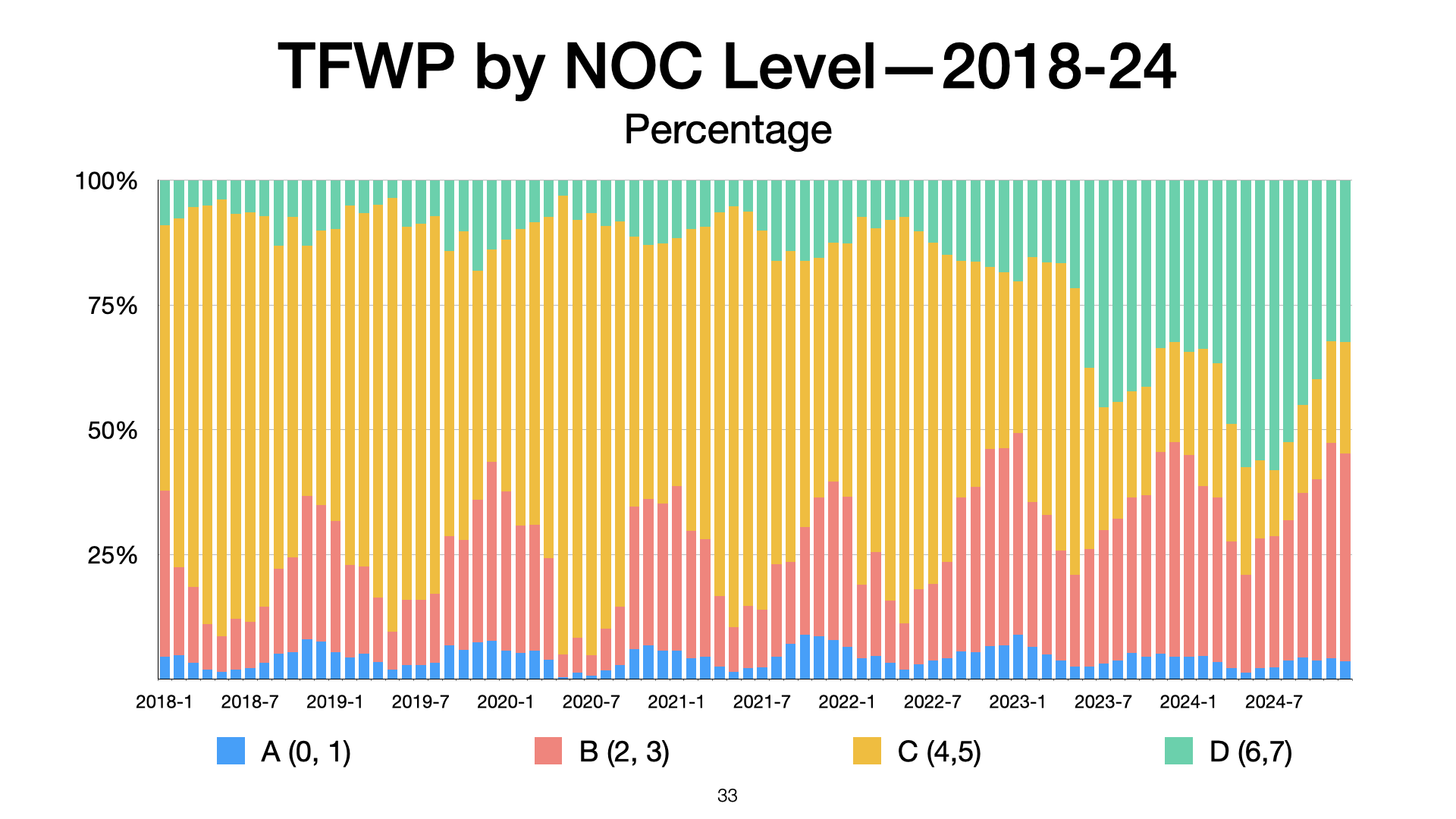
Confirmation what many have been noting (chart below highlights shift before more recent reversal_:

The share of native-born Canadians in the labour force has dropped nearly 10 percentage points since 2006, according to a new Bank of Canada report documenting how the country’s economy is becoming increasingly reliant on low-wage migrant workers.

“Not only has Canada experienced an unprecedented surge in immigration, but the composition of recent newcomers has been markedly different than in the past,” reads a discussion paper published May 9 by the bank’s Economic Analysis Department.

The paper found that, driven largely by a surge in temporary migration, the average Canadian immigrant has now become younger, lower-skilled and more likely to hail from poorer regions such as India, sub-Saharan Africa or the Middle East.

They’re also paid less. Particularly among Canada’s surging ranks of temporary migrant workers, wages have “reduced significantly relative to Canadian-born workers,” reads the paper.

Since 2015, “the average nominal wage gap between temporary and Canadian-born workers has more than doubled,” it read.

The authors calculated that the average migrant worker in Canada is now paid more than one fifth (22.6 per cent) less than a comparable Canadian-born worker. Prior to 2014, that gap was only 9.5 per cent.

The paper, entitled The Shift in Canadian Immigration Composition and its Effect on Wages, is one of the most definitive official documents as to the massive surge of migrant workers brought to Canada in the immediate wake of the COVID-19 pandemic.

Starting in 2022, Canada began accepting more than one million newcomers per year, mostly in “non-permanent” categories of immigrants ranging from international students, who are among those admitted under the international mobility program, to temporary foreign workers.

The Bank of Canada document shows that this wasn’t just unprecedented for Canada, but it went well beyond the pale of any comparable advanced economy.

Between 2019 and 2023, Canada charted population growth of more than six per cent. This was triple the rate seen in the United States, and double the rate seen in Switzerland, the only other developed economy analyzed by the paper whose demographic shift came anywhere close to those of Canada’s….

Source: Canada increasingly dependent on low-wage migrant workers, says report

Immigration advocates take Ottawa to court over refugee treaty with U.S. 

As was expected and they have a case, no matter how inconvenient, as it gets stronger day-by-day with clear incidents of USA and ICE over-reach and undermining protections:

The federal government is facing a legal challenge arguing that its oversight of a two-decade-old refugee treaty with the United States is “fundamentally flawed.”

The bilateral agreement is premised on both countries being safe for asylum seekers. It prevents refugee claimants passing through the U.S. from seeking protection in Canada and vice versa. 

Canada is legally required to regularly review its neighbour’s human-rights record and refugee protections as part of the treaty, the Safe Third Country Agreement, or STCA. Ottawa has not publicized its findings since 2009. 

In January, U.S. President Donald Trump ordered a sweeping immigration crackdown that has heightened asylum seekers’ risk of detention and deportation. Immigration rights groups have asserted that migrants and asylum seekers have been held in “secret” detention at the northern border. 

In an application for judicial review, the Canadian Association of Refugee Lawyers (CARL) and the South Asian Legal Clinic of Ontario (SALCO) argue that the lack of publicly available information about Ottawa‘s refugee monitoring process shields the government from accountability − and could violate the Constitution.

“This is so crucial because what we see happening at the Canada-U.S. border is quite troubling,” said lawyer Maureen Silcoff, who is representing CARL in the legal challenge.

Advocates in Canada have long maintained that cracks in American refugee protections leave asylum seekers at risk, raising concerns about the legality of the STCA treaty. Executive orders issued by the U.S. President in January, which initiated drastic immigration changes, have heightened fears over detention conditions for asylum seekers and rapid deportation without due process. 

Sujit Choudhry, who is representing SALCO in the case, said that without detailed evidence of how Ottawa determines its neighbour is safe for asylum seekers, it is impossible to know if Canada is complying with its legal obligations to refugee claimants.

An inaccurate designation – one that results in refugee claimants at the Canadian border being returned to the U.S. and then deported to a country where they would face torture – would violate the Canadian Constitution, he added. …

Source: Immigration advocates take Ottawa to court over refugee treaty with U.S.

Rempel Garner: Canada’s immigration system needs massive, wholesale reform. 

Gives a strong sense of where the Conservative opposition will likely focus on immigration. Mainly overall levels and program integrity. Focus is on the impact on housing and healthcare for immigrants and non-immigrants alike, not values. She is right in stating the need for “wholesale reform” (or at least major reform) but silent on the need for some form of commission to lay out issues and options. Some of her assertions are excessively partisan or exaggerated but the issues are real.

And of course, is coy on what the right level of immigration would be, back to the last year of the Harper government, less or more:

…I am presently convinced that nothing short of wholesale reform of the entire system, starting with the process by which the federal government sets and counts immigration levels, will fix the mess the Liberals have created. With millions of people currently in Canada with temporary permits about to expire, the government must urgently entirely rethink the criteria by which people are allowed to stay and enter the country – and then consistently enforce the same. Overall immigration levels need to be drastically reduced and the problem of millions of people with no legal reason to be in Canada must be addressed head on, for there to be any future hope of program or system reform.

Having only been officially on the job for a couple of days, I will consult with stakeholders and our newly expanded Conservative caucus and appointed Shadow Ministers on how they feel we should hold the government to account on this issue. Immigration policy affects all of their communities and files, and not necessarily in a homogenous way. However, what I will be pitching to them as a starting point are the following principles – which the Conservative Party has already generally established as our macro-level position on immigration.

As a first principle, the government must be forced to take action on something that they’ve already acknowledged, that present overall immigration levels must be massively and immediately curtailed. What is the correct number to allow you to enter the country, you ask? Whereas academics and special interest groups have recently often the loudest voices on that front, the reality is that the lived experience of millions of Canadians have been ignored. And many of those Canadians, grappling with job losses, soaring housing costs, and lengthy healthcare wait times, believe the ideal immigration number is far less than what it is now, zero—or even negative. It falls to the Liberal government to justify any figure they propose by first validating these concerns – which have been long ignored – and addressing the systemic strains exacerbated by high immigration. Every parliamentarian must hold the government accountable on this front, demanding decisive action and transparent data.

As a second principle, the Liberals must be made to acknowledge that the immigration system is so strained that simple tweaks are insufficient and sidestep the core issue: Canada’s capacity to absorb newcomers successfully. Fraud, abuse, and massive backlogs now plague everyimmigration stream, with the unifying problem being unchecked inflow coupled with countless people living in the country without legal status. Without significantly reducing overall immigration, massively tightening temporary resident permit criteria, and promptly removing those with no legal right to remain, the pressure on the system will simply shift elsewhere—such as illegal border crossings leading to work permits or temporary residents with expired permits claiming asylum. The bureaucratic dysfunction underpinning Canada’s immigration system cannot be resolved while piling on more entrants, while unscrupulous actors manipulate the system, visa standards stay lax, asylum backlogs grow, and deportations are delayed.

Finally, parliamentarians must to have the courage to address head-on the uncomfortable questions that underpin both of these principles (of which there are many and will be the topic of future columns), while remaining compassionate. Every policy decision made on this file has a human face and story – for newcomers and long-standing Canadian citizens alike. So, the Liberals must be made to rethink the criteria and circumstances in which we will allow people into the country, but also when we won’t, and then held to account to strictly enforce those rules. Only then can our systems and processes make sound and expedited decisions on when to allow or deny someone entry, remove them, and prevent profiteers from profiting from failure.

Solving these challenges is integral to virtually every other area of government policy – from the economy to health care, housing, and more.

Failure is not an option. So giddyup, back in the immigration saddle again.

Source: Canada’s immigration system needs massive, wholesale reform.