Changes in outcomes of immigrants and non-permanent residents, 2017 Text – Selected

The latest. Some encouraging trends:

Immigrants admitted to Canada in 2016 reported a median entry wage of $25,900 in 2017, the highest recorded among immigrants admitted since 1981. Although the entry wages of recent immigrants have increased over the past few years, their income remains lower than that of the overall Canadian population. The Canadian Income Survey estimated the Canadian population’s median wage at $36,100 in 2017.

When immigrants arrive in Canada, they face a number of challenges, such as getting their credentials recognized, being able to speak one of the official languages and acquiring Canadian work experience. However, the longer immigrants live in Canada, the more their income increases and, for some, their income reaches the level of the overall Canadian population.

This analysis uses new data from the Longitudinal Immigration Database (IMDB), which comprises information on permanent and non-permanent (temporary) residents, including asylum claimants. It presents the type of information that can be extracted from the IMDB and its outputs to better understand how the socioeconomic situation of these individuals has evolved.

Recent immigrants have higher entry wages and more work experience prior to admission than before

Over the past 10 years, the median entry wage of immigrants, one year after admission, in 2017 constant dollars, has increased from $20,400 for the 2007 admission year to $25,900 for the 2016 admission year (+27%).

Not all immigrants face the same challenges after admission. Those who had work experience in Canada upon admission reported the highest median entry wages. For the 2016 admission year, income one year after arrival was $39,800 for study and work permit holders, and $38,100 for work permit holders only. These wages are comparable with those of the entire Canadian population. For immigrants who had no experience prior to admission, or who had a study permit only, incomes were $19,900 and $12,500, respectively.

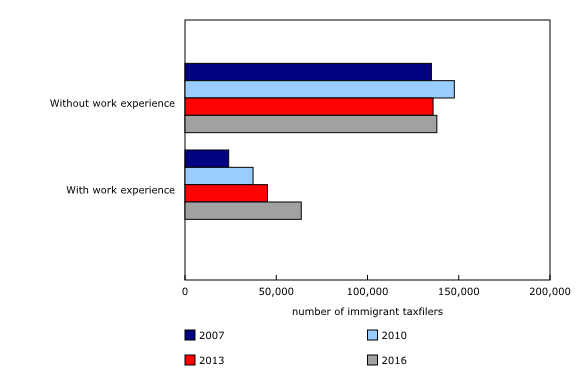
In recent years, an increasing number of non-permanent resident permit holders are transitioning to permanent residence. The observed growth in entry wages can be partly accounted for by differences in income between immigrants with pre-admission work experience in Canada and immigrants without such work experience. From the 2007 admission year to the 2016 admission year, the number of immigrant taxfilers one year after arrival who had work experience in Canada increased by 166%, while the number of immigrants without work experience rose 2%.

Chart 1  Chart 1: Number of immigrant taxfilers one year after admission, by admission year and work experience in Canada prior to admission
Number of immigrant taxfilers one year after admission, by admission year and work experience in Canada prior to admission

Chart 1: Number of immigrant taxfilers one year after admission, by admission year and work experience in Canada prior to admission

Immigrants who hold at least a pre-admission study permit have stronger wage catch-up in the 10 years after admission

Overall, immigrants’ wages increase with the number of years since admission and, for some, their wages eventually reach that of the overall Canadian population ($36,100). For example, the median wage for immigrants admitted in 2007 increased from $20,400 in 2008 to $33,500 in 2017, an increase of 64%.

Wage catch-up factors include pre-admission work experience, which facilitates integration through increased knowledge of official languages and the development of professional networks in Canada, among other things. In 2017, immigrants admitted in 2007 who had held both a study permit and a work permit prior to admission had the highest median wage (up 81% to $63,800), and their wage exceeded that of immigrants who held only a work permit (up 36% to $48,100) and that of Canadians as a whole. The median wage of immigrants admitted in 2007 who held only a pre-admission study permit increased significantly over 10 years (up 163% to $37,600) and now exceeds the median wage of immigrants without pre-admission experience (up 72% to $30,700).

Chart 2  Chart 2: Median wage of immigrants admitted in 2007, 1 year and 10 years after admission, by pre-admission experience
Median wage of immigrants admitted in 2007, 1 year and 10 years after admission, by pre-admission experience

Chart 2: Median wage of immigrants admitted in 2007, 1 year and 10 years after admission, by pre-admission experience

The median wage for asylum claimants increases with length of residence in country

Asylum claimants are individuals who request refugee protection in Canada. Because of their situation, they face many challenges in terms of economic integration. Even after their refugee claim is accepted, asylum claimants have lower median wages than other immigrants with pre-admission experience.

According to a Statistics Canada article on asylum claimants published earlier this year, the number of claimants fluctuated from 2000 to 2018 and reached over 50,000 in 2017 and 2018. Asylum claimants are relatively young. Of those who arrived in 2017, 39% were younger than 25 years of age, while 14% were aged 45 or older.

The median entry wage for asylum claimant taxfilers refers to their income one year after they submitted their refugee claim. Among those who claimed refugee status from 2006 to 2016, the median wage fluctuated between $10,900 and $16,000. As with immigrants, the median wage of asylum claimants increases with each additional year spent in the country. Therefore, the median wage for those who submitted a refugee claim in 2006 was $14,100 in 2007 and $28,600 in 2017.

There are significant differences in income among the top 15 countries of origin for asylum claimants. Among asylum claimants in 2012 who filed taxes in 2017, the highest median wages were reported by claimants from Sri Lanka ($31,600), Somalia ($30,700) and Nigeria ($30,700). Claimants from Afghanistan ($18,200), Iraq ($17,300) and China ($14,300) reported the lowest median wages.

Economic immigrants and their dependants stay more frequently in their province of admission when they have pre-admission work experience

Reasons for immigrating to Canada can influence the likelihood of immigrants to remain in their province of admission over time. For example, family class immigrants come to Canada to be closer to their loved ones, while economic immigrants are selected based on their ability to contribute to the Canadian economy.

In 2017, 86% of immigrant taxfilers admitted in 2012 filed a tax return in their province of admission. The provincial retention rate was highest among family-sponsored immigrants (93%) and slightly lower among refugees (87%). For economic immigrants and their dependants, the retention rate was 82%. However, for these immigrants, the rate was higher among those with a pre-admission work permit only (90%) than among those with no pre-admission experience (81%).

How to improve Canada’s Parents and Grandparents immigration program in 2020

Interesting proposal by Kareem El-Assal for a Parents and Grandparents Human Capital Pilot:

January has typically marked the opening of the window for immigrants to express their interest in sponsoring family under Canada’s Parents and Grandparents Program, or PGP.

However, given the challenges Canada has had managing the PGP and the recent federal election in October, it remains unknown as to when the PGP intake window will open in 2020 and what the application process will look like.

This provides an opportunity to think of innovative solutions that could help improve the PGP. For instance, the federal government might consider launching a new Parents and Grandparents Human Capital Pilot.

PGP costs and benefits

Canada is keeping its PGP intake target stable at about 21,000 people under its 2019-2021 Immigration Levels Plan.

The PGP accounts for only six per cent of all newcomers to Canada because its economic benefits are not as strong as Canada’s other social immigration streams.

It is more beneficial to Canada’s economy to welcome spouses and other dependents, as well as refugees, who tend to arrive at a younger age and will contribute more in working hours and taxes than the average parent and grandparent. The time these former groups spend working in Canada will help to subsidize the health care they will require later in life, whereas parents and grandparents arrive in Canada at ages when they need health care the most, even though they will have yet to contribute in taxes.

There is, however, an economic justification for welcoming parents and grandparents. They provide child care, which enables their families to save money and earn more income by working extra hours. They also help to supplement the household income by working in Canada themselves. This helps us understand why data from the 2016 Census show that immigrant families tend to have nearly identical homeownership rates (69 per cent) and household incomes as Canadian-born families (CAD 85,000 annually).

We must also take into consideration the PGP’s social benefit: strong families are the bedrock of Canadian society.

Frustration abounds

Given that some 100,000 people tried to access a request to sponsor form in January 2019, vying for just 21,000 PGP spots, pleasing everyone is an impossible task and the PGP process has inevitably become a source of widespread frustration.

The federal government has recognized the limitations of the different approaches that it has tried to process PGP applications. It previously operated a first-come, first-served model where it would review applications in the order in which they were received. By 2011, this had produced a backlog of about 165,000 PGP applications. Processing times were over five years which meant that unfortunately, some parents and grandparents passed away before their application could be reviewed.

To tackle the backlog, Canada announced in 2011 that it would temporarily freeze new PGP applications and increased its PGP intake target from about 15,000 annually to 25,000 people in 2012 and 2013, before reducing it to the current target.

In 2017, the federal government introduced a lottery system for the PGP. Interested sponsors had 30 days to submit an expression of interest and the government then randomly selected candidates and invited them to apply to sponsor family.

While this approach was innovative, it had several limitations. Applicants were uncertain if their family member would ever make it into Canada. There were also applicants who were not serious about sponsoring their parents or grandparents—some of them were randomly selected but they never went ahead and submitted an application, regrettably causing delays for the federal government and more genuine candidates.

The federal government returned to a first-come, first-served approach in January 2019. The government set a date and time when the PGP Interest to Sponsor form would be made available online and accepted the first 27,000 submissions. This approach again proved problematic as more than 100,000 people tried to access the form at the same time and the submission period lasted about 10 minutes before the quota was met. Many could not access the form and others that did could not complete it on time, leading to renewed criticism of the process.

Federal government should not be afraid to innovate

We can expect another revamped version of the PGP in 2020. Since the demand to sponsor will continue to exceed the number of available spots, managing the PGP to everyone’s satisfaction will never be possible. But recent lessons provide us with a roadmap of how the federal government can proceed prudently.

First, dropping the expression of interest approach in favour of a return to an application-based model would solve a key headache for the government. This move would require giving stakeholders advance notice of when the application window will open so they can prepare their documentation. When the window does open, the federal government needs to give sponsors a reasonable amount of time to submit an electronic or paper-based application. To avoid overburdening the system, the federal government can increase efforts to attract genuine candidates by requiring that they pay the sponsorship fee in full upfront.

Second, the federal government can adjust its immigration levels based on the number of applications it receives. This would require more flexibility to, say, welcome up to an additional 10,000 PGP in certain years to ensure a reasonable processing standard (e.g., within three years).

Third, it can continue to promote its Super Visa that enables parents and grandparents to visit Canada multiple times for a period of up to 10 years. The Super Visa has been criticized for requiring these individuals to obtain private health insurance, which may be unaffordable for some families, but it at least provides families with certainty that they will be able to reunite with their loved ones. Moreover, encouraging greater use of the Super Visa would take the pressure off the PGP.

Fourth, the federal government can explore other innovative approaches to managing the PGP. Despite the criticism of its efforts to better handle the PGP in recent years, a key reason why Canada’s immigration system is so successful is the federal government’s willingness to find new solutions to longstanding challenges, such as managing backlogs. The introduction of the Express Entry system in January 2015 is a case in point.

Parents and Grandparents Human Capital Pilot

One innovation for consideration is introducing a human capital-based approach to managing some PGP applications. The federal government could launch an Economic Class pilot whereby parents and grandparents who are younger in age and have higher levels of education, work experience, and English or French proficiency would get first preference. The pilot would complement the existing PGP Family Class stream and the Super Visa.

One of the reasons the pilot would be novel is that candidates under federal Express Entry-managed programs receive fewer points once they hit a certain age (a candidate gets no points for their age once they turn 45).

Under the Parents and Grandparents Human Capital Pilot, the federal government could welcome up to 2,750 principal applicants per year (the maximum number allowed under a pilot). This figure would likely be more in the neighbourhood of 3,500 parents and grandparents per year since a share of principal applicants would be accompanied by their spouses.

This idea may be unpopular since critics could argue the PGP exists to strengthen Canadian society, not its economy. But this pilot could at least expedite processing for individuals who meet its criteria and would reduce the number of applications submitted to the PGP, which would help to improve PGP processing times.

Moreover, it is an idea that would be easier to sell to the Canadian public. Previous federal government research has indicated the PGP has less public support than other immigration streams. This is likely due to the perception the PGP has little economic benefit and is a burden to the health care system.

However, by bringing in parents and grandparents who are younger and possess stronger human capital, the federal government could make the argument that such individuals are more likely to contribute to the labour market as workers and could help subsidize the health care they will eventually need in Canada.

The future of the PGP in 2020 remains uncertain. The only certainty is it will remain difficult for Canada to manage a program with some 100,000 people vying for just 21,000 spots.

Source: How to improve Canada’s Parents and Grandparents immigration program in 2020

Liberal Platform and Mandate Letter Comparison: IRCC and Diversity, Inclusion and Youth

Now that the mandate letters are out, went through the letters for Ministers Mendicino and Chagger, supplementing with other Ministers as needed (e.g., Justice, Public Safety, Innovation). The following table contrasts the platform commitments with the mandate letters, with no major surprises or omissions.

The most striking point was the relatively large number of Minister Chaggar’s commitments, although many are shared with other Ministers.

Hope you find this helpful and welcome any comments.

Liberal Platform and Mandate Letters 2019 – Immigration and Diversity Related

Wealthy Singapore Faces Rising Opposition To Immigration

Seeing more articles on immigration debates in Singapore:

Singapore’s Changi Airport has commenced a six-month trial under which Singaporeans returning home will no longer need passports to clear customs – rather their identities will be verified by iris and facial recognition technology.

This “contactless” form of identification is considered a faster and smoother way of processing arrivals compared to the old passport-and-thumbprint method.

Changi Airport processed some 65.6 million passengers in 2018, a 5.5% jump from the prior year.

However, while Singapore is seeking to make returning citizens more comfortable at airport customs, the city-state is grappling with rising opposition to immigration. As in parts of the West, immigrants are being blamed in Singapore for driving down wages and increasing other living costs.

Proponents of immigration say foreign workers are needed as Singapore ages.

Leong Chan Hoong, an associate professor at the Singapore University of Social Sciences, told World Policy Review that immigration is important to sustain Singapore’s long-term economic performance, “as it is a rapidly aging society with one of the lowest fertility rates in the world.”

Indeed, the government indicated the percentage of citizens at least 65 years of age jumped from 9.9% in 2009 to 16% in 2019. This figure is projected to increase to about 23.7% in 2030.

“Immigration helps to moderate the impact of aging and low birth rates in our citizen population, and keeps it from shrinking over the longer term,” the Prime Minister’s Office Strategy Group said.

However, Leong also said that immigrants are seen by many Singaporeans “as taking away jobs and other resources and eroding Singapore’s cultural identity. There also exists a perception, he added, that Singapore’s political leaders “shows favoritism toward immigrants at the expense of native-born Singaporeans.”

About 40% of Singapore’s 5.7 million residents are immigrants, hailing primarily from China, India, Bangladesh, Malaysia, Philippines and Indonesia.

While the overall population has increased slightly since 2014, the number of permanent residents and nonresidents has  actually remained relatively stable over that period.

As of June 2018, Singapore had a population of about 5.64 million – comprised 3.47 million residents, 520,000 permanent residents, who have the most privileges as citizens but can’t vote nor hold office, and 1.64 million nonresidents, who typically are work permit holders, students, foreign domestic workers and other dependents.

Leong noted that since the 2011 election, the government has pacified anti-immigrant elements in the society by, among other things, making “a sharper legal distinction between citizens, permanent residents and migrant workers that made it harder for noncitizens to access public benefits.

For example, Singapore has reduced the issuance of “employment passes” – which are granted to foreign professionals, managers, executives and technicians – to an average of 3,000 between 2014 and 2017, versus a peak of 32,000 in 2011.

While public demonstrations are rare in the city-state, a  gathering assembled at the Speaker’s Corner in Hong Lim Park in early November to protest the Singapore-India Comprehensive Economic Cooperation Agreement – a free trade agreement signed in 2005. Protesters contended this agreement makes it too easy for Indians with professional degrees to immigrate into Singapore, thereby hurting Singaporean citizens.

Gilbert Goh, the organizer of the protest, wrote on Facebook: “Singaporeans, it is time to stand up for your rights to a reasonably good job in our own country — we must always adhere to the Singaporean-first slogan and that employment must be given to a local first before we ever consider a foreigner.”

A recent report on Singapore’s housing market in Bloomberg noted that “with the local labor market hitting a soft patch, and amid rising clamor for a “Singaporean First” employment policy, tight controls on immigration are likely to remain in place through 2020.”

There appears to exist a specific focus on new arrivals from India, many of whom are regarded as unwilling to integrate.

John Solomon. a historian at National University of Singapore, said some Singaporeans are concerned about Indians transferring their caste system.

“Whether or not new immigration from India is indeed bringing about a gradual revival in caste identities in Singapore, the growth of this perception has manifested itself in popular xenophobic stereotypes about the new Indian migrant as an exporter of atavistic and backward social ideas,” he wrote.

Kumaran Pillai, publisher of The Independent News, said new Indian migrants tend to “have their own enclaves” and “they hang around and move in their own circles, … [and] rarely mix and talk with locals.”

Pillai added that many new Indian immigrants are better educated than native Singaporeans and carry an arrogant attitude.

“They’re perceived as a bit uppity, those in management positions. It’s not caste, it’s class consciousness,” Pillai said.

Source: Wealthy Singapore Faces Rising Opposition To Immigration

After Stephen Miller’s white nationalist beliefs outouted, Latinos ask, ‘where’s the GOP outrage?’

Good question but yet not surprising:

It wasn’t the content of White House adviser Stephen Miller’s leaked emails that shocked Rep. Veronica Escobar, a Democrat from El Paso, Texas, but the silence of her Republican colleagues that has followed.

Miller is the architect of President Donald Trump’s hardline immigration policies that have separated children from parents,forced people seeking asylum in the U.S. to wait in Mexico under squalid conditions, instituted the Muslim ban and poured money from the military into border wall construction. The administration is currently under fire for the deaths of migrant children and teens who have died while in government custody.

In a trove of emails provided to the Southern Poverty Law Center, a civil rights group, Miller cited and promoted white nationalist ideologies of white genocide, immigrants as criminals and eugenics, all of which were once considered fringe and extreme. White nationalists embrace white supremacist and white separatist views.

Three weeks after the emails were made public, Miller still is in the White House. Only Democrats have called on the White House to rid itself of white nationalism.

“It really has been jarring (that) the president’s enablers and Republicans have not stood up and said, Mr. President, this is unacceptable,” Escobar said in an interview. “I would implore my Republican colleagues to join us in calling for Stephen Miller’s resignation,” she said.

MIller’s ideology has wide reach, consequences

Escobar represents El Paso, where a gunman opened fire in a Walmart on Aug. 3, killing 22 people and injuring 26.

Police have said the suspect in the El Paso shootings told them his target was “Mexicans.” They also said he posted an anti-immigrant, anti-Latino screed that stated the attack was a “response to the Hispanic invasion of Texas.” Some of the language in the screed is consideredsimilar to words used by the president and state leaders.

After the shootings, Trump condemned white supremacy and said “hate has no place in America” but did not mention that Latinos were targeted or that the victims were predominantly Latino in his speech.

Miller is more than helping reshape immigration policy.

With Miller’s assistance, the administration is “doing an end run around Congress to dismantle every aspect of the immigration system” through executive actions and gutting regulations and replacing them with their own, said Doug Rand, an immigration policy adviser in the Obama White House and cofounder of Boundless Immigration, which uses technology to help immigrants obtain green cards and citizenship.

“Believe it or not, it’s possible to be to the right of President Trump on immigration, and that’s where Stephen Miller has spent his whole career,” Rand said. “He idealizes the 1924 law that banned immigrants from just about everywhere but Western Europe, and he is pulling every lever he can find throughout the federal government to accomplish the same outcome.”

Escobar has asked the Department of Homeland Security to audit its policies to determine which were influenced by Miller “to show the motivations of the administration’s immigration policies and shed light on the people that help craft them.”

Separately, 107 members of Congress signed a letter to Trump demanding he fire Miler.

“A documented white nationalist has no place in any administration, and especially not in such an influential position,” the Democratic congressional members said in the letter.

There also are several petitions calling for Miller’s resignation, including one started by Rep. Alexandria Ocasio-Cortez that had more than 130,000 signatures as of this week.

Miller previously worked for former Sen. Jeff Sessions, R-Ala. — who served as Trump’s first attorney general — before joining the Trump campaign.

More tolerance for intolerance?

That he persists reflects a change in what the country and political leaders are willing to tolerate under a Trump administration.

At the start of the year, House Republicans removed Rep. Steve King, R-Iowa, from committee assignments after he said in an interview with The New York Times: “White nationalist, white supremacist, Western civilization — how did that language become offensive?”

When he said in 2013 that young immigrants had calves the size of cantaloupes, King drew condemnation from throughout the party, including from Rep. Mario Diaz-Balart and former Rep. Ileana Ros-Lehtinen, both Florida Republicans. King has been repeatedly re-elected and is a Trump ally.

Diaz-Balart, Sen. Marco Rubio, R-Fla. and Sen. Ted Cruz, R-Texas, the three most senior Latino Republicans in Congress, either didn’t respond or declined to comment on the calls for Miller’s resignation.

Rubio and Diaz-Balart, both from immigrant families, have a moderate record on immigration. Miller even targeted Rubio in emails to get negative stories written about him by Breitbart. Rubio’s response has been that he knew Miller wasn’t a fan of his immigration policies.

The White House did not respond to requests for comment. The White House has defended Miller in previous statements to media, raising Miller’s Jewish background in that defense.

Ocasio-Cortez dismissed that defense in an interview with MSNBC’s Chris Hayes saying “the color of your skin and the identity you are born with does not absolve you of moral wrong.”

“I don’t think any public servant should weaponize their identity in order to advance white nationalist ideas. Period. Punto. I don’t care who you are,” Ocasio-Cortez said. Having Miller at the helm of U.S. immigration policy means policies “will become more fascistic and we cannot allow that to be us,” she said.

A rise in violent, white supremacist extremism

In his emails, Miller makes clear the esteem he holds for another period in the country, when President Calvin Coolidge signed the Immigration Act of 1924 that severely restricted immigration from certain parts of the world. Coolidge is admired by white nationalists, according to the SPLC.

The act was the nation’s first comprehensive restrictive immigration policy that established the Border Patrol.

After being told that Fox radio host Mark Levin has said there should be no immigration for several years “for assimilation purposes,” Miller responds:

“Like Coolidge did. Kellyanne Conway poll says that is exactly what most Americans want after 40 years of non-stop record arrivals,” according to emails posted by SPLC. Conway is an adviser to Trump.

In referencing the 1924 act, Miller is “harkening to an era of racial violence,” said Monica Muñoz Martinez, author of “The Injustice Never Leaves You: Anti-Mexican Violence in Texas.”

FBI statistics released in November showed an increase in hate crimes and violence against Latinos.

In a September report, the Department of Homeland Security said while the country still faces threats from foreign terrorist organizations, “unfortunately, the severity and number of domestic threats have also grown.”

The agency said there has been a “concerning” rise in attacks by people motivated by racially and ethnically motivated violent extremism, including white supremacist violent extremism, anti-government and anti-authority violent extremism and other ideologies.

White supremacist violent extremists can generally be characterized by hatred for immigrants and ethnic minorities, often combining these prejudices with virulent anti-Semitism or anti-Muslim views, the DHS report states.

In a Sept. 6, 2015, email, Miller suggested Breitbart write about “The Camp of the Saints,” SPLC reported. The novel’s theme is the end of white civilization by migrants who arrive from India.

Kathleen Belew, an expert on the white-power movement, said in an interview with NPR that Miller’s citation of the book is “clear evidence that this is a person who is immersed in trafficking in white nationalist ideology.”

“Voters across the country, constituents across the country who see their leaders standing in silence in the face of unprecedented racism and bigotry at the highest levels of government in our generation, they need to look at themselves in the mirror and ask themselves: Is this acceptable?” Escobar said.

Source: After Stephen Miller’s white nationalist beliefs outouted, Latinos ask, ‘where’s the GOP outrage?’

The Chinese Roots of Italy’s Far-Right Rage

Good long read and analysis of populism and the far right. Always better to have some fears for the future than not:

Like everyone in her family and most of the people in the factories where she labored in this town nurtured by the textile trade, Roberta Travaglini counted herself an unwavering supporter of the political left.

During her childhood, her father brought her to boisterous Communist Party rallies full of music, dancing and fiery speeches championing workers. When she turned 18, she took a job at a textile mill and voted for the party herself.

But that was before everything changed — before China emerged as a textile powerhouse, undercutting local businesses; before she and her co-workers lost their jobs; before she found herself, a mother of two grown boys, living off her retired parents; before Chinese immigrants arrived in Prato, leasing shuttered textile mills and stitching up clothing during all hours of the night.

Canadian immigrants more overeducated for jobs than U.S. counterparts: StatsCan

Good analysis of the data by StatsCan of both the comparatively large gap among recent immigrants and a minimal gap with respect to immigrants who have resided in Canada or USA for 10 years or more:

Recent immigrants in Canada with a university degree were more likely to be over-educated for their jobs compared to immigrants in the United States, a new study from Statistics Canada has found.

The Tuesday release from the federal agency found 35 per cent of working-age, university-educated immigrants who arrived in Canada within the last 10 years were over-educated for their jobs.

In comparison, only 21 per cent of their counterparts south of the border were deemed to be over-educated for their jobs.

Overeducation in the study refers to situations where workers with at least a bachelor’s degree hold a job that requires only a high school diploma or less.

Statistics Canada said the gap was little changed when difference in socio-demographic characteristics among recent immigrants in the two countries were factored in.

The findings raise questions about whether Canada’s immigration system can be better linked to its economic needs and is efficiently employing its highly-educated workforce.

While Canada’s economy in recent years has grown at a steady rate, much due to lockstep expansion of its labour force, the growth of productivity remains sluggish.

Labour productivity, which measures real GDP per hours worked, only increased 0.2 per cent in the second quarter of 2019 for Canadian businesses. The U.S., meanwhile, saw productivity grow by three times as much in the same period. Statistics Canada will release its third quarter figures on Wednesday.

“Overeducation leads to inefficient use of human capital and lost productivity,” Tuesday’s report reads.

While helping to sustain long-term economic growth, productivity gains can lead to wage increases that raise the standard of living.

Tuesday’s report noted that compared to the U.S., “Canada’s industrial structure is less knowledge-intensive and has a weaker demand for university-educated workers.”

As well, the study said up until the early 2010s, university-educated immigrants in Canada were mostly admitted through a points system that selected those based on their human capital characteristics, such as education, language, age and work experience.

Such factors have led to a large supply of university-educated immigrants “relative to labour market demand for skilled workers in Canada than in the United States.”

“The differences in supply–demand balance and how new immigrants are selected could affect immigrants’ relative performance in the labour market in the two countries,” the report read.

University-educated immigrants in the U.S. were generally selected and sponsored by employers.

Pedro Antunes, chief economist at the Conference Board of Canada, said better employing immigrants to their qualifications could improve Canada’s economic performance.

“What we’re talking about is bringing in qualified workers that aren’t being fully employed. So we certainly could improve our productivity if we fully utilise their skill sets and their credentials,” he said.

But Antunes said economic outcomes for highly-educated immigrants have improved in recent years, in part due to a tightening of the labour market. He said Canada has also done a better job in creating arrival streams that ensure there are opportunities for highly-skilled immigrants.

The report had observed that new immigrants admitted through the Canadian Experience Class had the lowest overeducation rate of 18 per cent among economic streams.

The entry stream introduced in 2008 allows immigrant to arrive as temporary foreign workers who can then apply for permanent residence after working for one year.

“I do think we’re doing some things right,” Antunes said. “I wouldn’t want to be too critical of the system.”

While new immigrants in Canada were more likely to be over-educated for their jobs compared to those in the U.S., the disparity for immigrants who arrived more than a decade ago was much smaller.

Twenty-one per cent of long-term immigrants in Canada were over-educated, compared to 18 per cent for similar immigrants in the U.S.

The report said this finding suggests immigrants to Canada are able to find jobs better aligned with their qualifications in the long run.

Among domestic-born workers, the overeducation rate for also slightly lower in Canada than in the U.S.

Antunes added that more could be done for highly-skilled immigants to support arriving spouses and by reducing employer bias.

Source: Canadian immigrants more overeducated for jobs than U.S. counterparts: StatsCan

What do the latest EU migration statistics mean for immigration? [UK]

Interesting analysis:

With just two weeks to go before the General Election (the outcome of which will determine the direction of future UK immigration policy), the latest ONS EU migration statistics show yet another drop in overall EU migration to 48,000 – down from 200,000 at its peak in 2015, paint a troubling picture for employers who have been increasingly struggling to recruit talent since the referendum.

Brexit impacts

The skills shortages facing businesses in many sectors, including social care, construction, hospitality and manufacturing since the referendum are well-documented, while EU citizens have been voting with their feet and leaving the UK for destinations offering greater opportunities/prospects or preferring to stay in their member states here economies have been improving while the pound has been losing value.

Political indecision and the uncertainty of Brexit carry wider costs – with delayed projects, missed business opportunities and many businesses abandoning Britain to relocate all or part of their operations to other EU countries from where they can continue with frictionless trade. As the General Election looms, the much-needed clarity businesses need remains somewhat elusive.

Election rhetoric

Despite the publication of the long-awaited Conservative Party manifesto on Sunday and the much-trailed references to the introduction of a new ‘Australian-style points-based system’, there remains scant detail of the proposed future immigration system that will apply to EU and non-EU nationals alike from 2021. The manifesto’s slogans of prioritising people who ‘have a good grasp of English’, are ‘law-abiding citizens’ and ‘have a good education and qualifications’ really offer nothing new – these are all long-established features of the existing UK system.

It is regrettable that the toxic and arbitrary language of numbers is returning to the campaign: notwithstanding abandoning the ill-fated (and ill-considered) net migration target of predecessor Conservative administrations since 2010, the manifesto pledges that “overall numbers will come down”, absent of any apparent rationale or assessment of the future needs of the UK economy – or indeed any explanation of how this reduction will be delivered.

Cost deterrent

Recent years have witnessed a dramatic increase in Home Office filing fees and related charges, meaning only those able to afford the substantial fees are able to come to the UK.
Indeed, the Prime Minister announced last week that the immigration health surcharge, which until a year ago was £200 per migrant per year of residence in the UK, will increase to £625 per year per migrant according to EU migration statistics.

This means for example, that an employer of a skilled worker in a family of four would be required to pay up-front government charges of over £22,500 for a standard five-year sponsorship – indeed these costs are only likely to be significantly increased in future. This impacts for business will be all the greater given that EU migrants who are currently able to come and take jobs without the need for sponsorship from an employer, would be subject to the same high fees once free movement comes to an end.

Remarkably, the spouse of a British citizen with two non-British children would be required to pay a minimum of £24,000 over a five-year period to settlement in government fees. This is a staggering figure, meaning that families would have to save almost £5,000 per year just to pay the Government fees – no easy task considering that a quarter of British families hold an average of £100 in savings.

All of this comes against a backdrop of an actual Government cost of decision-making of just £155 per application as well as an erosion of appeal rights and of legal aid which has meant families are trying to navigate the highly-complex immigration system themselves while putting their savings on the line.

Costs appear to be increasingly used to deterrent effect and as a mechanism to limit numbers, prejudicially affecting certain groups – a far cry from the ‘more fair and compassionate system’ lauded in the manifesto.

Innovator and Start-up routes

The hasty closure of the Tier 1 (Entrepreneur) and Tier 1 (Graduate Entrepreneur) routes earlier this year, replaced by the new Innovator and Start-up categories – which may be seen as poor substitutes, not least due to the lack of transparency and accessibility of participating endorsing bodies’ schemes – have led to a dramatic reduction in the number of entrepreneurs coming to/remaining in the UK.

An analysis of the figures shows just 10 Innovator entry clearance applications in the last quarter (14 in total for the past six months), compared to approximately 2,500 Tier 1 (Entrepreneur) applications for the year prior to the route’s closure – which under the Tier 1 (Entrepreneur) criteria would have required the creation of at least 5,000 new jobs for settled workers – further compounding concerns that the UK is not as open for business as the Government suggests.

Source: What do the latest EU migration statistics mean for immigration?

The Creepy Racist Network Behind Trump Aide Stephen Miller

Creepy indeed, an entire ecosystem:

Even amid the impeachment drama, the tranche of emails unearthedthis month by the Southern Poverty Law Center has been attention-grabbing. The communications, sent in 2015 and 2016 by current Trump senior adviser Stephen Miller, reveal a man deeply immersed in the most rancid tenets of white nationalism.

Jonathan Greenblatt, head of the Anti-Defamation League, called the evidence “incontrovertible.” U.S. Rep. Alexandria Ocasio-Cortez (D-N.Y.) wrote that “Miller, Trump’s architect of mass human rights abuses at the border (including child separation & detention camps w/child fatalities), has been exposed as a bona fide white nationalist.” Fifty-nine civil rights groups, saying Miller promotes “white supremacy, violent extremism, and hate,” sent a letter to President Trump demanding that he immediately dismiss his senior adviser.

But the story is much bigger than Stephen Miller. The real story is about a vast racist network that has a shocking degree of reach into mainstream Republican politics.

Miller has long been a close ally of the nativist empire built over decades by the late John Tanton, who was himself revealed as a white nationalist in private communications that became public years ago. Tanton’s many powerful groups—which include the Federation for American Immigration Reform (FAIR), the Center for Immigration Studies (CIS), and Numbers USA—adopt varying degrees of camouflage, but at their heart are infected with Tanton’s view of America as a nation for white people.

FAIR, CIS, and Numbers USA form the core of what has grown into a sprawling American nativist lobby. FAIR officials have testified more than 100 times to Congress and CIS propaganda is regularly cited by politicians and other important players. Numbers USA played a key role in the defeat of comprehensive immigration reform in 2007.

And they are not alone. Tanton has founded or funded more than a dozen anti-immigration groups, and those groups have in turn worked with many smaller groups in a continuing battle for immigration restriction.

The most remarkable thing about the Tanton network is how seriously it is taken, despite the white nationalism at its core. The result is that virtually the entire immigration restriction movement is the fruit of a poisonous tree.

Tanton, who died age 85 in July, was plainspoken enough when he wasn’t in the public eye. He once wrote that he had “come to the view that for European-American society and culture to persist requires a European-American majority, and a clear one at that.” Elsewhere, he added, “Demography is destiny. We decline to bequeath to our children minority status in their own land.”

Tanton warned darkly of a “Latin onslaught,” and corresponded with white supremacists, Holocaust deniers, and a Klan attorney. He republished a wildly racist French novel, The Camp of the Saints, that describes an invasion of France by “swarthy hordes” of Indian refugees who end up taking over the country and consigning white women to special whorehouses for Hindu men. (Tanton’s edition of the book included an afterword from author Jean Raspail claiming that “the proliferation of other races dooms our race, my race, to extinction.”) He enthused over eugenics, the Nazi “science” of breeding a better human race, and once asked if a “local pair of sisters” with nine children could be forcibly sterilized.

“The larger world of the racist Tanton network constitutes a grave threat to rational and humane immigration policies that will continue long after Miller is gone.”

Above all, Tanton wanted to overturn the 1965 immigration law that ended a racist quota system instituted in 1924. He idolized the architect of the 1924 law, John Trevor Sr., a man who warned of “diabolical Jewish control” and distributed pro-Nazi propaganda. To Tanton, as he wrote to a FAIR board member, Trevor’s work should serve as “a guidepost to what we must follow again this time.”

Miller’s connection to Tanton’s world is a tight one.

He has repeatedly cited CIS, an organization listed by the SPLC as a hate group. In May 2015, Miller was the keynote speaker at a CIS awards ceremony, where he praised staffers extravagantly. In February 2017, he cited misleading CIS claims about terrorism to support Trump’s Muslim ban, and six months later he cited the group again while arguing for drastic reductions in legal immigration. He spoke to CIS and other nativist groups in a January 2018 phone conference.

Miller promoted The Camp of the Saints in some of his newly revealed emails, which were sent to a staffer at Breitbart News whom he was cultivating as a racist writer on immigration issues. He suggested the staffer read articles from American Renaissance, a racist journal published by Jared Taylor—a man Tanton also admired and who once asserted in his publication that “[w]hen blacks are left entirely to their own devices… civilization disappears.”

Miller also cited a racist website called VDARE, after Virginia Dare, said to be the first English person born in the New World. While VDARE is not a Tanton group, it was partly funded for years by Colcom, a foundation established by the late Cordelia Scaife May, who harbored racist and eugenicist views like Tanton’s. Between 2005 and 2017, Colcom lavished about $180 million on FAIR, CIS and NumbersUSA, according to a New York Times investigation.

Miller’s views are loathsome. But Miller is both a promoter and, to some extent, a product of a much wider racist network aimed at preventing non-white immigration into the United States.

It is possible, if unlikely, that the Miller brouhaha will lead to his demise as a presidential adviser. But the larger world of the racist Tanton network—a network that already has contributed several key officials to the Trump administration and has repeatedly worked to frustrate comprehensive immigration reform—constitutes a grave threat to rational and humane immigration policies that will continue long after Miller is gone.

Douglas Todd: Up to 1 in 3 study-visa holders in Canada not in school

More on international students and some of the abuses of the program:

One in three people who entered Canada on student visas do not appear to have been enrolled at educational institutions in the country, Statistics Canada reports.

A recent StatsCan analysis could not find indications that 30.5 per cent of people in the country on post-secondary study permits in 2015 were signed up that year at a Canadian college or university.

The StatsCan study, by Marc Frenette, Yuquian Lu and Winnie Chan, echoes the findings of an internal Immigration Department report that revealed 25 per cent of would-be foreign students in Canada in 2018 were likely not complying with the conditions of their visa or were just not being monitored by school administrators.

The high no-show rate comes as there is a rising trend toward “edu-immigration” to Canada. Many foreign nationals are being encouraged by immigration agents to use Canada’s study permits to gain a relatively easy foothold in the country to find work, through which they can try to obtain permanent resident status.

Canada has a reputation as an unusually open country for international students, especially in the way it allows newcomers to study part-time and hold down an almost unlimited range of jobs. Compared to Britain, the U.S. and Australia, Canada is known for having a poor record of tracking study-visa holders once they’re in the country.

Vancouver immigration consultant Laleh Sahba and immigration lawyer Sam Hyman say it’s an unfortunate reality that many international students are being told by dubious agents they can bypass school to work. But the immigration specialists say such misuses shouldn’t overshadow that most international students are using the system responsibly.

The number of study-visa holders in Canada has shot up by 73 per cent in four years, to 573,000 in 2018, with the highest concentration in Metro Vancouver.

Many officials welcome the hike in high-fee-paying offshore students. They maintain they enhance cultural diversity on campuses and boost the budgets of public educational institutions, which are not being funded by governments as well as in the past.

In addition to articles published by Postmedia on loopholes in Canada’s study-visa program, The Toronto Star reported in November that many would-be international students are routinely fail to pursue their studies, instead looking for work and applying for permanent residency.

Some get caught. Canadian officials revoked 5,502 study visas last year, an almost-four-fold increase from 2016.

The Globe and Mail also reported last month that many trucking companies, primarily in Surrey, are taking large illegal cash payments from foreign students in exchange for truck-driver jobs that might help them qualify for permanent residency. The trucking companies send many of the study-visa holders out on the road with no training, leading to deadly accidents.

Visa officials appear to be starting to respond to flaws in Canada’s burgeoning program: A growing number of study-visa applications, two out of five, are now being rejected, Postmedia reported this month.

Immigration department officials have acknowledged a tenth of all study-visa applications are fraudulent, often because they use faked acceptance letters from Canadian institutions.

One of the disquieting findings in the StatsCan report is that 2015’s rate was an improvement over previous years: In 2009, only half of study-permit holders were signed up with a school.

When Postmedia asked Statistics Canada why such a large proportion of would-be foreign students appear to be avoiding studying, officials said the authors of the report were not permitted to directly answer Postmedia’s questions.

Although the report said statistical “noise” made it hard to precisely determine the ratio of study-visa holders who were not enrolled at the time researchers did their calculations, a Statistics Canada official also acknowledged: “We did not ask respondents their motivation for coming to Canada on a student visa. We only observed their work patterns.”

The study concluded that about one in four study-visa holders in Canada eventually gain permanent resident status. But beyond such data, the authors said, “Little is known about international students in Canada.”

Hyman, the immigration lawyer, says there is no doubt many study-permit holders come to Canada essentially to work and not to study.

“Some work full-time in contravention of the terms of their study permit, which limits them to working no more than 20 hours a week when school is in session, plus full-time during scheduled school vacations.” Some, Hyman said, obtain work “off the books for cash.”

Ottawa has failed to hire staff dedicated to enforcing the evolving rules about what it requires to be a genuine international student, said Hyman. “Still, sometimes detection occurs when the student goes to renew the initial student permit and has to demonstrate academic progress, or try to explain the lack of it.”

An Ottawa immigration official said that up until 2014, a prospective international student did not have to enrol in an educational program. He or she only needed to demonstrate an “intent” to study. It took until this year for Immigration Canada to more clearly define what it really means to “actively pursue” an academic program.

Canada’s more than 650 institutes of higher education are allowed to follow the honour system in informing authorities about study-visa infractions. And even though Canadian schools have been required since 2016 to report on their total international-student enrolment, 68 schools failed to do even that last year.

There can be legitimate reasons for not complying with study-visa requirements, including illness, running out of money or switching schools, says Sahba, the immigration consultant. But she’s convinced Canada’s institutes of higher learning should make it a higher priority to report on absent foreign students.

Sahba is disturbed by the dubious migration agents in Canada and abroad who increasingly tell young would-be migrants the easiest way to get permanent resident status in Canada is by obtaining a study visa, largely avoiding school and getting access to employers, some of whom exploit the workers in exchange for providing a crucial sponsorship letter.

While this is an “unfortunate reality” for some study-permit holders, Sahba said “there are also many responsible, ambitious and self-motivated international students currently studying in Canada. And many more waiting in the queue for their visas.”

Source: Douglas Todd: Up to 1 in 3 study-visa holders in Canada not in school

For the StatCan study: The Postsecondary Experience and Early Labour Market Outcomes of International Study Permit Holders