Opposition MPs question purpose of Canadian consulate in Chandigarh, India, that sends work to New Delhi

Don’t see what the fuss is about. Distinction between front and back office functions fairly common. Decision to open Chandigarh was political as reported in article and, if I recall correctly, Global Affairs was not happy with the decision.

The office had a wall highlighting some of the fraudulent practices when then IRCC Minister Kenney visited it:

Opposition MPs on the House Immigration Committee are accusing the government of “deception” and “lack of transparency” after learning by “happenstance” two weeks ago that visa applications filed in the Canadian Consulate in Chandigarh, India, are processed in New Delhi, raising questions about the need for the consulate office when that work is done in the capital city.

In a House Citizenship and Immigration Committee meeting on Feb. 27, Conservative MP Kyle Seeback (Dufferin-Caledon, Ont.) asked departmental officials if they had any statistics on how many visa applications the Chandigarh office receives and the success rate of those processed there, compared to the New Delhi office. He said he asked this question because he had received numerous complaints from his Indo-Canadian constituents about the low success rate in getting visas in Chandigarh.

Mr. Seeback cited a specific example in which a visitor visa application was denied because the applicant had no travel history, when the applicant’s passport clearly showed that the same individual had a U.S. visa and had a travel history.

“Is there any review that takes place with respect to visa officers that are clearly making mistakes when they are rejecting a temporary resident visa, and there’s a procedure for a Member of Parliament or individual to raise that issue and see if there is any redress that would happen in the department?” Mr. Seeback asked, according to the transcript of the meeting.

In response, a senior departmental official told the committee that “for the last couple of years,” visa applications filed with the Chandigarh office were being processed in the New Delhi office. This was a surprise to many committee members; the idea behind opening the full service consulate office in Chandigarh in 2003 was to help Indians in the Punjab province and the neighbouring area to get service without having to travel eight or nine hours to get to the capital, where they often had to queue at 4 or 5 a.m. to get in.

In addition to the residents of Punjab, the residents of neighbouring province Haryana also visit the consulate office in Chandigarh, as it’s a shorter commute than New Delhi.

“So, I was absolutely shocked by that answer,” Mr. Seeback told The Hill Times. “I’ve spoken to other Liberal Members of Parliament who did not know that this was the case, and they were shocked that this was the answer given. As far as I know, this was not announced, and no one is aware of the fact that people in Punjab who go to Chandigarh to apply for a visitor’s visa, … they are effectively going to [be processed in New Delhi].”

In his response to Mr. Seeback’s question, the immigration official also said the decision making has been “shifted to Delhi,” but did not provide any specifics as to when the change happened, whose decision it was, who was consulted, and why this information was not publicly shared. He said only “complex” cases are handled in Chandigarh, but it was unclear what he meant by “complex” cases.

It’s not clear whether residents of Punjab and neighbouring areas are being forced to travel to New Delhi again for interviews as part of the application process.

“I do want to mention quickly that we do not process visa applications in Chandigarh, everything is now done in Delhi,” Harpreet Kochhar, assistant deputy minister of Citizenship and Immigration Canada, told the committee. “That has been happening for a couple of years. The decision making has shifted from Chandigarh to Delhi. [Only] complex cases are done in Chandigarh, but most of the decision making has shifted to Delhi,” Mr. Kochhar told the committee, according to the meeting transcript.

He conceded that sometimes officials make mistakes in their application reviews. But Mr. Kochhar added that sometimes individuals have visas for the U.S. or other countries such as Australia, New Zealand, and the United Kingdom, but have not actually travelled, which means they do not have travel history. Also, he said, the department has its internal quality control processes in place to evaluate how officers are processing applications. Mr. Kochhar said the unsuccessful applicants have the option to reapply.

“I do accept that at times there are mistakes. We regularly do a quality control check on our applications. We have an internal system of doing that, as well as the clients are more than welcome to reapply. We will reconsider if they reapply,” he said.

Mr. Seeback, who in the past represented the riding of Brampton West, said he was planning on questioning Immigration Minister Marco Mendicino (Eglinton-Lawrence, Ont.) on this subject in the coming weeks.

In an emailed response to written questions, a spokesman for Mr. Mendicino said the change to process visa applications from Chandigarh in New Delhi was made to speed up the processing times. He said the department is transitioning to a more centralized system to expedite the application review system.

“Immigration, Refugees and Citizenship Canada has been moving towards a more integrated, modernized and centralized system in order to speed up application processing and to improve client service,” wrote Kevin Lemkay, press secretary to Mr. Mendicino, in his email. “The department moves applications around its global network to ensure they are processed as efficiently as possible, which means applications may not be processed at or decided upon by decision makers at the office closest to where a client lives, or where an application is submitted.”

Mr. Lemkay also said that regardless of where the applications are filed, all applications are processed under the Immigration and Refugee Protection Act. He wrote that in 2018, 393,000 visas were issued to Indian nationals, an increase of more than 50 per cent compared to 2017.

“Applications may be distributed throughout IRCC’s networks to provide optimal processing times and to improve client service. Regardless of geography, all decisions are made in accordance with the Immigration and Refugee Protection Act and Regulations,” he said.

Neither Mr. Lemkay nor the department would say where the personal interviews for visa applications are done, or what is the precise role of the Chandigarh office. They also did not say what Mr. Kochhar meant by “complex” cases” that are processed there. The Hill Timesreached out to Mr. Kochhar for an interview request, but his office referred all questions to the departmental communications office.

“While the majority of temporary resident applications are processed in New Delhi, many are also processed in Chandigarh,” Mr. Lemkay said in his email. “Clients can submit their temporary resident applications to the nearest Visa Application Centre.”

Former Liberal cabinet minister Herb Dhaliwal—who played an instrumental role in opening up the Chandigarh office while in Jean Chrétien’s cabinet—questioned why Canada still has its office there if applications are being handled in New Delhi, in an interview with The Hill Times. He also said if the interviews are done in New Delhi, then it defeats the purpose of establishing the consulate office.

Mr. Dhaliwal said he was lobbied by members of the Punjabi community while a B.C. MP and cabinet minister to ask the government to set up an office in Chandigarh, as it was a long and expensive commute for their relatives and friends to apply for visas in New Delhi. The Punjabi community is an influential part of the Liberal Party’s voter base.

In 2003, Mr. Dhaliwal accompanied Mr. Chrétien to inaugurate the office.

“What exactly does the Chandigarh office do now?” questioned Mr. Dhaliwal.

None of the Liberal MPs from the Immigration Committee responded to interview requests from The Hill Times.

NDP MP Jenny Kwan (Vancouver East, B.C.) said that it was news to her that applications filed at the Chandigarh office are processed in the capital city. She said she looked up the Immigration Canada website after the committee meeting to see if there’s any indication as to where the applications filed with the Chandigarh office are processed, but didn’t find any information. Ms. Kwan said the government should be more transparent about this information, as an applicant has the right to know where his or her application would be reviewed.

“The government, with this change in not informing the public or anyone else for that matter, and the way in which they’ve set up the website to make you believe that things are still business as usual, is deceptive at best,” said Ms. Kwan, who is also a member of the Citizenship and Immigration Committee.

“The government, you know, in going forward with this without sharing basic information to the public about it, I think, is inappropriate. What are they [Chandigarh office] doing? It seems according to their website, the only thing they’re doing is to accept applications. Is that the only thing they’re doing? I have no idea, we don’t know. And there’s no transparency from the government on this.”

She said the lack of information leaves unanswered questions as to what does the change means for an applicant.

“In the very minimum, they should make it clear on their website, like people should know, right, and you cannot find that information out,” said Ms. Kwan. “And then more to the point, you will not know what it means.”
Source: Opposition MPs question purpose of Canadian consulate in Chandigarh, India, that sends work to New Delhi

It’s not a competition: Scotland’s skills and the post-Brexit immigration system

More on UK government’s immigration plans and the worries about the impact on caregivers:

In her policy statement to the House of Commons in February, the Home Secretary, Priti Patel, described the UK’s new immigration system as one that “prioritises those who come to our country based on the skills they have to offer, not on the country they come from”.The new points-based approach will be “fair” but “firm”, she said, and give top priority to highly skilled workers – “the brightest and the best” – to come here and drive innovation, grow the economy and, where necessary, support our public services.

Through this new system, Patel said, the UK will develop “a true meritocracy where anyone with the skills who wants to come here will have the ability to do so”.

The question for businesses in Scotland, though, is, which skills?

Representatives of the social care and hospitality sectors were quick to express their significant concerns about the impact that a restriction of so-called ‘low-skilled’ EU migrants could have on their businesses and the wider Scottish economy.

The Federation of Small Businesses Scotland, for example, has warned that around one in five small businesses could close or be forced to radically change their business models in order to survive.

But beyond economics, the immigration debate has also sparked a more fundamental discussion on the nature of skills and their relationship with pay and qualifications: who gets labelled ‘high’ or ‘low’ skilled and what type of skills does Scotland really need right now?

“The whole sector was extremely dismayed at the continued equation of low skill being of low value and of the equating of low skill with social care activity,” Dr Donald Macaskill, the CEO of Scottish Care, told Holyrood.

“My concern is that both some of our politicians but also the wider public think of the job of caring as something which anybody could do,” he said.

“That is simply not the case.”

Scotland’s care sector has particular reason to be concerned about the changes being proposed by the Home Office because it’s a sector that is already facing a skills and employment crisis.

Independent care providers are reporting significant vacancy rates. Skills Development Scotland (SDS) estimates there were 12,346 vacancies across the sector in 2018 and a ‘density of skills shortages’ of 28 per cent.

Shortages in rural areas, where the effects of an ageing population are most pronounced, have put care provisions under “unprecedented” strain. The Western Isles Health and Social Care Partnership is reporting that one in six frontline adult social care positions is vacant.

While this is already the case, the new immigration policy could stand to exacerbate these problems. Between six and eight per cent of frontline care home workers are from outside of Scotland. Up to 16.5 per cent of agency nurses, who often work in care homes, come from EU countries.

And whether by pay or by skill, many of these workers stand to fall short of the new system that aims to reduce the number of “cut-price EU workers”.

Prospective migrants would have to negotiate on a set of criteria including a salary threshold, language abilities, academic qualifications and, crucially, the points value attached to their particular set of skills.

The general salary threshold will be set at £25,600, which is down from the initial £30,000 suggested by the Conservatives a few months ago, after the Migration Advisory Committee (MAC) warned that such a high bar would make it difficult to recruit new teachers and NHS workers from abroad.

Such a salary threshold represents far too high a bar for many of the most critically required jobs in adult social care, where the average salary of a frontline worker is £17,500.

But with the right skills, the threshold could drop – as long as the skillset or industry qualify for a “tradeable points” mechanism in the system.

“For example,” Patel said, “a PhD in a relevant subject will earn extra points, with double the number of points for specialists in science, technology, engineering and mathematics.”

The emphasis on STEM disciplines reflects the government’s desire to sell the UK as a nation that is at the “cutting edge of life-changing innovation and technology”, somewhere the “finest international minds” would be attracted to live.

There will be concessions made to the system to reflect the need for workers in certain areas, such as a special visa tier for NHS workers. A separate scheme for seasonal agricultural workers will also be introduced.

And shortages for very specific roles included on the MAC Shortage Occupation List, like nuclear scientists and Gaelic-medium teachers, will continue to get easier access.

But care workers are set to fall short of all of these standards, for pay and, seemingly, for skill level.

This is the thing that Macaskill takes most exception to.

“In order to be a frontline social carer, you have to be registered with the Scottish Social Services Council (SSSC),” he says.

“You have to be qualified and that qualification has to be at SVQ level and over a period of time, you have to demonstrate that you are continuing in your professional development.

“And you have to have the necessary core skills. What are those core skills?

“They are the ‘softer skills’ and I suppose some of my critiques of the political statements and the immigration proposals is that they are very much based on what are called ‘hard, cognitive and technical skills’. They’re related to the earnings level that some of those skills attract.”

Care workers in Scotland are paid at least the Scottish Living Wage, unlike other parts of the UK, but the industry is still considered low paid. Still, the contribution of the care sector to the wider Scottish economy is hard to underestimate: the SSSC estimates the sector to be worth £3.4bn to the economy, and that’s before taking into account how adult social care alleviates the care burden and allows people to continue working in other sectors.

This is not a competition, it’s about validating skills and abilities which are of paramount significance to the wellbeing of a nation

The Scottish Government’s proposals for a Scottish visa to allow a tailored migration approach that would “[welcome] people with the range of skills we need to work” was rejected out of hand by the UK Government hours after it was published.

The First Minister has since offered to lead a delegation, made up of business and care sector representatives, to Westminster, to put the case for greater flexibility to the Prime Minister personally, but there has so far been no response. The Scottish Conservative party is continuing to meet with stakeholders before announcing a position on immigration that is likely to clash with the UK Government’s as well.

In the meantime, the discussion around the definition of low and high skills continues.

“What I’ve been calling for is a reorientation for what we mean by skills,” Macaskill said.

“And skills of compassion, empathy, communication, the ability to relate and the ability to deal with the various challenges, the ability to enable and encourage – all those that we have traditionally thought of as softer skills are, I think, as valuable to any society as technical skills and higher academic skills.

“This is not a competition, it’s about validating skills and abilities which are of paramount significance to the wellbeing of a nation,” he said.

The Future Skills Action Plan was launched in September 2019 following a commitment announced by the First Minister in the 2018-19 programme for government (PfG) to recognise “the importance of skills to improving Scotland’s productivity and economic growth”.

In the ministerial foreword to the plan Jamie Hepburn, Minister for Business, Fair Work and Skills, described Scotland’s need for a skills system that is “characterised by agility and flexibility”. The core vision of the plan is for a future where “Scotland’s highly skilled workforce ensures we are an ambitious, productive and competitive nation”.

The plan discusses the need to respond to the challenges associated with Brexit as well as climate change, including the need to develop a specific Climate Emergency Skills Action Plan to turn the existing skills across industries in Scotland toward creating an environmentally sustainable economy.

SDS and the Scottish Funding Council (SFC) are currently working on this plan. Both bodies have received a funding boost in the 2020-21 Scottish budget, with a 4.7 per cent raise for SDS to a total £224.8m and a £40m increase for SFC to £1.88bn.

Further measures to this end include £10m of additional funding for those already in work, through doubling the Flexible Workforce Development Fund and a £2m fund for innovation and skills in the transition to offshore wind power.

The limit to the potential of Scotland’s tech economy continues to be a digital skills shortage that runs all the way through from education to the present workforce.

“We need about 12,500 people every year and we produce about 5,000 from the usual sources,” Polly Purvis, the former head of ScotlandIS warned last year. Her successor, Jane Morrison-Ross, has said there are currently 13,000 vacancies across the sector.

In high schools, there has been a long-term decline in both the number of pupils taking computing as a subject and in the number of computing teachers – both still well below the levels of a decade ago.

For the current workforce, the Scottish Government launched the £1m Digital Start Fund to reskill workers, particularly those returning to work or who join from disadvantaged backgrounds, with skills like software development and cyber security much in demand.

Launching the scheme, then minister for digital economy Kate Forbes said: “Technology is forecast to be the fastest growing sector in Scotland by 2024, but success is dependent on skills. This is a big opportunity not only for tech businesses, but also to future employees.”

The Scottish Government also sees upskilling as a means for tackling issues such as child poverty. The 2019-20 PfG announced a £500,000 Family Learning Scotland Programme to help parents gain new skills and take up learning and training. The programme is designed to be integrated with the expansion of early learning and childcare to “allow parents to build on their skills and gain better work”.

And for young people, the apprenticeship route into careers is expanding. The Scottish Government says that over 37,000 apprenticeships were in training in 2018-19 with an expected 30,000 new starts projected for 2020-21.

With Scottish Apprenticeship Week running last week, from 2-6 March, SDS was encouraging councils, schools and employers to take part in raising awareness of apprenticeships as a more practical alternative to further education, leading to a wide range of careers, from technology to care.

SDS Director of National Training Programmes Katie Hutton said: “Scottish apprenticeships are increasingly becoming a vital means for industry to shape its workforce.

“More and more individuals are recognising the benefits of work-based learning, with opportunities to gain skills in careers for the future.

“Scottish Apprenticeship Week shines a light on the major contribution apprenticeships make across all business sectors and the difference they make to the lives of thousands of people across the country.

Source: It’s not a competition: Scotland’s skills and the post-Brexit immigration system

Trump’s Immigration Policies Will Make the Coronavirus Pandemic Worse

Frightening given the implications. And former Kenney staffer Candice Malcolm continues to defend the Conservative government’s reduction of healthcare coverage of refugee claimants despite the risks it poses to public health at times like this (MALCOLM: Docs show asylum-claimant health access expanded to 20 years):

Pandemics have a way of testing us. Throughout history, societies have responded to plagues by blaming immigration and minority populations. Such approaches usually make matters worse.

If pandemics reveal anything, it is that our health depends in no small measure on how we treat the most vulnerable among us.

The Covid-19 outbreak is now testing the U.S. Some recent and not-so-recent immigration policies do not put us in a good position to combat it.

On February 24, just one day before the Centers for Disease Control and Prevention warned Americans to prepare for the spread of Covid-19 inside the U.S., the Department of Homeland Security began enforcing its new public charge rule. Under a provision that has been in our immigration laws since 1882, many classes of immigrants are ineligible to receive a visa or permanent residency status if they are found likely to become a public charge. Prior to the new rule, the receipt of non-cash benefits, except for long-term care, did not enter into the public charge determination.

The new rule will change that, defining a public charge as someone who receives Medicaid (and other listed benefits) for 12 out of 36 months, and treating receipt of Medicaid after February 24 as a heavily weighted factor in the determination of whether the individual is likely to be a public charge in the future.

To avoid being identified as a public charge, millions of non-citizens are expected to disenroll from Medicaid. Confusion and fear about the rule may also drive many parents to disenroll their children, even though the use of Medicaid by minors will not count against them.

Thus, just as more people are likely to start needing testing and treatment for a worrisome infectious disease, untold numbers of them may drop their health insurance and avoid health care for fear of being found a public charge. With more people uninsured, hospitals will likely experience drops in revenue, even as they need to purchase new infection control equipment, and cope with a surge of patients in emergency departments and needing intensive care. These totally predictable consequences do not bode well for our ability to mitigate the pandemic.

The public charge rule is not the only way in which our immigration laws and policies may impede an effective response to the pandemic. At least four other mechanisms warrant attention.

First, long before the new public charge rule, non-citizens faced numerous legal hurdles to accessing publicly funded health insurance. A 1996 federal law, for example, makes most undocumented immigrants ineligible for federal Medicaid except to cover emergencies. Undocumented immigrants are also ineligible to purchase insurance or receive subsidies under the Affordable Care Act.

Even lawfully present immigrants face barriers. Although they can purchase insurance on the Affordable Care Act exchanges, most lawfully present non-citizens are not eligible for Medicaid for the first five years of their lawful status.

As of result of these barriers, as well as the fact that non-citizens are disproportionately employed in jobs that don’t provide insurance, non-citizens are far less likely to have health coverage than citizens. Not surprisingly, they are also less likely to have an ordinary source of care. While always troubling for public health purposes, these barriers are likely to be especially dangerous during a pandemic.

Second, fear of immigration enforcement may deter immigrants from seeking health care or working with public health authorities. Under guidelines from Immigration and Customs Enforcement (ICE), health care settings are “sensitive zones” in which enforcement actions should not normally be conducted. Even so, since President Trump took office there have been highly publicized cases of individuals being detained by immigration agents on their way to seeking care. As a result, many undocumented immigrants have forgone medical appointments.

In an epidemic, that can have dire consequences for public health as those who are undiagnosed and untreated are particularly likely to spread the infection.

Equally concerning is the prospect that immigrants, as well as citizens, who are infected with the coronavirus will fear sharing with public health officials the names of undocumented contacts—a key part of containing any epidemic or pandemic. This classic public health tool will be undermined if patients fear that sharing names can lead to immigration enforcement actions.

Third, restrictive immigration policies may exacerbate shortages of health care workers, especially in nursing homes and other long-term care facilities, just when we need more such workers. Since Trump took office, legal immigration to the U.S. has been falling. The new public charge rule will almost certainly add to the decline, as many of its provisions will make it exceptionally difficult for low-wage individuals to receive visas to come to the U.S. That means trouble for nursing homes and other health care institutions that rely heavily on low-wage workers and that may need new workers as some take time off due to infection. About one-quarter of nursing, psychiatric and home health aides are currently immigrants — precisely the people who will likely be denied visas due to the public charge rule.

In addition, many existing workers, citizens and non-citizens alike, rely on Medicaid. Their inability to get the care they need due to their loss of health insurance will heighten the risk for their vulnerable patients.

U.S. border policies create further risk. In the last three years, at least seven children have died in immigration custody, mostly due to the flu. Adding to the risk was the fact the Customs and Border Control officials refused to vaccinate detainees against the flu. Immigrants who have been forced to stay in makeshift camps in Mexico due to the administration’s so-called Remain in Mexico policy are also facing health risks from living in overcrowded conditions without adequate hygiene or health care. Such settings are especially susceptible to outbreaks of contagious diseases.

What can be done? This week I joined more than 700 experts in law, public health, and human rights in writing an open letter to Vice President Mike Pence and other federal, state, and local policymakers outlining guidelines for a fair and effective response to Covid-19. Among our recommendations were that health care facilities must be immigration enforcement-free zones. We also urged the administration to ensure that individuals should not face any immigration consequences related to contact tracing. These policies, we wrote “should be clearly and unequivocally articulated to the public by the federal, state and local governments.”

In addition, the Department of Homeland Security should stay implementation of the public charge rule as a whole—or at least suspend the adverse consequences attached to using Medicaid until after the outbreak passes. There simply is no justification for rushing to implement a rule that may worsen a pandemic.

Fourth, the Department of Homeland Security must work to improve health care in detention facilities and relax the policies that are adding to crowding both north and south of the border. During a pandemic, overcrowding and unsafe conditions not only pose a risk for migrants, but can endanger the health of everyone.

There are precedents for these four steps. After 9/11, the Immigration and Naturalization Service (the predecessor agency to Immigration and Customs Enforcement), announced that it would “exercise discretion in a compassionate way towards families of victims during this time of mourning and readjustment.”

With a pandemic upon us, it doesn’t require compassion to ensure that our immigration policies don’t threaten public health. It just requires common sense.

Source: Trump’s Immigration Policies Will Make the Coronavirus Pandemic Worse

‘They’re addicted to me’: How immigrants keep U.S. heartland cities afloat

Interesting counter to anti-immigration positions in “heartland” states:

One evening last fall, Jawad Rahimi held forth in his downtown bodega as a steady stream of hockey fans en route to a St. Louis Blues game mingled with his neighborhood regulars.

A native of Afghanistan who arrived 16 years ago as a refugee from Azerbaijan, Rahimi has become a fixture in a city center beset with vacant homes and abandoned buildings. A typical day brings a steady flow of customers who come for beer, snacks or just to banter in his St. Louis corner store.

“I think they’re addicted to me,” he said, nodding to the patrons who traded friendly banter with him as they bought snacks and drinks and lottery tickets.

Indeed, St. Louis – and more than a dozen other cities in heartland states which were as often as not carried by Donald Trump in 2016 when curbing immigration was a central plank of his campaign – is hooked on Rahimi and those like him who are serving as economic props for sometimes troubled urban areas.

A dentist by training, the 46-year-old worked in an embroidery shop as he learned English before opening his store. He is now raising two daughters here.

“St. Louis was a good place to start,” he said.

Between 2010 and 2018, if not for the influx of 15,000 foreign-born residents who arrived here, St. Louis’s chronic population shrinkage would have been more than double the 10,000 recorded in that span.

Moreover, a Reuters analysis of census data covering that period shows immigration reversed what would have been outright population declines in 18 cities, including Detroit, Milwaukee and Akron, Ohio, rust belt manufacturing towns in swing states where the 2020 presidential election will be decided.

In St. Louis and elsewhere, immigrants are helping arrest population decline in urban areas caught on the losing end of an internal U.S. trend. Increasingly, people and jobs are concentrating in a few dozen high-performing metropolitan areas, leaving others struggling to maintain population, economic growth rates, or both.

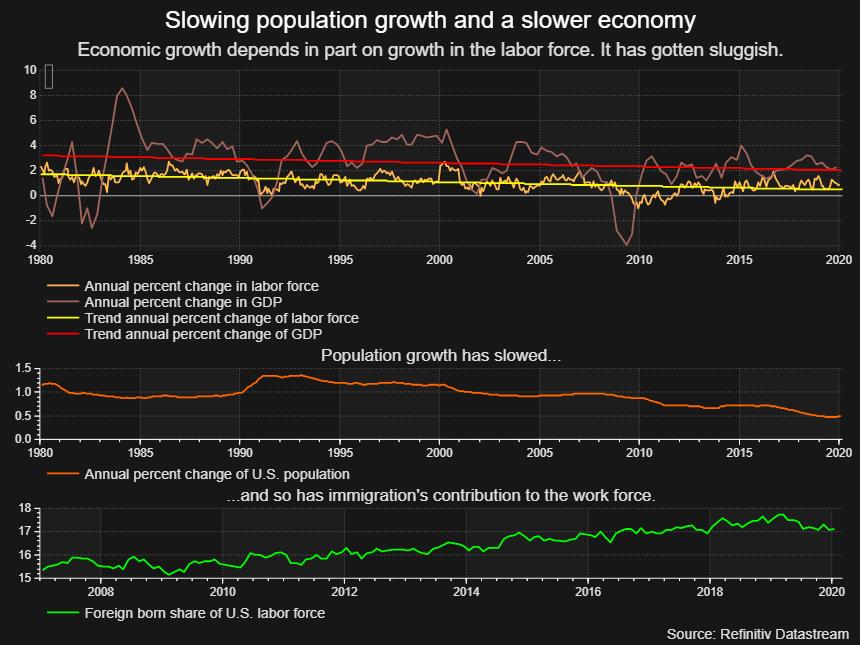
Nationally, the United States recorded its lowest immigration level since the great financial crisis in 2018 as Trump made slowing immigration a top priority – at one point declaring the country “full.” At 202,000, the increase in foreign-born residents in 2018 was about a third of the average since 2010.

(GRAPHIC: Slowing population growth and a slower economy – here)

Reuters Graphic

To officials in this Midwestern town, that poses a challenge: where to find the bodies needed to fill those empty homes, start businesses and keep the population from shrinking even faster?

For Betsy Cohen, the answer is simple: More Jawad Rahimis.

“When those numbers fall, it is hard to have the growth in the region we want,” said Cohen, executive director of the St. Louis Mosaic Project, whose aim is to make St. Louis’s immigrant population the fastest growing in the country.

“Every person counts,” Cohen said. “All skill lines. All families. We need people.”

PUSHING BACK

If the immigration debate nationally focuses on visceral issues like border security and family separation, cities like St. Louis are pursuing a different narrative – of immigration as needed to stabilize often struggling local economies and downtowns.

After Trump gave governors the right to reject refugees, only one state, Texas, did so. The issue is tied up in court, but many Republican state leaders have rendered it moot by saying they would still welcome refugees.

In a January letter to the State Department, Missouri Governor Mike Parson said the new arrivals would inevitably become “patriotic and productive fellow Americans.”

Pittsburgh, Buffalo and a host of other places, largely in the northeast and industrial Midwest, have also relied on immigrants to ease their overall population loss, and the economic drag that goes with it.

At its root, annual expansion in an area’s gross domestic product is based on the number of people working and how productive they are. Productivity growth has been disappointing since the 1990s.

Though the U.S. unemployment rate is low and many previously sidelined adults have started working again, underlying growth in the labor force has averaged below 1% annually since the 2007 to 2009 financial crisis. It is being pinched at both ends, with the population aging, and overall fertility rates well below the replacement level.

At the same time, the country’s economic geography features a widening divide between places that are adding disproportionate numbers of people and jobs, and those that see their college graduates and mid-career professionals leave town.

It can become self-reinforcing, economists Adam Ozimek, Kenan Fikri, and John Lettieri wrote in a report last year for the Economic Innovation Group. Smaller populations leave a smaller tax base, leading to a decline in services and real estate values, fewer business starts – and fewer reasons to stay.

The one factor that’s somewhat controllable is immigration, the organization noted, suggesting that like Australia and Canada the United States could expand immigration with visas targeted “to places confronting chronic population stagnation or loss as a means of boosting economic dynamism and fiscal stability.”

BETTER AT THEIR STORY

There has been a push in the Midwest in particular to acknowledge regional population decline as relevant to the national immigration debate.

In a 2017 report, the Chicago Council on Global Affairs noted the “extreme native population loss” in Midwestern cities of people aged 35-44, a group entering their prime earning years. The 1.4 million person decline in that group between 2000 and 2015 represented a fall of 24%, eased at least somewhat by the arrival of 313,000 foreign-born residents of that age.

The 12-state region from the Dakotas to Missouri and Ohio, “is home to dozens of metropolitan areas that have come to be increasingly defined by immigration and rely on immigration as a source of population stability… The foreign-born now play a critical role in offsetting regional workforce gaps.”

In Chicago’s Pilsen neighborhood, the dynamic is on display. Initially the home of Czech and other eastern European immigrants whose churches still spire over local homes and shops, the area was in decline during the 1970s and 80s. The people who stayed were the Latino immigrants who have anchored a neighborhood revival.

Marcos Carbajal, 36, left a career with Northern Trust Bank to put his MBA from Northwestern University’s Kellogg School of Management to what he feels will be better use – building his dad’s Michoacan-style barbecue stand, Carnitas Uruapan, from a 45-year-old neighborhood staple into a recognizable citywide brand, and possibly beyond.

“The first generation struggles to move up and traditionally the second generation has better access to education, a better job… better positioning,” he said.

The family has kept the building on Chicago’s W. 18th Street occupied and on the tax rolls since the 1970s, and with 38 employees, a second location now open, and a third “in our sights,” Carbajal said their footprint and economic impact, is expanding. “The food has not changed, the recipe has not changed but we are getting better at telling our story.”

Source: ‘They’re addicted to me’: How immigrants keep U.S. heartland cities afloat

ACLU Sues ICE Over Its Deliberately-Broken Immigrant ‘Risk Assessment’ Software

Good for the ACLU for launching a lawsuit and the research and study behind it:

from the can’t-really-call-it-an-‘option’-if-there-are-no-alternatives dept

A couple of years ago, a Reuters investigation uncovered another revamp of immigration policies under President Trump. ICE has a Risk Classification Assessment Tool that decides whether or not arrested immigrants can be released on bail or their own recognizance. The algorithm had apparently undergone a radical transformation under the new administration, drastically decreasing the number of detainees who could be granted release. The software now recommends detention in almost every case, no matter what mitigating factors are fed to the assessment tool.

ICE is now being sued for running software that declares nearly 100% of detained immigrants too risky to be released pending hearings. The ACLU’s lawsuit [PDF] opens with some disturbing stats that show how ICE has rigged the system to keep as many people detained as possible.

According to data obtained by the New York Civil Liberties Union under the Freedom of Information Act, from 2013 to June 2017, approximately 47% of those deemed to be low risk by the government were granted release. From June 2017 to September 2019, that figure plummeted to 3%. This dramatic drop in the release rate comes at a time when exponentially more people are being arrested in the New York City area and immigration officials have expanded arrests of those not convicted of criminal offenses. The federal government’s sweeping detention dragnet means that people who pose no flight or safety risk are being jailed as a matter of course—in an unlawful trend that is getting worse.

Despite there being plenty of evidence that immigrants commit fewer criminal acts than natural-born citizens, the administration adopted a “No-Release Policy.” That led directly to ICE tinkering with its software — one that was supposed to assess risk factors when making detention determinations. ICE may as well just skip this step in the process since it’s only going to give ICE (and the administration) the answer it wants: detention without bond. ICE agents can ask for a second opinion on detention from a supervisor, but the documents obtained by the ACLU show supervisors depart from detention recommendations less than 1% of the time.

The negative effects of this indefinite detention are real. The lawsuit points out zero-risk detainees can see their lives destroyed before they’re allowed anything that resembles due process.

Once denied release under the new policy, people remain unnecessarily incarcerated in local jails for weeks or even months before they have a meaningful opportunity to seek release in a hearing before an Immigration Judge. While waiting for those hearings, those detained suffer under harsh conditions of confinement akin to criminal incarceration. While incarcerated, they are separated from families, friends, and communities, and they risk losing their children, their jobs, and their homes. Because of inadequate medical care and conditions in the jails, unmet medical and mental-health needs often lead to serious and at times irreversible consequences.

When they do finally get to see a judge, nearly 40% of them are released on bond. ICE treats nearly 100% of detained immigrants as dangerous. Judges — judges employed by the DOJ and appointed by the Attorney General — clearly don’t agree with the agency’s rigged assessment system.

There will always be those who say, “Well, don’t break the law.” These aren’t criminal proceedings. These are civil proceedings where the detained are tossed into criminal facilities until they’re able to see a judge. This steady stripping of options began under the Obama administration but accelerated under Trump and his no-release policy.

ICE began to alter its custody determinations process in 2015, modifying its risk-assessment tool so that it could no longer recommend individuals be given the opportunity for release on bond. In mid-2017, ICE then removed the tool’s ability to recommend release on recognizance. As a result, the assessment tool—on which ICE offices across the country rely— can only make one substantive recommendation: detention without bond.

The ACLU is hoping to have a class action lawsuit certified that would allow it to hold ICE responsible for violating rights en masse, including the Fifth Amendment’s due process clause. Since ICE is no longer pretending to be targeting the “worst of the worst,” the agency and its deliberately-broken risk assessment tool are locking up immigrants who have lived here for an average of sixteen years — people who’ve added to their communities, held down jobs, and raised families. These are the people targeted by ICE and it is ensuring that it is these people who are thrown into prisons and jails until their hearings, tearing apart their lives and families while denying them the rights extended to them by our Constitution.

Source: ACLU Sues ICE Over Its Deliberately-Broken Immigrant ‘Risk Assessment’ Software

Keep Immigration Requirements in Mind When Preparing Coronavirus Response Plans

Practical advice from US immigration lawyers. Have not seen any indication of any impact on Canadian immigration but welcome comment from any Canadian immigration lawyers:

As employers prepare plans to handle possible alternate employee work arrangements in light of the 2019 Novel Coronavirus outbreak, it is important to keep in mind how these plans and policies—including telework policies—may affect foreign national employees working pursuant to US work visas.

H-1B Employees

Telework Arrangements May Necessitate Amended or New H-1B Petitions

It is US Citizenship and Immigration Services (USCIS) policy, based on case law, that an amended or new H-1B petition must be filed whenever there is a move to a location outside the area of intended employment. Once an employer properly files the amended or new H-1B petition, the H-1B employee can immediately begin to work at the new place of employment. Approval of the amended or new H-1B petition is not required in order for work to commence at the new site.

USCIS has made it clear that a new Labor Condition Application (LCA) and amended or new H-1B petition are not required in the following circumstances:

  • A move within an “area of intended employment”: Where the H-1B employee moves to a new job location within commuting distance, a new LCA is not required, provided there are no other changes in the terms and conditions of employment.
    • Although a new LCA and H-1B petition are not required, the employer must post the previously certified LCA in two conspicuous locations at the new work location and update the corresponding public access file.
  • Short-term placements: Under certain circumstances, an H-1B employer may assign an H-1B employee at a new worksite outside the area of intended employment for up to 30 days in a one-year period, and in some cases 60 days in a one-year period (where the employee is still based at the “home” worksite), without obtaining a new LCA. In these instances, a new LCA and H-1B petition are not required, provided there are no other changes in the terms and conditions of employment.
    • We note that short-term placement is not available where there is already an LCA covering the area of intended employment for the occupational classification. The short-term placement provisions provide H-1B employers with flexibility in assignments to afford enough time to obtain an approved LCA for a worksite outside the area of intended employment where the H-1B employer intends to have a continuing presence.
  • Non-worksite locations: Where the H-1B employee is going to a non-worksite location (e.g., going to a location to participate in employee developmental activity, or the job is primarily at one location but requires occasional travel for short periods to other locations) and there are no material changes in the authorized employment, a new LCA and H-1B petition are not required.

Our Recommendation

Before finalizing telework arrangements for H-1B employees, we recommend that employers first review the change in work location with their immigration counsel to confirm whether a new LCA and amended or new H-1B petition are required.

F-1 (Student) Optional Practical Training Employees

Telework Arrangements May Require Updates to Student and Exchange Visitor Information System (SEVIS) Records

The US Department of Homeland Security (DHS) requires that international students on any type of optional practical training (OPT) report changes, including changes in their employment, to their designated school officials (DSOs) to properly annotate their SEVIS records and maintain their student status.

Additionally, every six months, students benefiting from a two-year science, technology, engineering, and mathematics (STEM) OPT extension must work with their DSOs to confirm that their SEVIS records accurately reflect their employers’ addresses and the status of their employment, among other things. STEM OPT students and their employers are obligated to report to their DSOs any material changes to, or material deviations from, Form I-983, the formal training plan for STEM OPT students.

Our Recommendation

Once a telework arrangement is finalized for an F-1 OPT employee, we recommend that the employer remind the F-1 OPT employee to communicate the changes to his/her DSO to ensure that his/her SEVIS record is updated appropriately.

Other Situations

Other Work Visas such as L-1, E-1, E-2, E-3, TN, and O Visas

The above-listed visa classifications do not have geographic limitations in terms of work location. Unless a change in work location creates a material change in the job duties of an employee in one of these classifications, there is no need to notify USCIS about the change.

Should it become impossible to carry out the duties described in the foreign national’s visa petition, we recommend that you consult with immigration counsel to discuss appropriate steps.

Employees Working Remotely from Outside the United States

There may be situations in which foreign nationals who are outside the United States may be unable to return. For example, limited staffing at certain US embassies and consulates abroad may lead to delays in visa application processing times, which could require a foreign national employee to remain abroad for longer than originally anticipated.

While abroad, foreign national employees can work remotely and remain on US payroll without any legal implications with respect to US immigration laws. While US immigration laws are not an issue, we recommend that employers consult counsel to determine whether there are any US tax implications or tax implications in the foreign location as a result of such an arrangement.

Additionally, we note that working remotely from a country other than the foreign national’s country of citizenship may require prior approval from the local immigration authorities. We recommend that employers consult their global immigration counsel to discuss appropriate steps.

Source: Keep Immigration Requirements in Mind When Preparing Coronavirus Response Plans

China’s Proposed Immigration Changes Spark Xenophobic Backlash Online

Of note, not to mention Chinese government repression of minorities such as the Yuighurs:

While China is struggling with the coronavirus pandemic, the country’s Ministry of Justice has sparked another controversy over some proposed changes in China’s immigration policy. The policy proposed by Chinese officials has been slammed by Chinese internet users on the country’s social media outlets WeChat and Weibo since the ministry began seeking public consultations through departmental websites and social media in late February.According to the proposed clauses listed by the Chinese Ministry Of Justice, the new legislation aims to attract high-income foreign nationals to permanently live in China. In order to qualify, applicants need to have made major contributions to China’s science, technologies, sports, or cultural sectors. Experts in specific subjects may also qualify for permanent residence status in China. Foreign nationals whose incomes are six times higher than local residents can also apply after working in China for four consecutive years, or eight consecutive years if their incomes are less than six times but more than three times the average income of local residents.

The latest proposed changes to China’s immigration system are designed to attract a limited number of experts, specialists, and high-income individuals who can contribute significantly to China. Yet Chinese internet users are not showing any signs of support. There were more than 70,000 comments under the original Ministry of Justice Weibo post, which later got censored because of the backlash. The ministry closed down comments on the post announcing the legislative proposal for granting permanent resident status to foreign nationals. According to reports from the Beijing News, the topic generated billions of reads on the Chinese social media platform Weibo.

The Chinese Communist Party (CCP) regime is attempting to win back some support on this issue from the public through its state media outlets. Following the online anger, China Daily issued an op-ed about the importance of attracting foreign talents to develop the country’s economy and technology. CGTN, another English-language state media outlet, also published an op-ed calling for “a more open and inclusive society.” However, the overwhelming voices of dissent are dominating the spotlight.

Immigration has always been a challenging issue in Chinese society. The CCP’s past policies and records are making it difficult for the Chinese government to argue in favor of immigration, even for the purpose of attracting elite talents from other countries. According to an Initium News report, the majority of people in Chinese society believe that foreign nationals have been granted privileges and special status that they do not deserve. Some critics point out the unequal treatment between local Chinese and foreign nationals, accusing the Chinese government of opening up immigration while still having population planning policies to restrict the number of children Chinese nationals can have.

It is also important to note the prevalence of hatred and racism among the voices speaking against China’s plan to attract foreign talents. From questioning the loyalties of individuals from a different race to propagating stereotypes about other ethnic groups, many internet users seem to be opposing the Chinese government’s immigration proposals not because of the potential impacts of the policies, but rather because of racial biases and prejudices. Such attitudes are all too common. In 2017, a Chinese legislator attempted to bring up a proposal to conduct stringent and swift measures to eliminate the black communities in China’s Guangdong province. Pan Qinglin, a member of China’s Political Consultative Conference, claimed that “Africans have a high rate of AIDS and the Ebola virus.” Pan further suggested that China will change from a “yellow country” to a “yellow and black country” if black communities continue to exist in China.

While some argue that those reactions are rooted in the country’s closed cultural background, it is obvious that China’s propaganda strategy has also played a huge part in fueling nationalism and anti-foreign sentiments. In 2016, Chinese President Xi Jinping added the importance of promoting “cultural confidence” as a major propaganda theme. The cultural confidence portion began to advocate for stronger recognition of China’s cultural strength and traditional values. Adding to the propaganda efforts promoting the country’s political system, the CCP’s messages have been actively instigating nationalism that shows little respect for other cultures around the world.

In 2018, a short program show on China’s CCTV Chinese Spring Festival Gala had an actress dressed in blackface. Ironically designed to demonstrate China’s positive influence in Africa, the skit featured several disturbing scenes that sparked controversies. In addition to having a Chinese actress in blackface and wearing fake buttocks, the program also made cast members of African descent dress in animal costumes to perform “African dances.”

China Central Television, also known as CCTV, is one of the most important propaganda outlets in China. Its annual Spring Festival Gala is recognized as an essential channel to set out the country’s core propaganda messages of the year.

This was not the only occasion where the Chinese government found its representations to be endorsing racism. In July 2019, Chinese diplomat Zhao Lijian made inappropriate comments about black and Hispanic communities in the United States on Twitter: “If you’re in Washington, D.C., you know the white never go” to certain a part of the city “because it’s an area for the black & Latin.” Zhao later deleted the tweet after getting called out for his racist remarks. Instead of getting fired or receiving any kind of disciplinary measures, Zhao was later promoted by China’s Ministry of Foreign Affairs and now serves as the ministry’s new spokesperson.

From greenlighting a show that featured blackface and enhanced biases on national state media to promoting a diplomatic official who openly propagates hatred against other ethnic groups, it is evident that the Chinese government is fueling the country’s propaganda message with a narrow-minded nationalism at the cost of respecting equality and justice. It should not be a surprise, then, that many Chinese are outraged at the idea of allowing foreigners of different races and ethnicities to become permanent residents in China.

Through years of promoting nationalism and unity, Chinese propaganda has in fact put up a significant barrier for its government to implement effective immigration policies to attract foreign talents to reside and work in the country. While China often praises its own political system for being efficient and effective, its propaganda strategies are now, ironically, impeding the government’s own legislative agenda.

Source: China’s Proposed Immigration Changes Spark Xenophobic Backlash Online

Canada shares expertise with Germany on successfully integrating immigrants

Over the years, there has been a steady stream of German politicians and officials coming to Canada to learn about Canadian immigration policies and programs.

Environics and the Konrad Adenauer Stiftung did an interesting comparison of public attitudes between the two countries: Public sentiment toward immigrants and refugees: Current perspectives in Canada and Germany

Immigration Minister Marco Mendicino was in Germany this week to share what Canada has learned from an immigration program that helps newcomers find jobs and learn about life in Canada before they arrive.

At the invitation of German Chancellor Angela Merkel, Mendicino took part in a summit looking at best practices for integrating migrants. Canada was the only foreign country the Germans invited to take part in the summit.

“Our friends in Germany see Canada as a role model, as a country that has achieved success,” Mendicino told CBC News.

Canada’s pre-arrival settlement services provide newcomers with information and supports, including employment assistance, while they’re still overseas. The goal of the program is to better prepare immigrants to ease into Canadian society by educating them about life in Canada and navigating roadblocks they could encounter.

An internal government audit in 2018 found that while the program was valuable in helping newcomers, it had a low uptake due to a lack of widespread awareness about the services available. It concluded there was a “missed opportunity.”In response to that finding, the government set aside $113 million to raise the profile of the program. Mendicino said a recent survey showed that 85 per cent of people who used the services said the program helped them find them a job, and about 88 per cent said the program helped them get foreign credentials recognized in Canada.

Boost for productivity, growth

“If we are able to facilitate integration by speeding up the processes and helping immigrants to land a job, then that will contribute to productivity and growth. It will mean that one more job vacancy is filled and that will contribute to a stronger economy as a whole,” Mendicino said.

The minister said Canada’s pre-arrival settlement services program has been around for about 20 years, undergoing various refinements and adjustments over that period.

Describing Canada and Germany as “like-minded countries,” Mendicino said the two nations have shared values and an understanding that solid integration of immigrants leads to better outcomes for both the newcomers and the country’s economy.

Canada has been praised in past on the world stage for programs that attract and retain workers to communities outside large urban centres, and that link immigration to labour gaps.”What we’re discovering is that some of our strongest G7 partners like Germany are starting to look at Canada as a role model, so that tells me that we certainly have been recognized for having a specific expertise in this area,” he said.

Last year, the OECD praised Canada’s economic migration system as one of the most successful in the world. It said Canada is widely seen as a “benchmark” for other countries.

Programs that assist in successful immigration and attract skilled workers are key to meeting the economic challenges of the future, Mendicino said.

“We will really benefit from continuing to grow our country and our economy through immigration, and that’s part of the narrative that I shared with our friends in Germany,” he said.

Immigration attitudes have barely changed – so why is far right on rise?

Interesting take:

There are three major reasons why voters have become more likely to back far-right parties in Europe

Over the last three decades, far-right parties in Europe have tripled their vote share, from about 5% in the early 1990s to more than 15% today. About one in six Europeans now vote for parties such as Marine Le Pen’s National Rally (previously National Front) in France, Matteo Salvini’s League in Italy, or Viktor Orbán’s Fidesz in Hungary. This is one of the most striking outcomes of a new edition of the PopuList, a research collaboration supported by the Guardian, which launches on Tuesday.

Political scientists have demonstrated that the single most important reason why people vote for far-right parties is their attitude towards immigration. In other words, those who support these parties tend to do so because they agree with them that immigrants are “dangerous others” who form an economic and/or cultural threat to their own native group. This in itself is not remarkable – it just shows that many supporters of far-right parties are rational voters in the sense that they opt for outlets that express ideas they agree with and deem important.

What is remarkable, however, is that people’s attitudes towards immigration have not changed much over the years. On average, people have become neither more positive nor more negative about the influx of immigrants. This confronts us with an interesting puzzle: how is it possible that the electoral successes of far-right parties have increased so much, while at the same time the main determinant of far-right support – anti-immigration sentiment – has remained relatively stable? Let me mention three developments that can help us understand what is going on.

First, far-right parties have learned how to better mobilise voters. Until the turn of the millennium, most far-right parties were generally conceived of as beyond the pale. Voters associated them with fascism and violent anti-democratic skinheads. This has changed as many far-right parties have succeeded in moderating their images. A good example is Le Pen’s “detoxification” strategy. She cut connections to extremists, changed her party’s tarnished name and distanced herself from her father, the more radical previous leader and founder of the party. It is important to emphasise, however, that although various far-right leaders have succeeded in moderating their party’s reputation, when it comes to their actual programmes most of them have remained as radical as ever.

Mainstream parties have also played an important role in this process of reputation moderation. They have legitimised the ideas of far-right parties by incorporating watered-down versions in their own political programmes. Many academic studies have shown that when it comes to their positions on immigration and integration, mainstream parties have moved towards the far right. The Dutch prime minister, Mark Rutte, for instance, wrote a letter to all citizens in the Netherlands, in which he argued they had to actively defend the country’s values against people who refused to integrate or who acted antisocially. “Behave normally or leave,” was one of his letter’s core messages. Similar strategies have been employed by mainstream parties in Austria, Denmark and France.

Second, it is not only political parties that have adapted their behaviour – voters have also changed. Not so long ago the average voter was loyal to their political party; a typical social democrat remained a social democrat forever, and did not even consider voting for a conservative or liberal party. Yet processes of individualisation and emancipation have made people much more whimsical when it comes to their electoral behaviour. Slowly but steadily, loyal voters became floating voters, and many of them started to switch between parties – in particular in multi-party democracies. These voters often have a “choice set” of several parties to which they feel attracted, and base their eventual choice on things such as election promises, the performance of party leaders, or parties’ past behaviour in parliament. Voters have started to actually vote, and have thereby become available for mobilisation by far-right parties.

Source: Immigration attitudes have barely changed – so why is far right on rise?

Le Québec perd la course aux étudiants étrangers

More pressures from within Quebec regarding more immigration, this time on the part of students and the relatively low number studying in Quebec:

Le nombre d’étudiants étrangers qui entrent au pays a doublé en quatre ans. L’Ontario en profite à plein. Le Québec ? Si peu que la province risque de perdre la course aux talents internationaux.

Selon les données d’Immigration Canada, le Canada a délivré 256 000 permis d’études à des étrangers en 2019, le double d’il y a quatre ans.

La moitié des candidats acceptés au pays étudie en Ontario. Le Québec, pour sa part, accueille seulement 12 % des titulaires de permis d’études, moins que le poids de sa population de 22,5 % dans le Canada.

Cette sous-représentation n’est pas sans conséquence, puisque l’attraction et la rétention des étudiants étrangers constituent un axe stratégique en vue de créer de la richesse et de soulager un tant soit peu la pénurie de main-d’œuvre à moyen terme. Le ministre de l’Immigration du Québec, Simon Jolin-Barrette, a décliné notre demande d’entrevue en nous invitant à communiquer plutôt avec Ottawa.

« La réalité, c’est que l’écart se creuse entre le Québec et les autres provinces dans la course aux talents », déplore Christian Bernard, économiste à Montréal International, organisme de prospection des investissements directs étrangers, qui fait aussi la promotion de Montréal comme ville étudiante internationale.

M. Bernard rappelle que le Canada est en compétition avec la plupart des pays occidentaux dans cette course aux talents.

D’après les chiffres obtenus par La Presse, 51 % des étrangers voulant étudier au Québec se sont vu refuser leur permis d’études par le gouvernement canadien en 2019, contre 38 % dans le reste du pays.

Outre la barrière de la langue française, qui réduit le nombre de demandes à son égard, le Québec est pénalisé par le refus du Canada de laisser entrer au pays un fort contingent d’étudiants francophones en provenance d’Afrique.

Selon Immigration, Réfugiés et Citoyenneté Canada (IRCC), les raisons courantes pour refuser une demande sont que « le demandeur n’a pas prouvé qu’il a assez d’argent pour subvenir à ses besoins pendant ses études ». Ou qu’« il n’a pas convaincu l’agent des visas qu’il quittera[it] le Canada à la fin de sa période d’études », explique, dans un courriel, Peter Liang, conseiller en communication d’IRCC. Pour certains pays, un examen médical est également requis. Dans tous les cas, le candidat ne doit pas avoir de dossier criminel.

« Ce qui est désolant, ajoute Christian Bernard, de Montréal International, c’est la contradiction entre, d’une part, les critères mis de l’avant pour délivrer ou non le permis d’études et, d’autre part, la volonté de tous les paliers de gouvernement qui déploient des initiatives et qui investissent des sous avec l’intention d’attirer et de retenir davantage d’étudiants internationaux au Canada et au Québec. »

Le 31 janvier, l’organisme a recommandé que le Canada réduise le taux de refus des étudiants francophones dans une étude sur la connectivité de la métropole, produite conjointement avec la Chambre de commerce du Montréal métropolitain.

Accepter deux fois plus d’étudiants dans l’espoir de pourvoir les places disponibles

Au trimestre d’automne 2019, à l’Université de Sherbrooke, 37 des 102 places réservées aux étudiants étrangers admis au bac en régime coopératif avec stages de travail rémunérés n’ont même pas pu être pourvues, les étudiants admis ayant été refusés par Immigration Canada. L’institution avait pourtant admis 189 étrangers au départ pour que soient pourvues ces 102 places.

À l’Université Laval, le taux d’inscription des étudiants internationaux préalablement admis a décliné depuis 2014. Il se situait à 67 % en 2018, dernière année pour laquelle la donnée est disponible. « En nombre absolu, le nombre a augmenté de 1100 à 1400 étudiants internationaux. Ce qui nous préoccupe, c’est qu’en pourcentage, ça baisse. On a des étudiants qui ne peuvent pas venir chez nous faute d’obtenir leur permis d’études à temps », dit Yan Cimon, vice-recteur adjoint aux affaires externes, internationales et à la santé et directeur des affaires internationales et de la francophonie.

Ces bourses d’exemption de droits de scolarité pour la francophonie du Sud, au nombre de 235 par an, ont été créées par le premier ministre Philippe Couillard lors du Sommet de la Francophonie tenu au Madagascar en 2016.

En raison de refus de permis d’études, le réseau des cégeps est incapable d’atteindre son objectif, datant de 2012, de 5000 étudiants internationaux. Les 48 cégeps publics accueillent actuellement 4300 élèves étrangers au diplôme d’études collégiales.

Dans le reste du Canada, les collèges d’enseignement professionnel formaient 151 000 étrangers en 2017, d’après un document de 2018 du Bureau canadien de l’éducation internationale. C’est 35 fois plus qu’au Québec.

« On cherche à mieux faire connaître aux agents d’immigration le réseau collégial, avance M. Tremblay, en guise de solution. On leur dit que ça se peut qu’un diplômé universitaire d’Afrique veuille suivre après coup une technique dans un cégep. Il y a un grand attrait pour les formations techniques qui ne sont pas très présentes dans le système d’éducation en Afrique. »

« Dans un contexte de pénurie de main-d’œuvre, l’intégration des étudiants internationaux au réseau collégial représente la solution à la régionalisation de l’immigration, qui est un problème au Québec depuis 40 ans », soutient le patron de la Fédération des cégeps.

Les Africains refusés par dizaines de milliers

Les données d’Immigration Canada montrent que les taux de refus sont particulièrement élevés pour les demandeurs des pays africains, principal réservoir de locuteurs francophones, après la France.

La proportion de refus atteint 90 % pour les Guinéens, 82 % pour les Camerounais, 77 % pour les Algériens et 75 % pour les Sénégalais.

Depuis cinq ans, 16 000 étudiants algériens et 5300 Sénégalais se sont ainsi vu refuser l’entrée au pays.

« Nous n’arrivons pas à nous expliquer cette situation, écrit dans un courriel René Gingras, DG du Cégep de Rivière-du-Loup. Nous espérons qu’il y aura déblocage bientôt. Nous pourrions ainsi accueillir plus d’étudiants qui parlent français, qui s’intègrent dans notre région et qui répondent aux besoins du marché du travail. »

De leur côté, les collèges et universités anglophones du reste du Canada ne rencontrent pas ce problème. Ils recrutent les étudiants de pays anglo-saxons, de pays comme le Japon, la Chine, l’Inde et la Corée du Sud, tous plus riches que les pays africains. Les taux de refus y sont beaucoup plus faibles.

« Aucune discrimination », soutient Immigration Canada

« Les demandes du monde entier sont examinées de façon uniforme et en fonction des mêmes critères. Il n’y a absolument aucune discrimination dans notre processus d’évaluation des demandes », se défend M. Liang, d’Immigration Canada.

Aucune discrimination, mais des objectifs totalement contradictoires avec ceux du Québec, déplore la Fédération des cégeps.

Le fédéral ferme la porte quand il n’est pas convaincu que l’étudiant quittera le pays à la fin des études. Or, ce même étudiant est recruté en se faisant promettre par Québec qu’une fois diplômé, il pourra rester au pays de façon permanente.

Par exemple, des missions de recrutement d’étudiants visent régulièrement le Maghreb, une région pour laquelle Immigration Canada refuse de 40 à 77 % des demandeurs.

Autant de cerveaux qui n’entrent pas au Québec.

Cinq pistes pour hausser la part du Québec

Pour attirer davantage d’étudiants étrangers, le Québec pourrait toujours emprunter un raccourci et imiter la France en proposant des formations uniquement en anglais. Le cégep de Gaspé a choisi cette voie avec son campus de Montréal, qui accueille 2000 Indiens et permet à la maison d’enseignement de faire des profits de 1 million. Des solutions moins controversées existent néanmoins.

Diminuer le taux de refus des permis d’études

« On aimerait voir plus de flexibilité dans le processus de délivrance des permis d’études, confie Yan Cimon, de l’Université Laval. Il y a énormément de pièces justificatives à fournir. C’est difficile de voir des dossiers refusés pour des formalités. »

Si le taux d’acceptation des demandes visant le Québec remontait au niveau du Canada hors Québec, la province aurait accueilli 10 000 étudiants internationaux de plus en 2019. Rapidement, la part du Québec passerait de 12 à 18 % de l’ensemble des étudiants étrangers présents au Canada.

Le fédéral ferait ainsi d’une pierre deux coups. Le pays marquerait plus de points dans la course aux cerveaux qui a cours en Occident tout en diminuant sa dépendance à l’égard de l’Inde et de la Chine, responsables à eux deux de 54 % du flux d’étudiants internationaux au pays.

Instaurer le traitement rapide des permis dans les pays francophones

En 2018, le gouvernement canadien a lancé le Volet direct pour les études (VDE) pour les demandeurs de la Chine, de l’Inde, des Philippines et du Viêtnam, puis en juillet 2019 pour le Pakistan. Le VDE a permis de réduire les délais de traitement.

« Quand vous avez des délais qui interrompent ou qui induisent un report de projets d’études, ce n’est à l’avantage ni de l’étudiant ni de l’université », dit Yan Cimon, de l’Université Laval, où les deux tiers des étudiants étrangers inscrits sont africains.

« Dans le cadre du VDE, les permis d’études des étudiants potentiels peuvent être traités plus rapidement, avance Immigration Canada, dans un courriel, car en faisant leur demande, ceux-ci montrent d’emblée qu’ils ont les ressources financières et les compétences linguistiques. » Le VDE a été élargi au Maroc et au Sénégal en septembre 2019.

Élargir l’admissibilité des diplômés du collégial au PEQ

L’accès rapide à la résidence permanente pour les candidats ayant passé par la filière étudiante contribue à la popularité du Canada comme terre d’études. Au Québec, la voie rapide se nomme le Programme de l’expérience québécoise (PEQ), en révision. Les cégeps voudraient que le gouvernement ouvre le PEQ aux diplômés d’une attestation d’études collégiales, obtenue habituellement après un an d’études, dans les secteurs en pénurie de main-d’œuvre.

Augmenter le nombre de bourses

La France a haussé les droits de scolarité facturés aux étrangers en 2018. La mère patrie cible dorénavant les pays payants comme l’Inde et la Chine. L’Afrique francophone pourrait en subir les contrecoups, elle qui fournissait historiquement 45 % des étudiants étrangers en France, selon un article du Devoir de novembre 2018. Une fenêtre s’ouvre pour le Québec en augmentant le nombre de bourses versées aux Africains. Depuis 2016, le Québec offre 500 bourses d’études aux francophones du Sud qui s’inscrivent au cégep. Encore faudrait-il que les agents d’Immigration Canada considèrent la bourse dans l’examen de la demande de permis d’études.

Entente avec la Belgique et la Suisse

La Fédération des cégeps est en demande auprès du gouvernement pour que celui-ci conclue une entente pour admettre les étudiants de la Belgique et de la Suisse aux mêmes conditions monétaires que les Français dans le réseau collégial. Les étudiants en provenance de l’Hexagone acquittent les mêmes frais que les Québécois. Une entente existe avec la Belgique depuis deux ans pour faciliter l’inscription de ses ressortissants à l’université, mais rien en ce qui concerne le cégep. Aucune entente n’existe actuellement avec la Suisse.