Howard Ramos: #Immigration to Canada May Not Return to Pre-Pandemic Levels

Good analysis and commentary by my friend, Howard Ramos, that asks some needed questions rather than assuming immigration will just bounce back, particularly the impact of Canada’s mixed handling of COVID-19 compared to immigration source countries:

After almost three months of lockdown because of the COVID-19 pandemic, Canada and other countries around the world are working to slowly re-open. As they do, immigration will be a key component to their economic recovery.

The question Canadian policymakers should be considering: will immigrants want to move and call Canada their new home? At the moment, it’s a theoretical question. However, a closer look at a number of trends suggests that a rebound in immigration to Canada is far from a guarantee.

A recent report by RBC underscores the extent to which the pandemic could derail Canada’s immigration-driven economy. With travel restricted and the pandemic still spreading in some parts of the world, quarantines and shutdowns are going to be a key part of the ‘new normal.’ The impact of closed borders and restricted movement on migration will not only interrupt movement but it will also create backlogs and other obstacles in immigration systems that most countries will have to wrestle with.

For Canada’s immigration levels to return to pre-COVID levels, Canadian governments will have to look beyond our borders to see how it has handled the pandemic relative to other countries.

Canada does not fare well compared to global counterparts

According to Worldometer, Canada ranks 17th worldwide in the most deaths per million, at 217, as of June 15, 2020. When this is broken down by region, as done by Andrew Griffith on the Multicultural Meanderings web site, death rates in Quebec are higher than the United States or Italy – and almost as high as the United Kingdom.

By this metric, Canada also does not fare well when it compares itself to the countries that are its most prominent sources of its immigrants. In 2019, the top 10 countries of citizenship of new permanent resident admissions to Canada were: India, China, Philippines, Pakistan, United States, Syria, Eritrea, South Korea, and Iran.

Among these, all but the United States had lower death rates, per million, from COVID-19 than Canada. And it wasn’t even close. China had a low of three deaths per million, while Iran had 107 deaths per million.

Policymakers would also be wise to consider that many of Canada’s hardest hit neighbourhoods by the pandemic were ones with a high concentration of recent immigrants. That reality undercuts many of the perceived advantages Canada presents to immigrants, such as its accessible and strong health care system or its quality of life.

When Canada is compared to other immigrant receiving countries such as Australia or New Zealand it does not fare well either. Australia ranks 129th in most deaths per million and New Zealand declared victory over the pandemic. Both managed the disease more efficiently and have a head start in reopening. As the world may experience a second or future waves of the pandemic, Canada does not look as attractive compared to competing immigrant receiving countries.

Multicultural ‘veneer’ tarnished by recent events

While Canada is recognized internationally for being open and multicultural, that veneer has been tarnished slightly by many reported incidents of anti-Asian discrimination. Polling shows that the majority of Canadians believe negative attitudes towards Asian-Canadians have increased since the pandemic and the Vancouver police report that anti-Asian hate crime has gone up in the city this year. Given that the top three source countries of newcomers last year were all Asian, this too makes the country less attractive.

The good news for Canada is that people have continued to apply for immigration and the country has continued processing applications during the pandemic. However, if the country aims to re-kindle its high level of immigration intake, it will need to reopen its borders. Canada cannot sit back and assume that people will want to come. Canadians will have to do the hard work of assuring newcomers that the country is indeed safe, healthy, and a welcoming place to build a future.

Immigration slowdown to weigh on Canada’s economic recovery

More on the likely impact on the Canadian economy.

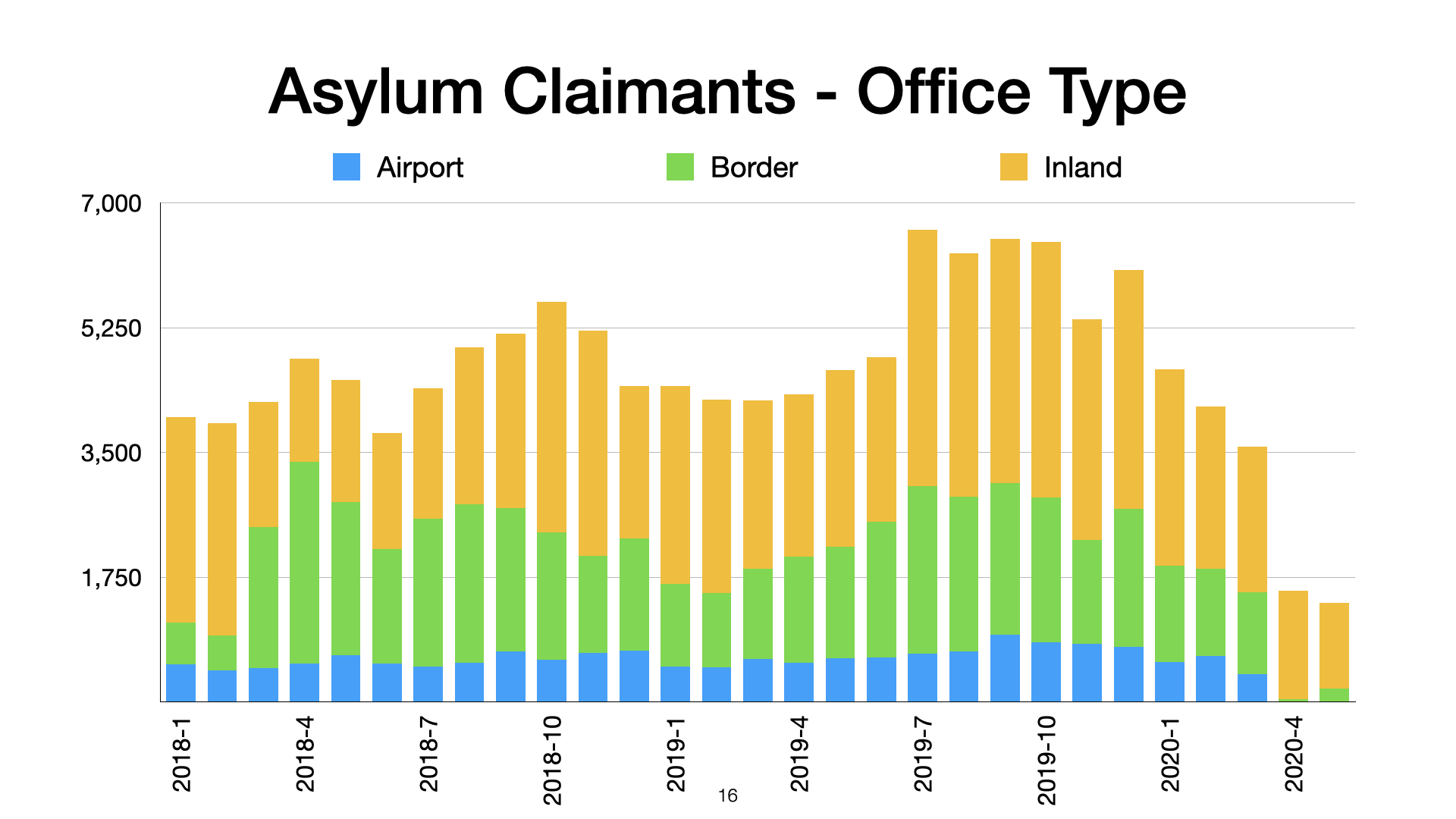
The slides below provide the monthly statistics since 2018 and capture the dramatic decrease in 2020:

Ramping up immigration without addressing Canada’s endemic productivity challenge means that any increase in GDP will not translate into an increase in GDP per capita, which economic and immigration should aim at:

Immigration to Canada has plummeted during the coronavirus pandemic, weakening a dependable lever of economic growth as the country mounts its recovery.

Canada’s population increased by about 76,000 people (0.2 per cent) over the first three months of 2020, the slowest growth in a first quarter since 2015, Statistics Canada said Thursday, warning a bigger impact will likely be felt in the second quarter.

The shift was severe for temporary immigration. The net increase of non-permanent residents in the first quarter was nearly 80 per cent lower than a year ago, largely because of fewer foreign students.

The dramatic slowdown is by design. In response to the pandemic, travel to Canada is heavily restricted. Those allowed entry include temporary foreign workers, along with foreign students and permanent residents who were approved before March 18. But for most people, the border is closed.

That is a complication for the recovery because the Canadian economy relies heavily on immigration to bolster output and consumption. Fewer immigrants will affect the labour supply, housing demand and university budgets, to name some prominent examples.

“If immigration falls by so much, then there’s a number of aspects of the Canadian economy that may be impacted pretty significantly,” said Andrew Agopsowicz, a senior economist at Royal Bank of Canada.

Before the pandemic, another record-setting year of immigration looked possible. The federal Liberals planned to welcome 341,000 new permanent residents in 2020, rising to 361,000 in 2022. The high-end estimate for 2020 was an intake of 370,000 permanent residents, which would have broken the 2019 record of about 341,000. Now, those targets look unfeasible.

For one, the Canada-U.S. border is closed to all non-essential travel through at least July 21, and with COVID-19 cases accelerating in some parts of the world, border restrictions may not ease substantially in the short term.

“We’re definitely not going to be growing very rapidly as a country this year,” said Robert Falconer, a research associate at the University of Calgary who studies immigration.

The early data suggest a massive slowdown in the second quarter. In April, about 4,100 people were approved for permanent residency, down 85 per cent from the previous April, according to the most recent data published by the federal immigration department. Most approvals were for people already living in the country.

If travel restrictions and border closings last all summer, Canada’s intake of permanent residents will decline by up to 170,000 people in 2020, RBC said in a recent report.

“The disruption will reverberate across the economy, given our reliance on immigration for labour-force growth and to offset Canada’s aging demographic,” Mr. Agopsowicz wrote at the time.

Higher immigration has been a key part of the Liberals’ economic strategy. Newcomers tend to be younger than current residents, helping to slow the country’s aging toward a fiscal cliff caused by non-working seniors with few working taxpayers to support them. They also provide talent to companies, buy goods and services, and often pay higher tuition to attend Canadian universities.

Moreover, the country is stuck in a productivity rut. For years, labour productivity – output produced for every hour worked – has essentially stagnated, Statscan data show. Instead, Canada relies on population growth – that is, more workers – to juice overall growth.

For instance, Canada’s population grew by some 580,000 people last year, the largest annual gain since 1971, and driven mostly by immigration. In percentage terms, the population grew 1.6 per cent in 2019, or the same as gross domestic product when adjusted for inflation.

Still, productivity gains are needed. As it increases, so too does the value of labour, resulting in higher wages and better living standards.

Ottawa remains committed to high immigration levels and is still accepting most applications, although processing times have been significantly affected by the virus. The federal government recently posted a tender to its procurement website, marked “urgent,” that seeks to modernize an application system that still relies on paper documents and in-person interviews.

“It’s going to be key for the government to figure out an effective strategy to ramp back up to high levels of immigration,” Mr. Agopsowicz said.

Source:  slowdown to weigh on

Canada has an unused card up its sleeve against China: our immigration system

Valid suggestions by Robert Falconer and to focus on Hong Kong asylum seekers and others from mainland China:

Canada is limited in the ways it can respond to the bully tactics of larger countries such as the People’s Republic of China. Yet as it confronts China’s heavy-handed attempt to quash the autonomy it had promised Hong Kong, Ottawa is not without levers of influence. One policy tool that Canada should immediately deploy is our immigration, refugee and asylum system.

As governments worldwide closed their countries’ borders, and as the United Nations suspended its refugee program, a more subtle trend emerged: an uptick in the number of Hong Kongers claiming asylum. According to the Immigration and Refugee Board of Canada, 25 Hong Kongers have claimed asylum in the first three months of 2020; unofficial sources suggest the number may be as high as 46. While that’s still a relatively small number, it represents a six-year high for Canada in just three months. Regardless of the choices Canada makes, we are likely to see record-high levels of people from Hong Kong fleeing here to seek refuge when international travel fully resumes.

Our asylum system is particularly well-suited to receiving claims from Hong Kong. It includes the ability to streamline cases from countries with well-established human-rights abuses, where asylum seekers have reliable forms of identification, and where the evidence is not ambiguous regarding the risks they face for holding an adverse political opinion or for opposing the current government.

Choosing to welcome those seeking asylum is not only the right thing to do but has practical benefits as well. It might seem odd to make a utilitarian argument in favour of asylum, and indeed, if all policy-makers and politicians were angels, such a justification would not be necessary. But there is a compelling case to be made for a renewed Canadian foreign policy that considers the role immigration and refugee status plays in our national security and response to foreign competitors. As the People’s Republic seeks to impose its will on Hong Kong, an open refugee policy is one that permits Hong Kongers to vote with their feet between an oppressive China or an open Canada.

The decision to welcome Hong Kongers as part of a robust foreign policy is not without precedent. Conservative governments in the 1970s and ’80s understood that an open-door policy was one that would attract those with the greatest levels of dissatisfaction in the Soviet bloc. The arrival of refugees and immigrants during that time strengthened our economies and added linguistic diversity and cultural understanding to our law enforcement, military and intelligence communities.

The same applies to Hong Kongers and mainland Chinese fleeing oppression. Indeed, combatting the possibility of intellectual-property theft and industrial espionage is far more likely to be aided, rather than hampered, by recruiting from a population that shares similar cultural and linguistic characteristics and understands the methods of potential competitors. Above all, welcoming Hong Kongers aligns with Canadian democratic traditions – standing against tyranny and welcoming the oppressed.

Granting asylum to Hong Kongers fleeing persecution from Beijing should not be a difficult task for this government, either. While the Trudeau government has shifted its tone regarding Canada’s relationship with China, it has faltered when asked whether Canada will accept refugee claimants from Hong Kong. In contrast, British Prime Minister Boris Johnson has announced that Britain will allow 2.8 million Hong Kongers to live and work in Britain if China implements its national-security law on the former British colony. In response, the Chinese Communist Party regime has threatened Britain with vague consequences if it continues to meddle in an “internal affair.”

Granting asylum to Hong Kongers will force the federal government to recognize the well-established truth that China is a hostile actor, and doing so will signal to both the international community and China that Canada acknowledges that hard truth. Dealing with China is not a risk- or cost-free interaction. There are no other options, aside from total silence, that will not draw retaliation from Beijing, and it should be expected if Canada decides to grant asylum to claimants from Hong Kong. But the government needs to accept this reality, recognize the risks and rethink how to move forward. Granting asylum to Hong Kongers seeking to flee persecution is not only the right thing to do – it is the Canadian thing to do.

For a government that prides itself on the principles of championing human rights, our inaction on Hong Kong remains a persistent dark stain.

Coronavirus has increased interest in immigrating to Canada

The optimistic view based upon an April World Education Services survey. Survey intentions, of course are intentions, we shall see over the next few quarters the extent to which they materialize:

The economic impacts of coronavirus have largely not changed people’s plans to immigrate to Canada. In most cases, prospective immigrants still expect that Canada will endure less economic hardship than their own country.

Of the 4,615 people who responded to a recent survey from World Education Services (WES), 38% say they are more interested in immigrating to Canada, 57% say that the pandemic does not impact their interest, and 5% say they are less interested. Researcher Joan Atlin said she was surprised to see such a small percentage of people who were less interested in immigrating to Canada.

“The research was done in April, so quite early in the pandemic, and I would have expected that number to potentially be a little bit higher,” Atlin told CIC News, “It was very encouraging to see.”

The survey was conducted by WES from April 15 to 21 in an effort to understand how COVID-19affected the intentions of prospective Canadian immigrants. The non-profit credential evaluation provider collected survey results from their clients, most of whom are in the pre-arrival phase and are on track to immigrate to Canada.

All respondents were outside of Canada at the time the survey was conducted. More than half of the people surveyed from the Philippines (64%), China (64%), and Nigeria (58%) said they are more interested in immigrating to Canada as a result of COVID-19. There was largely no impact on the desire to immigrate to Canada for respondents from Pakistan (58%), the U.K. (59%), the U.S. (57%), India (64%), and France (73%).

Just over half of respondents, 52%, do not expect COVID-19 to impact their ability to pay for the costs of immigrating to Canada; however, about 35%, do expect it to negatively impact their ability to pay the costs.

More than a third, 39%, say that personal and family economic hardships would make them more interested in immigrating.

Most are still interested despite worsening job prospects. The loss of job opportunities in a respondent’s occupation in Canada had the biggest impact on attitudes toward the move, with 31% saying it would make them less interested to come to Canada. Even so, the majority, 46%, said job loss would not impact them.

Most report that they would not be impacted by immigration obstacles such as increases in IRCC processing times, a reduction in immigration targets, or travel restrictions. The risk of contracting COVID-19 was the biggest hurdle with 36% reporting they would be less interested in immigrating to Canada, however 42% still reported that it would not impact their interest.

Just over a third, 35%, of respondents are considering delaying immigration to Canada to a future date, and 42% said they were unlikely to delay. The biggest reason for the delay was the risk of contracting coronavirus.

WES is conducting at least two more surveys on this topic. One is expected for this month and another is scheduled for August.

Source: https://www.cicnews.com/2020/06/coronavirus-has-increased-interest-in-immigrating-to-canada-0614757.html#gs.8cw8es

With Stephen Miller pouring poison into Trump’s ear, the uncivil war rages on

Strong but accurate portrayal:

Does the Trump administration’s face of evil have a point?

Stephen Miller, the white supremacist who steers United States President Donald Trump’s immigration policies, and also serves as his xenophobic speechwriter, claims it is hypocritical for Democrats and progressives to decry the President’s planned political rally in Tulsa, Okla., on Saturday as a coronavirus superspreader.

How can they do that, he asks, when they’re the same people who are encouraging and participating in massive protest rallies against racism and police brutality? Thousands of demonstrators milling together on streets, many of them without masks. It’s hypocrisy on stilts, Mr. Miller says.

He cited Washington Mayor Muriel Bowser, who extended her lockdown order at the same time as she was promoting mass street protests. And how about Florida congresswoman Val Demings, who is on presumptive Democratic presidential nominee Joe Biden’s shortlist for a running mate? She joined a major protest while blasting the President for his planned rally.

“There is almost assuredly going to be a spike in COVID cases and it will also almost assuredly be put on red-state governors and the President holding rallies,” Mr. Miller wrote in The Spectator this week. “But Democratic activists and politicians themselves created this situation.”

It’s too early to determine whether protests are contributing to a spike in COVID-19 cases. But progressives have to be careful about rhetoric and activities that play into the hands of the 34-year-old Mr. Miller and his Oval Office master. Campaigns to defund police departments, for example, are a godsend to Mr. Trump’s law-and-order campaign, as are protests that descend into violence.

Mr. Trump tweeted on Monday that the news media was “trying to Covid Shame us on our big Rallies.” Unconcerned about a new wave of the coronavirus plague, he will hold these rallies, no matter how dangerous they may be. Re-election, as he sees it, depends on the country getting out of its crouching, virus-defensive posture and back on its economic feet.

Despite U.S. Vice-President Mike Pence’s assertion that fears of a renewed virus outbreak are overblown, a dozen or so states, including Florida, Texas and Oklahoma – which is a heavily pro-Trump state – are still seeing a surge in cases.

While the anti-racism protests have been outdoors, where the virus is less contagious, the Trump team was planning on holding its rally in a packed indoor arena. But last-minute plans were being made to shift it to an outdoor venue. Mr. Pence said this was to accommodate huge crowds, but there was also pressure to do so for health reasons.

The Tulsa rally will be the President’s first in three months. The city was also the site of a massacre 99 years ago, when a white mob attacked Black residents of Tulsa’s Greenwood District, killing as many as 300 people. The Trump rally was originally planned to be held on Friday, June 19, which is known as Juneteenth, a holiday when many Black Americans celebrate their emancipation from slavery. But owing to the outrage the plan provoked, it was moved back a day.

Even so, the event is likely to heighten racial tensions. It will play to Mr. Trump’s base, as all his other measures do. The police reforms he announced this week were toothless. He has rejected calls to rename military bases honouring Confederate generals.

Mr. Miller has had Mr. Trump’s ear since day one, and is still pouring poison into it. Mr. Miller is a blank-faced, cold and uncompromising bigot. In most everything written about him, the word evil or something synonymous can be found.

He is architect of the ban limiting travel to the U.S. from many Muslim countries, harsh anti-refugee policies and Trump speeches berating immigrants. Last November, leaked e-mails between himself and a former Breitbart editor showed him promoting white nationalist propaganda and materials from white supremacist sites. A group of 27 senators sent a letter to the White House saying Mr. Miller was motivated by white supremacy, not national security, and demanded he be fired.

Firing Mr. Miller is the furthest thing from Mr. Trump’s mind. His campaign priority is hardly to attract Black voters. With the help of Mr. Miller, he has pretty much lost them all.

As many have noted in the wake of George Floyd’s death, the Civil War of the 1860s in the United States has never really ended. Mr. Trump and Mr. Miller are shamefully keen to extend it into this campaign.

Source: With Stephen Miller pouring poison into Trump’s ear, the uncivil war rages on: Lawrence Martin

New Zealand: #Immigration “was never a sustainable source of growth”

Canadian immigration policy makers should also take note on the difference of overall GDP growth and the more important measure, per capita GDP growth:

ANZ economists believe there is a “slim” prospect of a population-driven recovery for the New Zealand economy given the weak outlook for migration. They also claimed that immigration “was never a sustainable source of growth”anyway:

This crisis has turned New Zealand’s recent model of migration-driven growth on its head… Once borders reopen, we expect net inflows to rebound, but to lower levels than before the crisis (figure 1)…

Migration-induced population growth has been one of the most dominant drivers of economic activity in recent years, with per capita GDP growth trailing well below the headline measure (figure 4). This was never a sustainable source of growth.

Overall, the weaker outlook for migration means that the prospect of a population-led recovery is slim. That will put the burden on domestic stimulus and productivity. So far, we’ve seen nothing on the policy front to convince us that productivity is about to take the reins, so expect a pretty ho-hum performance on the other side.

Meanwhile, a new report for the New Zealand Productivity Commission claims that mass immigration has distorted the economy and wrecked productivity:

The substantial net migration inflows that New Zealand has received over the past 25 years has been a strong source of support for headline GDP growth, but has created a series of distortions and pressures in the New Zealand economy: infrastructure and cost pressures, greater residential real estate demand (with implications for allocation of investment capital), downward wage pressure that deters business investment, as well as upward exchange rate pressure. An explicit immigration policy that was focused on quality and filling skills gaps, with lower gross inflows, would create a more supportive environment for higher levels of international engagement by New Zealand firms.

Given the similarities between the New Zealand and Australian economies and immigration systems, these findings can be equally applied to Australia.

Source: ANZ: Immigration “was never a sustainable source of growth”

Essential but expendable: How Canada failed migrant farm workers

Good investigative reporting on the policy and enforcement failures after the quarantine period:

When the novel coronavirus pandemic hit in March, the annual flow of farm labour into Canada hung in the balance.

Farmers feared that border closings and grounded planes would prevent agricultural workers, coming from countries such as Mexico, Guatemala and Jamaica, from reaching their fields and greenhouses in time for the seeding season. Knowing this, Ottawa allowed entry of temporary foreign workers critical to the food system.

Conditions – including a mandatory 14-day quarantine upon arrival – were put in place to protect Canadians. But advocates and health officials say not enough was done to protect the workers themselves.

In interviews, farm workers detailed the myriad reasons that COVID-19 has infiltrated farms with such success: a lack of personal protective equipment (PPE), an information vacuum and pressure to work, despite symptoms. In one instance, a feverish worker developed chest pains and a nosebleed that dripped on the vegetables he tended; he said his supervisors refused to take him home until the shift was over. Photos, videos and interviews portrayed overrun bunkhouses with broken toilets and stoves, cockroach and bed-bug infestations, and holes in the ceiling.

Rules were rolled out, but they weren’t adequately enforced and failed to consider what life on a farm is actually like for a migrant worker. Ottawa requires that farms, which generally provide housing under the Temporary Foreign Worker (TFW) program, ensure that accommodations allow physical distancing during the initial quarantine period.

But what happened after those 14 days was a massive blind spot. After isolating, workers often move into the bunkhouses, where they share bathrooms and kitchens and climb atop one another to get into bed. As former migrant worker Gabriel Allahdua put it, conditions in farm accommodations are a “recipe for COVID-19 to spread like wildfire.”

In Ontario alone, more than 600 foreign farm workers have tested positive for COVID-19, according to a Globe and Mail count; health officials have stressed that, for the most part, the workers came to Canada healthy and contracted the virus locally. British Columbia, Alberta and Quebec have also recorded outbreaks among migrant agri-food workers.

The situation is most dire in Southwestern Ontario, home to the continent’s highest concentration of greenhouses. Ontario’s largest outbreak is at Scotlynn Group, where at least 167 of 216 migrant workers have tested positive. Mexico has become so concerned by the outbreaks that Ambassador Juan Jose Gomez Camacho told The Globe that his country has “put a pause” on sending more workers – 5,000 more are still due to make the trip – until Canadian officials ramp up monitoring of health and safety rules, and ensure workers are paid while in isolation.

Two of Mr. Gomez Camacho’s countrymen have already died. Bonifacio Eugenio Romero, 31, and Rogelio Munoz Santos, 24, left their loved ones in Mexico to earn a better living. Their families are now planning the young men’s funerals. Mr. Eugenio Romero and Mr. Munoz Santos died – on May 30 and June 5, respectively – after testing positive for COVID-19. Their final days were spent mostly in hotel rooms, mostly alone.

“For a 24-year-old to die of this is beyond tragic,” said David Musyj, president and chief executive of Windsor Regional Hospital, where Mr. Munoz Santos died. “It should not happen. Just because he was from Mexico, I don’t give a damn. He was my son’s age. He was in Canada. And we should be taking care of him.” Mr. Munoz Santos is one of the youngest people in Canada to die from COVID-19-related causes. Ontario’s Office of the Chief Coroner is investigating both deaths and will decide whether to launch the province’s first inquest into a migrant worker fatality.

The federal government has the power to conduct pro-active inspections of farm accommodations, but during a six-week period at the height of the pandemic, these audits stopped. They are now being done virtually. The provinces are responsible for occupational health and safety, but in Ontario at least, the Ministry of Labour does not inspect employer-provided accommodations. Local public-health units in the province typically inspect farm bunkhouses once or twice a year, but this is done before workers arrive; an empty space looks markedly different from one with dozens of occupants.

In Canada, advocates and community health care workers for months warned federal and provincial politicians, as well as local public-health officials, that migrant workers were at a heightened risk. In letters, e-mails and conference calls, they asked for a number of measures, including increased funding for public-health units to ensure adequate housing inspections and limits on the number of people using each bathroom in bunkhouses. While some action was taken, many people say help came too little, too late. And advocates worry that unless enforcement and public-health outreach kick into high gear, there are lives and livelihoods at stake, along with the potential for disruption to the food system.

To understand what went so wrong, The Globe interviewed seven migrant workers across four farm operations, at times through a translator, as well as employers, advocates, academics, hospital executives, former migrant workers, doctors, lawyers and industry associations. The Globe reviewed four immigration files detailing allegations of employers who did little or nothing to protect workers. Migrant workers’ identities are being concealed because of privacy concerns and fears of reprisals.

The investigation revealed that problems in an already broken system have only been exacerbated by the pandemic. The experiences of workers varied, with some describing decent housing and respectful bosses who have worked hard to keep them healthy. Others spoke of racism and recounted threats of termination or deportation if they didn’t meet stringent productivity quotas.

Syed Hussan, executive director of Migrant Workers Alliance for Change (MWAC), said there is a massive disconnect at play. “Migrant workers,” he said, “have been treated as expendable and exploitable – and essential, all at the same time.”

….

The agriculture sector employs approximately 60,000 temporary foreign workers each year, with upward of 10,000 of them in Windsor-Essex county, which includes Leamington. Under the TFW program, foreign nationals are allowed to work for a particular employer for a set amount of time. Some stay for several months, others are here year-round. There are also foreigners who work in the country unauthorized; according to some estimates, Canada is home to hundreds of thousands of undocumented migrants.

Source: Investigation: Essential but expendable: How Canada failed migrant farm workers

Douglas Todd: Number of Chinese students in Canada plunges 44 per cent

Latest from Douglas Todd on the decline in international students as a result of COVID-19 travel and related restrictions.

The three charts below highlight the extent of the decline starting in late 2019, along with the impact of the largest 10 source countries (2018 basis) contrasting the April 2020 change with the the first quarter of 2020.

The extent to which COVID-19 will impact the third quarter, when most students arrive, is of course the big question facing universities and colleges and the related economic impact:

The number of people from China obtaining Canadian study permits nosedived 44 per cent in the first four months of this year as COVID-19 restrictions and diplomatic battles took their toll.

Australia is experiencing an even more precipitous slump in what has been its largest foreign-student contingent — as China’s leaders this week warned against studying in Australia, which it said discriminates against Asians.

In addition, Canada has in the past two months come up with several incentives designed to limit the drop in study visas and woo high-fee-paying international students, who numbered 642,000 in Canada at the end of 2019, making up one in five of all those in higher education.

More than 150,000 Mainland Chinese citizens studied and worked in Canada in 2019, the second largest foreign-student group after India. Greater Toronto last year was the temporary home to 53,000 students from China, while Metro Vancouver had 34,000 and Victoria hosted 4,000.

This year, however, a Chinese study visa downturn appears to be coming in response to COVID-19 lockdowns, diplomatic tensions, border restrictions, a switch to online teaching and massive job losses in labour sectors that often get filled by foreign students.

The latest Immigration Department figures show just 12,065 citizens of the People’s Republic of China obtained study visas in Canada in the first four months of 2020. That’s down 44 per cent from the same period last year.

It’s more severe than the 31 per cent overall decline in study visas from all foreign students. Of the four other largest source countries sending students to Canada, the number of Indians has dropped by 29 per cent this year, South Koreans are down 35 per cent, French have declined 29 per cent and Vietnamese dipped 15 per cent.

When it comes to China’s 640,000 foreign students, almost all have chosen to study in five English-language countries, including the U.S., Britain and New Zealand. But Australia and Canada have welcomed by far the highest number per capita.

While specialists say the international-student market will struggle over the next few years because of coronavirus restrictions, students from China, who have arguably flocked the most to foreign institutions, appear now to be among those most reluctant to head abroad.

When the pandemic hit and Australian politicians urged all foreign nationals who couldn’t financially support themselves to go home, the country’s leaders in effect began saying goodbye to many of the nation’s 720,000 international students, including 212,000 from China.

Australia’s plunge is coming at the same time China has singled out the country, telling citizens “by no means travel to Australia,” and citing “racist incidents targeting Asians.” It also brought up health risks from COVID-19, even though Australia has a much lower rate of coronavirus deaths than the U.S. and Canada. Some reports say only a tiny trickle of Chinese students have obtained study visas in Australia this year.

For his part, Australian Prime Minister Scott Morrison on Thursday told China, which has also cut its Australia beef imports, that he wouldn’t be bullied by offshore “coercion.”

The reaction from Canadian Prime Minister Justin Trudeau has been almost the opposite, even while China has unfairly placed two Canadians in solitary confinement and drastically cut Canadian canola imports.

In addition to speaking softly about China, Canada’s Liberal government has recently offered unprecedented incentives to international students, which it says bring $21 billion annually into higher education and the economy.

In an effort to head off more drastic drops, Ottawa recently removed the cap on how many hours most foreign students can work while studying.

In addition, the Liberals changed policy so that up to a million foreign students, refugees and guest workers already in Canada could apply for the government’s Canada Emergency Response Benefit of $2,000 a month without providing proof of a work permit.

In late May, the Liberals also announced that foreign students will be permitted to complete 50 per cent of their studies outside Canada. Perhaps most importantly, Ottawa also said such students will still be able to get a postgraduate work permit for up to three years.

How far should Ottawa continue to go to lure international-student dollars and workers, including from China? Clearly, a lot of transnational money is at stake.

Last year, students from China made up 40 per cent of the 153,000 foreign students in B.C. The University of B.C. recently enrolled 6,281 students with Chinese citizenship, taking in $184 million a year from their fees. Almost half of Simon Fraser University’s foreign students have been from China, paying $126 million in fees in the 2018-19 school year. They also typically fill low-wage jobs and pay rent.

There is no doubt Canada has built a significant reliance on China and its students. Now, dealing with COVID-19 and country-to-country tensions, that dependence is being put to the test.

Source: Douglas Todd: Number of Chinese students in Canada plunges 44 per cent

Canadians have farmed out tragedy to the migrant workers who provide our food

Valid if somewhat imbalanced commentary on the vulnerability of temporary agriculture workers by Edward Dunsworth but yes, more and better regulation required. Permanent residency for seasonal work is more problematic:

On May 30, Bonifacio Eugenio Romero, a 31-year-old Mexican migrant farm worker in Windsor-Essex County, became the first known temporary foreign farm labourer to die from COVID-19 in Canada. One week later, a second Mexican migrant in Windsor-Essex, 24-year-old Rogelio Munoz Santos, met the same fate.

Elsewhere in Ontario, hundreds of farm workers have tested positive for the virus and dozens have been hospitalized, with the biggest outbreak occurring at the Scotlynn Group farm in Norfolk County, where about three-quarters of the migrant work force has contracted the novel coronavirus.

Lamentably, for these men and women, risking their lives in the course of their work is nothing new. Instead, in the half-century in which they have laboured in Canada, seasonal farm workers from the Global South have found themselves in a permanent state of risk – of illness, injury and death – while governments and employers have demurred on enacting meaningful reforms. These latest tragic deaths and the swell of infections during the pandemic are part of a rotten, decades-old regime of racial and economic apartheid and amount to nothing less than the systemic sacrifice of human lives at the altar of profit.

Mr. Eugenio Romero, Mr. Munoz Santos and the Scotlynn farm workers all came to Canada through the Seasonal Agricultural Worker Program (SAWP). Founded in 1966, the SAWP brings upward of 40,000 workers to Canada each year from Mexico, Jamaica and other Caribbean countries to work seasonal jobs in agriculture and food processing. Another 20,000 or so temporary farm workers enter Canada each year through other programs.

Participants in the SAWP are bound to their assigned employer, unable to freely change jobs. In most provinces, they are barred from joining or forming a union. They are often housed in cramped, if not downright appalling, conditions – perfectly suited for the spread of infectious disease. With their employment and immigration status effectively controlled by employers, migrants dependent on their minimum-wage Canadian incomes have a strong disincentive to speak out against abuses. And though many toil for decades in Canada, there is no pathway for SAWP workers to become permanent residents in the country that so desperately needs their labour. (A small permanent residency pilot program announced last year is open only to workers on year-round contracts, thus excluding the large majority.)

On top of it all, migrant farm workers’ jobs and living situations are highly dangerous and – as we are seeing now – sometimes even deadly.

This has been evident since the very founding of the SAWP. While none of the 264 Jamaicans who travelled to Canada in the program’s first year died on the job, 13 of them were chased out of their bunkhouse one night by a drunken, shotgun-toting friend of their boss, and forced to flee seven kilometres down a dark rural road. The program’s first fatalities came in 1967, its second year, when two of the 1,077 participants died in Canada from unknown causes.

In the decades since, dozens of workers have had their names added to this unenviable list, with countless more injured and taken ill. A Jamaican worker, who is unnamed in government reports, was killed by lightning strike in Beamsville, Ont., in 1973. Ned Peart, another Jamaican, was killed in 2002 on a tobacco farm in Brantford, Ont. In 2012, in Hampstead, Ont., a passenger van carrying 13 Peruvian and Nicaraguan poultry labourers returning home after a long day’s work collided with a truck driven by Christopher Fulton; David Armando Blancas Hernandez, Elvio Suncion Bravo, Enrique Arturo Arenaza Leon, Juan Castillo, Fernando Martin Valdiviezo Correa, Jose Mercedes Valdiviezo Taboa, Cesar Augusto Sanchez Palacios, Corsino Jaramillo, Lizardo Mario Abril and Oscar Walter Campomanes Corzo were killed, as was Mr. Fulton. Ivan Guerrero of Mexico drowned in 2014 while trying to fix a leak near his bunkhouse in Ormstown, Que., a year after recording a video in which he described being treated like a dog by his employer. Sheldon McKenzie, a Jamaican worker who suffered a severe head injury working at a tomato farm in Leamington, Ont., passed away months later in September, 2015. Zenaida, a Mexican woman whose last name was not made public, was killed in a hit-and-run in Niagara last summer. And now, Mr. Eugenio Romero and Mr. Munoz Santos.

Just as the Black Lives Matter movement has so poignantly implored us to do for victims of police violence, we should know – and say – their names.

Then and now, employers that have built a multibillion dollar industry on the backs of migrant labourers have demonstrated more concern for the financial costs of death and illness than with providing safer conditions for workers.

The primary response from growers to the two SAWP workers’ deaths in 1967 was to lobby the government on cost-sharing arrangements. “The employers … felt that they should not be held responsible for the costs of burial in case of the death of a worker,” a government memo tersely noted.

Amid the current pandemic, as a scathing June 8 report by the Migrant Workers Alliance for Change reveals, employers have illegally clawed back wages from quarantining workers, imposed draconian restrictions on their freedoms and required employees to live and work in wildly unsafe conditions.

Publicly, farmers have voiced opposition to quarantine rules, and stridently so in Norfolk County, the site of the Scotlynn outbreak. In recent weeks, Schuyler Farms – with the vocal support of many other area growers – launched a legal challenge against local health unit regulations that prohibit more than three workers sharing accommodations during their two-week quarantine upon arrival in Canada. Even with the Scotlynn outbreak in full effect, Schuyler has pushed forward with the challenge, decrying the threat to crops and calling the requirement “arbitrary.”

Meanwhile, Scotlynn chief executive Scott Biddle saw it fit to give a newspaper interview last week lamenting the loss of 450 acres of asparagus, even as seven of his employees lay in hospital beds – two in intensive care – with COVID-19.

For their part, governments in both Canada and migrant-sending countries have remained steadfastly disinterested in taking measures to better safeguard the health and safety of migrant workers, preferring to treat worker deaths and accidents as isolated incidents rather than as manifestations of systemic oppression.

To date, there has never been a single coroner’s inquest into the death of a migrant farm worker, despite significant pressure from victims’ families and advocacy groups such as Justicia for Migrant Workers over the years. Meanwhile, workers who have been incapacitated on the job in Canada are frequently sent back home and cut off from compensation payments, regardless of their employment prospects. And now, as Toronto Star uncovered, Jamaican workers leaving for Canada are required to sign waivers that release the Jamaican government from liability for any coronavirus-related “costs, damages and loss.”

Urgent changes are needed to protect migrant farm workers from COVID-19. But the coronavirus is merely the latest symptom of a decades-old illness for Canada’s migrant agricultural work force. To treat it properly will require a complete overhaul of the temporary foreign worker regime, a key component of which will be the granting of permanent residency status to all participants, as has been done for front-line migrant workers in many other countries during the pandemic.

Only then can Canada begin to correct the rank hypocrisy of treating essential workers as expendable and turn a page on this shameful part of our history.

Source: Canadians have farmed out tragedy to the migrant workers who provide our food

As Donald Trump tightens immigration rules, Indian tech students ditch the American Dream for Canada

Yet another article of the shift with some interesting data:

Indian students are slowly getting over their fascination with the US.

The number of Indians enrolled in graduate-level computer science and engineering courses at American universities declined by more than 25% between 2016-’17 and 2018-’19, according to an analysis of government data by the National Foundation for American Policy.

The key factors for this decline are “more restrictive immigrationand international student policies under the [Donald] Trump administration and the difficulty of obtaining green cards in the United States,” the think tank focused on public policy research on trade and immigration said in a report published on June 8.

Data: National Foundation for American Policy, US Department of Homeland Security, US Immigration and Customs Enforcement, special tabulations (2018) of the Student and Exchange Visitor Information System (SEVIS) database via Quartz

This decline is a massive hit to the entire international tech student population in the US, as Indians form an outsized proportion of the group.

Data: National Foundation for American Policy, US Department of Homeland Security, US Immigration and Customs Enforcement, special tabulations (2018) of the Student and Exchange Visitor Information System (SEVIS) database via Quartz

America’s loss

In a letter dated June 2, 21 members of the US Congress highlighted that international students and their families contributed approximately $41 billion to the US economy in 2018-’19 alone, despite making up just 5.5% of overall US college enrollments. This cohort subsidises tuition for many domestic students.

Moreover, “as a source of research assistants, graduate students help professors conduct research and retain top faculty,” the National Foundation for American Policy report said. “Without the ability to perform high-level research, many leading professors would move on to other careers, which would weaken American universities as a global centre for science.”

While the US is losing out on Indian talent, its neighbour is making strides.

Canada’s gain

National Foundation for American Policy’s research shows that the share of Indian students in Canada more than doubled between the academic years 2016-’17 and 2018-’19.

Data: Canadian Bureau for International Education, National Foundation for American Policy via Quartz

Unlike America’s hardline approach, Canada’s policies have been incentivising students. In June 2018, Immigration, Refugees and Citizenship Canada announced the Student Direct Stream for China, India, Vietnam, and the Philippines. Students from these four countries enrolled in any of the 1,400-plus designated learning institutes in Canada can fast-track their applications, as long as they pass English-language tests and prove they are financially stable.

While the US has suspended immigration due to coronavirus outbreak and is reconsidering the post-graduate work programme Optional Practical Training, Canada isn’t letting Covid-19 get in its way.

As of May 14, international students with valid study permits in Canada from before March 18 have been exempted from the travel restrictions contingent on passing health checks and following isolation protocols.

Not just students but even Indian working professionals have been flocking to Canada as Trump’s anti-immigration rhetoric builds up. Several Indian techies have been swapping Silicon Valley for the more immigrant-friendly neighbour.

“Canada is benefiting from a diversion of young Indian tech workers from US destinations, largely because of the challenges of obtaining and renewing H-1B visas and finding a reliable route to US permanent residence,” said Peter Rekai, founder of the Toronto-based immigration law firm Rekai LLP. The country even offers express entry for skilled immigrants.

Moreover, Canada allows permanent residents to apply for citizenship after six years. Indian permanent residents admitted into the country jumped up over 117% between fiscal years 2016 and 2019, National Foundation for American Policy found.

Source: As Donald Trump tightens immigration rules, Indian tech students ditch the American Dream for Canada